
Life, 1896-09-17 · page 12 of 18
Life — September 17, 1896 — page 12: what you’re looking at
What you’re looking at
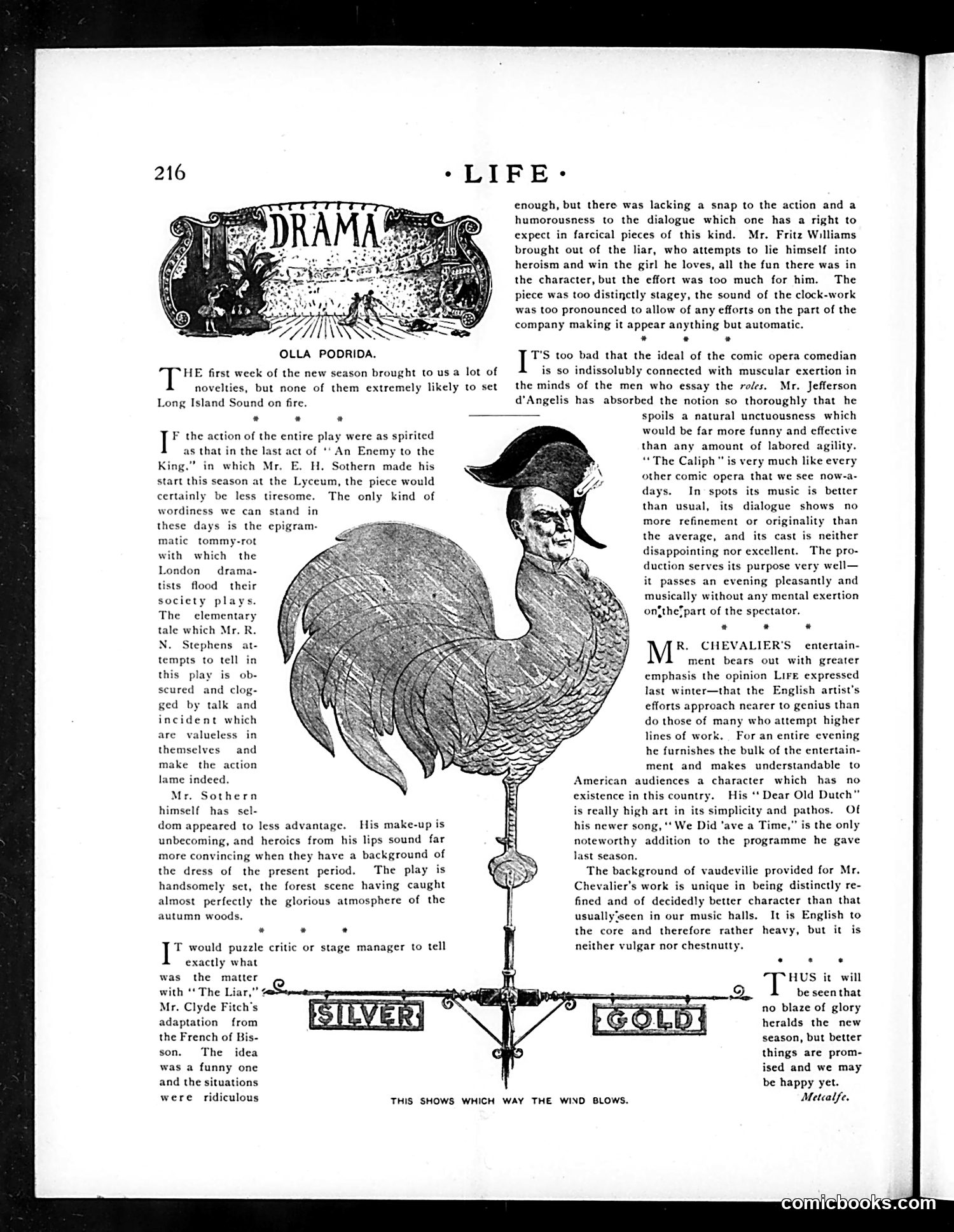
This page reviews several Broadway productions. The central illustration—a figure perched atop a scale marked "SILVER" and "GOLD" with the caption "THIS SHOWS WHICH WAY THE WIND BLOWS"—appears to be satirizing theatrical success and financial performance. The reviews critique: - *An Enemy to the King* (starring E.H. Sothern), called tedious despite good staging - *The Liar* (adapted by Clyde Fitch), a farce with good premise but poor execution - *The Caliph*, a mediocre comic opera - A performance by Mr. Chevalier, praised for artistic merit and his character work The overall tone is dismissive of the theatrical season's offerings, suggesting producers prioritize spectacle and financial returns over genuine artistry—hence the "which way the wind blows" reference to commercial pressure rather than artistic merit.
📄 Transcribed text from this page (OCR, searchable)
Machine-transcribed from the original scan — historical spelling and the odd misread are preserved.
*LIFE: OLLA PODRIDA. HE first week of the new season brought to usa lot of novelties, but none of them extremely likely to set Long Island Sound on fire. * * . F the action of the entire play were as spirited as that in the last act of ‘‘ An Enemy to the King.” in which Mr. E. H, Sothern made his start this season at the Lyceum, the piece would certainly be less tiresome. The only kind of wordiness we can stand in these days is the epigram- matic tommy-rot with which the London’ drama- flood their society plays. The elementary tale which Mr. R. N. Stephens at- tempts to tell in this play is ob- scured and clog- ged by talk and incident which are valueless in themsel and make the action lame indeed. Mr. Sothern himself has sel- dom appeared to less advantage. His make-up is unbecoming, and heroics from his lips sound far more convincing when they have a background of the dress of the present period. The play is tists handsomely set, the forest scene having caught almost perfectly the glorious atmosphere of the autumn woods. * * * T would puzzle critic or stage manager to tell exactly what was the matter with * The Li Mr. Clyde Fitch's adaptation from the French of Bis- son. The idea was a funny one and the situations were ridiculous THIS SHOWS WHICH WAY THE WIND BLOWS. enough, but there was lacking a snap to the action and a humorousness to the dialogue which one has a right to expect in farcical pieces of this kind. Mr. Fritz Williams brought out of the liar, who attempts to lie himself into heroism and win the girl he loves, all the fun there was in the character, but the effort was too much for him. The piece was too distinctly stagey, the sound of the clock-work was too pronounced to allow of any efforts on the part of the company making it appear anything but automatic. * * * j ie too bad that the ideal of the comic opera comedian is so indissolubly connected with muscular exertion in the minds of the men who essay the roles. Mr. Jefferson d’Angelis has absorbed the notion so thoroughly that he spoils a natural unctuousness which would be far more funny and effective than any amount of labored agility. “The Caliph" is very much like every other comic opera that we see now-a- days. In spots its music is better than usual, its dialogue shows no more refinement or originality than the average, and its cast is neither disappointing nor excellent. The pro- duction serves its purpose very well— it passes an evening pleasantly and musically without any mental exertion ontthe{part of the spectator. * * * R, CHEVALIER’S _ entertain- ment bears out with greater emphasis the opinion Lire expressed last winter—that the English artist’s efforts approach nearer to genius than do those of many who attempt higher lines of work. For an entire evening he furnishes the bulk of the entertain- ment and makes understandable to American audiences a character which has no existence in this country. His ‘* Dear Old Dutch” is really high art in its simplicity and pathos. Of his newer song, ‘ We Did ‘ave a Time,” is the only noteworthy addition to the programme he gave last season. The background of vaudevilie provided for Mr. Chevalier’s work is unique in being distinctly re- fined and of decidedly better character than that usually’scen in our music halls, It is English to the core and therefore rather heavy, but it is neither vulgar nor chestnutty. oe HUS it will be seen that no blaze of glory heralds the new season, but better things are prom- ised and we may be happy yet. Metcalfe.