
Life, 1896-09-17 · page 7 of 18
Life — September 17, 1896 — page 7: what you’re looking at
What you’re looking at
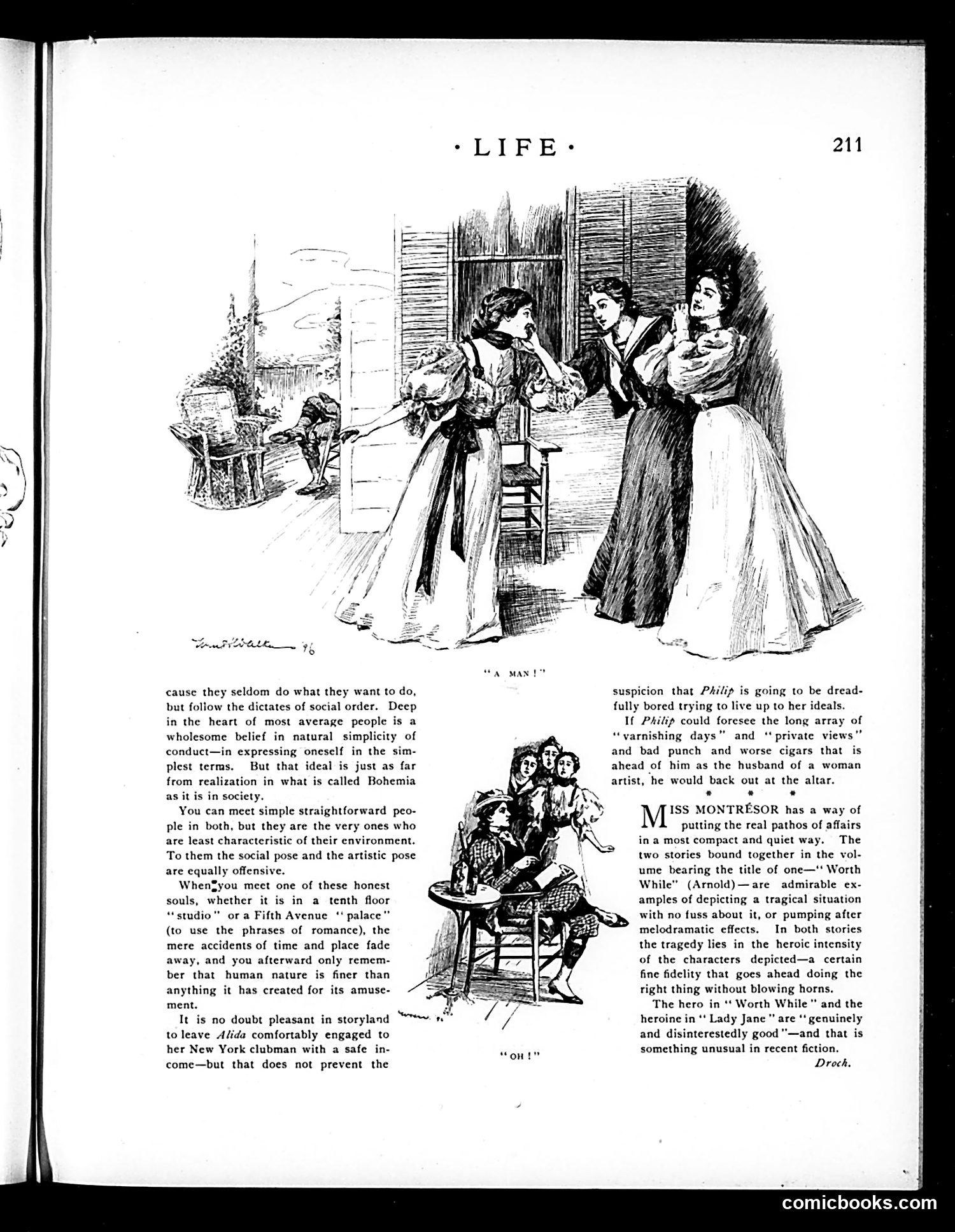
This page contains two sketched scenes satirizing social behavior and romantic relationships among the upper classes. The top cartoon, titled "A Max!", depicts three well-dressed women greeting a man arriving at what appears to be a social gathering or home visit. The satire likely comments on courtship rituals and social performance. The bottom illustration, captioned "Oh!", shows women in an interior domestic scene, apparently reacting with surprise or dismay to news or gossip. The accompanying text discusses Miss Montrésor's literary works, praising her realistic portrayal of characters with "genuine and disinterestedly good" qualities—described as unusual for recent fiction. The text suggests the satire targets both romanticized ideals of bohemian life and the gap between social expectations and actual behavior among educated, artistic circles in early 20th-century America.
📄 Transcribed text from this page (OCR, searchable)
Machine-transcribed from the original scan — historical spelling and the odd misread are preserved.
cause they seldom do what they want to do, but follow the dictates of social order. Deep in the heart of most average people is a wholesome belief in natural simplicity of conduct—in expressing oneself in the sim- plest terms. But that ideal is just as far from realization in what is called Bohemia as it is in society. You can mect simple straightforward peo- ple in both, but they are the very ones who are least characteristic of their environment. To them the social pose and the artistic pose are equally offensive. WhenZyou meet one of these honest souls, whether it is in a tenth floor “studio” ora Fifth Avenue “palace” (to use the phrases of romance), the mere accidents of time and place fade away, and you afterward only remem- ber that human nature is finer than anything it has created for its amuse- ment. It is no doubt pleasant in storyland to leave Alida comfortably engaged to her New York clubman with a safe in- come—but that does not prevent the “ont” suspicion that PAilip is going to be dread- fully bored trying to live up to her ideals. If Philip could foresee the long array of “varnishing days” and “private views” and bad punch and worse cigars that is ahead of him as the husband of a woman artist, he would back out at the altar. * * * M* MONTRESOR has a way of putting the real pathos of affairs in a most compact and quiet way. The two stories bound together in the vol- ume bearing the title of one—‘* Worth While” (Arnold)—are admirable ex- amples of depicting a tragical situation with no fuss about it, or pumping after melodramatic effects. In both stories the tragedy lies in the heroic intensity of the characters depicted—a certain fine fidelity that goes ahead doing the right thing without blowing horns. The hero in *t Worth While" and the heroine in “ Lady Jane " are ‘genuinely and disinterestedly good "—and that is something unusual in recent fiction. Droch. comicbooks.com