
A complete issue · 20 pages · 1896
Life — September 10, 1896
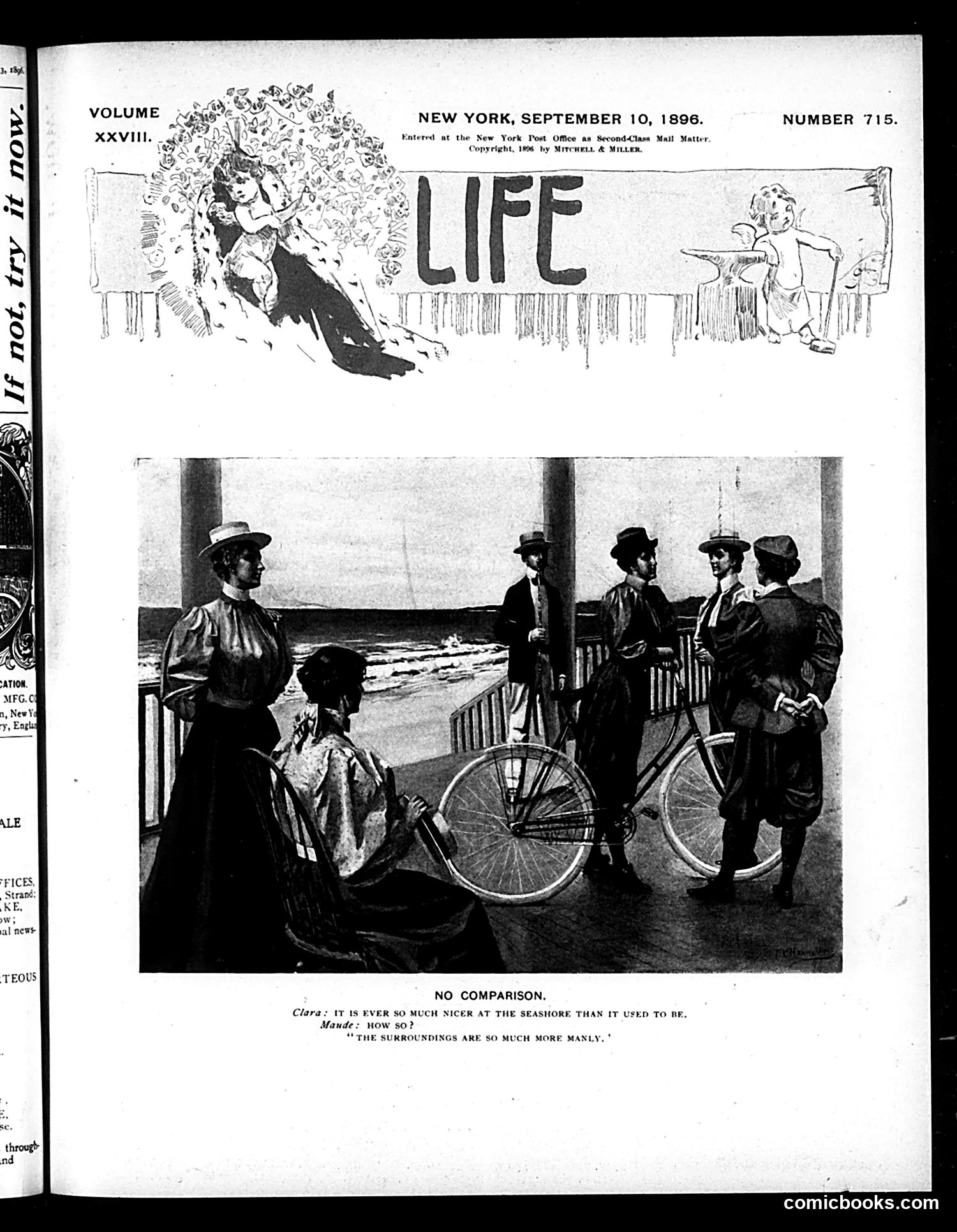
This page contains a single cartoon titled "NO COMPARISON," depicting women at a seaside location with bicycles. The dialogue reads: **Clara:** "IT IS EVER SO MUCH NICER AT THE SEASHORE THAN IT USED TO BE." **Maude:** "HOW SO?" **Clara:** "THE SURROUNDINGS ARE SO MUCH MORE MANLY." The joke satirizes the bicycle craze of the 1890s and changing gender dynamics. The "manly surroundings" refers to the women now present at the seashore with bicycles—a symbol of female independence and mobility that was socially controversial at the time. The cartoon mocks how women's increased freedom and public presence (enabled by bicycles) was reshaping traditionally male-dominated spaces. It's social commentary on the "New Woman" movement of the era.
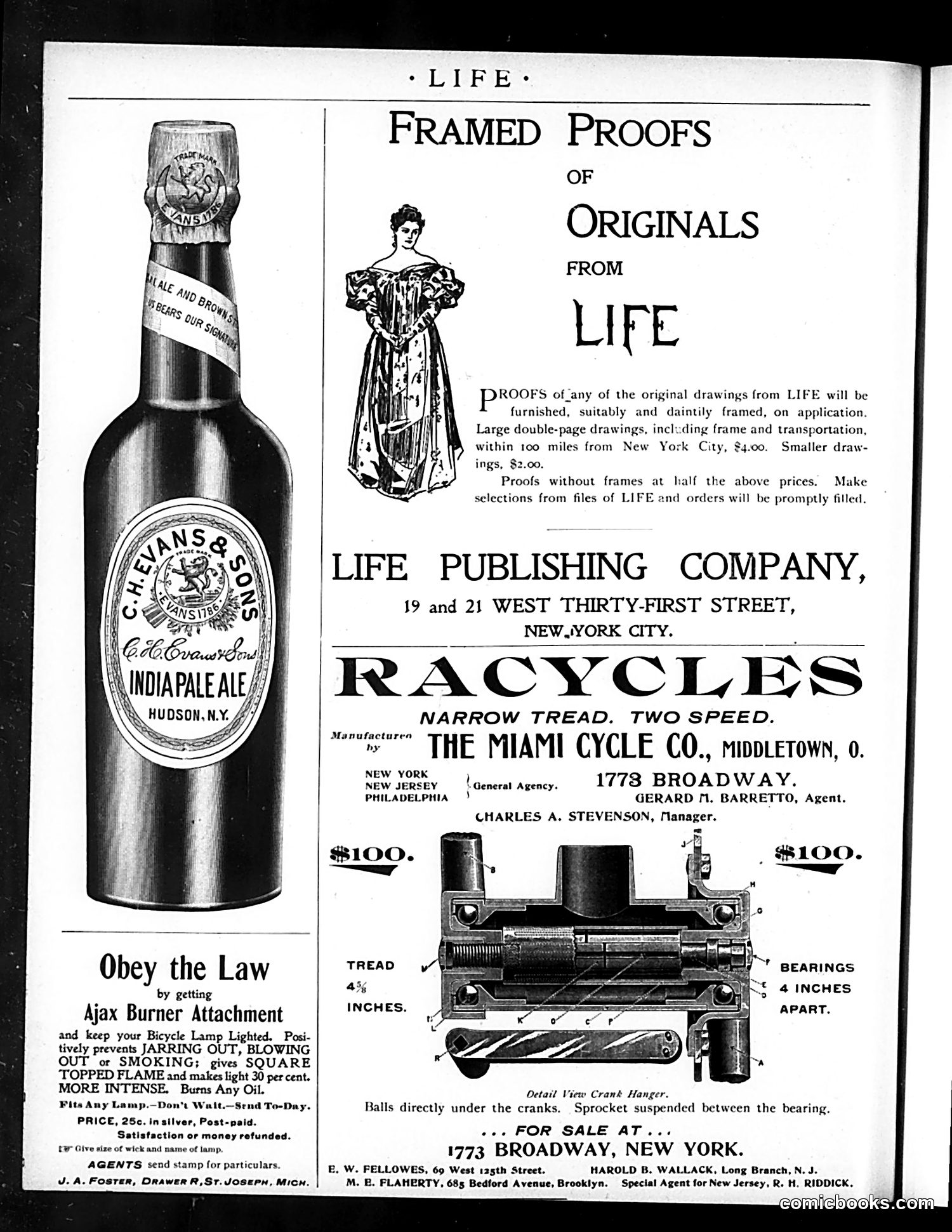
This page is primarily **advertising, not political satire**. It contains three distinct ads: 1. **Chevalier's India Pale Ale** (left): A beer bottle ad emphasizing legal compliance—"Obey the Law"—likely referencing Prohibition-era concerns about proper lampwick attachments for bicycle safety lamps. 2. **LIFE Publishing Company** (top right): Offers framed proofs of original artwork from LIFE magazine, priced $4.00 for large drawings. 3. **Racycles** (bottom right): The Miami Cycle Company advertises bicycles with technical specifications (tread width, bearing distance) and pricing of $100. Distribution details list New York, New Jersey, and Philadelphia locations. The page reflects early 1900s consumer goods marketing rather than satirical commentary.
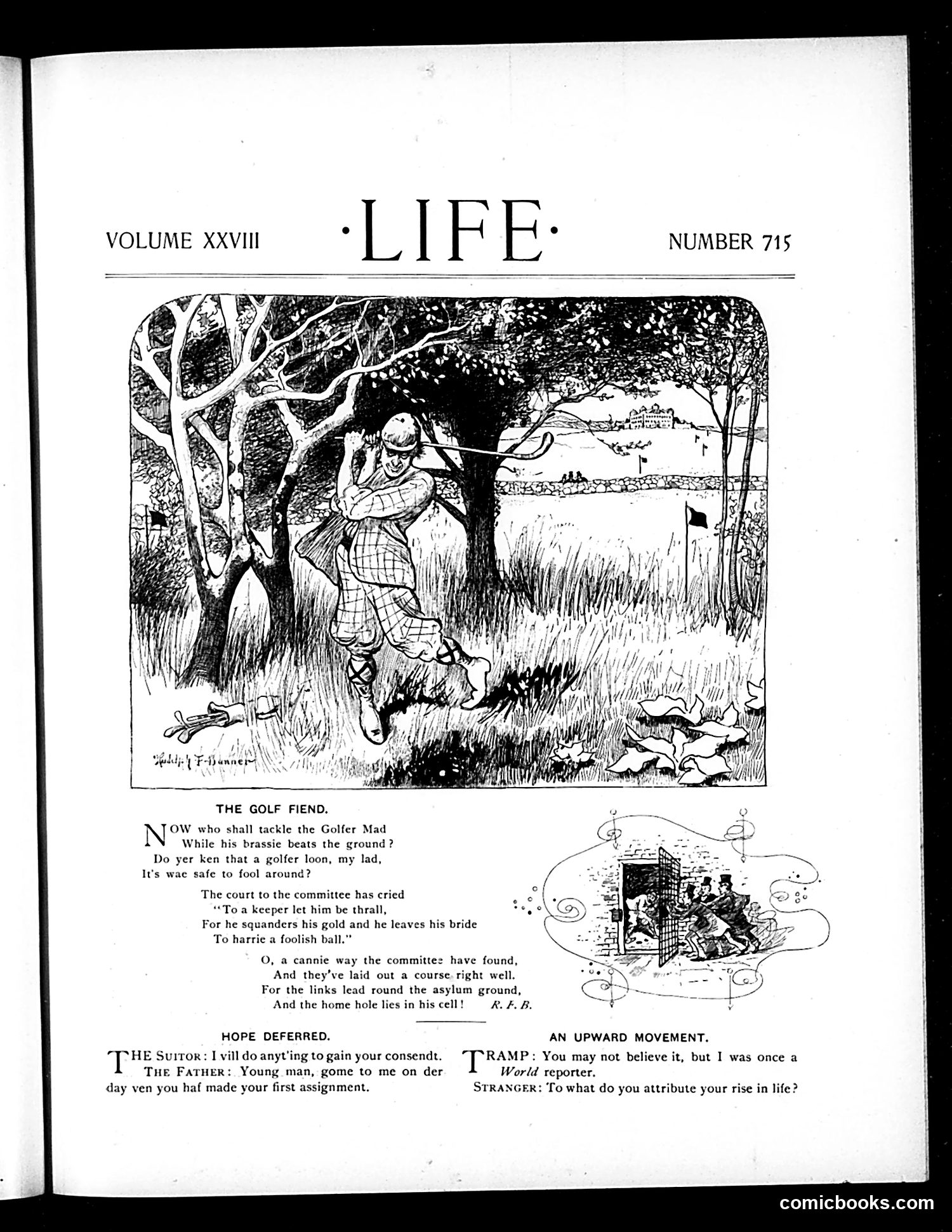
This page satirizes obsessive golfers through verse and cartoon. The main illustration shows a man in golfing attire swinging wildly in a natural setting, with a golf course visible in the distance—establishing golf as the sole focus of his existence. The accompanying poem mocks the "golfer fiend" who abandons responsibilities: he "squanders his gold and leaves his bride / To harrie a foolish ball." The humor targets how golf consumed wealthy men's time and finances during the early 20th century, neglecting family and business obligations. The satire treats golf not as innocent sport but as an addiction rendering men foolish and irresponsible. The accompanying brief dialogues ("Hope Deferred," "An Upward Movement") appear to shift topics but continue the magazine's social commentary on contemporary behavior and ambitions.
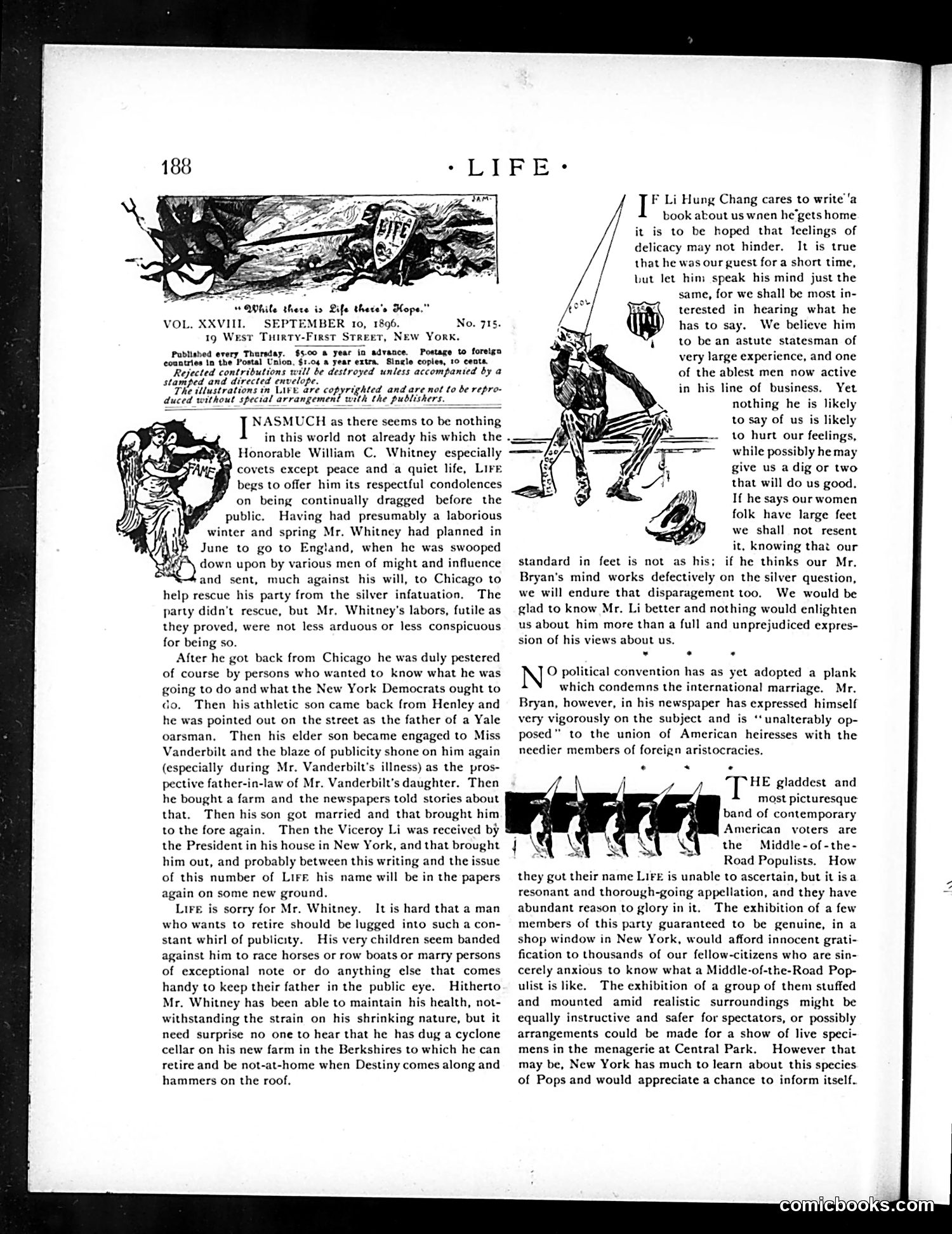
This page from *Life* magazine (September 10, 1896) discusses the retirement of Honorable William C. Whitney from public life. The text expresses hope that Whitney won't be dragged into Democratic politics again, noting his recent efforts to rescue his party "from the silver situation" (likely referring to the 1896 currency debate over free silver coinage). The accompanying illustrations appear to be satirical cartoons depicting Whitney's political entanglements and family connections—including references to his sons' marriages into prominent families like the Vanderbilts. The magazine critiques how public figures struggle to escape political pressure even when seeking retirement, using Whitney's situation as an example of this inescapable scrutiny.
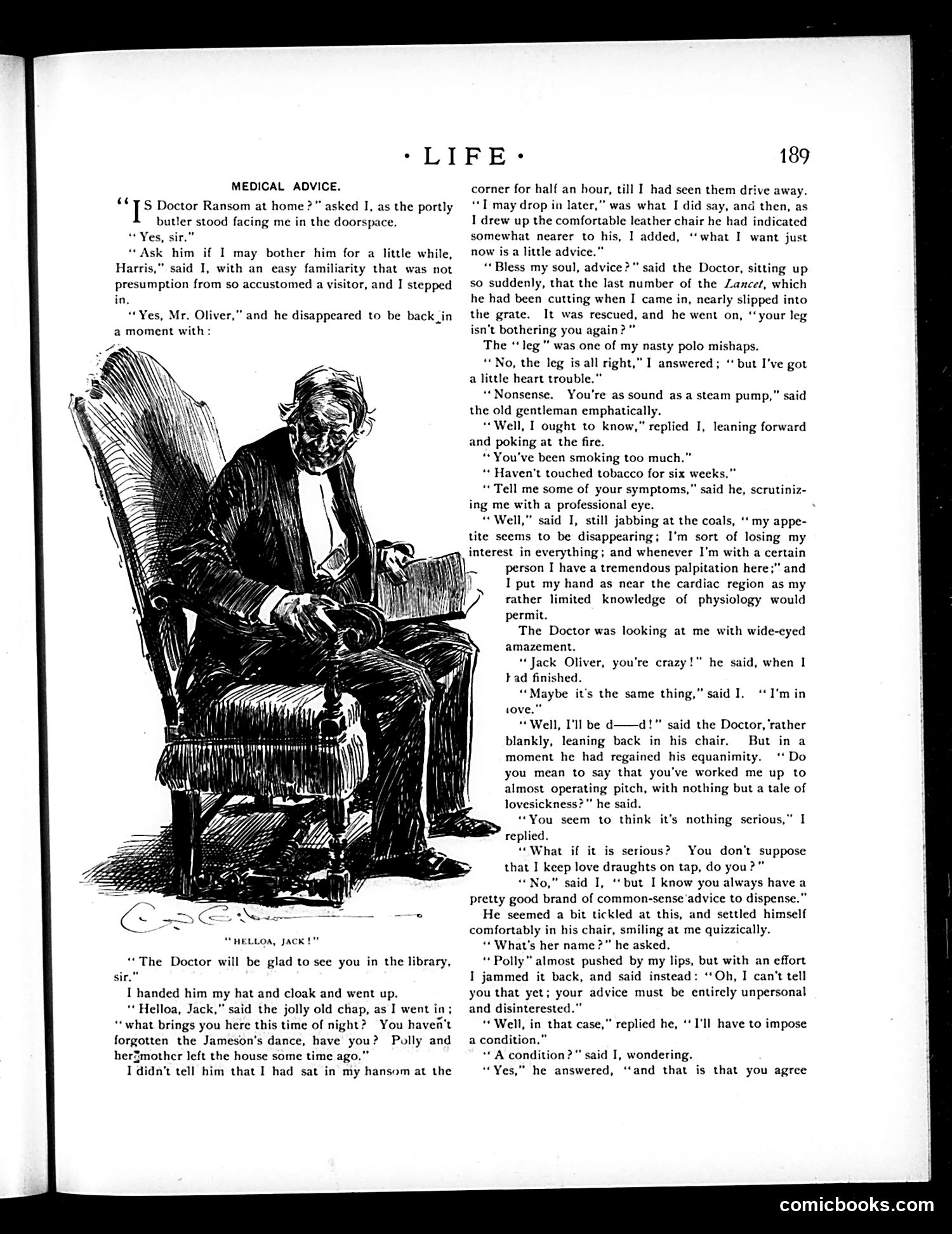
This page contains a narrative story titled "Medical Advice" rather than a political cartoon. The illustration shows a doctor examining a patient (Jack Oliver) in what appears to be a Victorian-era domestic setting. The text describes Oliver visiting Doctor Ransom at home, where the physician diagnoses Oliver's ailments—lost appetite, disinterest in activities, heart palpitations—as symptoms of being "in love." The doctor's response is satirical: he prescribes that Oliver maintain emotional distance from the woman (Polly) and approach the situation with "common-sense advice." The satire targets the sentimental romanticism of the period by having the practical doctor treat lovesickness as a medical condition requiring rational intervention rather than emotional indulgence. It's social humor about courtship and masculine restraint, not political commentary.
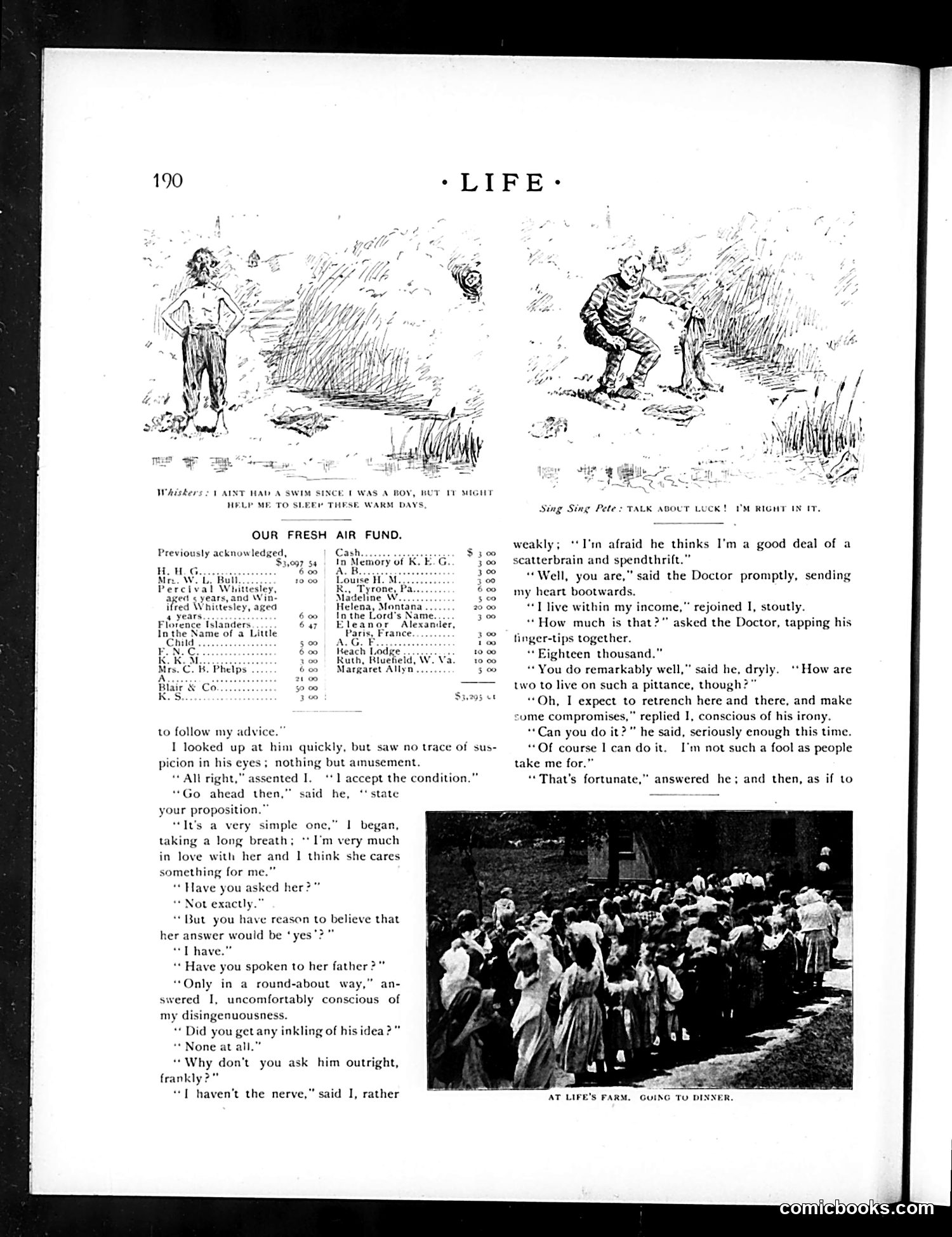
This page contains two cartoon vignettes and unrelated content. **Top left cartoon**: A man standing alone says he hasn't swum since boyhood but might now to "sleep these warm days"—a joke about using swimming to escape summer heat. **Top right cartoon**: Titled "Sing Sing Pete," a man discusses luck with another figure, claiming "I'm right in it." This appears to reference Sing Sing Prison (a famous New York penitentiary), suggesting the humor involves a convict's ironic optimism despite incarceration. The page also includes a "Fresh Air Fund" donation list and a lengthy dialogue about courtship between a man and a doctor, ending mid-sentence. A photograph at bottom shows a crowd "going to dinner" at Life's Farm. The content is typical early-20th-century Life magazine satire mixing social commentary with lighthearted humor.
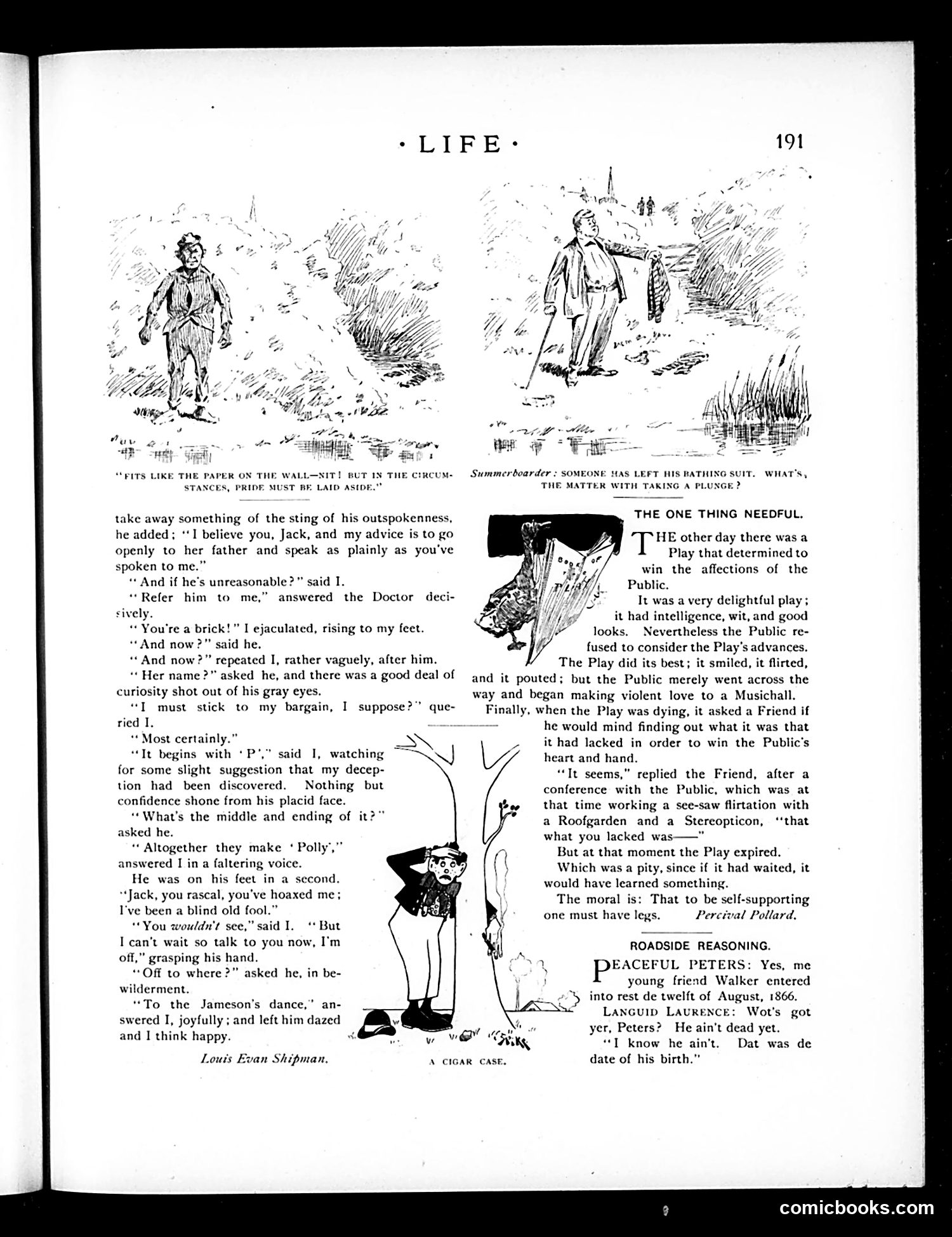
This page contains two distinct elements: **Top illustrations**: Two sketches showing a disheveled man in outdoor settings, accompanied by dialogue about referring someone to "the Doctor" and concerns about "outspokenness." The context suggests social commentary about a character's blunt behavior. **"The One Thing Needful" section**: A satirical piece about a theatrical play that failed to impress the public despite having "intelligence, wit, and good looks." The play was dying when asked what it lacked to win audiences' affections. The moral concludes that self-supporting ventures require "legs"—a pun suggesting the play needed either financial substance or, humorously, literal physical appeal (dancing). **"A Cigar Case" illustration**: Shows a cartoonish figure, likely illustrating a humorous anecdote about social interaction or commercial exchange. The page exemplifies Life's satirical commentary on theater, social pretension, and human nature circa this publication period.
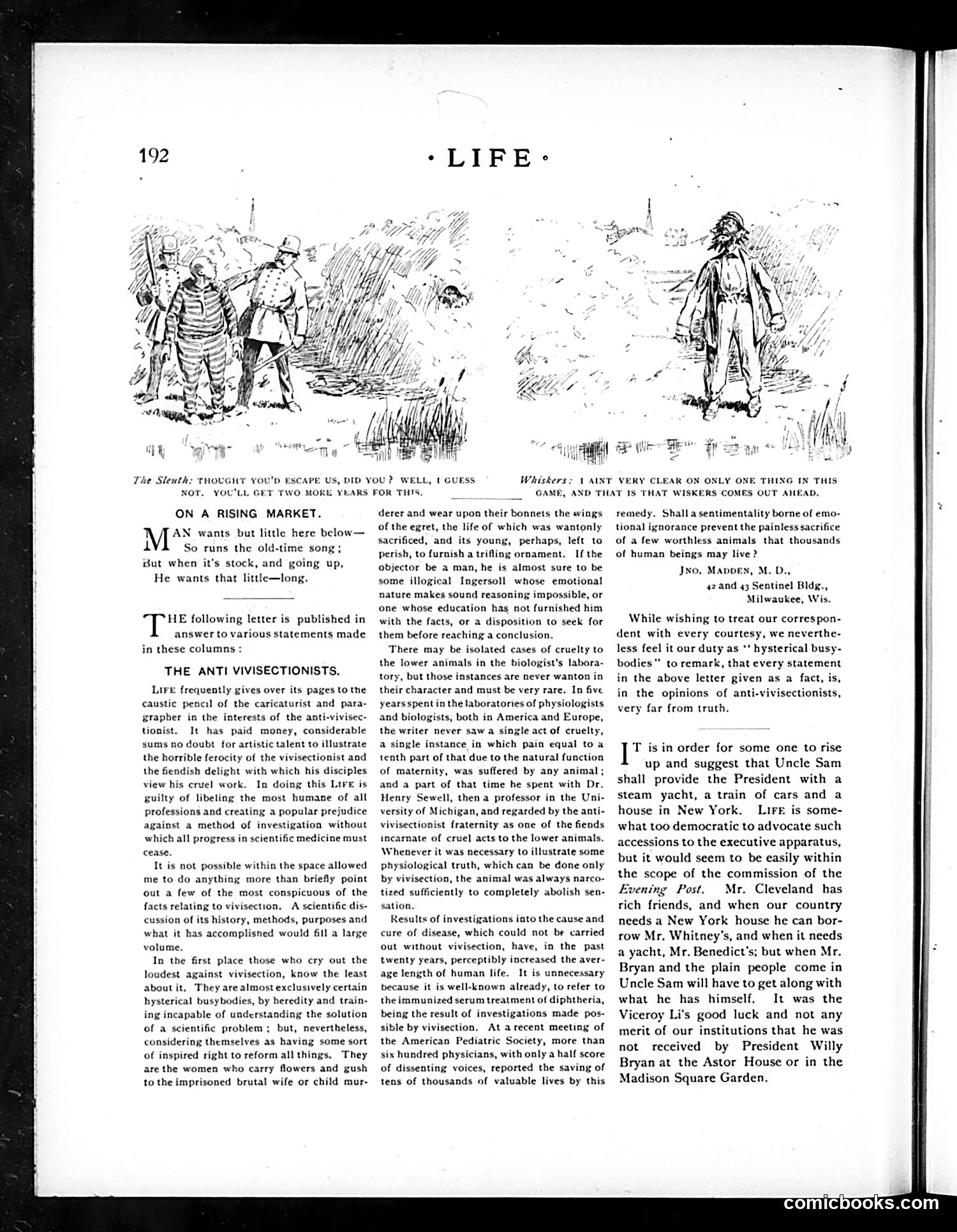
This page contains two satirical cartoon panels about hunting or trapping, positioned above an essay titled "On a Rising Market" and a section debating vivisection (animal experimentation). The left cartoon shows two hunters discussing their prey, with the caption "The Strath: 'Thought you'd escape us, did you? Well, I guess not. You'll get two duck years for this!'" The right panel shows a single figure with the caption "Whiskers: 'I aint very clear or only one thing in this game, and that is that whiskers comes out ahead.'" The humor appears to satirize hunting culture and the hunter's mentality. The cartoons mock hunters' confidence in their superiority over animals and the inevitability of their success, using anthropomorphized animal perspectives to create ironic commentary on human conquest of wildlife.
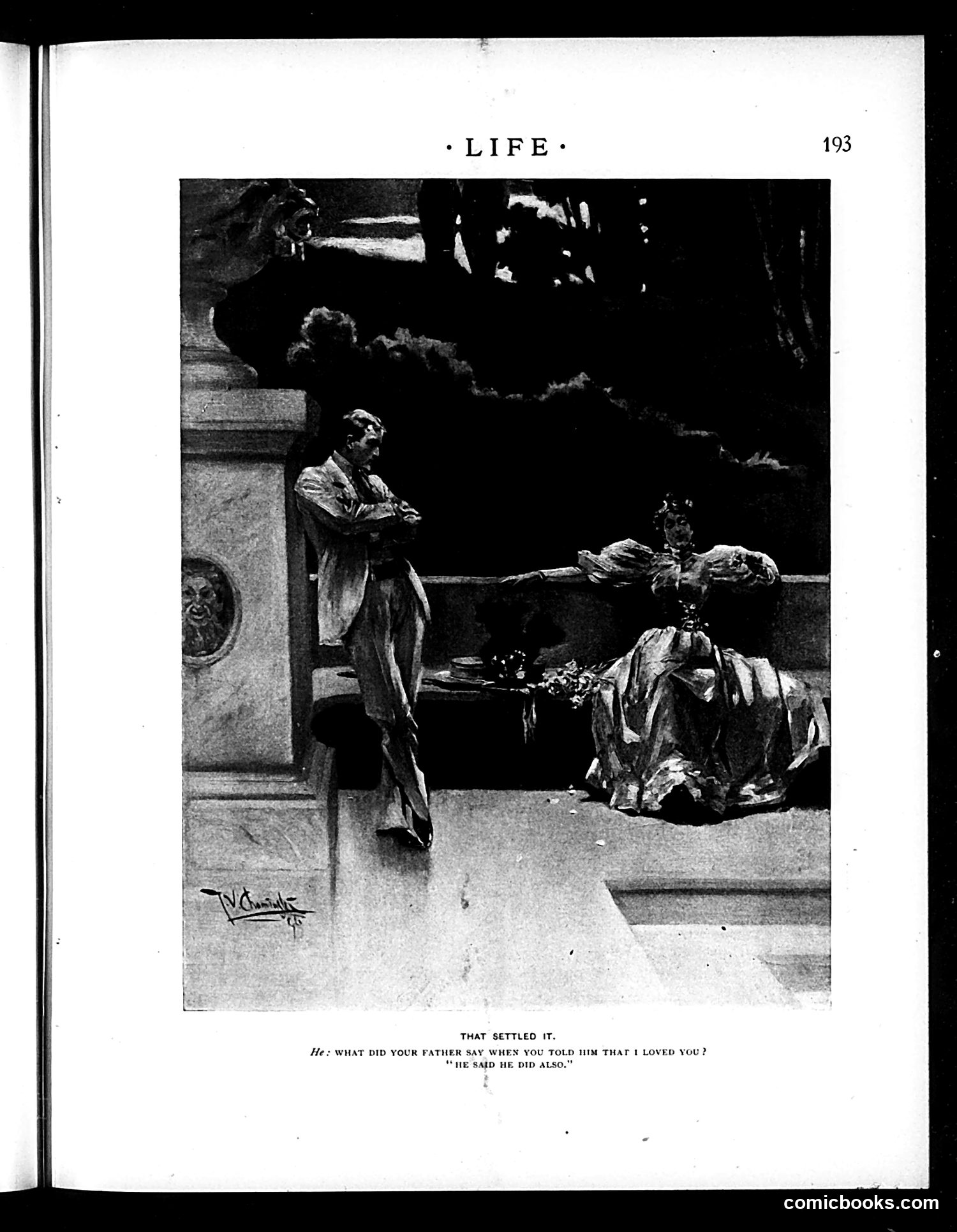
This is a single illustration titled "THAT SETTLED IT," appearing on page 193 of Life magazine. The image shows a religious scene: a man in modern dress stands before what appears to be a tomb or altar with a cross, where a robed figure (possibly representing clergy or a saint) is depicted. The caption reads: "He: 'What did your father say when you told him that I loved you?' 'He said he did also.'" The satire appears to target romantic courtship conventions and religious authority. The joke hinges on the father's response—rather than objecting to the suitor's declaration of love, he reciprocates it, suggesting either absurd family dynamics or possibly mocking religious hypocrisy regarding love and devotion. The sacred setting heightens the satirical contrast with the mundane romantic scenario.
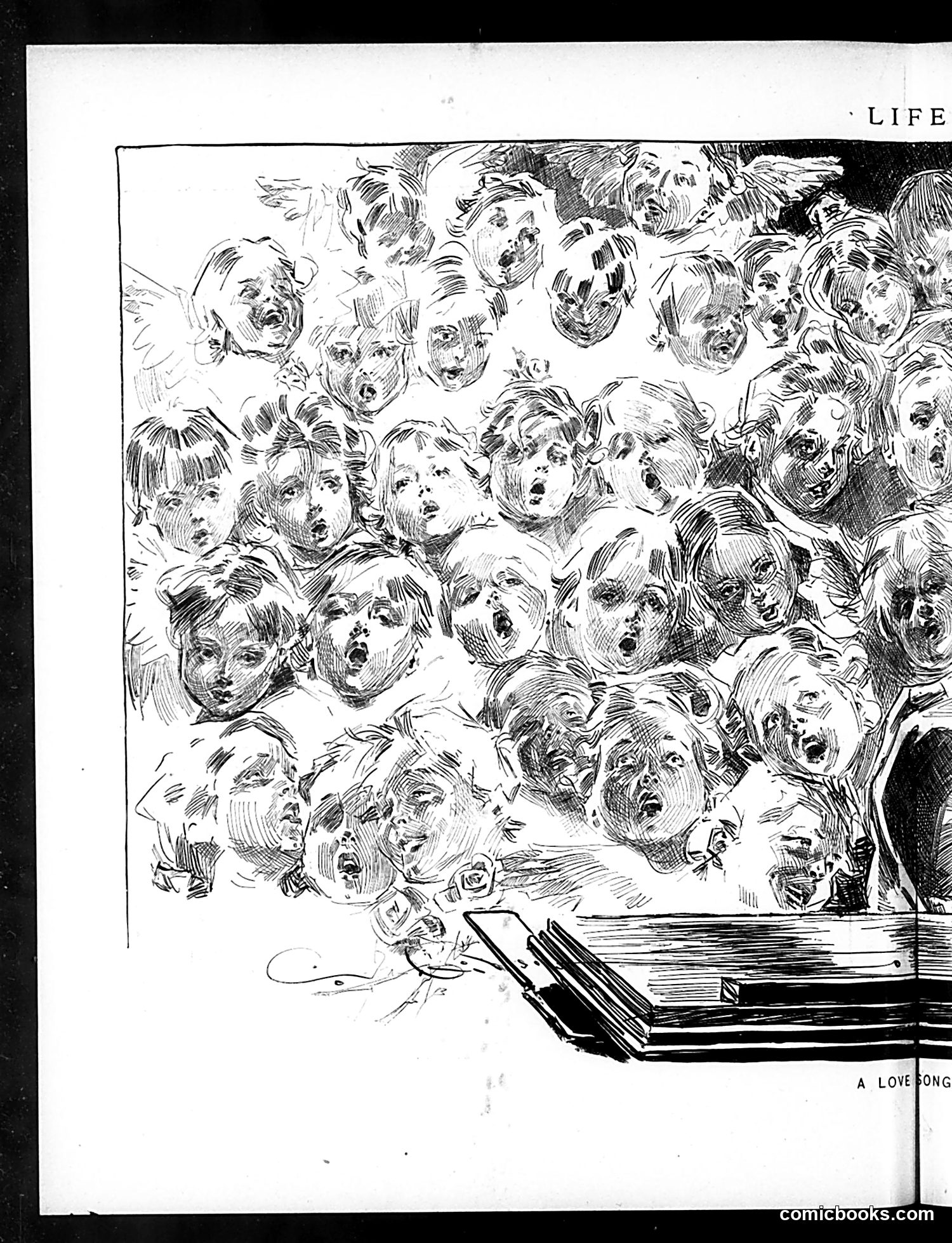
This page from *Life* magazine shows a satirical illustration titled "A Love Song" (visible at bottom right). The cartoon depicts a large chorus of open-mouthed faces singing together—appearing to be a choir or crowd performing. The exaggerated, caricatured expressions and crowded composition suggest mockery of mass sentimentality or popular entertainment. The specific reference is unclear without additional context, but the style suggests satire of either: popular music crazes, sentimental mass culture, or possibly operatic/theatrical excess of the era. The densely packed, somewhat grotesque faces convey the cartoonist's satirical view of collective emotional display or crowd behavior. The exact historical reference and intended target remain uncertain without dating or attribution information visible on this page.
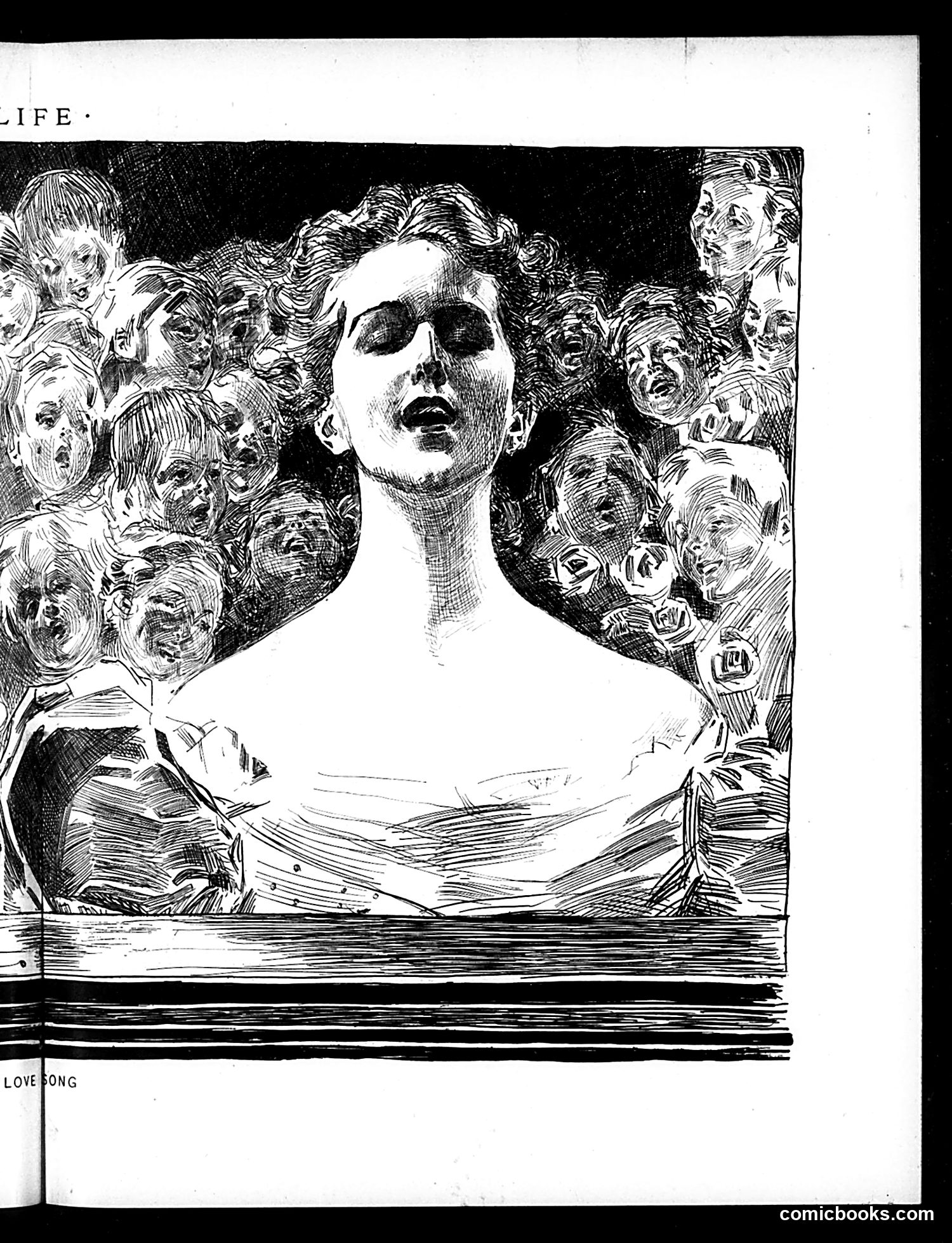
This engraving depicts a central female figure with closed eyes, rendered in white against a darkly crosshatched background. She's surrounded by numerous grotesque male faces expressing various emotions—appearing to gaze upon or admire her. The caption "LOVE SONG" suggests satirical commentary on romance or desire. The stark contrast between the idealized, serene female form and the crude, caricatured male faces surrounding her likely mocks either: 1. The disconnect between romantic idealization and reality 2. The superficiality of male admiration 3. Victorian sentimentality about love The style and composition suggest early 20th-century social satire, though without additional context, the specific target of ridicule remains unclear.
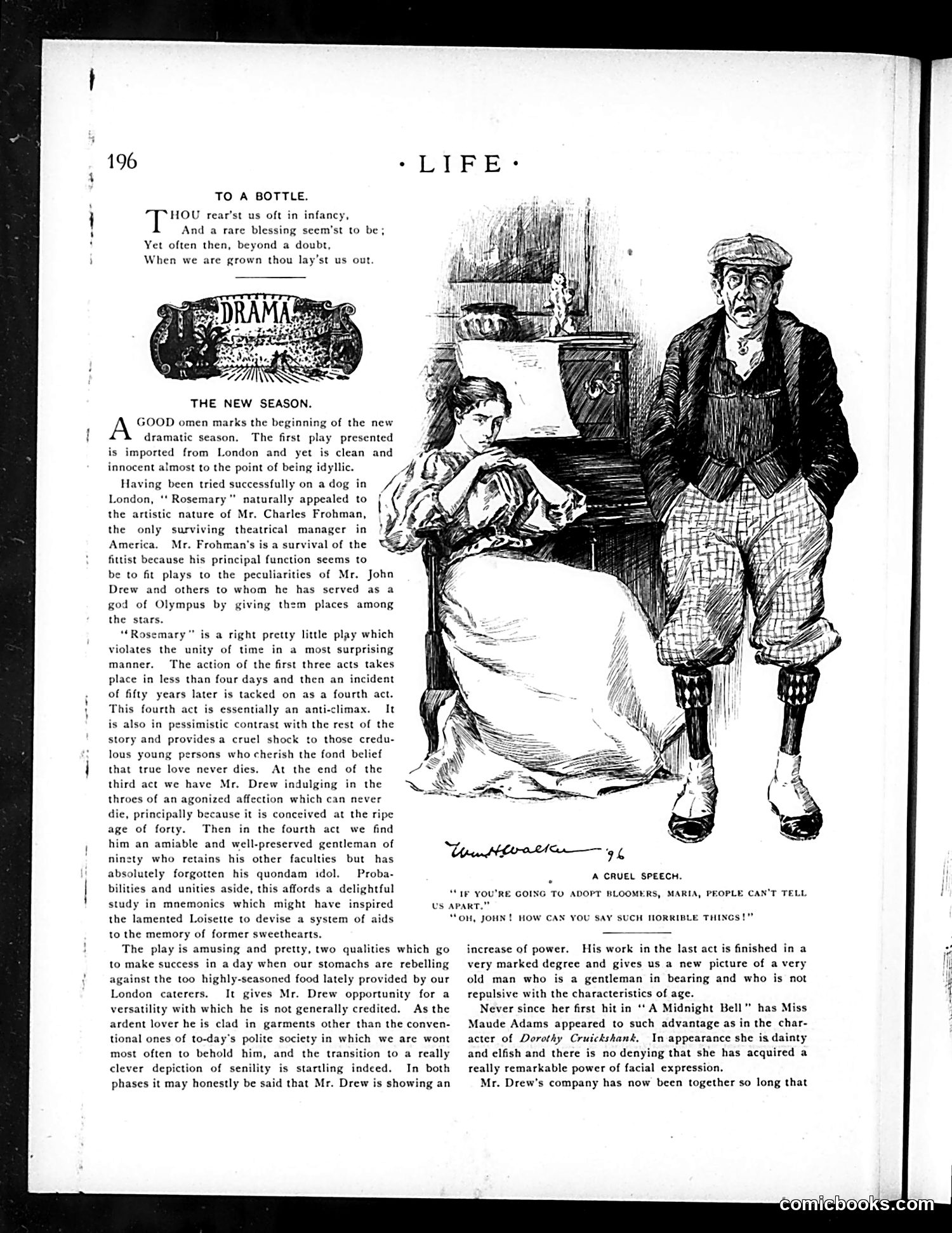
This page contains theater criticism and social satire from an early 20th-century Life magazine. **Main Content:** The article reviews a play called "Rosemary," praising its London import as refreshingly innocent. It praises actor John Drew's performance across the play's arc—from passionate young lover to forgetful elderly gentleman—noting his improved range. **The Cartoons:** The upper illustration, "To a Bottle," is a drinking joke: bottles nurture us in infancy (as containers) yet "lay us out" (render us unconscious) when grown. **"A Cruel Speech" Cartoon:** The lower cartoon satirizes women's fashion debates of the era. A man tells his wife that if she adopts bloomers (the controversial divided-skirt garment gaining acceptance), people won't be able to distinguish them. The "cruelty" is the implication that women in bloomers would resemble men—a common anti-bloomer argument of the 1890s-1900s that mocked women's dress reform as unfeminine. Both pieces reflect period anxieties about tradition versus modernity.
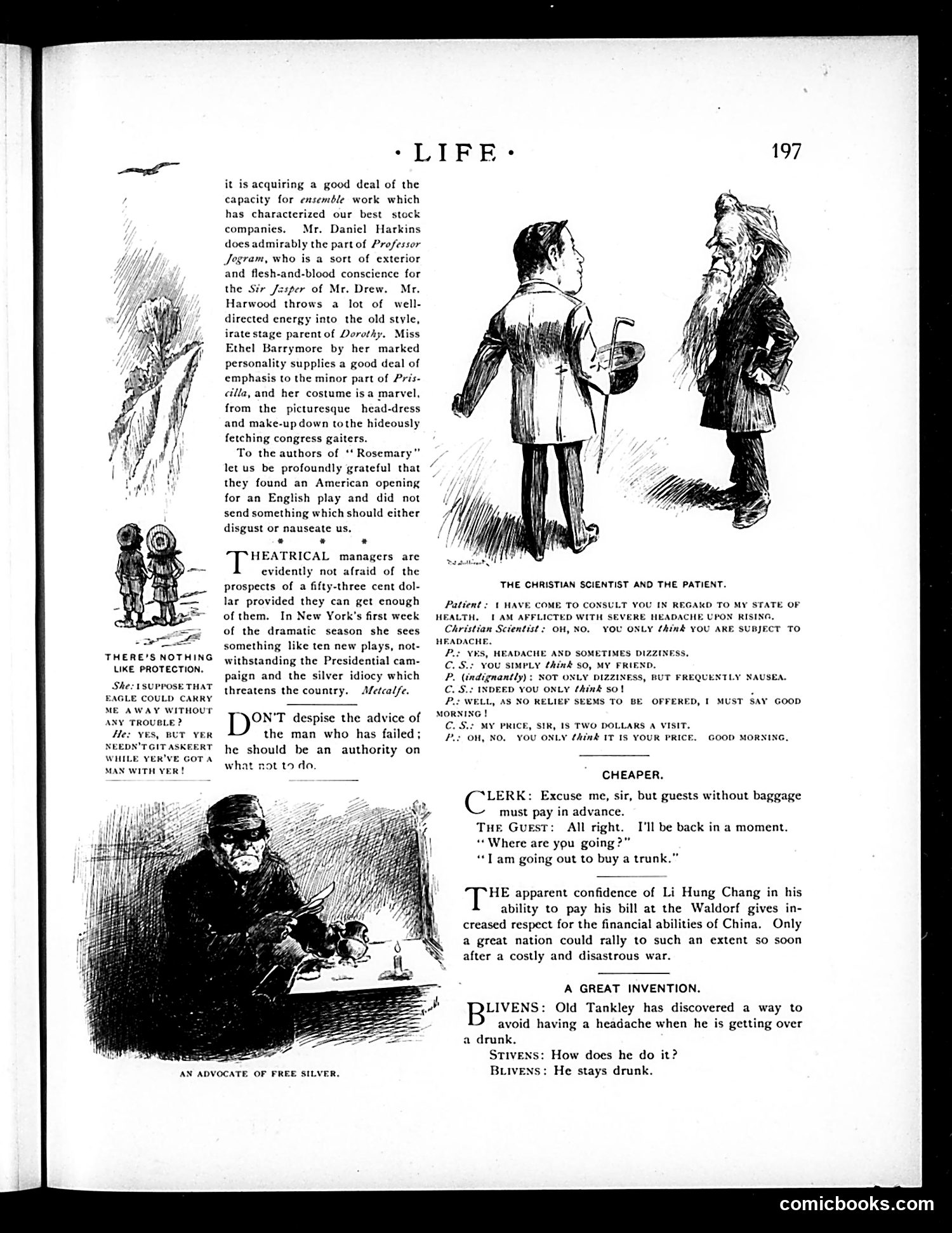
This page contains several brief satirical pieces typical of Life magazine's humor: **Top cartoon**: "Protection" mocks Victorian-era gender dynamics. A man reassures his companion that despite an eagle's threat, his presence offers safety—ironic given his obvious inability to help. **Theater review section**: Discusses the play "Rosemary," praising its ensemble cast and expressing relief that American theaters aren't receiving inferior English imports. **"Free Silver" cartoon**: Depicts a man advocating for free silver (a late-1800s economic debate), portrayed as foolish—the text dismisses silver currency as "idiocy." **Christian Scientist satire**: Mocks Christian Science healing by showing a practitioner denying a patient's obvious symptoms (dizziness, nausea), insisting they merely "think" they're ill, then charging $2 for the visit. **Hotel scene**: A guest avoids paying upfront by claiming he'll buy luggage—suggesting he has none and may be a deadbeat. **Li Hung Chang joke**: Notes China's financial confidence after war, appearing to reference the Chinese diplomat's 1896 U.S. visit. **Final joke**: "Staying drunk" prevents hangovers—crude but straightforward mockery of alcoholism.
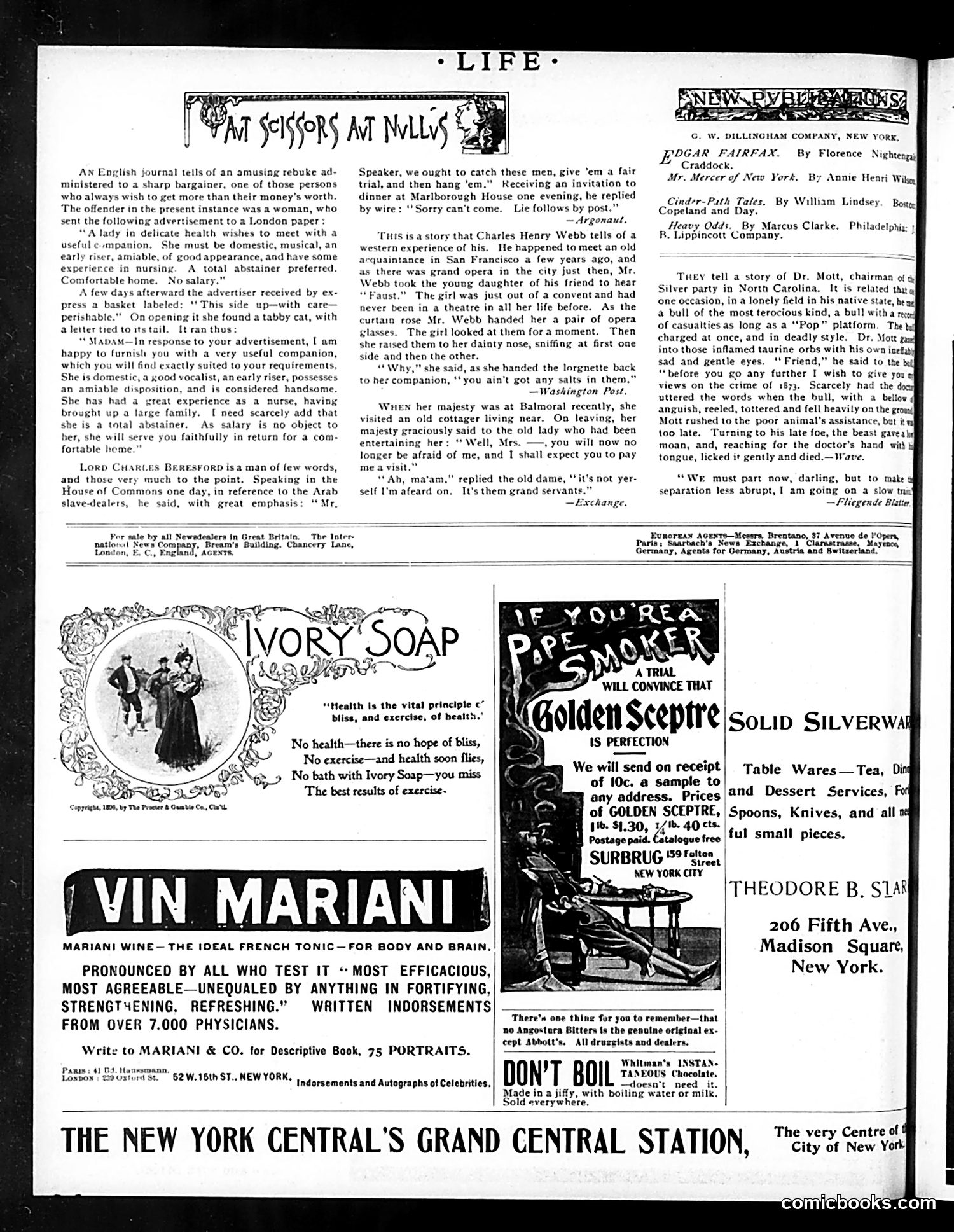
This page from *Life* magazine contains several satirical short anecdotes mocking human behavior: 1. **The Cat Letter**: A sharp-bargaining woman advertises for a cheap live-in companion with no salary. She receives a cat with a mock-serious letter describing it as meeting all her requirements—a joke about her unreasonable demands. 2. **The Opera Glasses**: A convent-educated girl, seeing opera glasses for the first time, sniffs them expecting perfume or smelling salts—satirizing provincial innocence and lack of theatrical experience. 3. **Lord Coleridge and the Hanging**: A brief joke about a stern judge who casually advocates execution, then tersely declines a dinner invitation. 4. **The Bull and Dr. Mott**: A comical tall tale where a fierce bull is somehow pacified by a doctor's attempt to discuss "the crime of 1873" (likely political corruption), dying peacefully—absurdist satire on political rhetoric's supposed power. These are genteel Victorian humor pieces targeting pretension, ignorance, and social hypocrisy. The page is otherwise filled with period advertisements.
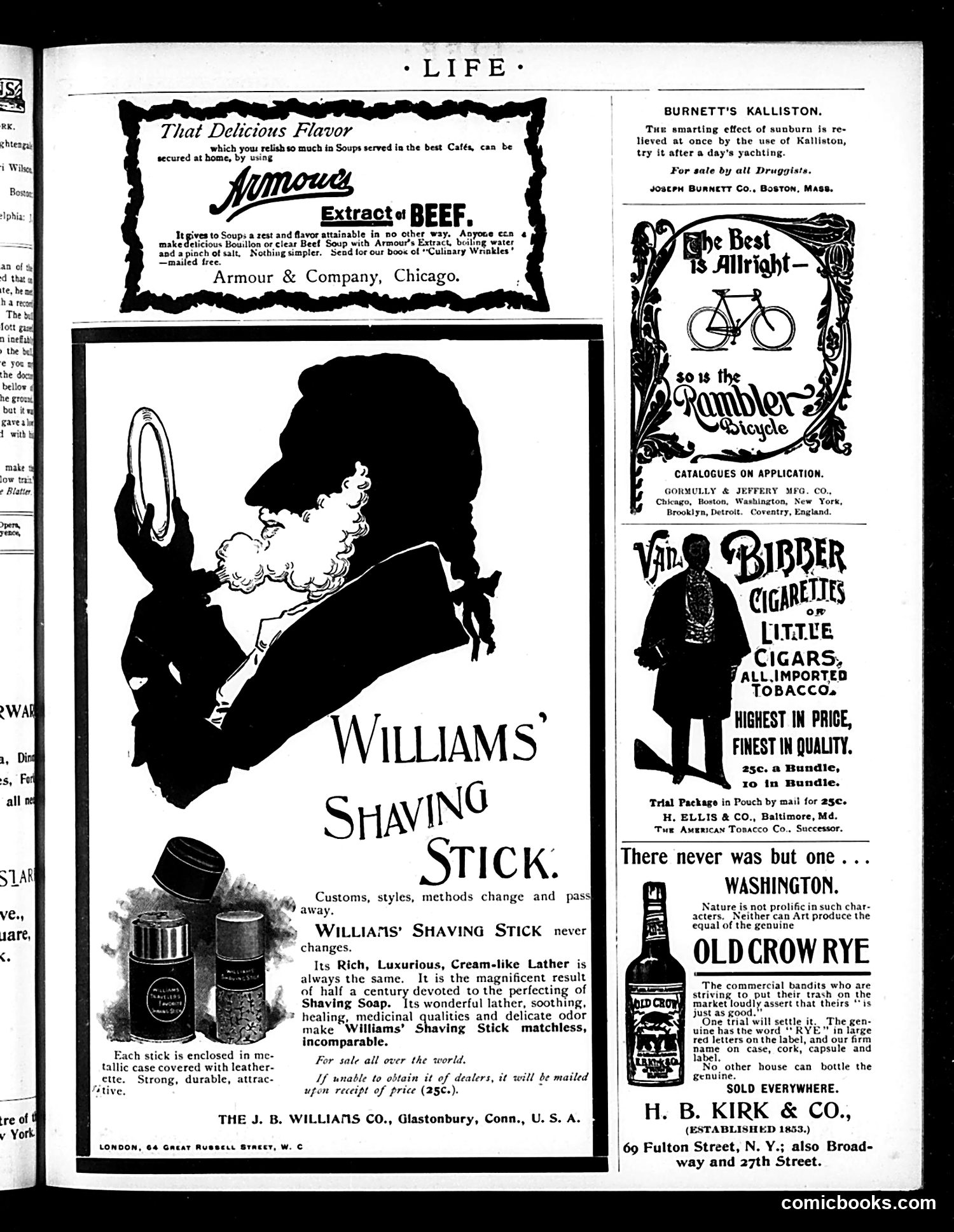
This page contains **no political cartoons or satire**—it is primarily a **advertising section** from an early 20th-century Life magazine. The page features six product advertisements: 1. **Armour's Extract of Beef**—a cooking ingredient for making soups 2. **Williams' Shaving Stick**—marketed as unchanging and reliable for over 50 years 3. **Burnett's Kalliston**—a sunburn remedy for yacht enthusiasts 4. **Rambler Bicycle**—positioned as "the best" 5. **Vail Dibber Cigarettes and Little Cigars**—imported tobacco products 6. **Old Crow Rye Whiskey**—emphasizing authenticity against counterfeit competitors The only notable visual element is a **silhouette illustration** for Williams' Shaving Stick showing a man examining his reflection. The page reflects early 1900s consumer culture and advertising conventions—products claiming reliability, luxury, and superiority over competitors. There is no political commentary or satire present.
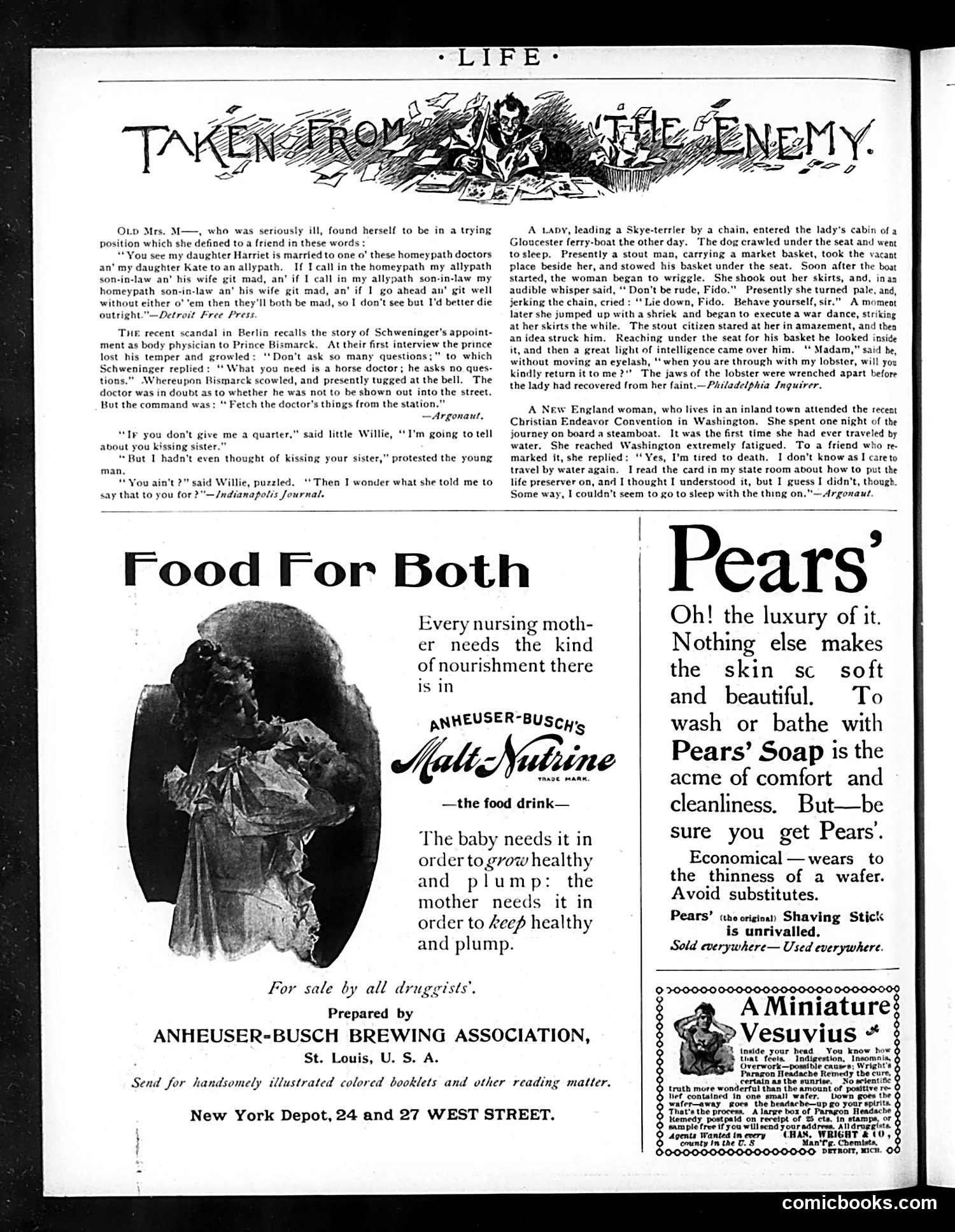
This page collects brief humorous anecdotes satirizing everyday absurdities. The title cartoon depicts a devil amid scattered items, introducing lighthearted social commentary. The jokes mock: 1. **Medical rivalry**: A sick woman caught between homeopathic and allopathic doctor sons-in-law—whichever she consults angers the other, so she's trapped. 2. **Prussian militarism**: A story about Bismarck's physician Schweninger, implying even Germany's iron chancellor needs someone to stand up to him. 3. **Child extortion**: A boy blackmailing a man by claiming to tell his sister about a kiss that never happened. 4. **Mistaken identity mishap**: A woman on a ferry boat repeatedly disciplines what she assumes is a dog misbehaving under her seat, only to discover it was actually a man's escaped lobster. 5. **Travel inexperience**: A landlocked New England woman, unfamiliar with ships, tries sleeping while wearing a life preserver after misunderstanding safety instructions. The advertisements for Malt Nutrine (a brewery product marketed to nursing mothers) and Pears' Soap anchor the page.
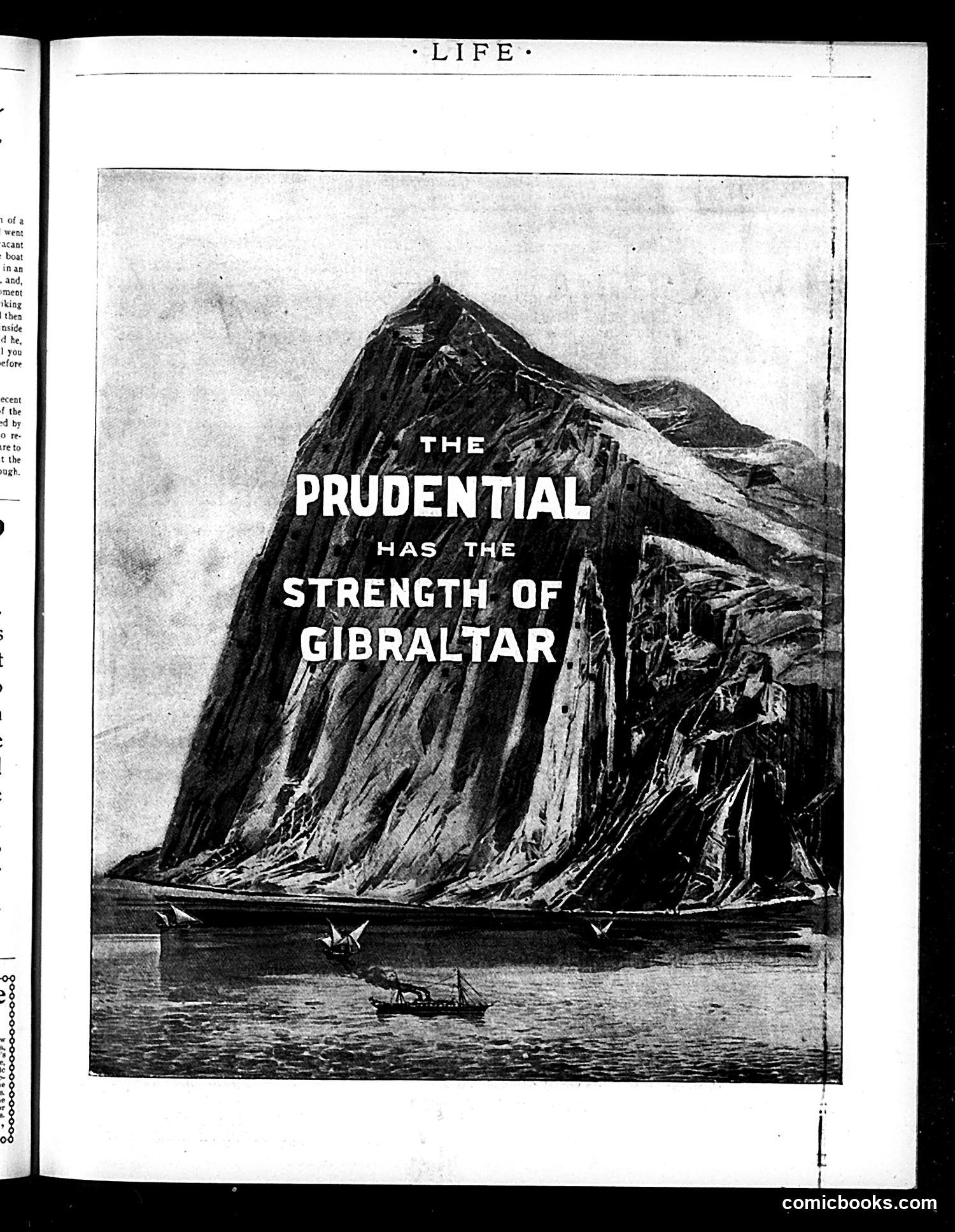
This appears to be an advertisement page from *Life* magazine featuring an image of the Rock of Gibraltar with the text "THE PRUDENTIAL HAS THE STRENGTH OF GIBRALTAR." This is a commercial advertisement for Prudential Insurance, not a political cartoon or satire. The ad uses Gibraltar—a famously massive, immovable rock formation—as a metaphor for stability and strength. By claiming Prudential possesses "the strength of Gibraltar," the company implies its financial security and reliability are as unshakeable as the landmark itself. The visual comparison between an insurance company and a geological fortress was a common advertising strategy of the era, appealing to customers' desire for dependable financial protection. There is no satirical or political commentary visible on this page.
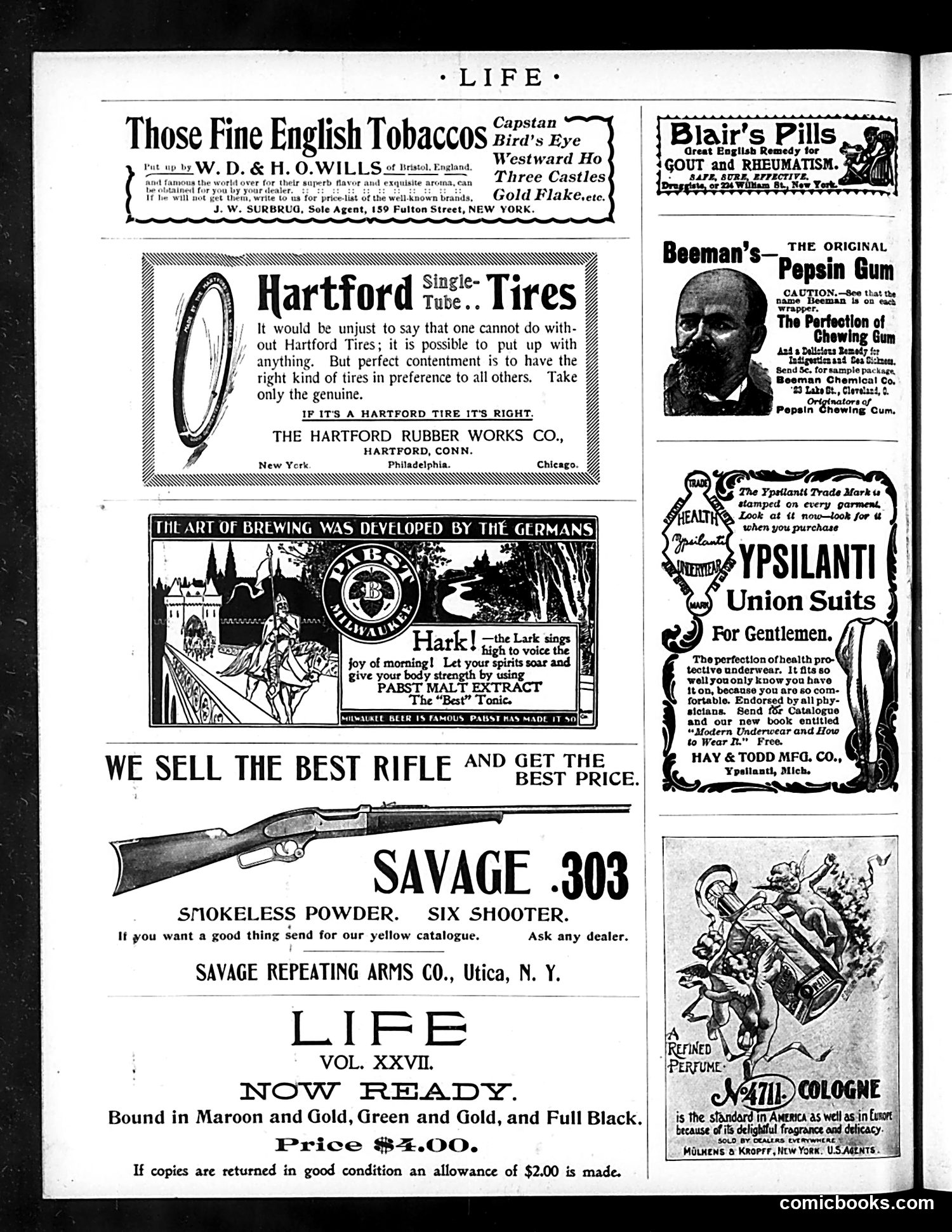
This is primarily an **advertising page** from Life magazine (Vol. XXVII), not a satirical cartoon page. The content consists of vintage product advertisements typical of early 20th-century American publications. Notable ads include: - **English tobacco brands** (Capstan, Gold Flake) for W.D. & H.O. Wills - **Hartford Tires** — emphasizing reliability and authenticity ("If it's a Hartford Tire it's Right") - **Pabst Malt Extract** — accompanying a woodcut showing Germans brewing beer, playing on the association of beer-making with German expertise - **Savage .303 rifle** — marketed for hunting/sport shooting - **Consumer products**: Beeman's Pepsin Gum, Blair's Pills, Ypsilanti Union Suits (men's underwear), and 4711 Cologne The page also announces Life's bound volume ($4.00) is now available in multiple color options. These ads reflect consumer goods, leisure products, and patent medicines typical of the era — not political satire.
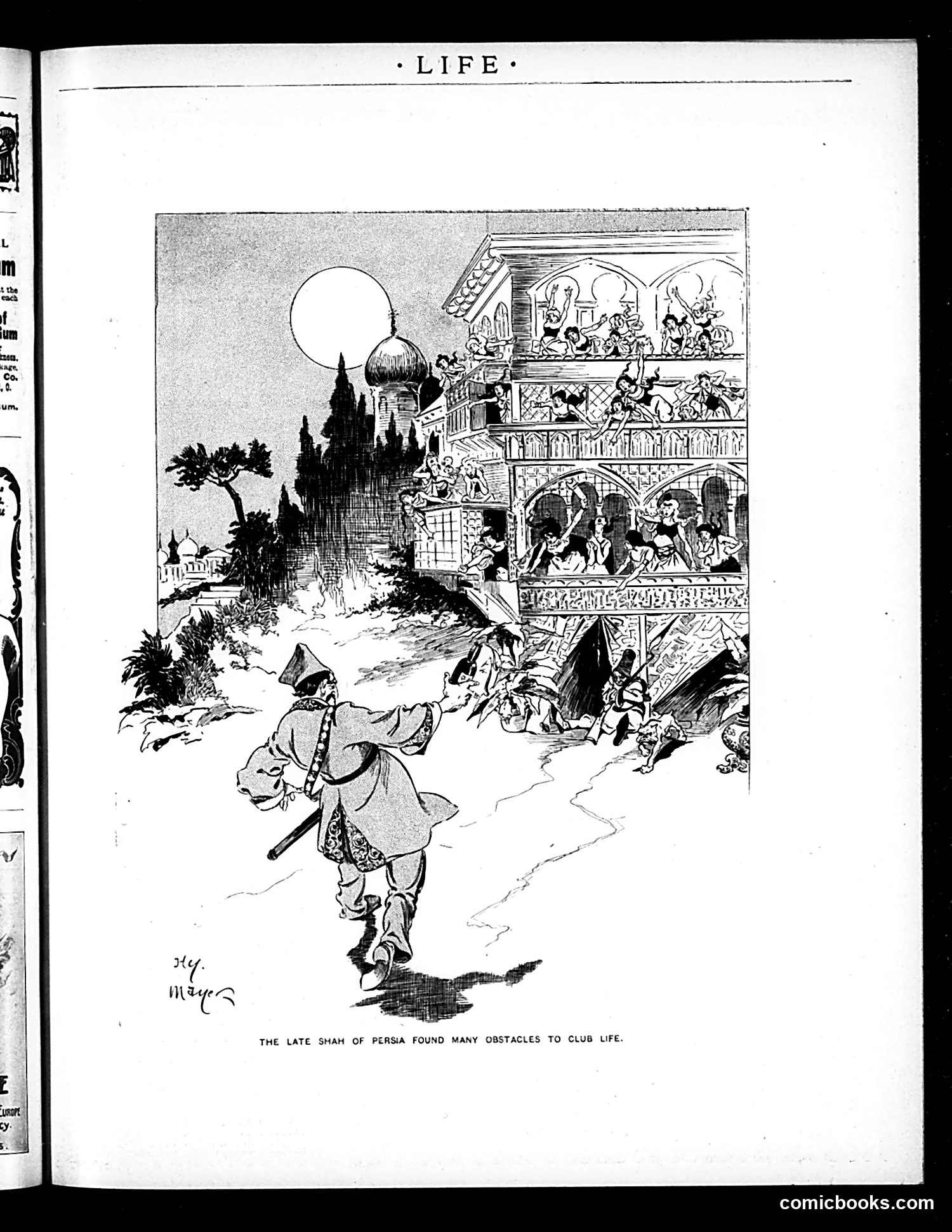
This satirical illustration depicts the late Shah (ruler) of Persia encountering difficulties accessing an exclusive social club. The figure in the foreground, dressed in Persian royal attire, approaches an ornate building where well-dressed club members socialize on multiple levels. The caption's humor relies on the contrast between the Shah's supreme political power in his own nation and his apparent exclusion from Western high-society clubs—suggesting that even absolute monarchs faced social barriers and snobbery in elite Western establishments. The satire critiques both the Shah's aspirations to Western acceptance and Western societies' class-based exclusivity. This reflects early 20th-century tensions around imperialism, orientalism, and the social hierarchies governing who was considered "acceptable" in prestigious Western institutions, regardless of political status.
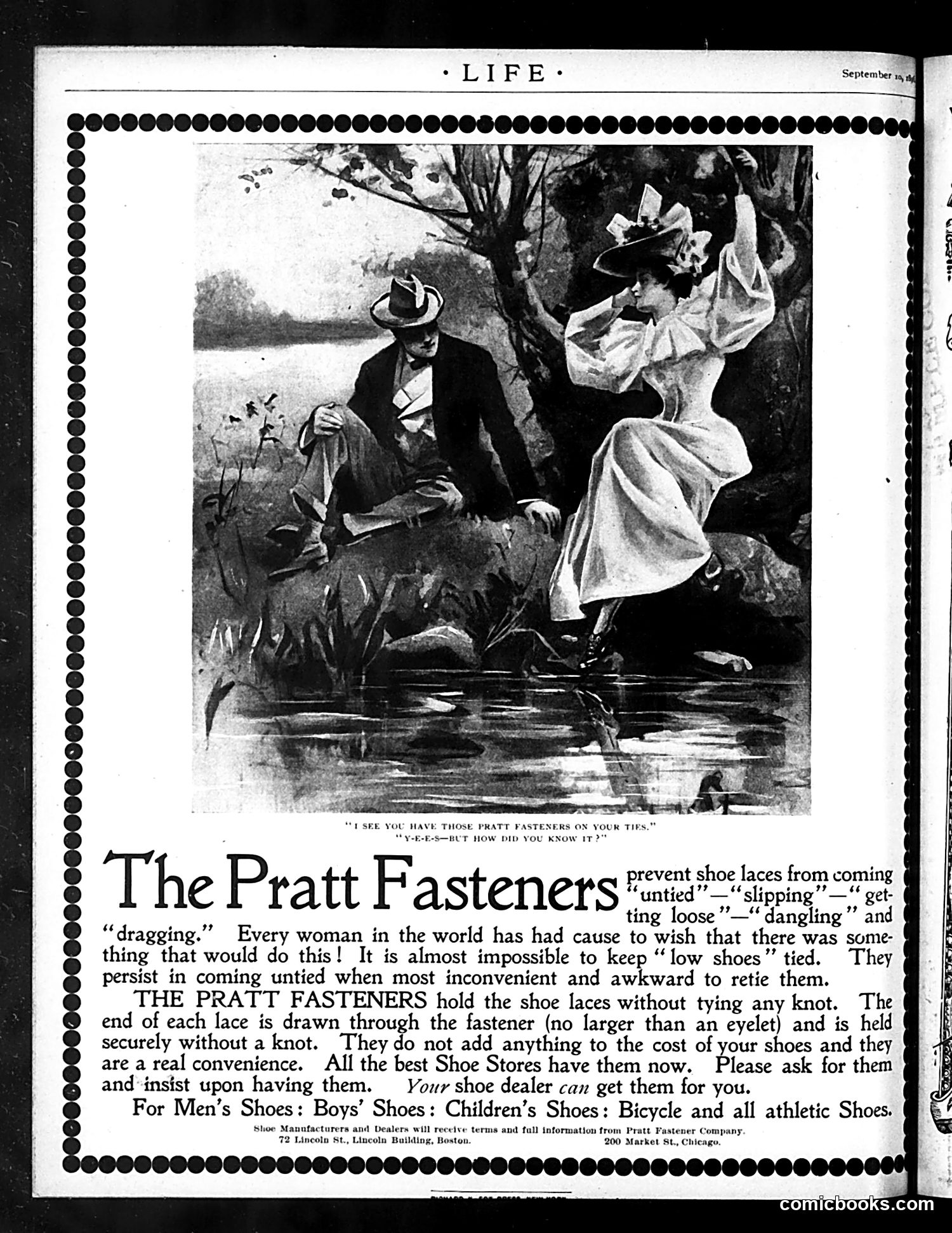
This is primarily a **product advertisement**, not political satire. The page promotes "Pratt Fasteners"—small devices that prevent shoelaces from coming untied without requiring knots. The cartoon caption shows two well-dressed figures by a pond or stream; one notices the other's shoe laces are secured and asks how they knew about the fasteners. It's a lighthearted vignette meant to demonstrate the product's appeal and visibility. The humor is gentle and social: the implication is that using these fasteners is becoming a recognizable status marker among fashionable people—you can tell someone is "in the know" by spotting them. The advertisement emphasizes that fasteners prevent the everyday frustration of constantly retying low shoes, a genuine inconvenience for the era, particularly for women. The copy stresses convenience and availability at "the best Shoe Stores," positioning the product as modern and desirable.