
Life, 1896-09-10 · page 4 of 20
Life — September 10, 1896 — page 4: what you’re looking at
What you’re looking at
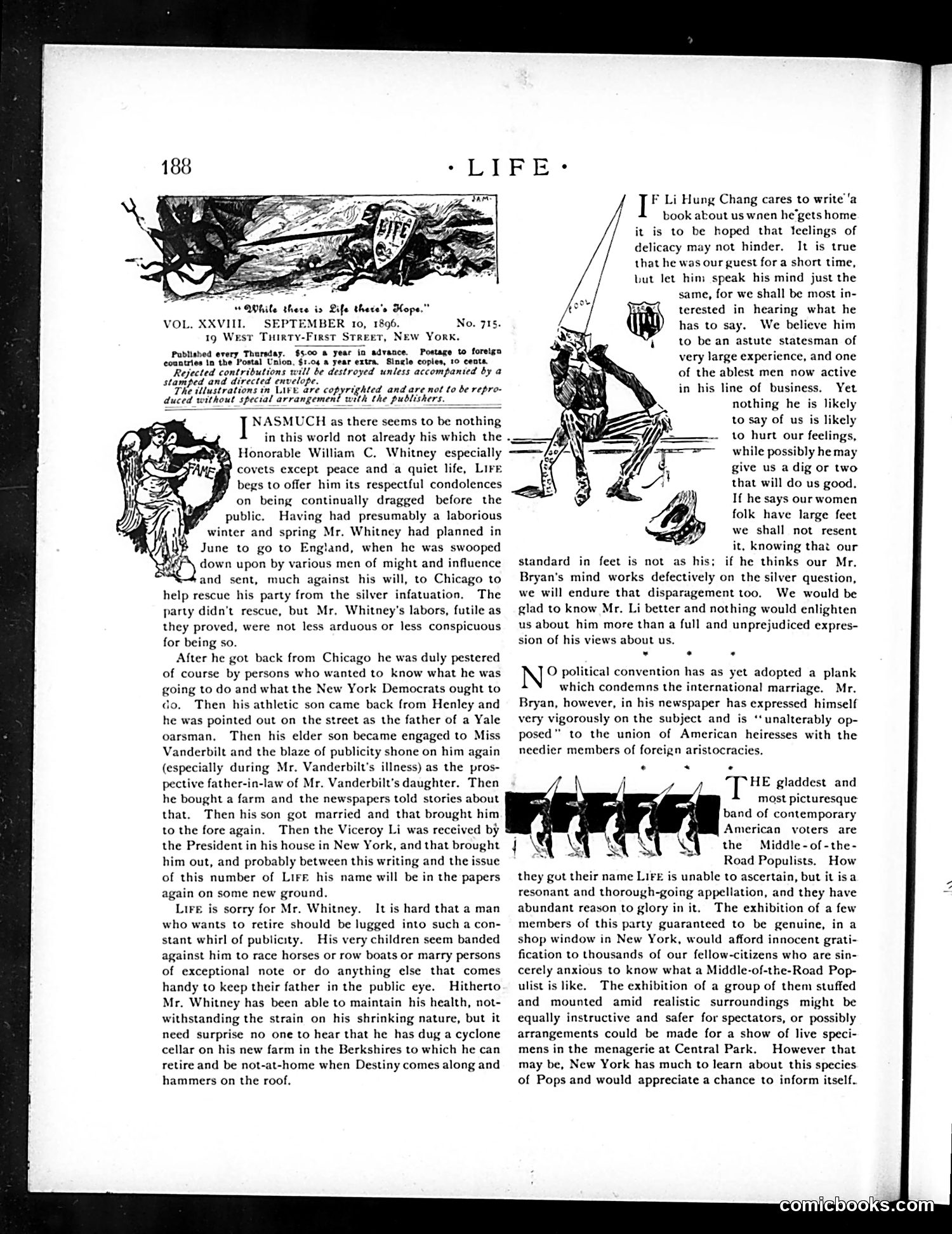
This page from *Life* magazine (September 10, 1896) discusses the retirement of Honorable William C. Whitney from public life. The text expresses hope that Whitney won't be dragged into Democratic politics again, noting his recent efforts to rescue his party "from the silver situation" (likely referring to the 1896 currency debate over free silver coinage). The accompanying illustrations appear to be satirical cartoons depicting Whitney's political entanglements and family connections—including references to his sons' marriages into prominent families like the Vanderbilts. The magazine critiques how public figures struggle to escape political pressure even when seeking retirement, using Whitney's situation as an example of this inescapable scrutiny.
📄 Transcribed text from this page (OCR, searchable)
Machine-transcribed from the original scan — historical spelling and the odd misread are preserved.
VOL. XXVIII. SEPTEMBER 10, 1896. No. 715. 1g West Tuirty-First Street, NEW York. Published every Thursday. $5.00 a year ia advance. Postage to foreign countries In the Postal Union, $1.04 a year extra, Single copies, 10 cents, ‘Rejected contributions will be destroyed unless accompanted by a stamped and directed envelope. ; The illustrations in Lave are copyrighted and are not t0 be repro- duced without special arrangement with the publishers. _ ] NASMUCH as there seems to be nothing in this world not already his which the .. ® covets except peace and a quiet life, Lire begs to offer him its respectful condolences on being continually dragged before the public. Having had presumably a laborious winter and spring Mr. Whitney had planned in June to go to Engiand, when he was swooped down upon by various men of might and influence and sent, much against his will, to Chicago to help rescue his party from the silver infatuation. The party didn’t rescue, but Mr. Whitney's labors, futile as they proved, were not less arduous or less conspicuous for being so. After he got back from Chicago he was duly pestered of course by persons who wanted to know what he was going to do and what the New York Democrats ought to do, Then his athletic son came back from Henley and he was pointed out on the street as the father of a Yale oarsman, Then his elder son became engaged to Miss Vanderbilt and the blaze of publicity shone on him again (especially during Mr. Vanderbilt's illness) as the pros- pective father-in-law of Mr. Vanderbilt's daughter. Then he bought a farm and the newspapers told stories about that. Then his son got married and that brought him to the fore again. Then the Viceroy Li was received by the President in his house in New York, and that brought | X him out, and probably between this writing and the issue of this number of Lirr his name will be in the papers again on some new ground. Lire is sorry for Mr. Whitney. It is hard that a man who wants to retire should be lugged into such a con- stant whirl of publicity. His very children seem banded against him to race horses or row boats or marry persons of exceptional note or do anything clse that comes handy to keep their father in the public eye. Hitherto Mr. Whitney has been able to maintain his health, not- withstanding the strain on his shrinking nature, but it need surprise no one to hear that he has dug a cyclone cellar on his new farm in the Berkshires to which he can retire and be not-at-home when Destiny comes along and hammers on the roof. * Li Hung Chang cares to write’'a book atout us wnen he'gets home it is to be hoped that teelings of delicacy may not hinder. It is true that he was our guest for a short time, but let him speak his mind just the same, for we shall be most in- terested in hearing what he has to say. We believe him to be an astute statesman of very large experience, and one of the ablest men now active in his line of business. Yet nothing he is likely to say of us is likely to hurt our feelings, while possibly he may give us a dig or two that will do us good. If he says our women folk have large feet we shall not resent it, knowing that our standard in feet is not as his; if he thinks our Mr. Bryan's mind works defectively on the silver question, we will endure that disparagement too. We would be glad to know Mr. Li better and nothing would enlighten us about him more than a full and unprejudiced expres- sion of his views about us. N O political convention has as yet adopted a plank which condemns the international marriage. Mr. Bryan, however, in his newspaper has expressed himself very vigorously on the subject and is ‘‘unalterably op- posed” to the union of American heiresses with the needier members of foreign aristocracies. T HE gladdest and most picturesque band of contemporary American voters are the Middle-of-the- Road Populists. How they got their name Lire is unable to ascertain, but it isa resonant and thorough-going appellation, and they have abundant reason to glory in it. The exhibition of a few members of this party guaranteed to be genuine, in a shop window in New York, would afford innocent grati- fication to thousands of our fellow-citizens who are sin- cerely anxious to know what a Middle-of-the-Road Pop- ulist is like. The exhibition of a group of them stuffed and mounted amid realistic surroundings might be equally instructive and safer for spectators, or possibly arrangements could be made for a show of live speci- mens in the menagerie at Central Park. However that may be, New York has much to learn about this species of Pops and would appreciate a chance to inform itself.