
Life, 1896-09-10 · page 12 of 20
Life — September 10, 1896 — page 12: what you’re looking at
What you’re looking at
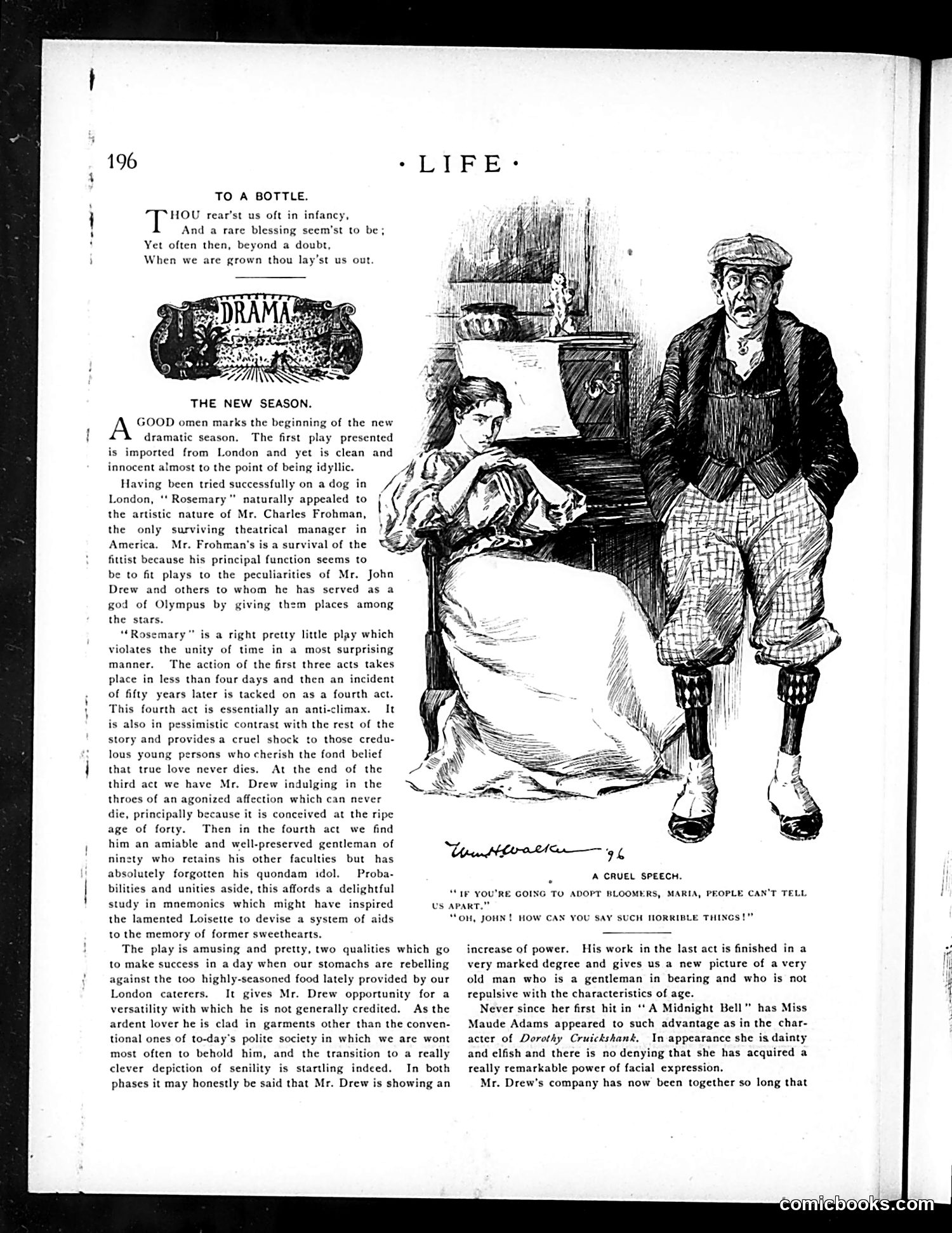
This page contains theater criticism and social satire from an early 20th-century Life magazine. **Main Content:** The article reviews a play called "Rosemary," praising its London import as refreshingly innocent. It praises actor John Drew's performance across the play's arc—from passionate young lover to forgetful elderly gentleman—noting his improved range. **The Cartoons:** The upper illustration, "To a Bottle," is a drinking joke: bottles nurture us in infancy (as containers) yet "lay us out" (render us unconscious) when grown. **"A Cruel Speech" Cartoon:** The lower cartoon satirizes women's fashion debates of the era. A man tells his wife that if she adopts bloomers (the controversial divided-skirt garment gaining acceptance), people won't be able to distinguish them. The "cruelty" is the implication that women in bloomers would resemble men—a common anti-bloomer argument of the 1890s-1900s that mocked women's dress reform as unfeminine. Both pieces reflect period anxieties about tradition versus modernity.
📄 Transcribed text from this page (OCR, searchable)
Machine-transcribed from the original scan — historical spelling and the odd misread are preserved.
TO A BOTTLE. HOU rear’st us oft in infancy, And a rare blessing scem'st to be; Yet often then, beyond a doubt, When we are grown thou lay’st us out. THE NEW SEASON. GOOD omen marks the beginning of the new The first play presented is imported from London and yet is clean and innocent almost to the point of being idyllic. dramatic season. Having been tried successfully on a dog in London, ‘ Rosemary" naturally appealed to the artistic nature of Mr. Charles Frohman, the only surviving theatrical manager in America. Mr. Frohman’s is a survival of the fittist because his principal function seems to be to fit plays to the peculiarities of Mr. John Drew and others to whom he has served as a god of Olympus by giving them places among the star: “Rosemary” is a right pretty little play which violates the unity of time in a most surprising manner. The action of the first three acts takes place in less than four days and then an incident of fifty years later is tacked on as a fourth act. This fourth act is essentially an anti-climax. It is also in pessimistic contrast with the rest of the story and provides a cruel shock to those credu- lous young persons who cherish the fond belief that true love never dies. At the end of the third act we have Mr. Drew indulging in the throes of an agonized affection which can never die, principally because it is conceived at the ripe age of forty. Then in the fourth act we find him an amiable and well-preserved gentleman of ninsty who retains his other faculties but has absolutely forgotten his quondam idol. Proba- bilities and unities aside, this affords a delightful study in mnemonics which might have inspired the lamented Loisette to devise a system of aids to the memory of former sweethearts. The play is amusing and pretty, two qualities which go to make success in a day when our stomachs are rebelling against the too highly-seasoned food lately provided by our London caterers. It gives Mr. Drew opportunity for a versatility with which he is not generally credited. As the ardent lover he is clad in garments other than the conven- tional ones of to-day’s polite society in which we are wont most often to behold him, and the transition to a really clever depiction of senility is startling indeed. In both phases it may honestly be said that Mr. Drew is showing an A CRUEL SPEECH. “IF YOU'RE GOING TO ADOPT BLOOMERS, MARIA, PEOPLE CAN'T TELL US APART.” “on, JOHN! HOW CAN YOU SAY SUCH HORRIBLE THINGS!" increase of power. His work in the last act is finished in a very marked degree and gives us a new picture of a very old man who is a gentleman in bearing and who is not repulsive with the characteristics of age. Never since her first hit in ‘‘A Midnight Bell” has Miss Maude Adams appeared to such advantage as in the char- acter of Dorothy Cruickshank. In appearance she is dainty and elfish and there is no denying that she has acquired a really remarkable power of facial expression. Mr. Drew's company has now been together so long that