
A complete issue · 18 pages · 1896
Life — September 3, 1896
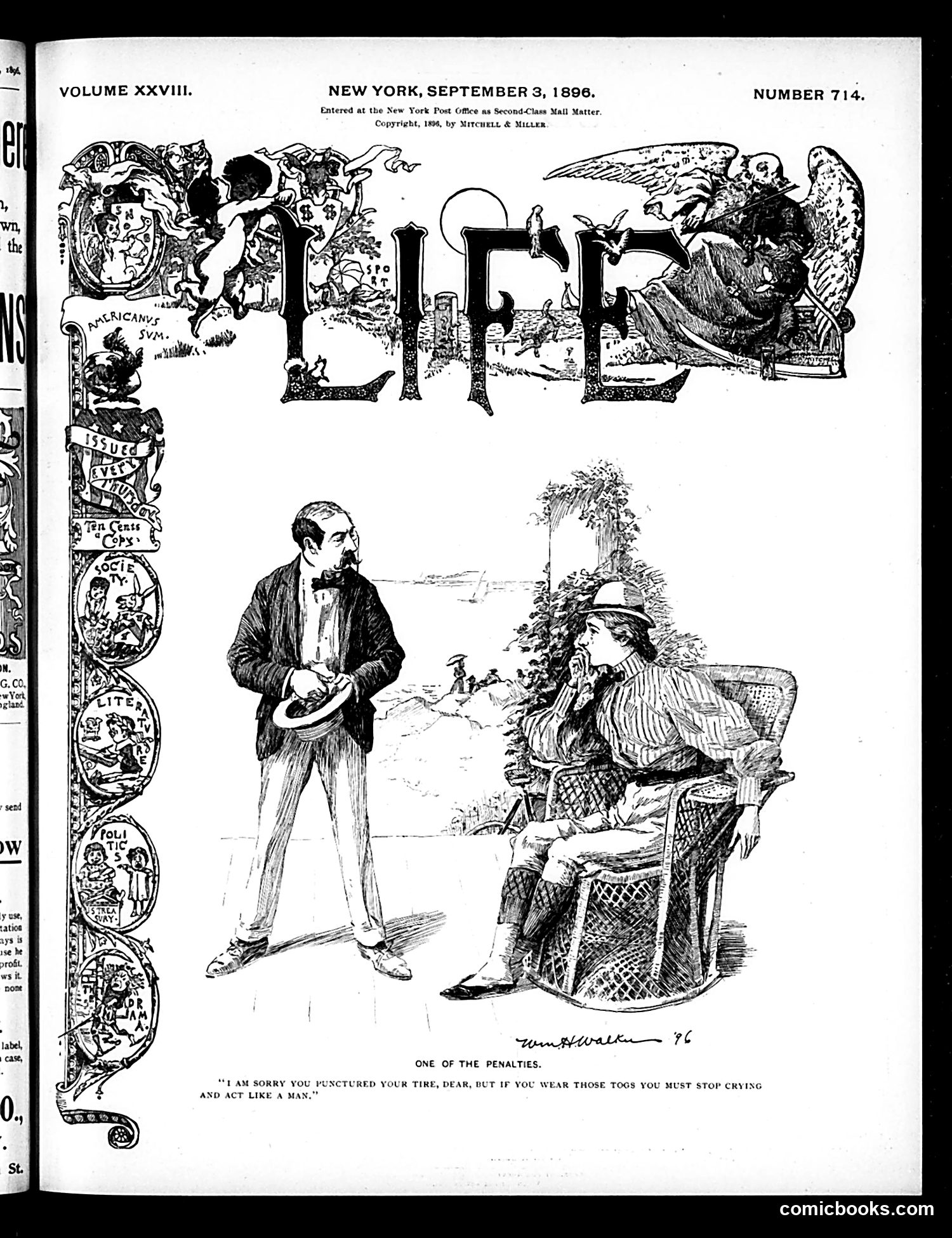
This cartoon from Life magazine (September 3, 1896) depicts a domestic dispute titled "One of the Penalties." A man holding a hat stands confronting a seated woman, saying: "I am sorry you punctured your tire, dear, but if you wear those togs you must stop crying and act like a man." The satire targets the emerging "New Woman" of the 1890s—women adopting cycling as a sport and wearing practical bloomers or knickerbockers instead of restrictive Victorian skirts. The man's comment mocks this gender-norm challenge: if women claim independence through athletic pursuits and unconventional dress, society expects them to abandon "feminine" complaints about hardship. The cartoon reflects anxieties about women's changing roles during this period.
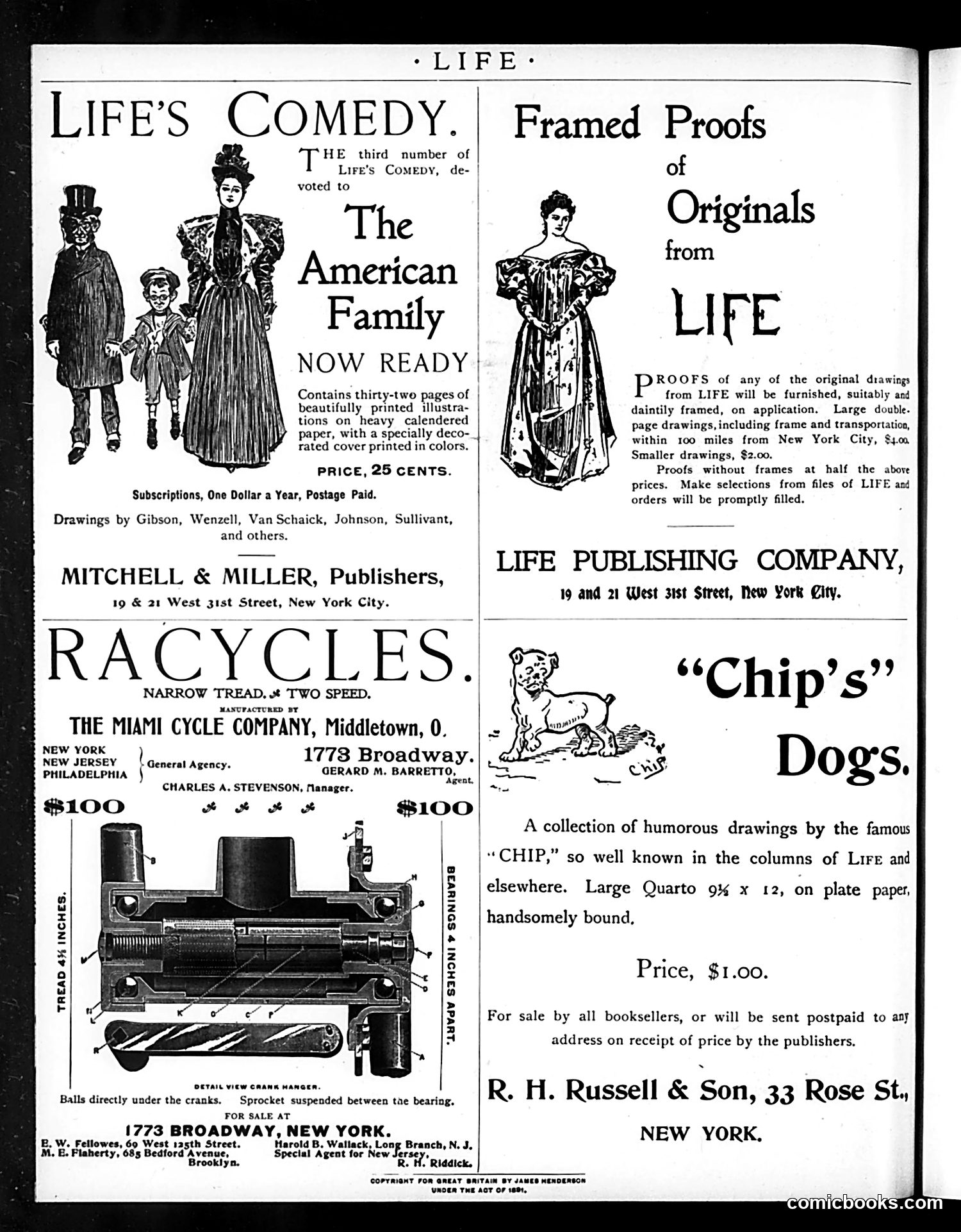
This page is primarily **advertising**, not editorial content or political cartoons. The top-left advertises "Life's Comedy: The American Family," a 32-page illustrated collection priced at 25 cents, featuring drawings by Gibson, Wenzel, Van Schaick, and others. The illustration shows Victorian-era figures in period dress. The top-right promotes framed proofs of original Life drawings available for purchase from the Life Publishing Company. The bottom-left advertises Miami Cycle Company's "Racycles" (narrow-tread, two-speed bicycles) for $100. The bottom-right promotes "Chip's Dogs," a collection of humorous dog drawings by the cartoonist "Chip" (well-known in Life's columns), priced at $1.00 from publisher R. H. Russell & Son. No satire or political commentary is evident here—this is a commercial page showcasing Life magazine's merchandise and related products.
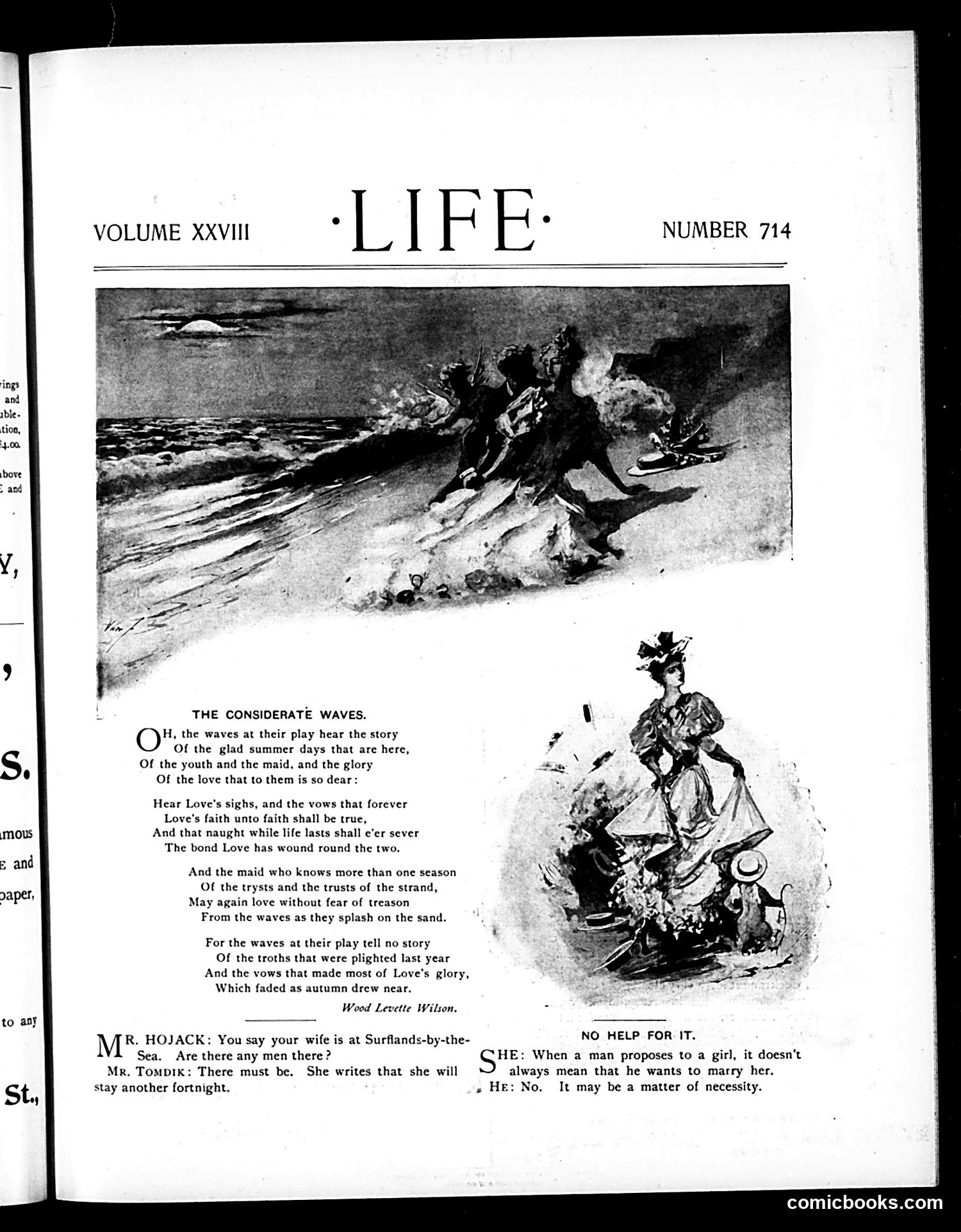
**"The Considerate Waves"** — A romantic poem by Wood Lovett Wilson accompanies an illustration of a couple by the seaside, suggesting themes of enduring love and constancy. The verses reference summer romance, faithfulness, and memories. **"No Help For It"** — A brief comic dialogue below presents a conventional joke about marriage proposals. When a man proposes to a girl, she questions whether his proposal truly indicates desire to marry, or merely necessity. The humor relies on the era's assumption that women might trap men into marriage through pregnancy or circumstance rather than genuine affection—a common satirical subject in early 20th-century humor. The page mixes sentimental poetry with social satire about courtship customs.
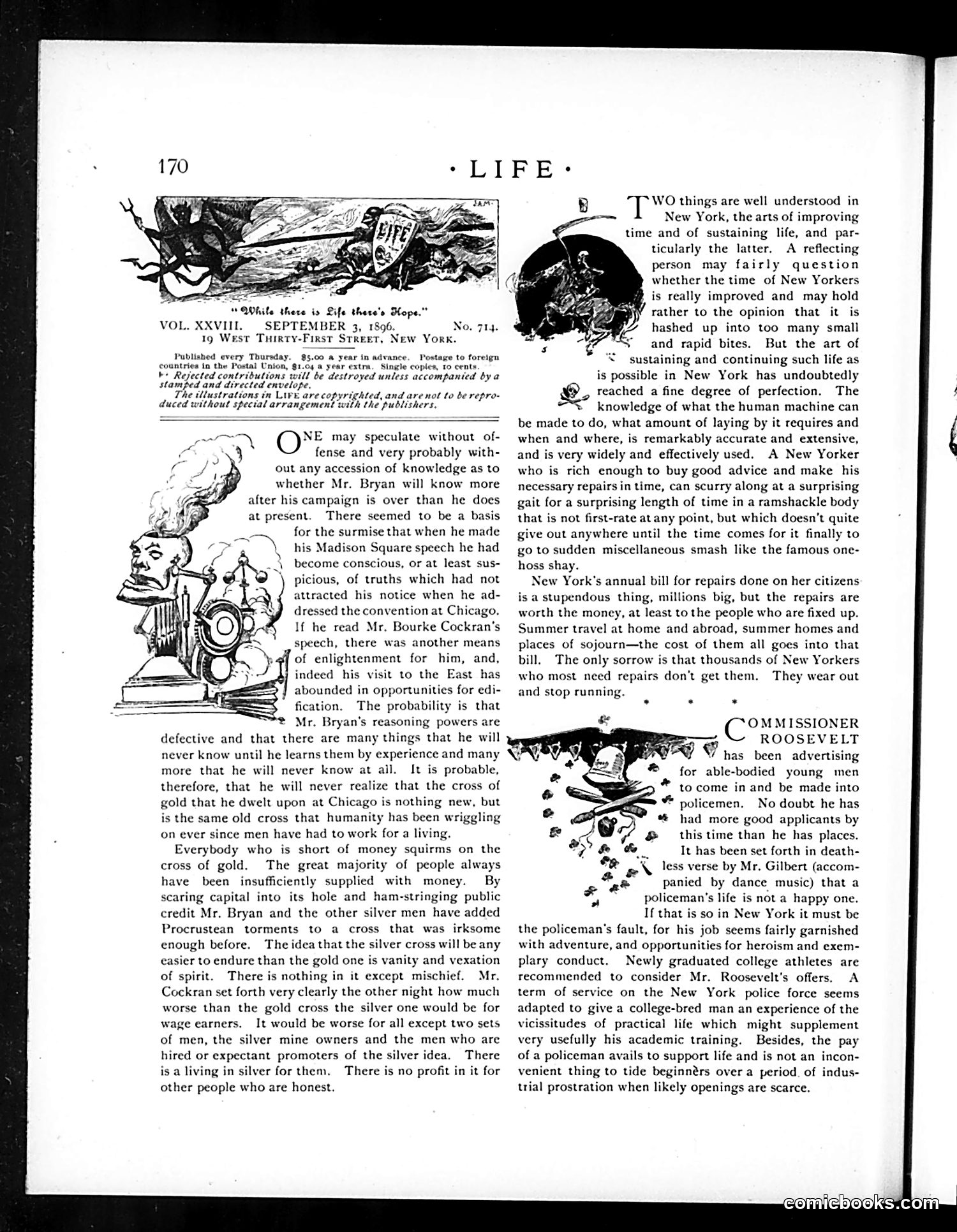
This page contains two satirical pieces about New York City life and politics from September 3, 1906. The left cartoon depicts **William Jennings Bryan**, the three-time presidential candidate, shown as an inflated figure spouting rhetoric. The text mocks his recent speech at the Democratic convention in Chicago, suggesting his "cross of gold" populist message about silver currency is outdated. The satire implies Bryan's reasoning is defective and that his ideological fixations (comparing them to both gold and silver monetary crosses) reveal his disconnect from practical reality. The right section discusses **Commissioner Roosevelt's** (likely Police Commissioner) recruitment of college athletes as policemen. The satire questions whether educated young men truly want police work, suggesting the job's low pay and adventure—rather than civic duty—motivates applicants, and doubting whether this addresses real policing needs.
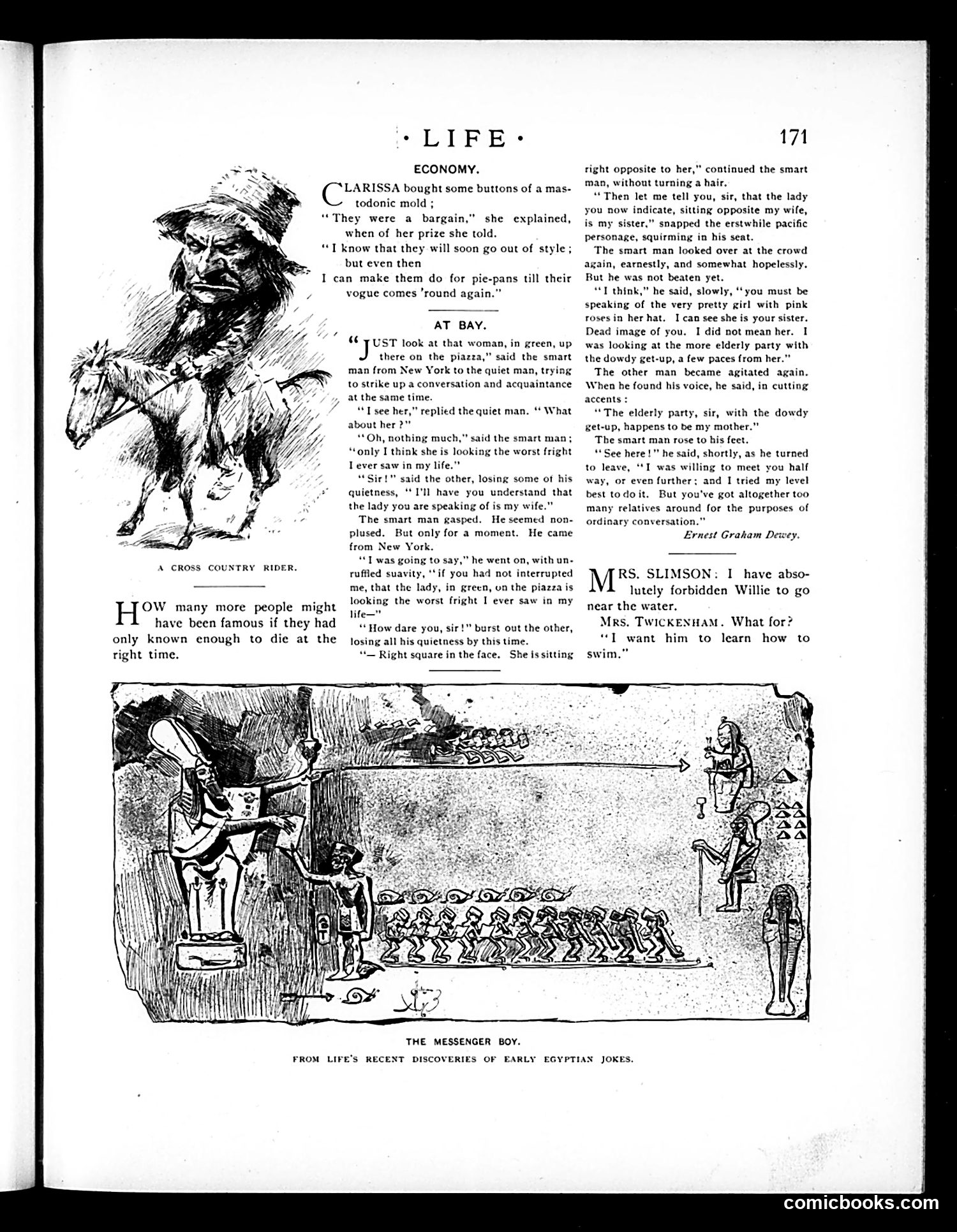
This page contains three distinct pieces: 1. **"Economy"** and **"At Bay"** stories featuring dialogue about fashion and social encounters—satirizing New York society's pretensions and romantic mishaps among the wealthy. 2. **"A Cross Country Rider"** - A brief aphorism about fame, illustrated with a sketch of a rough-looking man on horseback. 3. **"The Messenger Boy"** - A cartoon labeled "From Life's Recent Discoveries of Early Egyptian Jokes," depicting Egyptian figures in a humorous scene. This is a visual pun: the caption suggests ancient Egypt had "jokes" comparable to modern ones, satirizing both archaeological discoveries and the timelessness of human humor. The overall tone is light satire on American social life and human nature.
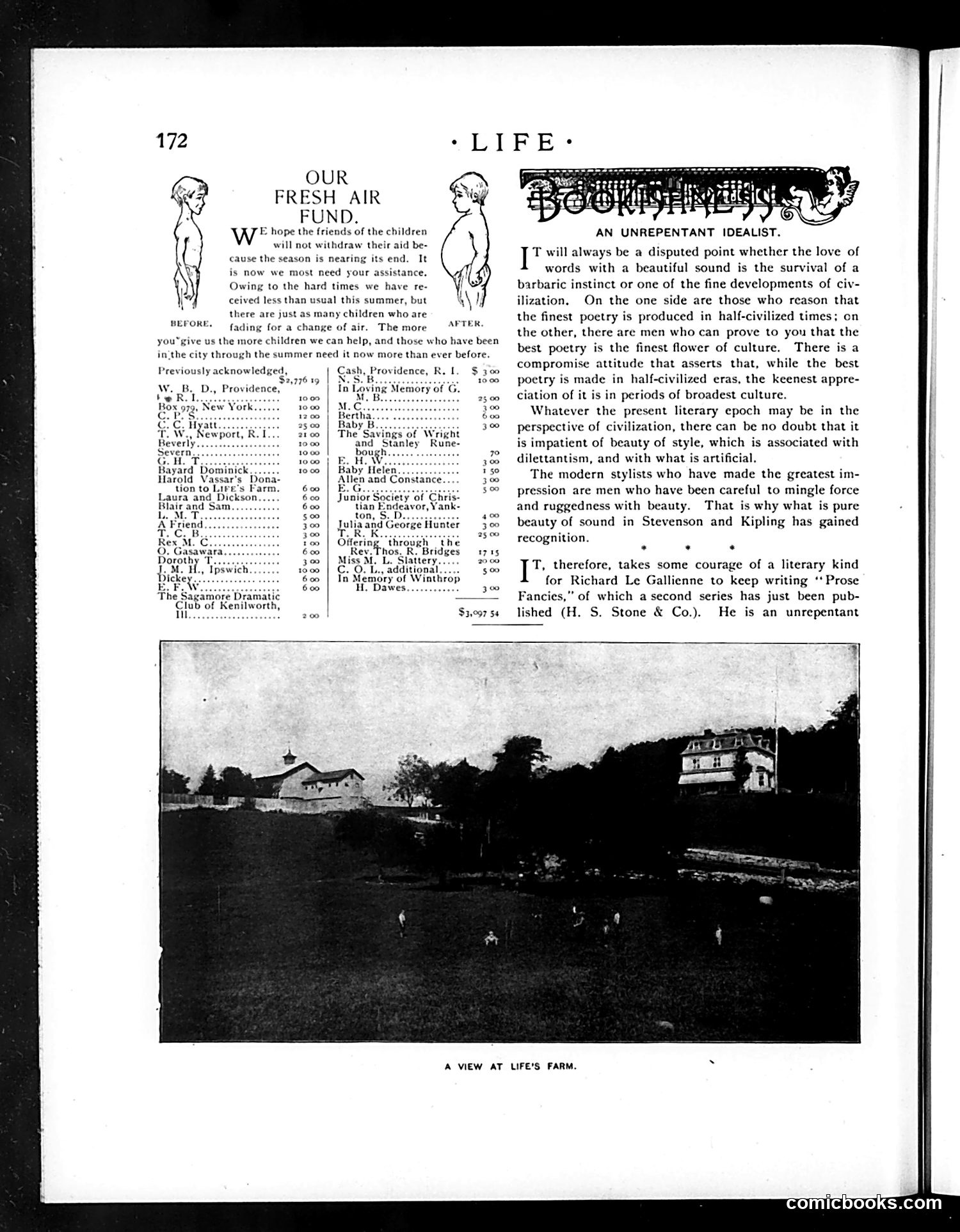
The page contains two distinct sections: **Left side:** "Our Fresh Air Fund" — a charitable fundraising appeal listing donations to send urban children to the countryside for health benefits. The accompanying illustrations show before/after silhouettes of a malnourished child, emphasizing the physical transformation fresh air provides. This reflects early 20th-century Progressive Era concerns about children's welfare in industrializing cities. **Right side:** An article titled "Richard Le Gallienne: An Unrepentant Idealist" discussing the literary figure's commitment to beauty and artistic expression in poetry, arguing that "pure beauty of sound" deserves recognition despite modernist trends toward roughness. **Bottom:** A photograph labeled "A View at Life's Farm" showing a pastoral landscape with buildings and figures, likely illustrating the Fresh Air Fund's destination. The page combines philanthropy promotion with literary criticism.
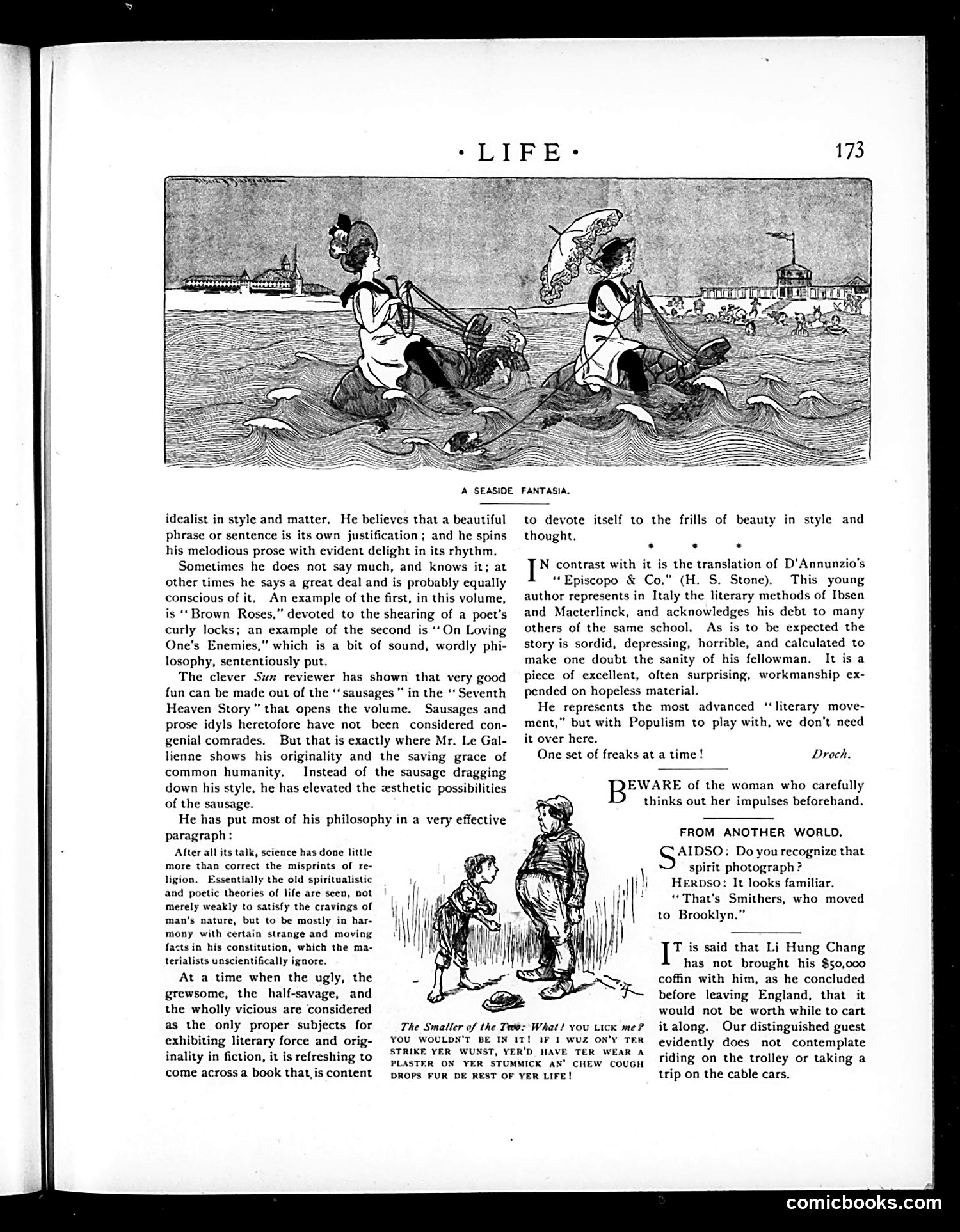
The cartoon depicts two women in bathing attire riding on what appear to be large fish or sea creatures in the ocean, with a beach pavilion visible in the background. This is satirical commentary on seaside leisure and bathing culture. The accompanying text discusses literary style and philosophy, mentioning various authors and works. The cartoon itself appears to be gentle satire about women's beach recreation—a relatively modern leisure activity for the era. The lower section contains conversational humor between characters about spirit photography and a Chinese guest named Li Hung Chang who apparently declined to bring his expensive coffin to Brooklyn. Without a visible date, the exact historical references remain unclear, though this reflects early 20th-century American leisure culture and attitudes toward women's public bathing.
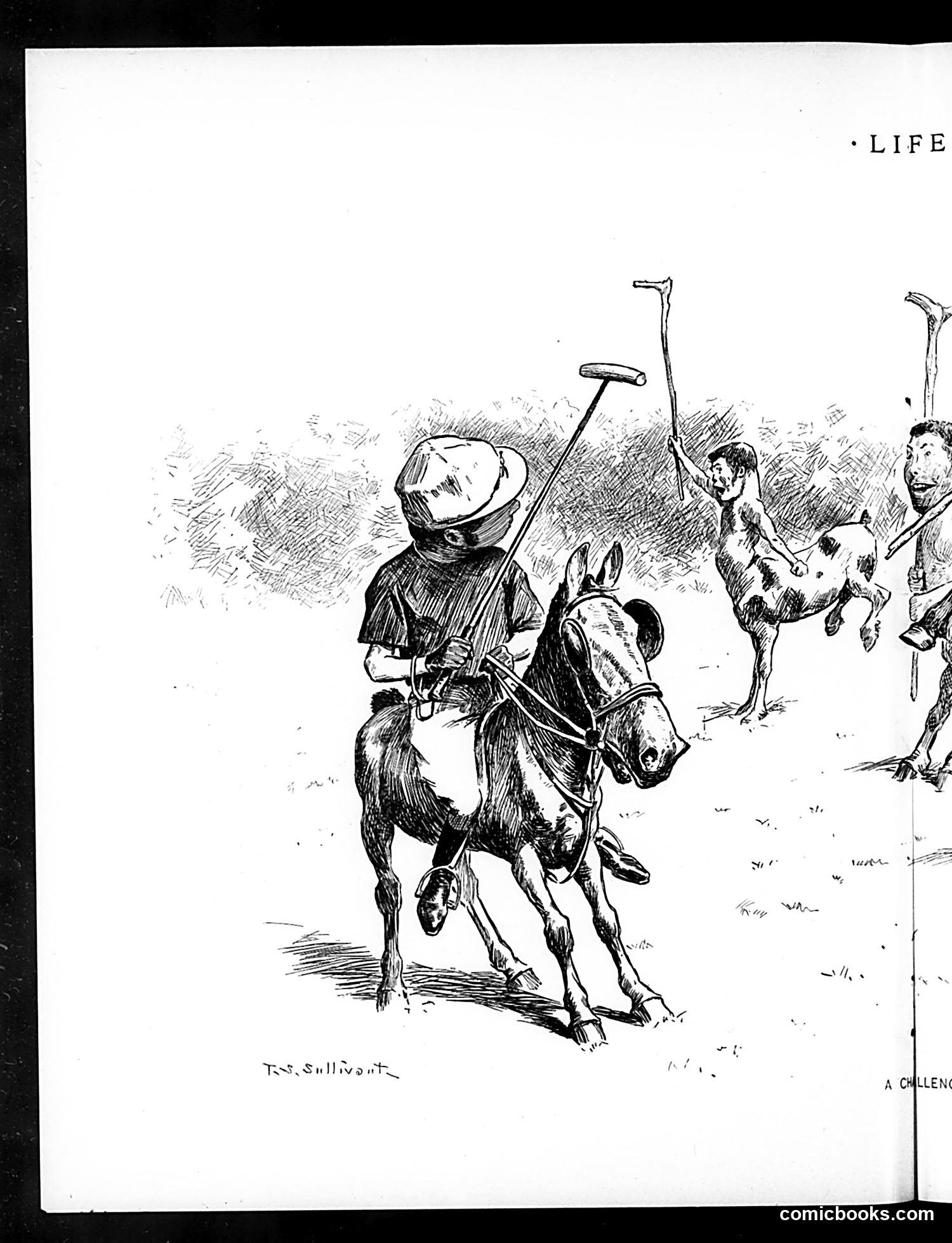
This sketch by T. S. Sullivant depicts a polo player on horseback raising his mallet in triumph, while spectators on the right appear to be reacting with surprise or concern. The cartoon is titled "A Challenge" (visible at bottom right). The satire likely mocks polo as an elite, aristocratic sport—the player's exaggerated pose suggests overconfidence or theatrical posturing. The spectators' reactions suggest the "challenge" is provocative or audacious in some way. Without additional context from the article accompanying this image, the specific political or social target remains unclear. The cartoon appears critical of upper-class sporting culture, but the precise reference—whether to a real polo match, a social climber, or broader class commentary—cannot be determined from the image alone.
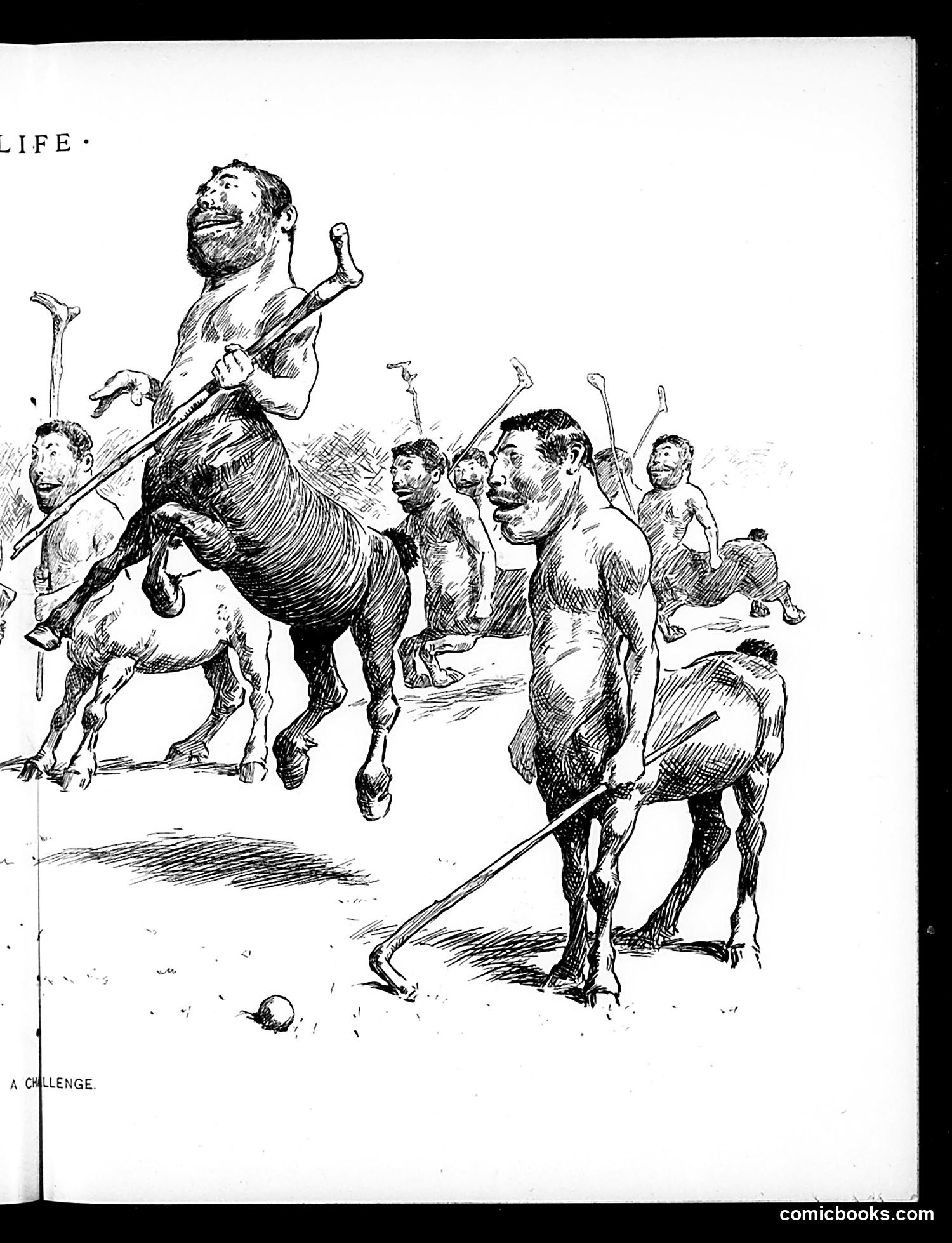
This satirical cartoon depicts ape-like figures in a confrontational scene. The central figure, elevated and prominently positioned, appears to be challenging or taunting smaller figures below who hold clubs or staffs. The exaggerated, animalistic depiction of all figures suggests a commentary on human behavior—likely mocking primitive or barbaric conduct among men. The title "A Challenge" indicates a confrontation or dare scenario. Given Life magazine's satirical tradition, this likely critiques some contemporary political or social conflict, perhaps portraying opponents as behaving like animals in their dispute. However, without additional context about the publication date or OCR text, I cannot definitively identify which specific historical event or political figures are referenced.
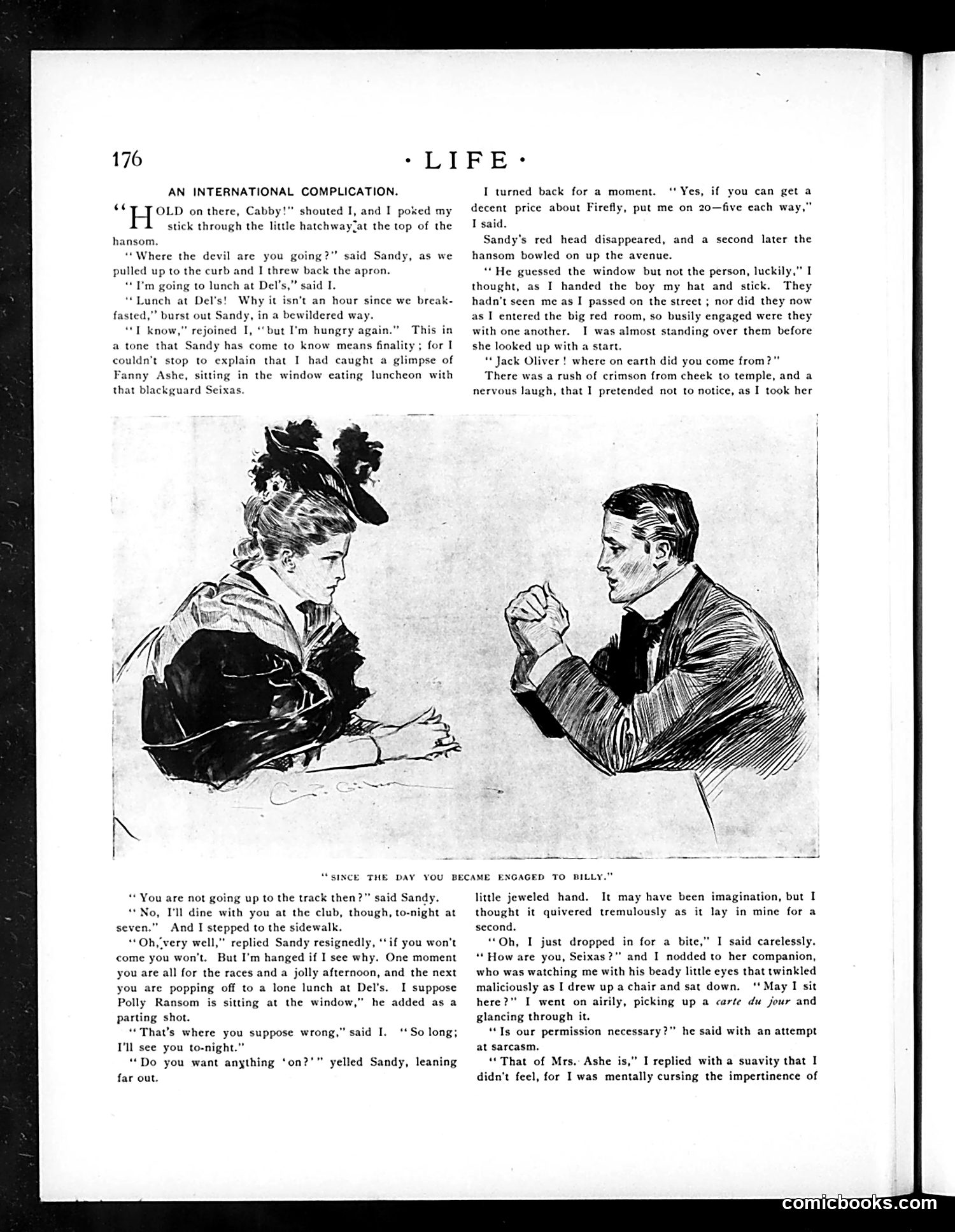
This page from *Life* magazine contains a short story titled "An International Complication" with an accompanying illustration. The sketch shows two people in conversation—a woman in elaborate dress with feathered hat and a man in dark suit—depicting what appears to be a romantic or social confrontation scene. The text references characters named Sandy, Cabby, Fanny Ashe, Billy, and Jack Oliver in a narrative about lunch arrangements, jealousy, and social maneuvering among the upper class. The dialogue suggests romantic entanglement and social intrigue typical of early 20th-century satirical fiction in *Life*. The illustration's caption—"Since the Day You Became Engaged to Billy"—indicates the scene depicts tension arising from an engagement. This represents *Life*'s satirization of aristocratic romantic complications and social pretension rather than political commentary.
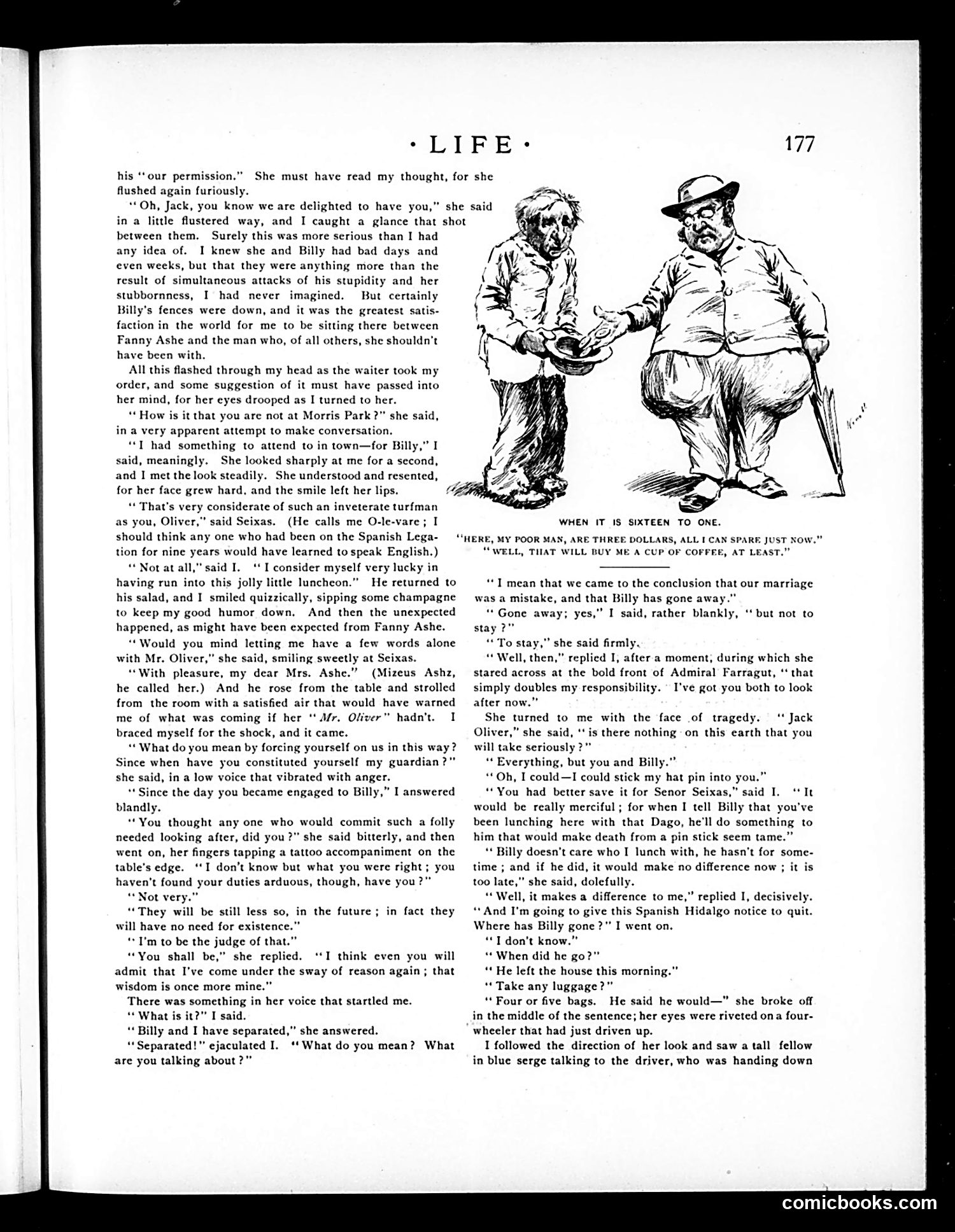
The illustration depicts two men in conversation, captioned "WHEN IT IS SIXTEEN TO ONE." The cartoon satirizes economic disparity and class conflict during the late 19th century—likely referencing the "free silver" debate of the 1890s, when "sixteen to one" was the proposed ratio of silver to gold for currency coinage. The well-dressed, portly figure (right) appears to represent wealthy interests or the gold standard establishment, while the gaunt, poorly-dressed figure (left) represents the working class or silver advocates. Their physical contrast emphasizes economic inequality. The accompanying dialogue concerns a marriage dissolution, using domestic conflict as metaphor for larger social/political divisions between rich and poor, or between competing economic systems. The humor relies on readers' familiarity with contemporary currency debates.
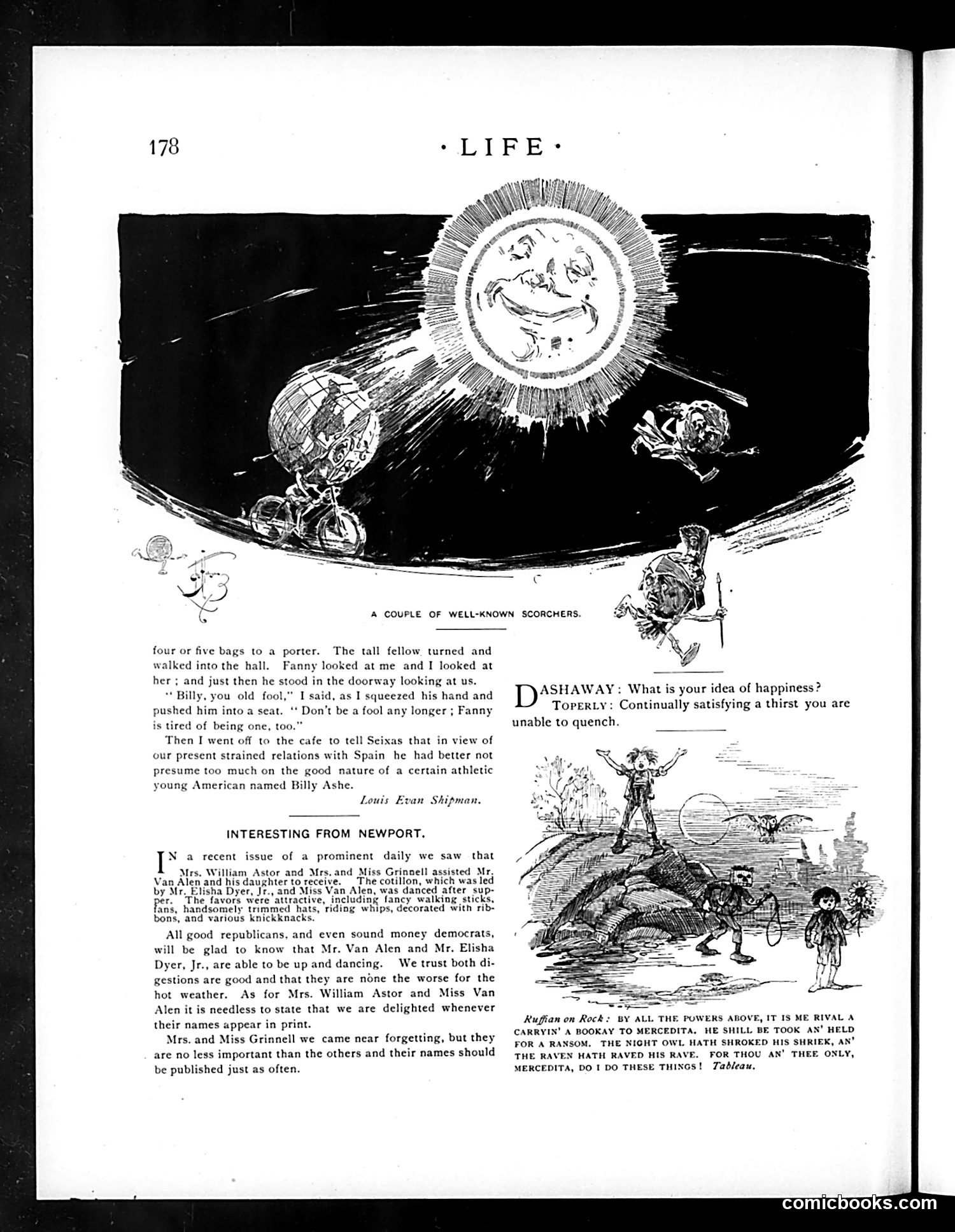
This page contains satirical social commentary typical of Life's format. The top cartoon, "A Couple of Well-Known Scorchers," depicts fashionable young people (likely wealthy New Yorkers) engaging in reckless behavior—"scorchers" being slang for those who drove or cycled dangerously fast. The main text, "Interesting from Newport," mocks the social pretensions of Newport's elite, particularly the Van Alen and Astor families. Life sarcastically praises their ability to attend cotillons (formal dances) and recover from wealthy excess, with barbed references to their digestions after hot-weather festivities. The tone suggests these ultra-wealthy families receive disproportionate press coverage simply for existing. The lower illustrations appear to be literary or theatrical references—one showing a figure on a rock, another a dialogue about happiness and thirst. Overall, the page satirizes Gilded Age excess, celebrity coverage of the ultra-wealthy, and their trivial social activities presented as newsworthy.
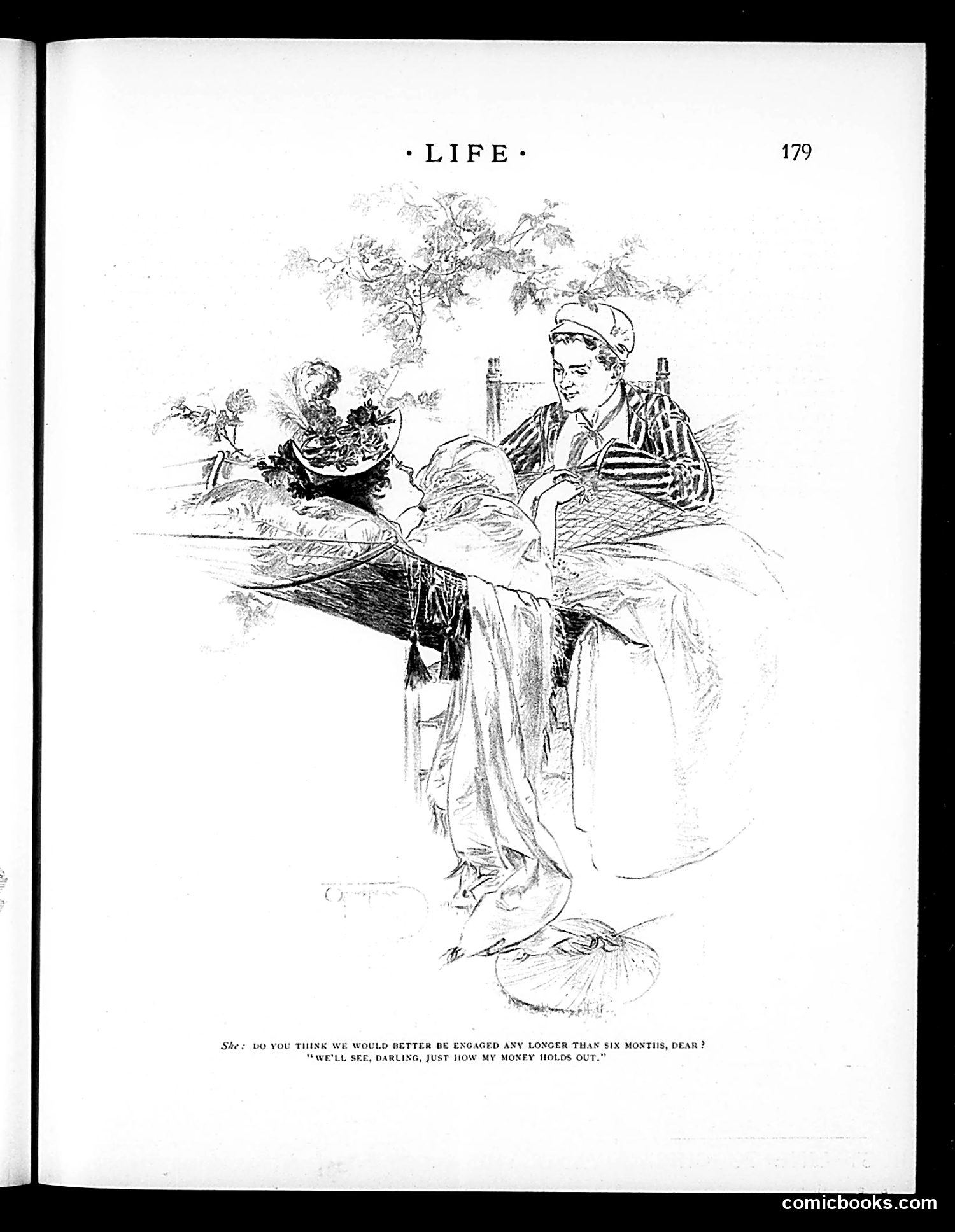
This satirical illustration depicts a romantic couple, with the woman proposing a six-month engagement timeline. The man's response—"We'll see, darling, just how my money holds out"—reveals the joke's cynical point: his commitment to marriage is purely financial, not romantic. The cartoon mocks the mercenary nature of courtship and marriage among the affluent classes, suggesting that a man's willingness to propose depends entirely on his bank account rather than genuine affection. The woman's casual proposal and his materialistic response both satirize the transactional view of romance prevalent in early 20th-century high society, where economic considerations often superseded matters of the heart.
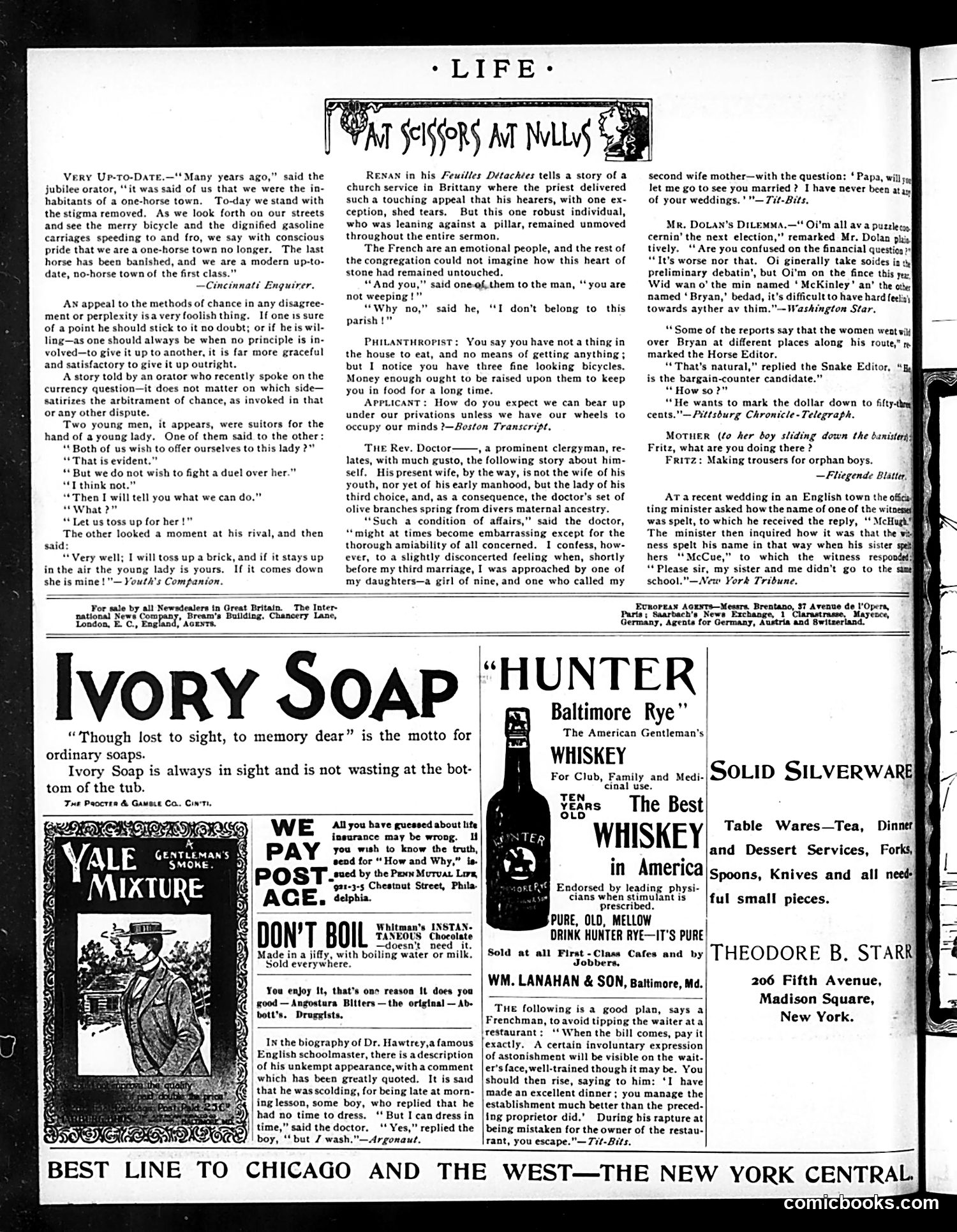
This page from *Life* magazine consists primarily of **humorous anecdotal columns** with accompanying advertisements—no political cartoons appear. The humor pieces are brief satirical stories targeting contemporary social pretensions and immigrant stereotypes: - **"Very Up-to-Date"**: Satirizes small-town boosterism—a town celebrates replacing horses with bicycles and automobiles as "progress." - **French/Irish vignettes**: Mock emotional excess (a Frenchman unmoved by a sermon) and Irish dialect humor (Mr. Dolan confused about McKinley vs. Bryan in the election). - **Currency debate anecdote**: Two suitors flip a coin rather than duel over a lady—satirizing the absurdity of chance-based decision-making. - **Philanthropist/cyclist joke**: A beggar with three bicycles claims poverty—satirizing the implausibility of such claims. The **advertisements** promote Victorian-era consumer goods: Ivory Soap, Yale Mixture (tobacco), Hunter Baltimore Rye whiskey, and Theodore B. Starr silverware. The page reflects early 1900s anxieties about modernization, immigration, and economic debates, presented through gentle class-based ridicule.
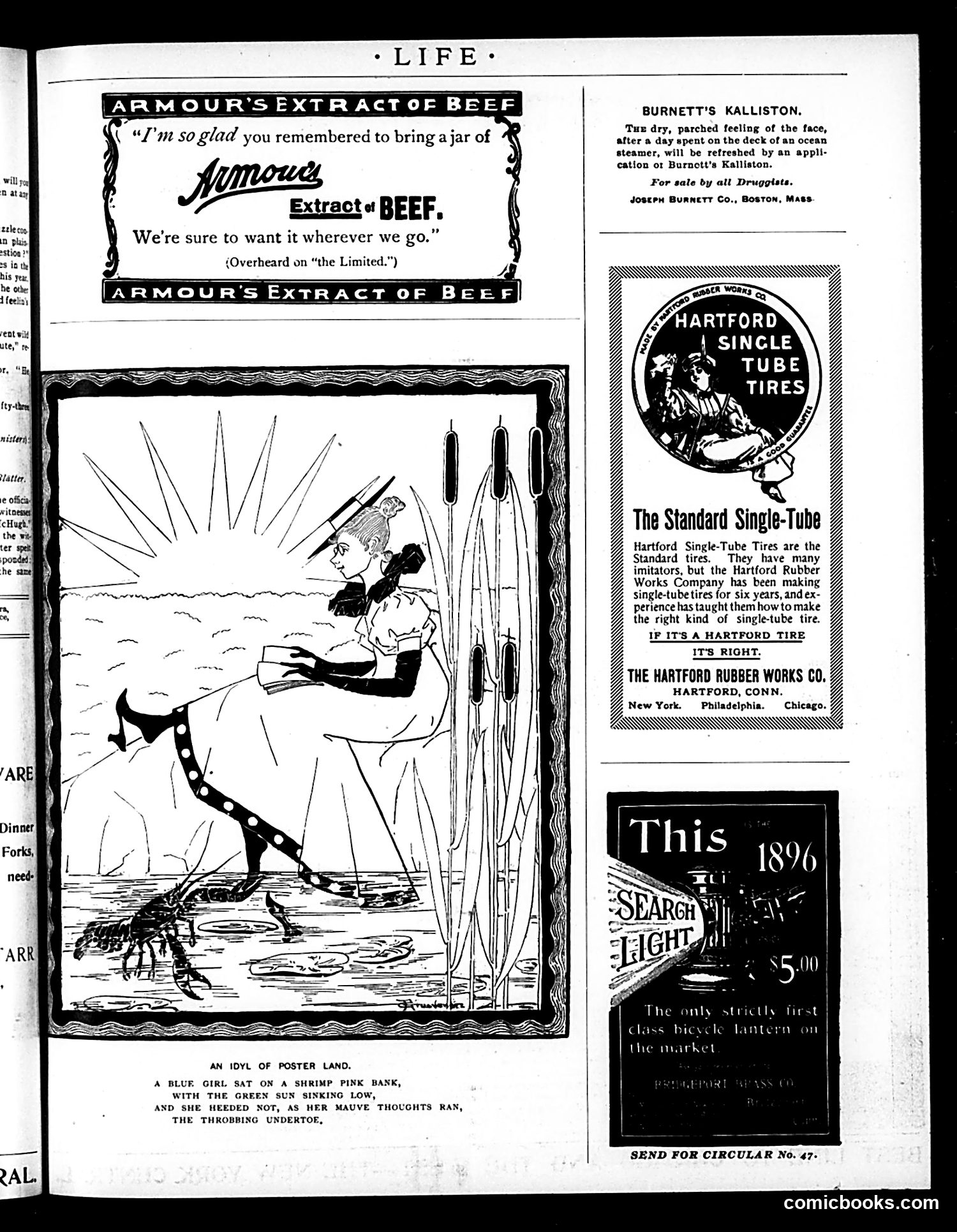
This page is primarily **advertising**, not political satire. The main content consists of four commercial advertisements from circa 1896. The cartoon titled "An Idyl of Poster Land" (lower left) is the only satirical element. It mocks the absurd aesthetics of contemporary poster art through deliberately nonsensical color descriptions: "blue girl," "shrimp pink bank," "green sun," and "mauve thoughts." The accompanying poem's overwrought romantic language ("throb-bing undertoe") parodies the pretentious melodrama often found in artistic posters of the era. The satire targets the emerging Art Nouveau movement and poster designers' tendency toward gaudy, irrational color combinations and purple prose—critiquing them as divorced from reality. The caption "Poster Land" suggests this is fantasy rather than genuine artistic merit. The other ads (Armour's beef extract, Hartford tires, Burnett's cosmetics, and Searchlight lantern) are straightforward period marketing with no satirical intent.
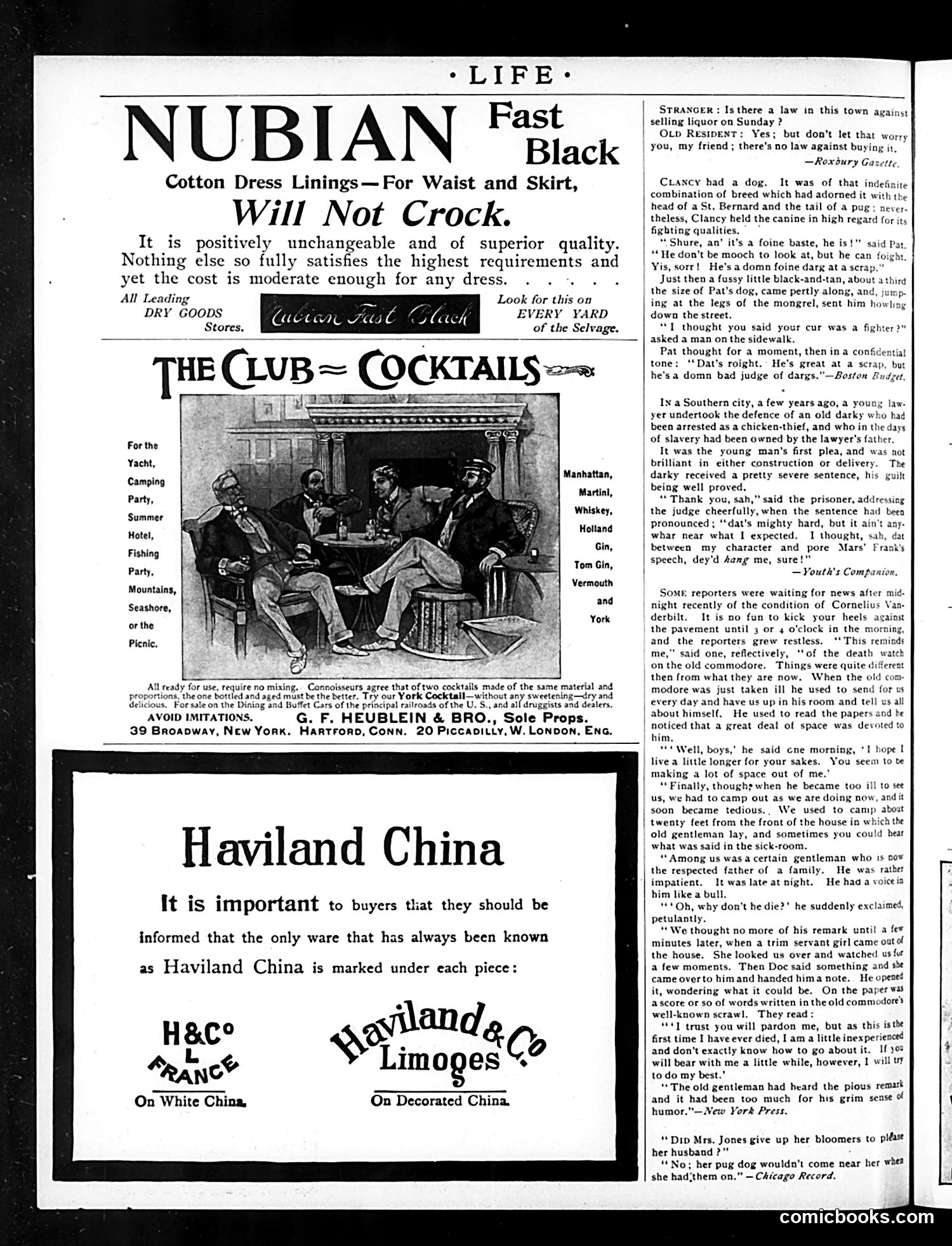
This page is primarily **advertisements** interspersed with humorous anecdotes rather than political cartoons. The main visual is "The Club Cocktails" advertisement showing men in formal dress enjoying drinks. The **satirical content** consists of brief jokes: 1. A town official admits there's no law against *buying* liquor on Sunday—only selling it—a wink at selective law enforcement. 2. An Irish immigrant boasts his dog is good at fighting, but admits it's a "bad judge of dargs" after a smaller dog thrashes it—ethnic humor playing on Irish dialect and the contradiction. 3. A lawyer's poorly delivered speech during slavery times is jokingly blamed for nearly getting his client hanged; the defendant thanks the judge it wasn't worse. 4. Reporters complain the dying Cornelius Vanderbilt was more cooperative with press access than modern protocol allows. These are gentle, period-typical jokes reflecting class attitudes, ethnic stereotypes, and commentary on privilege and legal hypocrisy—not serious political satire.
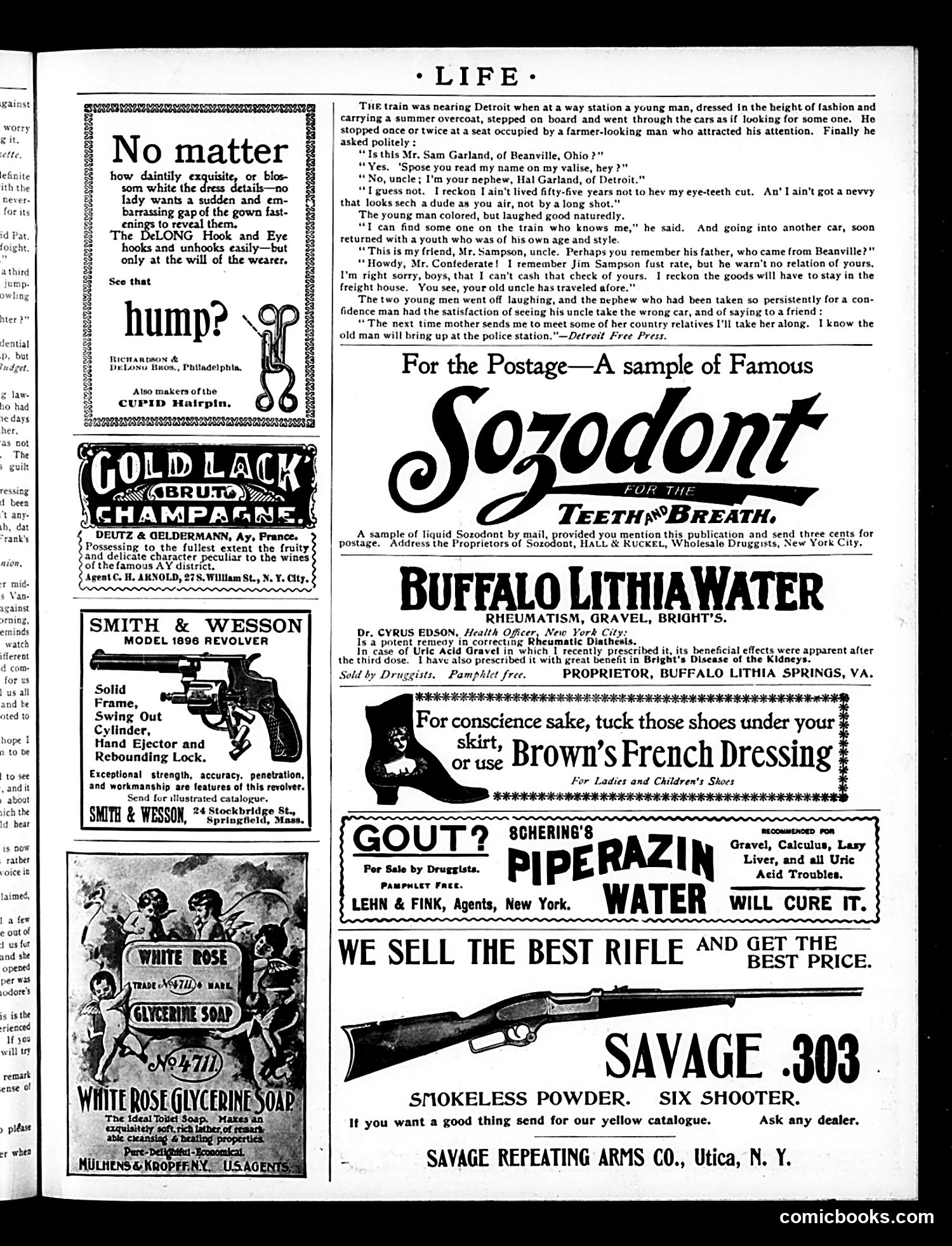
This page is primarily **advertisements** interspersed with one short satirical story. The main narrative ("No matter how daintily exquisite...") is a gentle comedy about a young, fashionably-dressed Detroit man attempting to deceive his uncle from rural Ohio by claiming to be the uncle's nephew. The uncle—portrayed as shrewd and experienced—immediately suspects the deception based on the young man's refined appearance and manner, which don't match someone actually related to him. When the nephew returns with a friend to vouch for him, the uncle remains skeptical and outsmart them. The satire targets **urban affectation versus rural common sense**: the city slicker's attempt at sophistication and deception fails against the farmer's practical wisdom and life experience. The uncle's suspicion proves justified when he accidentally boards the wrong train—suggesting his street smarts don't extend everywhere, but his initial judgment was sound. The remainder of the page consists of period patent medicines and consumer goods advertising (soap, champagne, revolvers, etc.), typical of early 20th-century Life magazine.
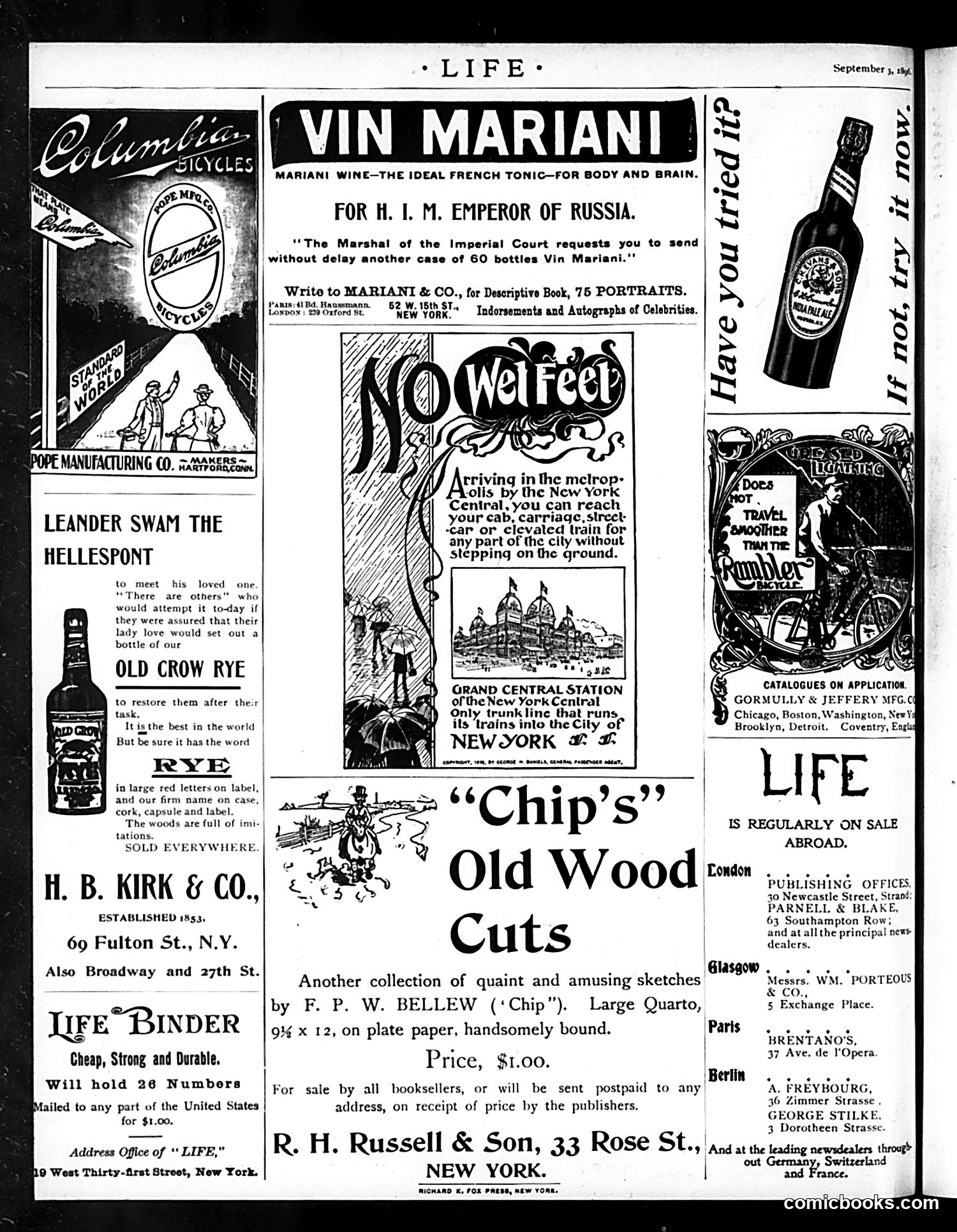
This page is primarily **advertising**, with one notable satirical advertisement: The **Vin Mariani wine ad** prominently claims the Russian Emperor ordered "another case of 60 bottles" through his Imperial Court Marshal. This is satirical flattery—a fake testimonial using the Tsar's supposed endorsement to market a French tonic wine as a luxury product for the elite. The page also advertises **Old Crow Rye whiskey** (referencing the classical myth of Leander swimming the Hellespont for his beloved), **bicycles**, a **Life Binder**, and other period products. The only actual cartoon is **"Chip's Old Wood Cuts"**—a book advertisement for sketches by F.P.W. Bellew. The small illustration shows a man on horseback, though its specific meaning is unclear from context. The bulk of the space serves commercial purposes typical of late 19th-century magazines, where advertising subsidized publication.