
Life, 1896-09-03 · page 4 of 18
Life — September 3, 1896 — page 4: what you’re looking at
What you’re looking at
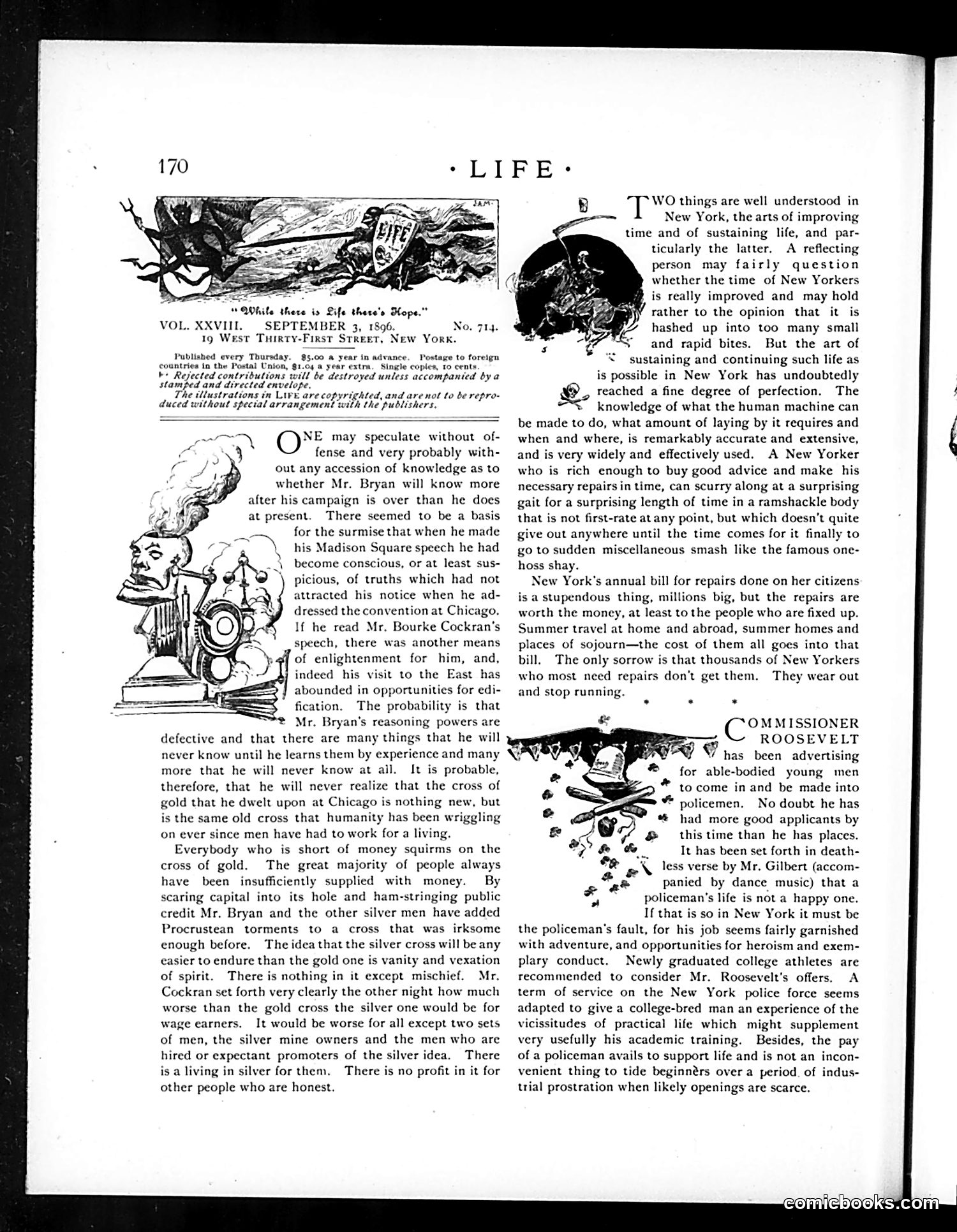
This page contains two satirical pieces about New York City life and politics from September 3, 1906. The left cartoon depicts **William Jennings Bryan**, the three-time presidential candidate, shown as an inflated figure spouting rhetoric. The text mocks his recent speech at the Democratic convention in Chicago, suggesting his "cross of gold" populist message about silver currency is outdated. The satire implies Bryan's reasoning is defective and that his ideological fixations (comparing them to both gold and silver monetary crosses) reveal his disconnect from practical reality. The right section discusses **Commissioner Roosevelt's** (likely Police Commissioner) recruitment of college athletes as policemen. The satire questions whether educated young men truly want police work, suggesting the job's low pay and adventure—rather than civic duty—motivates applicants, and doubting whether this addresses real policing needs.
📄 Transcribed text from this page (OCR, searchable)
Machine-transcribed from the original scan — historical spelling and the odd misread are preserved.
“While there is Life there's Hope.” VOL. XXVIIL. SEPTEME No. 714. 19 West Turrty-Firs Published every Thursday. $3.00 a year in advance. Postage to foreign countries in the Postal Union, $1.04 a year extra, Single coples, to cents b+ Rejected contributions will be destroyed unless accompanied bya stamped and directed envelope. The illustrations in Live are copyrighted, and are not to be repro- duced without special arrangement with the publishers. NE may speculate without of- fense and very probably with- out any accession of knowledge as to whether Mr. Bryan will know more after his campaign is over than he does at present. There seemed to be a basis for the surmise that when he made his Madison Square speech he had become conscious, or at least sus- picious, of truths which had not attracted his notice when he ad- dressed the convention at Chicago. If he read Mr. Bourke Cockran’s speech, there was another means of enlightenment for him, and, indeed his visit to the East has abounded in opportunities for edi- fication. The probability is that Mr. Bryan's reasoning powers are defective and that there are many things that he will never know until he ns them by experience and many more that he will never know at all, It is probable, therefore, that he will never realize that the cross of gold that he dwelt upon at Chicago is nothing new, but is the same old cross that humanity has been wriggling on ever since men have had to work for a living. Everybody who is short of money squirms on the cross of gold. The great majority of people always have been insufficiently supplied with money. By scaring capital into its hole and ham-stringing public credit Mr. Bryan and the other silver men have added Procrustean torments to a cross that was irksome enough before. The idea that the silver cross will be any easier to endure than the gold one is vanity and vexation of spirit. There is nothing in it except mischief. Mr. Cockran set forth very clearly the other night how much worse than the gold cross the silver one would be for earners. It would be worse for all except two sets of men, the silver mine owners and the men who are hired or expectant promoters of the silver idea. There is a living in silver for them. There is no profit in it for other people who are honest. WO things are well understood in New York, the arts of improving time and of sustaining life, and par- ticularly the latter. A reflecting person may fairly question whether the time of New Yorkers is really improved and may hold rather to the opinion that it is hashed up into too many small and rapid bites. But the art of sustaining and continuing such life as is possible in New York has undoubtedly &. reached a fine degree of perfection. The knowledge of what the human machine can be made to do, what amount of laying by it requires and when and where, is remarkably accurate and extensive, and is very widely and effectively used. A New Yorker who is rich enough to buy good advice and make his necessary repairs in time, can scurry along at a surprising gait for a surprising length of time in a ramshackle body that is not first-rate at any point, but which doesn’t quite give out anywhere until the time comes for it finally to go to sudden miscellaneous smash like the famous one- hoss shay. New York's annual bill for repairs done on her citizens is a stupendous thing, millions big, but the repairs are worth the money, at least to the people who are fixed up. Summer travel at home and abroad, summer homes and places of sojourn—the cost of them all goes into that bill. The only sorrow is that thousands of New Yorkers who most need repairs don’t get them. They wear out and stop running. . . OMMISSIONER ROOSEVELT y v has been advertising for able-bodied young men to come in and be made into * policemen. No doubt he has had more good applicants by this time than he has places. am It has been set forth in death- &e et less verse by Mr. Gilbert (accom- eae panied by dance music) that a ” policeman’s life is not a happy one. If that is so in New York it must be the policeman’s fault, for his job seems fairly garnished with adventure, and opportunities for heroism and exem- plary conduct. Newly graduated college athletes are recommended to consider Mr. Roosevelt's offers. A term of service on the New York police force seems adapted to give a college-bred man an experience of the vicissitudes of practical life which might supplement very usefully his academic training. Besides, the pay of a policeman avails to support life and is not an incon- venient thing to tide beginnérs over a period. of indus- trial prostration when likely openings are scarce.