
Life, 1896-09-03 · page 11 of 18
Life — September 3, 1896 — page 11: what you’re looking at
What you’re looking at
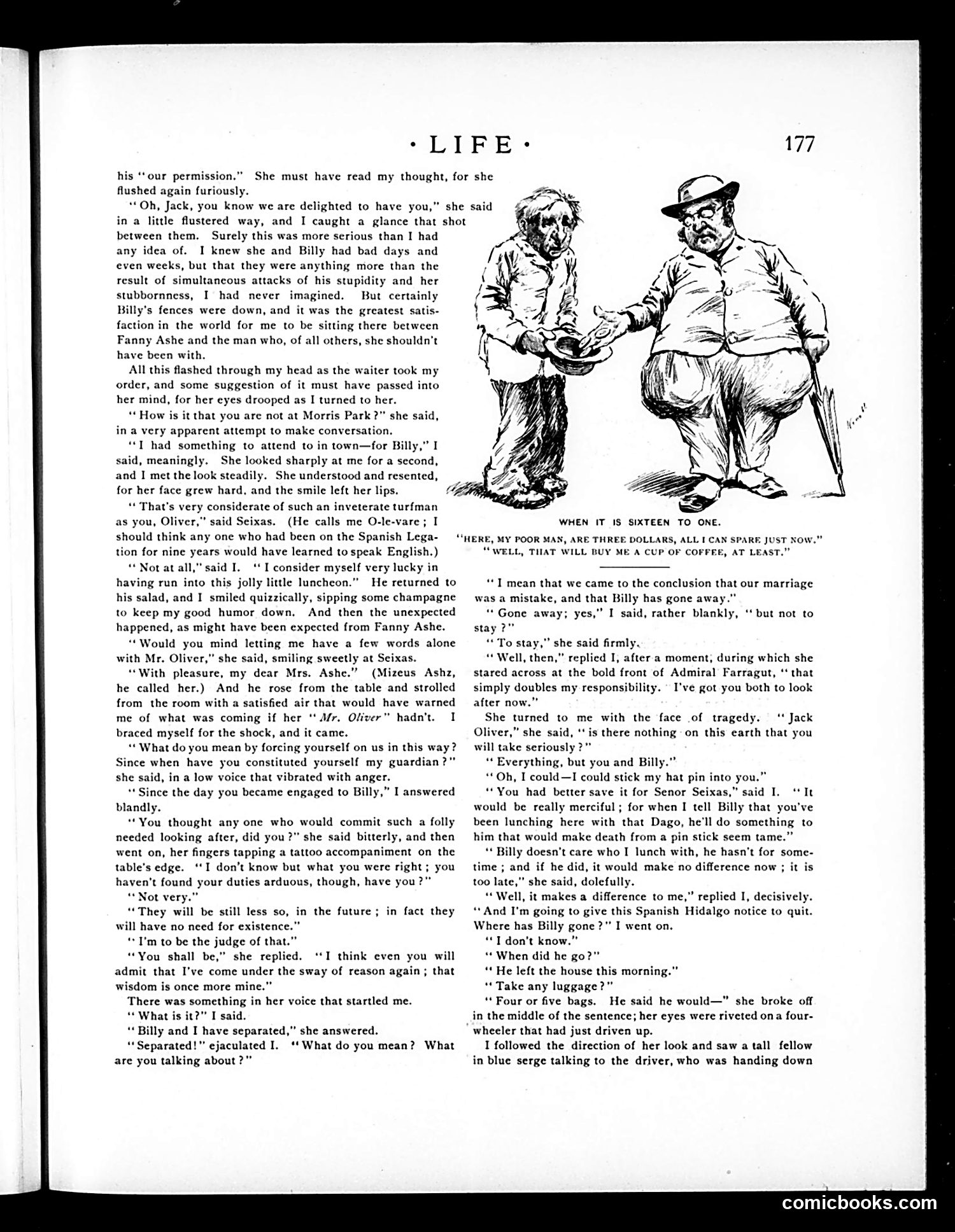
The illustration depicts two men in conversation, captioned "WHEN IT IS SIXTEEN TO ONE." The cartoon satirizes economic disparity and class conflict during the late 19th century—likely referencing the "free silver" debate of the 1890s, when "sixteen to one" was the proposed ratio of silver to gold for currency coinage. The well-dressed, portly figure (right) appears to represent wealthy interests or the gold standard establishment, while the gaunt, poorly-dressed figure (left) represents the working class or silver advocates. Their physical contrast emphasizes economic inequality. The accompanying dialogue concerns a marriage dissolution, using domestic conflict as metaphor for larger social/political divisions between rich and poor, or between competing economic systems. The humor relies on readers' familiarity with contemporary currency debates.
📄 Transcribed text from this page (OCR, searchable)
Machine-transcribed from the original scan — historical spelling and the odd misread are preserved.
*LIFE: his “our permission.” flushed again furiously. “Oh, Jack, you know we are delighted to have you, in a little flustered way, and I caught a glance that shot between them. Surely this was more serious than I had any idea of. I knew she and Billy had bad days and even weeks, but that they were anything more than the result of simultancous attacks of his stupidity and her stubbornness, I had never imagined. But certainly Billy's fences were down, and it was the greatest satis- faction in the world for me to be sitting there between Fanny Ashe and the man who, of all others, she shouldn't have been with. All this flashed through my head as the waiter took my order, and some suggestion of it must have passed into her mind, for her eyes drooped as I turned to her. “* How is it that you are not at Morris Park?” she said, in a very apparent attempt to make conversation. “IT had something to attend to in town—for Billy,” I said, meaningly. She looked sharply at me for a second, and I met the look steadily. She understood and resented, for her face grew hard, and the smile left her lips. ‘That's very considerate of such an inveterate turfman as you, Oliver,” said Seixas. (He calls me O-le-vare ; I should think any one who had been on the Spanish Lega- tion for nine years would have learned to speak English.) “Not at all," said I.“ I consider myself very lucky in having run into this jolly little luncheon.” He returned to his salad, and I smiled quizzically, sipping some champagne to keep my good humor down, And then the unexpected happened, as might have been expected from Fanny Ashe. “Would you mind letting me have a few words alone with Mr. Oliver,” she said, smiling sweetly at Scixas. “With pleasure, my dear Mrs. Ashe.” (Mizeus Ashz, he called her.) And he rose from the table and strolled from the room with a satisfied air that would have warned me of what was coming if her ‘* M/r. Oliver” hadn't. 1 braced myself for the shock, and it came. “+ What do you mean by forcing yourself on us in this way? Since when have you constituted yourself my guardian?” she said, in a low voice that vibrated with anger. “Since the day you became engaged to Billy,” I answered blandly. “You thought any one who would commit such a folly needed looking after, did you?" she said bitterly, and then went on, her fingers tapping a tattoo accompaniment on the table's edge. ‘‘I don’t know but what you were right; you haven't found your duties arduous, though, have you?” “Not very.” “They will be still less so, in the future; in fact they will have no need for existence." ‘I'm to be the judge of that. “You shall be,” she replied. ‘‘I think even you will admit that I’ve come under the sway of reason again ; that wisdom is once more mine.” There was something in her voice that startled me. ‘What is it?” I said. “Billy and I have separated eparated!" ejaculated I. are you talking about ?” she answered. “What do you mean? What “HERE, MY POOR MAN, ARE THREE DOLLARS, ALL I She must have read my thought, for she she said WHEN IT IS SIXTEEN TO ONE. S SPARE JUST Now.” “WELL, THAT WILL BUY ME A CUP OF COF! AT LEAST.” “*T mean that we came to the conclusion that our marriage was a mistake, and that Billy has gone away.” “Gone away; yes,” I said, rather blankly, ‘but not to stay?” “To stay,” she said firmly. “Well, then,” replied I, after. a moment, during which she stared across at the bold front of Admiral Farragut, ‘‘ that simply doubles my responsibility. © I've got you both to look after now.” She turned to me with the face of tragedy. ‘‘ Jack Oliver,” she said, ‘‘is there nothing on this earth that you will take seriously ? “ Everything, but you and Billy.” “Oh, I could—I could stick my hat pin into you.” ‘*You had better save it for Senor Seixas,” said I. ‘* It would be really merciful; for when I tell Billy that you've been lunching here with that Dago, he'll do something to him that would make death from a pin stick seem tame.” ‘ Billy doesn’t care who I lunch with, he hasn't for some- time ; and if he did, it would make no difference now ; it is too late,” she said, dolefully. “Well, it makes a difference to me,” replied I, decisively. “And I'm going to give this Spanish Hidalgo notice to quit. Where has Billy gone?" I went on. “*T don't know.” “When did he go?” “ He left the house this morning.” “Take any luggage?” ‘Four or five bags. He said he would—” she broke off in the middle of the sentence; her eyes were riveted ona four- wheeler that had just driven up. I followed the direction of her look and saw a tall fellow in blue serge talking to the driver, who was handing down comicbooks.com