
A complete issue · 20 pages · 1896
Life — August 20, 1896
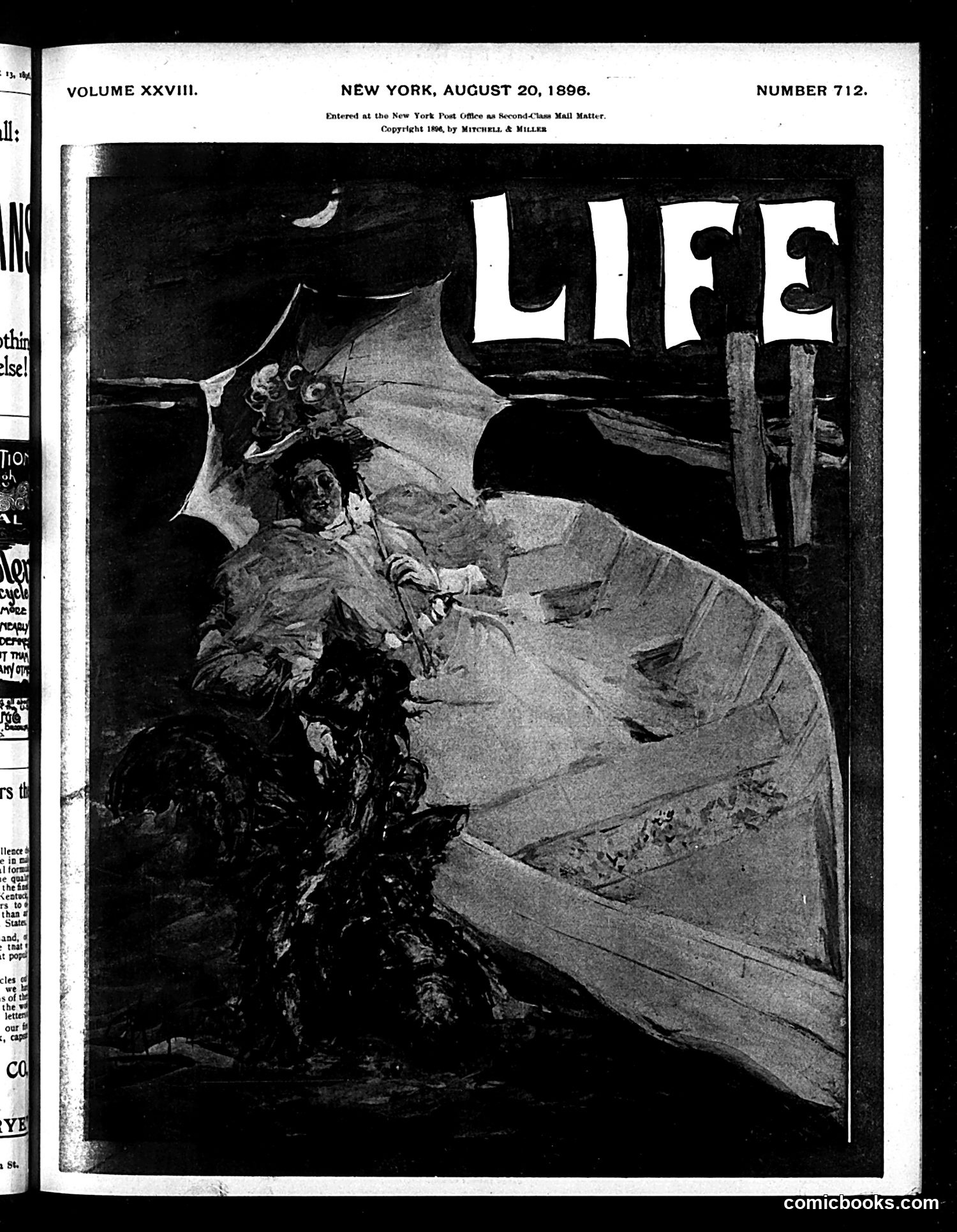
This cover depicts a figure in bed appearing ill or distressed, holding an umbrella indoors—an absurd juxtaposition. The imagery suggests someone is literally trying to shield themselves from something unpleasant. Without clearer text identifying the specific figure or event, the exact political reference remains unclear. However, given Life's satirical nature in 1896, this likely comments on a contemporary political or social figure attempting to avoid scrutiny or criticism (the "rain" being negative attention). The umbrella as defensive measure is the visual joke—the futility of protecting oneself from inevitable criticism or consequences. The specific identity of who or what is being satirized cannot be determined from the image alone.
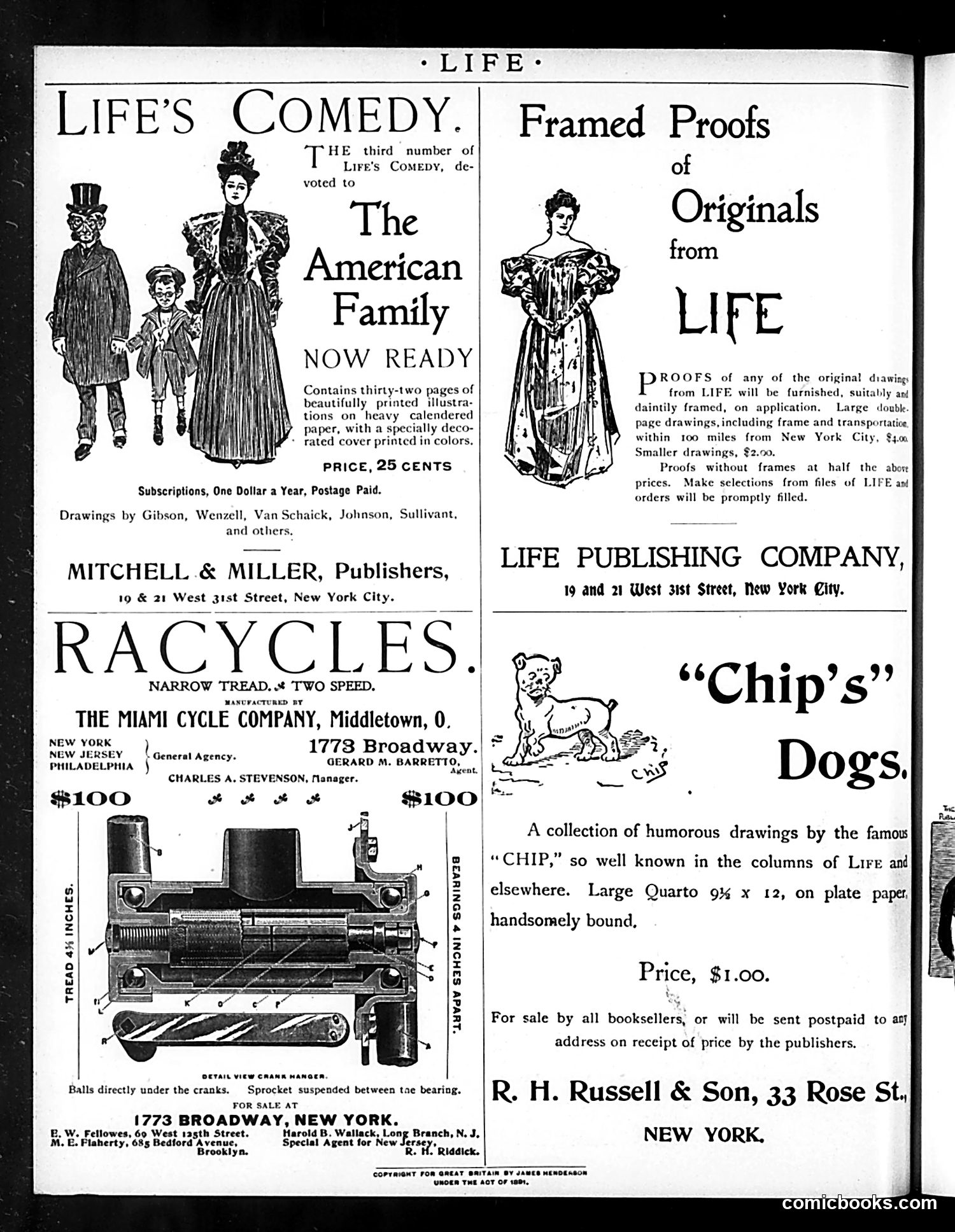
This page is primarily **advertising rather than editorial content**. It contains four advertisements: 1. **Life's Comedy** — promoting the third installment of a serialized comic collection titled "The American Family," featuring drawings by Gibson, Wenzel, Van Schaick, and others. Priced at 25 cents. 2. **Framed Proofs** — offering original artwork from Life magazine, available framed or unframed at various prices ($2-$4). 3. **Racycles** — advertising narrow-tread, two-speed bicycles manufactured by Miami Cycle Company. 4. **"Chip's" Dogs** — a $1 collection of humorous dog drawings by the cartoonist "Chip," popular in Life's columns. The page reflects early 1900s advertising targeting middle-class consumers interested in humor, home décor, and leisure activities.
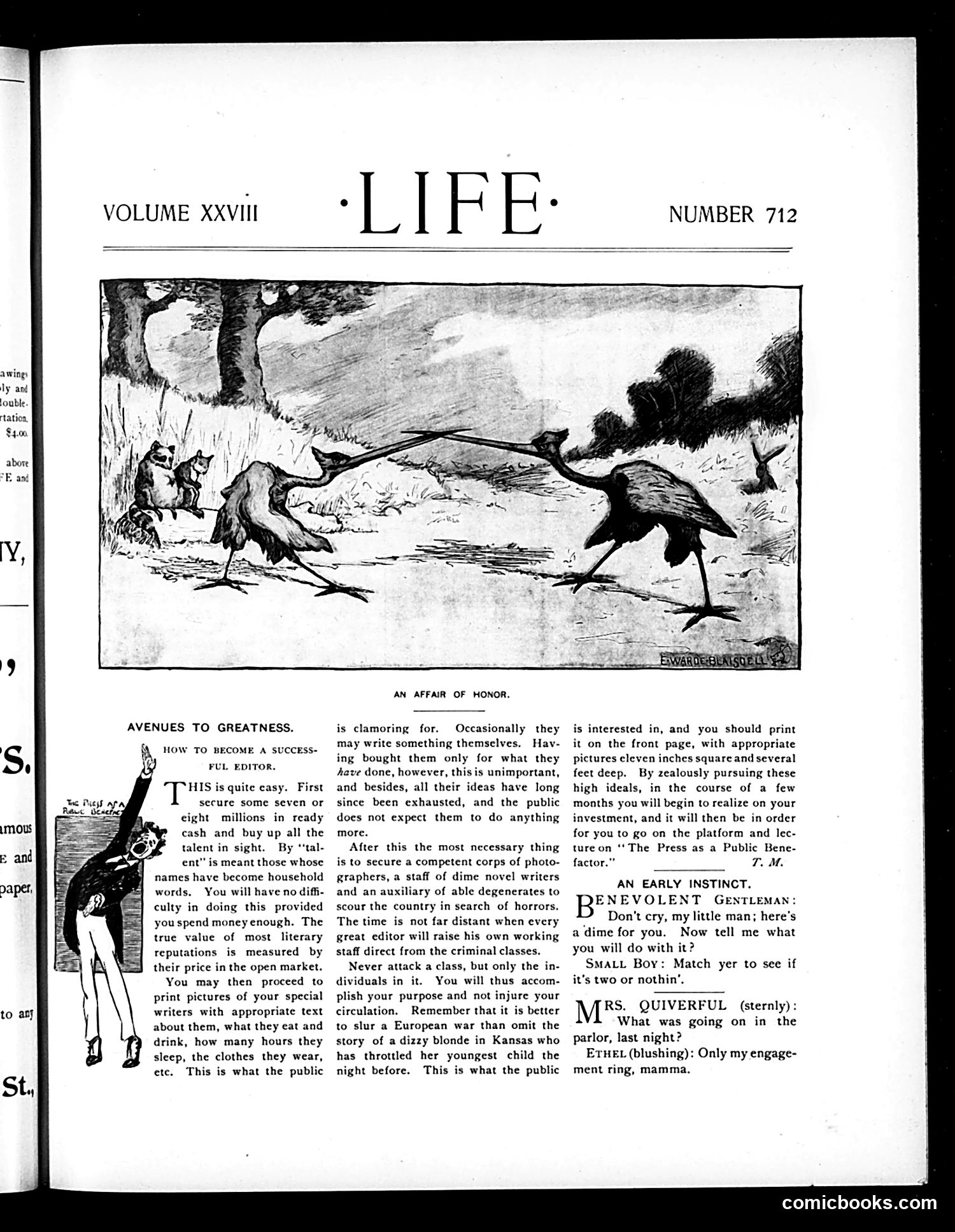
**Main Cartoon ("An Affair of Honor"):** The illustration depicts two anthropomorphized birds engaged in what appears to be a duel or confrontation, with smaller figures (possibly observers or seconds) in the background. The title "An Affair of Honor" suggests this is satirizing a formal duel—likely mocking the concept of settling disputes through ritualized combat. The birds' exaggerated postures and the formal staging parody the outdated tradition of gentlemanly honor duels. **Text Content:** The page includes editorial advice about becoming a successful writer, emphasizing that talent and literary connections matter more than formal credentials. Below are humorous dialogue snippets labeled "An Early Instinct," presenting comedic exchanges between characters. The overall page combines visual satire with practical editorial commentary, typical of Life's early 20th-century approach to entertainment and social commentary.
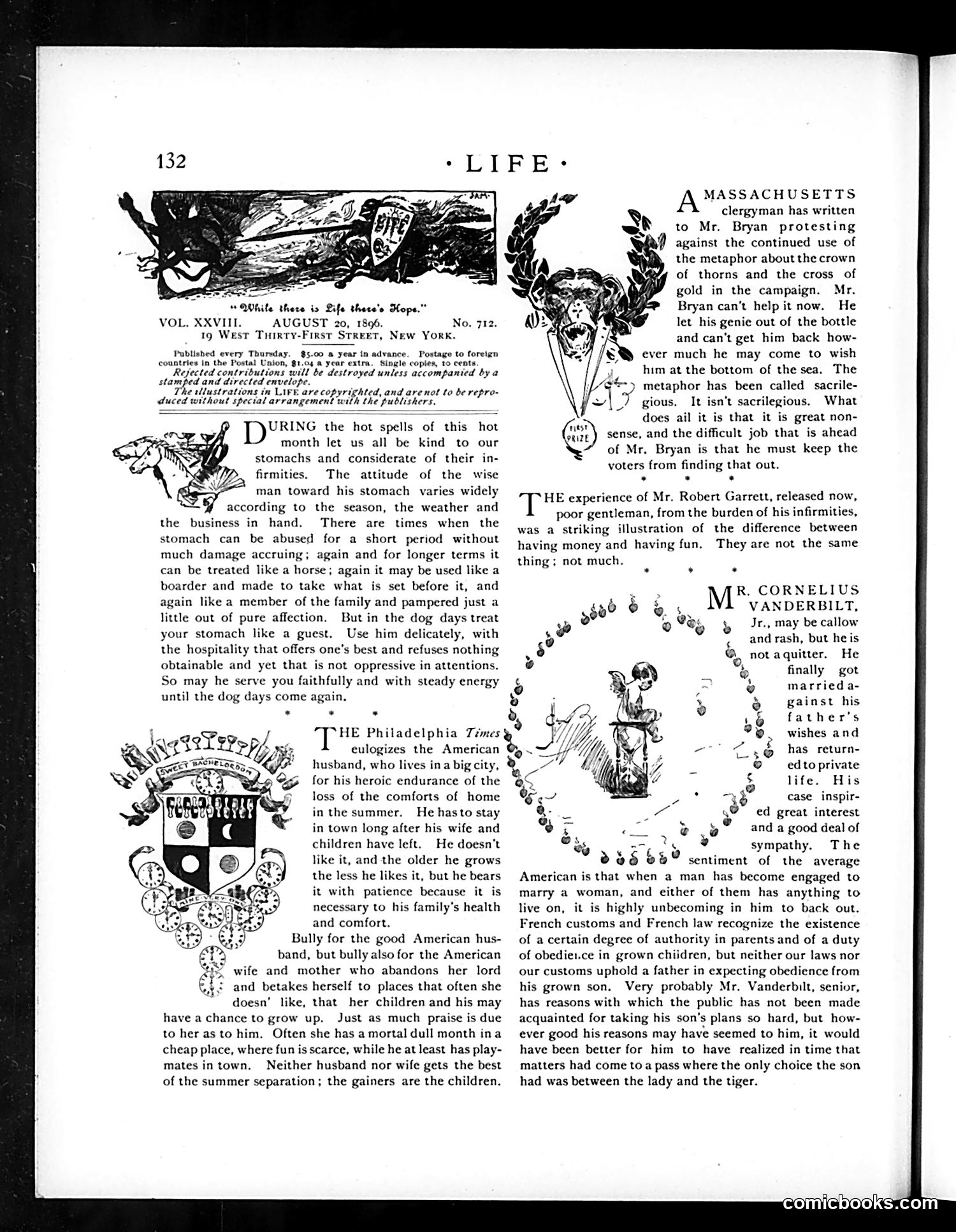
This page contains three distinct editorial pieces rather than political cartoons: 1. **The opening section** discusses summer stomach care—treating one's digestive system with delicacy during hot weather, using a metaphor of hospitality to a guest. 2. **A Massachusetts clergyman's letter** protests against William Jennings Bryan's use of the "crown of thorns and cross of gold" metaphor in his campaign, calling it sacrilegious. The text defends Bryan, arguing the metaphor is merely apt, not irreverent. 3. **Commentary on Robert Garrett and Cornelius Vanderbilt Jr.** discusses marriage and family authority—specifically how American customs differ from French law regarding paternal authority over adult children. The page is primarily textual commentary on contemporary social and political issues rather than visual satire.
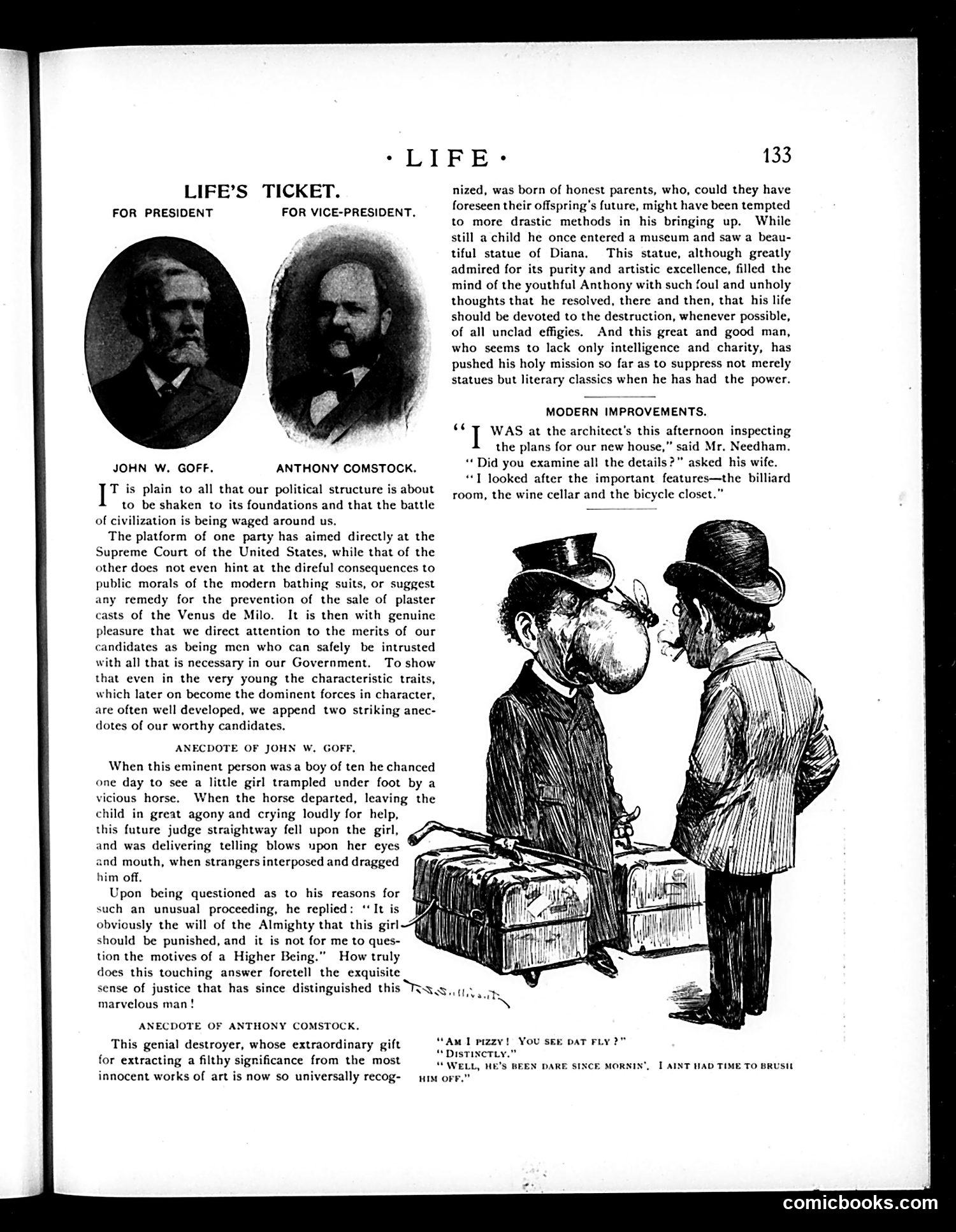
This page contains political satire about the 1880 presidential election. The top section presents "Life's Ticket" featuring photographs of John W. Goff (for President) and Anthony Comstock (for Vice President), accompanied by anecdotes praising their character. The satirical intent is unclear from the text alone, but Life magazine used mock endorsements to ridicule candidates or public figures. Comstock was a real anti-vice crusader known for aggressive moral campaigns; the anecdote about him destroying art suggests Life mocked his zealotry. The lower cartoon depicts two men examining luggage, with dialogue about a fly. The connection to the election ticket above is unclear, though it may relate to character themes the anecdotes establish.
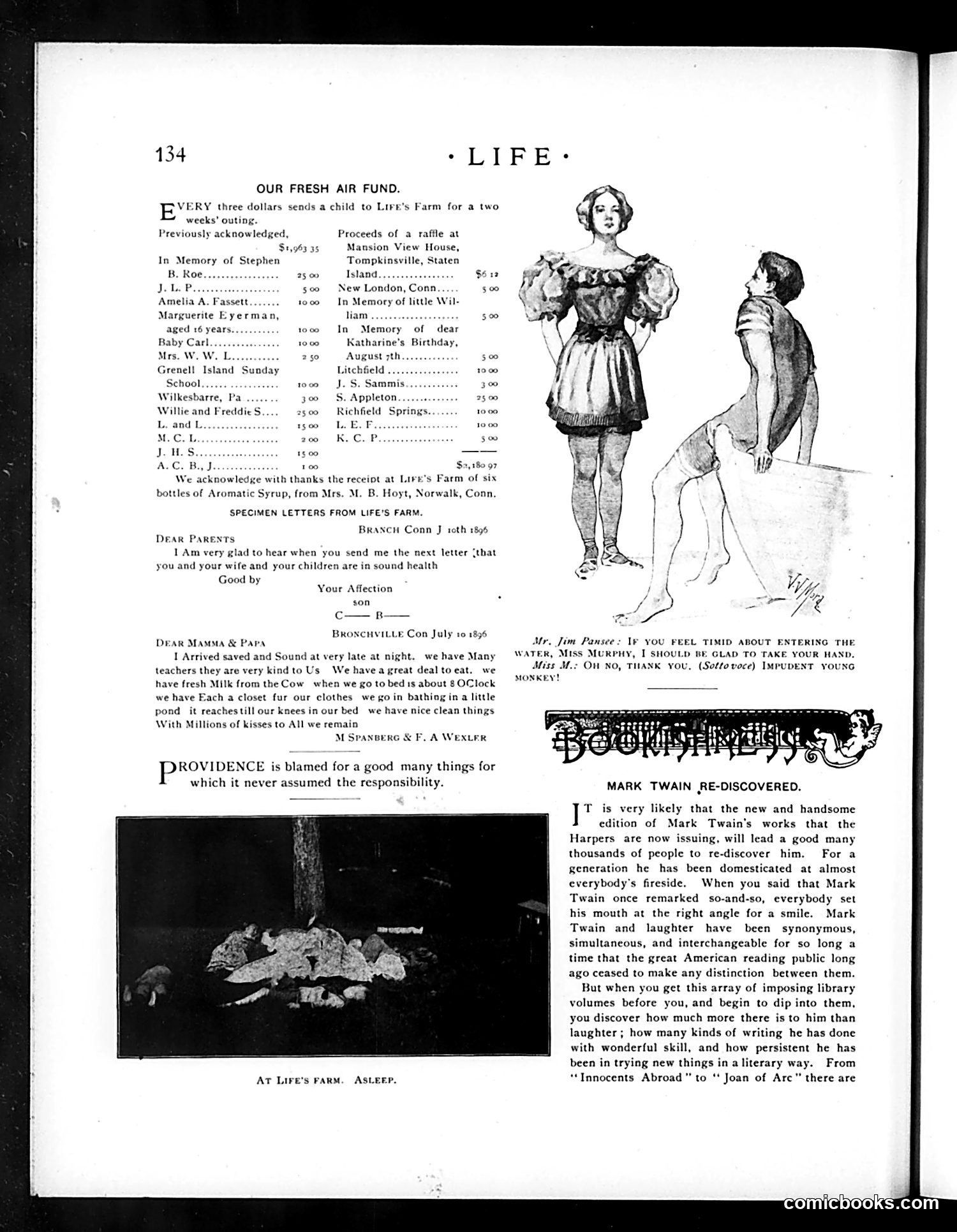
This page contains two main elements: **Upper Section:** "Our Fresh Air Fund" lists donations for sending children to Life's Farm for outings. It's a charitable fundraising column with individual and group contributions, featuring specimen letters from the farm describing children's experiences. **Lower Section:** An article titled "Mark Twain Re-discovered" discusses a new Harpers edition of Mark Twain's complete works. The piece argues that Twain deserves rediscovery beyond his reputation as a humorist—suggesting his literary works contain deeper complexity and social commentary than the public typically recognized. The article encourages readers to explore beyond his best-known humorous reputation. The page reflects turn-of-the-century American philanthropic interests and literary criticism, with no apparent political satire.
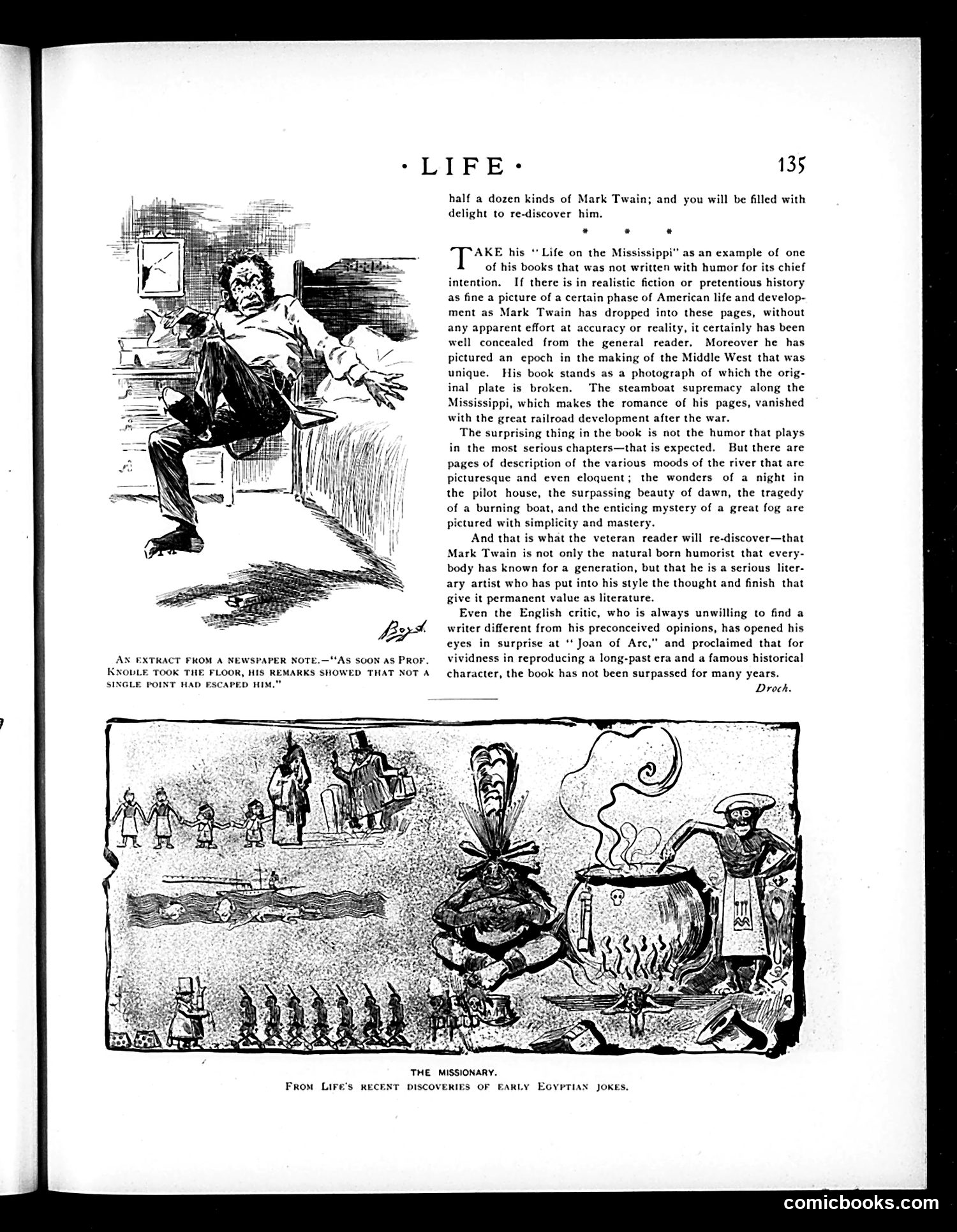
This page discusses **Mark Twain's literary merit**, arguing that his "Life on the Mississippi" deserves serious critical recognition despite his reputation as a humorist. The text defends Twain as a genuine literary artist whose work captures a vanishing historical era—the steamboat age on the Mississippi River—with both accuracy and eloquence. The upper illustration shows a caricatured figure (likely Twain) at his desk, emphasizing his role as writer. The lower cartoon, titled "The Missionary" and subtitled "From Life's Recent Discoveries of Early Egyptian Jokes," appears to be unrelated satirical content about ancient Egypt, possibly mocking pseudoscientific claims or archaeological pretensions popular at the time. The page advocates elevating Twain from "mere humorist" to serious artist—a notable critical reassessment for its era.
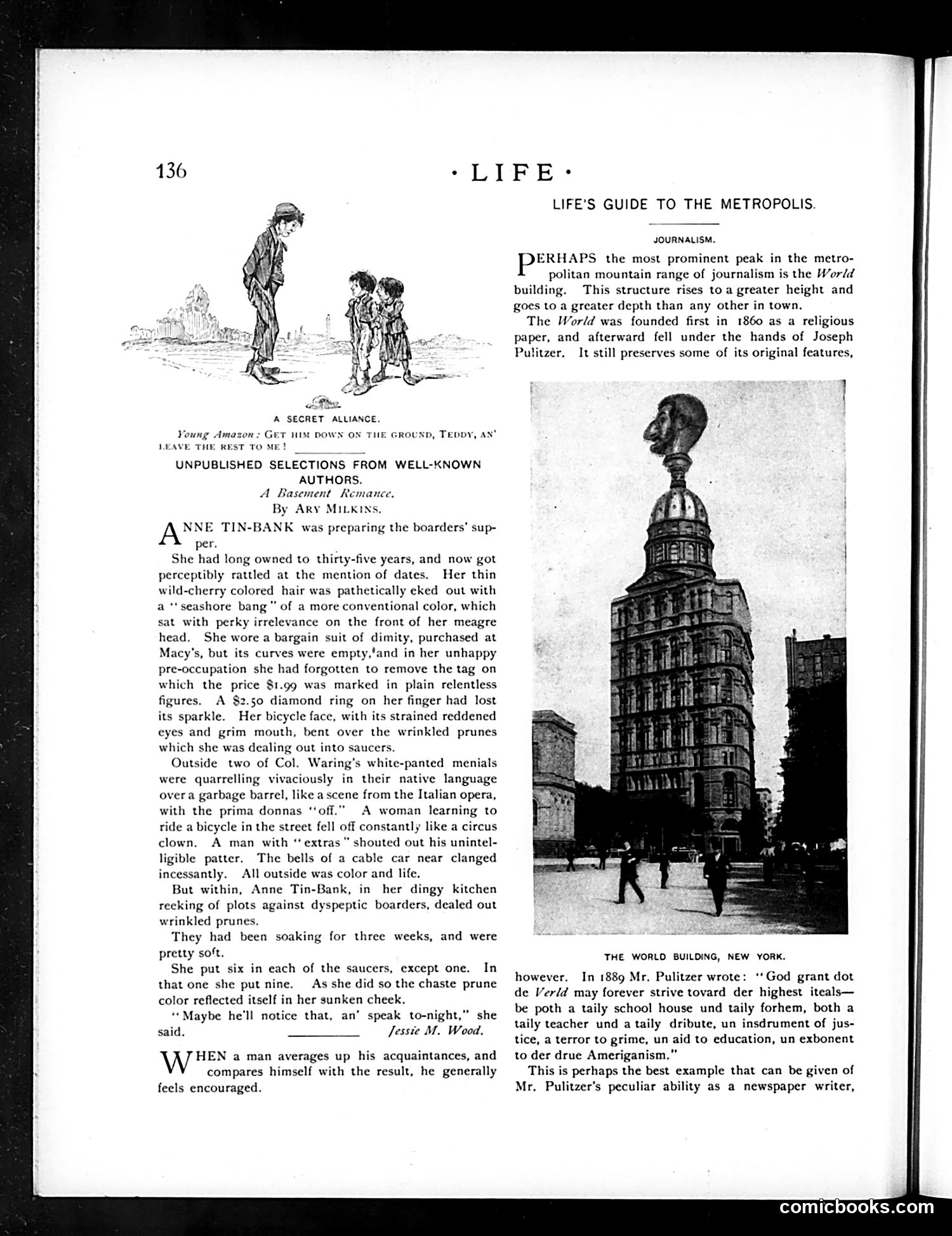
This page combines literary content with architectural journalism rather than political satire. The top illustration ("A Secret Alliance") depicts two young children conspiring, captioned with a humorous quote about leaving "the rest to me." The main content includes a story excerpt by Amy Milkins titled "A Basement Romance," describing the mundane life of Anne Tin-Bank, a boarding house keeper dealing with petty indignities—lost ring sparkle, price tags left on clothing, poorly cooked prunes. The photograph shows the World Building in New York, accompanying journalism about Joseph Pulitzer's newspaper headquarters. The text discusses Pulitzer's vision for the World as an instrument of justice and education, quoting his 1883 statement about the paper's idealistic mission. This page prioritizes literary and architectural content over satire.
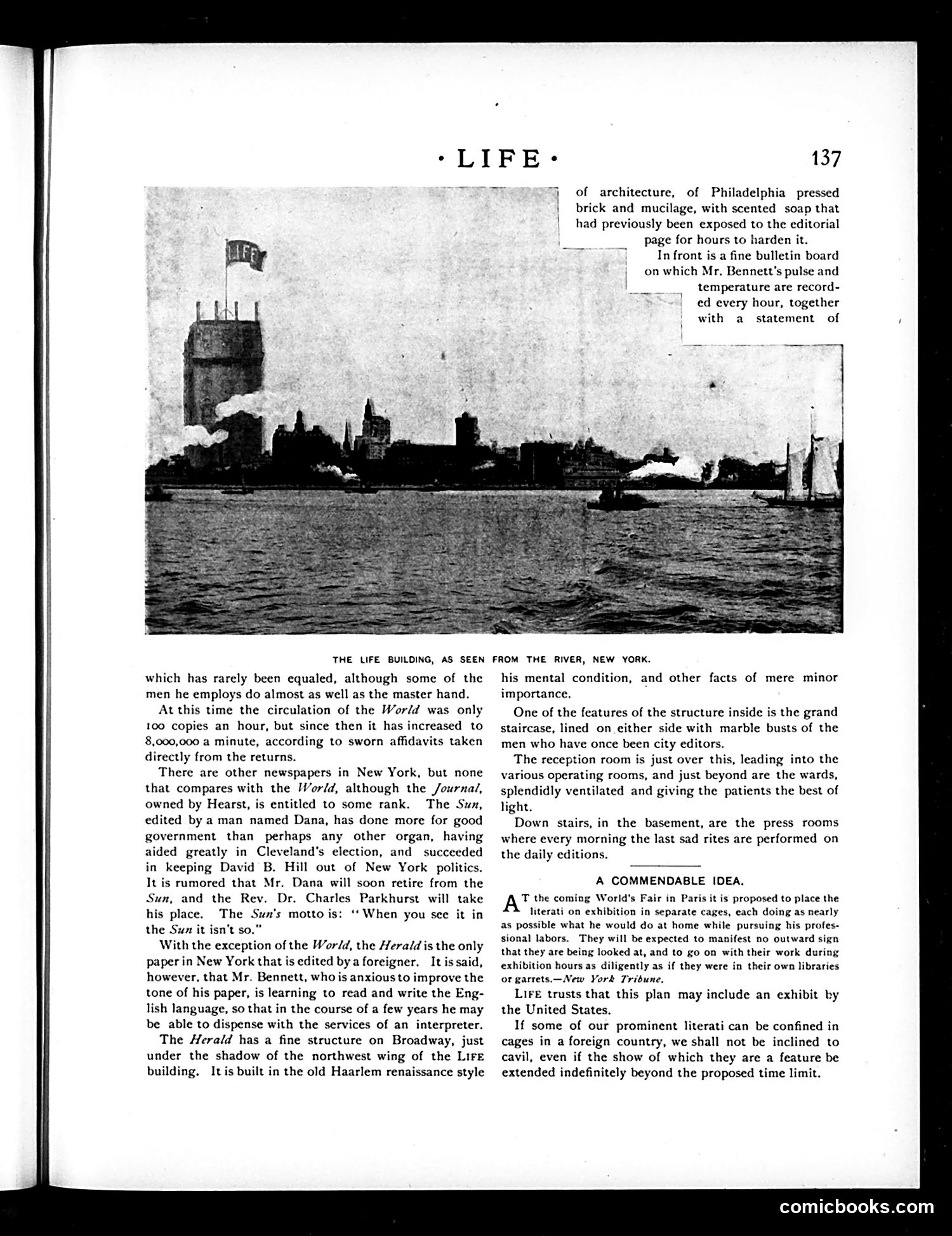
This page is primarily **text commentary** rather than a cartoon. The main image shows the Life Building in New York photographed from the river. The text discusses the **World newspaper's circulation and influence**, comparing it favorably to other New York papers like the Herald and Sun. It mentions that Mr. Bennett (likely the newspaper's owner) is learning English to improve the publication's language quality. There's a brief editorial note titled "A Commendable Idea" proposing that American literati be exhibited separately at Paris's World's Fair, allowing them to work without distraction—a mild satirical jab at the exhibition concept and American cultural representation abroad. The page lacks significant political satire; it's primarily a **house advertisement and editorial commentary** on contemporary journalism and cultural matters.
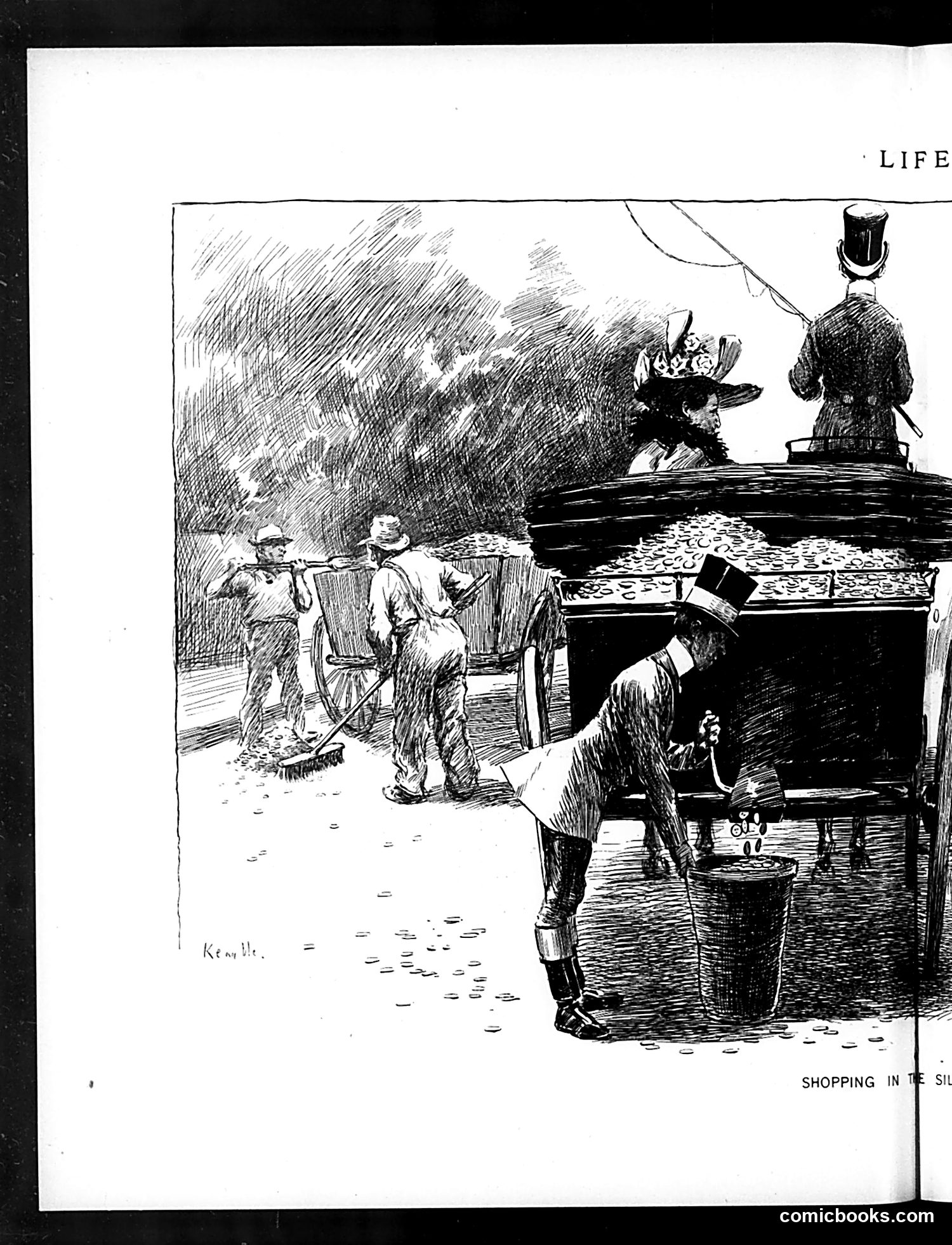
This satirical cartoon depicts wealthy, well-dressed figures (appearing to be upper-class society members or nobility, based on their top hats and formal attire) conducting what appears to be a tour or shopping expedition through a poor urban neighborhood. The contrast between their elegant dress and the ramshackle surroundings—suggested by the roughly-sketched buildings and modest structures—forms the satire's core. The title suggests wealthy people "shopping" or sightseeing in slum areas, likely mocking either aristocratic slumming (a real Victorian-era phenomenon where wealthy people visited poor neighborhoods as entertainment) or commenting on exploitation and poverty. The figures' detached, touristic poses emphasize the satirical point about class indifference to urban poverty.
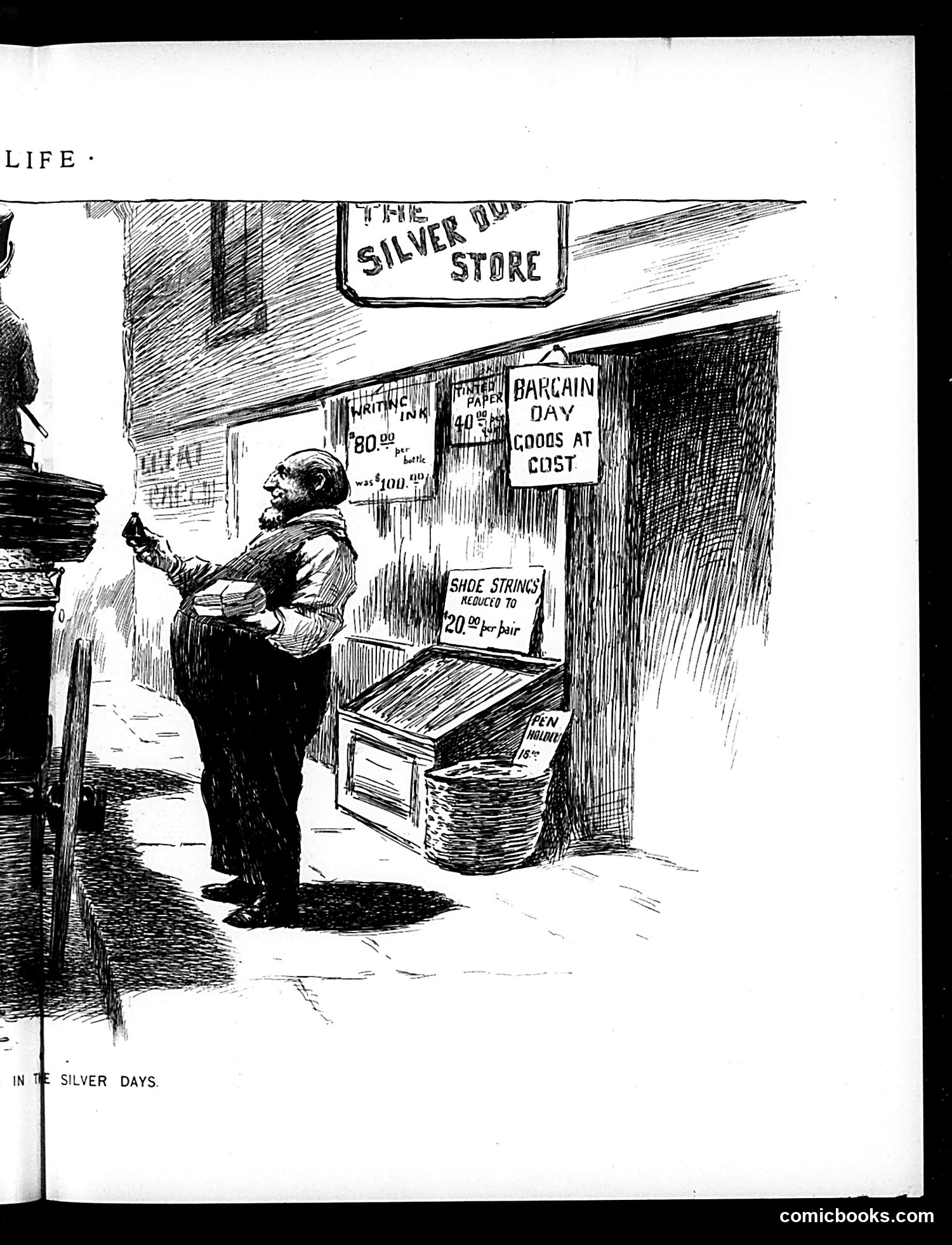
This cartoon satirizes discount retail during economically difficult times. A man examines bargain signs at "The Silver Dome Store," which advertises severely reduced prices: "Bargain Paper 40¢ lb" (originally higher), "Shoe Strings Reduced to 20¢ per pair," and "Pen Points" at reduced cost. The title "In the Silver Days" appears ironic—suggesting a period of prosperity or value, when actually the cartoon depicts a era of such financial hardship that customers seek the cheapest possible goods, even shoe strings. The exaggerated attention to penny-pinching reflects broader economic struggle, likely from the late 19th or early 20th century when Life magazine published such social commentary through humor.
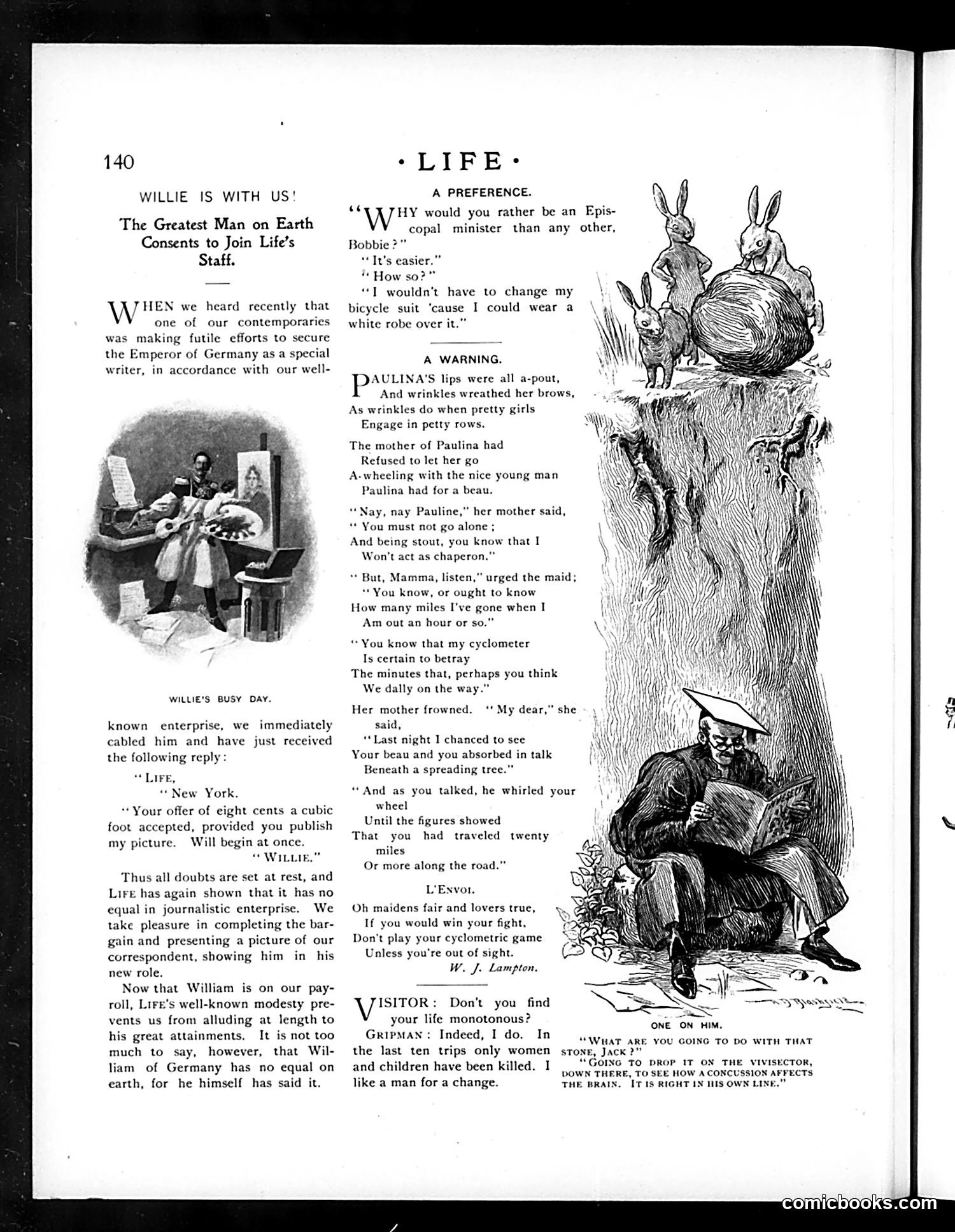
This page contains satirical commentary on Kaiser Wilhelm II of Germany, then emperor during World War I. **"Willie Is With Us"** is the main joke: *Life* magazine claims to have hired Kaiser Wilhelm as a correspondent for "eight cents a cubic foot"—a deliberately absurd rate. The satirical point mocks both Wilhelm's ego (he supposedly accepts, boasting "he himself has said" he has no equal on earth) and the magazine's tongue-in-cheek claim to journalistic reach. The accompanying illustration labeled "Willie's Busy Day" shows the Kaiser at work, reinforcing the conceit. The other content on the page—brief humorous pieces about an Episcopal minister, a girl's bicycle courtship, and a grimy worker—appears unrelated filler typical of *Life*'s format. The satire assumes readers recognize "Willie" as Wilhelm II and understand the joke relies on his notorious self-aggrandizement. The hostile tone reflects American wartime sentiment toward Germany.
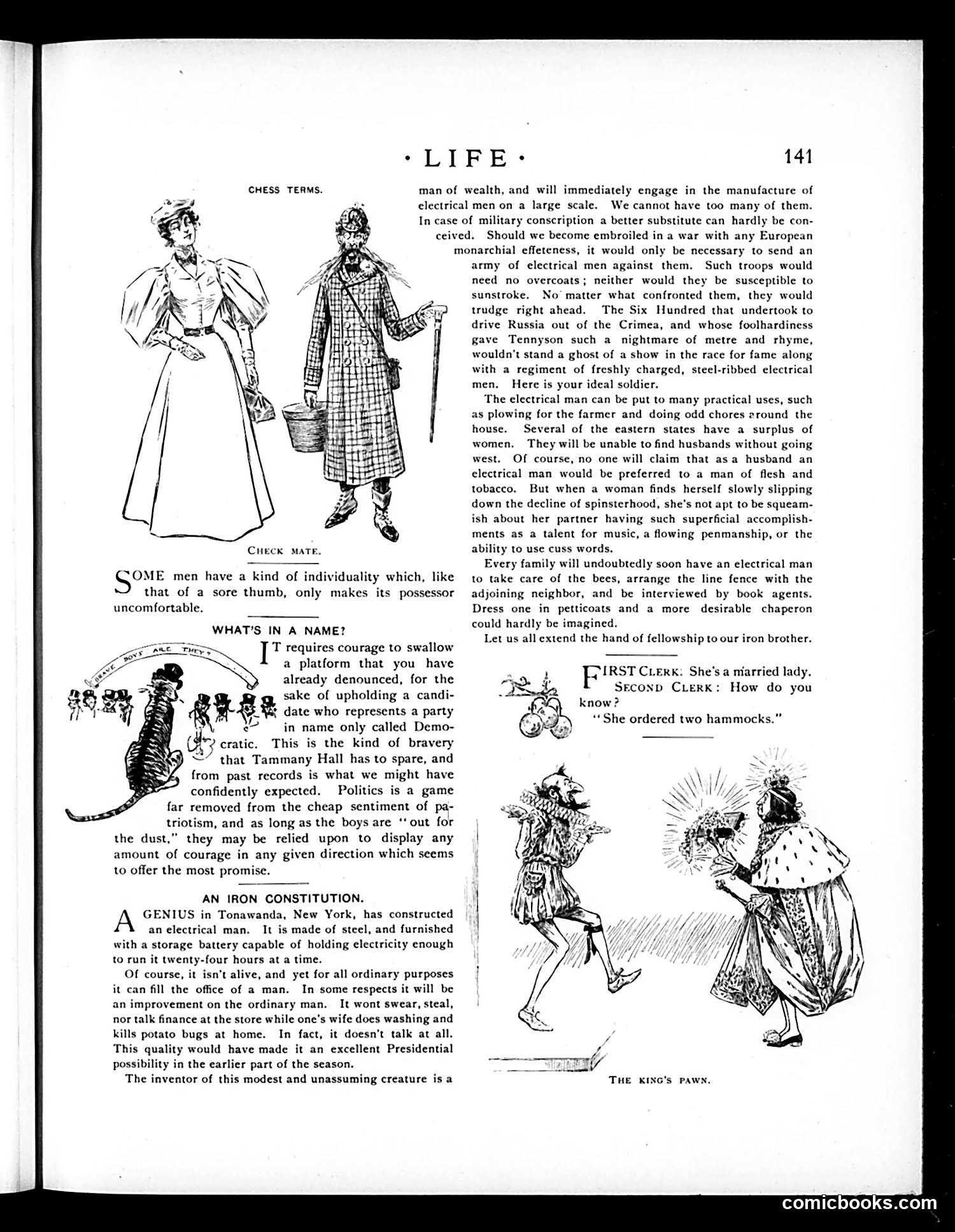
This satirical piece mocks the recent invention of an "electrical man" (an early automaton/robot) constructed in Tonawanda, New York. The satire operates on multiple levels: **The Main Joke**: The electrical man is presented as superior to actual humans—it won't steal, swear, complain about finances, or talk. This quality, the author quips, would have made it "an excellent Presidential possibility in the earlier part of the season," mocking contemporary politicians as inferior to a mechanical dummy. **Political Target**: "Tammany Hall," New York's notoriously corrupt Democratic machine, is criticized for political expediency—supporting candidates who don't match their party's stated values, sacrificing principle for power ("out for the dust"). **Social Commentary**: The piece humorously suggests practical uses: replacing soldiers (referencing the Crimean War), helping farmers, and solving the "surplus of women" problem in eastern states by providing husbands—though admittedly inferior ones. **The Chess Cartoons**: These illustrate "chess terms" (checkmate) as visual puns separate from the main text. The overall satire critiques both mechanization and political corruption through absurdist humor.
This page features a humorous frontier anecdote rather than a political cartoon. The story depicts a darkly comic encounter between a stranger and Jim Taylor, boss of a logging camp, regarding a lynching. The joke hinges on frontier justice and casual violence: the stranger inquires about a man hanged in June, and Jim cheerfully describes executing someone for theft. The punchline reveals the hanged man was the stranger's brother—yet the stranger accepts this with remarkable equanimity, even sharing a drink and acknowledging the execution was justified ("it had to be"). The satire targets frontier attitudes toward summary justice and the normalization of mob violence. The deadpan tone—Jim's matter-of-fact descriptions of hanging and the stranger's resigned acceptance—creates dark humor by contrasting civilized emotional responses with the brutal pragmatism of frontier life. The story likely aims to mock both frontier lawlessness and the stranger's implausible passivity about his brother's death. This appeared in *Life*, a satirical magazine, suggesting contemporary readers found these attitudes worth critiquing through humor.
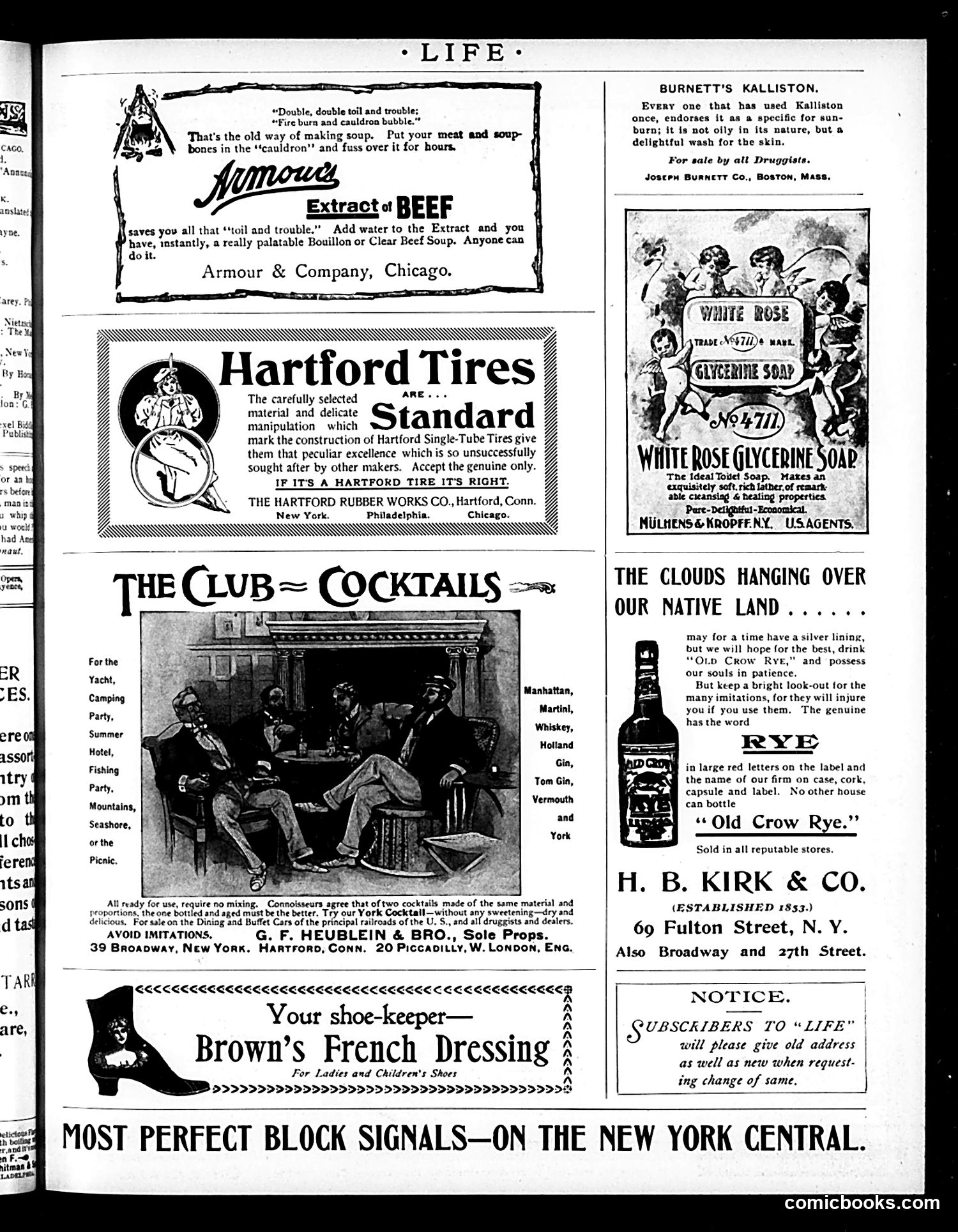
This is primarily an **advertising page** from Life magazine with no political cartoons or satirical content. The page features various product advertisements typical of the early 1900s, including: - **Armour's Extract of Beef** - A convenience product mocking the "old way" of making soup (referencing Shakespeare's witches from *Macbeth*: "double, double toil and trouble") - **Hartford Tires** - Promoting automobile tire quality - **Club Cocktails** - Pre-mixed bottled cocktails for social venues - **White Rose Glycerine Soap** - A toiletry product - **Old Crow Rye whiskey** - With vague reference to economic uncertainty ("clouds hanging over our native land") - **Brown's French Dressing** - For shoe care The advertisements reflect consumer culture and modern conveniences marketed to middle and upper-class readers. The Old Crow ad is the only piece with social commentary, obliquely referencing economic anxiety while promoting whiskey as a solace—though the specific historical "clouds" remain unclear from this page alone.
This page contains a humorous essay about imagination's power, illustrated by an anecdote about the famous violinist Paganini. An elderly woman attends his rehearsal expecting virtuosity but—unknown to her—Paganini plays without his violin, merely accompanying. She's amazed. When told he didn't actually play, she declares him *even more remarkable* for affecting her imagination so strongly. The piece satirizes human credulity and imagination's tendency to fill gaps. Following this are comic "campus elm advertisements"—fake notices college students allegedly posted selling furniture. These mock student exaggeration and desperation: a bookcase with "nervous prostration," a bed functioning "like a circus spring-board," and darkly humorous pitches ("Six callers killed already"). The satire targets student life's absurdities and commercialism. The remainder consists of period product advertisements (tobacco, medicinal water, china, bicycle lanterns), typical of Life magazine's mixed content format.
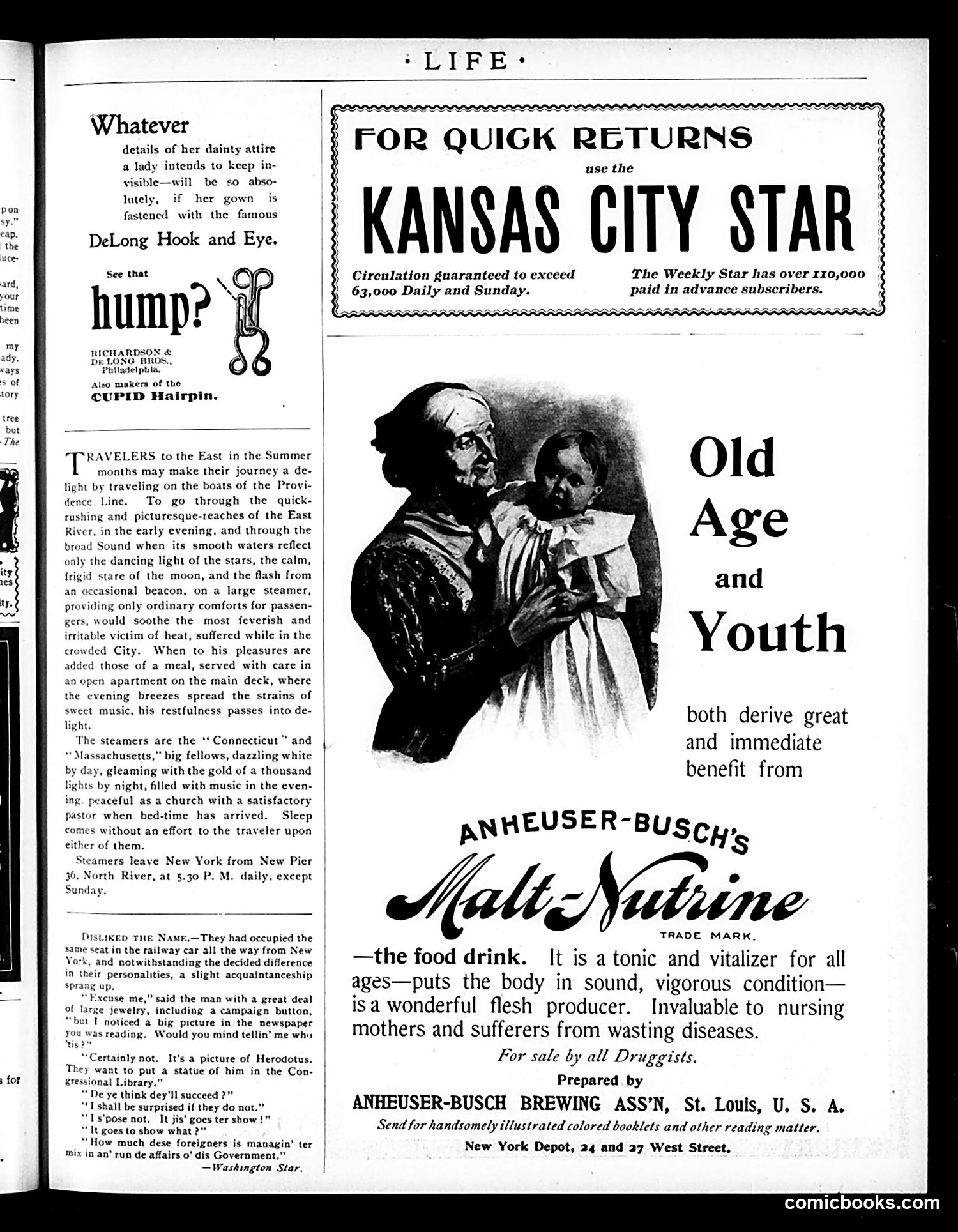
This page contains several distinct elements: **Main Cartoon ("Disliked the Name"):** A brief satirical dialogue mocking anti-immigrant sentiment. Two train passengers discuss a newspaper picture of Herodotus (ancient Greek historian). When told they plan to place his statue in the Congressional Library, the immigrant-coded character (indicated by dialect: "dey," "jis'") expresses suspicion that foreigners are "managin' ter mix in an' run de affairs o' dis Government." The satire targets xenophobic assumptions—the irony being that Herodotus is ancient history, yet the character reflexively blames "foreigners" for government involvement. **Advertisements:** The bulk of the page promotes consumer products (DeLong Hook and Eye fasteners, steamship travel, Anheuser-Busch's "Malt Nutrine" tonic) and the Kansas City Star newspaper. The Anheuser-Busch ad notably markets their malt drink as medicinal—"tonic and vitalizer"—reflecting pre-Prohibition-era marketing of alcohol as health products. The page blends satire with commercial content typical of early 20th-century Life magazine.
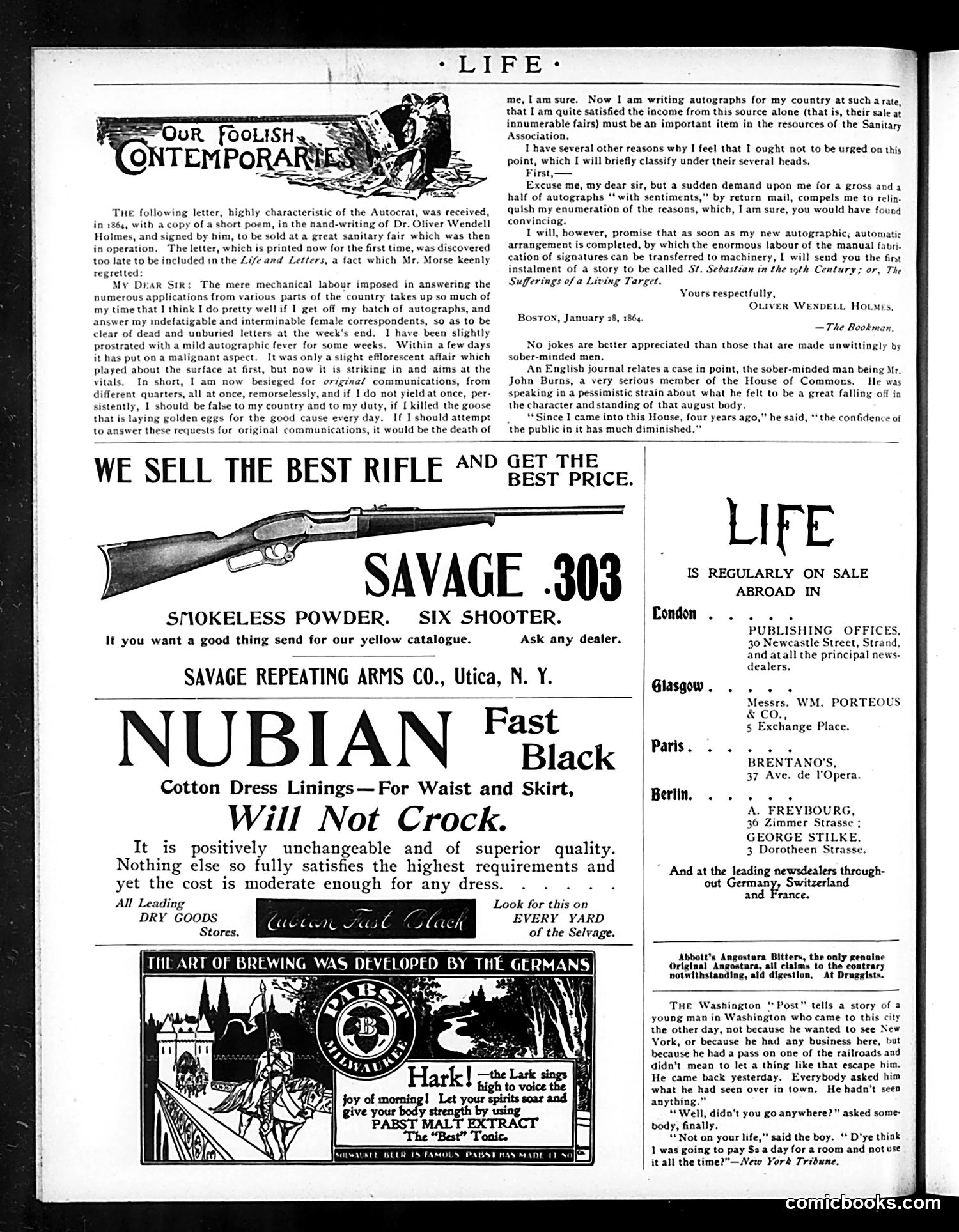
This page from *Life* (dated January 28, 1864) features primarily **literary content and advertisements** rather than political cartoons. The main content is a humorous letter from **Oliver Wendell Holmes**, the famous American writer and physician, complaining about demands for his autograph. Holmes jokes that he suffers from "autographic fever" and is besieged by requests for signed materials—many from women correspondents seeking autographs "with sentiments" for charitable fundraising (specifically the Sanitary Commission, a Civil War relief organization). He facetiously proposes inventing an "automatic arrangement" to transfer signature-writing to machinery, promising a satirical story called "St. Sebastian in the 20th Century; or, The Sufferings of a Living Target" once completed. Below this is a brief anecdote about British politician **John Burns**, humorously noting his complaint that public confidence in Parliament has declined—an unintentional joke since his pessimism itself demonstrates the problem. The page also contains period advertisements for a Savage rifle, Nubian cotton dress linings, and Pabst malt extract.
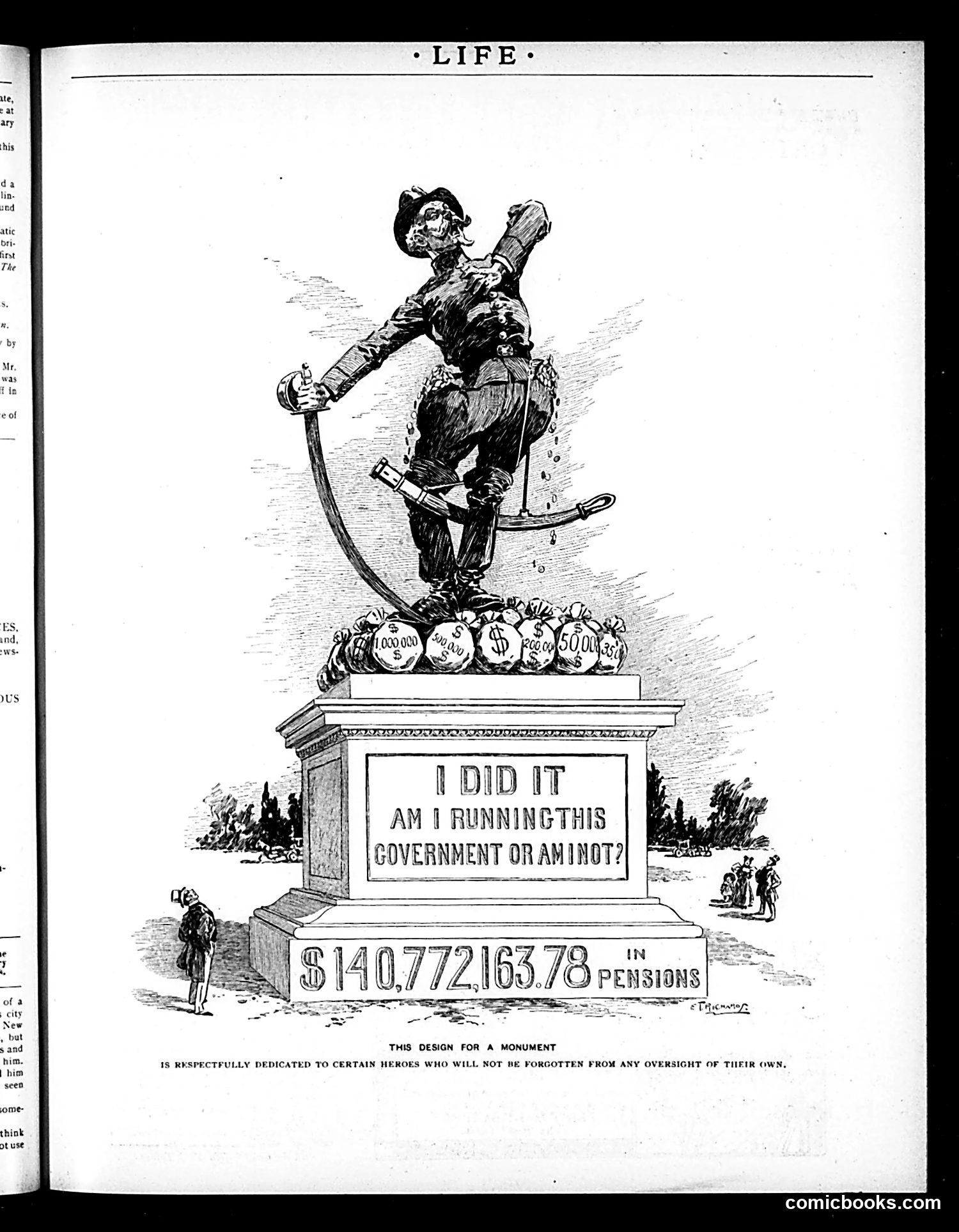
This Life magazine satirical cartoon depicts a military or political figure standing triumphantly atop a pedestal, balanced precariously on bags of money labeled with large dollar amounts (totaling $140,772,163.78 in pensions). The figure asks defensively: "I DID IT / AM I RUNNING THIS GOVERNMENT OR AM I NOT?" The satire targets excessive military pensions or government spending on veterans' benefits. The monument's ironic dedication mocks officials who oversee such expenditures—suggesting they ensure their own financial legacies through government funds rather than honest public service. The figure's boastful, defiant posture criticizes those in power who prioritize personal financial gain while claiming governmental authority. The cartoon critiques both fiscal irresponsibility and the arrogance of officials who justify wasteful spending through claims of authority.
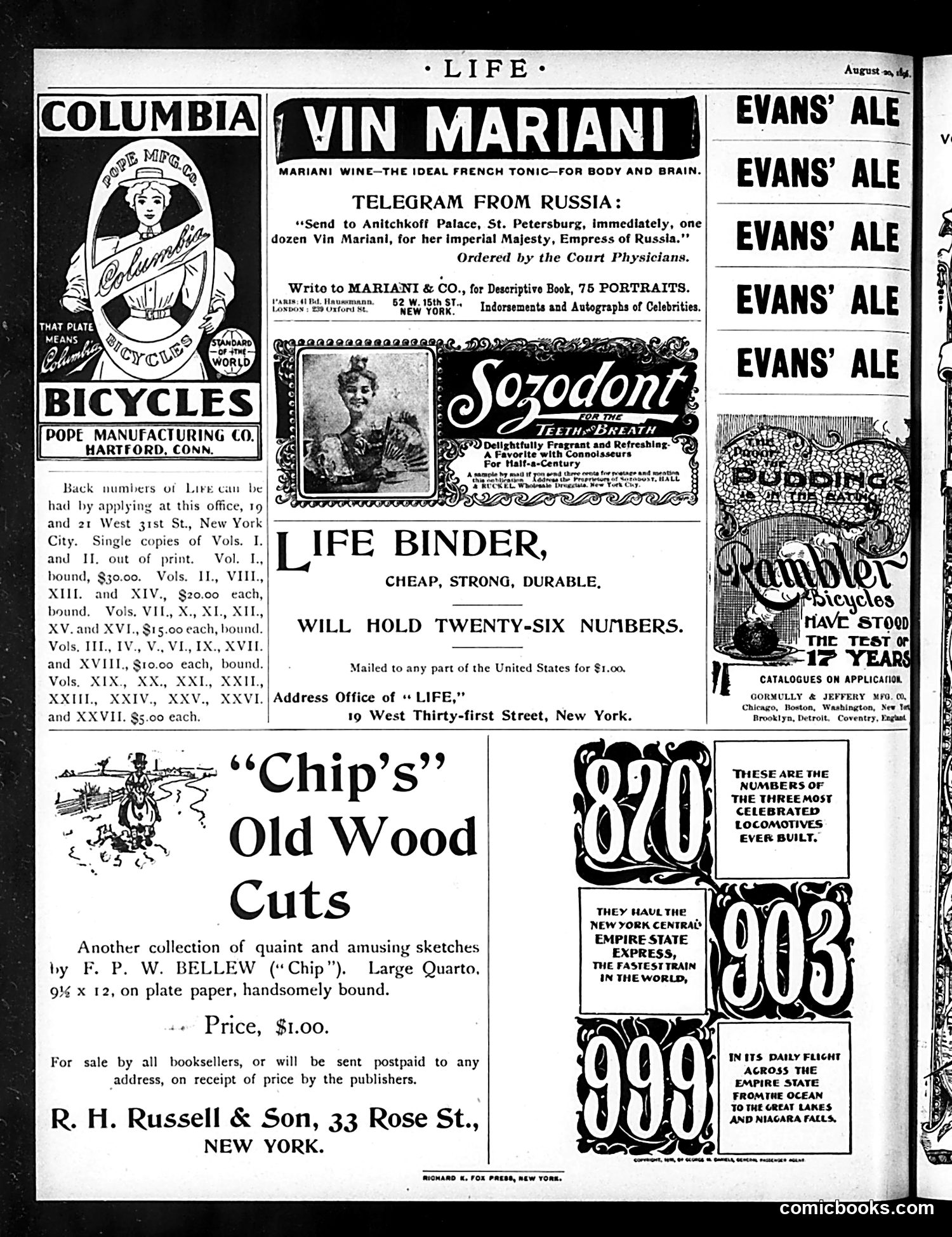
This is primarily an **advertising page** with minimal satirical content. The layout showcases period product endorsements: **Key Advertisements:** - **Vin Mariani wine**: A French tonic marketed as medicinal, endorsed via a fabricated telegram claiming the Russian Empress ordered it through court physicians—a common advertising tactic exploiting royal authority for credibility. - **Columbia Bicycles**: Featured with a woman cyclist, reflecting the 1890s "bicycle craze" and emerging female independence. - **Rambler Bicycles**: Emphasizes durability and longevity ("stood test of 17 years"). - **Locomotive numbers (870, 903, 999)**: Celebrates famous trains like the Empire State Express. **Historical Context:** The page reflects Gilded Age consumer culture, where medical products made extravagant claims and bicycles represented modern technology and women's liberation. The Russian imperial endorsement exemplifies period advertising's reliance on celebrity and authority figures to sell products. **Satirical Element:** Minimal—Life magazine here functions primarily as a vehicle for advertisements rather than social commentary.