
Life, 1896-08-20 · page 4 of 20
Life — August 20, 1896 — page 4: what you’re looking at
What you’re looking at
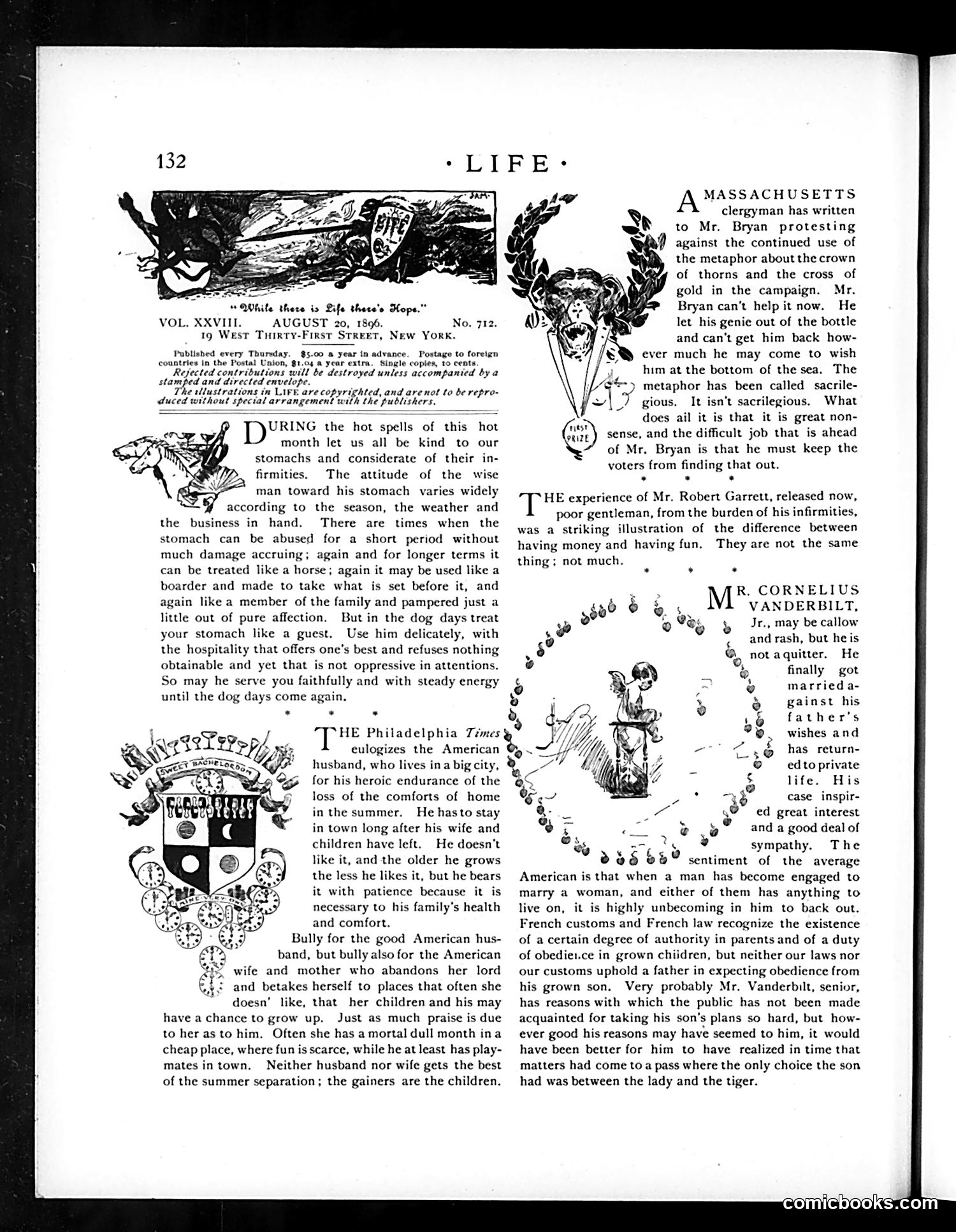
This page contains three distinct editorial pieces rather than political cartoons: 1. **The opening section** discusses summer stomach care—treating one's digestive system with delicacy during hot weather, using a metaphor of hospitality to a guest. 2. **A Massachusetts clergyman's letter** protests against William Jennings Bryan's use of the "crown of thorns and cross of gold" metaphor in his campaign, calling it sacrilegious. The text defends Bryan, arguing the metaphor is merely apt, not irreverent. 3. **Commentary on Robert Garrett and Cornelius Vanderbilt Jr.** discusses marriage and family authority—specifically how American customs differ from French law regarding paternal authority over adult children. The page is primarily textual commentary on contemporary social and political issues rather than visual satire.
📄 Transcribed text from this page (OCR, searchable)
Machine-transcribed from the original scan — historical spelling and the odd misread are preserved.
“While there is Life there's Hope.” VOL, XXVIII. AUGUST 20, 1896. No. 712. 19 West Tuirty-First Street, New York. Published every Thursday. $5.00 @ year in advance. Postage to foreign countries in the Postal Union, fa year extra. Single copies, to cents Rejected contributions will be destroyed unless accompanied by a stamped and directed envelope. he tllustrations in LIFE. are copyrighted, and are not to be repro- duced without special arrangement with the publishers. Ne) URING the hot spells of this hot 4 month let us all be kind to our stomachs and considerate of their in- firmities. The attitude of the wise man toward his stomach varies widely according to the season, the weather and the business in hand. There are times when the stomach can be abused for a short period without much damage accruing; again and for longer terms it can be treated like a horse; again it may be used like a boarder and made to take what is set before it, and again like a member of the family and pampered just a little out of pure affection. Butin the dog days treat your stomach like a guest. Use him delicately, with the hospitality that offers one's best and refuses nothing obtainable and yet that is not oppres in attentions. So may he serve you faithfully and with steady energy until the dog days come again. . . . i i ~HE Philadelphia Témes i Qstterey/ 5 y! eulogizes the American ; CE ERE ye husband, who lives ina big city, &y for his heroic endurance of the loss of the comforts of home in the summer. He hasto stay in town long after his wife and children have left. He doesn’t like it, and the older he grows the less he likes it, but he bears it with patience because it is necessary to his family's health and comfort. Bully for the good American hus- band, but bully also for the American wife and mother who abandons her lord and betakes herself to places that often she doesn’ like, that her children and his may have a chance to grow up. Just as much praise is due to her as to him. Often she has a mortal dull month ina cheap place, where fun is scarce, while he at least has play- mates in town. Neither husband nor wife gets the best of the summer separation; the gainers are the children. MASSACHUSETTS clergyman has written to Mr. Bryan protesting against the continued use of the metaphor about the crown of thorns and the cross of gold in the campaign. Mr. Bryan can’t help it now. He let his genie out of the bottle and can’t get him back how- ever much he may come to wish i him at the bottom of the sea. The <-> metaphor has been called sacrile- _/ gious. It isn’t sacrilegious. What does ail it is that it is great non- sense, and the difficult job that is ahead of Mr. Bryan is that he must keep the voters from finding that out. ° . . A titst Pai7e T HE experience of Mr. Robert Garrett, released now, poor gentleman, from the burden of his infirmities, was a striking illustration of the difference between having money and having fun, They are not the same thing ; not much. . R. CORNELIUS VANDERBILT, Jr., may be callow ; andrash, but heis @, notaquitter. He finally got married a- gainst his father’s wishes and has return- ed to private life. His 33 case inspir- sO ed great interest and a good deal of sympathy. The sentiment of the average is that when a man has become engaged to marry a woman, and either of them has anything to live on, it is highly unbecoming in him to back out. French customs and French law recognize the existence of a certain degree of authority in parents and of a duty of obediet.ce in grown chiidren, but neither our laws nor our customs uphold a father in expecting obedience from his grown son. Very probably Mr. Vanderbilt, senior, has reasons with which the public has not been made acquainted for taking his son's plans so hard, but how- ever good his reasons may have seemed to him, it would have been better for him to have realized in time that matters had come toa pass where the only choice the son had was between the lady and the tiger. v