
Life, 1896-08-20 · page 7 of 20
Life — August 20, 1896 — page 7: what you’re looking at
What you’re looking at
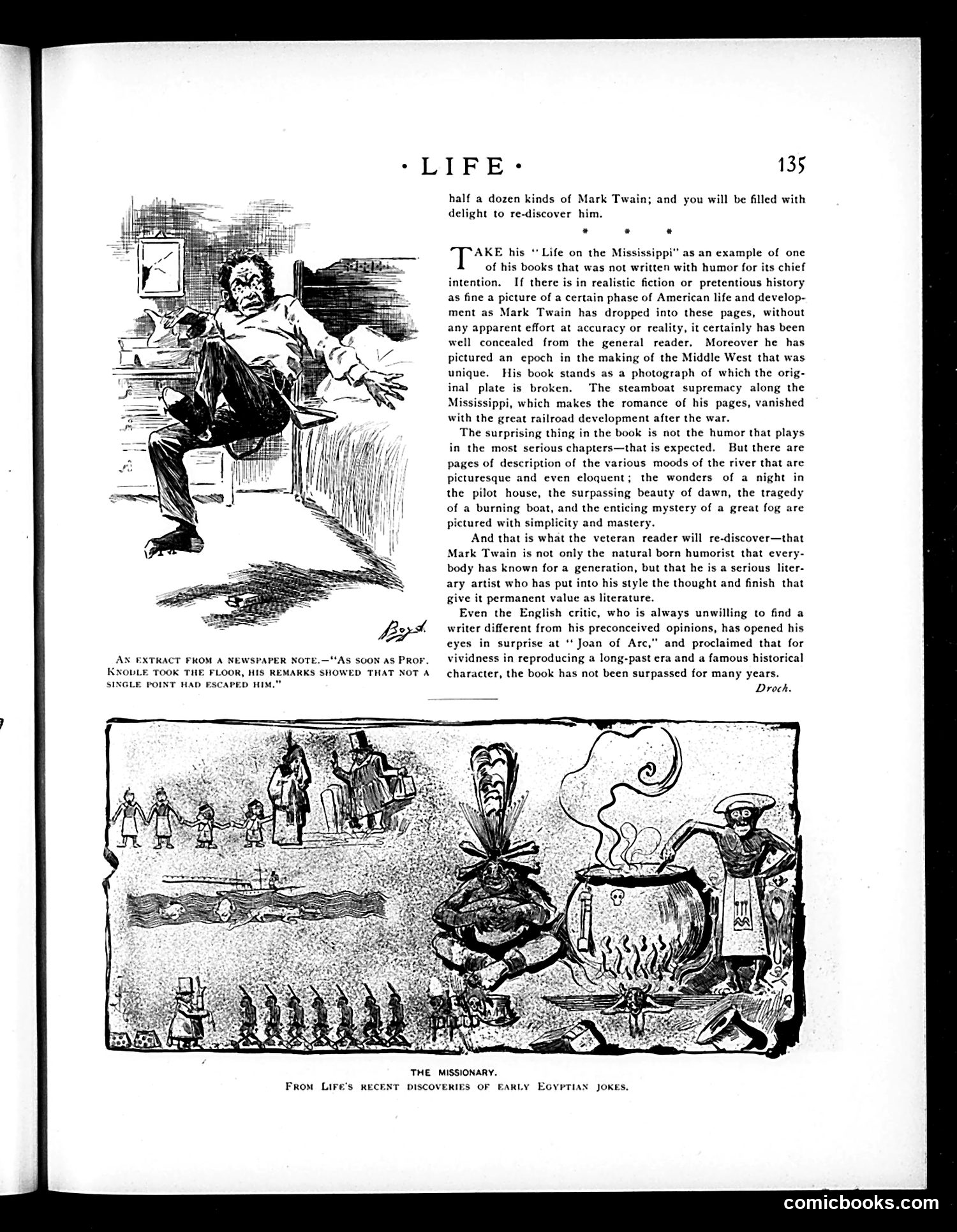
This page discusses **Mark Twain's literary merit**, arguing that his "Life on the Mississippi" deserves serious critical recognition despite his reputation as a humorist. The text defends Twain as a genuine literary artist whose work captures a vanishing historical era—the steamboat age on the Mississippi River—with both accuracy and eloquence. The upper illustration shows a caricatured figure (likely Twain) at his desk, emphasizing his role as writer. The lower cartoon, titled "The Missionary" and subtitled "From Life's Recent Discoveries of Early Egyptian Jokes," appears to be unrelated satirical content about ancient Egypt, possibly mocking pseudoscientific claims or archaeological pretensions popular at the time. The page advocates elevating Twain from "mere humorist" to serious artist—a notable critical reassessment for its era.
📄 Transcribed text from this page (OCR, searchable)
Machine-transcribed from the original scan — historical spelling and the odd misread are preserved.
> LIFE: 135 half a dozen kinds of Mark Twain; and you will be filled with delight to re-discover him. AKE his ‘Life on the Mississippi” as an example of one of his books that was not written with humor for its chief intention. If there is in realistic fiction or pretentious history as fine a picture of a certain phase of American life and develop- ment as Mark Twain has dropped into these pages, without any apparent effort at accuracy or reality, it certainly has been well concealed from the general reader, Moreover he has pictured an epoch in the making of the Middle West that was unique. His book stands as a photograph of which the orig- inal plate is broken. The steamboat supremacy along the Mississippi, which makes the romance of his pages, vanished with the great railroad development after the war. The surprising thing in the book is not the humor that plays in the most serious chapters—that is expected. But there are pages of description of the various moods of the river that are picturesque and even eloquent; the wonders of a night in the pilot house, the surpassing beauty of dawn, the tragedy of a burning boat, and the enticing mystery of a great fog are pictured with simplicity and mastery. And that is what the veteran reader will re-discover—that Mark Twain is not only the natural born humorist that every- body has known for a generation, but that he is a serious liter- ary artist who has put into his style the thought and finish that give it permanent value as literature. Even the English critic, who is always unwilling to find a writer different from his preconceived opinions, has opened his eyes in surprise at ‘‘ Joan of Arc,” and proclaimed that for AN EXTRACT PROM A NEWSPAPER NOTE.—"AS soon as Pror. _ Vividness in reproducing a long-past cra and a famous historical KNODLE. TOOK THE FLOOR, HIS REMARKS SHOWED THAT NOT A character, the book has not been surpassed for many years. SINGLE POINT HAD RSCAPED HIM." Droch. THE MISSIONARY. From Life's RECENT DISCOVERIES OF EARLY EGYPTIAN JOKES, comicbooks.com