
Life, 1896-08-20 · page 8 of 20
Life — August 20, 1896 — page 8: what you’re looking at
What you’re looking at
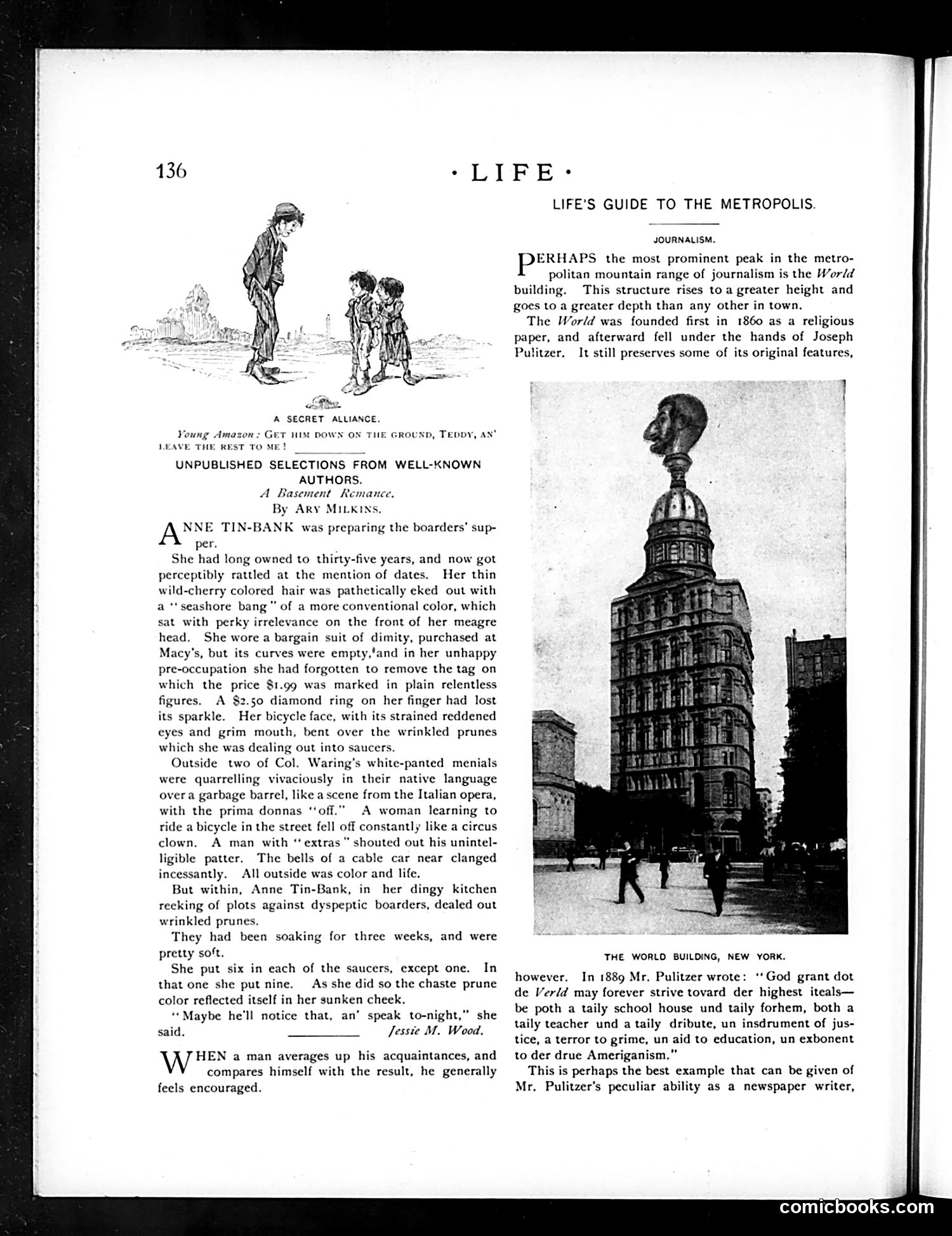
This page combines literary content with architectural journalism rather than political satire. The top illustration ("A Secret Alliance") depicts two young children conspiring, captioned with a humorous quote about leaving "the rest to me." The main content includes a story excerpt by Amy Milkins titled "A Basement Romance," describing the mundane life of Anne Tin-Bank, a boarding house keeper dealing with petty indignities—lost ring sparkle, price tags left on clothing, poorly cooked prunes. The photograph shows the World Building in New York, accompanying journalism about Joseph Pulitzer's newspaper headquarters. The text discusses Pulitzer's vision for the World as an instrument of justice and education, quoting his 1883 statement about the paper's idealistic mission. This page prioritizes literary and architectural content over satire.
📄 Transcribed text from this page (OCR, searchable)
Machine-transcribed from the original scan — historical spelling and the odd misread are preserved.
LIFE: A SECRET ALLIANCE. Young Amazon: GET MIM DOWN ON THE GROUND, TEDDY, AN’ LEAVE THE REST TOME! _ UNPUBLISHED SELECTIONS FROM WELL-KNOWN AUTHORS. A Basement Remance. By Ary MILKINS, ANNE TIN-BANK was preparing the boarders’ sup- r. She had long owned to thirty-five years, and now got perceptibly rattled at the mention of dates. Her thin wild-cherry colored hair was pathetically eked out with a ‘seashore bang” of a more conventional color, which sat with perky irrelevance on the front of her meagre head. She wore a bargain suit of dimity, purchased at Macy's, but its curves were empty,'and in her unhappy pre-occupation she had forgotten to remove the tag on which the price $1.99 was marked in plain relentless figures, A $2.50 diamond ring on her finger had lost its sparkle. Her bicycle face, with its strained reddened eyes and grim mouth, bent over the wrinkled prunes which she was dealing out into sauce Outside two of Col. Waring'’s white-panted menials were quarrelling vivaciously in their native language over a garbage barrel, like a scene from the Italian opera, with the prima donnas ‘‘off." A woman learning to ride a bicycle in the street fell off constantly like a circus clown. A man with ‘extras shouted out his unintel- ligible patter. The bells of a cable car near clanged incessantly. All outside was color and life. But within, Anne Tin-Bank, in her dingy kitchen recking of plots against dyspeptic boarders, dealed out wrinkled prunes. They had been soaking for three weeks, and were pretty soft. She put six in each of the saucers, except one. In that one she put nine. As she did so the chaste prune color reflected itself in her sunken cheek. ‘Maybe he'll notice that, an’ speak to-night,” she said. Jessie M. Wood. HEN a man averages up his acquaintances, and compares himself with the result, he generally feels encouraged. LIFE’'S GUIDE TO THE METROPOLIS. JOURNALISM. ERHAPS the most prominent peak in the metro- politan mountain range of journalism is the World building. This structure rises to a greater height and goes to a greater depth than any other in town. The World was founded first in 1860 as a religious paper, and afterward fell under the hands of Joseph Pulitzer. It still preserves some of its original features, THE WORLD BUILDING, NEW YORK. however. In 1889 Mr. Pulitzer wrote: ‘‘God grant dot de Verld may forever strive tovard der highest iteals— be poth a taily school house und taily forhem, both a taily teacher und a taily dribute, un insdrument of jus- tice, a terror to grime, un aid to education, un exbonent to der drue Ameriganism.” This is perhaps the best example that can be given of Mr. Pulitzer’s peculiar ability as a newspaper writer, comicbooks.com