
A complete issue · 18 pages · 1896
Life — July 2, 1896
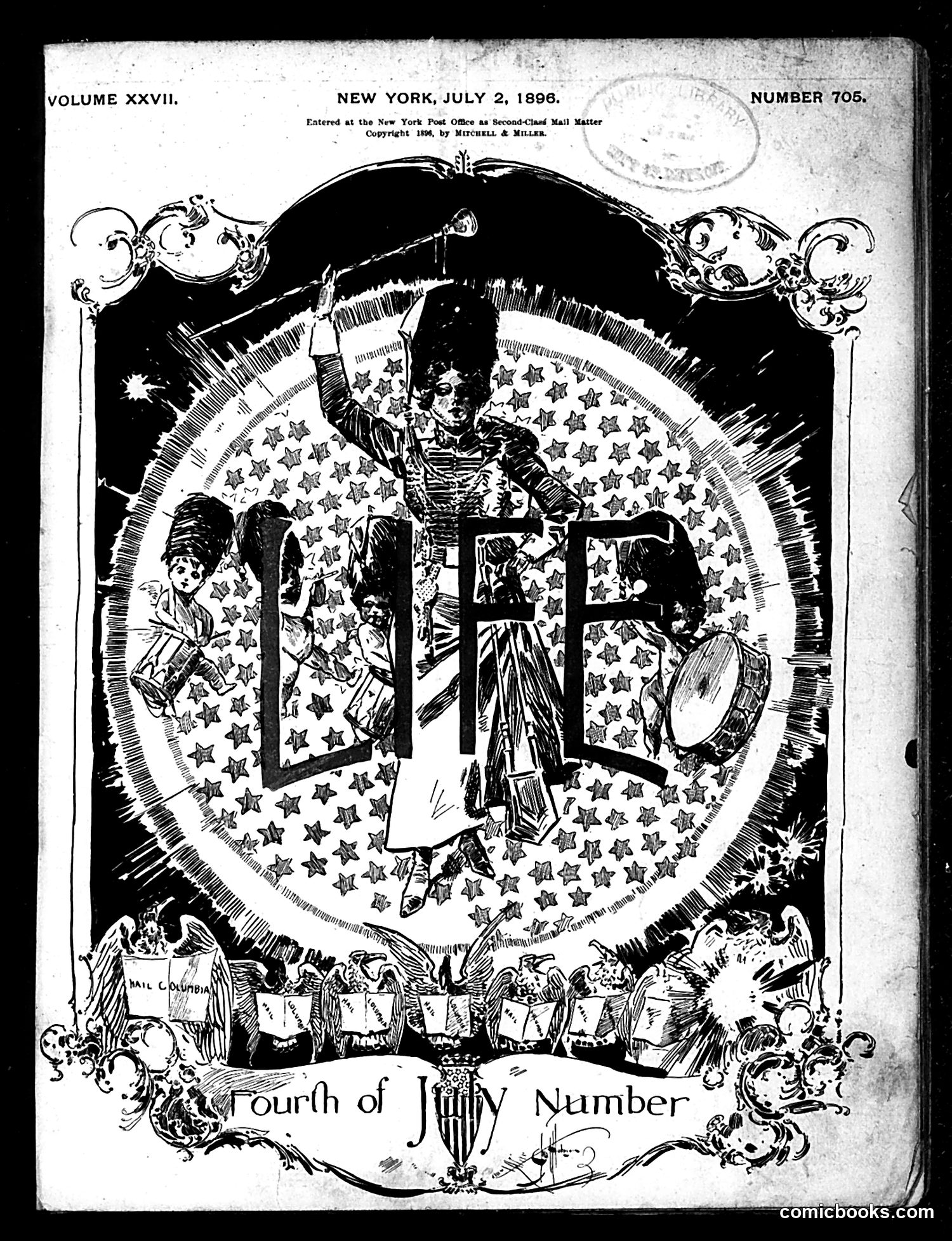
This is the cover of *Life* magazine's Fourth of July issue (July 2, 1896). The central figure appears to be Uncle Sam, identifiable by his tall star-spangled top hat and patriotic clothing, positioned within a large circular halo filled with stars. He's depicted conducting what appears to be an orchestra or band, with figures on either side holding musical instruments (drums visible). The bottom shows shields or state emblems arranged in a row, likely representing the American states. The overall composition suggests a satirical commentary on American national unity, patriotism, or political leadership around the 1896 election period—portraying Uncle Sam as orchestrating or conducting the nation's affairs during a significant moment in American history.
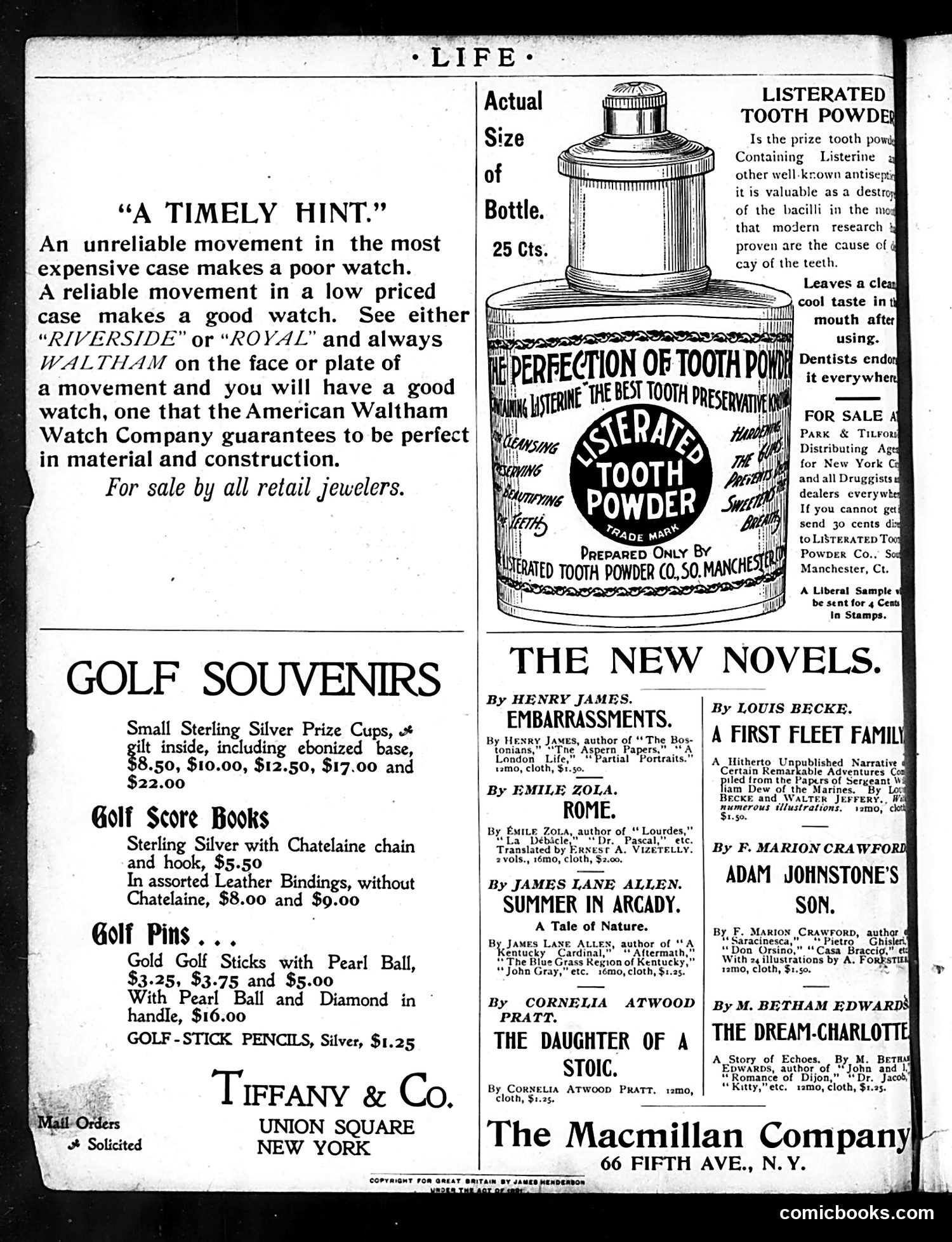
This page is **primarily advertising**, not satirical content. It contains: 1. **Watch advertisement** ("A Timely Hint"): Promotes Riverside and Royal Waltham watches, emphasizing that reliable movements matter more than expensive cases—a practical consumer message. 2. **Listerated Tooth Powder ad**: Features a product bottle claiming to be "the best tooth preservative" and antiseptic, manufactured in Manchester, Connecticut. 3. **Golf merchandise** from Tiffany & Co.: Advertises sterling silver prize cups, score books, pins, and pencils—luxury golf accessories. 4. **Book advertisements**: Lists new novels by Henry James, Émile Zola, Louis Becke, and others, published by Macmillan Company. The page reflects early 20th-century consumer culture and advertising practices, with no evident political satire or social commentary.
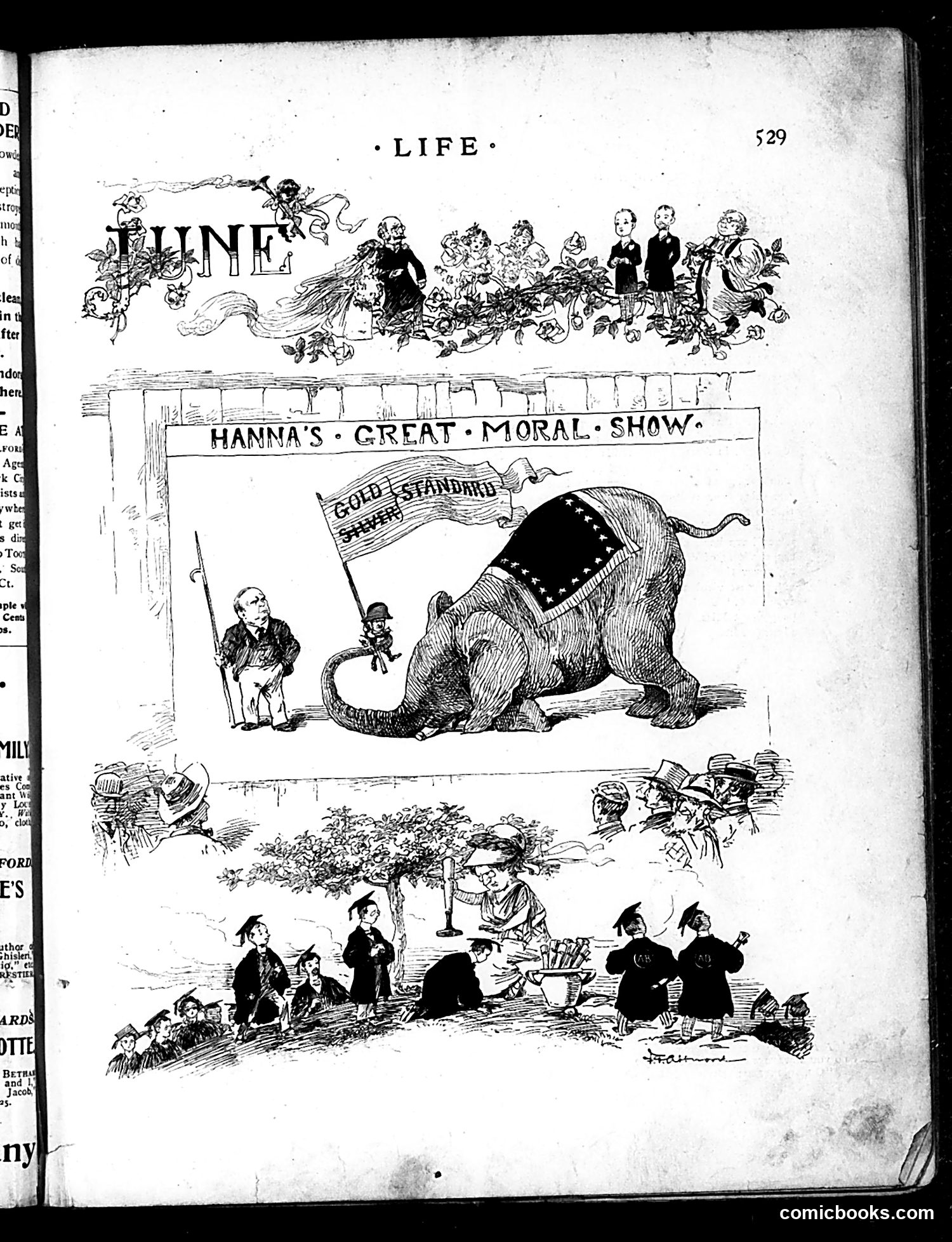
This satirical cartoon critiques Mark Hanna, the powerful Republican political operative and fundraiser of the 1890s-1900s. The elephant—the Republican Party symbol—is presented as a circus attraction labeled "Hanna's Great Moral Show," with a "Gold Standard" banner. The cartoon suggests Hanna exploited moral and economic rhetoric (the "gold standard" was a hotly debated monetary policy) as mere theatrical spectacle to manipulate public opinion. The small figures around the elephant appear to be spectators or political operatives, while others below seem to be camp followers or beneficiaries of Hanna's political machine. The satire mocks how Hanna's campaign apparatus turned serious political issues into entertainment and propaganda.
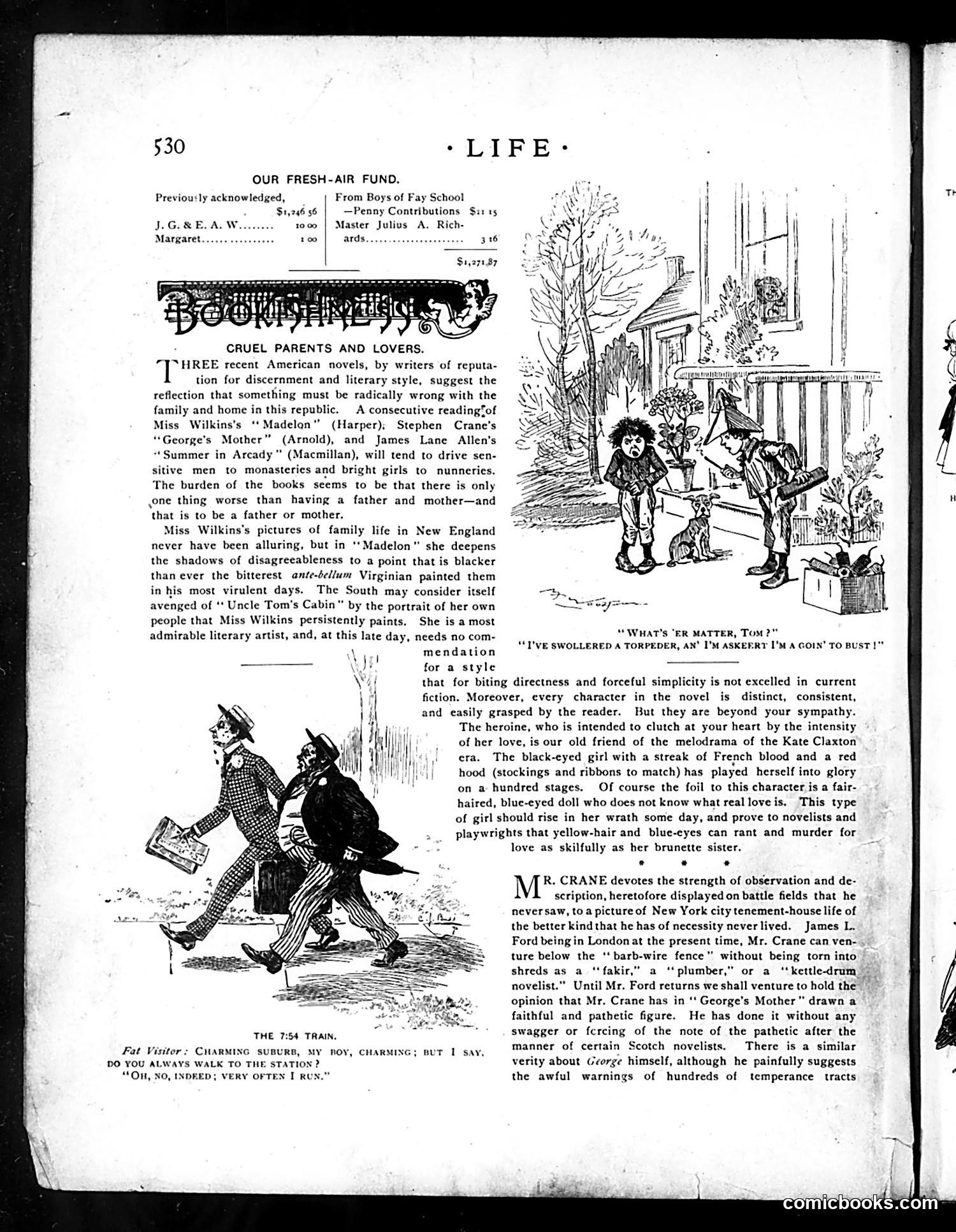
This page contains a literary review titled "Cruel Parents and Lovers" discussing three American novels about family dysfunction. The text critiques works by Wilkins, Crane, and Allen for depicting dysfunctional families and parent-child relationships. The two cartoons illustrate social commentary rather than political satire. The upper cartoon shows children at play near a house. The lower cartoon, captioned "The 7:54 Train," depicts a fat commuter being addressed by a woman, with dialogue about his walking habits to the station. These cartoons appear to satirize middle-class suburban life and domestic routines rather than reference specific political events. The page primarily functions as a literary review section with accompanying humorous illustrations about everyday social observations.
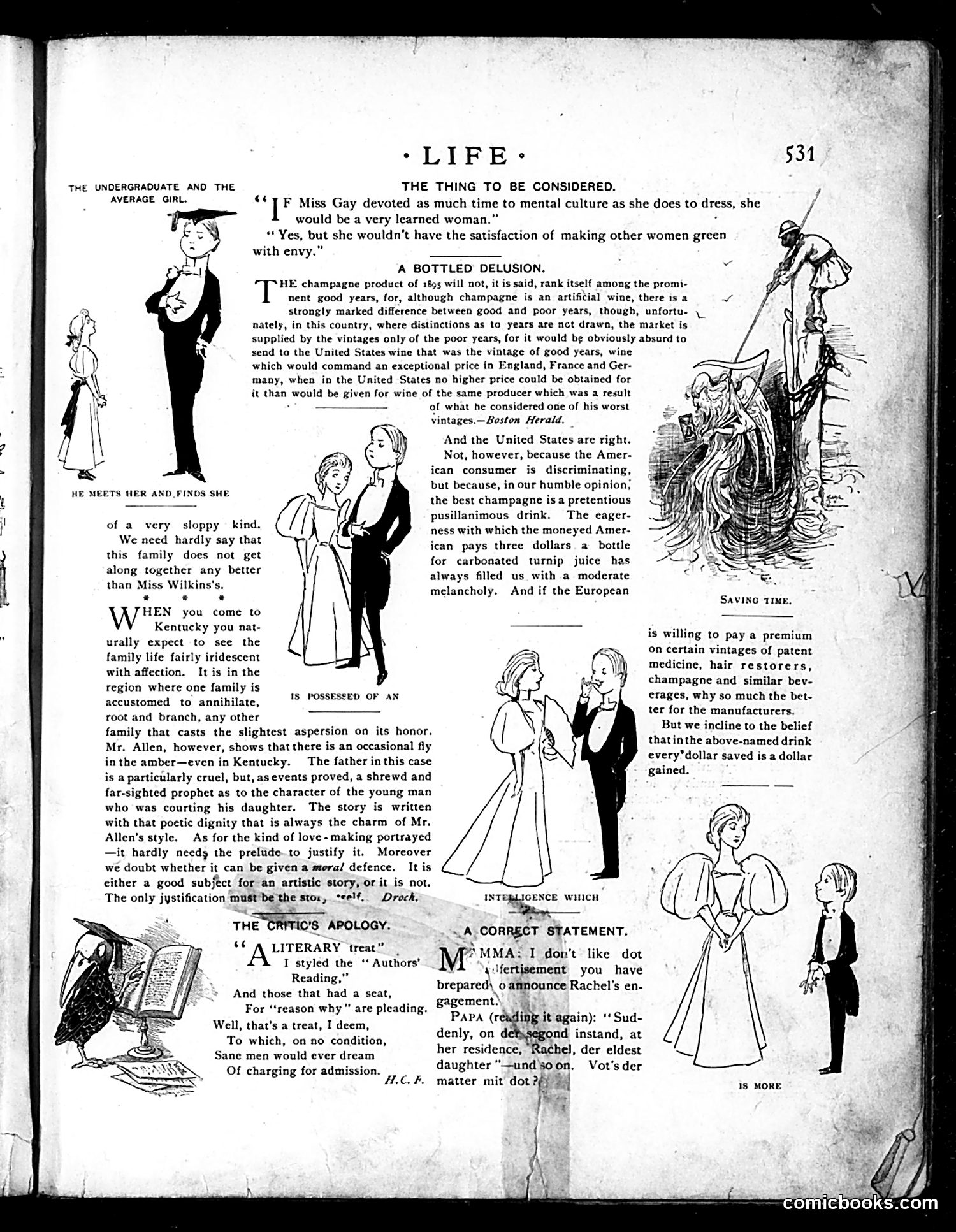
This page contains multiple short humorous pieces mocking early 20th-century courtship conventions: **"The Undergraduate and the Average Girl"** satirizes a young man's dismissive attitude toward an intellectually ambitious woman, suggesting men prefer women focused on appearance rather than "mental culture." **"A Bottled Delusion"** ridicules American champagne consumers who pay premium prices for inferior domestic products while believing they're sophisticated, contrasting this with European wine expertise. The various vignettes illustrate dating scenarios with titles like "Intelligence Which Is Possessed of an" and "A Correct Statement," poking fun at miscommunications and pretense in courtship. The overall tone critiques class pretension, gender expectations, and American consumer gullibility through satirical dialogue and illustrations typical of Life's early editorial style.
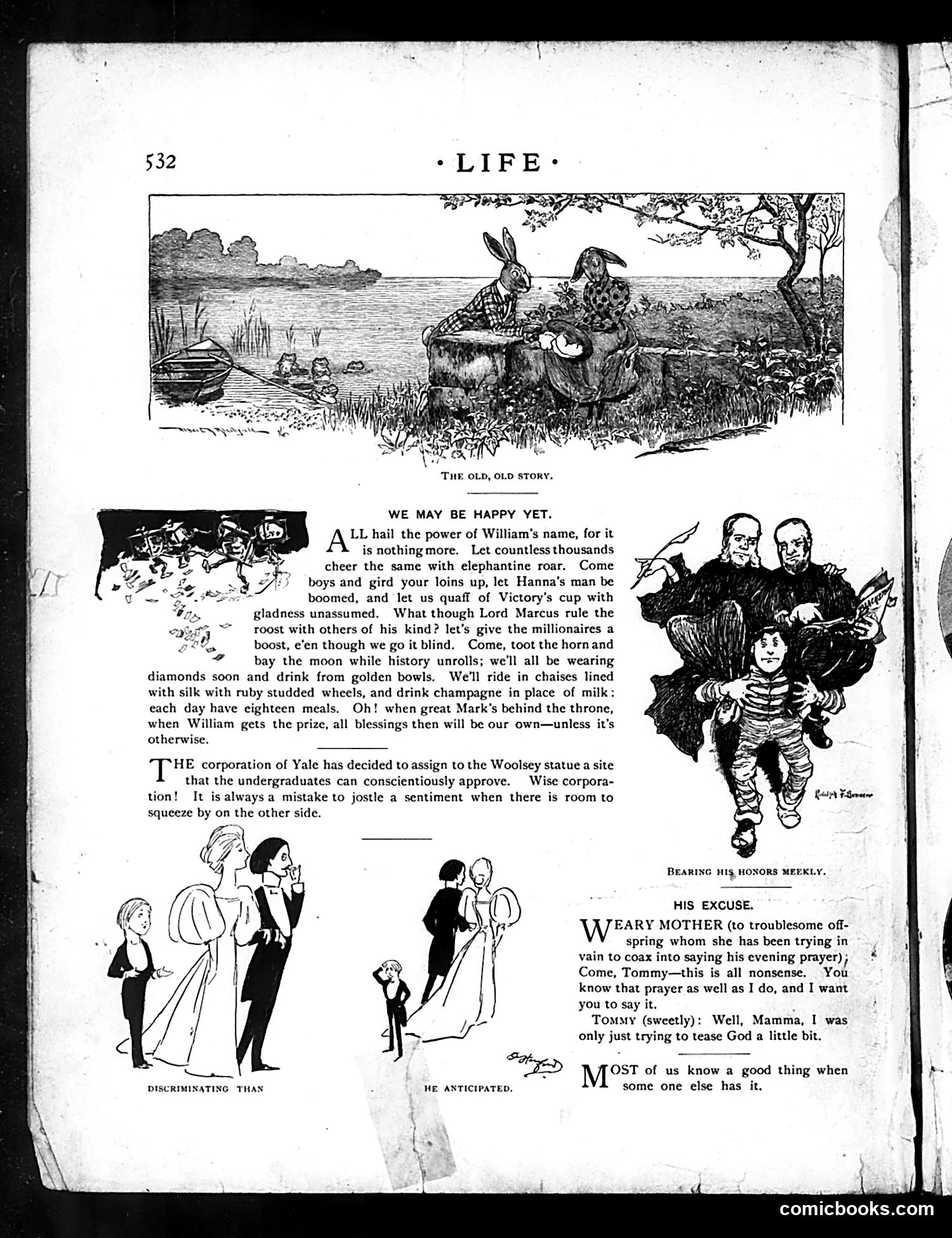
This page from *Life* magazine contains humorous social commentary rather than political cartoons. **"The Old, Old Story"** depicts anthropomorphic rabbits by a riverside, illustrating a romantic or domestic scene with period charm. **"We May Be Happy Yet"** is satirical prose celebrating William's (likely William Jennings Bryan or another political figure) leadership, with exaggerated predictions of wealth and luxury—clearly mocking excessive optimism or populist promises. The tone is ironic, suggesting the writer doubts these grandiose claims. **The remaining sketches** show domestic humor: adults and children in formal dress, with captions like "Discriminating Than" and "He Anticipated," depicting social awkwardness or class distinctions. **"His Excuse"** presents a dialogue between a weary mother and her son Tommy about evening prayers—gentle satire on childhood mischief and religious hypocrisy. The page emphasizes *social* rather than *political* satire, focusing on manners, family dynamics, and human nature.
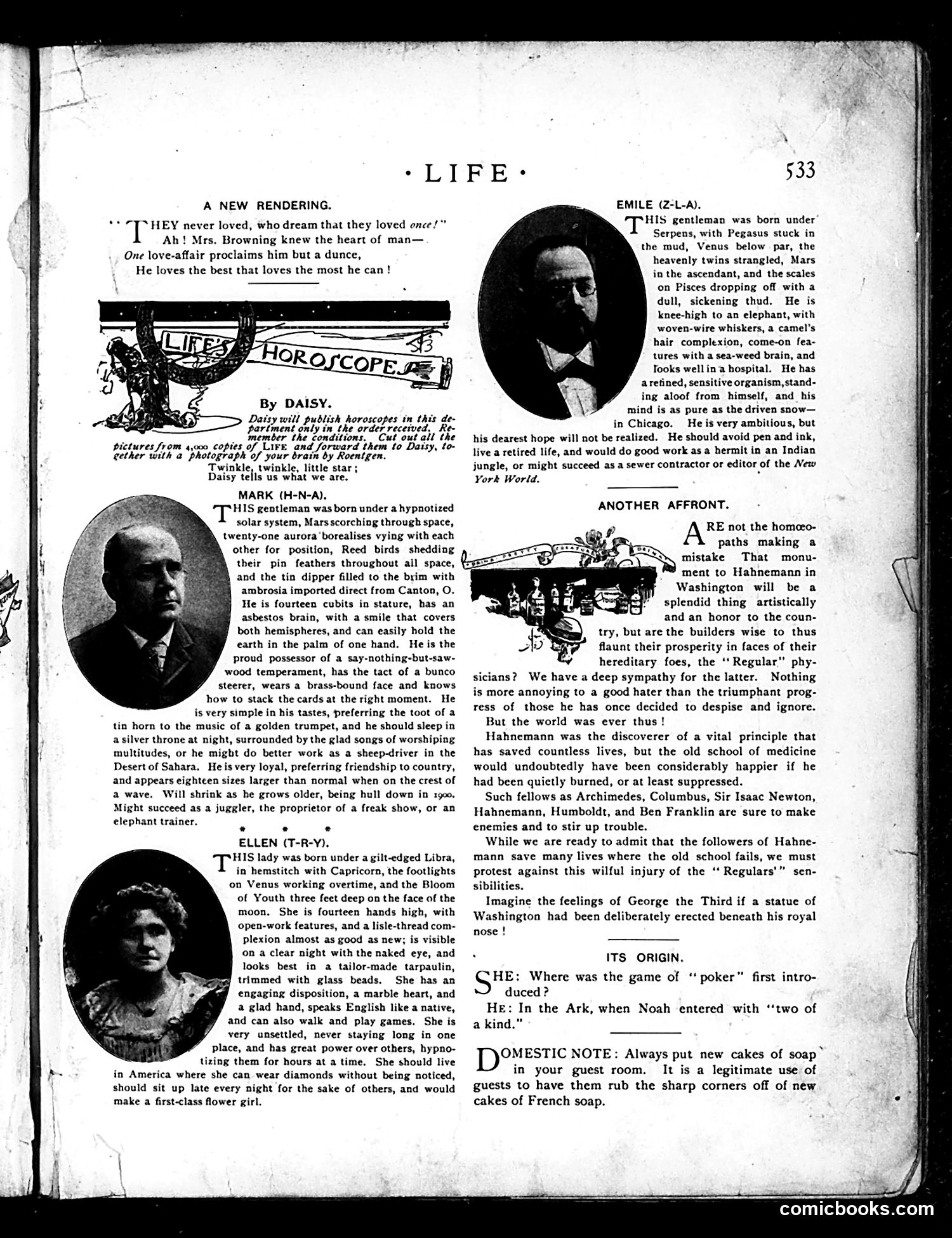
This page contains **"Life's Horoscope"** — humorous astrological character sketches with portraits. The visible entries describe three people by their zodiac signs: Emile (Pisces), Mark (Aries), and Ellen (Libra), offering satirical personality assessments based on birth signs. The page also includes editorial commentary mocking proposed monuments to **Samuel Hahnemann** in Washington, D.C. The writer sarcastically suggests such tributes are appropriate, then pivots to criticize Hahnemann's medical theories, comparing him unfavorably to Newton, Columbus, and Franklin. The satire targets what Life considers dubious "alternative" medical practices, lumping Hahnemann with other controversial figures who've caused societal disruption. The tone is characteristic of Life's era: playful mockery of pseudoscience and pretension.
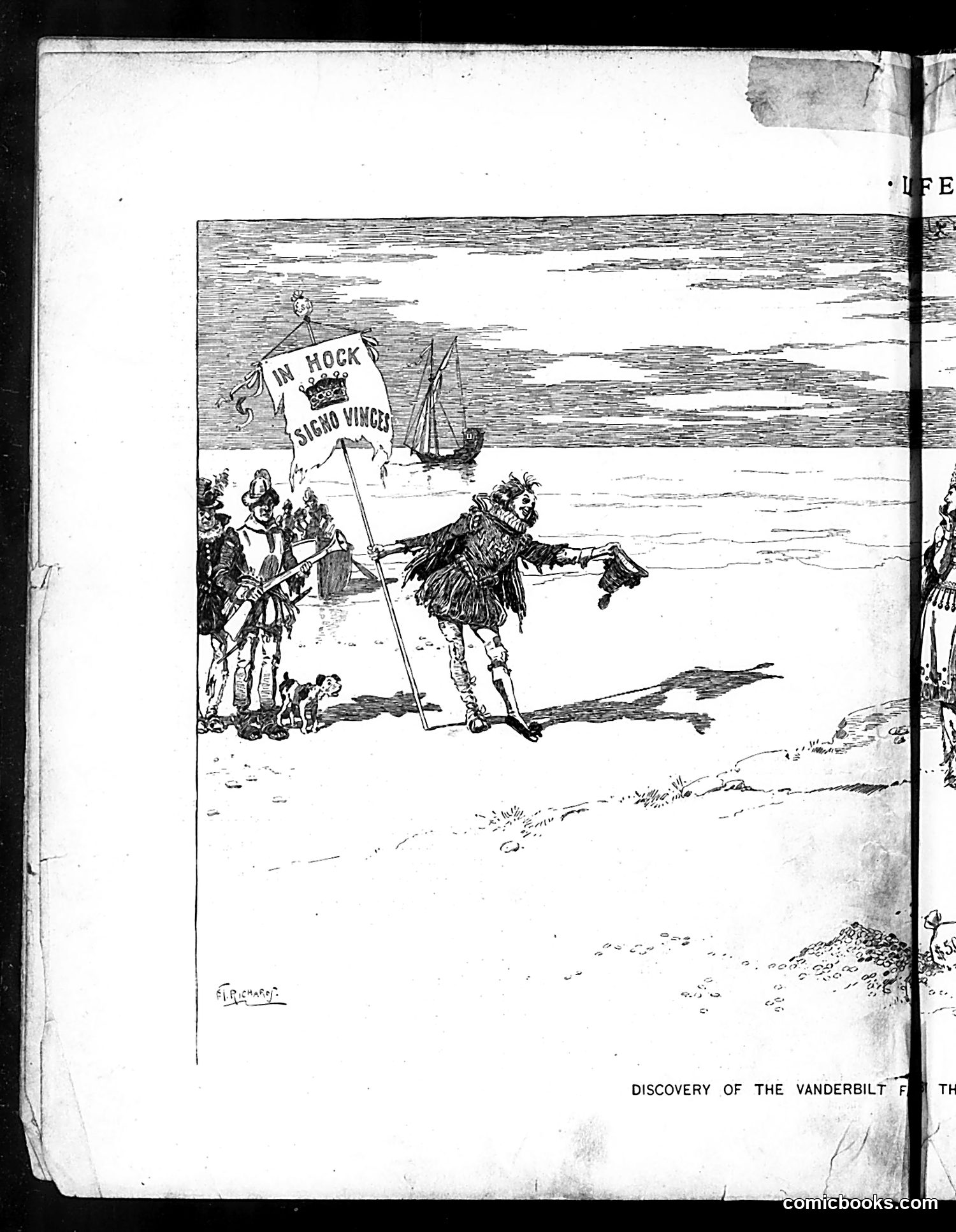
This satirical cartoon depicts a figure planting a flag reading "IN HOCK / SIGNO VINCES" (a Latin play on Constantine's "In this sign, conquer") on a beach. The figure appears to be a wealthy aristocrat or member of the Vanderbilt family, shown in period dress with exaggerated features typical of Life magazine's style. The satire likely comments on the Vanderbilt family's financial troubles or debt ("in hock" means in debt). The flag-planting references colonial discovery narratives, suggesting the cartoon mocks the Vanderbilts' pretensions to power and status despite financial problems. The Latin phrase reinforces the ironic juxtaposition of claimed superiority with actual financial distress.
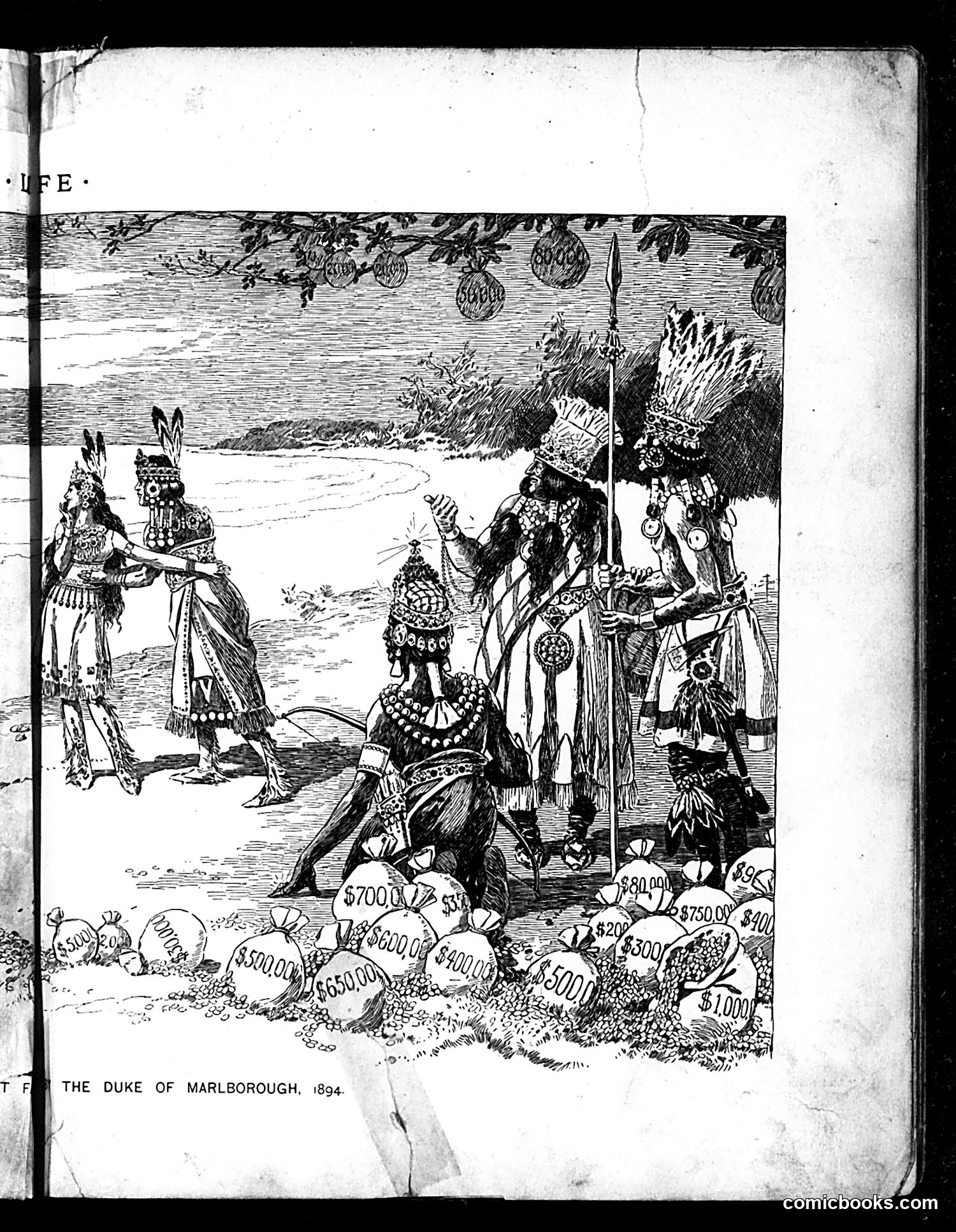
This satirical engraving depicts a scene of wealth redistribution or financial consequence. Elaborately dressed figures in aristocratic costume gather around a central seated figure (likely the Duke of Marlborough), surrounded by large sums of money labeled with dollar amounts ($700, $80, $400, $500, $650, etc.). The cartoon appears to mock the Duke's financial situation—possibly his marriage or business dealings involving American wealth. In 1894, the Duke of Marlborough famously married American heiress Consuelo Vanderbilt, whose substantial dowry helped restore the aristocratic family's finances. The heaps of money and the Duke's prominent central position suggest satire about the transactional nature of this union and the influx of American capital into British nobility.
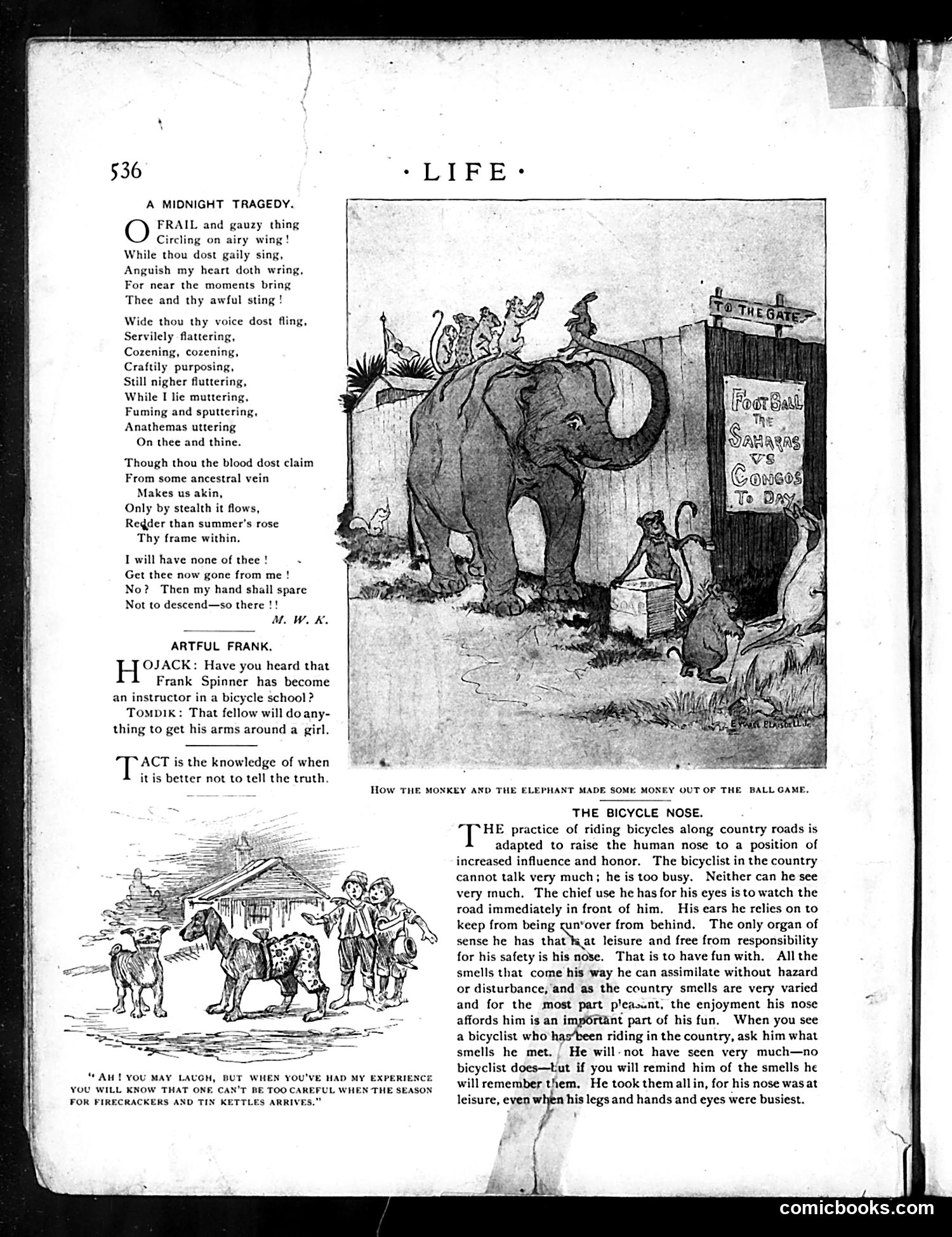
This page contains three separate pieces of humor: 1. **"A Midnight Tragedy"** — A poem satirizing overly dramatic, emotional speech. The speaker uses flowery, archaic language ("frail and gauzy thing," "anathemas uttering") to describe heartbreak, mocking theatrical sentimentality. 2. **"Artful Frank"** — A brief joke about Frank Spinner becoming a bicycle instructor, with the punchline that he wants to get his arms around girls—physical comedy mixing innocent activity with romantic intention. 3. **"The Bicycle Nose"** — A humorous article explaining that country cyclists develop prominent noses from riding, since they can't see ahead properly and must use their nose as a safety organ. The joke satirizes the awkward posture and limited awareness of bicycle riders, particularly on country roads. The cartoon showing a monkey and elephant at a baseball game illustrates the bicycling humor.
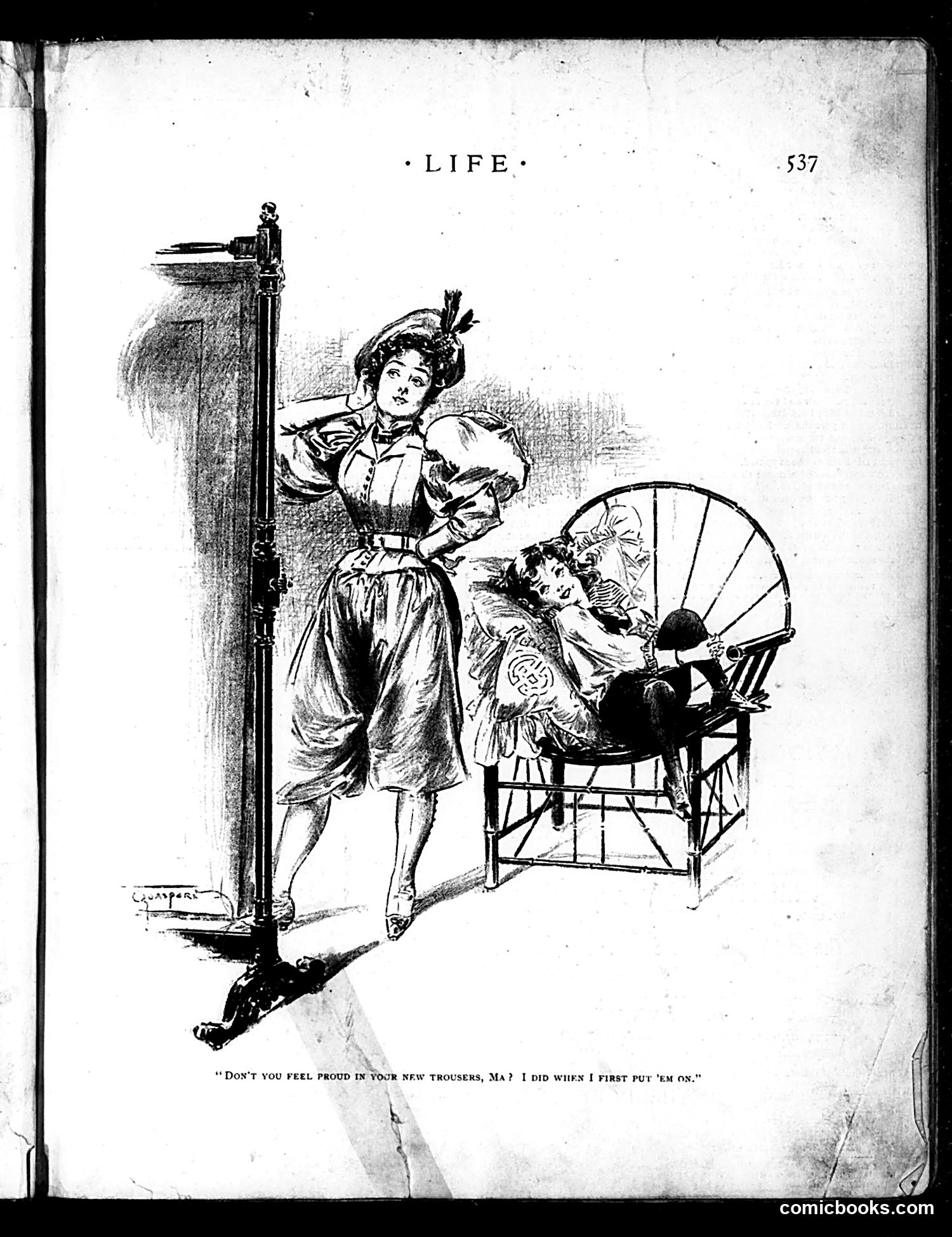
This is a humorous domestic scene from *Life* magazine (page 537). The cartoon shows a woman standing proudly while a child sits in a chair holding a fan. The caption reads: "Don't you feel proud in your new trousers, Ma? I did when I first put 'em on." The joke is a role-reversal gag typical of early 20th-century humor. The child teases the mother about her new trousers by comparing them to his own childhood experience wearing pants for the first time. The implication is that the mother, likely accustomed to long skirts, is wearing the then-scandalous "new woman" fashion of shorter hemlines or actual trousers—a sign of changing gender norms that conservative society viewed as somewhat absurd or unfeminine. The child's innocent comparison humorously highlights this social boundary-crossing.
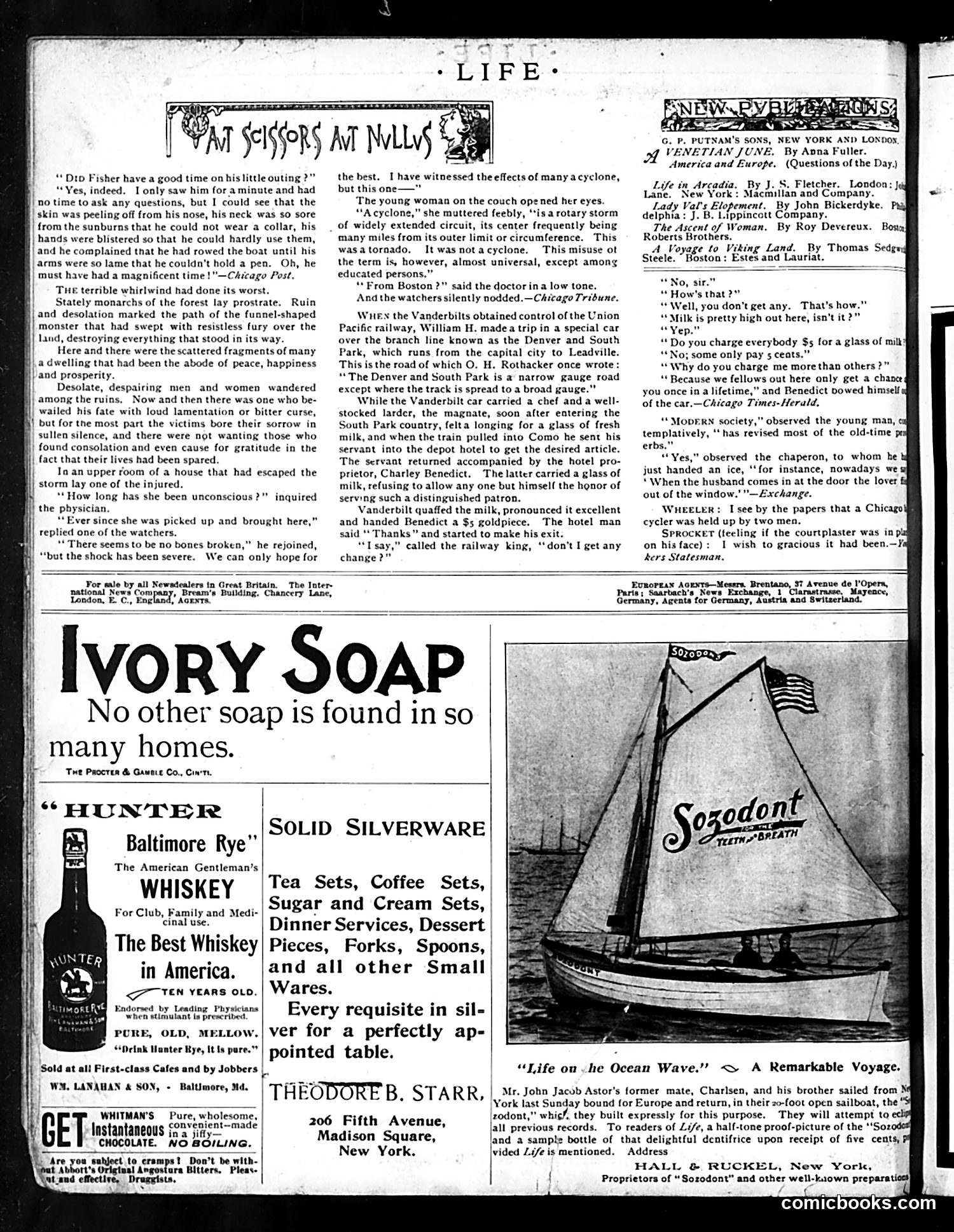
This page contains three separate humorous anecdotes rather than political cartoons: 1. **"Scissors at Nulls"**: A joke about Mr. Fisher's disastrous "outing"—he returned sunburned, blistered, and exhausted, yet claims to have had a "magnificent time." The satire mocks people who pretend hardship is enjoyment. 2. **The Tornado Story**: Satirizes pedantic Boston intellectuals. After a devastating cyclone, an injured woman regains consciousness only to correct the doctor's terminology—he said "cyclone" when she insists it was a "tornado," noting this misuse is "universal, except among educated persons." The watchers' silent nod confirms the Boston stereotype. 3. **The Vanderbilt Anecdote**: Mocks nouveau-riche magnate William H. Vanderbilt's obliviousness. Despite his wealth and special train, he fails to tip a hotel proprietor who personally served him milk, then asks for change from a $3 goldpiece—revealing misplaced priorities and cheap behavior despite his fortune. The page is primarily **advertising** (Ivory Soap, Hunter Whiskey, Sozodont toothpaste, silverware, chocolate), with literary reviews occupying the upper right.
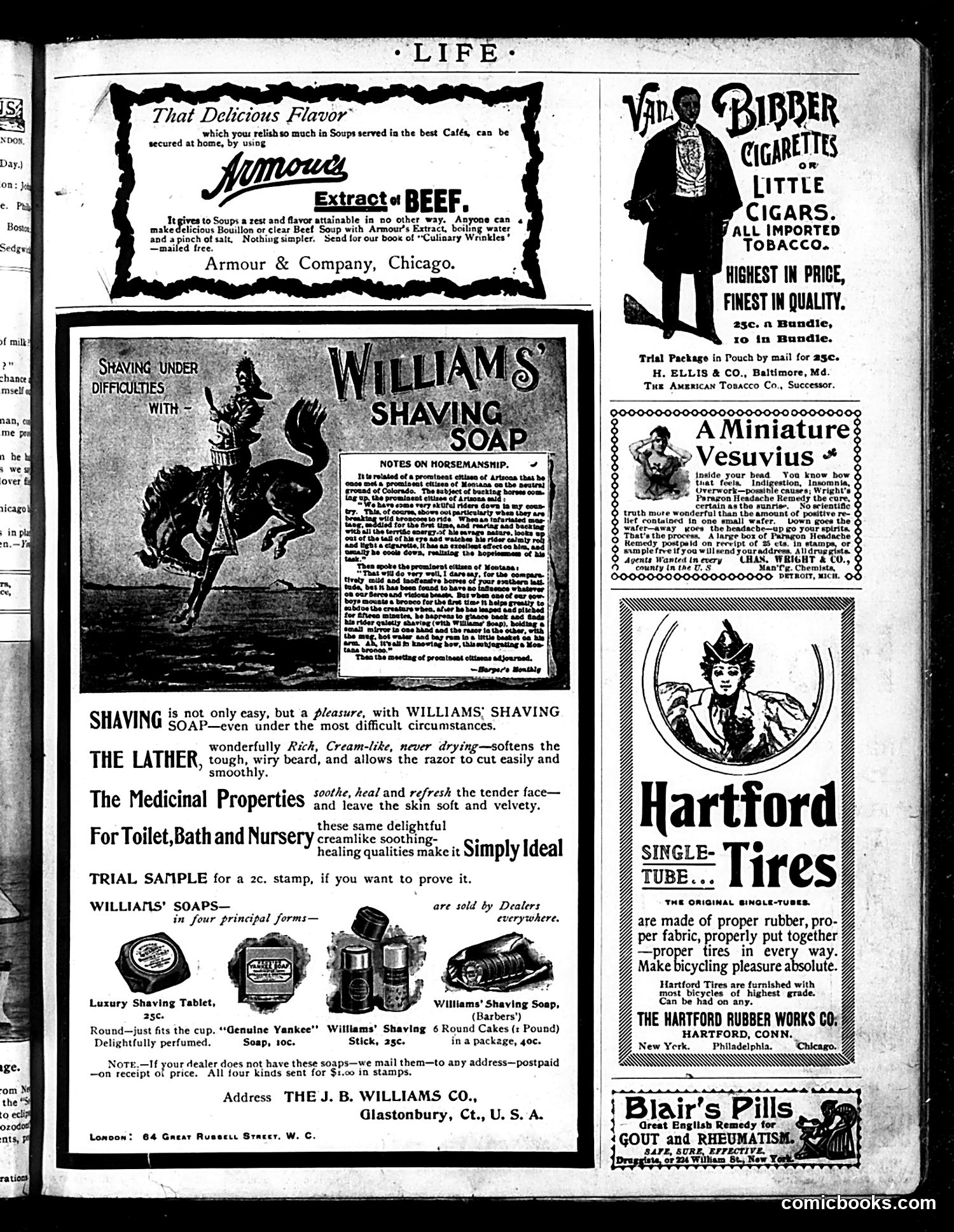
This page is **primarily advertising**, with one prominent cartoon feature. The main satirical content is the **Williams' Shaving Soap advertisement**, which includes a central illustration titled "Notes on Horsemanship." The cartoon depicts a cowboy on a bucking horse, referencing an anecdote about "a prominent citizen of Arizona" meeting "a prominent citizen of Montana on the neutral ground of Colorado." The joke appears to satirize the rough, untamed nature of the American West and frontier behavior—suggesting these regional characters are as wild and difficult to manage as bucking horses. The humor implies that shaving (and civilized grooming) is nearly impossible under such "difficult circumstances," making Williams' Soap remarkable for working even in such rough conditions. The remainder of the page consists of period advertisements for common products: beef extract, shaving supplies, cigars, bicycle tires, patent medicines (for indigestion and rheumatism), and other consumer goods typical of early 20th-century American magazines.
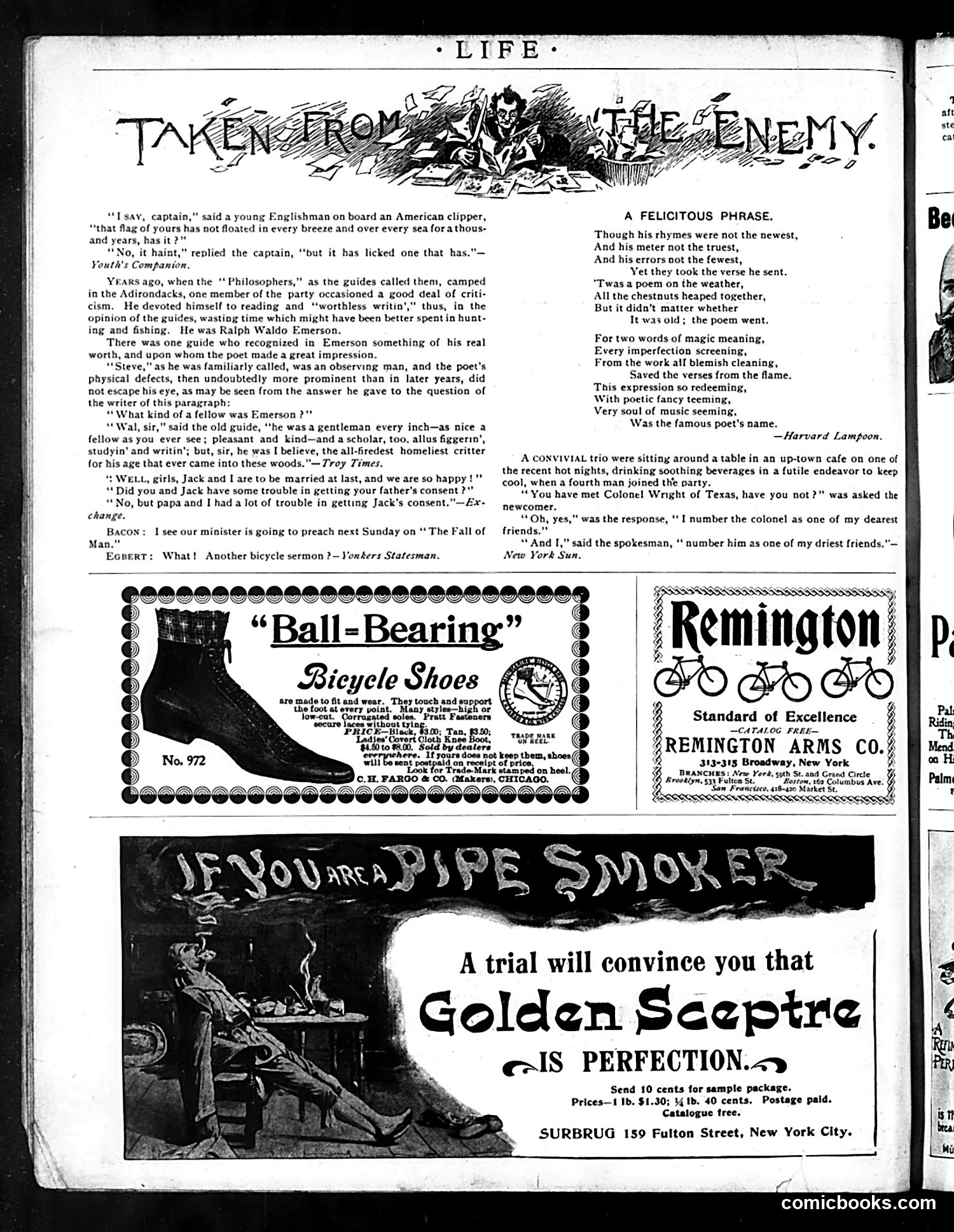
This page mixes humorous anecdotes with advertisements. The main content consists of several brief jokes: **"Taken from the Enemy"** depicts a patriotic exchange between an English passenger and American ship captain, asserting American naval superiority—likely referencing Anglo-American rivalry of the era. **The Emerson anecdote** recalls Ralph Waldo Emerson's time in the Adirondacks, where a guide recognized his intellectual worth despite his physical homeliness. This celebrates American transcendentalist philosophy while using self-deprecating humor. **Other jokes** include a young woman's quip about reluctant bridegroom Jack, a minister's sermon about bicycle accidents (a contemporary fad), and a pun about numbering someone as a "driest friend" (playing on thirst during hot weather). **"A Felicitous Phrase"** (Harvard Lampoon verse) humorously suggests a poet's only saving grace was his famous name. The page is predominantly **advertisements** for bicycle shoes, Remington bicycles, and Golden Sceptre pipe tobacco—reflecting turn-of-century consumer culture and the bicycle craze.
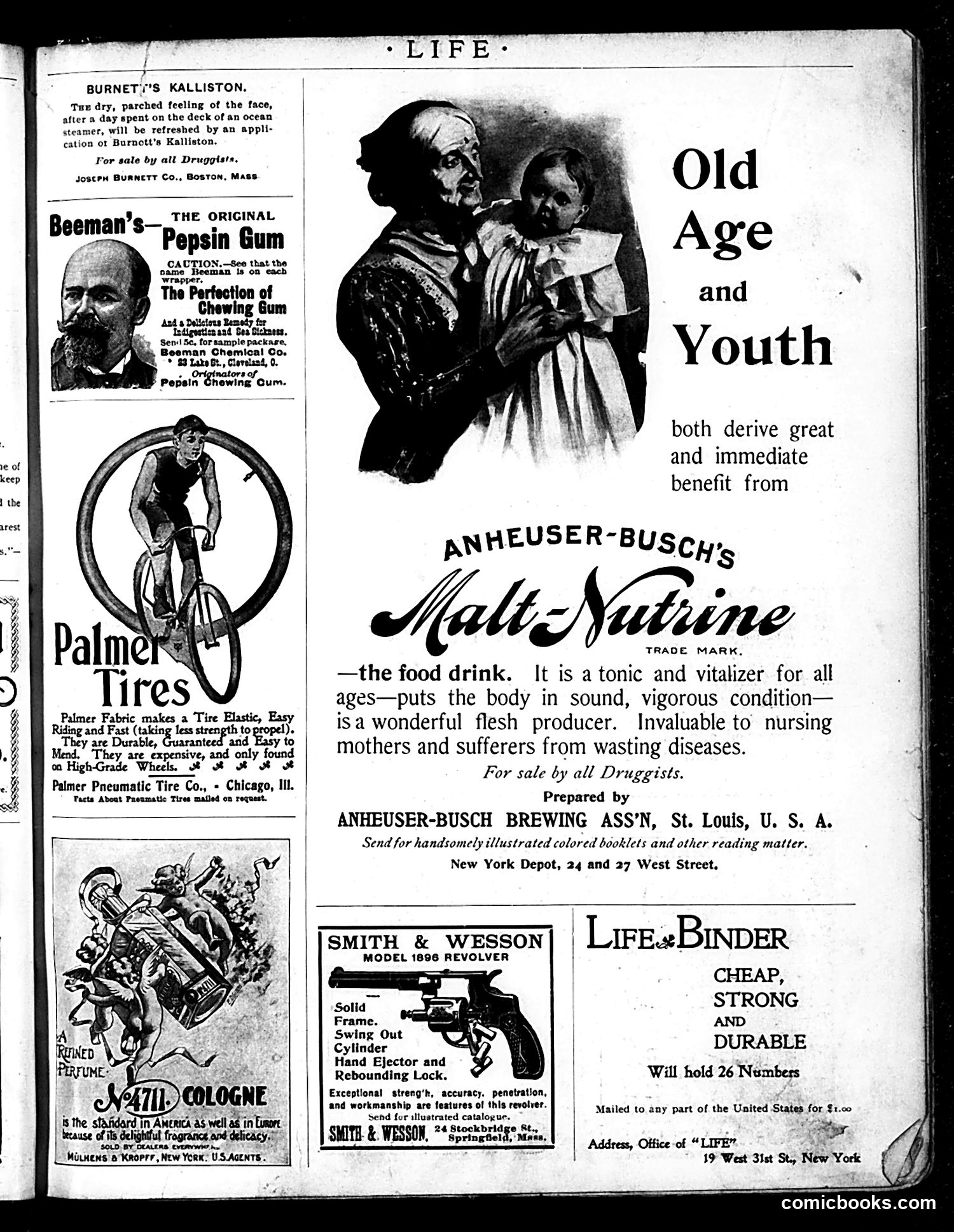
This page is primarily **advertising**, not satire or political commentary. It showcases late 19th/early 20th-century consumer products targeted at middle-class Americans: The central advertisement features **Anheuser-Busch's Malt Nutrine**, marketed as a "food drink" and health tonic for "all ages"—particularly nursing mothers and those with wasting diseases. The illustration depicts an elderly man and child, embodying the ad's claim that "Old Age and Youth both derive great and immediate benefit." Surrounding ads include: - **Burnett's Kalliston** (facial cosmetic for ocean travelers) - **Beeman's Pepsin Gum** (digestive aid) - **Palmer Tires** (bicycles) - **Smith & Wesson Model 1896 Revolver** - **No. 711 Cologne** (fragrance) - **Life Magazine Binder** These advertisements reflect period attitudes: patent medicines making dubious health claims were legal and commonplace; malt beverages were sold as nutritional supplements rather than alcohol; and firearms were marketed casually alongside toiletries.
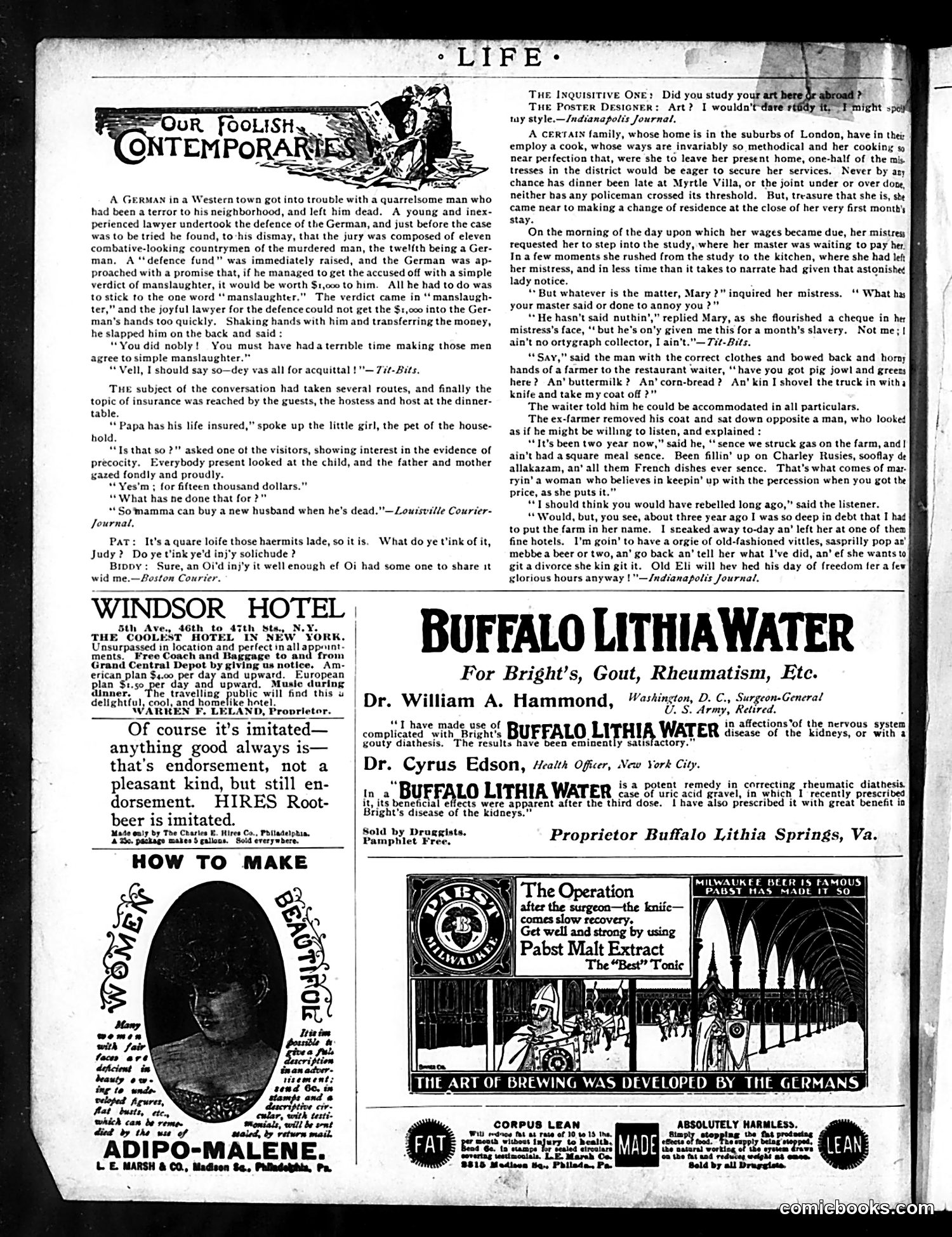
This page from *Life* magazine presents three brief satirical anecdotes mocking human nature and social pretension: 1. **The German Lawyer**: A German defendant's attorney promises a bribe to secure a "manslaughter" verdict from a jury of the victim's countrymen. The lawyer is shocked when the jury wanted outright acquittal—he wasted his bribe money. The satire targets corrupt legal practices and ethnic prejudice. 2. **Life Insurance Joke**: A child innocently explains her father insures his life "so mamma can buy a new husband when he's dead," exposing the mercenary aspects of marriage and insurance. 3. **The Farm Boy**: A newly wealthy farmer strikes oil and visits a restaurant, asking for rustic food (pig jowl, greens, cornbread) while boasting about his sudden wealth—satirizing the social awkwardness of nouveau riche attempting to maintain rural identity despite newfound money. The humor relies on vernacular speech, unexpected punchlines, and gentle mockery of working-class aspirations and moral flexibility.
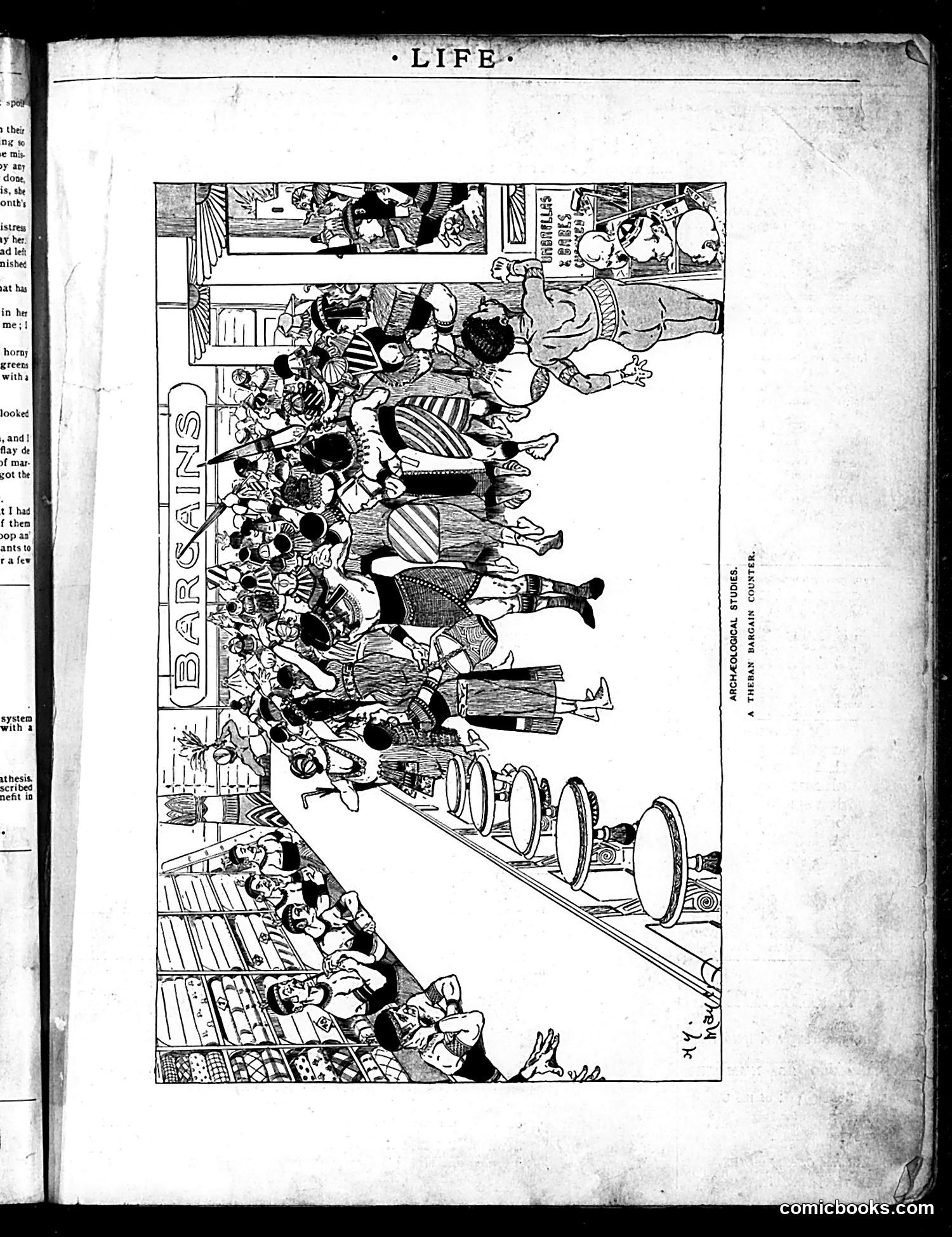
This appears to be a satirical cartoon about commercial excess or consumer culture, titled "BARGAINS" (visible on the left side). The image shows a chaotic street scene with crowds of people surging around what appears to be a storefront or sale event, with early automobiles visible at the bottom. The satire critiques the frenzied behavior of shoppers during sales or bargain events—depicting the undignified scramble and mob mentality that accompanies discount shopping. The crowded, disorderly composition emphasizes how consumers abandon restraint pursuing deals. The OCR text is largely illegible, preventing precise identification of specific satirical targets or contemporary references. Without clearer text, the exact political or social commentary remains unclear, though the general critique of commercialism and crowd behavior is evident from the visual composition alone.
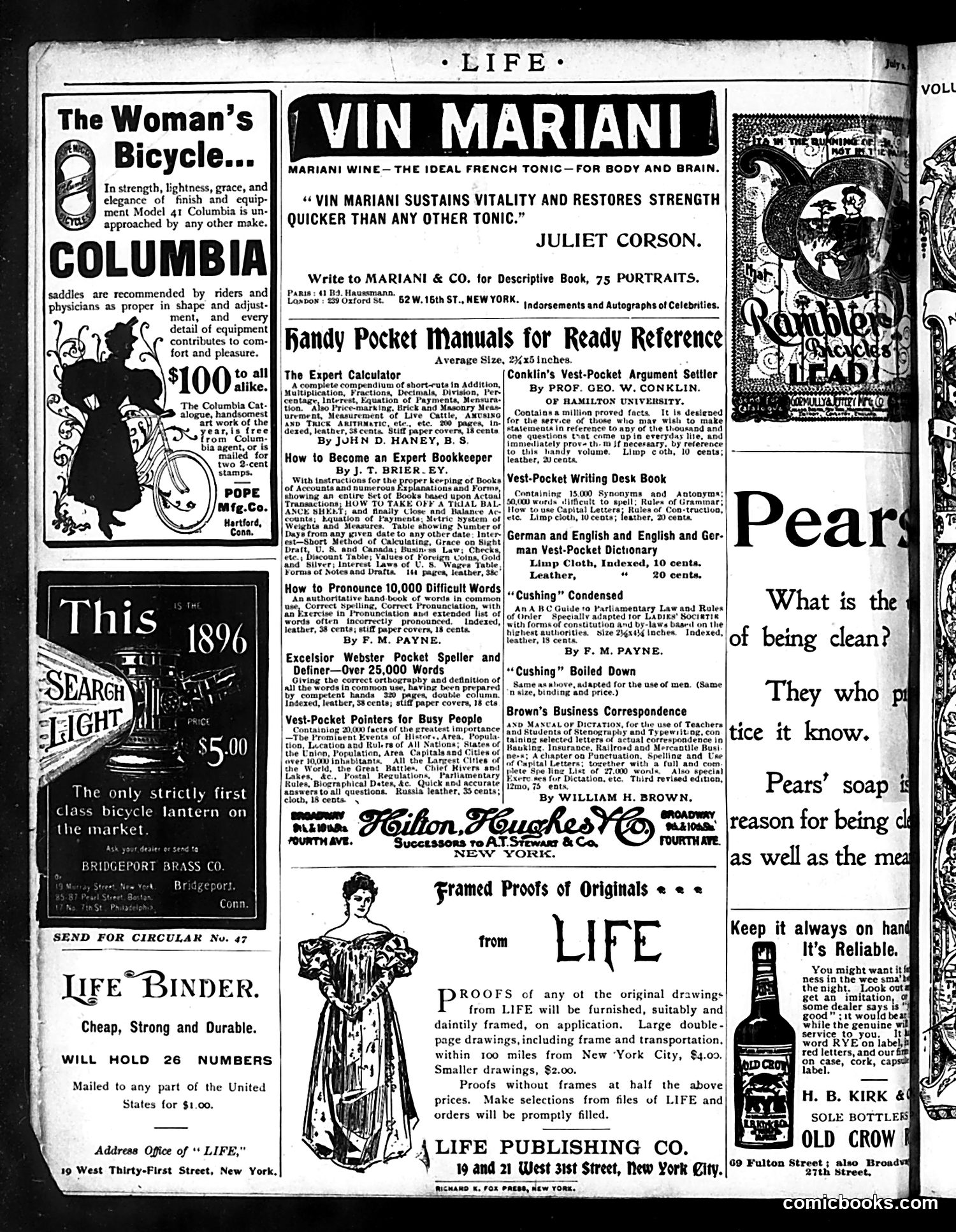
This page is primarily **advertising and product announcements**, not political satire. It showcases turn-of-the-century commercial offerings: **Notable Ads:** - **Vin Mariani**: A French wine tonic claiming to restore vitality and strength, endorsed by "Juliet Corson" (a real 19th-century cooking authority). Wine-based tonics were common patent medicines of the era, before modern FDA regulations. - **Columbia Bicycles**: Marketed specifically to women, emphasizing "The Woman's Bicycle" with safety features—reflecting the 1890s bicycle craze and emerging female independence. - **Search Light Lantern (1896)**: Promoted as the "first class bicycle lantern." **Life Binder & Pocket Manuals**: Advertisements for reference books on bookkeeping, pronunciation, spelling, and parliamentary procedure—typical self-improvement materials for middle-class readers. The page reflects **1890s consumer culture** and emerging markets targeting women and self-educated professionals, with no apparent political cartoon or satire.