
Life, 1896-07-02 · page 4 of 18
Life — July 2, 1896 — page 4: what you’re looking at
What you’re looking at
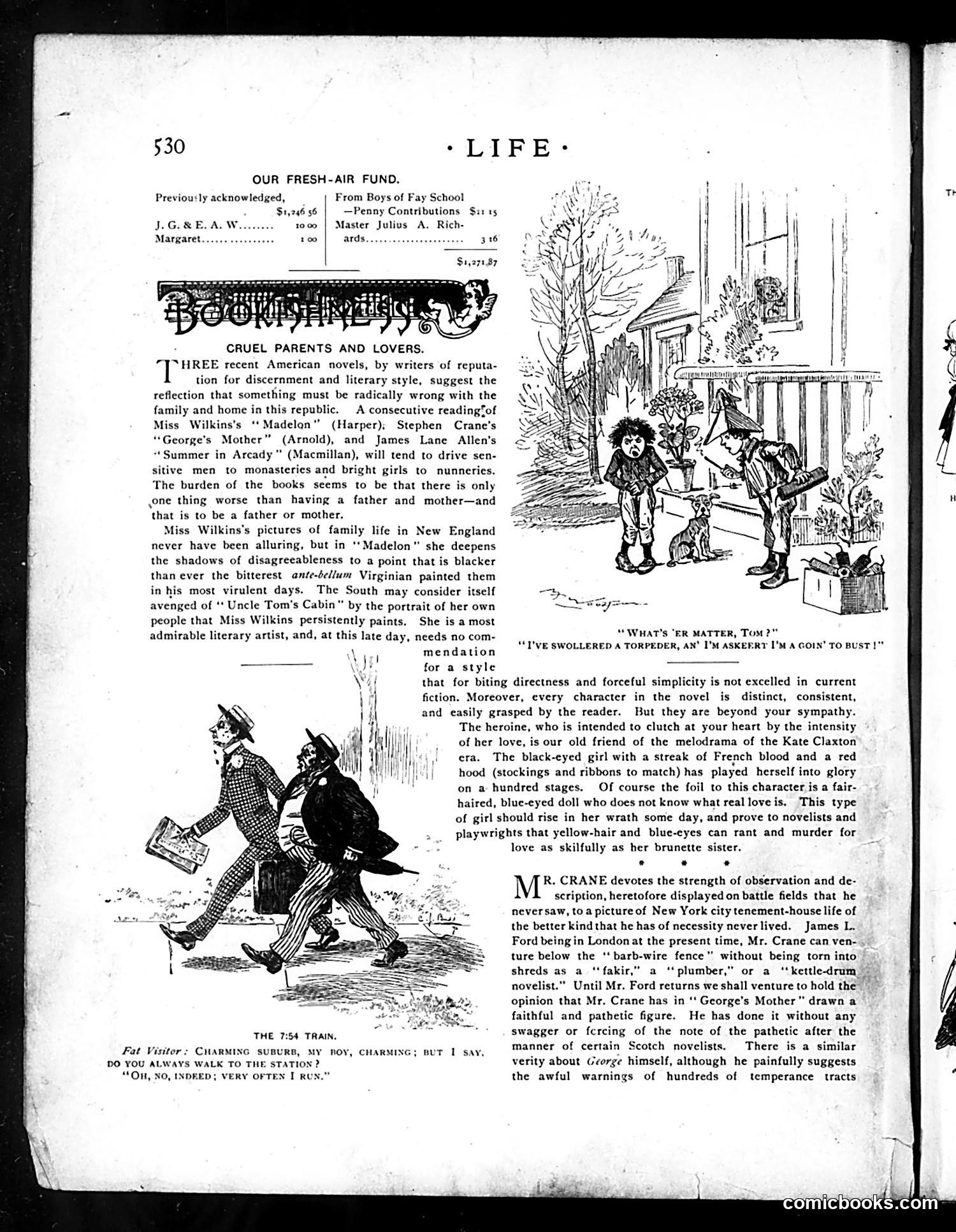
This page contains a literary review titled "Cruel Parents and Lovers" discussing three American novels about family dysfunction. The text critiques works by Wilkins, Crane, and Allen for depicting dysfunctional families and parent-child relationships. The two cartoons illustrate social commentary rather than political satire. The upper cartoon shows children at play near a house. The lower cartoon, captioned "The 7:54 Train," depicts a fat commuter being addressed by a woman, with dialogue about his walking habits to the station. These cartoons appear to satirize middle-class suburban life and domestic routines rather than reference specific political events. The page primarily functions as a literary review section with accompanying humorous illustrations about everyday social observations.
📄 Transcribed text from this page (OCR, searchable)
Machine-transcribed from the original scan — historical spelling and the odd misread are preserved.
530 *LIFE: OUR FRESH-AIR FUND. Previously acknowledged, From Boys of Fay School $1,246 6 | —Penny Contributions $:1 15 J.G.8E.ALW. Master Julius A. Rich- Margaret. . 316 $1,271.87 CRUEL PARENTS AND LOVERS. *[ BREE recent American novels, by writers of reputa- tion for discernment and literary style, suggest the reflection that something must be radically wrong with the family and home in this republic. A consecutive reading‘of Miss Wilkins’s ‘‘Madelon” (Harper); Stephen Crane's George's Mother” (Arnold), and James Lane Allen’s ummer in Arcady” (Macmillan), will tend to drive sen- sitive men to monasteries and bright girls to nunneries. The burden of the books seems to be that there is only one thing worse than having a father and mother—and that is to be a father or mother. Miss Wilkins's pictures of family life in New England never have been alluring, but in ‘*Madelon" she deepens the shadows of disagreeableness to a point that is blacker than ever the bitterest ante-bellum Virginian painted them in his most virulent days. The South may consider itself avenged of ‘* Uncle Tom's Cabin" by the portrait of her own y= people that Miss Wilkins persistently paints. She is a most admirable literary artist, and, at this late day, needs no com- mendation for a style that for biting directness and forceful simplicity is not excelled in current fiction. Moreover, every character in the novel is distinct, consistent, and easily grasped by the reader. But they are beyond your sympathy. The heroine, who is intended to clutch at your heart by the intensity of her love, is our old friend of the melodrama of the Kate Claxton era. The black-eyed girl with a streak of French blood and a red hood (stockings and ribbons to match) has played herself into glory on a hundred stages. Of course the foil to this character is a fair- haired, blue-eyed doll who does not know what real love is. This type of girl should rise in her wrath some day, and prove to novelists and playwrights that yellow-hair and blue-eyes can rant and murder for love as skilfully as her brunette sister. . * * M . CRANE devotes the strength of observation and de- scription, heretofore displayed on battle fields that he neversaw, toa picture of New York city tenement-house life of the better kind that he has of necessity never lived. James L. Ford being in London at the present time, Mr. Crane can ven- ture below the ‘barb-wire fence" without being torn into shreds as a ‘* faki a ‘‘plumber,” or a ‘kettle-drum~ novelist.” Until Mr. Ford returns we shall venture to hold the opinion that Mr. Crane has in ‘‘ George’s Mother” drawn a faithful and pathetic figure. He has done it without any swagger or fcrcing of the note of the pathetic after the Fat Visitor: CMARMING SUBURB, MY ROY, CHARMING; BUT I SAY, manner of certain Scotch: poveliata.”, “There, is 7s} almilar DO YOU ALWAYS WALK TO THE STATION ? verity about George himself, although he painfully suggests “ON, NO, INDRED; VERY OFTEN IR the awful warnings of hundreds of temperance tracts “WHAT'S "ER MATTER, Tom?” “I'VE SWOLLERED A TORPEDER, AN’ I'M ASKEERT I'M A GOIN’ TO BUST!" THE 7:54 TRAIN.