
A complete issue · 18 pages · 1896
Life — June 18, 1896
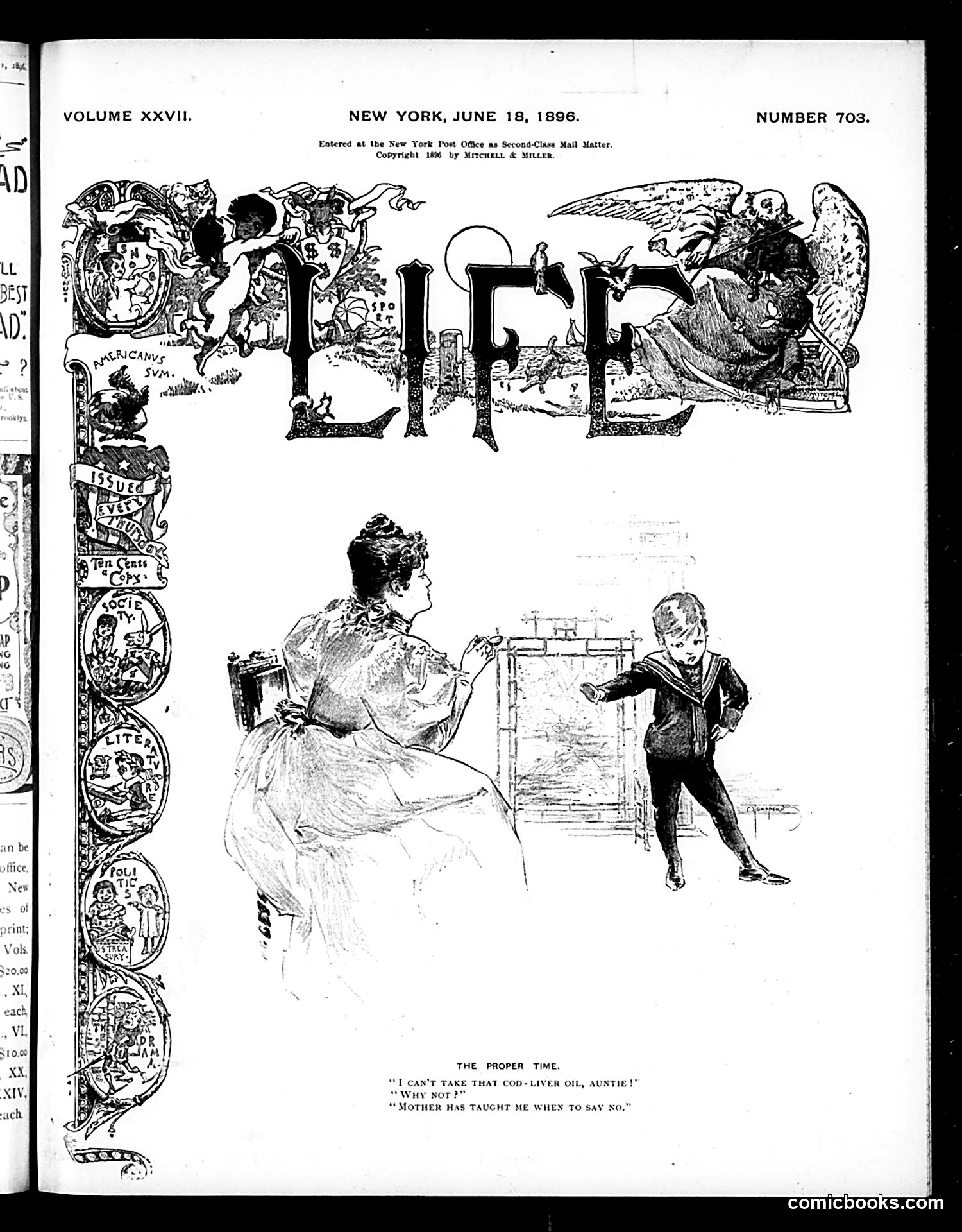
This cartoon depicts a domestic scene where a woman sits while a young boy stands nearby, apparently refusing to take cod-liver oil. The dialogue reads: "I can't take that cod-liver oil, Auntie!" / "Why not?" / "Mother has taught he when to say no." The satire addresses a timely parental concern: cod-liver oil was a common (and notoriously unpleasant) medicinal tonic given to children in the 1890s for health benefits. The joke plays on contemporary anxieties about child-rearing—specifically the tension between enforcing parental authority and teaching children when to assert independence or refuse things. The boy's refusal, framed as following his mother's teachings about saying "no," satirizes evolving attitudes toward child autonomy versus obedience in Victorian-era parenting debates.
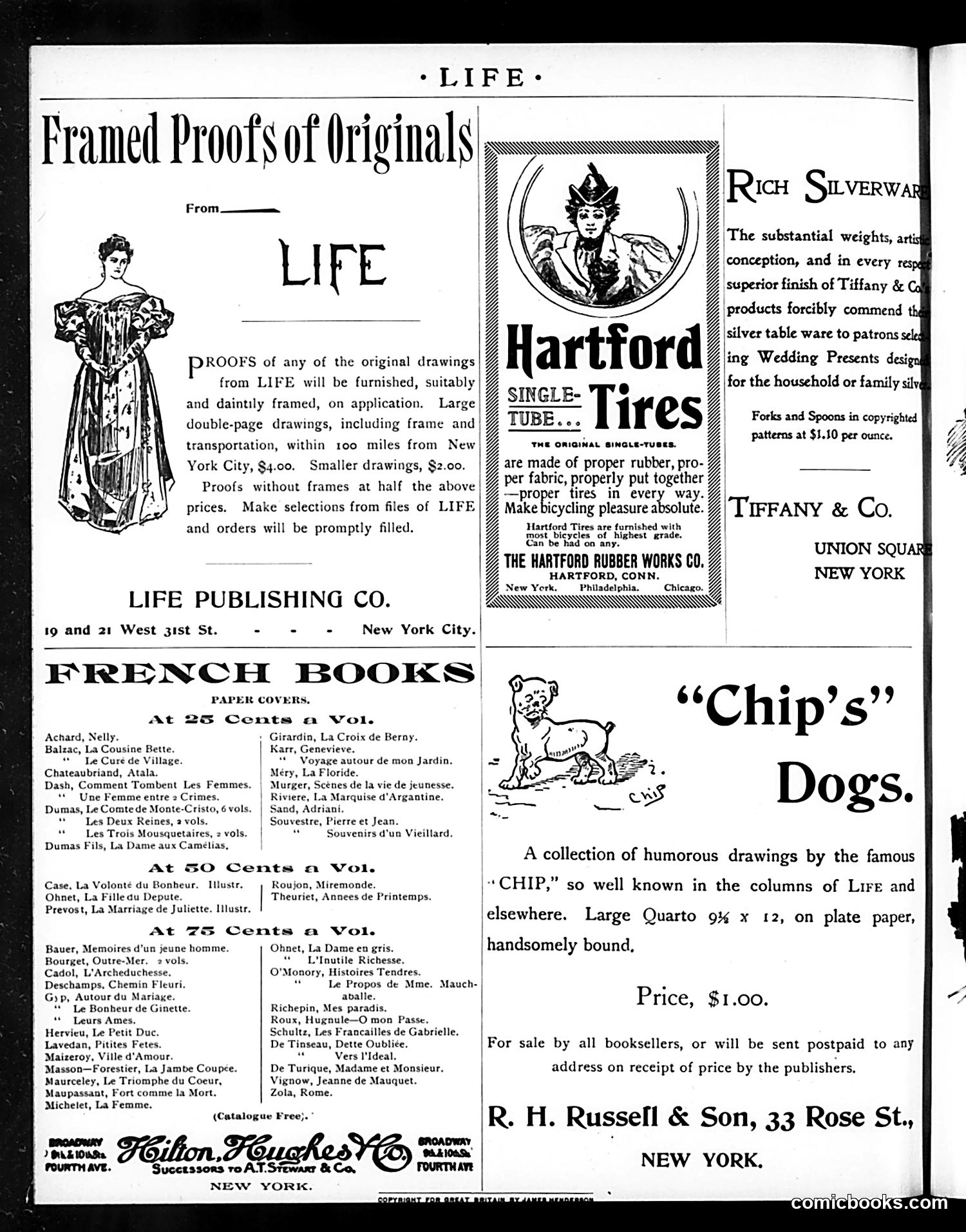
This page is primarily **advertising**, not satirical content. It contains four distinct ads: 1. **Life Publishing Co.** offers framed proofs of original drawings from *Life* magazine, available with or without frames at various prices. 2. **Hartford Tires** advertises single-tube bicycle tires, emphasizing quality rubber and construction for cycling pleasure. 3. **Tiffany & Co.** promotes rich silverware, highlighting the superior craftsmanship of their products for household and family use. 4. **"Chip's Dogs"** advertises a book of humorous dog drawings by the cartoonist "Chip," who was apparently well-known in *Life*'s columns. Priced at $1.00 and sold through R.H. Russell & Son. The page also lists French books available through Holton, Houghkes & Co. in New York. No political or social satire is evident—this is purely commercial content.
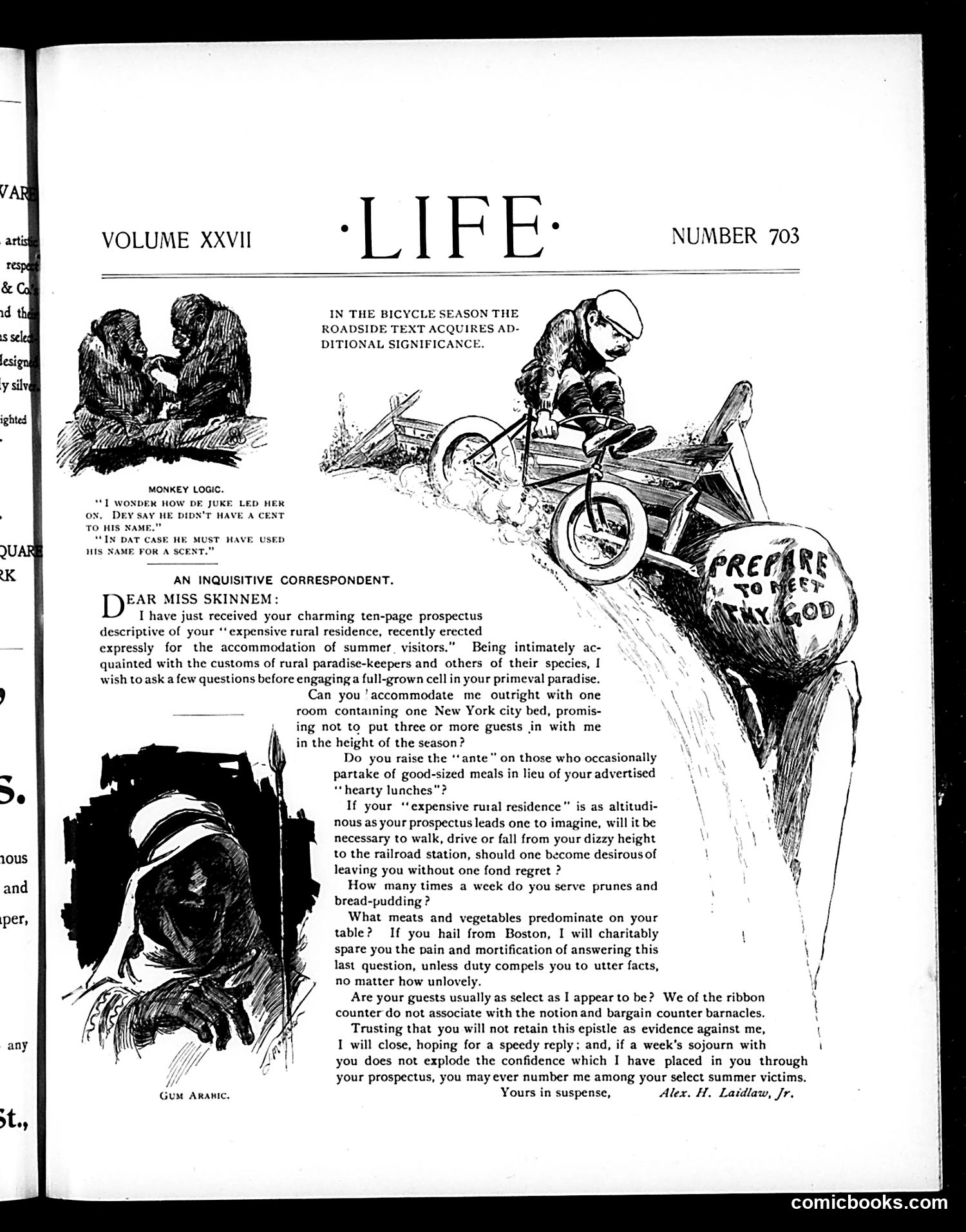
This page combines social satire with humor about early-1900s bicycling culture and rural hospitality. **Top cartoon ("Monkey Logic"):** A crude racial caricature labeled "Gum Arabic" jokes about a person of color using a jukebox—playing on racist stereotypes about Black Americans and mechanical entertainment. **Main cartoon:** Shows a cyclist on a runaway bicycle labeled "Prepare to Meet God," satirizing the bicycle craze's dangers. The "bicycle season" caption suggests cycling was a seasonal phenomenon for leisure travelers. **Letter:** A satirical "inquisitive correspondent" mocks wealthy urban visitors seeking "expensive rural residences" for summer stays. The writer humorously interrogates Miss Skinnem about accommodations, food, guest quality, and social pretensions—poking fun at rural landlords catering to city tourists and the class anxiety this created.
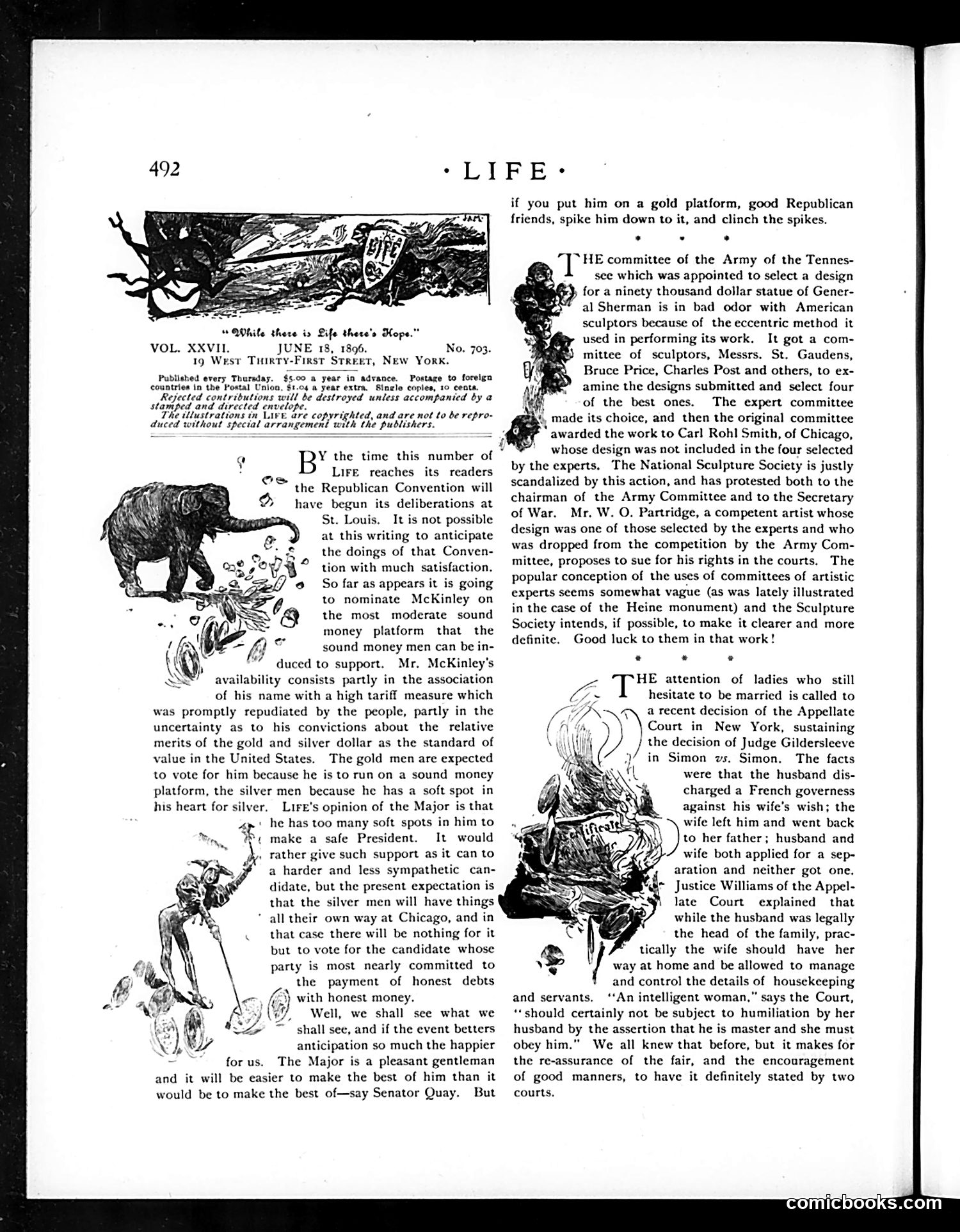
This page contains political satire about the 1896 Republican Convention and McKinley's presidential candidacy. The left column mocks the convention deliberations, using animal caricatures (appearing to represent different political factions) to satirize competing interests—specifically gold versus silver monetary standards, a major issue dividing Republicans. The text criticizes McKinley as a moderate compromiser on currency policy, suggesting he represents neither camp convincingly. The right column discusses a completely separate topic: a New York court ruling affirming husbands' legal authority over wives, which Life uses to satirize women's legal subordination. The cartoons illustrate these political and social commentary pieces through exaggerated character drawings typical of 1890s satirical journalism.
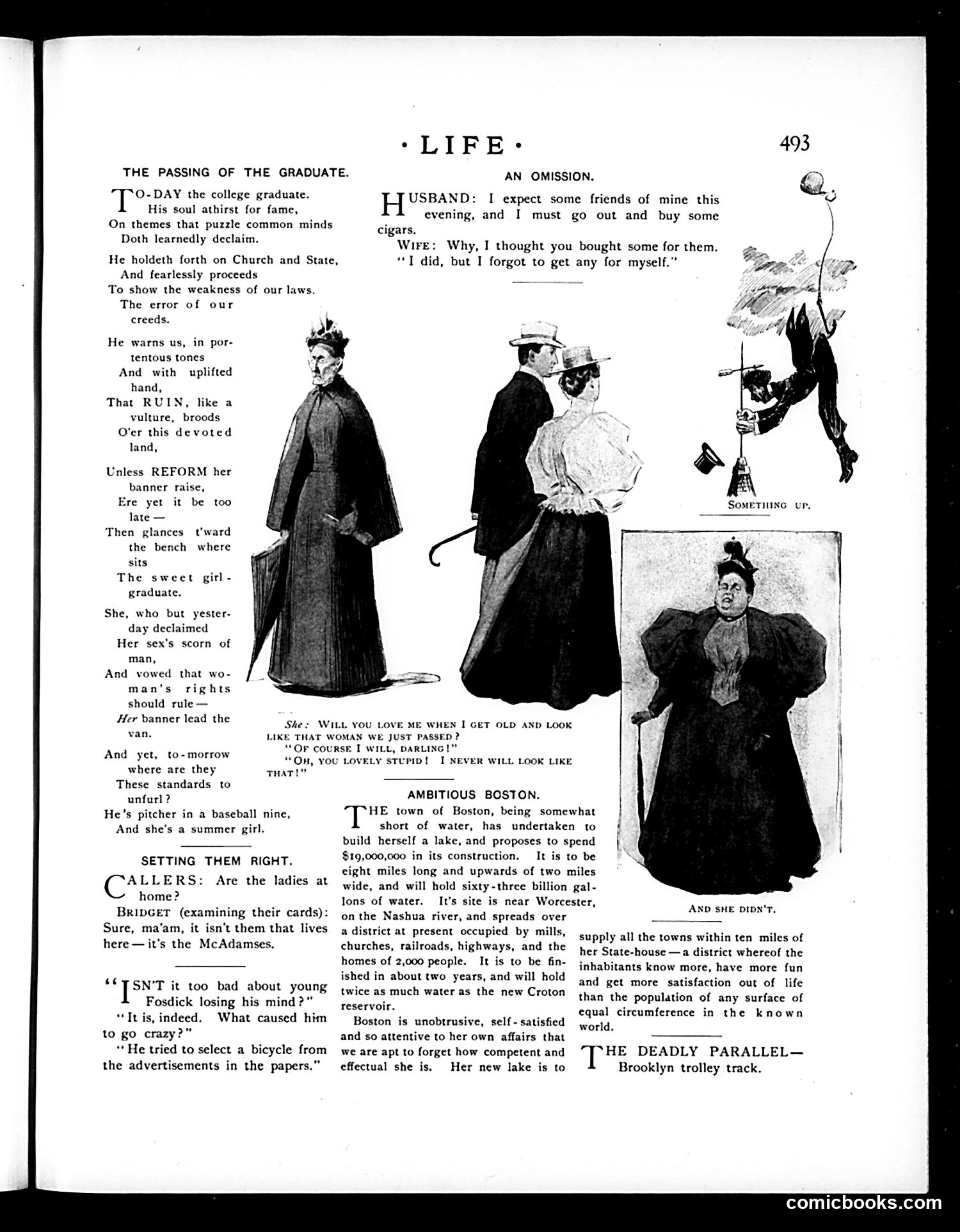
This page contains several satirical pieces mocking social conventions of the era: **"The Passing of the Graduate"** critiques a young woman college graduate who advocates for women's rights and reform but whose actual impact seems limited—she'll likely abandon her ideals for marriage. **"An Omission"** is a brief domestic joke about a husband forgetting to buy cigars for himself while shopping. **"Setting Them Right"** mocks a caller asking about "the McAdams ladies," with humor about a bicycle-related mental breakdown. **"Ambitious Boston"** discusses Boston's proposal to build a large artificial lake near Worcester. **"The Deadly Parallel"** references a Brooklyn trolley track incident. The cartoons use exaggerated illustrations and period-appropriate domestic/social situations typical of early 1900s American satirical humor.
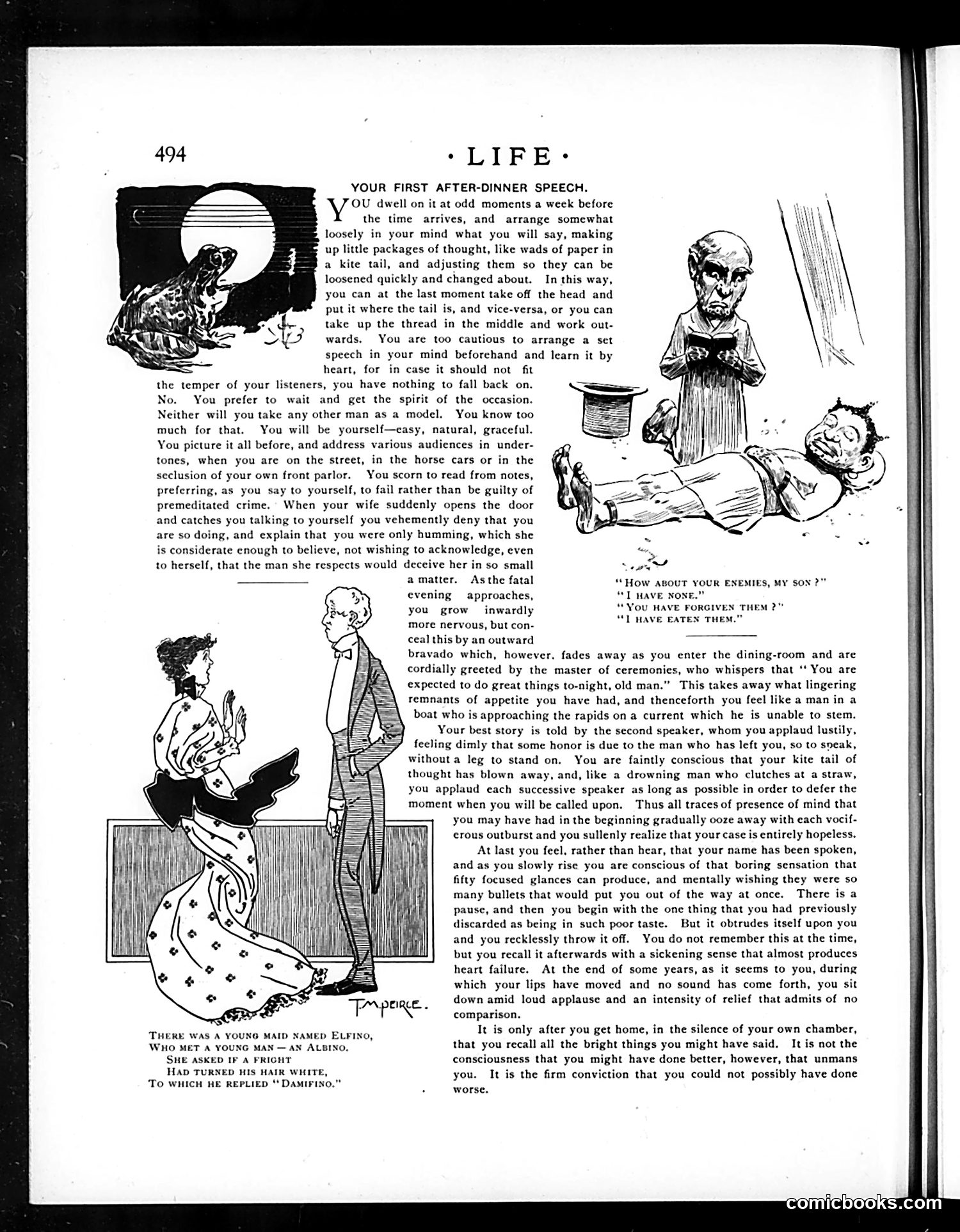
This satirical piece humorously advises nervous first-time after-dinner speakers on public speaking etiquette. The illustrations show various scenarios: a man sweating nervously, another gesturing awkwardly, and figures in formal dining attire. The satire targets common speaker anxieties—memorizing speeches, fear of forgetting lines, anxiety about audience judgment. It mocks the pretense of appearing "natural" while actually carefully rehearsed, and the desperate need to fill silence with applause from successive speakers. The closing illustrations (including one captioned with dialogue about "enemies" and "fates") appear to reference Dante's *Inferno*, suggesting after-dinner speeches are themselves a kind of social torment. The piece ultimately satirizes Victorian-era social conventions requiring public speaking performances at formal dinners, treating the ordeal as both ridiculous and nearly unavoidable.
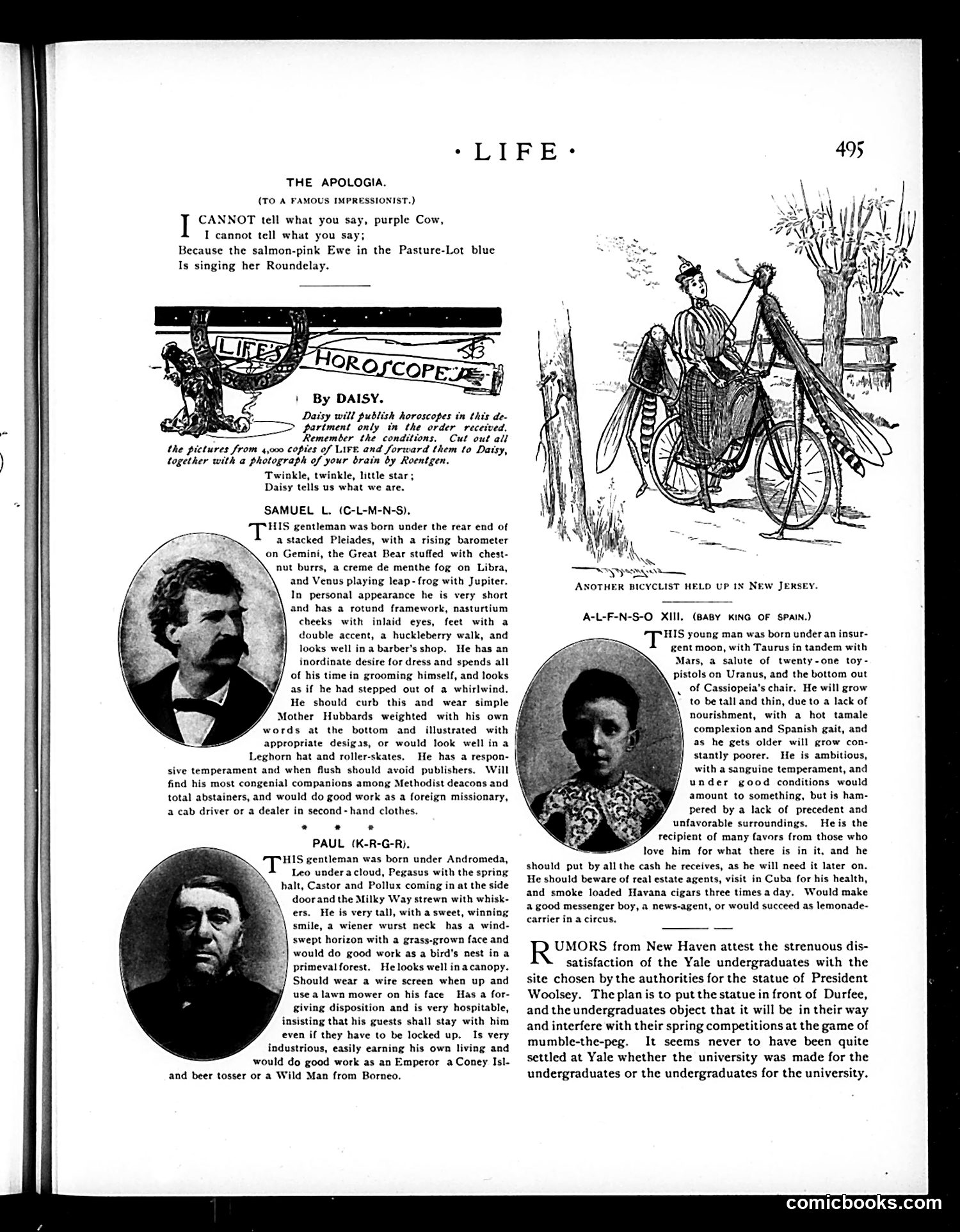
This page combines horoscope satire with character sketches. "The Apologia" mocks a famous Impressionist painter (unnamed here) who cannot articulate their artistic vision—the salmon-pink cow and roundelay reference abstract/modernist elements that baffle conventional understanding. The horoscope section profiles three individuals under zodiac signs: Samuel L. (Gemini), Paul (Virgo), and Alfonso XIII (Baby King of Spain). These appear to be contemporary public figures receiving satirical character assessments based on astrological signs. The text critiques their personal habits, ambitions, and foibles in mock-serious horoscope format. The page also includes a bicycle cartoon showing another cyclist "held up in New Jersey," likely referencing contemporary robberies or traffic incidents. Overall, this represents *Life's* satirical approach: mixing art world mockery, celebrity roasting, and humorous current events commentary.
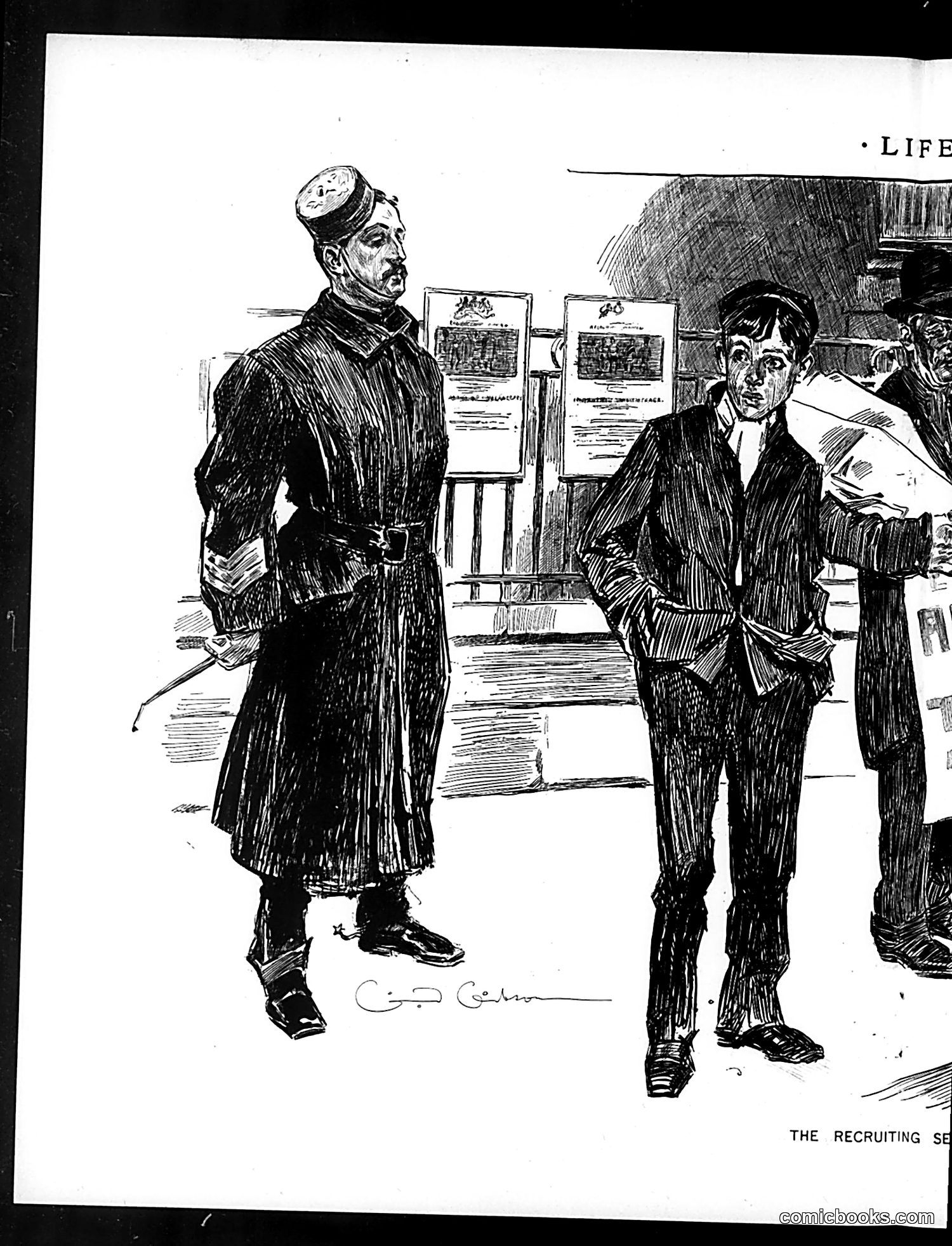
This ink sketch depicts a military recruiting scene. A uniformed sergeant (left) with a distinctive cap addresses a civilian man (right) in an indoor setting with posted notices visible in the background—likely recruitment posters typical of military enlistment offices. The satire appears to comment on military recruitment practices, though the specific historical context isn't entirely clear from the image alone. The exaggerated facial expressions and body language suggest the cartoon mocks either the recruiter's persuasive tactics or the civilian's reluctance to enlist. The artist's signature is visible at bottom left. Without additional context from Life magazine's publication date, the specific conflict or social situation being satirized remains unclear.
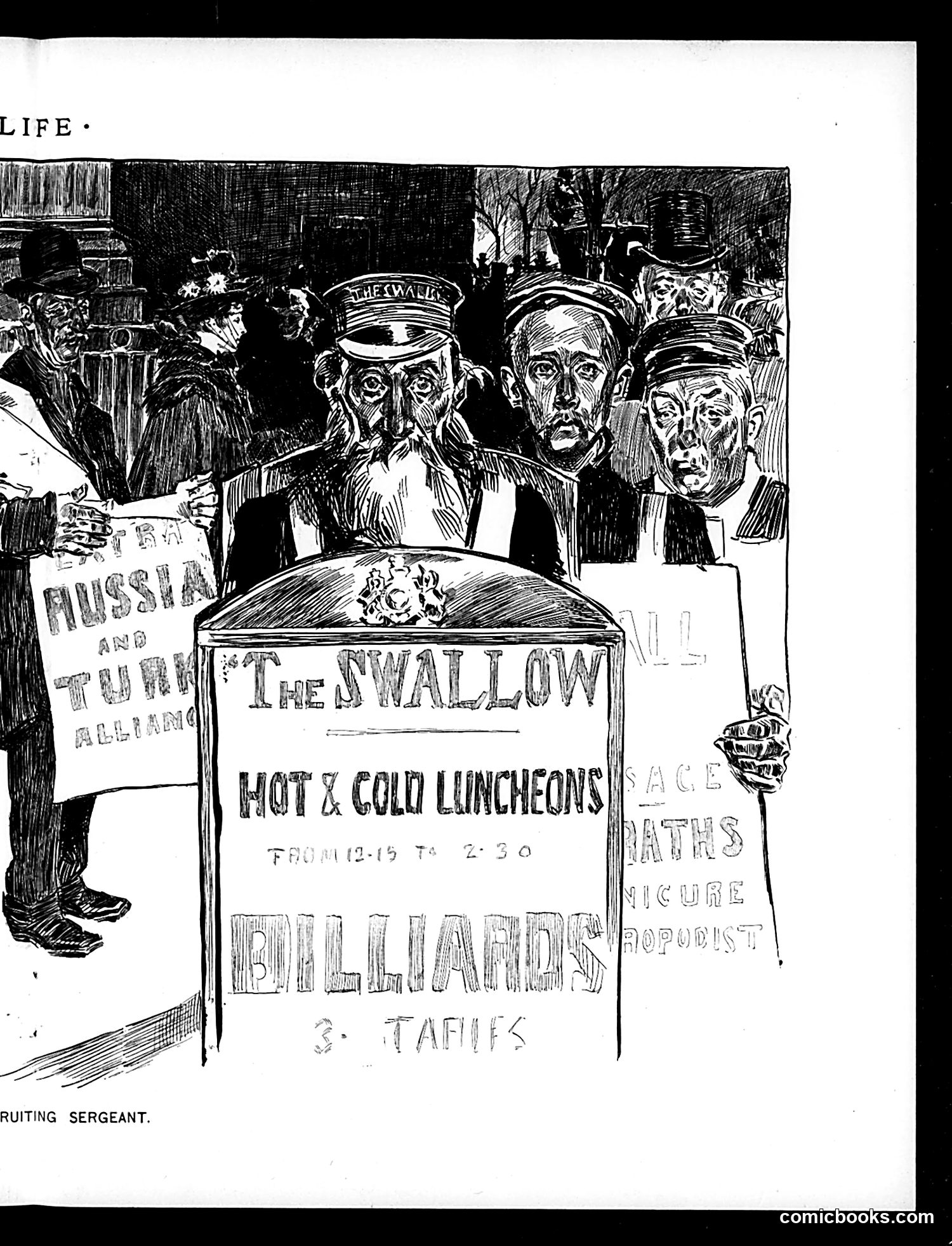
This cartoon satirizes international diplomatic negotiations, likely from the WWI era based on references to "Russia and Turkey Alliance" visible on a poster. The central figure appears to be a military or political leader being presented with "The Swallow" restaurant's offerings—"Hot & Cold Luncheons" with specific pricing and a "3-Tariff" note. The satire suggests that while serious geopolitical alliances are being negotiated (Russia-Turkey), the real business being conducted involves commercial dealings and tariffs. The uniformed figures surrounding the menu represent various national interests. The cartoon mocks how economic concerns disguised as diplomatic matters actually drive international relations, reducing grand alliance-building to mere commercial transactions.
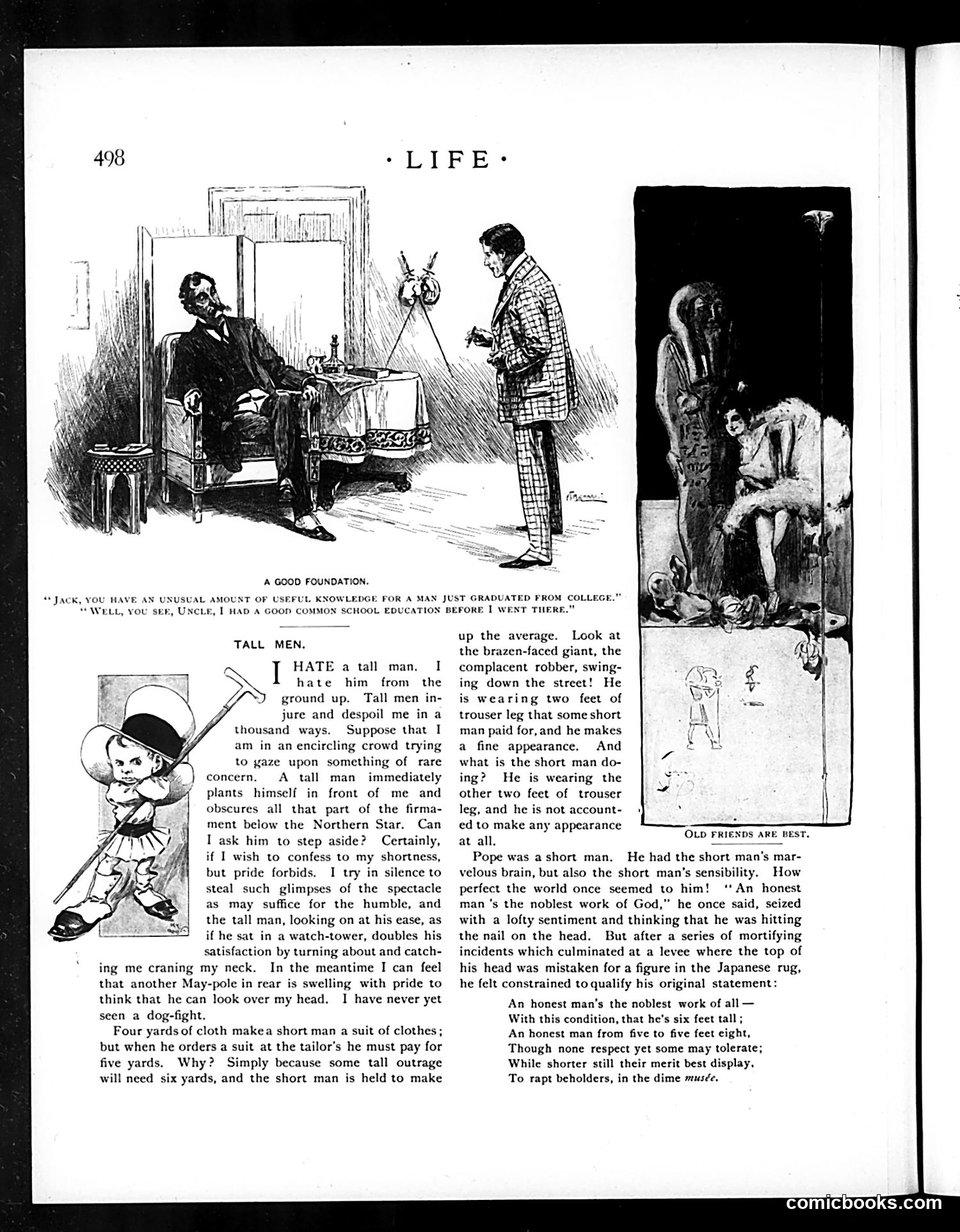
This page contains two satirical pieces about social hierarchies. **"A Good Foundation"** (top cartoon) depicts a college graduate being praised for his "useful knowledge" by his uncle, who had only "common school education." The joke mocks the pretentiousness of formal education—the graduate's knowledge appears purely theoretical. **"Tall Men"** (bottom section) satirizes discrimination against short men. The author expresses frustration that tall men monopolize social respect despite no actual merit, comparing their arbitrary advantage to a dog-fight. The piece notes absurdities: tall men can wear clothes that fit poorly and still look respectable, while short men cannot. A poem concludes that honest merit should matter more than height—a direct critique of society's superficial status judgments based on physical characteristics rather than character.
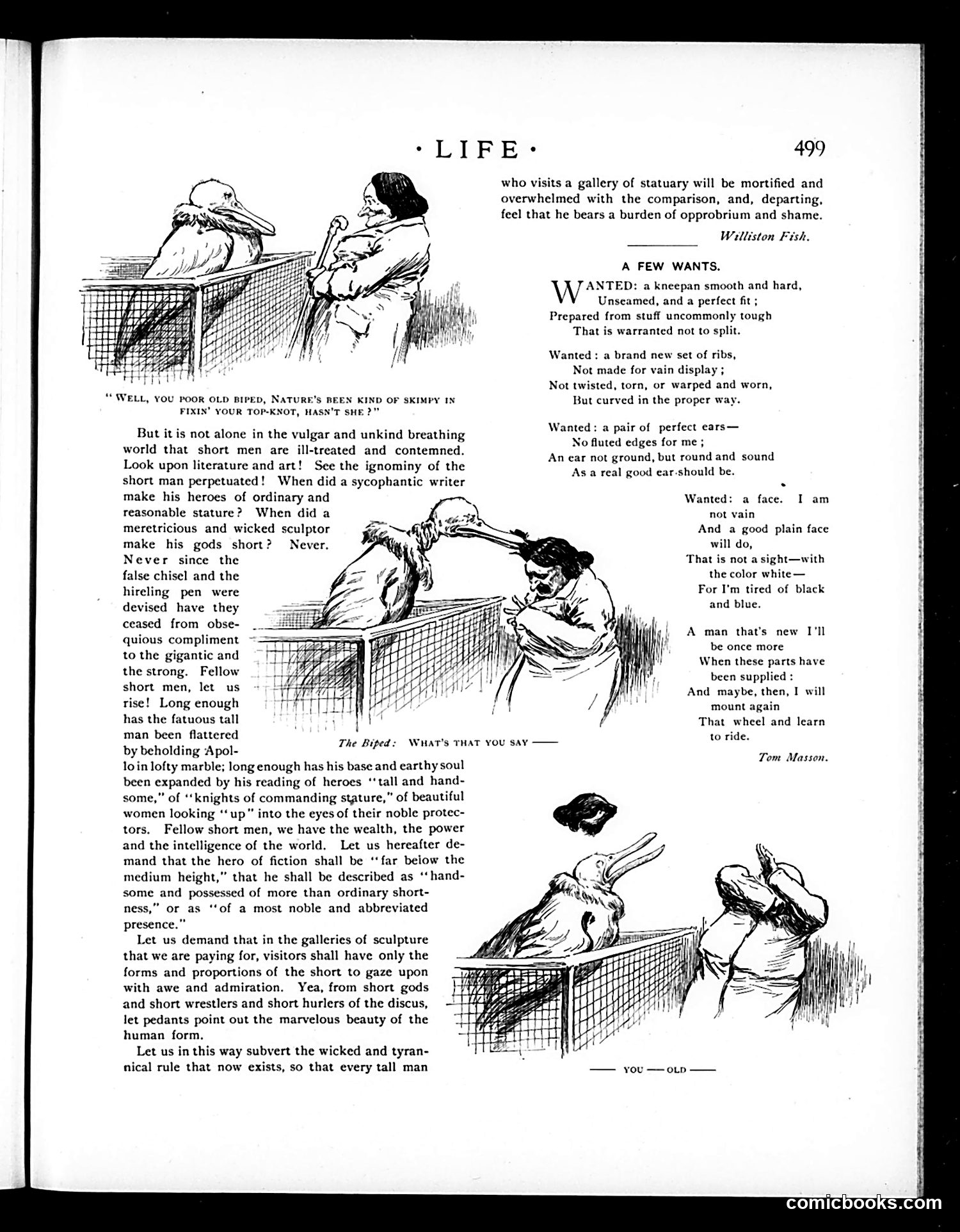
This page contains a satirical essay defending short men against social prejudice, accompanied by three sketch illustrations showing short men in awkward situations with taller figures. The main text argues that literature and art unfairly depict short men as comic or inferior, and demands that fictional heroes—and sculptures in galleries—should no longer be required to possess exceptional height. The author uses humor to mock the cultural bias treating shortness as a character flaw. The right column presents "A Few Wants"—a humorous list of desired improvements by a short man, including a properly-fitted kneespan, undamaged ribs, perfect ears, and a plain face. The final want is a working bicycle after these physical improvements. The sketches illustrate the physical indignities short men endure in a world designed for taller people.
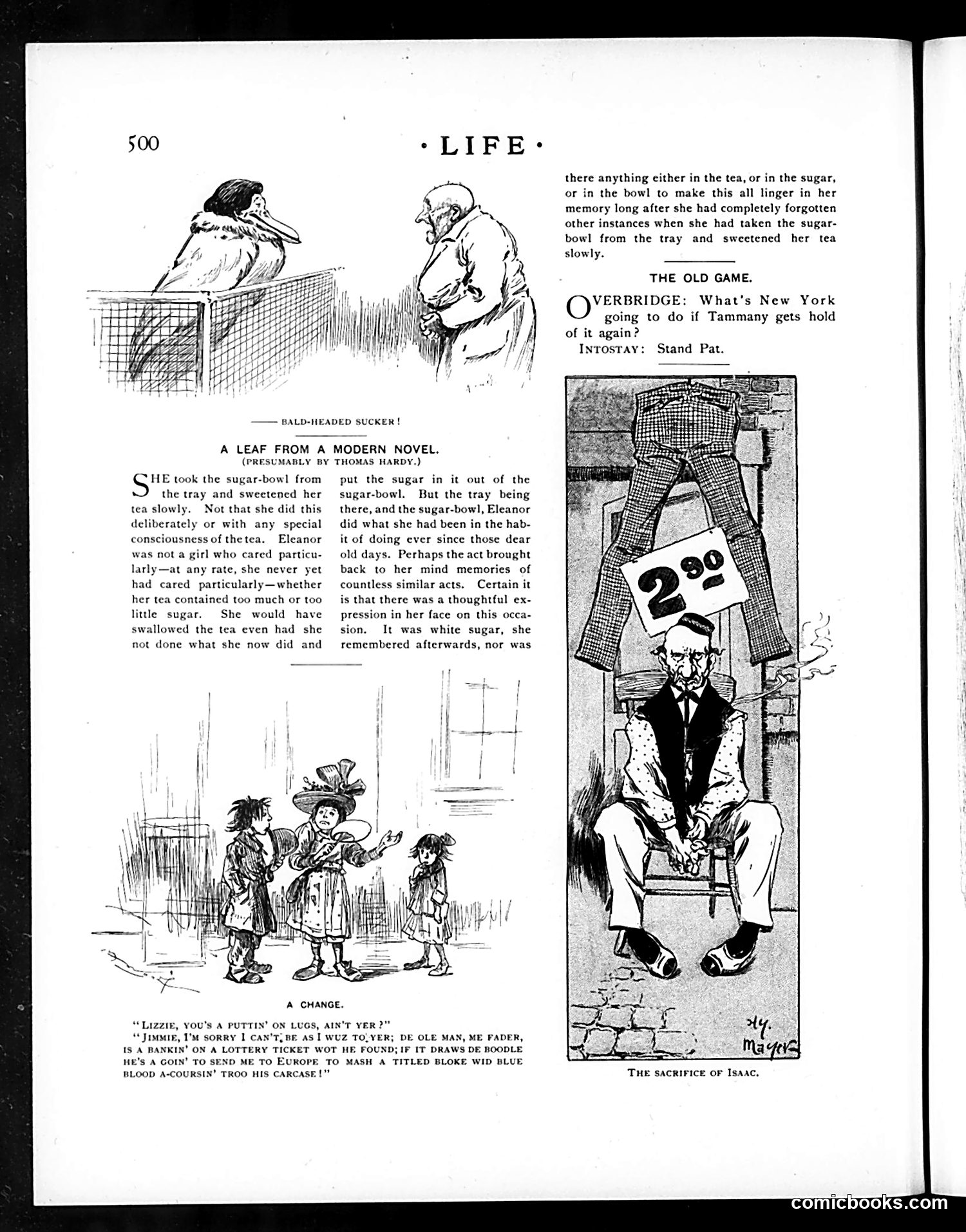
This page contains three distinct satirical pieces: **"A Leaf from a Modern Novel"** parodies Thomas Hardy's dense, overly introspective literary style by presenting an absurdly trivial scene—a woman sweetening tea—with pretentious psychological analysis about sugar bowls and memory. **"A Change"** is working-class dialogue satire. A woman ("Lizzie") claims she's putting on airs because she won a lottery ticket and plans to marry a titled British nobleman ("a bloke wid blue blood"). It mocks both social climbing and the fantasy of lottery wealth solving poverty. **"The Old Game"** references Tammany Hall, New York's corrupt Democratic political machine. The dialogue suggests that regardless of what happens politically, Tammany will maintain power through established corrupt practices—"Stand Pat" meaning maintain the status quo. **"The Sacrifice of Isaac"** (bottom right cartoon) depicts a man offering up a price tag of $2.90, likely satirizing commercial greed or exploitation, though the specific reference is unclear.
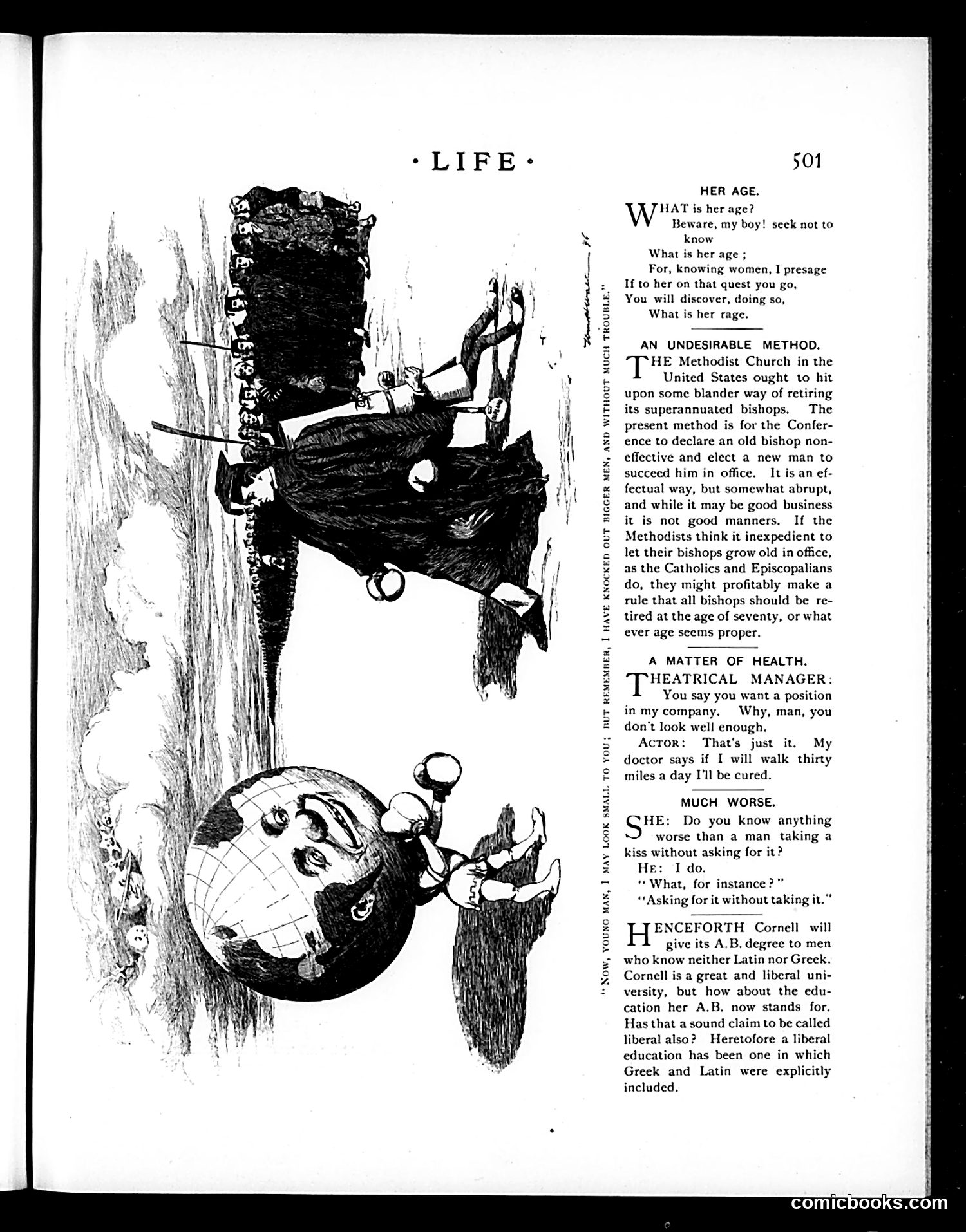
This page contains four brief satirical pieces typical of early 20th-century *Life* magazine humor: 1. **"Her Age"**: A humorous poem warning men against asking women their age, suggesting they'll discover female anger instead. 2. **"An Undesirable Method"**: Editorial commentary criticizing the Methodist Church's practice of abruptly retiring bishops by declaring them "non-effective" rather than adopting a gentler mandatory retirement age (like 70), as Catholic and Episcopalian churches do. 3. **"A Matter of Health"**: A joke about an actor seeking employment, claiming his doctor prescribed 30 miles of daily walking as a cure—implying he looks too ill to hire. 4. **"Much Worse"**: A brief dialogue joke about kissing: a woman says taking a kiss without asking is bad; a man counters that asking without taking is worse. 5. **"Henceforth Cornell"**: Criticism of Cornell University's decision to award A.B. degrees without requiring Latin or Greek, questioning whether such degrees merit the "liberal education" label when those languages were traditionally essential.
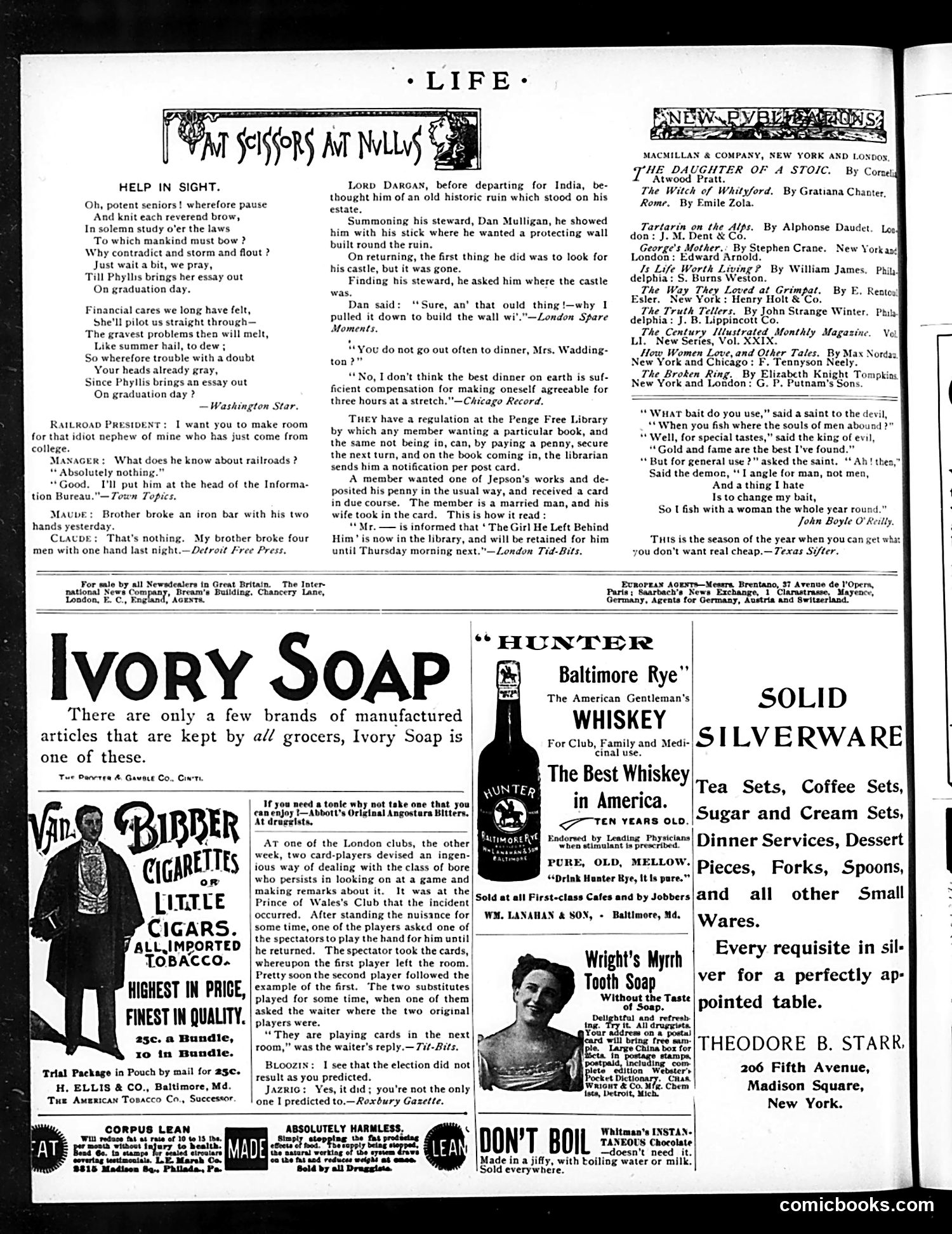
This page contains multiple short humorous pieces satirizing contemporary society (circa 1890s): **"Help in Sight"** mocks senior college women, suggesting a graduating girl named Phyllis will solve the nation's financial and legal problems through her essay—satirizing both excessive faith in education and the limited roles available to educated women. **The railroad anecdote** ridicules nepotism and incompetence in business: a railroad president hires his "idiot nephew" with "absolutely nothing" of qualifications directly into an information bureau, suggesting qualifications are irrelevant in the Gilded Age business world. **"The Girl He Left Behind Him"** joke plays on ambiguous library notification wording—a married woman intercepts her husband's library card notice about a book title, creating scandal where none exists. It satirizes both the potential for misunderstanding and gossip in respectable society. **Other brief items** mock pretension, social climbing, and marital dissatisfaction among the educated classes. The page is primarily **satirical content and period advertising** rather than political cartooning in the visual sense.
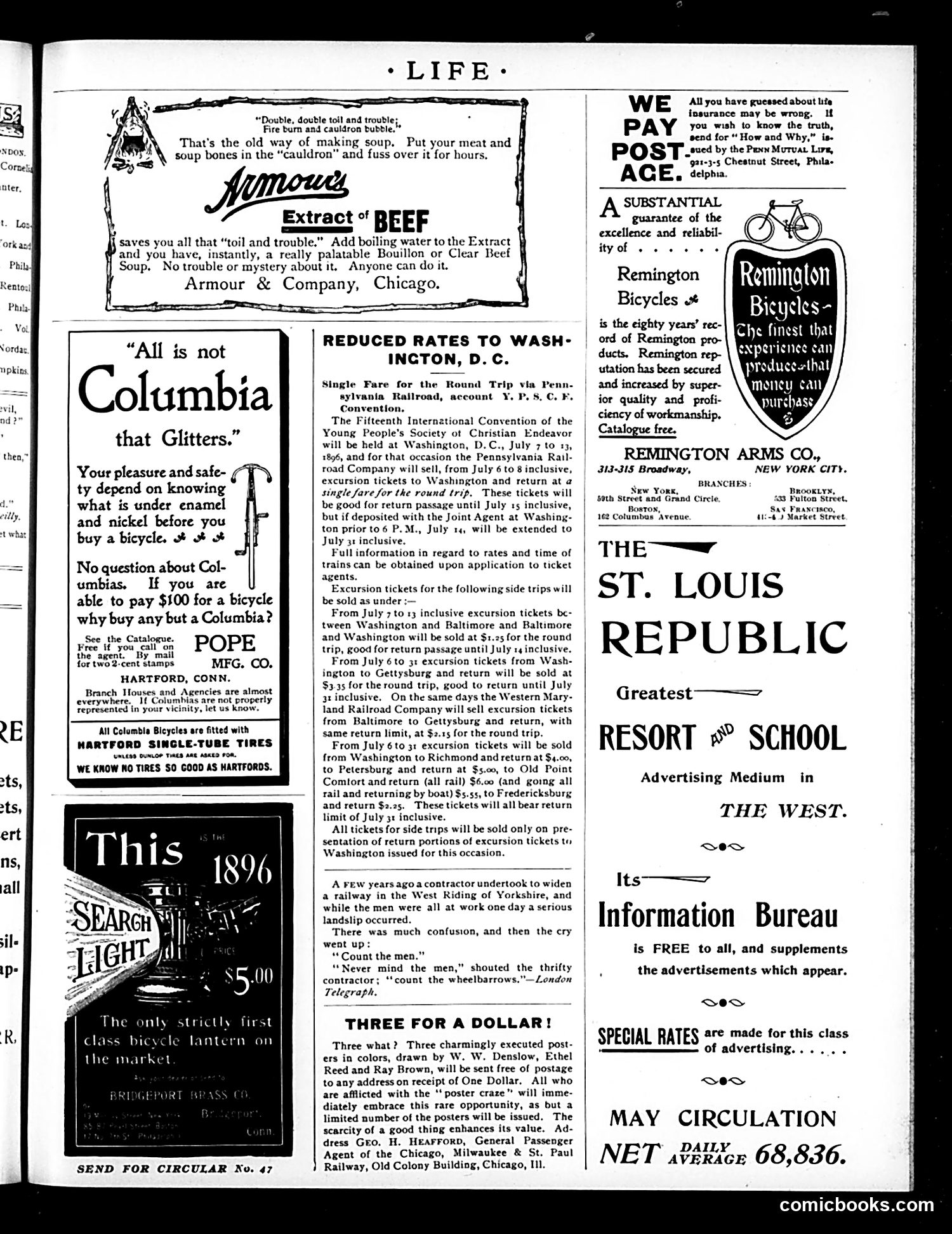
This page is primarily **advertising** with minimal editorial content. The main elements include: **Key Advertisements:** - **Armour's Beef Extract**: Uses the "double, double toil and trouble" opening from *Macbeth* to humorously contrast old-fashioned soup-making (witches' cauldron imagery) with instant modern convenience via their product. - **Columbia Bicycles**: Emphasizes quality and brand prestige, asking why buy cheaper alternatives when you can afford a superior product. - **Search Light Bicycle Lantern** (1896): Markets itself as "the only strictly first class bicycle lantern." **Notable Content:** A brief anecdote about a Yorkshire railway contractor prioritizing wheelbarrow inventory over worker safety during a landslip—a dark joke about misplaced priorities in industrial labor. The page reflects 1896 consumer culture: bicycles were luxury goods, instant food products represented technological progress, and advertising employed literary references and humor to appeal to educated readers.
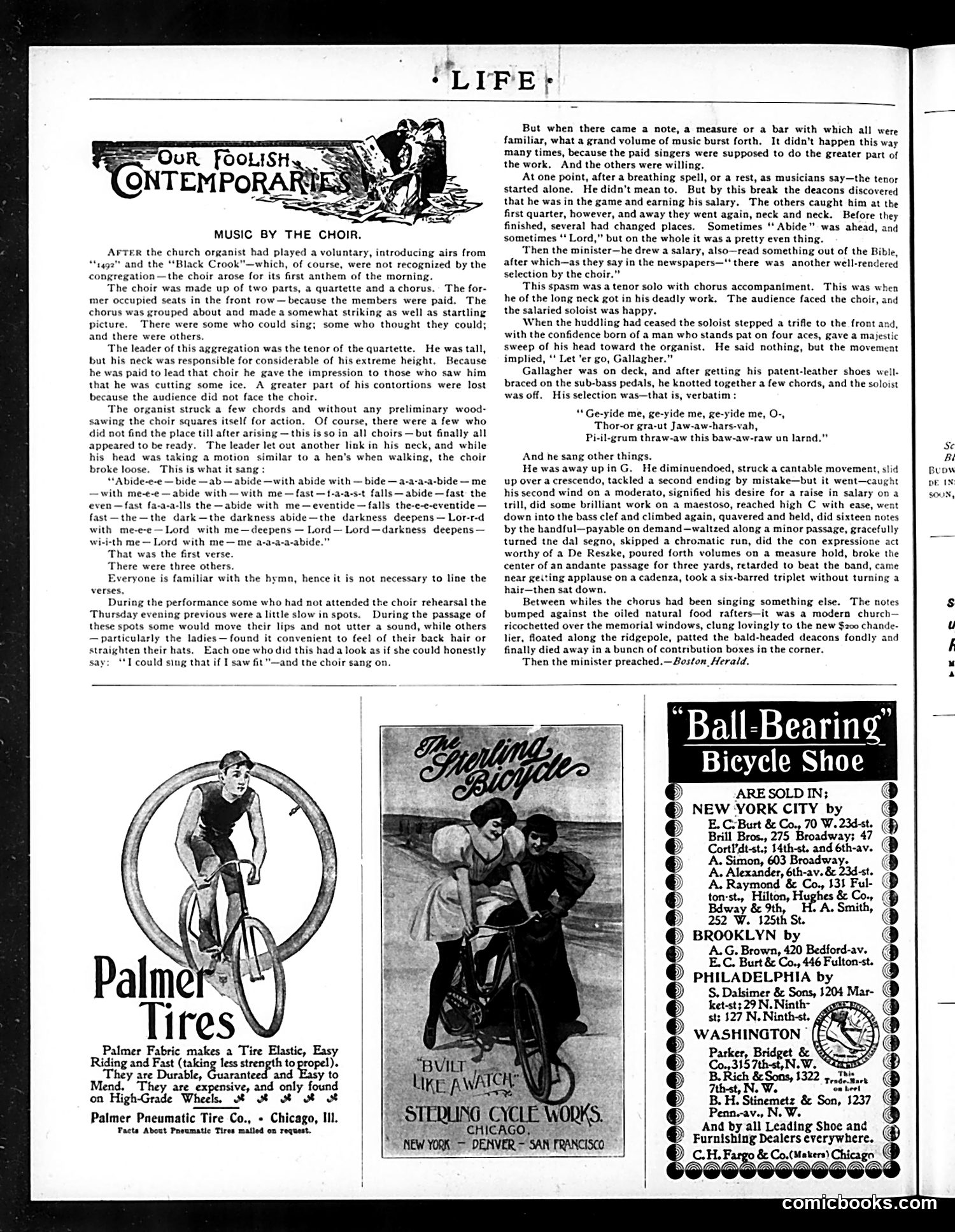
This humorous essay mocks amateur church choirs and paid musical performers. The satire targets: **The Setup:** A church choir composed of paid quartette singers (front row) and unpaid volunteers (back), led by a lanky tenor with an exaggerated neck who conducts ostentatiously despite minimal actual talent. **The Joke:** When choir members encounter unfamiliar music passages, they mime singing or adjust their hair rather than admit ignorance. They only confidently belt out well-known hymn portions. The paid tenor soloist, despite mediocre ability, performs with unearned swagger once he gets a solo. **The Social Satire:** This mocks the pretense of church music—how performers prioritize appearance over genuine skill, how paid musicians lord their status over volunteers, and how congregations accept this theatrical mediocrity as spiritual enhancement. The minister also "draws a salary," grouping clergy with other self-interested performers. The detailed transcription of the hymn's garbled lyrics ("Abide-e-e—bide") emphasizes the absurdity and lack of coordination.
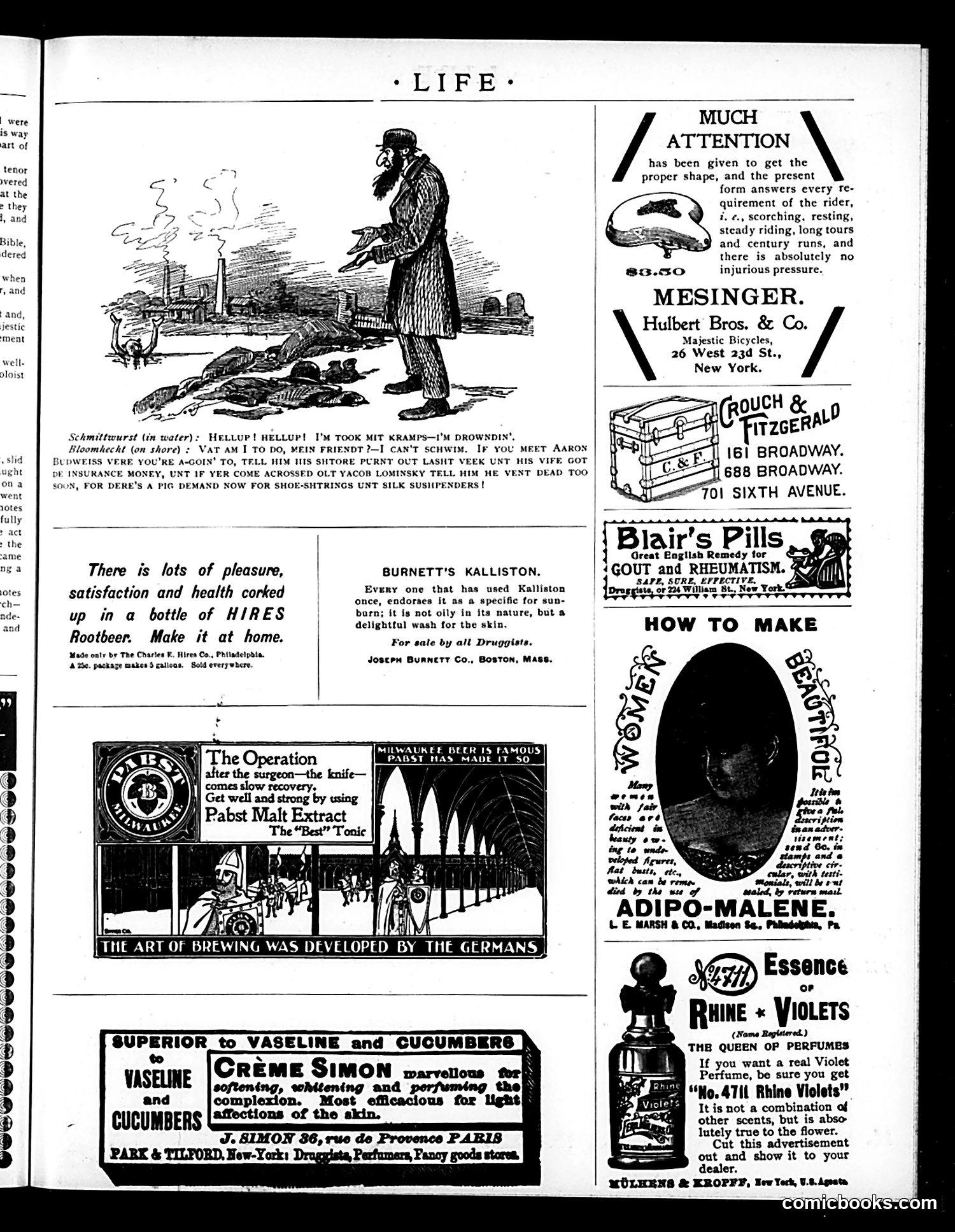
The main cartoon depicts two Jewish immigrants—Schmittwurst drowning in water and Bloomhecht on shore—speaking in thick Yiddish-inflected English dialect. The humor relies on ethnic caricature and stereotyping common to early 1900s American satire. While appearing to be a rescue scenario, Bloomhecht ignores the drowning man to gossip about local Jewish business owners' misfortunes (store fire, death, wife's insurance claim), ending with a callous joke about demand for suspenders—suggesting profiteering from others' tragedies. The cartoon reflects the period's casual antisemitic humor targeting Jewish immigrants, portraying them as materialistic and indifferent to suffering. The exaggerated dialect and names reinforce ethnic stereotyping typical of *Life* magazine's satirical approach to immigrant communities. The rest of the page consists entirely of period advertisements (bicycles, patent medicines, cosmetics, beer), typical of magazine layouts from this era.
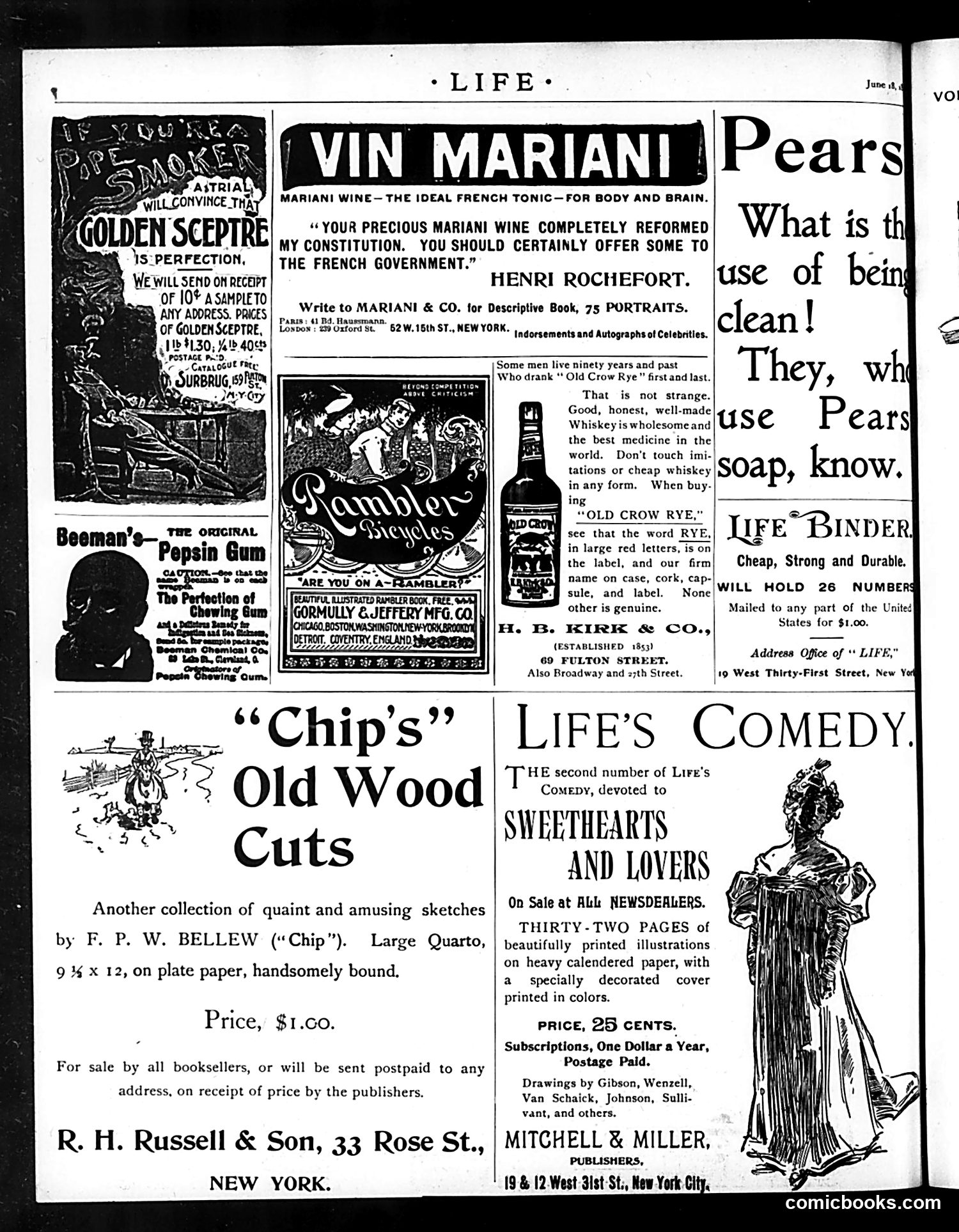
This page is primarily **advertising**, not political satire or comics. It contains multiple product advertisements typical of early 1900s publications: **Key advertisements:** - **Vin Mariani**: A French wine tonic marketed as medicinal, endorsed by Henri Rochefort (a French political figure). The claim that it "reformed" his constitution reflects the era's belief in alcohol as health tonic. - **Old Crow Rye whiskey**: Advertised as "wholesome" medicine, typical of pre-Prohibition rhetoric when whiskey was marketed for health benefits. - **Beeman's and Golden Sceptre** chewing gums - **"Chip's" Old Wood Cuts book** by F.P.W. Bellew - **Life Binder** and **Life's Comedy** (a comic publication) The page reflects **early 1900s patent medicine culture**, when alcoholic tonics were sold as cure-alls without regulation. The endorsements and health claims would seem absurd today but were standard marketing then. No political cartoon appears on this page.