
Life, 1896-06-18 · page 6 of 18
Life — June 18, 1896 — page 6: what you’re looking at
What you’re looking at
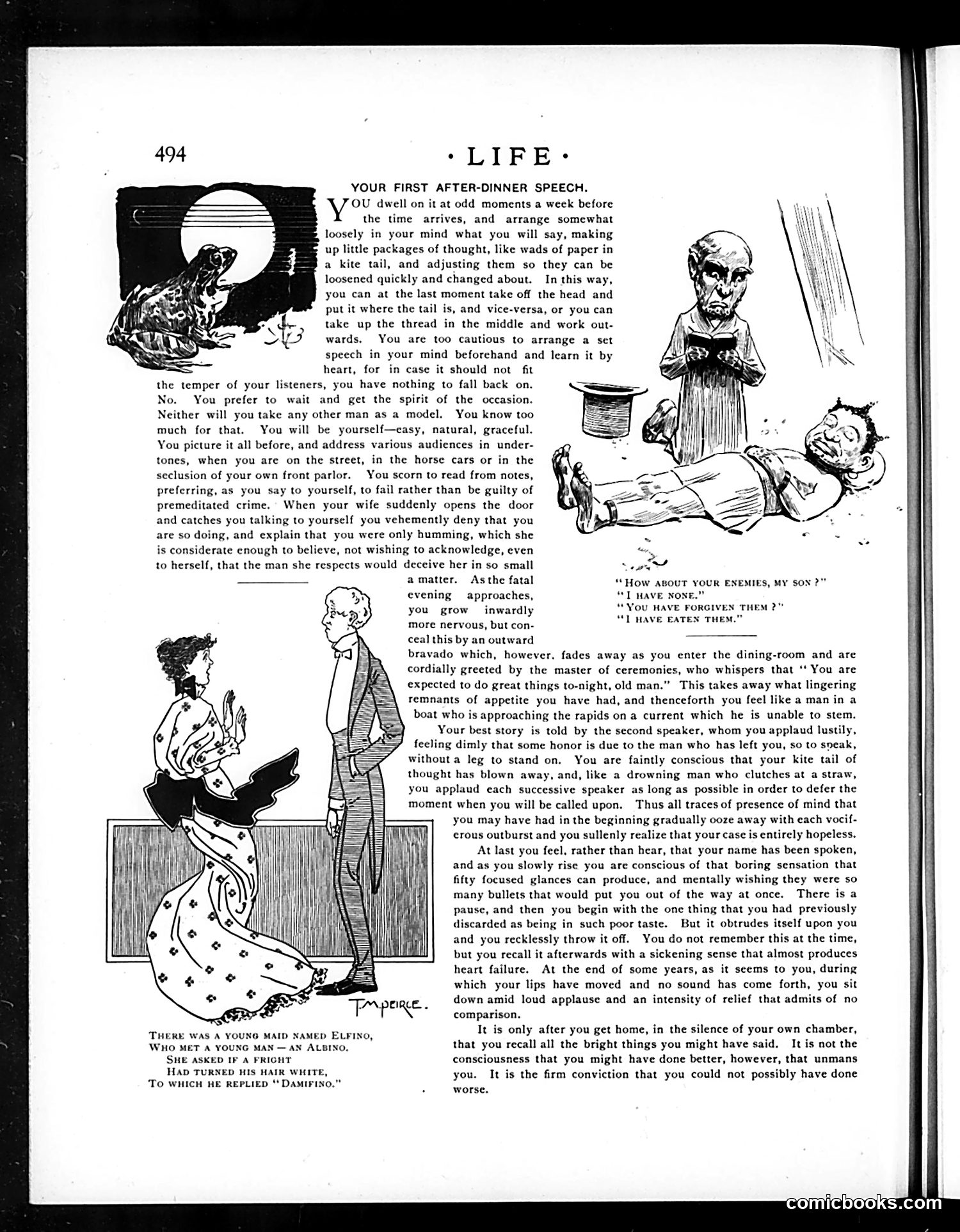
This satirical piece humorously advises nervous first-time after-dinner speakers on public speaking etiquette. The illustrations show various scenarios: a man sweating nervously, another gesturing awkwardly, and figures in formal dining attire. The satire targets common speaker anxieties—memorizing speeches, fear of forgetting lines, anxiety about audience judgment. It mocks the pretense of appearing "natural" while actually carefully rehearsed, and the desperate need to fill silence with applause from successive speakers. The closing illustrations (including one captioned with dialogue about "enemies" and "fates") appear to reference Dante's *Inferno*, suggesting after-dinner speeches are themselves a kind of social torment. The piece ultimately satirizes Victorian-era social conventions requiring public speaking performances at formal dinners, treating the ordeal as both ridiculous and nearly unavoidable.
📄 Transcribed text from this page (OCR, searchable)
Machine-transcribed from the original scan — historical spelling and the odd misread are preserved.
*LIFE-: YOUR FIRST AFTER-DINNER SPEECH. OU dwell on it at odd moments a week before the time arrives, and arrange somewhat loosely in your mind what you will say, making up little packages of thought, like wads of paper in a kite tail, and adjusting them so they can be loosened quickly and changed about. In this way, you can at the last moment take off the head and put it where the tail is, and vice-versa, or you can take up the thread in the middle and work out- wards. You are too cautious to arrange a set speech in your mind beforehand and learn it by heart, for in case it should not fit the temper of your listeners, you have nothing to fall back on. No. You prefer to wait and get the spirit of the occasion. Neither will you take any other man as a model. You know too much for that. You will be yourself—easy, natural, graceful. You picture it all before, and address various audiences in under- tones, when you are on the street, in the horse cars or in the seclusion of your own front parlor. You scorn to read from notes, preferring, as you say to yourself, to fail rather than be guilty of premeditated crime. When your wife suddenly opens the door and catches you talking to yourself you vehemently deny that you are so doing, and explain that you were only humming, which she is considerate enough to believe, not wishing to acknowledge, even : to herself, that the man she respects would deceive her in so small <u amatter. As the fatal “How ABOUT YOUR ENEMIES, SY SON?” evening approaches, ST MAVEN you grow inwardly “You HAVE FORGIVEN more nervous, but con- “A, HAVE: BATES THEM ceal this by an outward bravado which, however. fades away as you enter the dining-room and are cordially greeted by the master of ceremonies, who whispers that ‘* You are expected to do great things to-night, old man.” This takes away what lingering remnants of appetite you have had, and thenceforth you feel like a manin a boat who is approaching the rapids on a current which he is unable to stem. Your best story is told by the second speaker, whom you applaud lustily, feeling dimly that some honor is due to the man who has left you, so to speak, without a leg to stand on. You are faintly conscious that your kite tail of thought has blown away, and, like a drowning man who clutches at a straw, you applaud each successive speaker as long as possible in order to defer the moment when you will be called upon. Thus all traces of presence of mind that you may have had in the beginning gradually ooze away with each vocif- crous outburst and you sullenly realize that your case is entirely hopeless. At last you feel, rather than hear, that your name has been spoken, and as you slowly rise you are conscious of that boring sensation that fifty focused glances can produce, and mentally wishing they were so many bullets that would put you out of the way at once. There is a pause, and then you begin with the one thing that you had previously discarded as being in such poor taste. But it obtrudes itself upon you and you recklessly throw it off. You do not remember this at the time, but you recall it afterwards with a sickening sense that almost produces heart failure. At the end of some years, as it seems to you, during which your lips have moved and no sound has come forth, you sit “Pope. down amid loud applause and an intensity of relief that admits of no comparison. Piigeu Wia.k VOUNERIKiG WAM ELPiNS, Ik is only after you get home, in the silence of your own chamber, WHO MET A YOUNG MAN — AN ALBINO, that you recall all the bright things you might have said. It is not the SHE ASKED IF A FRIGHT consciousness that you might have done better, however, that unmans HAD TURNED HIS HAIR WHITE, you. It is the firm conviction that you could not possibly have done To WHICH HE REPLIED “ DaMtrino,” worse.