
Life, 1896-06-18 · page 4 of 18
Life — June 18, 1896 — page 4: what you’re looking at
What you’re looking at
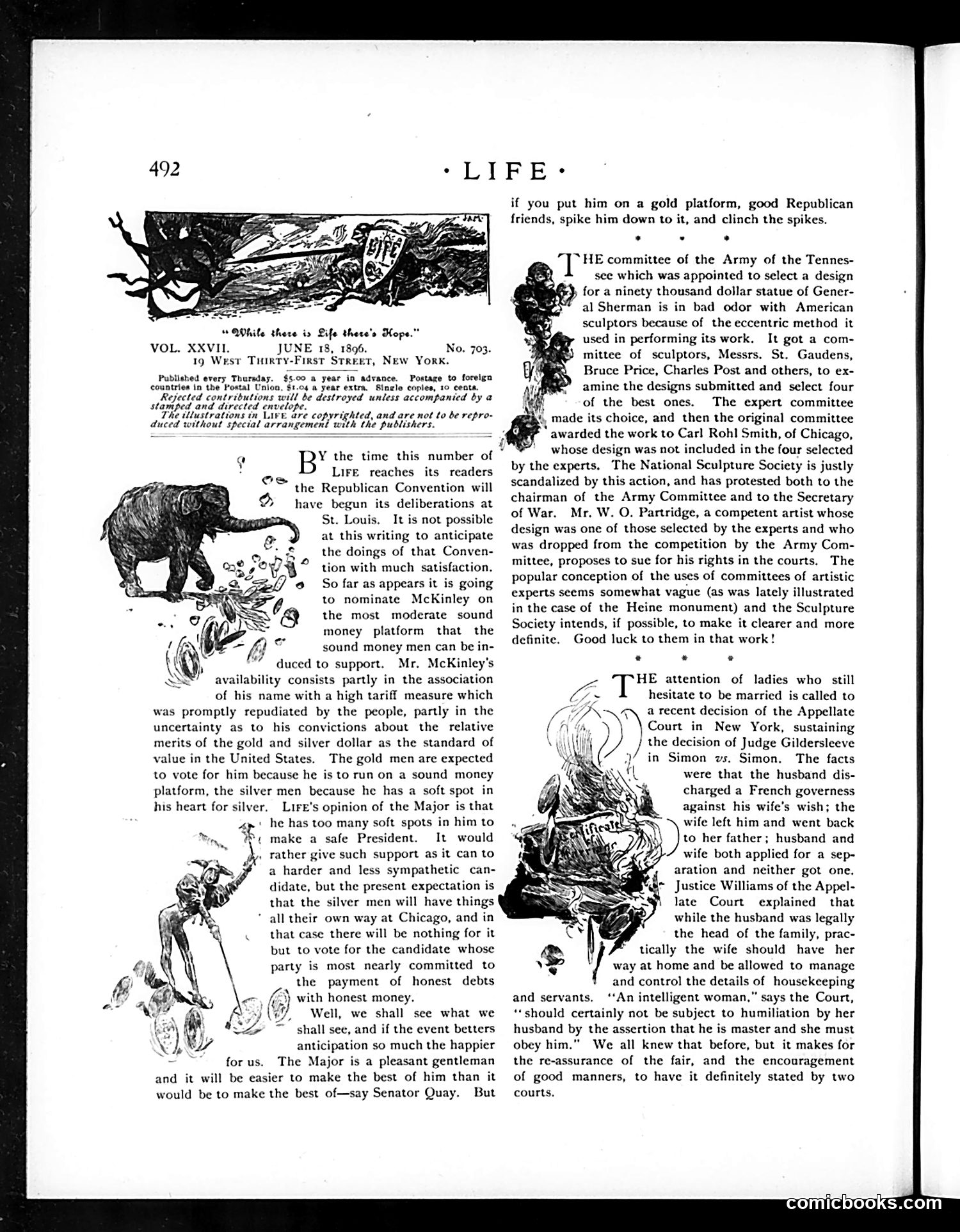
This page contains political satire about the 1896 Republican Convention and McKinley's presidential candidacy. The left column mocks the convention deliberations, using animal caricatures (appearing to represent different political factions) to satirize competing interests—specifically gold versus silver monetary standards, a major issue dividing Republicans. The text criticizes McKinley as a moderate compromiser on currency policy, suggesting he represents neither camp convincingly. The right column discusses a completely separate topic: a New York court ruling affirming husbands' legal authority over wives, which Life uses to satirize women's legal subordination. The cartoons illustrate these political and social commentary pieces through exaggerated character drawings typical of 1890s satirical journalism.
📄 Transcribed text from this page (OCR, searchable)
Machine-transcribed from the original scan — historical spelling and the odd misread are preserved.
* LIFE: No. 703. 19 Wesv Tuirt rst Street, New York. Published every Thursday. $5.09 a year in advance. Postage to foreign countries in the Postal Union, $1.04 a year extra. Single coples, 10 ceata, Rejected contributions will be destroyed unless accompanied by a stamped and directed envelope. The illustrations in Live are copyrighted, and are not to be repro- duced without special arrangement with the publishers. ¢ Y the time this number of © oe LiFE reaches its readers the Republican Convention will have begun its deliberations at St. Louis. It is not possible at this writing to anticipate the doings of that Conven- tion with much satisfaction. So far as appears it is going to nominate McKinley on the most moderate sound money platform that the sound money men can be in- duced to support. Mr. McKinley's availability consists partly in the association of his name with a high tariff measure which was promptly repudiated by the people, partly in the uncertainty as to his convictions about the relative merits of the gold and silver dollar as the standard of value in the United States. The gold men are expected to vote for him because he is to run on a sound moncy platform, the silver men because he has a soft spot in his heart for silver. LiFe’s opinion of the Major is that 4p he has too many soft spots in him to Py ¥, make a safe President. It would = , rather give such support as it can to a harder and less sympathetic can- didate, but the present expectation is that the silver men will have things * all their own way at Chicago, and in that case there will be nothing for it but to vote for the candidate whose party is most nearly committed to the payment of honest debts Well, we shall see what we shall see, and if the event betters anticipation so much the happier for us. The Major is a pleasant gentleman and it will be easier to make the best of him than it would be to make the best of—say Senator Quay, But if you put him on a gold platform, good Republican friends, spike him down to it, and clinch the spikes. . . . “HE committee of the Army of the Tennes- see which was appointed to select a design for a ninety thousand dollar statue of Gener- al Sherman is in bad odor with American sculptors because of the eccentric method it used in performing its work. It got a com- mittee of sculptors, Messrs. St. Gaudens, Bruce Price, Charles Post and others, to ex- amine the designs submitted and select four of the best ones. The expert committee made its choice, and then the original committee * awarded the work to Carl Rohl Smith, of Chicago, whose design was not included in the four selected by the experts, The National Sculpture Society is justly scandalized by this action, and has protested both to the chairman of the Army Committee and to the Secretary of War. Mr. W. O. Partridge, a competent artist whose design was one of those selected by the experts and who was dropped from the competition by the Army Com- mittee, proposes to sue for his rights in the courts. The popular conception of the uses of committees of artistic experts seems somewhat vague (as was lately illustrated in the case of the Heine monument) and the Sculpture Society intends, if possible, to make it clearer and more definite. Good luck to them in that work! e * ° HE attention of ladies who still hesitate to be married is called to ion of the Appellate Court in New York, sustaining } the decision of Judge Gildersleeve in Simon vs. Simon. The facts were that the husband dis- charged a French governess against his wife's wish; the ) wife left him and went back SoS a recent dec ”, \)\ ] to her father; husband and wife both applied for a sep- aration and neither got one, ~ Justice Williams of the Appel- late Court explained that while the husband was legally the head of the family, prac- tically the wife should have her way at home and be allowed to manage and control the details of housekeeping and servants. ‘‘An intelligent woman,” says the Court, “should certainly not be subject to humiliation by her husband by the assertion that he is master and she must obey him.” We all knew that before, but it makes for the re-assurance of the fair, and the encouragement of good manners, to have it definitely stated by two courts.