
A complete issue · 20 pages · 1896
Life — June 4, 1896
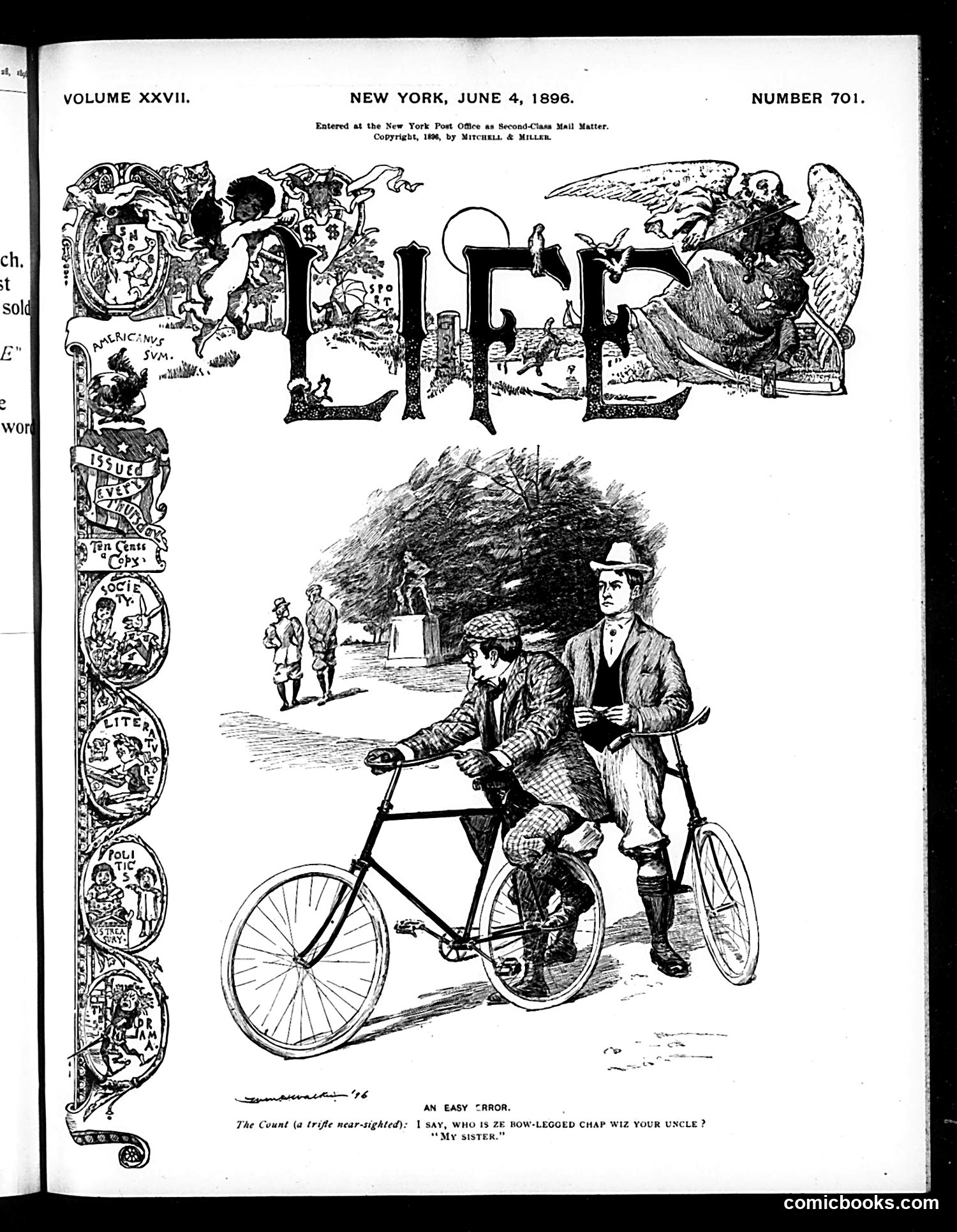
This cartoon depicts a simple visual pun about bicycle riding. Two men are tangled together on a tandem bicycle, with the caption explaining the "easy error": the man in front (described as a "Count" who is "trifle near-sighted") mistakes his companion for a woman, asking "Who is ze now-legged chap wiz your uncle?" The companion replies, "My sister." The joke plays on the absurdity of mistaking a man for a woman at close range, suggesting the Count's poor eyesight makes him comically oblivious. This reflects the 1890s bicycle craze and the social novelty of men and women cycling together—a relatively modern, somewhat scandalous activity for the era. The humor is straightforward physical comedy rather than political satire.
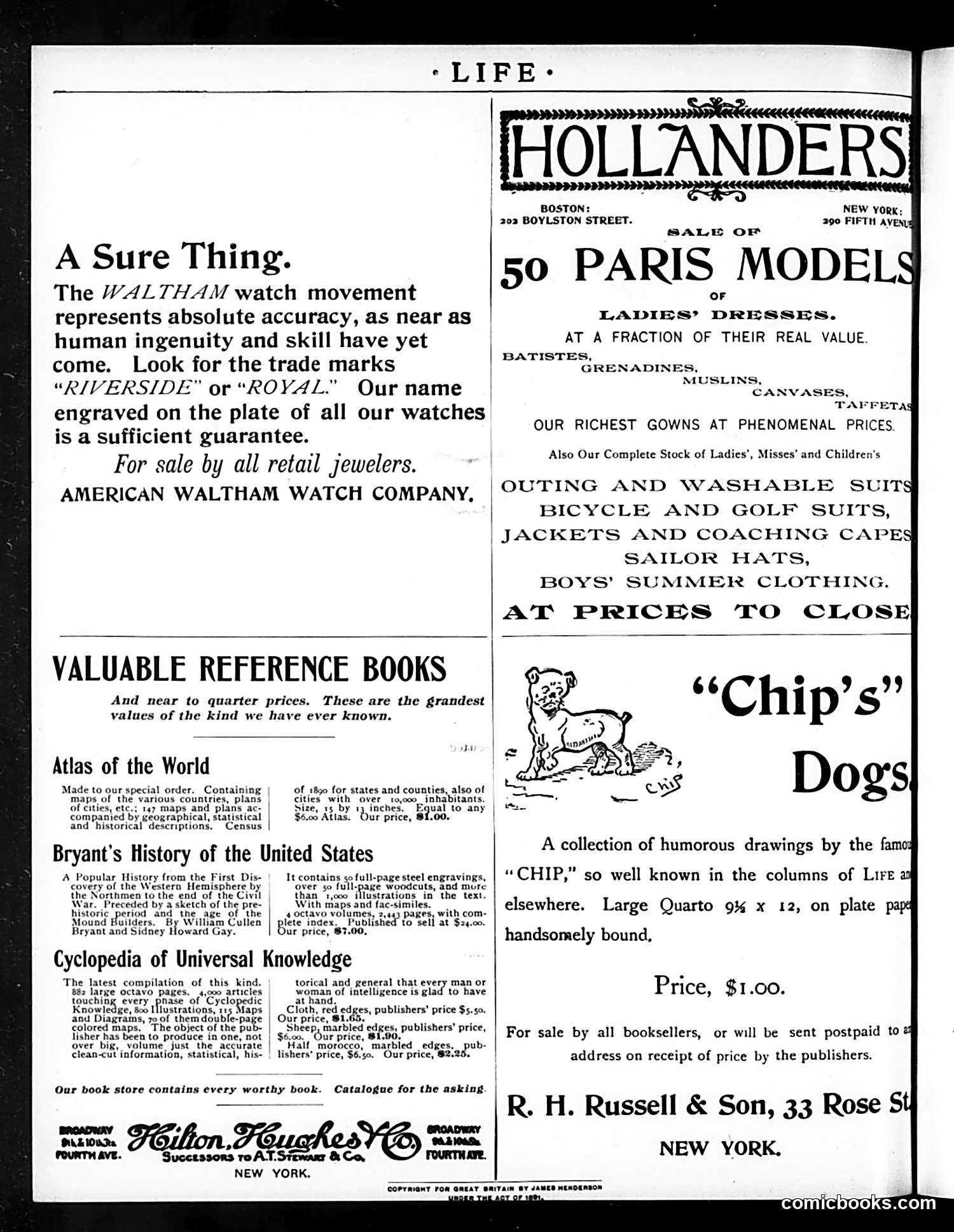
This page is primarily **advertising content** from an early 20th-century Life magazine, not political satire or editorial cartoons. The left side advertises Waltham watches and reference books (Atlas, Bryant's History, Encyclopedia). The right side features **Hollanders department store** advertising Paris fashion models and women's clothing at reduced prices, plus accessories like bicycle suits and sailor hats. The only cartoon element is "Chip's Dogs"—a small illustration showing a dog, advertising a collection of humorous drawings by someone called "Chip" who contributed regularly to Life magazine. This is a **book advertisement**, not political commentary. The page demonstrates how early Life magazine mixed satirical editorial content with commercial advertising to support publication costs.
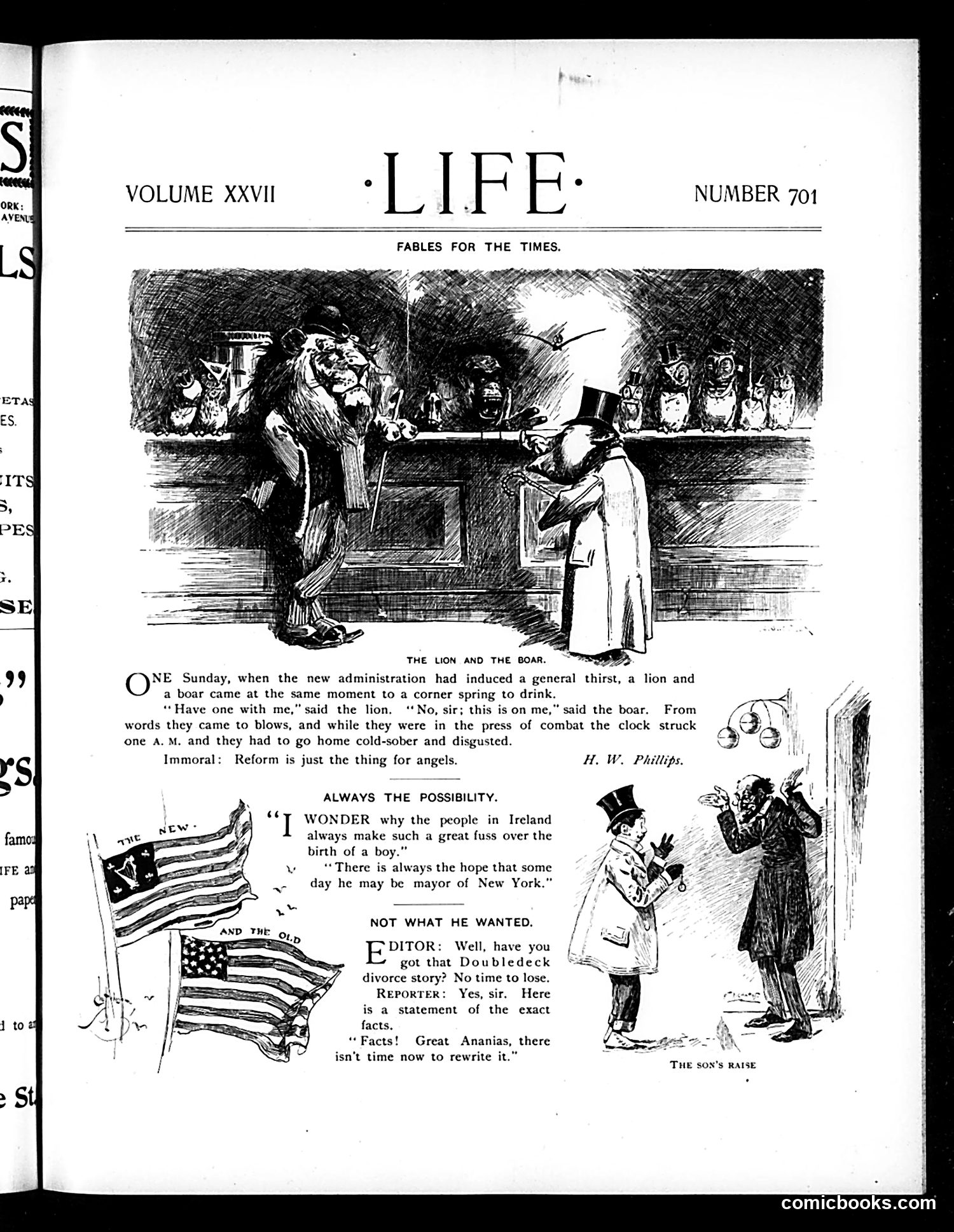
This page contains three satirical pieces: **"The Lion and the Boar"** is a fable about two animals fighting over drinking rights after "the new administration had induced a general thirst." The moral—"Reform is just the thing for angels"—suggests the cartoon critiques a recent political administration's reform efforts as naive or ineffective. **"Always the Possibility"** mocks Irish immigration, with a character hoping an Irish boy might become mayor of New York. **"Not What He Wanted"** satirizes journalistic pressure, showing an editor demanding a reporter rewrite the Doubledeck divorce story with made-up "facts" rather than actual facts—criticizing sensationalism in news reporting. The flag imagery appears to reference American identity politics of the era.
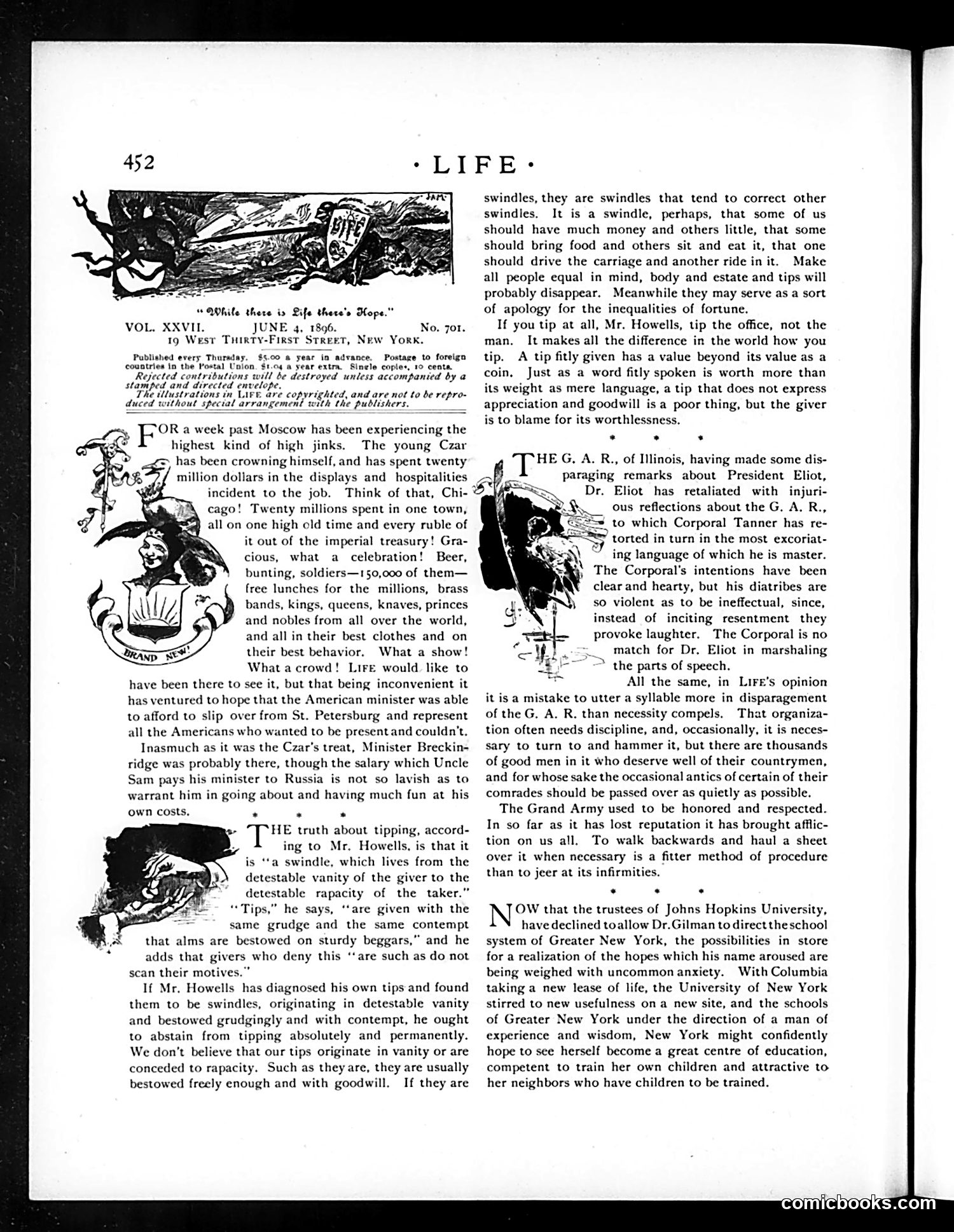
This page contains editorial commentary rather than political cartoons. The main topics are: 1. **Moscow's Celebrations**: Criticism of the young Czar spending twenty million dollars on displays and hospitalities in Moscow, described sarcastically as wasteful imperial extravagance. 2. **Tipping Debate**: A response to Mr. Howells's criticisms of tipping culture, defending the practice as originating from generosity rather than vanity, while acknowledging tips can reflect giver's conceit. 3. **Johns Hopkins University**: Discussion of Dr. Gilman declining to direct a school system in New York, with optimism that New York might develop better educational institutions. The decorative illustrations are generic period artwork rather than specific political caricatures. The page represents typical early-1900s American satirical journalism addressing social customs and institutional matters.
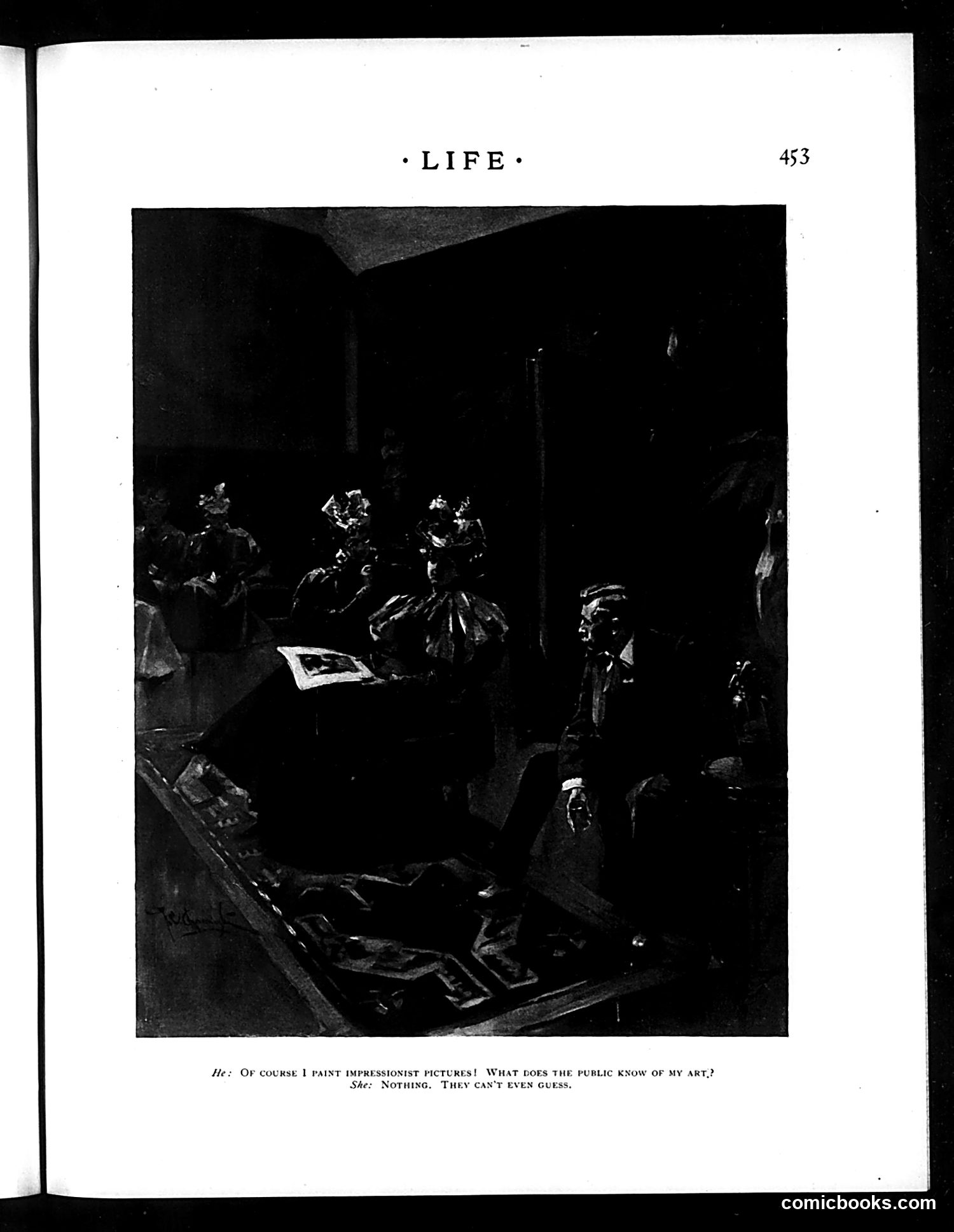
This appears to be a satirical illustration from an art world debate. The dialogue reads: "Of course I paint impressionist pictures! What does the public know of my art?" answered by "Nothing. They can't even guess." The cartoon mocks an artist who claims to create impressionist work while implying the public cannot understand or appreciate it. The satire cuts both ways—suggesting either the artist is pretentious and obscure, or the public lacks sophistication. The dark, crowded scene with multiple figures examining artwork likely depicts an artist's studio or gallery setting. This reflects early 20th-century tensions between modernist artists defending experimental styles (impressionism, post-impressionism) and public skepticism toward avant-garde art that departed from traditional representation.
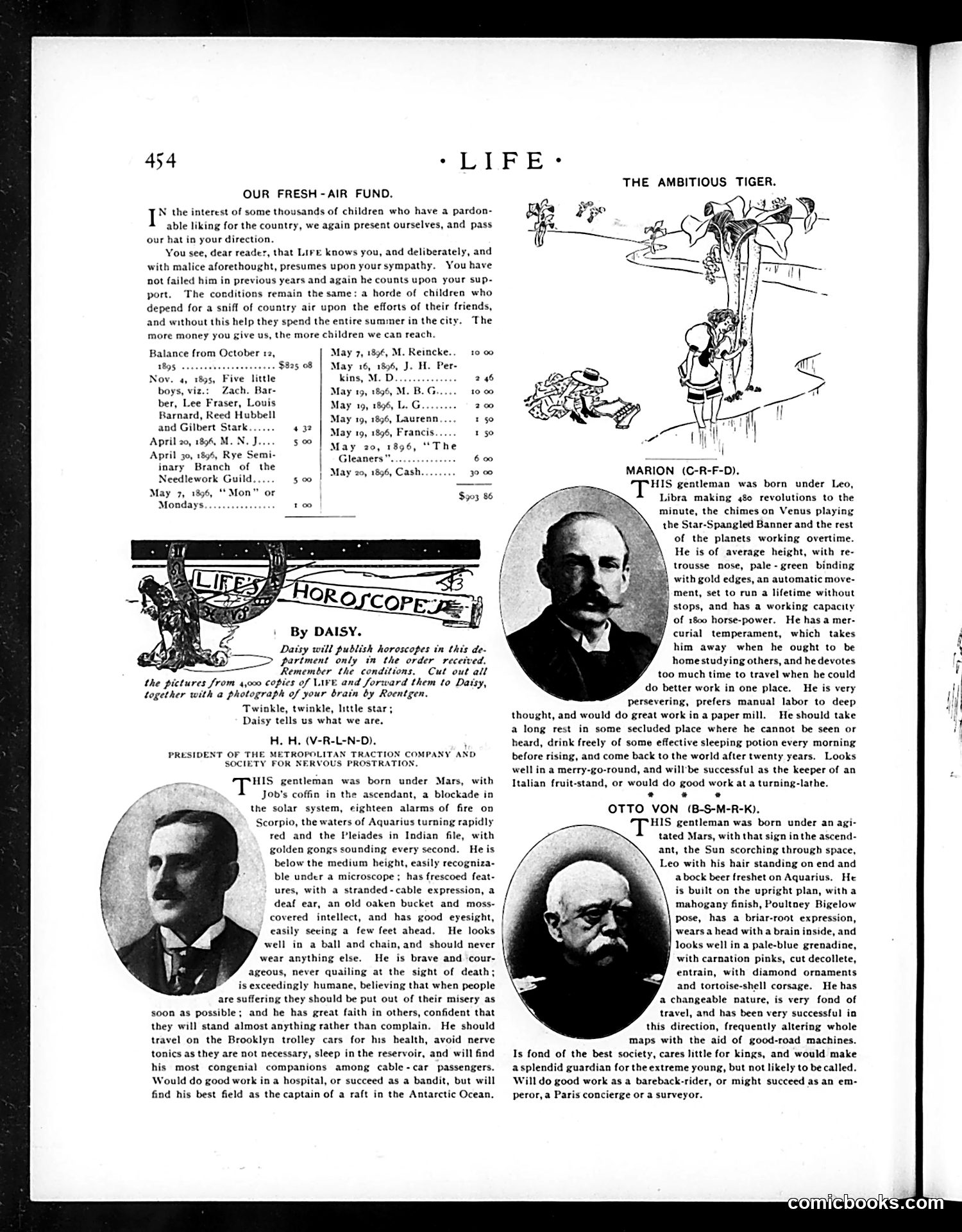
This page contains three distinct elements: 1. **Fresh-Air Fund Appeal**: A charitable solicitation listing donations for children's summer country air programs, with contributions from various donors ranging from $0.50 to $93.68. 2. **"Life's Horoscope" Feature**: An announcement that horoscopes will be published, inviting readers to send birth data and pictures for astrological readings—a humorous contemporary feature typical of early 1900s magazines. 3. **Character Portraits**: Three biographical sketches with photographs of individuals identified by astrological signs (Leo, Scorpio, and another), describing their personality traits supposedly determined by their birth signs. This satirizes the growing interest in astrology while presenting it as entertainment rather than serious prediction. The page reflects early 20th-century American magazine culture mixing charity appeals with popular pseudoscience entertainment.
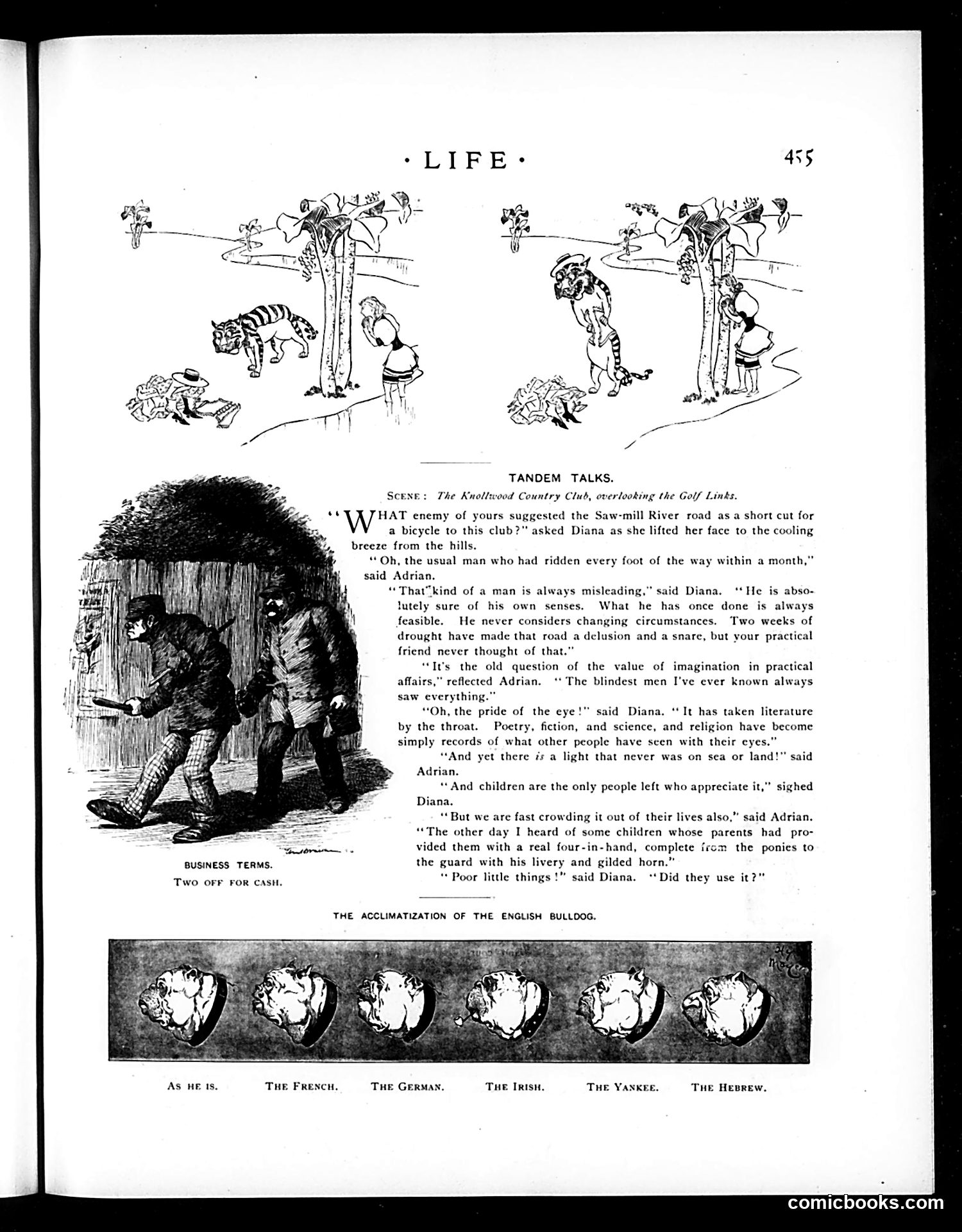
**Top Section - "Tandem Talks":** Two cartoon panels showing figures at a golf club discussing a shortcut bicycle route. The dialogue satirizes male overconfidence and lack of imagination—Adrian (presumably male) dismisses Diana's practical concerns, insisting his experience makes him infallible. The joke targets men who ignore advice and refuse to adapt to changing circumstances. **Middle - "Business Terms":** A single illustration captioned "Two off for cash" showing what appears to be a transaction or negotiation scene, likely a financial joke whose specific reference is unclear from context alone. **Bottom - "The Acclimatization of the English Bulldog":** Six profile images of bulldog heads labeled as different nationalities (French, German, Irish, Yankee, Hebrew), satirizing ethnic stereotyping through dog physiognomy—a common period practice mocking immigrant groups and national characteristics.
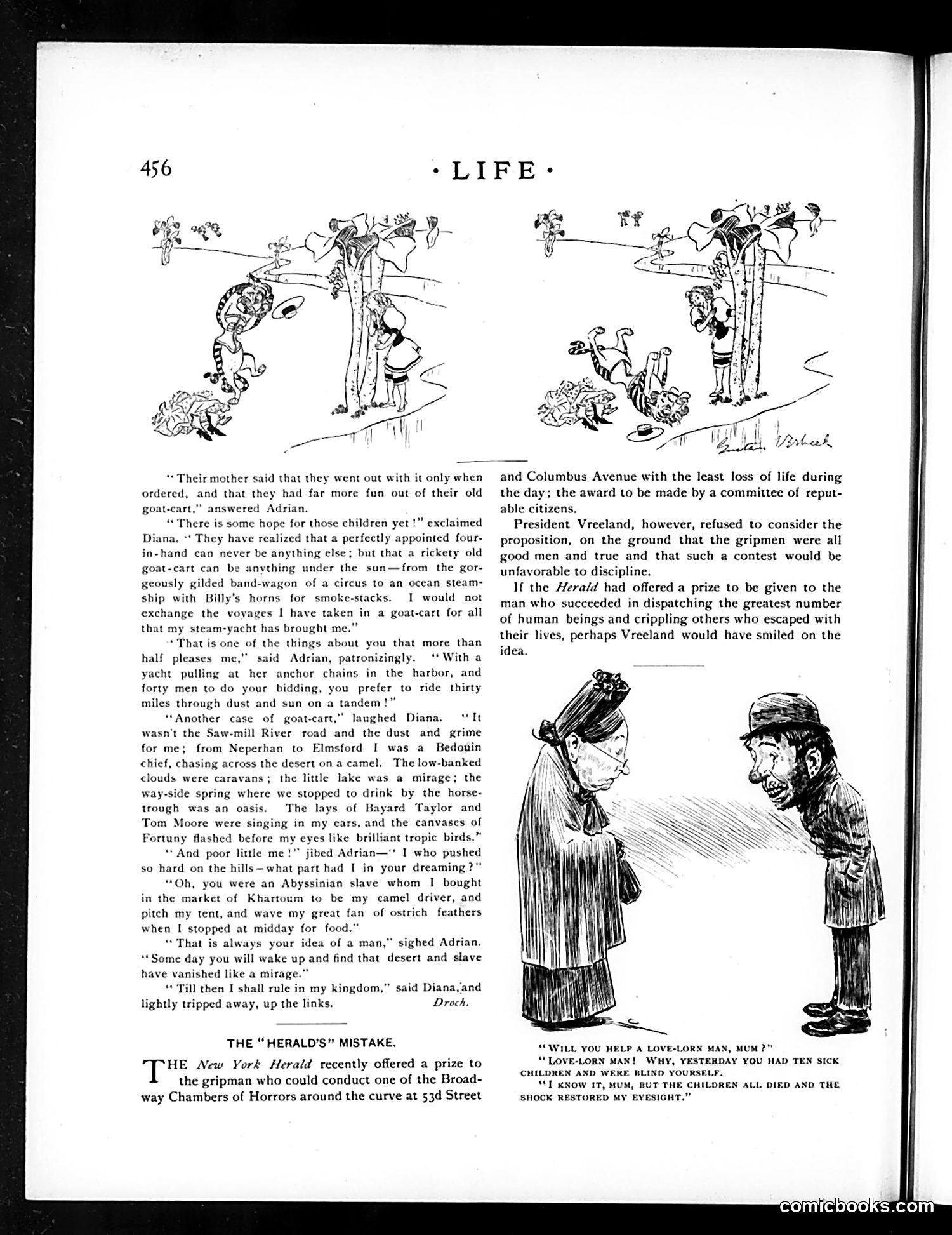
This page contains two sections: conversational anecdotes and a satirical piece titled "The Herald's Mistake." The main cartoon criticizes the *New York Herald* newspaper for offering a prize to a gripman (streetcar operator) who could conduct one of Broadway's Chambers of Horrors around a curve at 53rd Street. The satire mocks the Herald's dangerous contest proposal. President Vroeland apparently refused to endorse it, arguing such a competition would encourage reckless conduct and risk lives. The text suggests the Herald's idea was absurdly unsafe—turning a streetcar operation into a spectacle that prioritized sensationalism over public safety. The bottom cartoon depicts two figures in what appears to be a conversation about charity or misfortune, with social commentary on class and desperation.
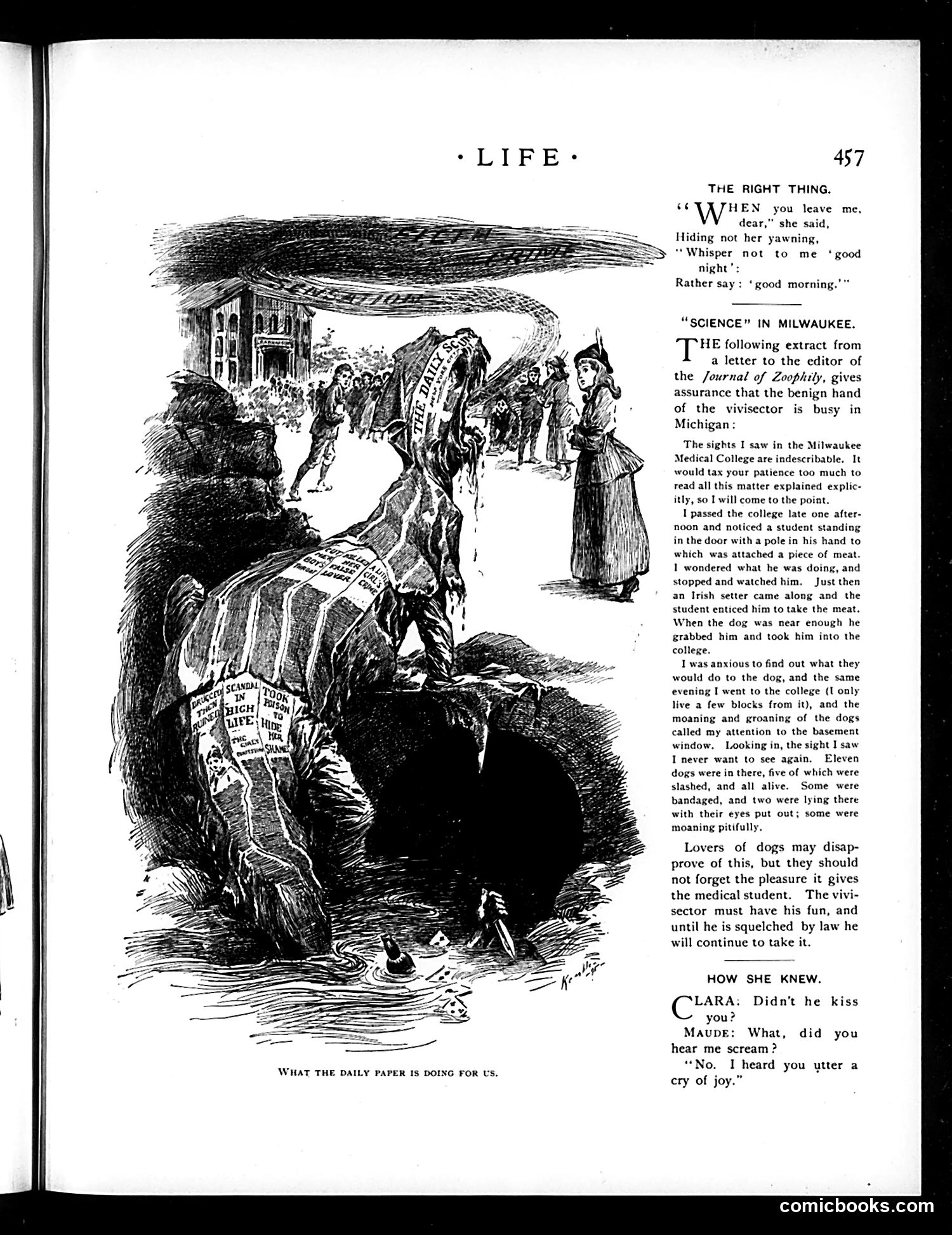
The main illustration satirizes medical education through vivisection. It depicts a donkey loaded with medical college supplies being led into a building, with students observing. The caption "What the Daily Paper is Doing for Us" suggests newspapers were exposing cruel laboratory practices. The accompanying article titled "Science in Milwaukee" describes a visitor's discovery of dogs in a medical college basement—some slashed, bandaged, or dying from vivisection experiments. The piece criticizes this practice while sarcastically noting that medical students apparently require such animal suffering for their education. This reflects late 19th/early 20th-century debates over animal testing ethics. The satire mocks both institutional indifference to animal cruelty and newspapers' role in publicizing these practices.
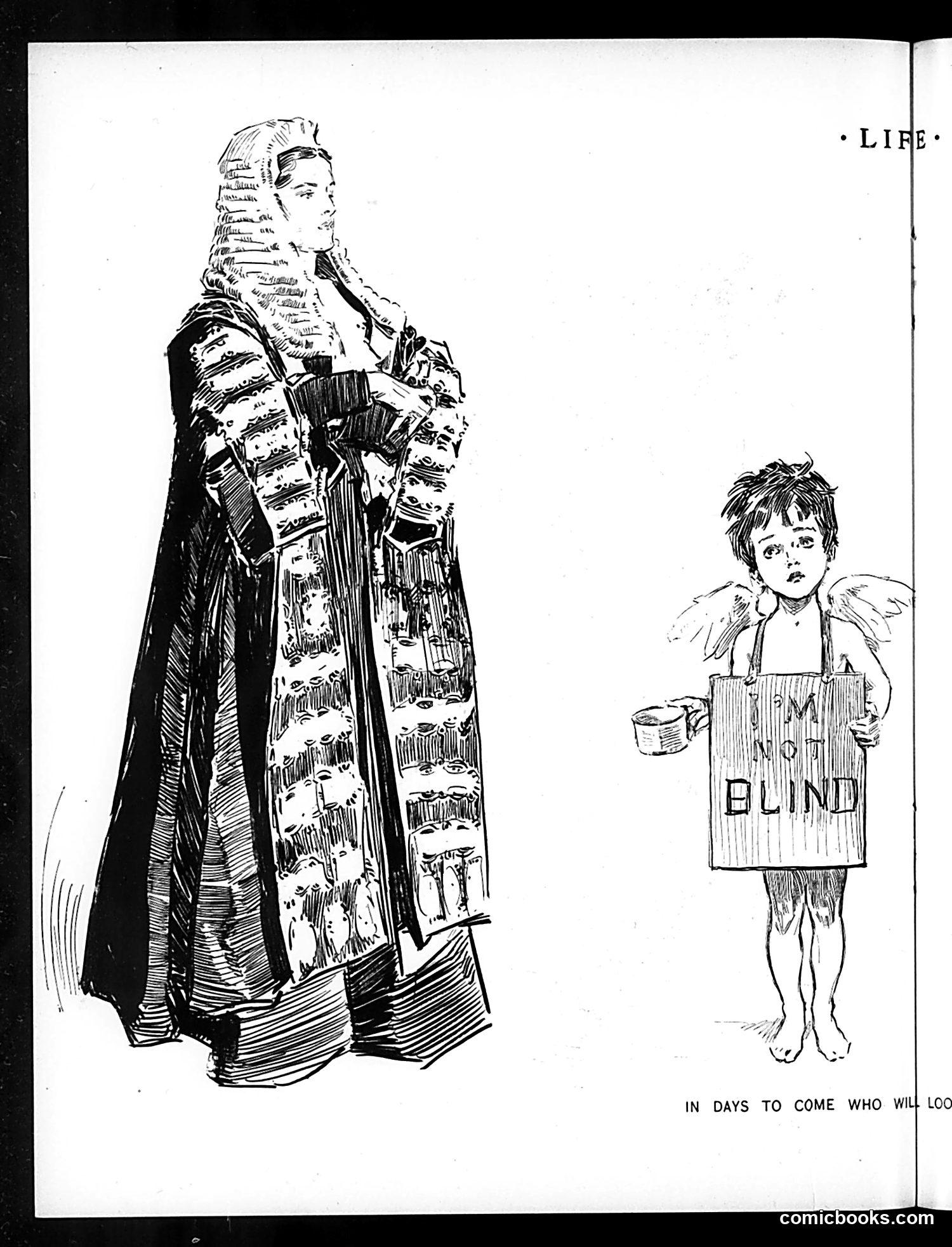
This page from *Life* magazine presents a stark political satire contrasting two figures. On the left stands an ornately dressed aristocrat or nobleman in elaborate 18th-century clothing with decorative patterns and a long cape—likely representing entrenched wealth, privilege, or old-world authority. On the right, a small child wearing a sign reading "I'M BLIND" holds a cup, appearing to beg. The partial caption at bottom reads "IN DAYS TO COME WHO WILL LOO[K]" (text cut off), suggesting a commentary on future consequences or accountability. The satire appears to critique wealth inequality and the contrast between opulent privilege and desperate poverty. The child's blindness may symbolize ignorance or society's willful indifference to suffering. The composition emphasizes the moral gulf between the two figures.
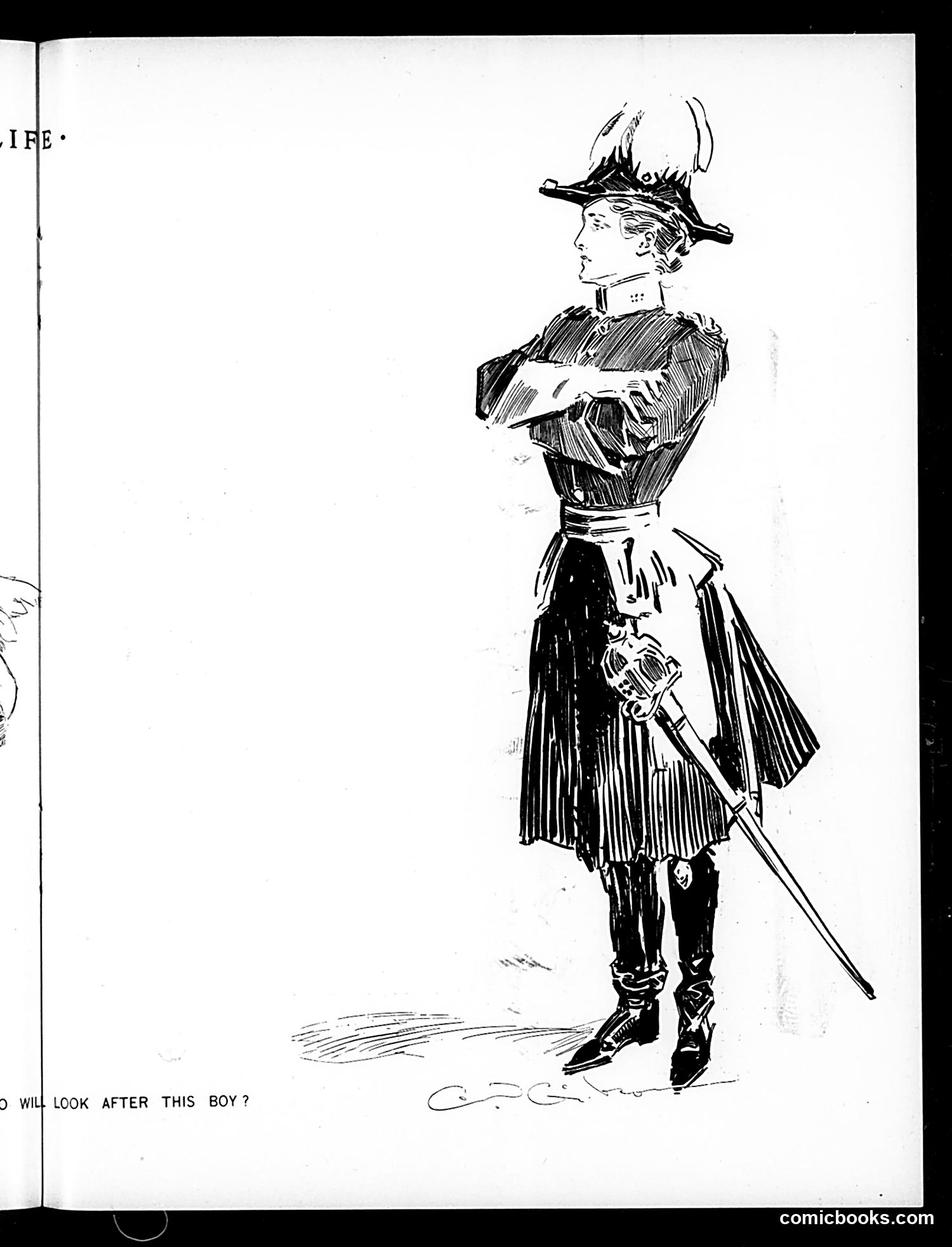
This is a satirical illustration from *Life* magazine showing a military figure in early 20th-century uniform—characterized by the distinctive spiked Prussian-style helmet (Pickelhaube), ornate jacket with epaulettes, pleated skirt, sword, and boots. The caption reads "WHO WILL LOOK AFTER THIS BOY?" The satire appears to target German militarism and imperial authority. The figure's exaggerated, almost feminine silhouette combined with the caption's patronizing tone suggests mockery of either a specific German leader or German military culture generally. The question implies the figure is irresponsible or requires supervision—a common satirical trope suggesting dangerous instability requiring restraint. Without a visible date or clearer context, the specific target remains unclear, though the style suggests early-to-mid 20th-century publication.
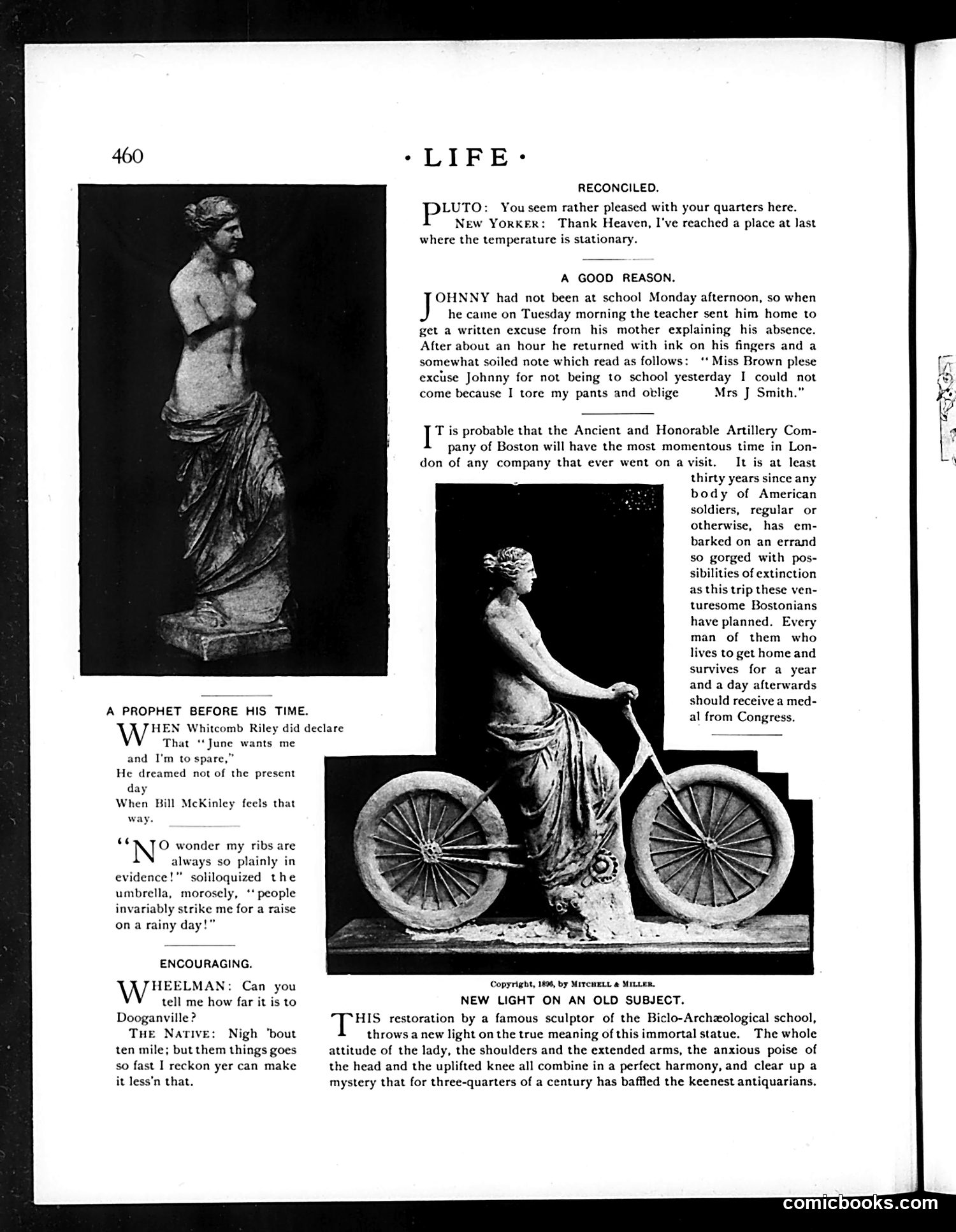
This page contains several short satirical pieces typical of Life's humor: **"Reconciled"** jokes about temperature extremes—a New Yorker finds relief in a stable climate, contrasting unstable conditions elsewhere. **"A Good Reason"** presents a child's excuse note with misspellings ("plese," "oblige"), humorously depicting working-class parental literacy. **The Artillery Company piece** references the "Ancient and Honorable Artillery Company of Boston" visiting London, jokingly suggesting the trip is so dangerous members deserve Congressional medals for surviving it. **"A Prophet Before His Time"** references poet James Whitcomb Riley's line "June wants me," then jokes that President William McKinley similarly "feels that way"—likely a veiled political criticism about McKinley's policies or character. **The bicycle statue restoration** describes a famous sculptor reinterpreting an ancient female statue, sarcastically claiming the "new light" finally explains its mysterious pose and meaning—essentially mocking over-interpretation of classical art.
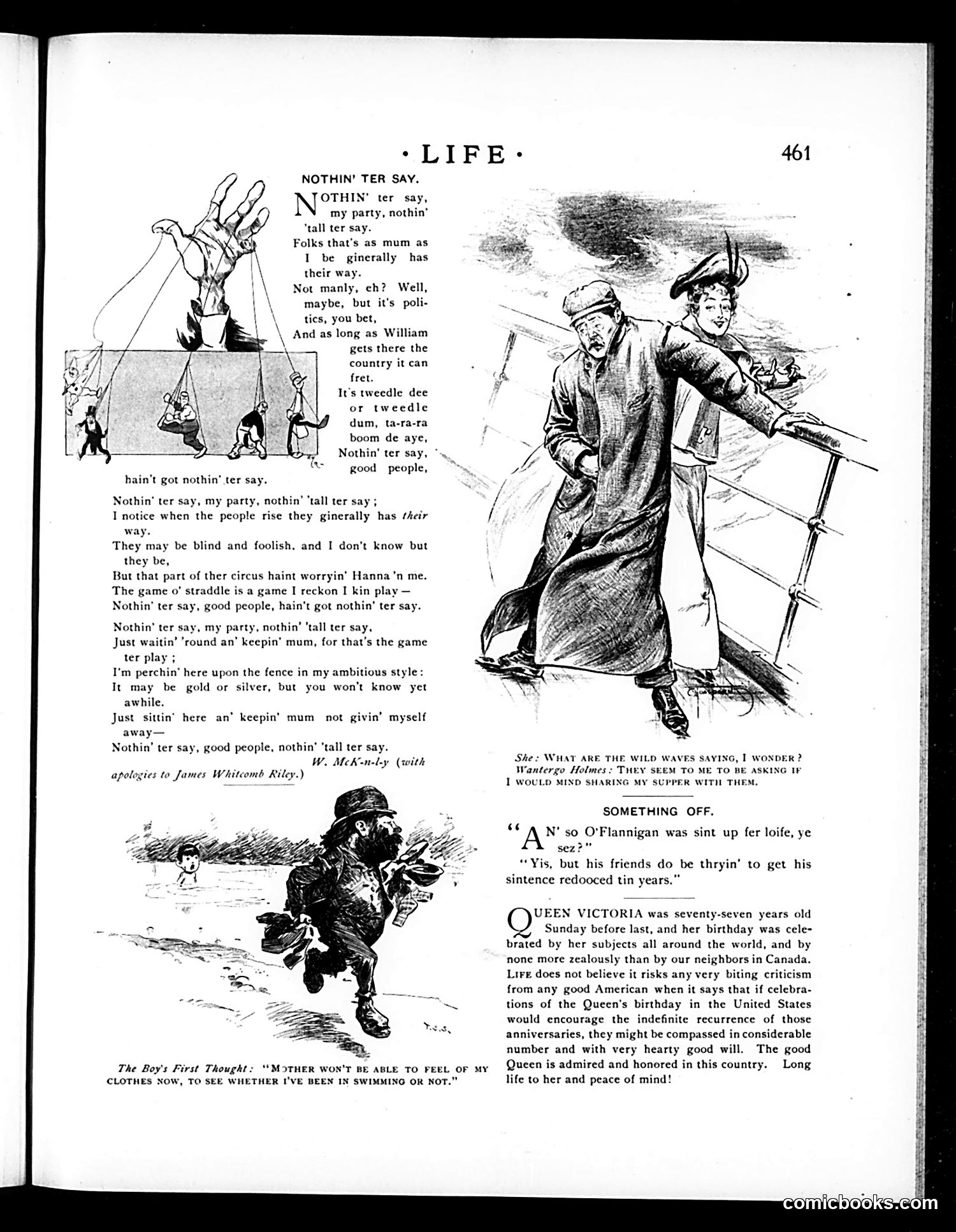
This page satirizes **President William McKinley's** political strategy of remaining noncommittal on key issues—particularly the currency debate dividing the 1890s Republican Party (gold vs. silver standard). The poem, written in rural dialect, depicts a politician sitting on the fence, deliberately avoiding statements while trusting party boss **Mark Hanna** to deliver electoral victory regardless. The satire mocks this passive approach: the speaker boasts of straddling positions ("tweedle dee or tweedle dum"), keeping mum while maintaining political ambitions. Life's point is clear—McKinley wins through Hanna's machinery and voter silence, not through honest debate. The page also includes lighter items: an O'Flannigan Irish-dialect joke about sentence reduction, and a humorous observation about Queen Victoria's birthday celebrations (contemporary reference), plus a boy's comic thought about hiding swimming evidence from his mother.
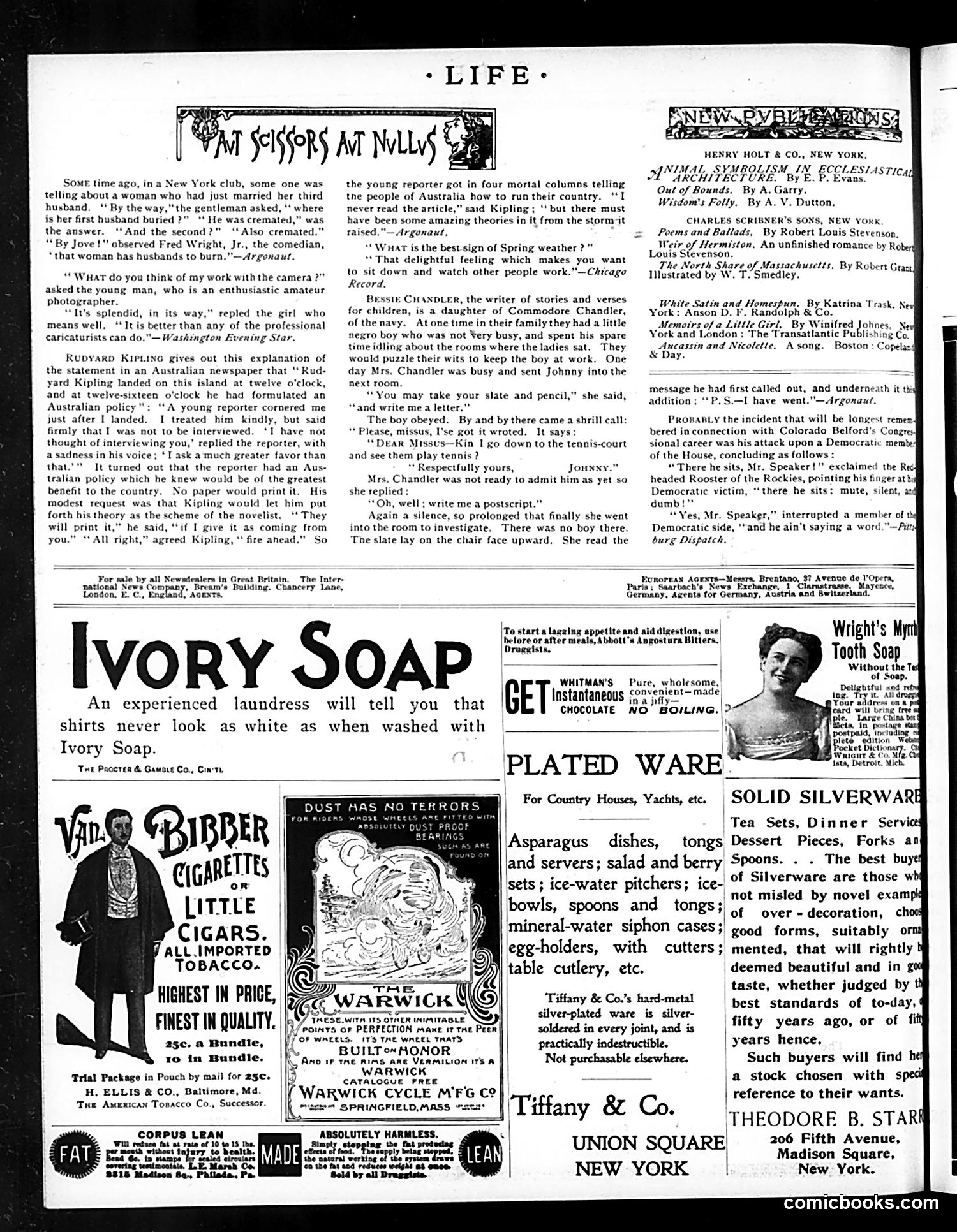
This page contains **humorous anecdotes** rather than political cartoons. The title "Scissors at Nullys" (likely "Nullities") suggests short, satirical pieces on everyday absurdities. The main joke concerns a **Black servant boy** who, when asked to write a letter requesting permission to watch tennis, obeys but then disappears, leaving only the slate with his message. The humor relies on the stereotype of a lazy servant evading work—the boy has written the request but fled before receiving an answer, thus avoiding further tasks. Other anecdotes mock: a woman who has cremated two husbands ("husbands to burn"), an overeager amateur photographer, and Rudyard Kipling's alleged quick formulation of Australian policy. The page is primarily **advertising** (Ivory Soap, Wright's Myth Tooth Soap, Tiffany & Co. silverware), typical of Life's era. The content reflects late-19th/early-20th-century attitudes, including casual racial stereotyping in the servant narrative that modern readers would find offensive.
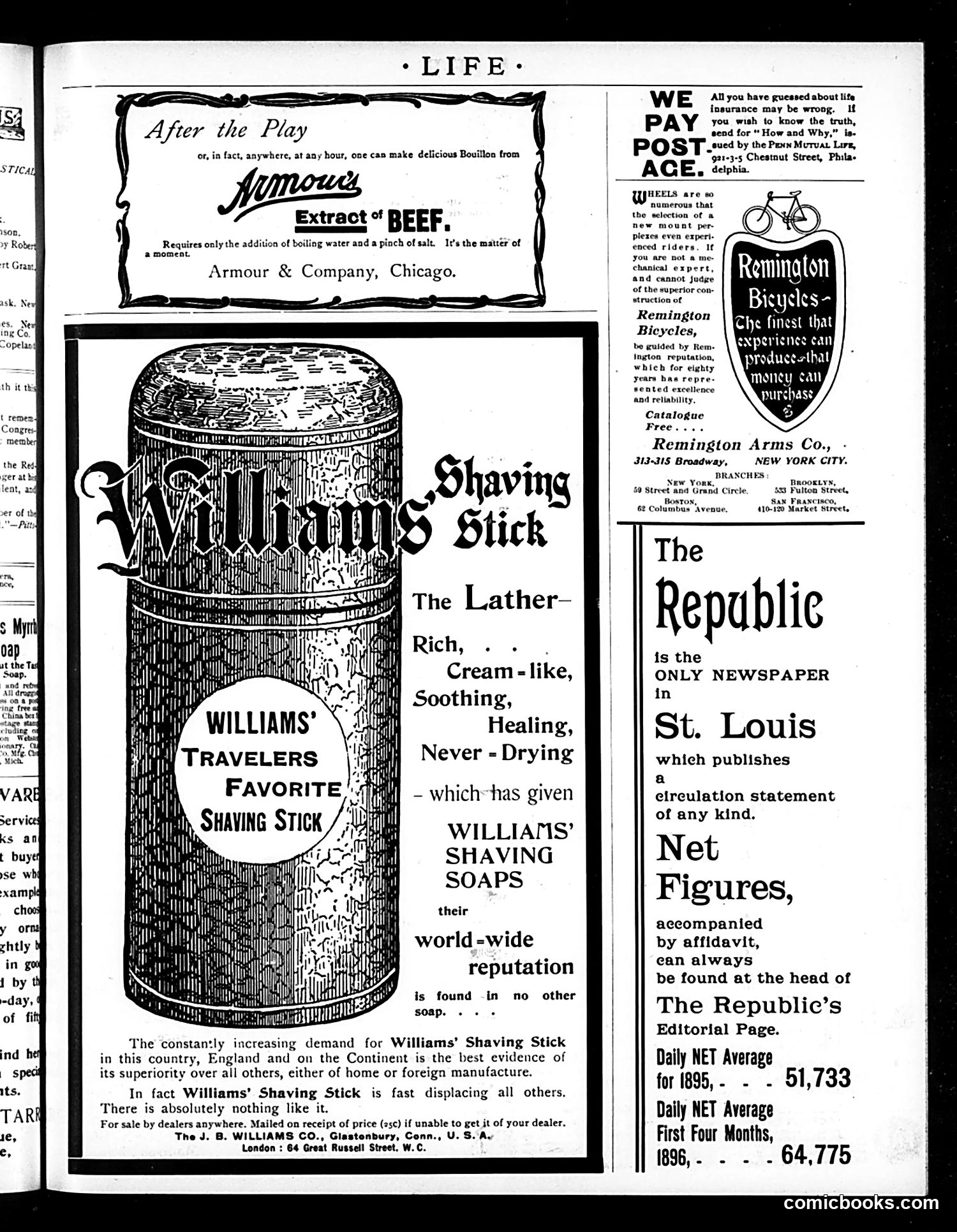
This page is primarily **advertising, not satire or political commentary**. It contains four unrelated commercial advertisements from the 1890s: 1. **Armour's Beef Extract** — promoting instant bouillon 2. **Williams' Shaving Stick** — claiming superiority over competitors, with the largest advertisement 3. **Remington Bicycles** — positioning their brand as reliable 4. **The Republic newspaper** — claiming exclusive circulation transparency and growing readership numbers There are **no political cartoons or satirical content** visible. The page header says "LIFE" (the magazine), but the content is straightforward product promotion typical of the 1890s. The only mild competitive claim is Williams' assertion that their shaving stick is "fast displacing all others" — standard advertising hyperbole rather than satire. The Republic's ad is notable for emphasizing published circulation figures at a time when such transparency was apparently uncommon in journalism.
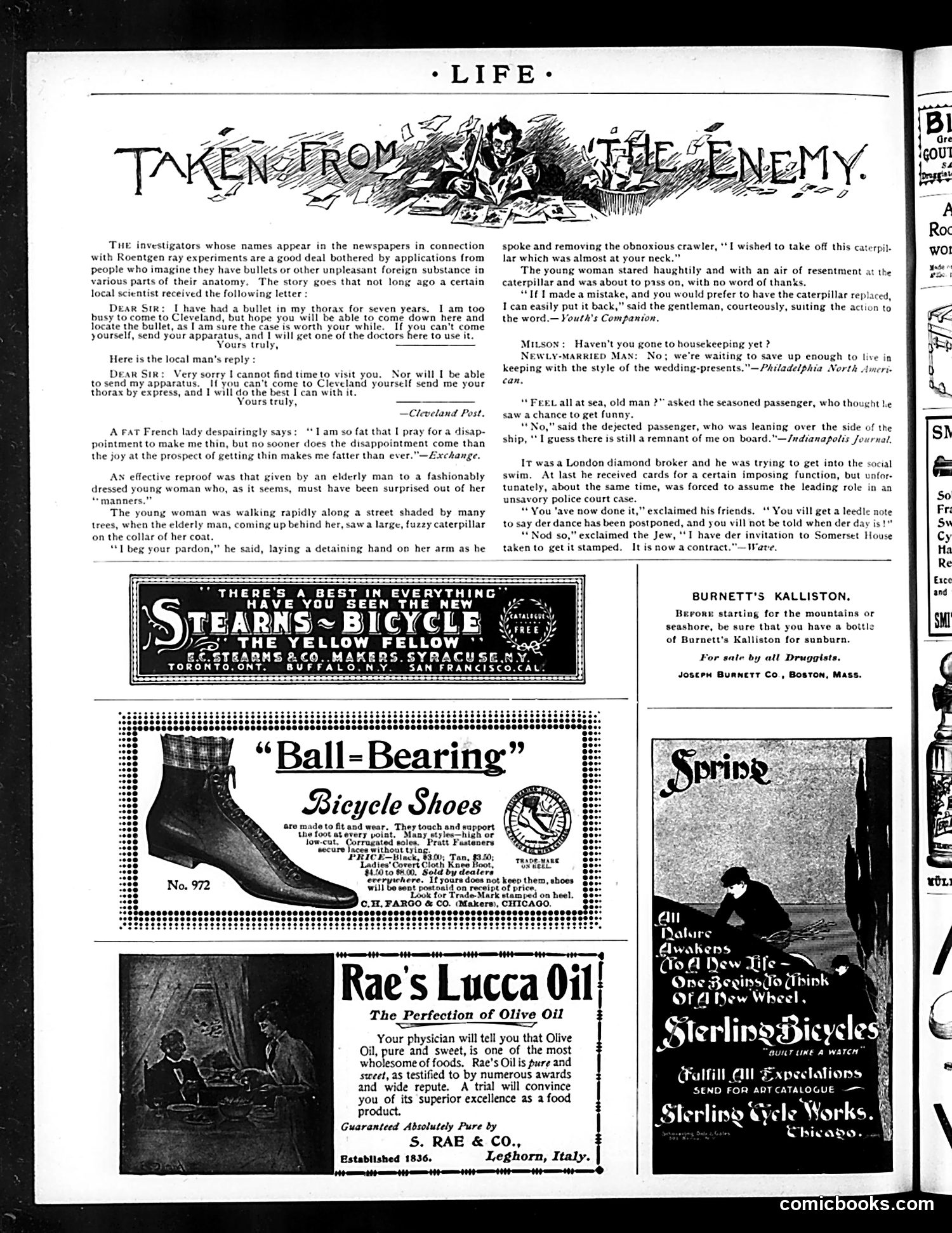
This page contains several **humorous anecdotes** rather than political cartoons. The main content satirizes the early fascination with X-ray technology (Roentgen rays), which was novel and exciting in the 1890s-1900s. The central joke involves a letter exchange where a man asks a scientist to travel far to locate a bullet in his chest using X-rays. The scientist's reply—suggesting the man ship his "thorax by express"—is absurdist humor mocking both the man's laziness and the era's overconfidence in new technology's convenience. Other brief jokes mock social behavior: a fashionably dressed woman's rudeness when a man removes a caterpillar from her coat; newlyweds waiting to afford housing matching their wedding gifts; and a London diamond broker attempting social climbing while caught in a scandal. The page also advertises bicycles, bicycle shoes, and olive oil—typical period advertisements. **There is no political cartoon here**; it's primarily satirical prose humor reflecting turn-of-century American attitudes toward technology and social pretension.
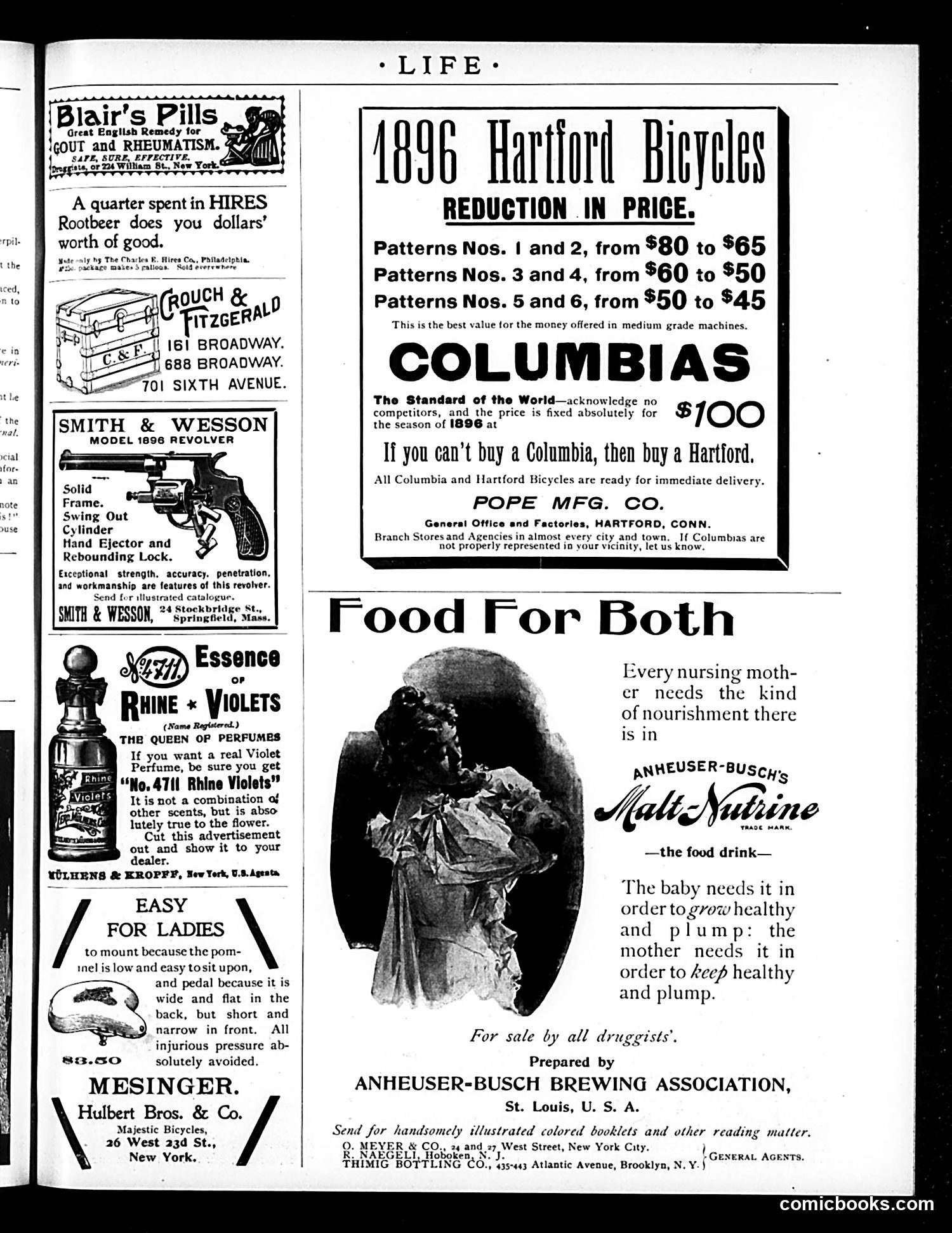
This page is primarily **advertising**, not satire or political commentary. It represents a snapshot of American consumer culture in the 1890s. Notable ads include: - **Bicycles dominate**: Columbia and Hartford bicycles heavily advertised, reflecting the 1890s bicycle craze as essential transportation and recreation - **Messinger bicycle ad** specifically targets women, emphasizing a low pommel and wide pedals—acknowledging practical concerns about women cyclists' clothing and comfort - **Weaponry**: Smith & Wesson revolvers advertised without irony, reflecting casual attitudes toward firearms - **Patent medicines**: Blair's Pills, Hires Rootbeer, and Rhine Violets perfume represent the era's unregulated "medicinal" products - **Anheuser-Busch Malt Nutrine**: Appears to be a non-alcoholic or low-alcohol "food drink," marketed to nursing mothers and infants—reflecting pre-FDA standards where such products made extraordinary health claims The ads collectively reveal 1890s consumer priorities: personal mobility (bicycles), self-defense, dubious health tonics, and perfume as status symbols.
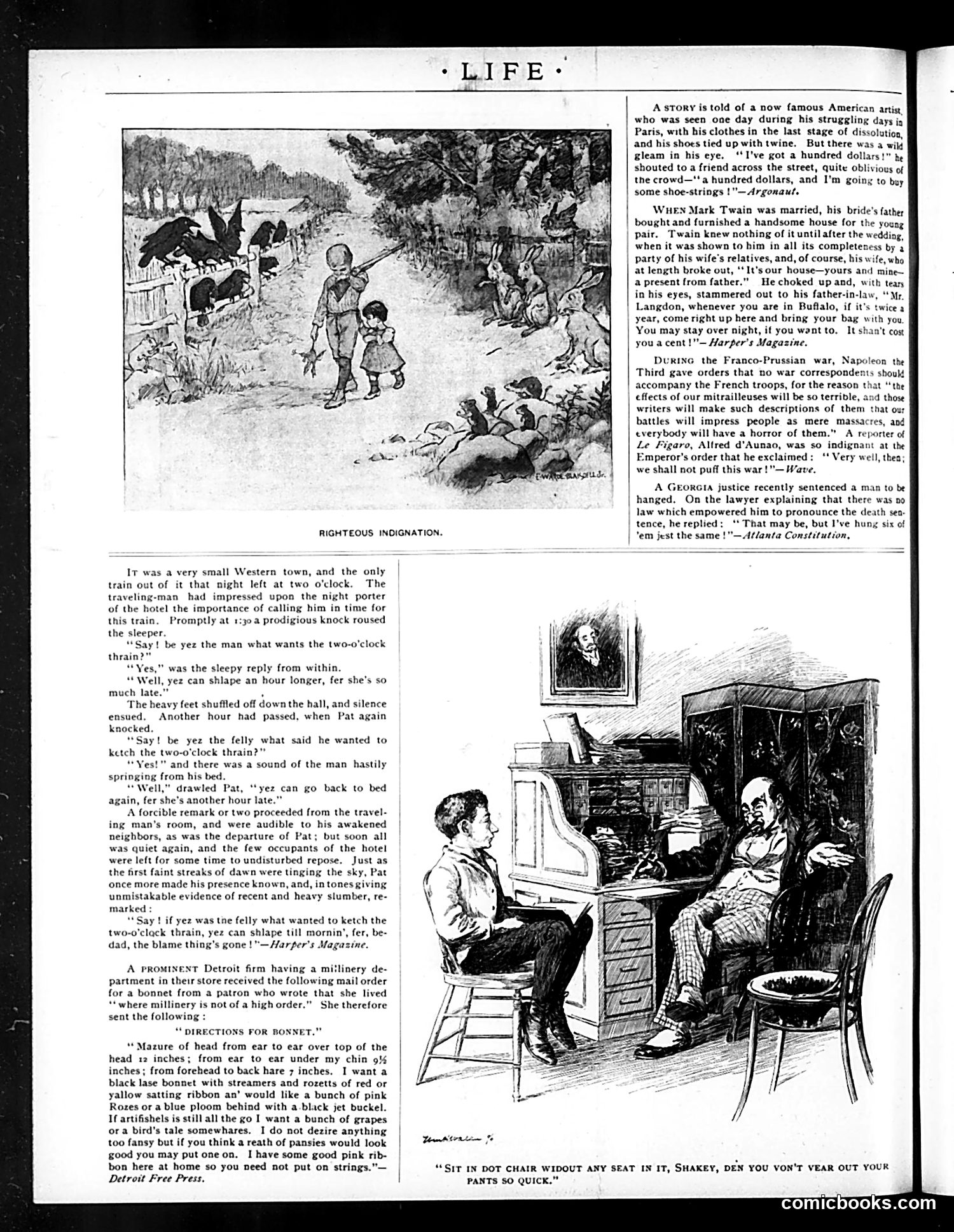
This page from the satirical magazine *Life* contains several humorous anecdotes mocking human nature and social absurdities: The top illustration, "Righteous Indignation," depicts a scene of street poverty or hardship (unclear exact context). The text presents four comedic stories: an artist's enthusiasm despite destitution; Mark Twain's awkward gratitude for a father-in-law's gift; Napoleon III's censorship of war correspondents; and a Georgia judge admitting he's hanged men without legal authority. The bottom illustration shows a man at a desk, accompanying a story about a hotel porter repeatedly waking a traveler with false train departure times, finally announcing the train has left. The final anecdote mocks a millinery customer's vague location description. Together, these satirize human folly: vanity, poor communication, abuse of power, and incompetence. The humor relies on exaggeration and ironic understatement typical of *Life's* social commentary.
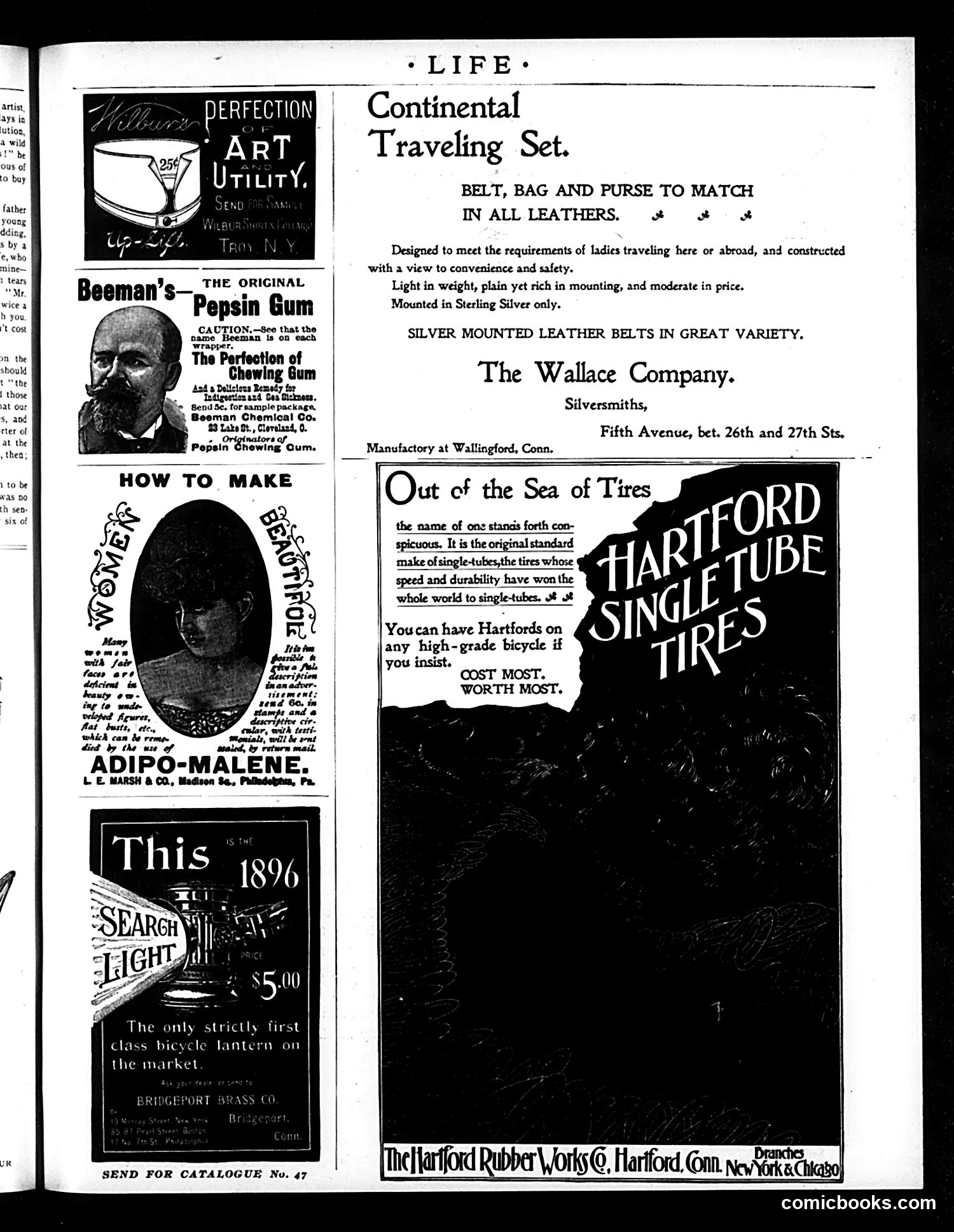
This page is primarily **advertising**, not political satire. It showcases late-19th century consumer products aimed at middle and upper-class readers. The advertisements include: - **Wilbur's Perfection Art Utility** (top left): A cosmetic or grooming product - **Beeman's Pepsin Gum**: Marketed as a digestive remedy, capitalizing on the era's enthusiasm for patent medicines - **Adipo-Malene**: A beauty/weight product by L.E. Marsh & Co. - **Continental Traveling Set** (top right): Leather accessories for ladies traveling abroad, reflecting growing female mobility and consumer culture - **The Wallace Company**: Sterling silver belt mountings, targeting affluent shoppers - **Search Light** bicycle lantern and **Hartford Single Tube Tires**: Products for the bicycle craze sweeping America in the 1890s The page reflects **Gilded Age consumer culture**—products promising modern convenience, health, beauty, and leisure. There is no apparent political cartoon or satirical commentary; this is straightforward commercial advertising typical of *Life*'s revenue model.
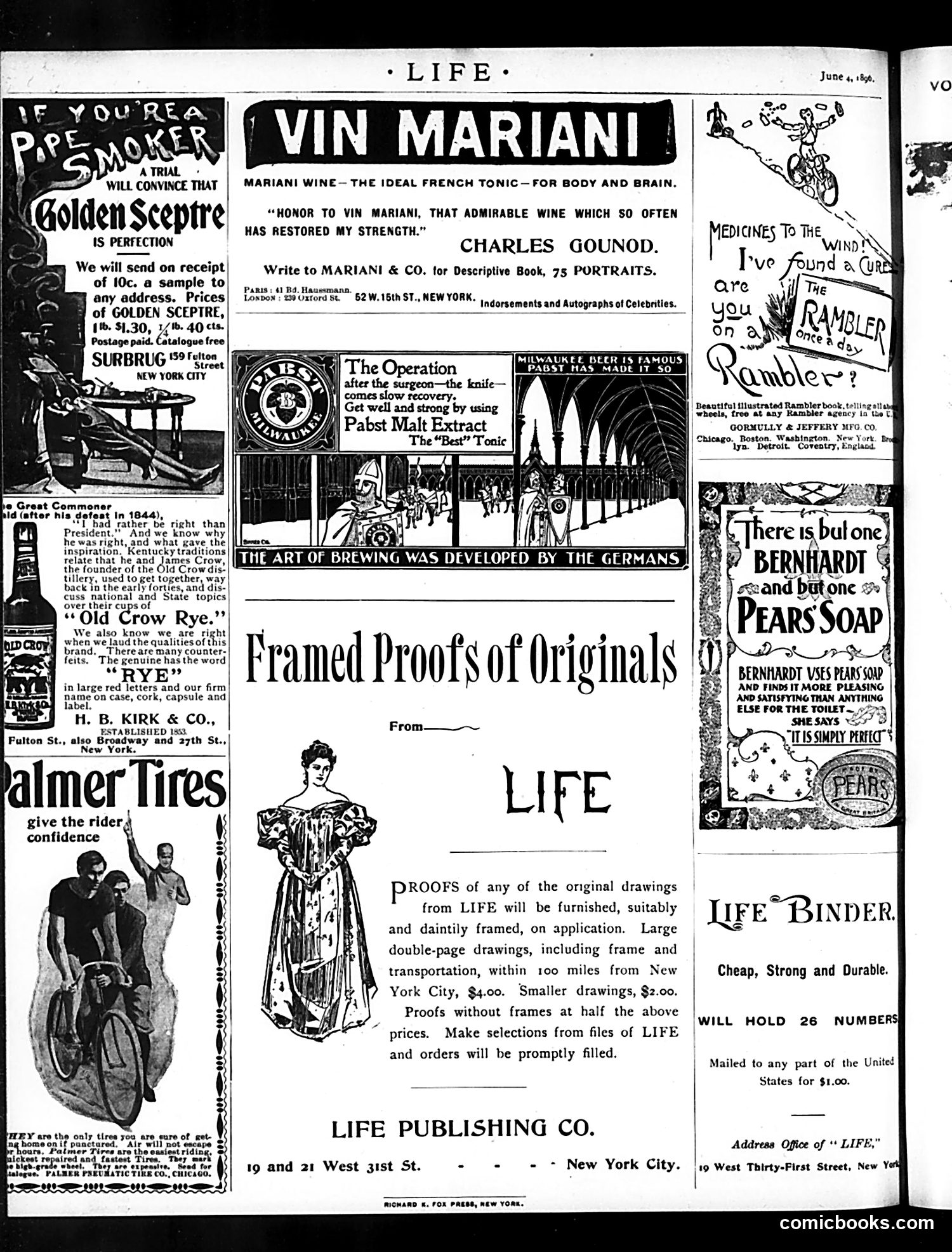
This is primarily an **advertising page** rather than editorial content. The page features product endorsements typical of early 1900s marketing, relying on celebrity testimonials and health claims now considered dubious. **Notable advertisements include:** - **Vin Mariani wine**: Endorsed by composer Charles Gounod as a "tonic for body and brain"—cocaine-laced wines were legal tonics marketed as medicinal - **Pabst Malt Extract**: Promoted for post-surgical recovery ("Get well and strong") - **Bernhardt reference**: Likely Sarah Bernhardt endorsing Pears Soap, a common celebrity marketing tactic - **Palmer Tires and Rambler bicycles**: Contemporary transportation products The page also advertises LIFE's own services: framed reproductions of original artwork from the magazine ($2-$4) and a binding service ($1) to collect 26 issues. The satire is implicit: these ads represent the period's credulous marketing practices, where any product could claim miraculous health benefits with minimal substantiation—a target LIFE magazine itself frequently mocked in its editorial cartoons.