
Life, 1896-06-04 · page 4 of 20
Life — June 4, 1896 — page 4: what you’re looking at
What you’re looking at
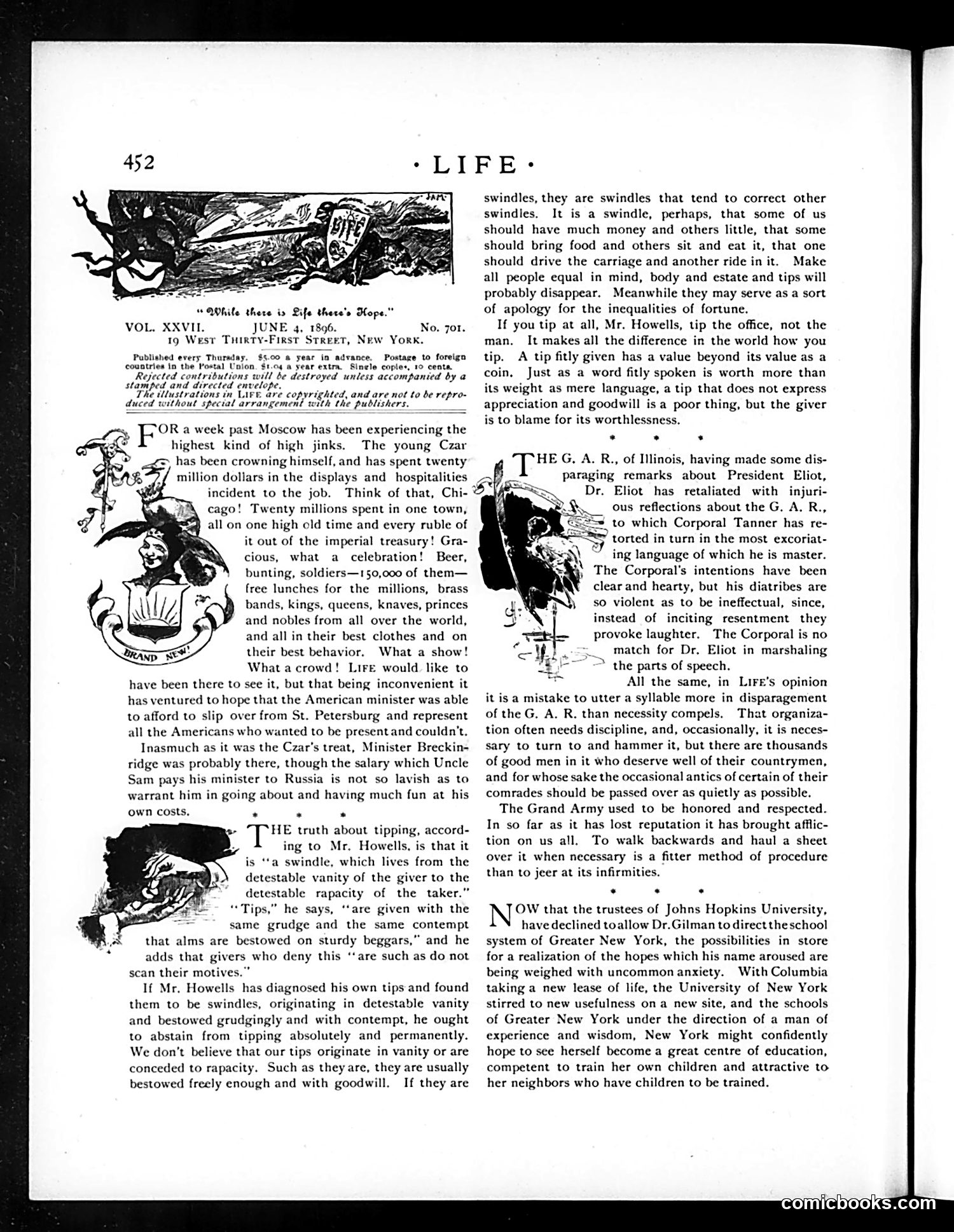
This page contains editorial commentary rather than political cartoons. The main topics are: 1. **Moscow's Celebrations**: Criticism of the young Czar spending twenty million dollars on displays and hospitalities in Moscow, described sarcastically as wasteful imperial extravagance. 2. **Tipping Debate**: A response to Mr. Howells's criticisms of tipping culture, defending the practice as originating from generosity rather than vanity, while acknowledging tips can reflect giver's conceit. 3. **Johns Hopkins University**: Discussion of Dr. Gilman declining to direct a school system in New York, with optimism that New York might develop better educational institutions. The decorative illustrations are generic period artwork rather than specific political caricatures. The page represents typical early-1900s American satirical journalism addressing social customs and institutional matters.
📄 Transcribed text from this page (OCR, searchable)
Machine-transcribed from the original scan — historical spelling and the odd misread are preserved.
“While there is Life there's Hope.” VOL. XXVII. JUNE 4, 1896. No. 7or. 19 West THirty-First Street, New York. $5.00 @ year in advai Postage to foreign in the Postal Union. $1.04 a year extra. Sinele copies, 10 cente, Rejected contributions will be destroyed untess accompanied by a stamped and directed envelope. The illustrations in LIFE are copyrighted, and are not to be repro- duced without special arrangement with the publishers. ‘OR a week past Moscow has been experiencing the highest kind of high jinks. The young Czar has been crowning himself, and has spent twenty million dollars in the displays and _hospitalities incident to the job. Think of that, Chi- * cago! Twenty millions spent in one town, it out of the imperial treasury! Gra- cious, what a celebration! Beer, bunting, soldiers—150,000 of them— free lunches for the millions, brass bands, kings, queens, knaves, princes and nobles from all over the world, and all in their best clothes and on their best behavior. What a show! What a crowd! Lire would like to have been there to see it, but that being inconvenient it has ventured to hope that the American minister was able to afford to slip over from St. Petersburg and represent all the Americans who wanted to be presentand couldn't. Inasmuch as it was the Czar's treat, Minister Breckin- ridge was probably there, though the salary which Uncle Sam pays his minister to Russia is not so lavish as to warrant him in going about and having much fun at his own costs. . e * HE truth about tipping, accord- ing to Mr. Howells, is that it is ‘ta swindle, which lives from the detestable vanity of the giver to the detestable rapacity of the taker.” “Tips,” he says, ‘tare given with the same grudge and the same contempt that alms are bestowed on sturdy beggars,” and he adds that givers who deny this ‘are such as do not scan their motives.” If Mr. Howells has diagnosed his own tips and found them to be swindles, originating in detestable vanity and bestowed grudgingly and with contempt, he ought to abstain from tipping absolutely and permanently. We don’t believe that our tips originate in vanity or are conceded to rapacity. Such as they are, they are usually bestowed freely enough and with goodwill. If they are swindles, they are swindles that tend to correct other swindles, It is a swindle, perhaps, that some of us should have much money and others little, that some should bring food and others sit and eat it, that one should drive the carriage and another ride in it. Make all people equal in mind, body and estate and tips will probably disappear. Meanwhile they may serve as a sort of apology for the inequalities of fortune. If you tip at all, Mr. Howells, tip the office, not the man. It makes all the difference in the world how you tip. A tip fitly given has a value beyond its value as a coin, Just as a word fitly spoken is worth more than its weight as mere language, a tip that does not express appreciation and goodwill is a poor thing, but the giver is to blame for its worthlessness, . . . HEG. A. R., of Illinois, having made some dis- paraging remarks about President Eliot, Dr. Eliot has retaliated with injuri- ous reflections about the G. A. R., == to which Corporal Tanner has re- torted in turn in the most excoriat- ing language of which he is master. ‘ The Corporal's intentions have been clear and hearty, but his diatribes are so violent as to be ineffectual, since, instead of inciting resentment they provoke laughter. The Corporal is no match for Dr, Eliot in marshaling > the parts of speech. All the same, in Lire’s opinion it is a mistake to utter a syllable more in disparagement of the G. A. R. than necessity compels, That organiza- tion often needs discipline, and, occasionally, it is neces- sary to turn to and hammer it, but there are thousands of good men in it who deserve well of their countrymen, and for whose sake the occasional antics of certain of their comrades should be passed over as quietly as possible. The Grand Army used to be honored and respected. In so far as it has lost reputation it has brought afflic- tion on us all, To walk backwards and haul a sheet over it when necessary is a fitter method of procedure than to jeer at its infirmities. wot < Veet . . . OW that the trustees of Johns Hopkins University, have declined toallow Dr.Gilman to direct theschool system of Greater New York, the possibilities in store for a realization of the hopes which his name aroused are being weighed with uncommon anxiety. With Columbia taking a new lease of life, the University of New York stirred to new usefulness on a new site, and the schools of Greater New York under the direction of a man of experience and wisdom, New York might confidently hope to sce herself become a great centre of education, competent to train her own children and attractive to her neighbors who have children to be trained.