
A complete issue · 20 pages · 1896
Life — May 14, 1896
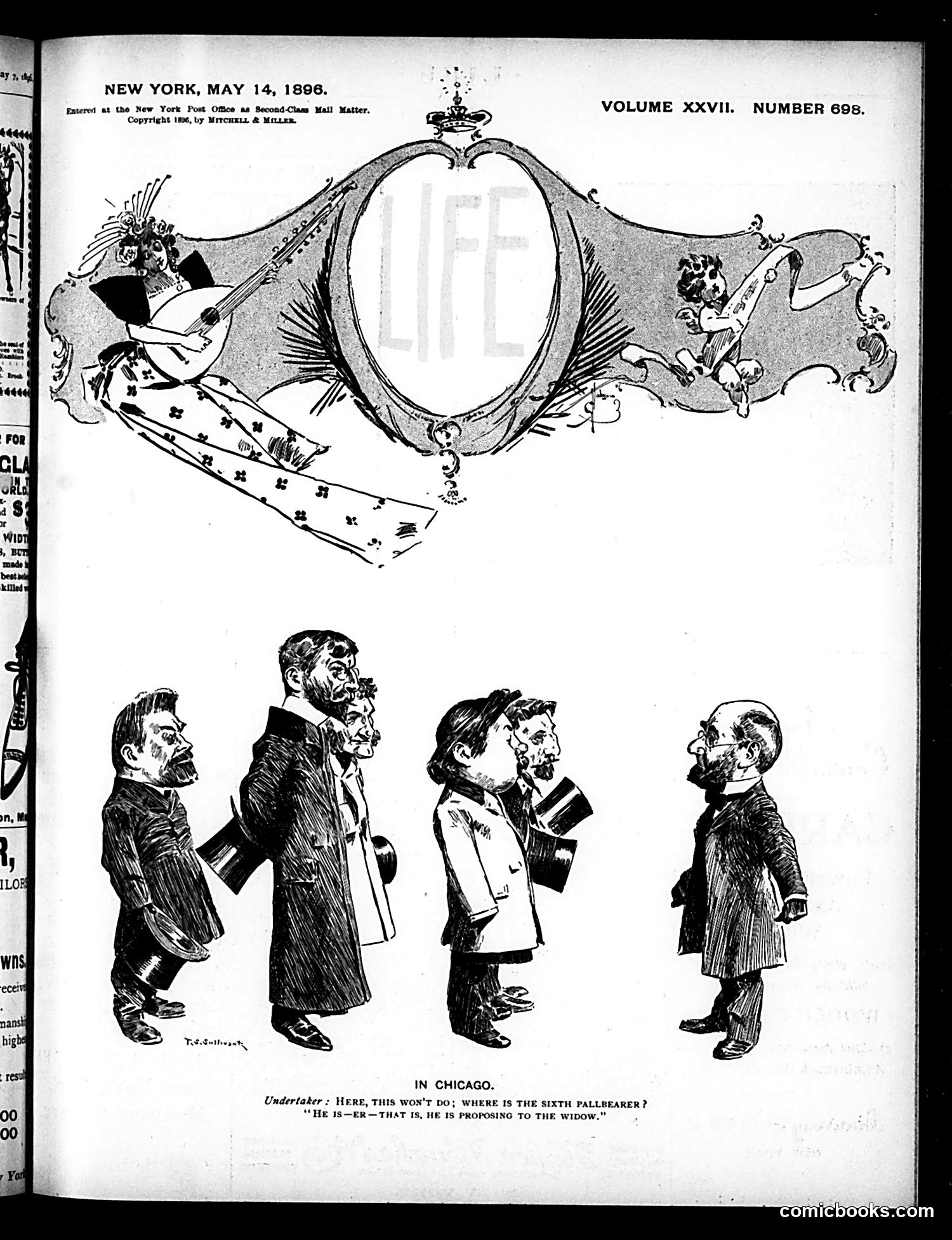
**"In Chicago" - The Sixth Pallbearer** This cartoon satirizes Chicago political figures attending a funeral. The undertaker (left) questions where "the sixth pallbearer" is, noting that one figure "is promising to the widow" — suggesting someone is both attending the funeral AND making potentially opportunistic promises to the deceased's widow simultaneously. The top decorative border features theatrical/musical imagery, possibly referencing entertainment or performance aspects of Chicago politics. The cartoon mocks corrupt or opportunistic Chicago political behavior circa 1896, though the specific individuals and funeral context remain unclear without additional historical documentation. The "sixth pallbearer" appears to be absent or unreliable—a metaphor for political untrustworthiness or hypocrisy during this era.
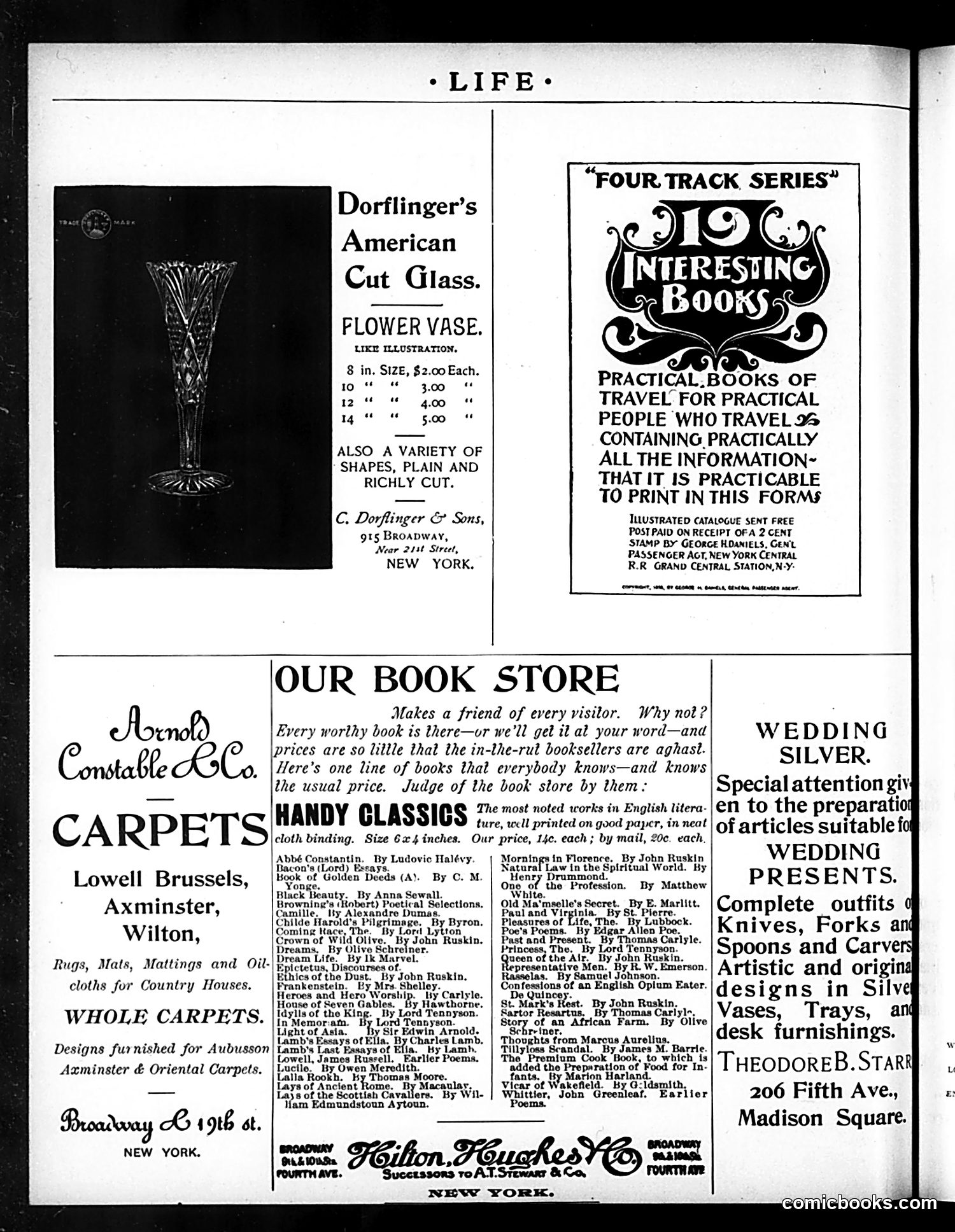
This page is **primarily advertising**, not satirical content. It contains four distinct advertisements: 1. **Dorflinger's American Cut Glass** - promoting a decorative flower vase with pricing by size 2. **"Four Track Series" Travel Books** - practical guidebooks for travelers 3. **Arnold Constable & Co.** - carpet and rug merchants offering home furnishings 4. **Theodore B. Starr** - luxury silverware and wedding gifts The only editorial content is a brief "Our Book Store" section promoting affordable classic literature titles through mail order. No political cartoons or satirical commentary appear on this page. It represents typical early 20th-century Life magazine advertising, targeting middle and upper-class consumers interested in home décor, travel, and luxury goods.
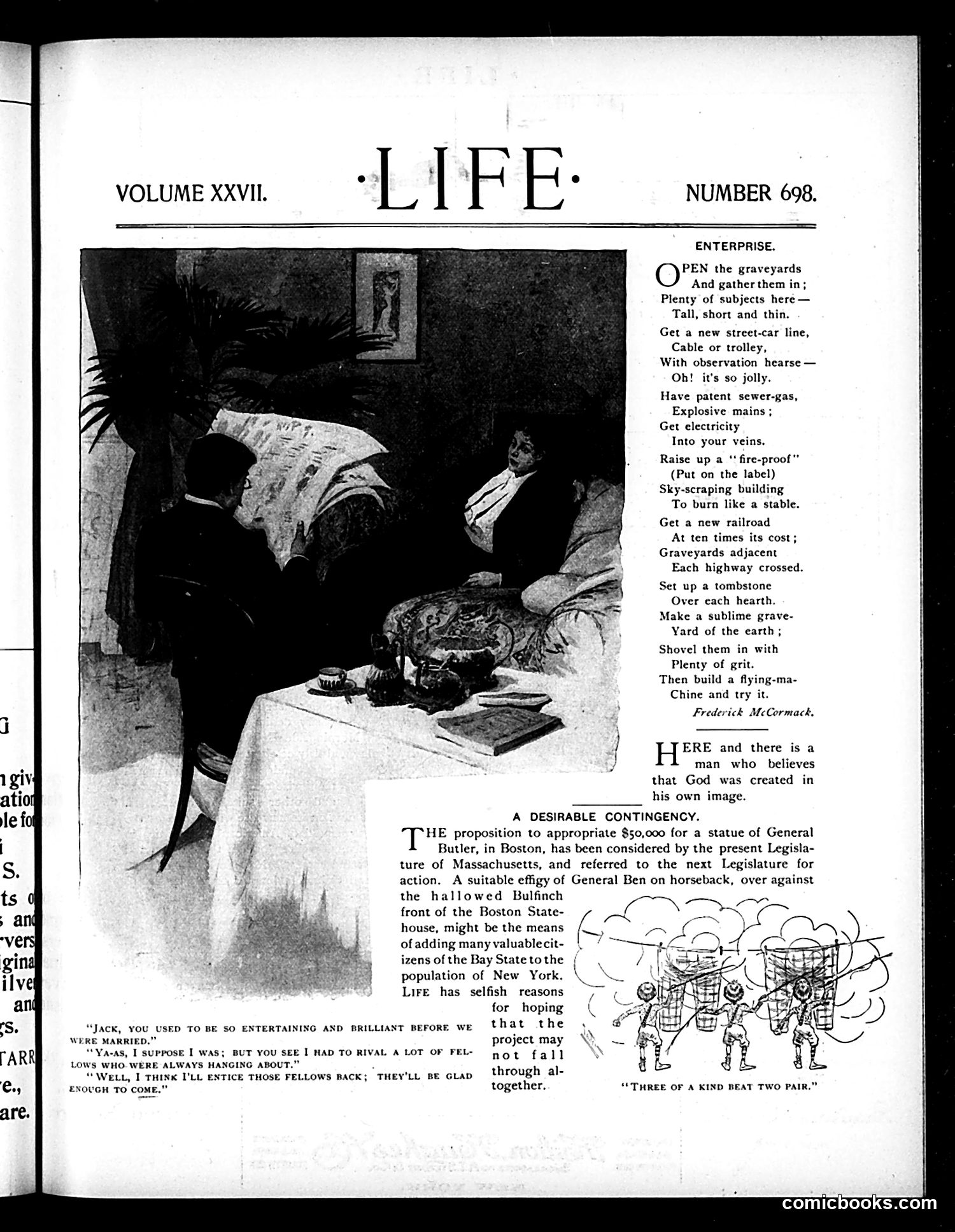
The page contains two distinct items: **Upper section**: A dramatic illustration showing what appears to be a séance or spiritualist gathering, with figures around a table in dim lighting. This likely satirizes the popular spiritualist movement of the early 20th century, mocking people's belief in communicating with the dead through mediums—a widespread phenomenon that attracted both genuine believers and charlatans. **Lower section**: "A Desirable Contingency" discusses appropriating $50,000 for a statue of General Butler in Boston. The accompanying cartoon shows three figures emerging from clouds labeled "Three of a Kind Beat Two Pair"—a poker reference suggesting the proposal involves corrupt backroom dealing among politicians. The satire critiques what Life viewed as wasteful public spending and political corruption in Massachusetts.
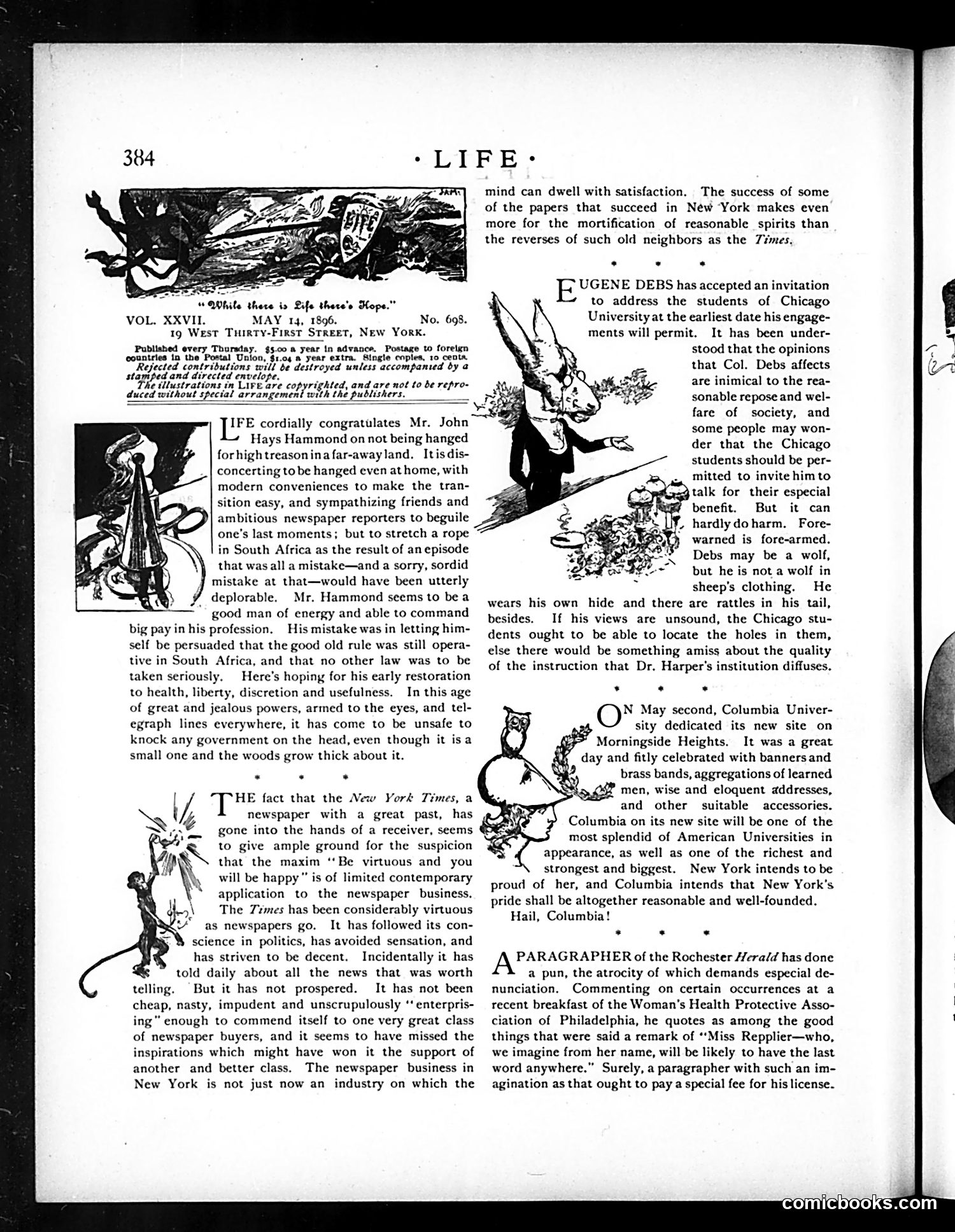
The page contains three distinct satirical pieces: 1. **John Hays Hammond execution cartoon**: Criticizes Hammond's execution in South Africa for treason, suggesting it resulted from poor judgment rather than actual disloyalty. The cartoon mocks the situation as a "sorrid mistake." 2. **New York Times critique**: Satirizes the *Times*' shift toward sensationalism under new ownership. Life accuses the paper of abandoning its previous decency and integrity to compete with "yellow journalism," suggesting it's chasing profits over principles and lost respectable readership. 3. **Columbia University dedication**: Celebrates Columbia's new Morningside Heights campus, praising it as a magnificent American institution worthy of New York's pride. The illustrations use anthropomorphic figures (owls, monkeys) for visual satire typical of Life's style.
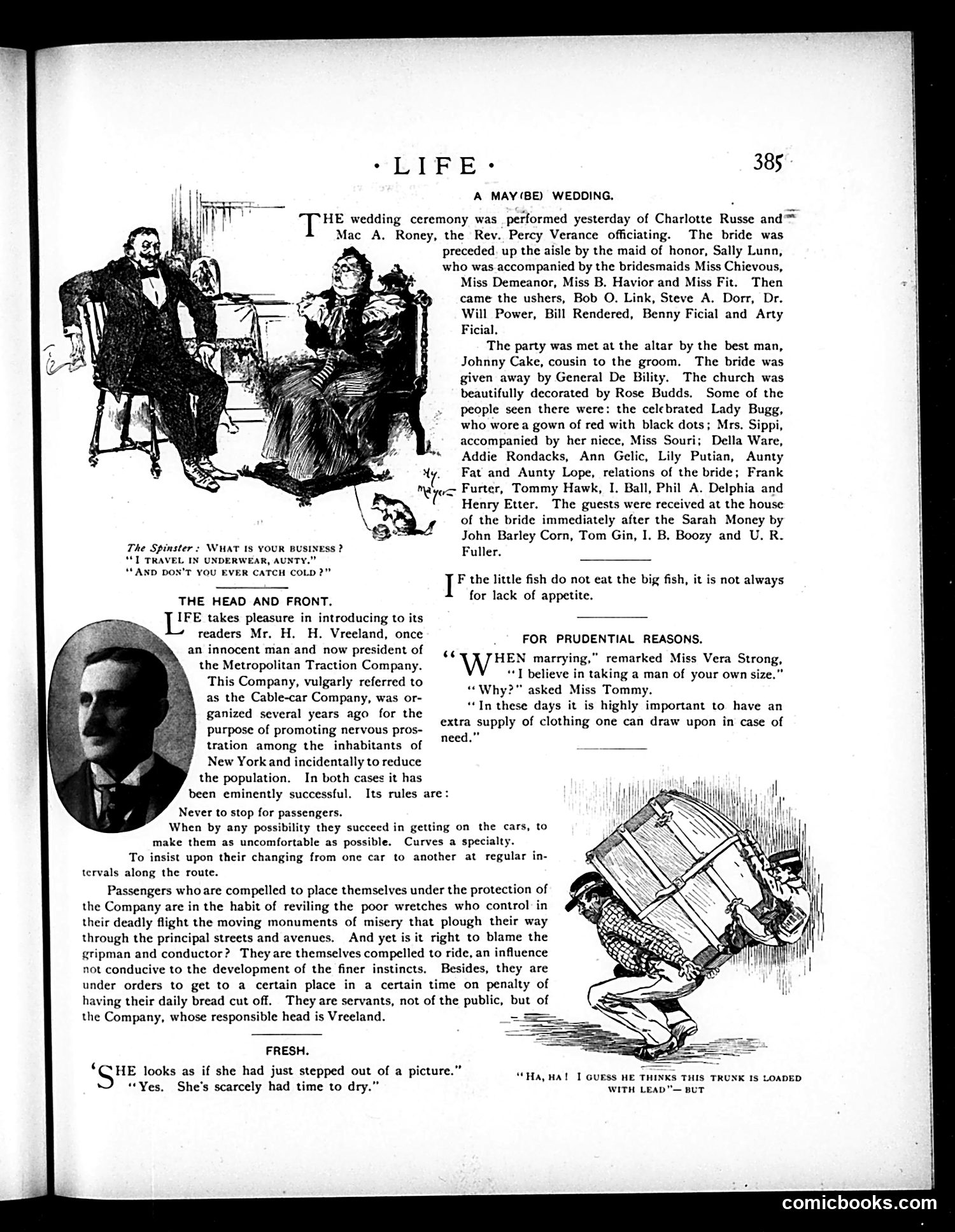
This page contains three separate satirical pieces: 1. **"A May(be) Wedding"** describes an actual wedding ceremony for Charlotte Russe and Mac A. Roney, listing numerous guests and details—this appears to be humorous social reporting rather than political satire. 2. **"The Head and Front"** introduces Mr. H. H. Vreeland, president of the Metropolitan Traction Company (Cable-car Company). The satire criticizes the company's harsh rules toward passengers and employees, depicting the cable-car system as an instrument of misery. Vreeland is blamed for prioritizing profit over passenger comfort and worker dignity. 3. **"Fresh"** and other brief joke sections provide light social humor unrelated to politics. The main satirical target is corporate transit monopolies and their indifference to public welfare.
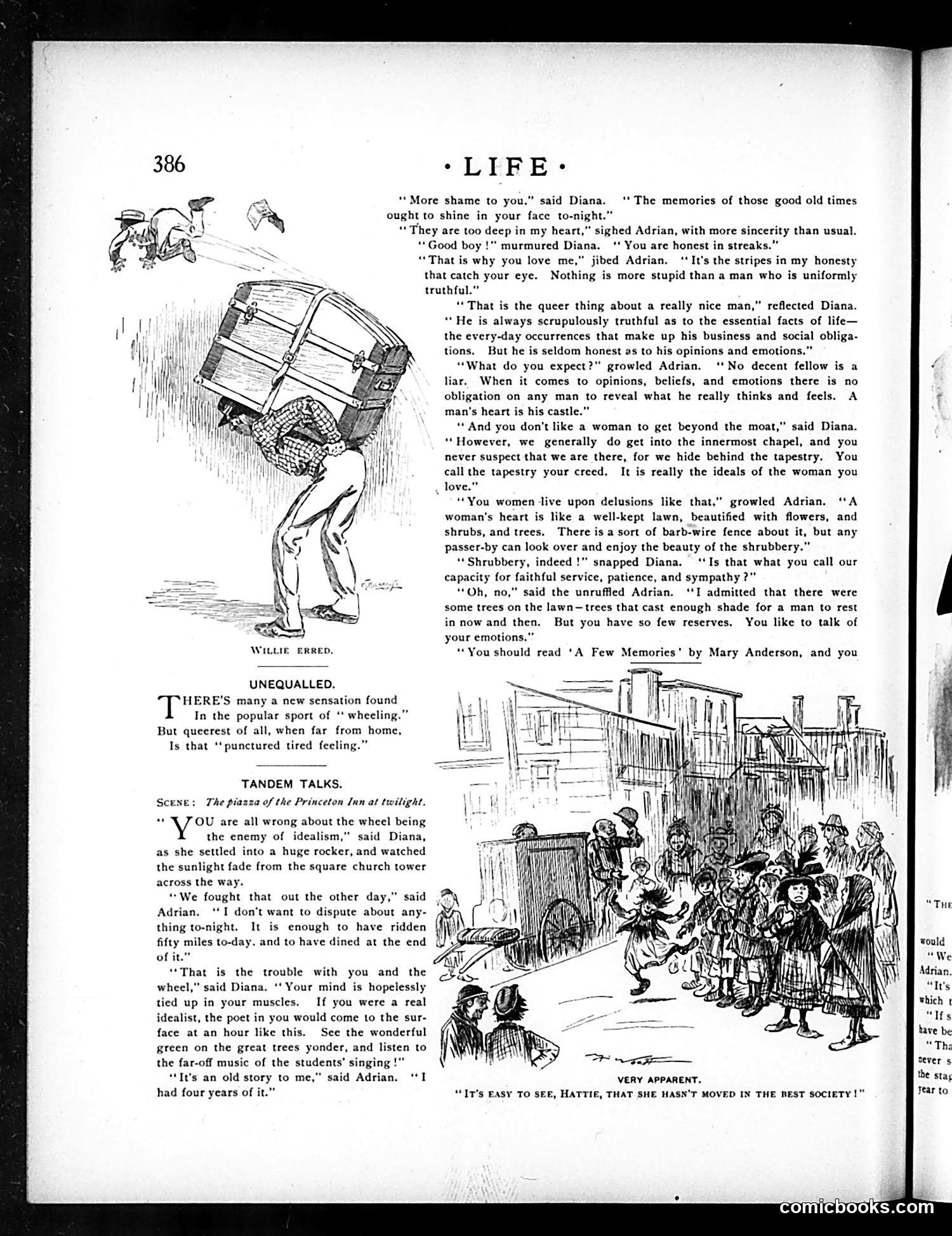
This page contains two distinct pieces of satirical content: **"Willie Erred"** (top illustration): Shows a man in uncomfortable physical posture, illustrating a dialogue between characters Diana and Adrian about honesty, emotional restraint, and gender differences in relationships. The cartoon mocks masculine emotional suppression—Adrian argues men shouldn't reveal their feelings, while Diana critiques this as dishonest artifice. The physical awkwardness of the figure reinforces the tension being discussed. **"Tandem Talks"** and **"Very Apparent"** (lower sections): Depicts a street scene with pedestrians and children. The dialogue suggests social commentary about class, respectability, and public perception—specifically that outward appearances don't reflect true social standing. The satire targets Victorian-era pretense and the gap between how people present themselves and their actual circumstances. Both segments explore early 20th-century social hypocrisy and gender role tensions.
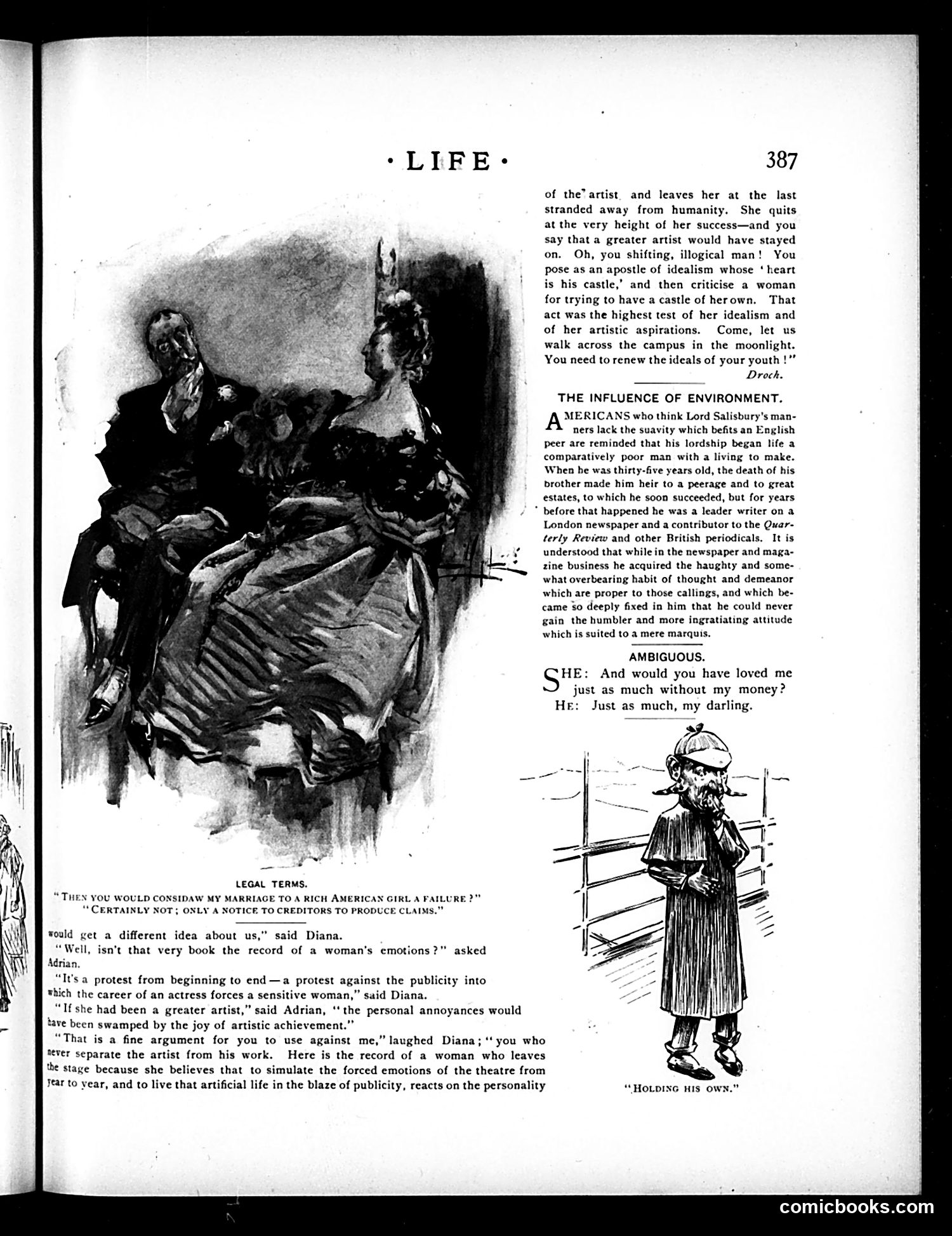
This page contains two distinct pieces: **Upper section ("Legal Terms"):** A dialogue between Diana and Adrian debating whether a woman should leave her artistic career for marriage to a wealthy American. Adrian argues the woman's departure from public life represents "a protest" against how actresses' "forced emotions" are consumed by audiences. Diana counters that abandoning art for money contradicts artistic idealism. The accompanying sketch shows two figures in conversation. **Lower section ("Holding His Own"):** A simple cartoon depicts a bearded man in work clothes standing by a fence, captioned "Holding his own." This appears to be a humorous image about rural self-sufficiency or independence. The page satirizes early 20th-century tensions between women's artistic ambitions and marriage expectations, alongside class commentary about wealth and authenticity.
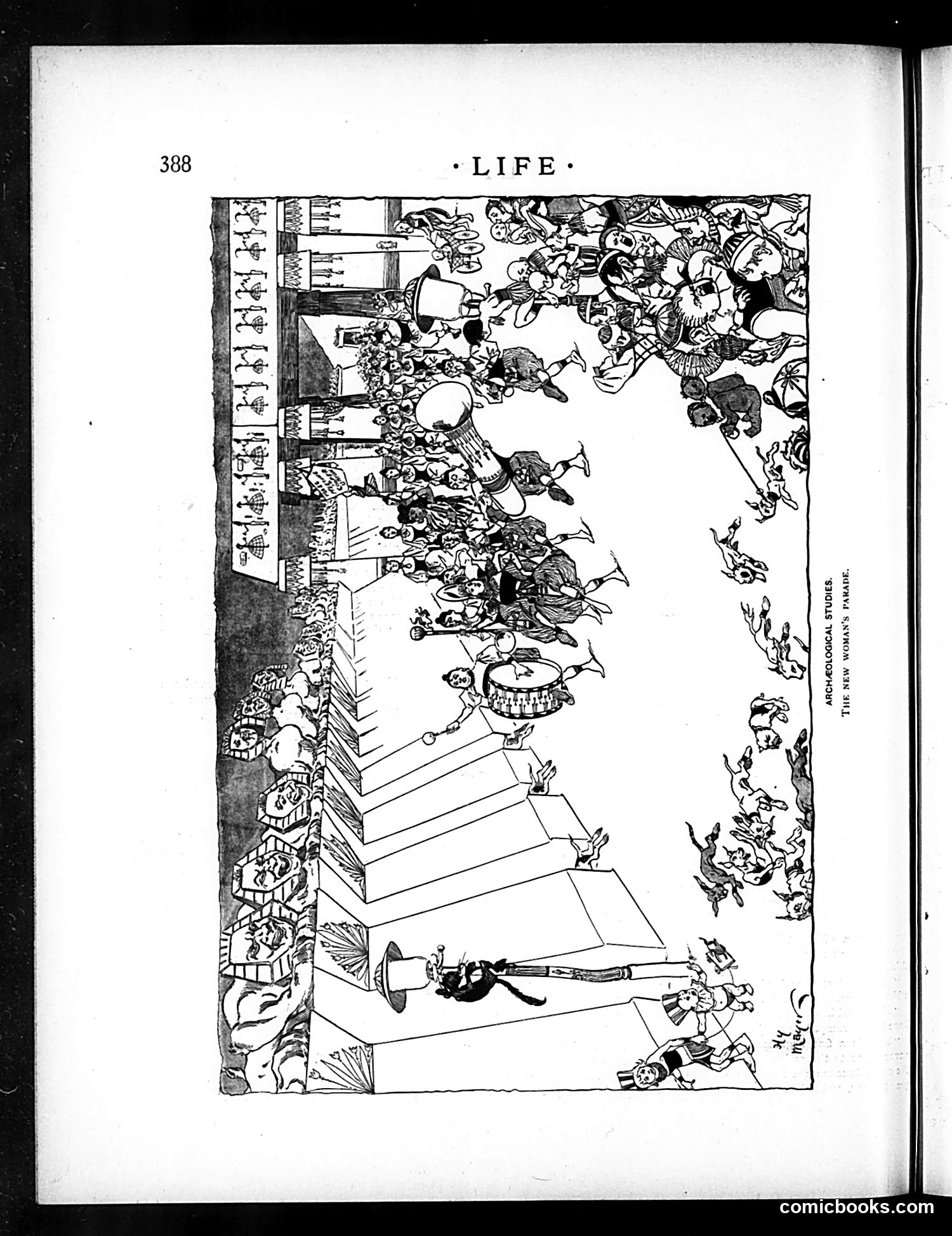
This satirical illustration depicts a chaotic schoolroom scene turned upside-down (literally—the image is rotated). A central female figure stands on a platform addressing a wildly disorderly crowd of students and onlookers. The scene emphasizes pandemonium: students are scattered chaotically, some appearing to ignore instruction entirely. The satire likely critiques either progressive education methods or anxieties about women in teaching/leadership roles during the early 20th century. The "new woman's panic" reference suggests contemporary concerns about female educators' ability to maintain classroom order and discipline. The inverted perspective reinforces the idea of social disorder and upheaval, making this a commentary on changing gender roles and educational reform debates of the period.
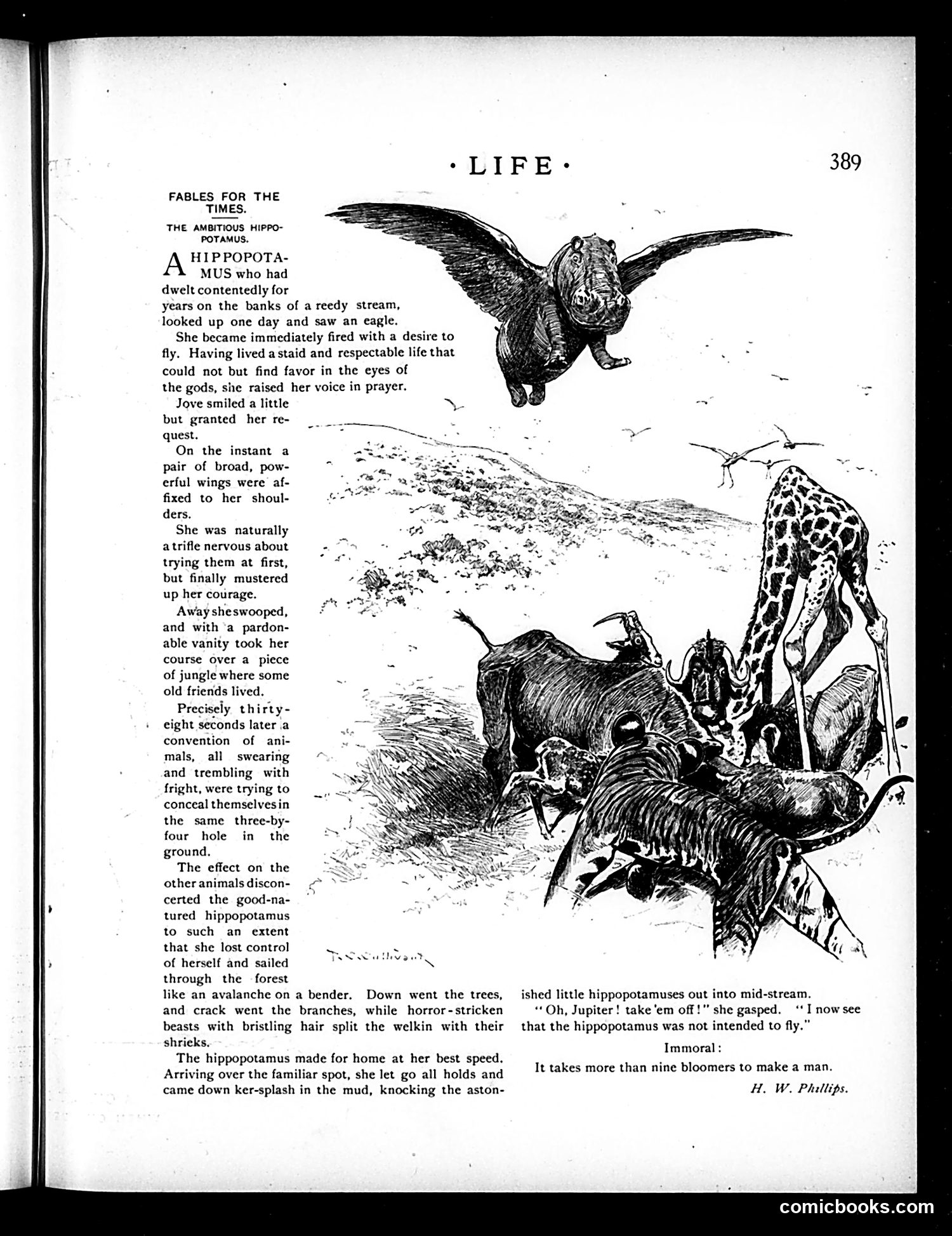
This is a fable illustrated with ink drawings showing a hippopotamus who gains wings and attempts to fly, causing chaos among jungle animals (giraffe, birds, etc.). The story satirizes social ambition—specifically the dangers of aspiring beyond one's station. The hippopotamus, content in her natural role, becomes "fired with a desire to fly," gaining wings through prayer. Her attempt ends in disaster: she crashes through the forest uncontrollably, terrifying other animals. The moral critiques overambition and suggests that accepting one's predetermined place in society is safer than striving for advancement. The final quote—"It takes more than nine bloomers to make a man"—implies that outward changes cannot fundamentally alter one's nature. This reflects early 20th-century conservative social attitudes about class mobility.
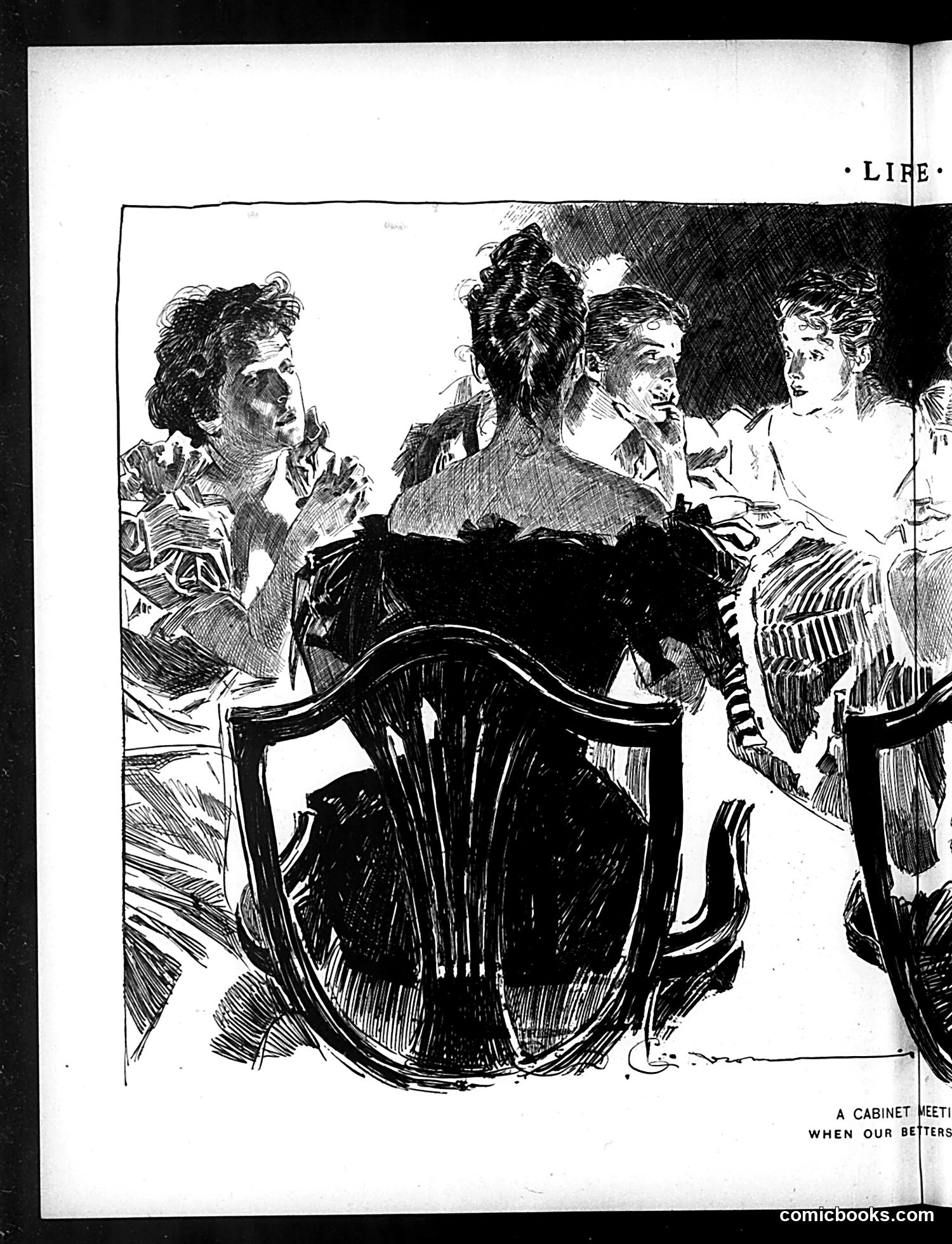
This page from *Life* magazine shows a political cartoon titled "A CABINET MEETI[NG] / WHEN OUR BETTE[RS]" (text cut off). The sketch depicts four men in formal 19th or early 20th-century dress gathered around a chair. The chair itself—rendered in heavy black ink and dominating the composition—appears to be the visual focus, suggesting it represents a position of power or authority that is conspicuously empty or contested. The caption's reference to "cabinet meeting" and "when our betters" suggests satirical commentary on government leadership or political pretension. The exaggerated style and emphasis on the empty chair likely mock political figures or the absence of capable leadership during a particular period, though without additional context or clearer identifying details, I cannot specify which officials or events are referenced.
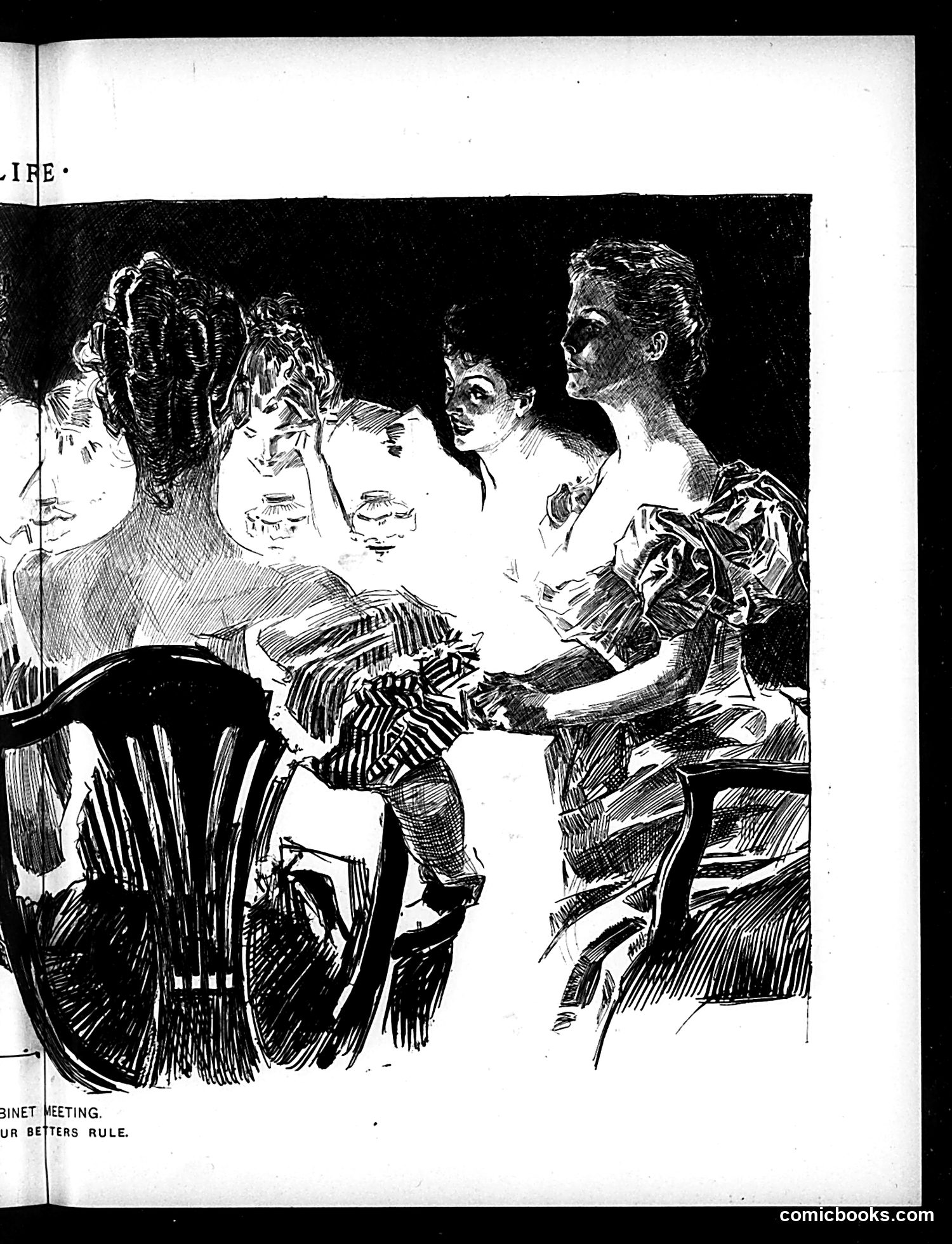
This appears to be a satirical sketch from Life magazine depicting a social gathering. The visible caption fragment reads "CABINET MEETING" and "OUR BETTERS RULE," suggesting the cartoon satirizes government officials or the upper class. The drawing shows several figures in formal attire engaged in conversation, rendered in the magazine's characteristic ink-sketch style. The caricatured faces and expressive body language typical of Life's satirical approach suggest commentary on political pretension or social hierarchy. However, without the complete caption, full date, or clearer context, I cannot definitively identify the specific figures, time period, or exact political event being mocked. The phrase "our betters rule" indicates class-based satire, but more information would be needed for precise historical attribution.
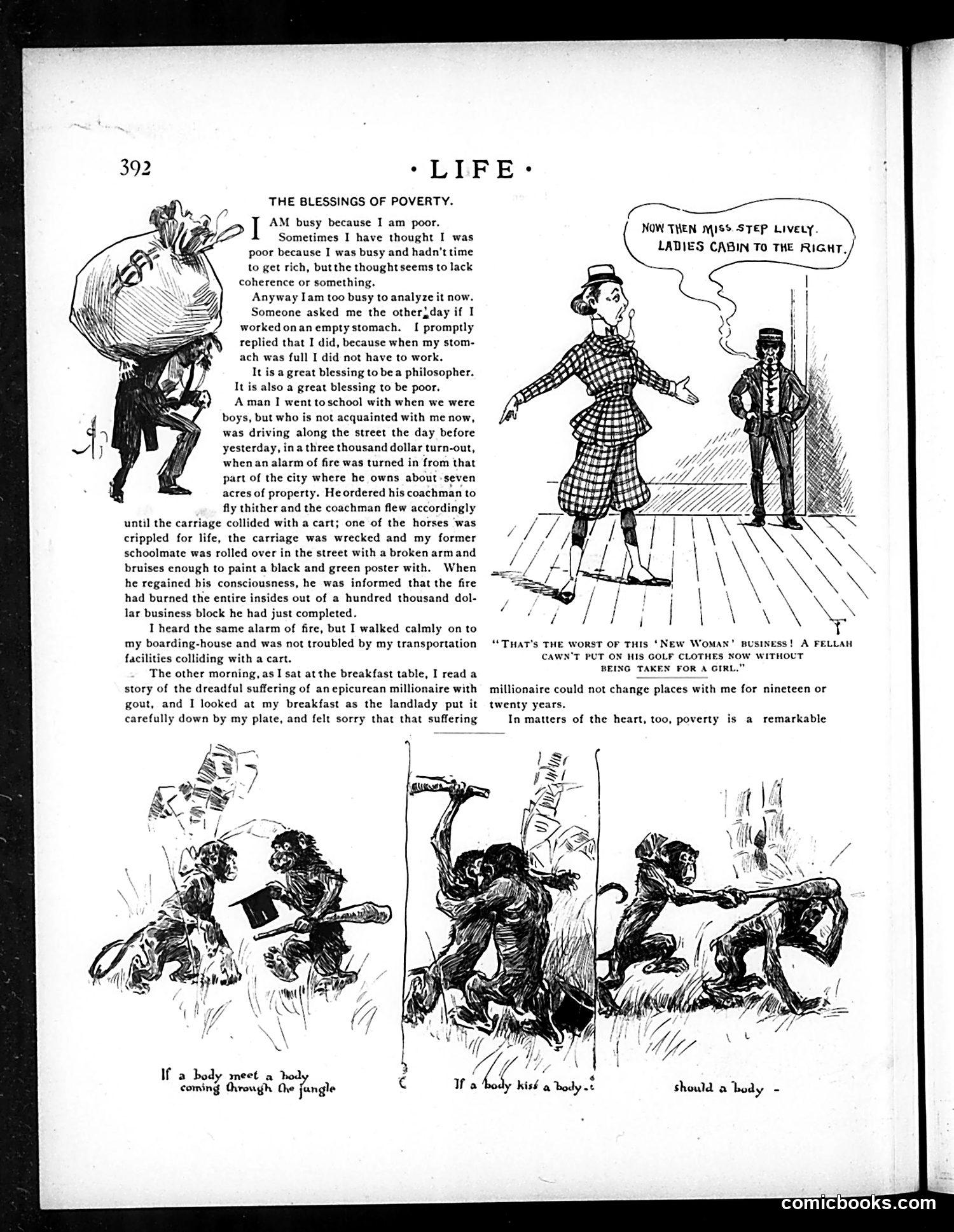
This is a humorous essay mocking the wealthy while celebrating poverty's supposed advantages. The author ironically argues that being poor is actually blessed—he has no property to worry about catching fire, no gout from rich foods, and no transportation accidents to fear. When a wealthy former schoolmate loses a fortune in a fire and gets hit by a carriage, the poor author simply walks calmly home untroubled. The accompanying cartoons satirize gender and class anxieties of the era. The top illustration mocks the "New Woman"—a figure referencing early 1900s feminism—suggesting men can't wear golf clothes without being mistaken for women in the new social order. The bottom sequential panels appear to reference children's nursery rhymes, possibly commenting on social chaos. The satire cuts both ways: praising poverty's freedom while implicitly criticizing wealthy anxiety and excess.
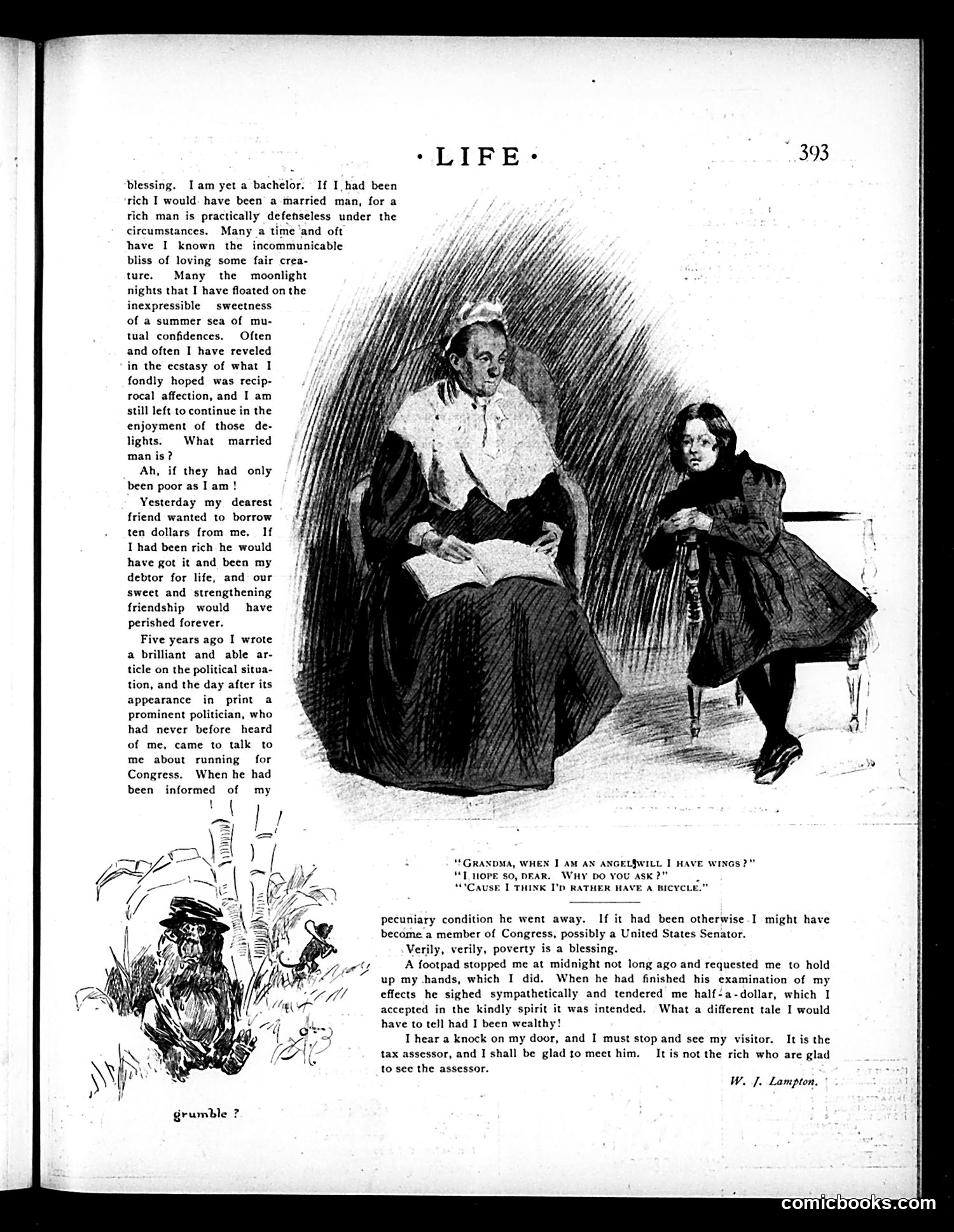
This is a humorous essay by W. J. Lampton celebrating poverty as a blessing. The author argues that being poor has protected him from life's complications: he avoided ruinous marriage (since rich men make convenient targets), preserved a friendship by being unable to lend money, missed becoming a corrupt congressman, and was actually *helped* by a robber who pitied his destitution. The two illustrations support this satire: the upper cartoon shows a grandmother with a child, capturing innocence contrasting with adult concerns about wealth. The lower sketch depicts a beggar, reinforcing the essay's theme. The joke is ironic—the author presents genuine hardships (inability to help friends, political powerlessness, robbery) as fortunate outcomes. By inverting conventional wisdom that wealth equals success, Lampton satirizes both poverty's real miseries and the moral compromises wealth supposedly brings. The tax assessor callback adds a final jab: only the poor welcome government officials who have nothing to take.
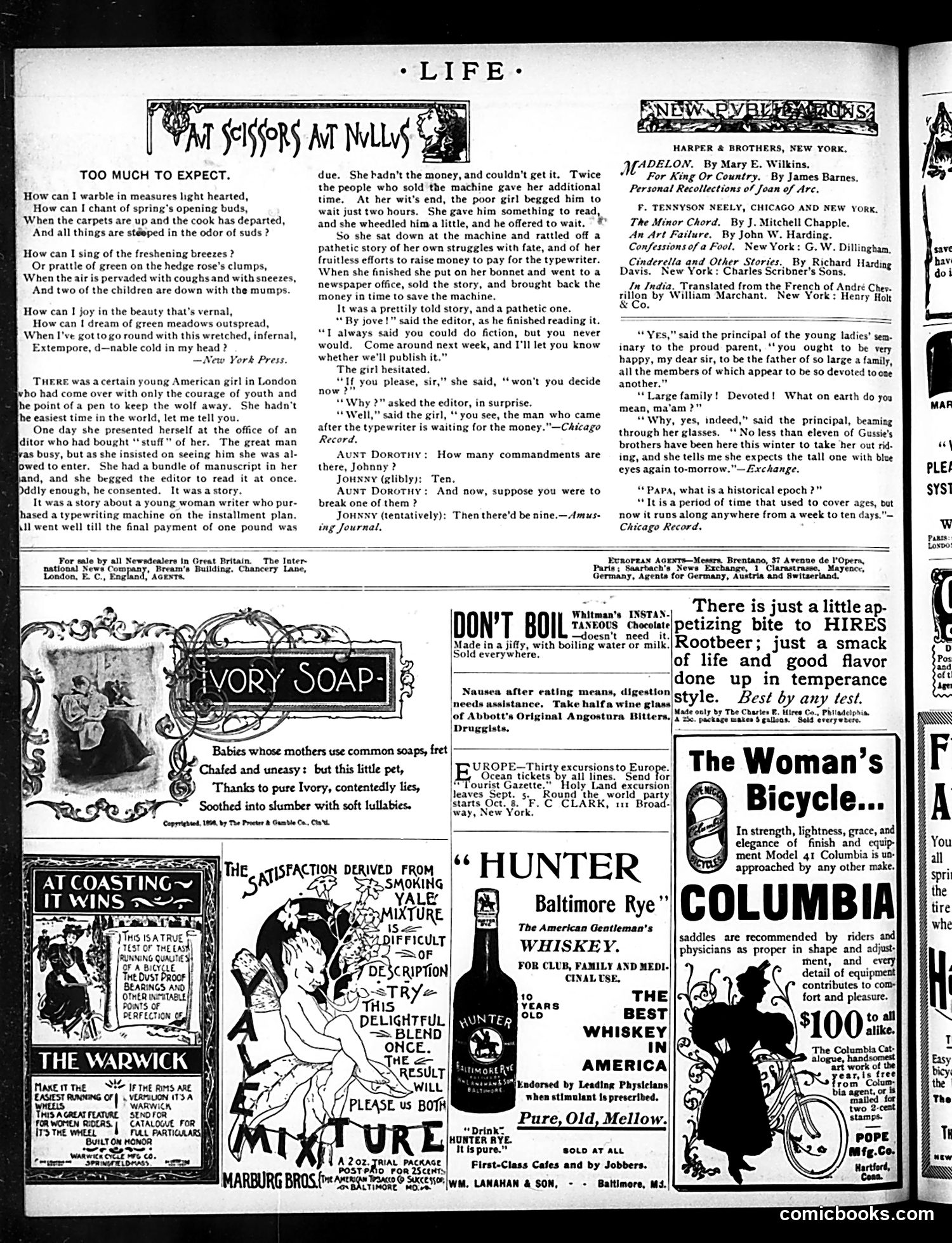
This page contains several humorous pieces mocking everyday frustrations and literary pretension. The main story satirizes the struggling young American writer in London: a girl sells a typewriter-company editor a *story about* selling a story to pay for her typewriter—a self-referential narrative trick. The editor initially dismisses her fiction abilities, yet her meta-narrative succeeds where straightforward work failed. The satire targets both the desperation of impoverished writers and the absurdity of editors' arbitrary taste. The opening poem mocks the romantic poet's inability to compose verse amid domestic chaos—spring inspiration dies under "the odor of suds" and children with mumps. The brief exchange between "Aunt Dorothy" and "Johnny" jokes about religious instruction: when asked if he'd break one of Ten Commandments, the boy naively calculates "nine remain"—satirizing literal-minded arithmetic replacing moral understanding. Overall, the page satirizes literary pretension, domestic disorder, and naive logic rather than specific political figures or events.
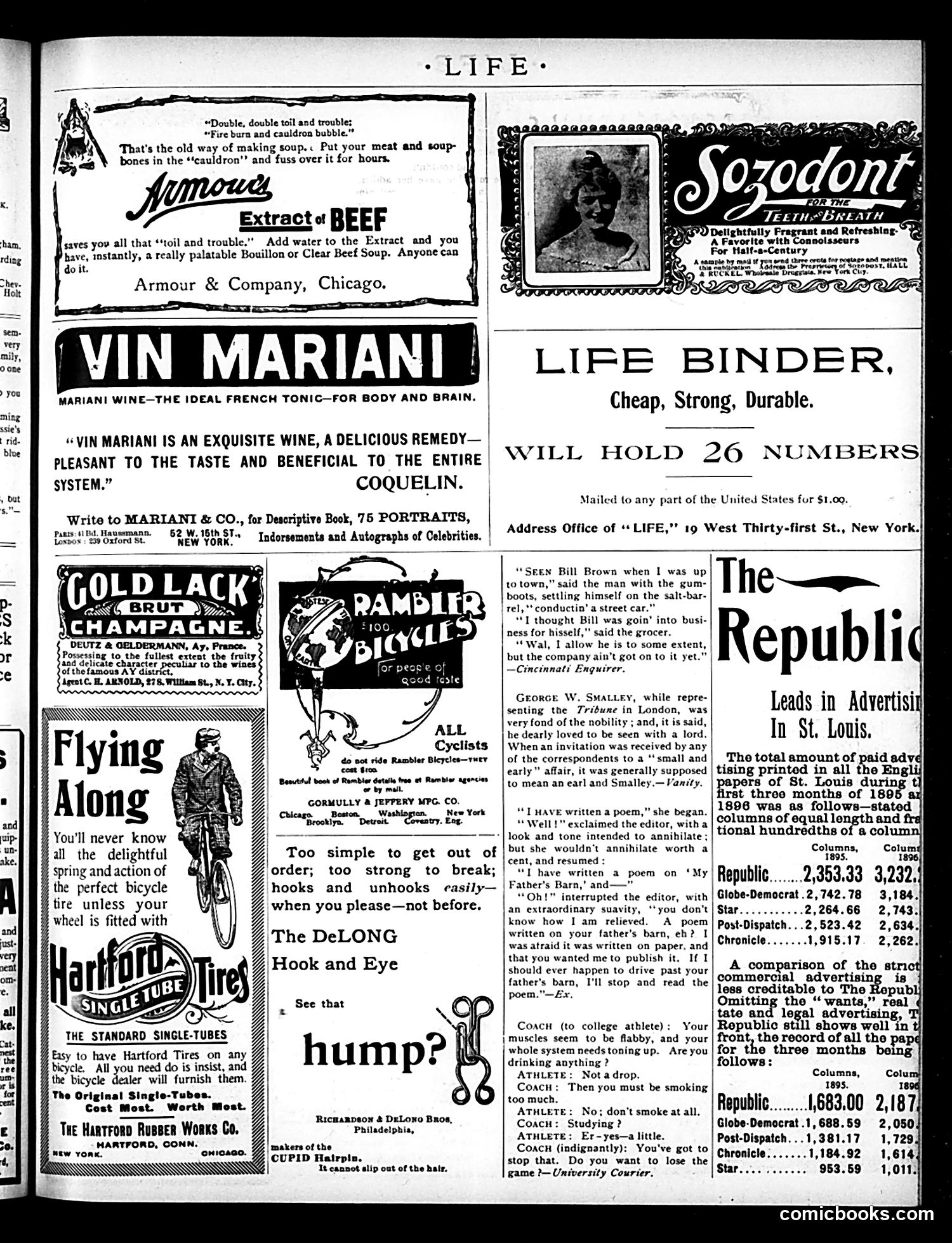
This page is primarily **advertising**, typical of early 1900s Life magazine, which supplemented satirical content with paid ads. Notable features: **Major Advertisements:** - Armour beef extract (with a Macbeth witches reference for comedic appeal) - Vin Mariani wine (marketed as medicinal tonic) - Hartford bicycle tires, Rambler bicycles, DeLong hooks - Sozodont toothpaste, Life magazine binders **Humorous Content:** The page includes several brief comedic anecdotes and jokes rather than political cartoons: - A grocer's tale about a streetcar conductor - George W. Smalley's fondness for nobility while reporting for the Tribune - An editor's sarcastic rejection of a poem written on a barn - A coach questioning an athlete about smoking and studying **Historical Context:** These jokes reflect turn-of-the-century concerns: transportation innovation, social climbing, newspaper culture, and college athletics. The tone is gently satirical of human foibles rather than overtly political. The advertisements themselves employ mild humor to sell products.
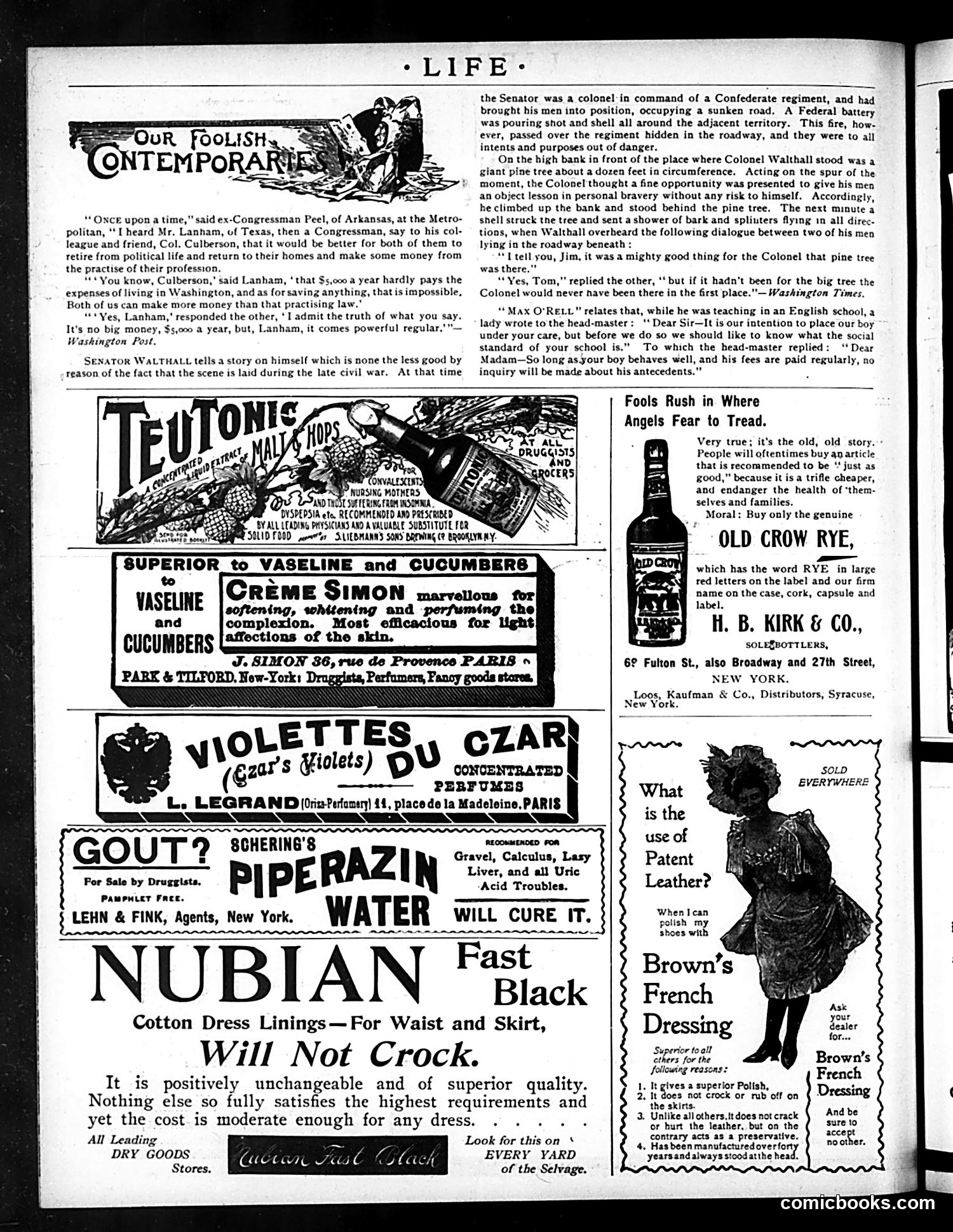
This page from *Life* magazine contains three humorous anecdotes satirizing American political and social hypocrisy: 1. **The Congressional Salary Story**: Politicians complain that $5,000/year barely covers Washington living expenses—yet admit this "comes powerful regular" (steady income). The satire: they won't leave despite claiming poverty, valuing job security over principle. 2. **Colonel Walthall's Bravery Lesson**: A Confederate officer demonstrates courage by standing behind a tree during artillery fire to inspire his men. His soldiers' conversation reveals the joke: the tree—not the Colonel's bravery—saved his life. Satire of performative heroism. 3. **The Headmaster's Standards**: A school administrator assures parents their son's social background won't matter "so long as your fees are paid regularly." Satire: institutions claim to value character but actually prioritize money. The rest of the page is period advertising (patent medicines, dress linings, cosmetics), typical of *Life*'s revenue model. The anecdotes collectively mock how Americans—politicians, military officers, educators—prioritize self-interest over stated principles.
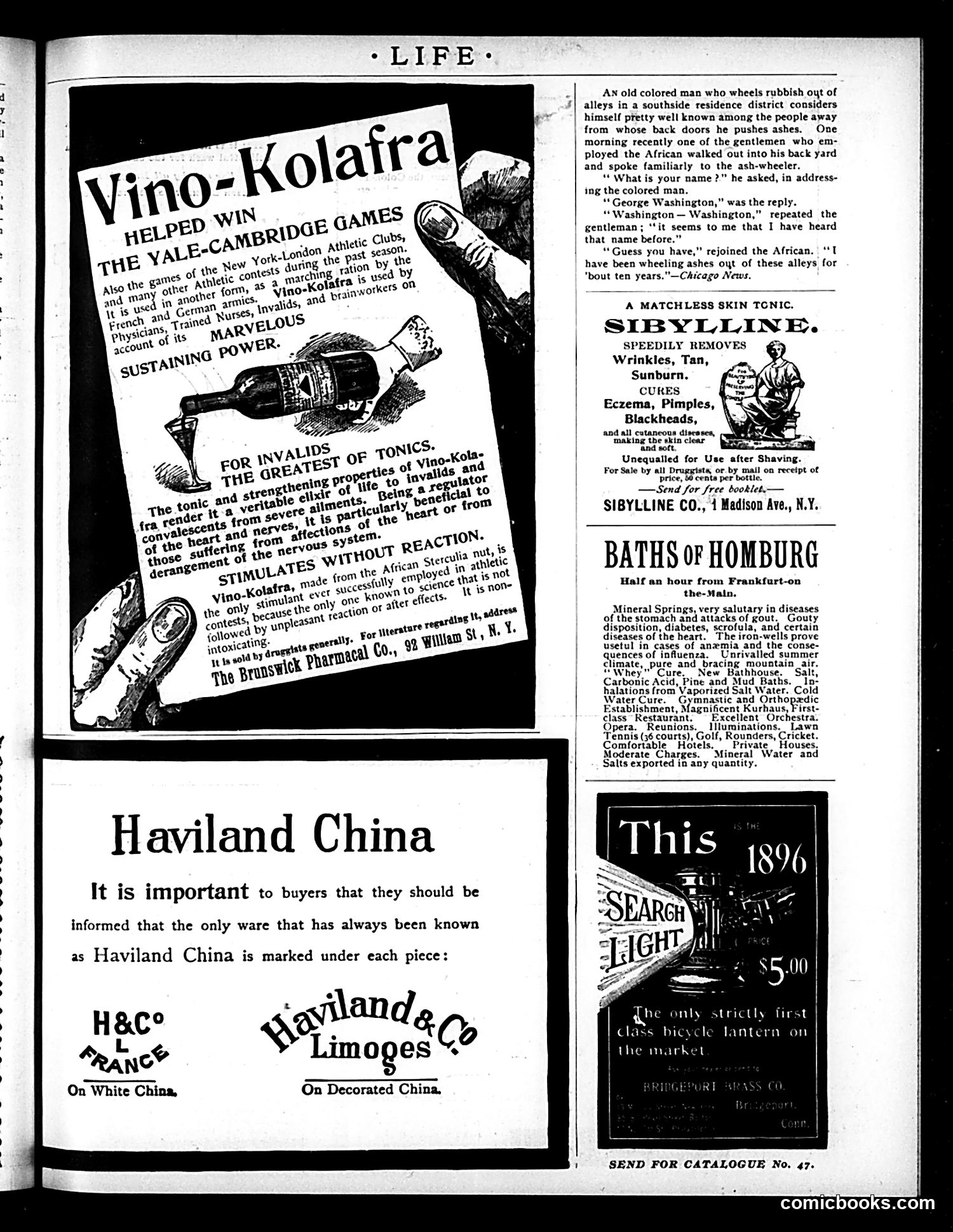
This page is primarily **advertising** rather than editorial satire. The dominant content includes: 1. **Vino-Kolafra advertisement** (top): A tonic wine claiming to help athletes (referencing Yale-Cambridge games) and benefit invalids, featuring muscular figures. Typical of patent medicine ads promising broad health benefits. 2. **Humorous anecdote** (right column): A brief joke about an ash-wheeler (garbage collector) named "George Washington" who's worked in the alleys for ten years—the humor relies on the contradiction between the famous name and the lowly occupation. 3. **Multiple product ads**: Sibyline skin tonic, Baths of Homburg (German spa), Haviland China (with trademark marks), and a Search Light bicycle lantern. The page reflects late 19th-century advertising conventions: patent medicines with exaggerated claims, spa tourism pitches, and luxury goods marketed alongside working-class humor. The racial dialect in the anecdote reflects period attitudes toward African Americans.
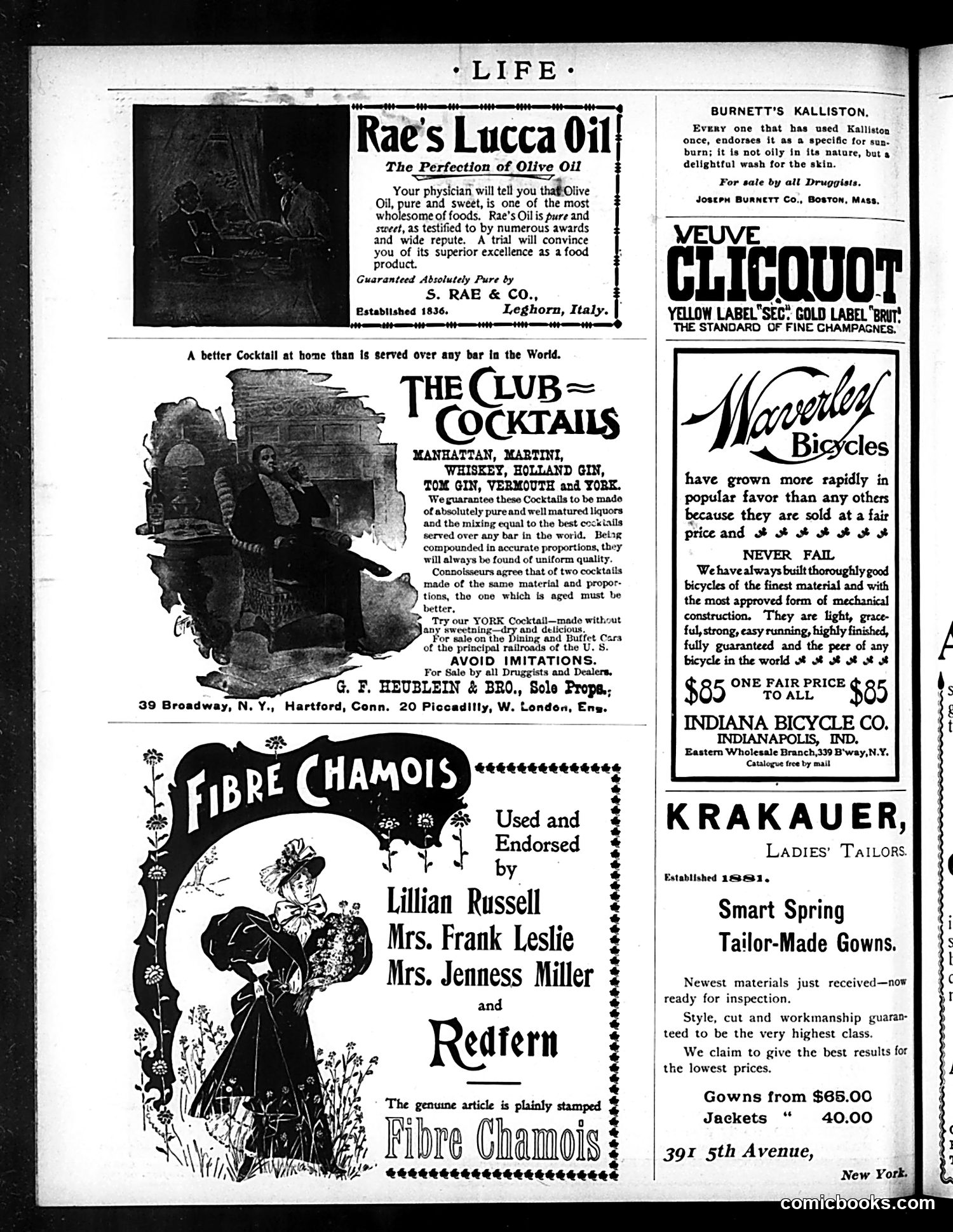
This page is primarily **advertising**, typical of early 20th-century Life magazine. There are no political cartoons or satire to analyze. The advertisements showcase products marketed to wealthy readers: imported Italian olive oil, pre-made cocktails (notably during the pre-Prohibition era), champagne, bicycles, women's tailored clothing, and cosmetics. The Fibre Chamois endorsement features celebrity names (Lillian Russell, Mrs. Frank Leslie, Mrs. Jenness Miller)—prominent society figures of the era whose names lent credibility to products. The humor, if any, is mild and commercial: The Club Cocktails ad claims home-mixed drinks rival bar service, and the York Cocktail is specifically marketed as "dry"—reflecting sophisticated tastes of the period. This reflects Life's role as a lifestyle magazine for affluent Americans, blending entertainment with consumer marketing rather than providing social commentary.
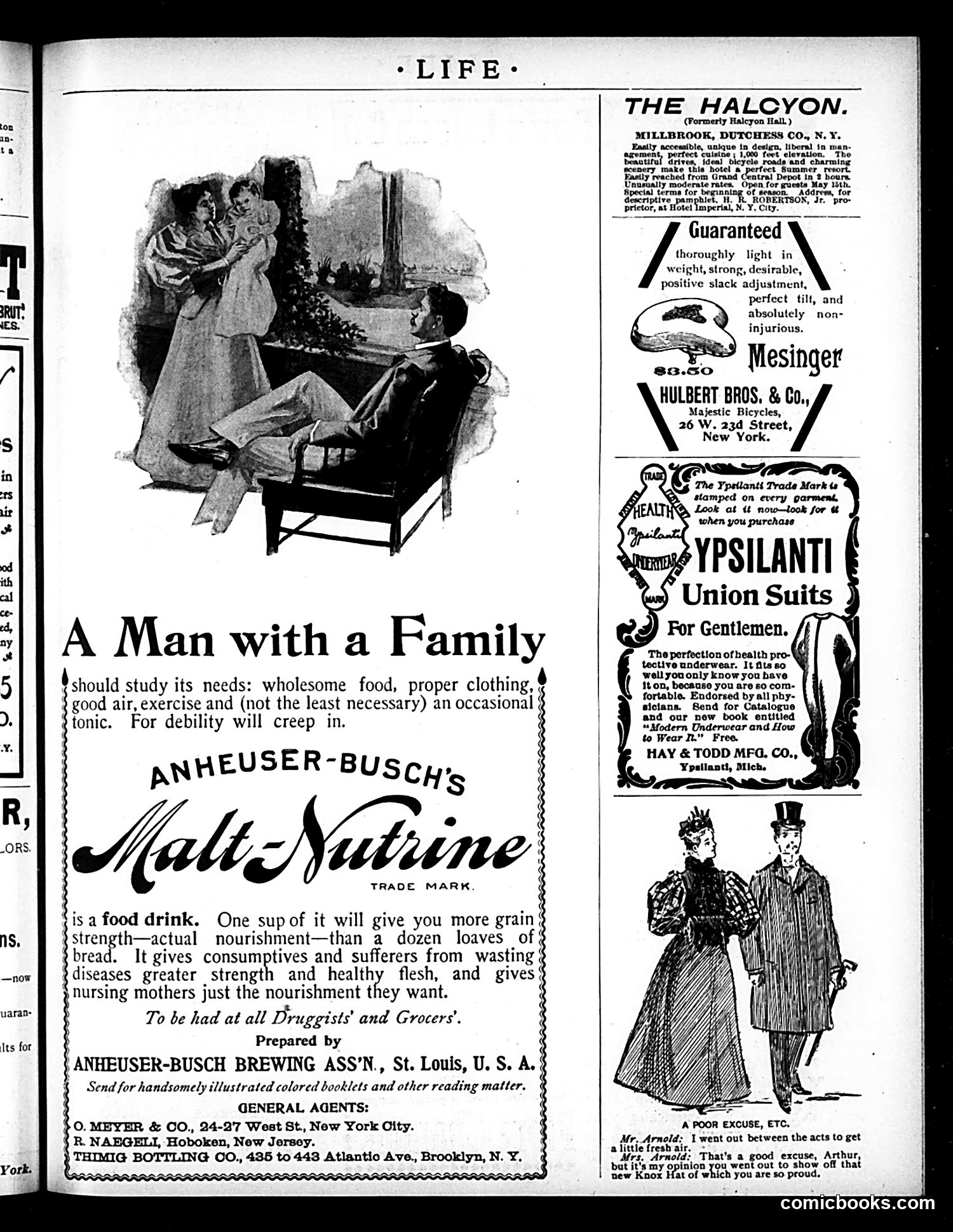
This page contains one satirical cartoon and multiple period advertisements. **The Main Cartoon:** "A Man with a Family" depicts a domestic scene where a man sits reading while his wife holds children. The accompanying text claims that family men need "wholesome food, proper clothing, good air, exercise and...an occasional tonic." This is actually an advertisement for Anheuser-Busch's "Malt-Nutrine"—beer marketed as medicinal nourishment. **The Satire:** The humor lies in the absurd claim that beer is health food for breadwinners and nursing mothers. This reflects early 1900s advertising practices when alcohol was genuinely marketed as therapeutic. Modern readers should note this represents pre-FDA regulation medicine advertising. **Bottom Cartoon:** "A Poor Excuse, Etc." shows a husband claiming he left the theater for fresh air; his wife sarcastically suggests he actually wanted to display his new Knox Hat. This jokes about vanity and marital dynamics. The page is primarily **advertising-driven**, typical of Life magazine's revenue model, mixing satirical humor with commercial pitches for hotels, bicycles, and clothing.
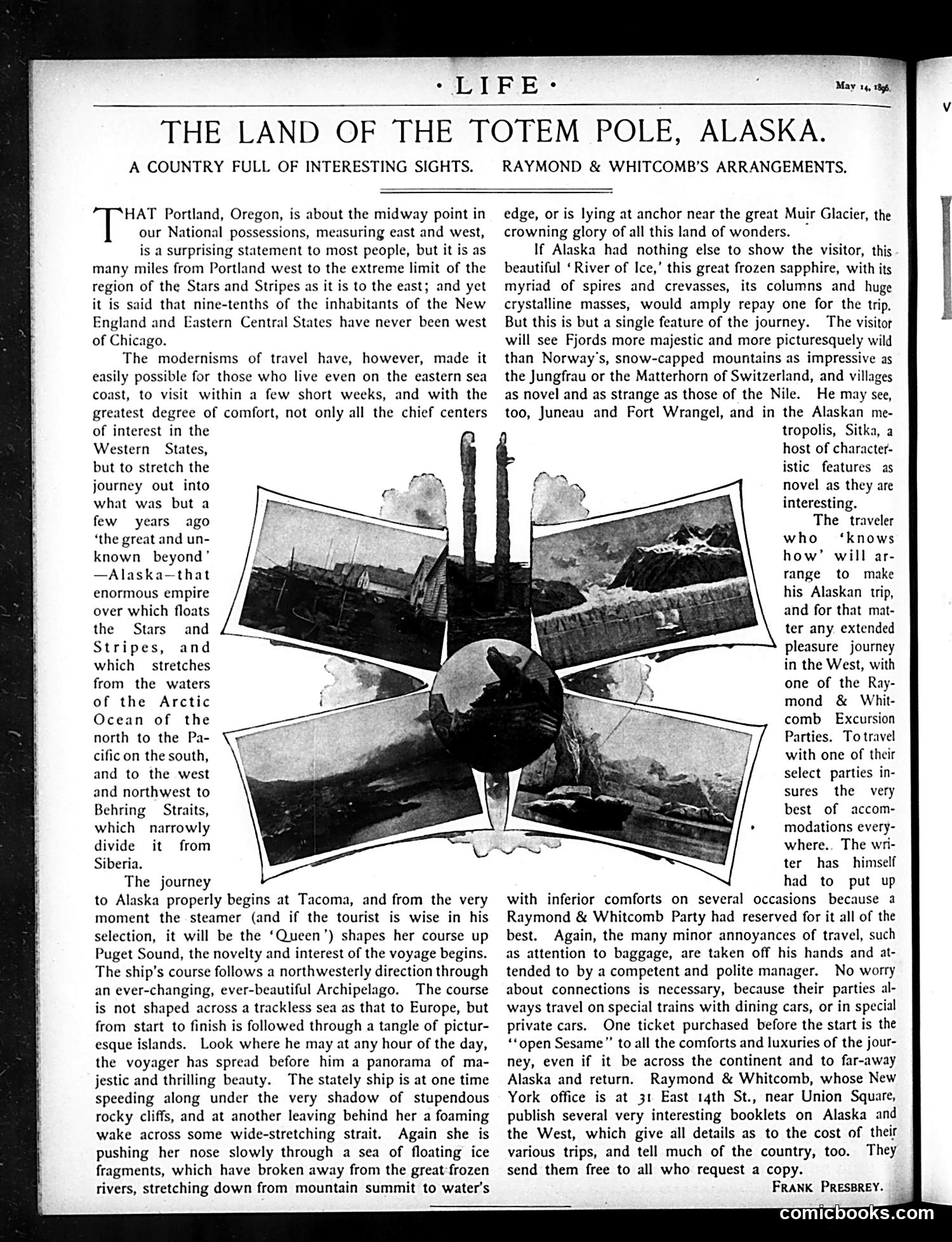
This page is **not satirical**—it's travel promotional content disguised as editorial journalism. The central image shows a bald eagle (the American symbol) surrounded by five photographs of Alaskan landscapes, framing the region as a natural wonder worth visiting. The text promotes Alaska as newly accessible to eastern Americans through modern steamship travel, emphasizing its exotic landscapes: glaciers, fjords, and Native villages ("Totem Pole" in the title). Notably, it frames Alaska—recently acquired territory—as part of "our National possessions" under the "Stars and Stripes," reflecting 1896 American expansionism. The article is essentially **advertising for Raymond & Whitcomb travel company**, repeatedly praising their "Excursion Parties" as providing superior accommodations and service for pleasure travelers. The writer's repeated endorsement suggests this is sponsored content—common in period magazines—presenting luxury tourism to Alaska's frontier as the pinnacle of modern travel comfort.