
A complete issue · 20 pages · 1896
Life — April 16, 1896
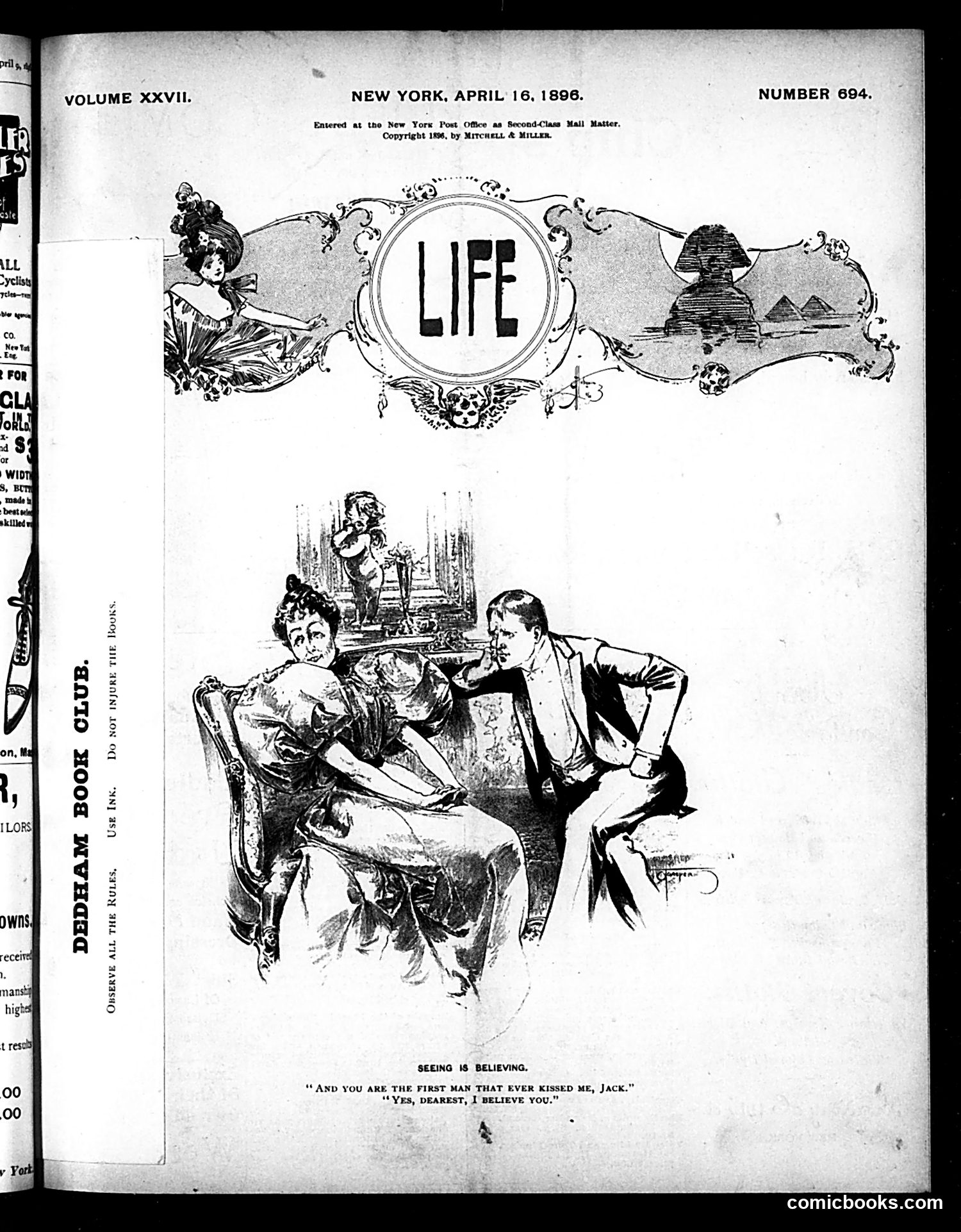
This page features a romantic illustration titled "Seeing is Believing," with dialogue: "And you are the first man that ever kissed me, Jack." / "Yes, dearest, I believe you." The cartoon satirizes romantic courtship and male credulity. The gentleman (Jack) expresses belief in his companion's claim of romantic inexperience, despite the suggestive intimacy of the moment. The satire targets the contradiction between what men *want* to believe about women's virtue and what reality suggests—the woman's declaration strains credibility, yet Jack accepts it uncritically because he desires to. The decorative header and illustration style are typical of Life's 1890s aesthetic. This appears to be general satirical commentary on romance and gender relations rather than specific political content.
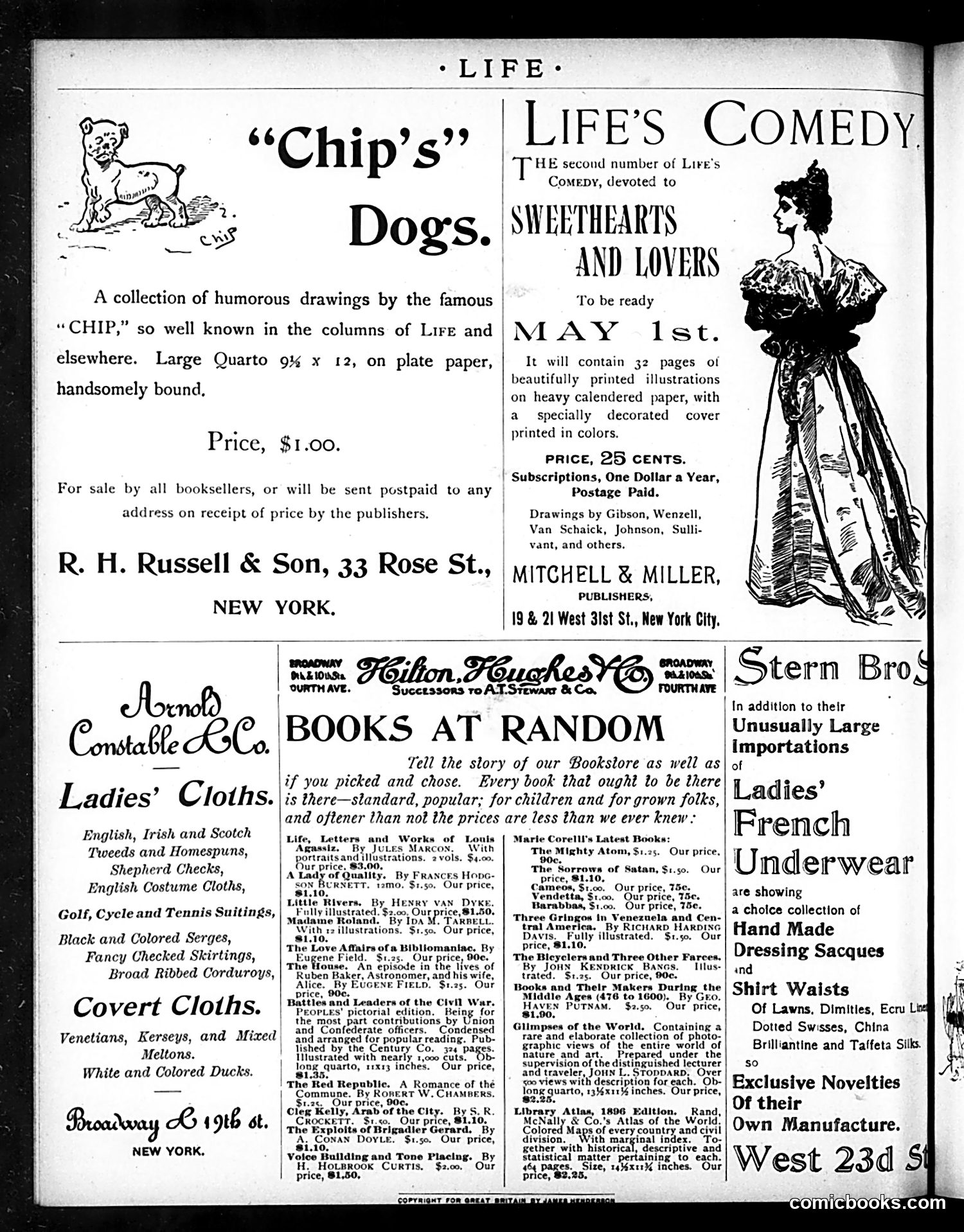
This page is primarily **advertising**, not political satire. It contains: 1. **"Chip's Dogs"** (left): A collection of humorous dog drawings by "Chip," a cartoonist known in Life magazine, priced at $1.00. 2. **"Life's Comedy"** (top right): An advertisement for the second issue of Life's Comedy series, devoted to sweethearts and lovers, featuring 32 pages with illustrations, priced at 25 cents. 3. **Multiple book and clothing advertisements**: Including "Books at Random" (Holton, Hughes & Co.), ladies' clothing from Arnold Constable & Co., and French underwear from Stern Bros. The page represents typical late 19th/early 20th-century magazine advertising rather than satirical political content. The "Chip" cartoons appear to be lighthearted animal humor rather than social commentary.
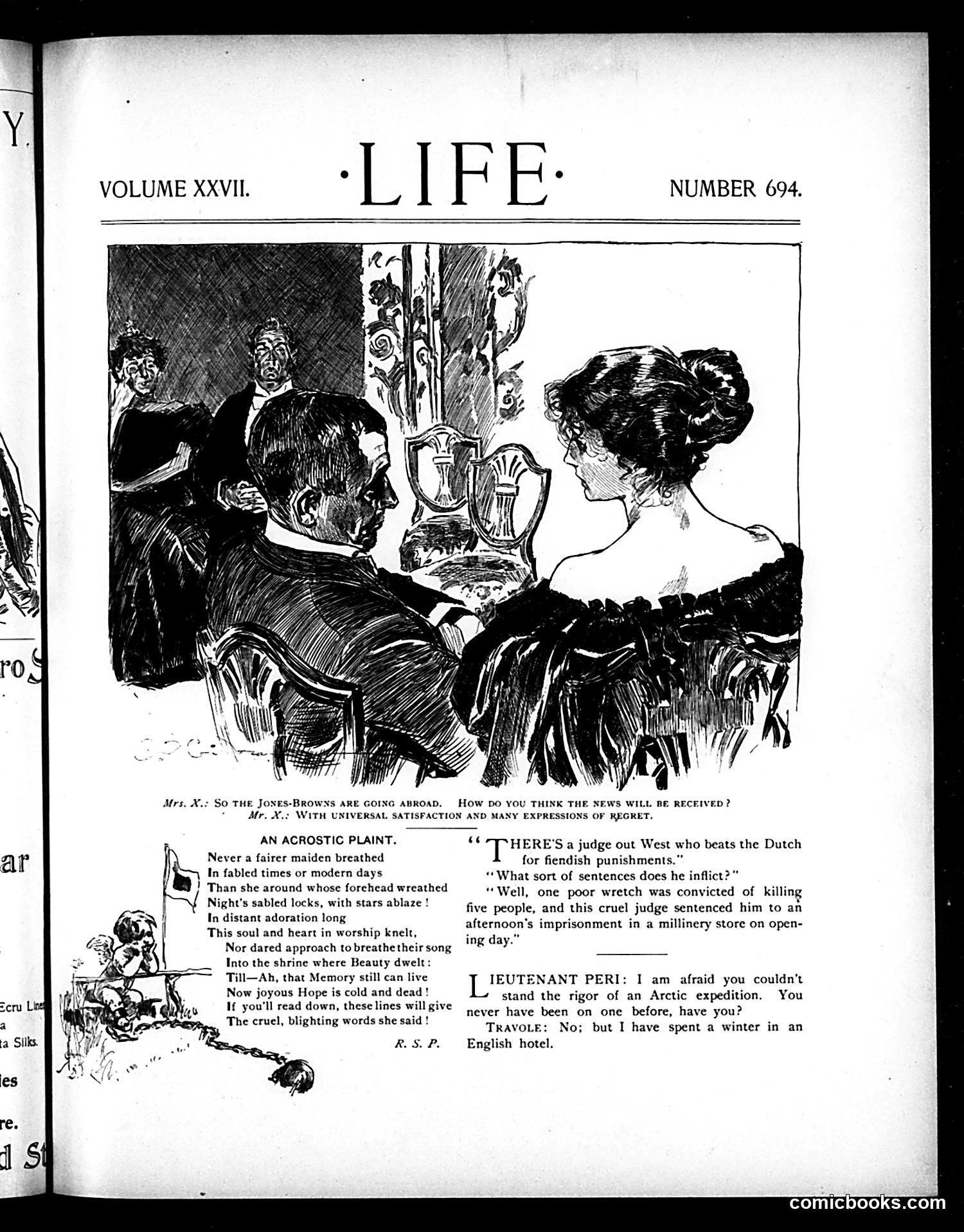
The main cartoon depicts a social scene where a man and woman sit facing each other, with observers in the background. The caption indicates "Mrs. X" and "Mr. X" are discussing the Jones-Browns' travels abroad, with reactions of "universal satisfaction and many expressions of regret." The satire targets social hypocrisy: the couple's departure apparently pleases society, contradicting polite pretense. The joke suggests that certain people's absence is welcomed despite conventional expressions of regret. Below, "An Acrostic Plaint" is a poem about lost love and memory, while a separate dialogue between "Lieutenant Peri" and "Traveler" discusses Arctic expeditions and English hotels—likely satirizing travelers' exaggerated adventure claims versus mundane reality.
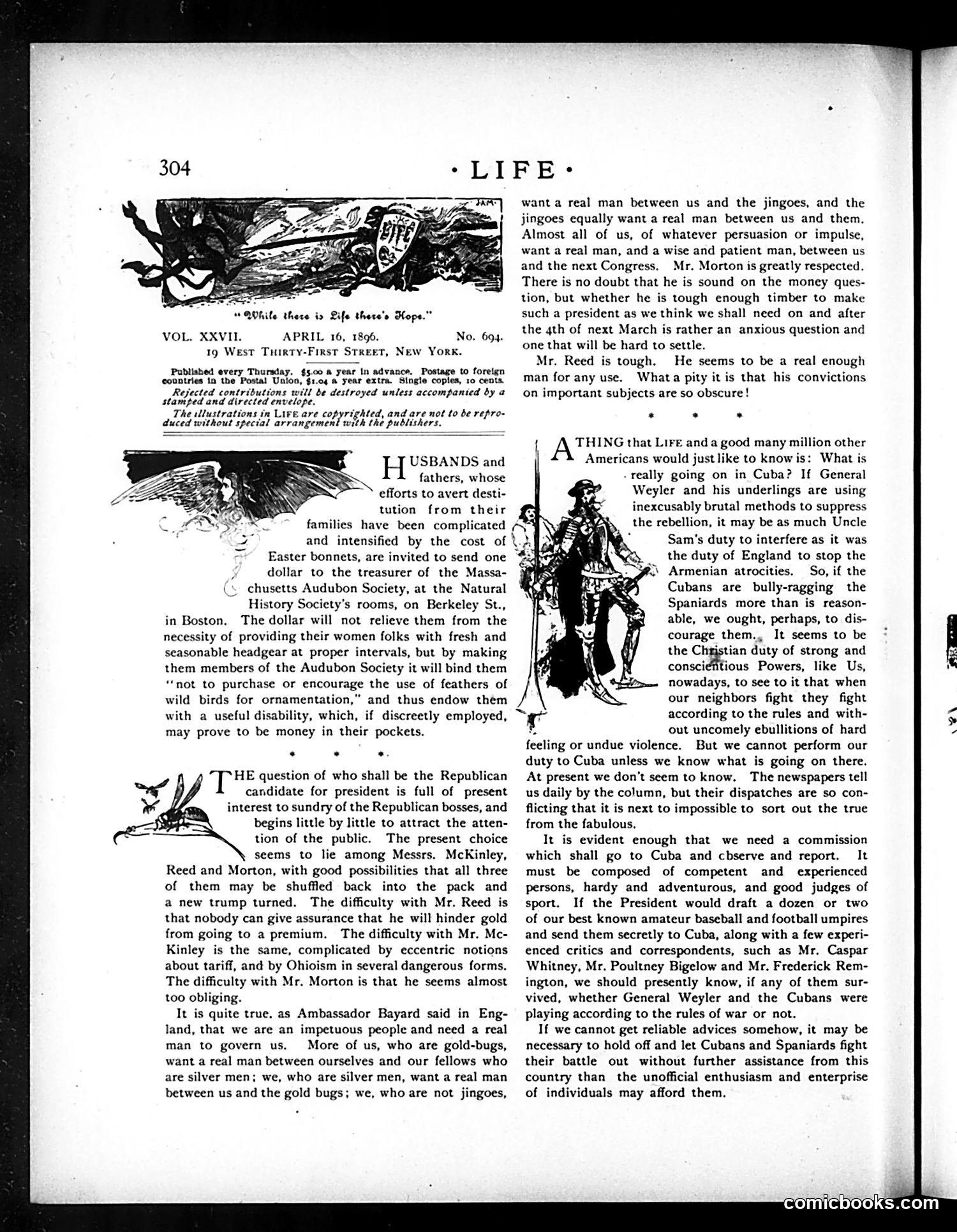
This page discusses the 1896 Republican presidential race and the Cuba crisis. The text debates three possible candidates—Reed, McKinley, and Morton—questioning which represents a "real man" strong enough to lead. The cartoons (though small and unclear in detail) appear to satirize political weakness and indecision. The opening illustration depicts a figure labeled "While there is Life there's Hope," likely commenting on the uncertain political landscape. The Cuba section criticizes American hesitation about intervening in Spanish colonial brutality, arguing that sending investigative commissions is insufficient—the nation needs decisive action and reliable intelligence rather than relying on newspaper reports. The satire targets both political vacillation and American reluctance to assert power in international affairs.
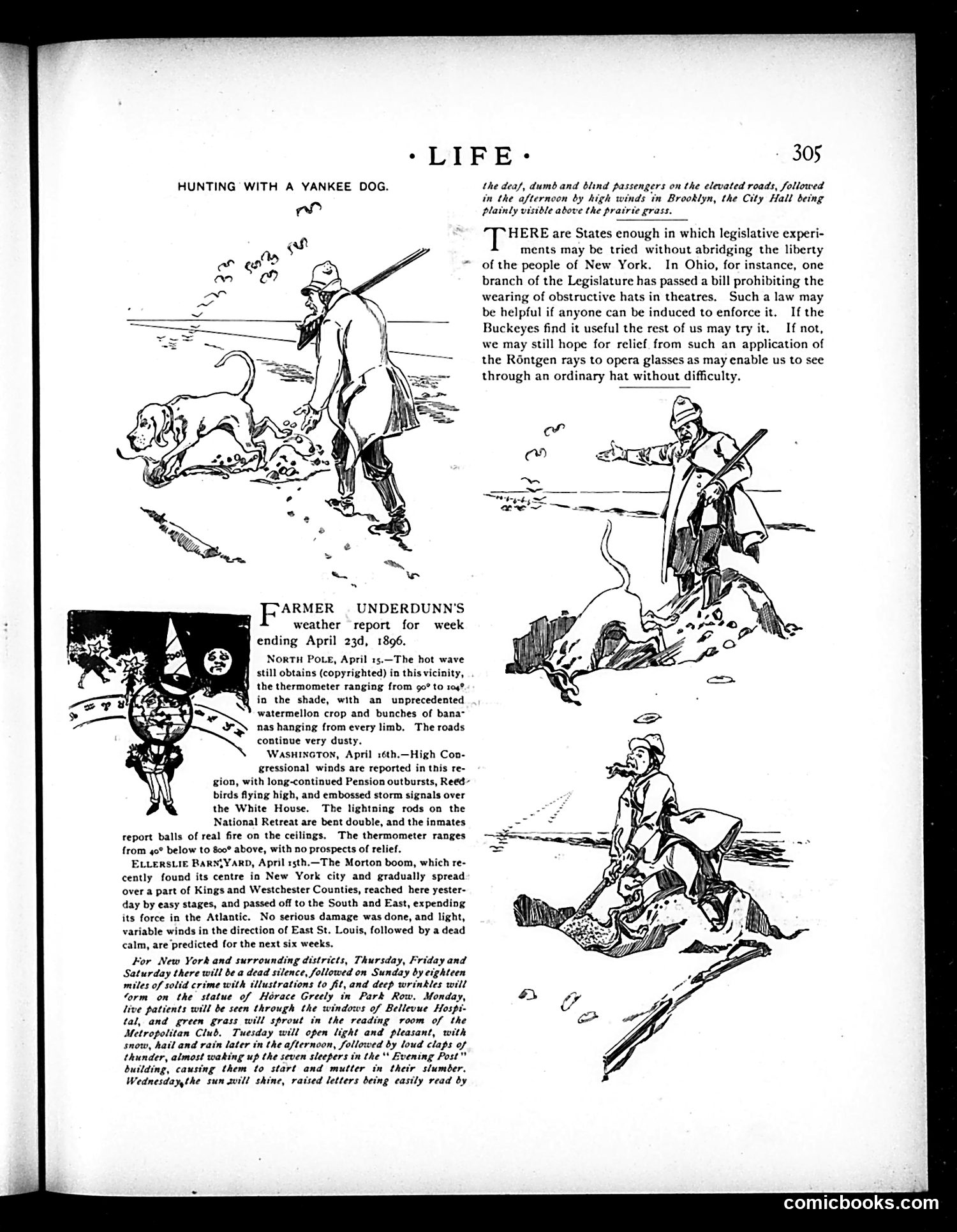
This page satirizes efforts to regulate theater dress codes. The text discusses Ohio's legislature passing a bill prohibiting "obstructive hats in theaters"—a genuine problem of the era when large bonnets blocked audience views. The satirist suggests this legislative approach is absurd, recommending instead that Röntgen rays (X-rays, then novel technology) be used to see through ordinary hats. The illustrations show hunters with a dog, likely a visual pun on "hunting" for solutions to social problems. The cartoons mock the impracticality of legislative overreach when simpler solutions exist. The "Farmer Underdunn's Weather Report" below provides comic relief with exaggerated meteorological observations, typical of Life's humorous filler content from this 1896 period.
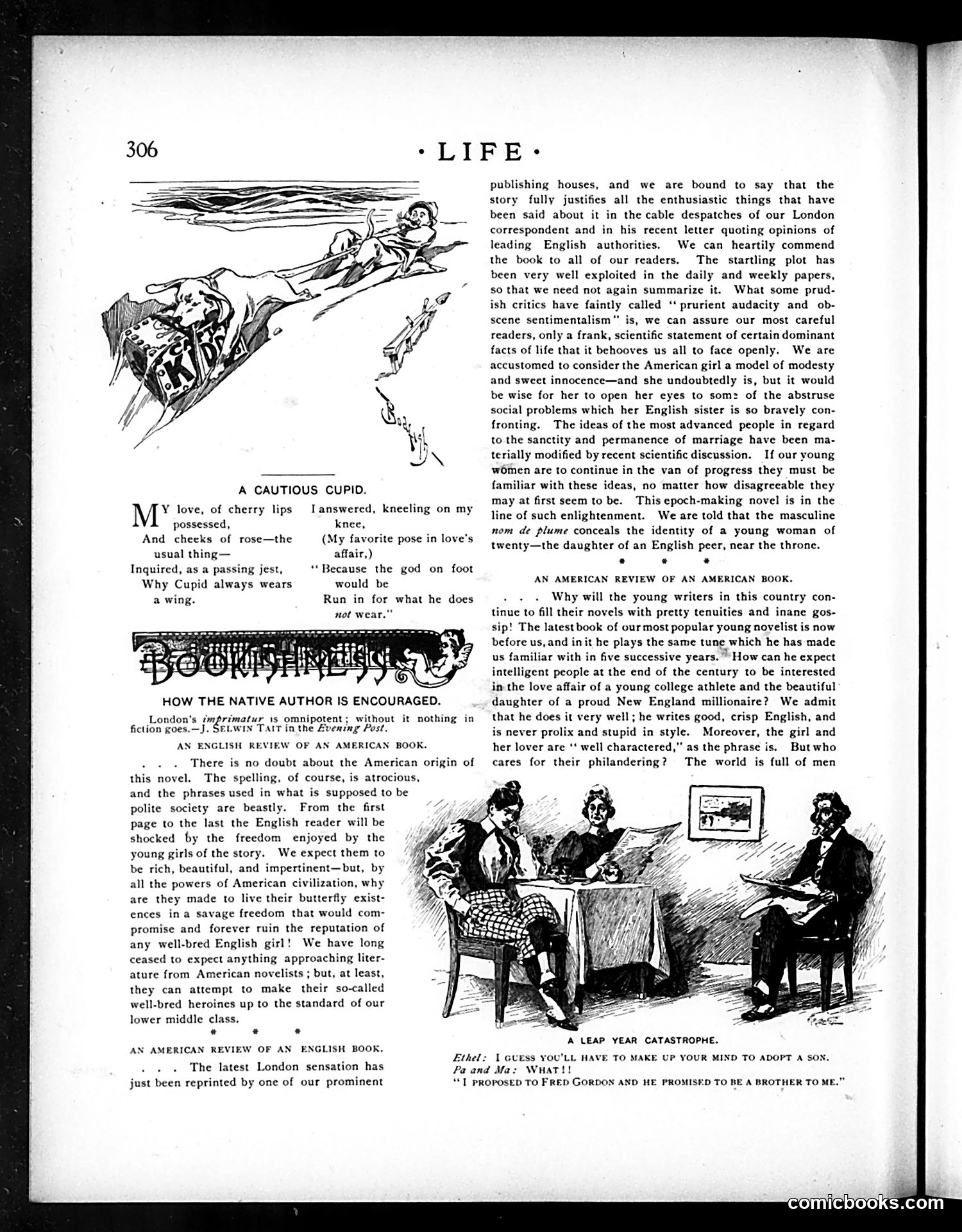
**"A Cautious Cupid"** (top illustration): A playful poem about courtship, with Cupid depicted cautiously—the joke being that even the god of love must be careful about romantic declarations and commitment. **"A Leap Year Catastrophe"** (bottom cartoon): References the tradition that women propose to men during leap years. The scene shows a woman presenting a marriage proposal, with the caption humorously depicting the man's panic. He protests that he promised to be a brother to someone named Fred Gordon instead—suggesting he's using a convenient excuse to avoid the proposal. Both pieces satirize gender dynamics and courtship customs of the era, poking fun at anxieties surrounding romantic commitment and the reversal of traditional proposal roles during leap years.
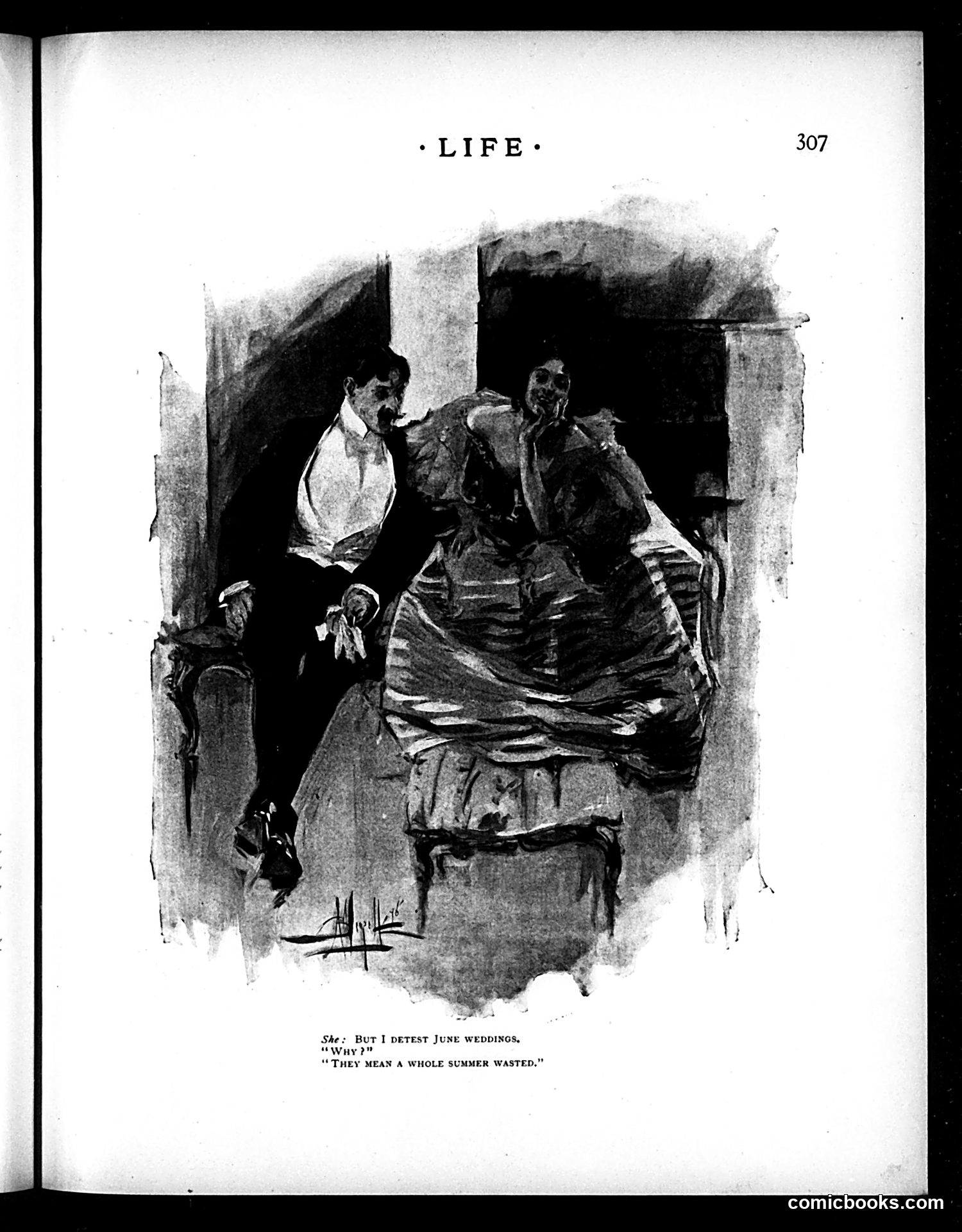
This single-panel cartoon depicts a well-dressed man in formal attire (left) conversing with a woman in elaborate dress and what appears to be a military officer (right). The caption reads: "She: But I detest June weddings. 'Why?' 'They mean a whole summer wasted.'" The satire targets upper-class social conventions around June weddings. The joke plays on the woman's complaint that marrying in June wastes her entire summer—presumably suggesting she'd miss social activities, travel, or leisure time available to unmarried women. The cartoon mocks the priorities of wealthy society women, implying marriage itself is an inconvenience to their social calendar rather than a life milestone. The formal setting and characters' dress emphasize the satirical focus on elite social customs of the era.
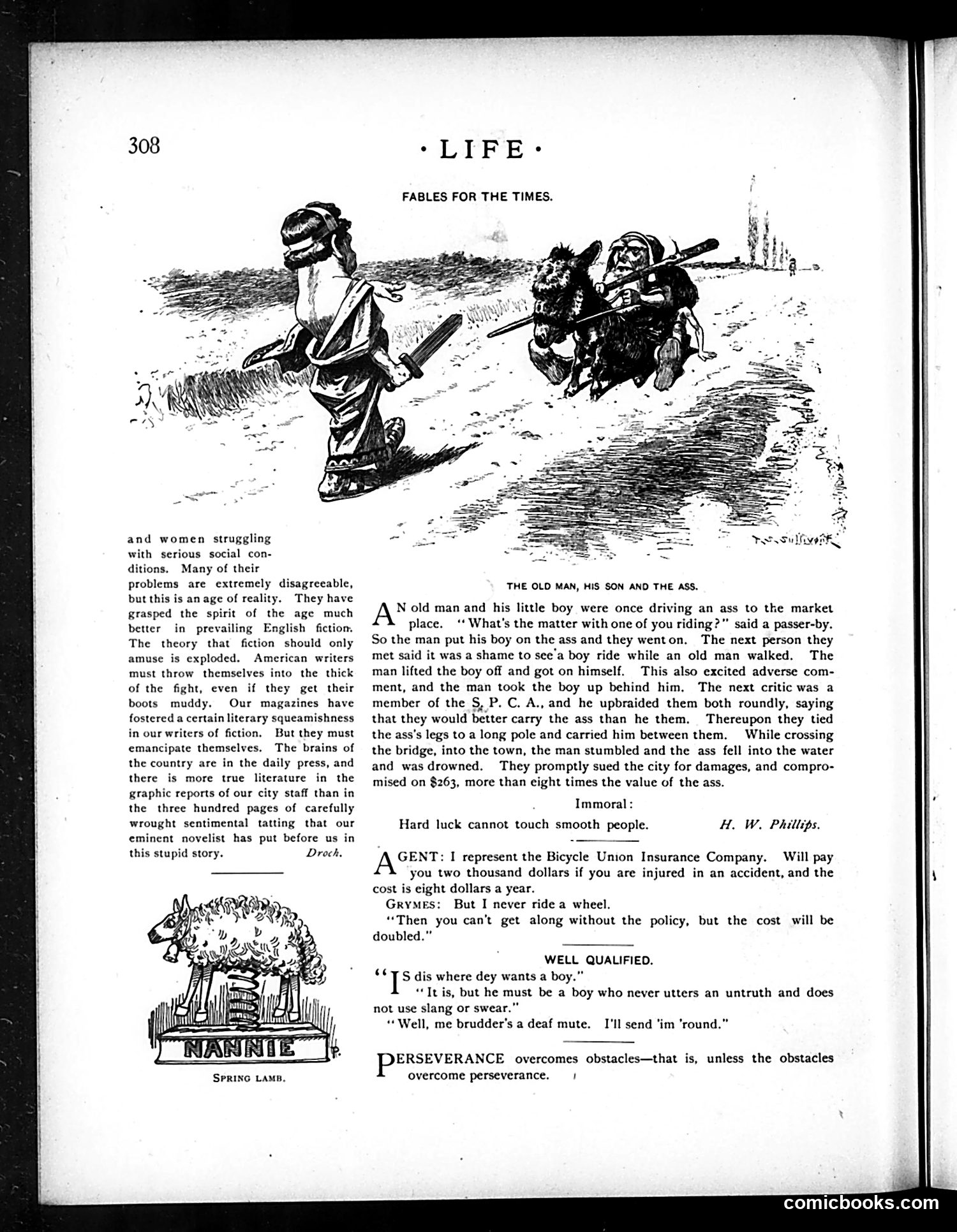
This satirical page mocks early 20th-century social concerns through several short fables: **"The Old Man, His Son and the Ass"** satirizes public opinion and animal welfare activism. An old man and boy are criticized for riding a donkey, then for the boy riding alone, then for the man riding—they can't win. When they try carrying the ass on a pole instead, it drowns, and they're sued. The moral: you cannot satisfy everyone's contradictory demands. **Other brief fables** target insurance sales tactics, requirements for moral perfection in hiring ("Well Qualified"), and the notion that perseverance always conquers obstacles. The cartoons mock rigid social reformers, oversensitive public critics, and insurance companies—reflecting Progressive Era tensions between various reform movements and practical life.
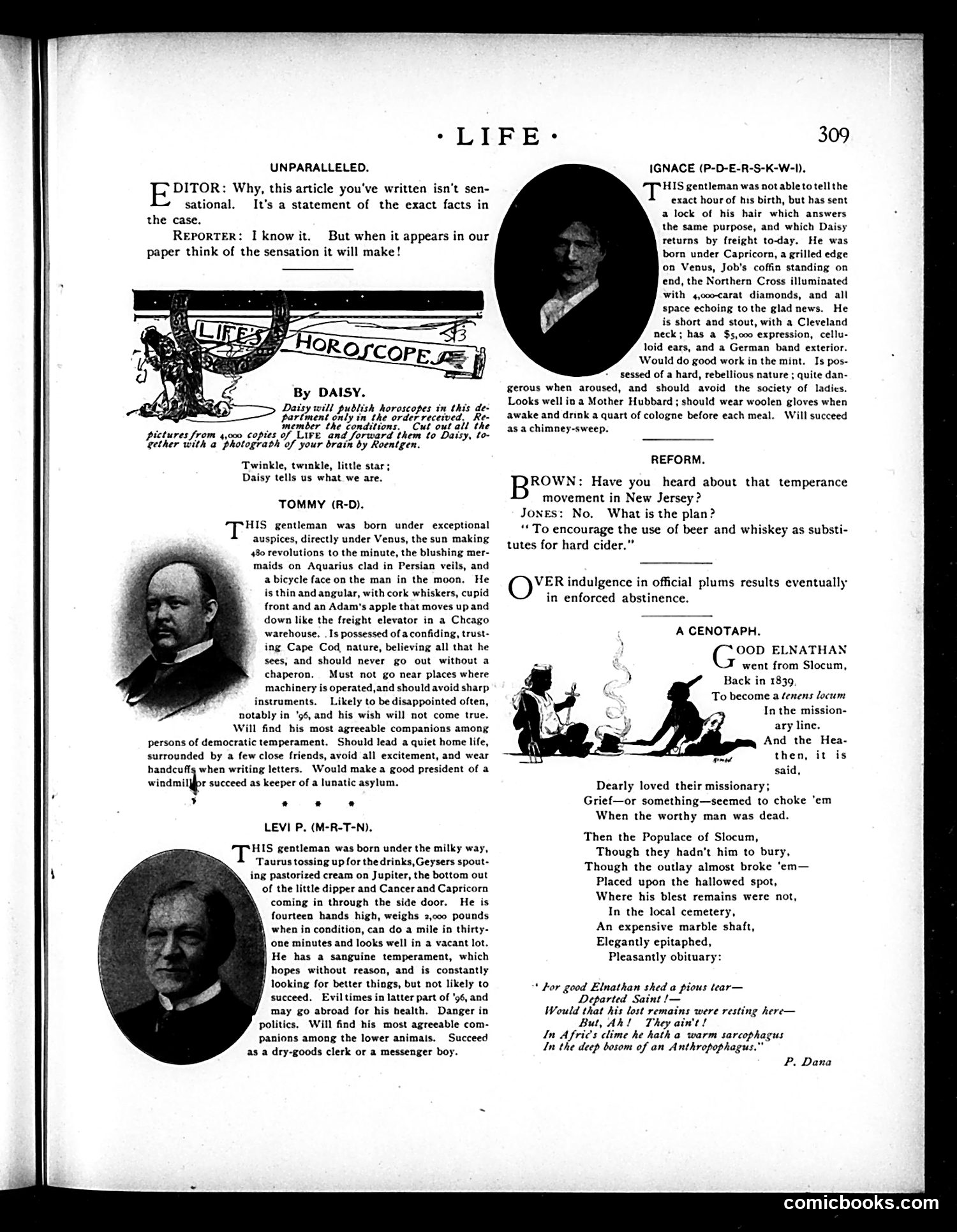
This page contains humorous character sketches typical of Life's satirical format. The main content includes: **"Life's Horoscope by Daisy"** — a mock astrological prediction feature, presented as though authored by someone named Daisy. **Character profiles** with accompanying portraits: - **TOMMY (R-D)** — described as born under Venus with exaggerated personality traits (angular features, contradictory nature) - **LEVI P. (M-R-T-N)** — born under Taurus, characterized as weighing 5,000 pounds, temperamentally unstable, seeking advancement but unlikely to succeed **"Reform" section** — a brief satirical commentary on New Jersey temperance movements proposing beer/whiskey as substitutes for hard cider. **"A Cenotaph"** — a poem about Elnathan from Slocum, apparently a missionary who died, with mock-heroic epitaph. The satire relies on astrological pseudoscience and exaggerated character assassination typical of early 20th-century American humor magazines.
This illustration depicts a naval or maritime social scene, likely satirizing high society's interaction with the military. The image shows elegantly dressed women in early 20th-century fashions mingling with uniformed naval officers on what appears to be a ship's deck. Two sailors are visible in the rigging above. The satire likely comments on the romanticization of military service by society women or critiques how fashionable society treats military personnel as social attractions. The formal dress and elaborate uniforms contrast with the working sailors above, suggesting commentary on class distinctions within naval hierarchy. The partial caption visible ("THE NEW NA..." and "ABOUT...") is cut off, preventing definitive identification of the specific event or figures being satirized. The style and clothing suggest this dates from approximately 1910-1920.
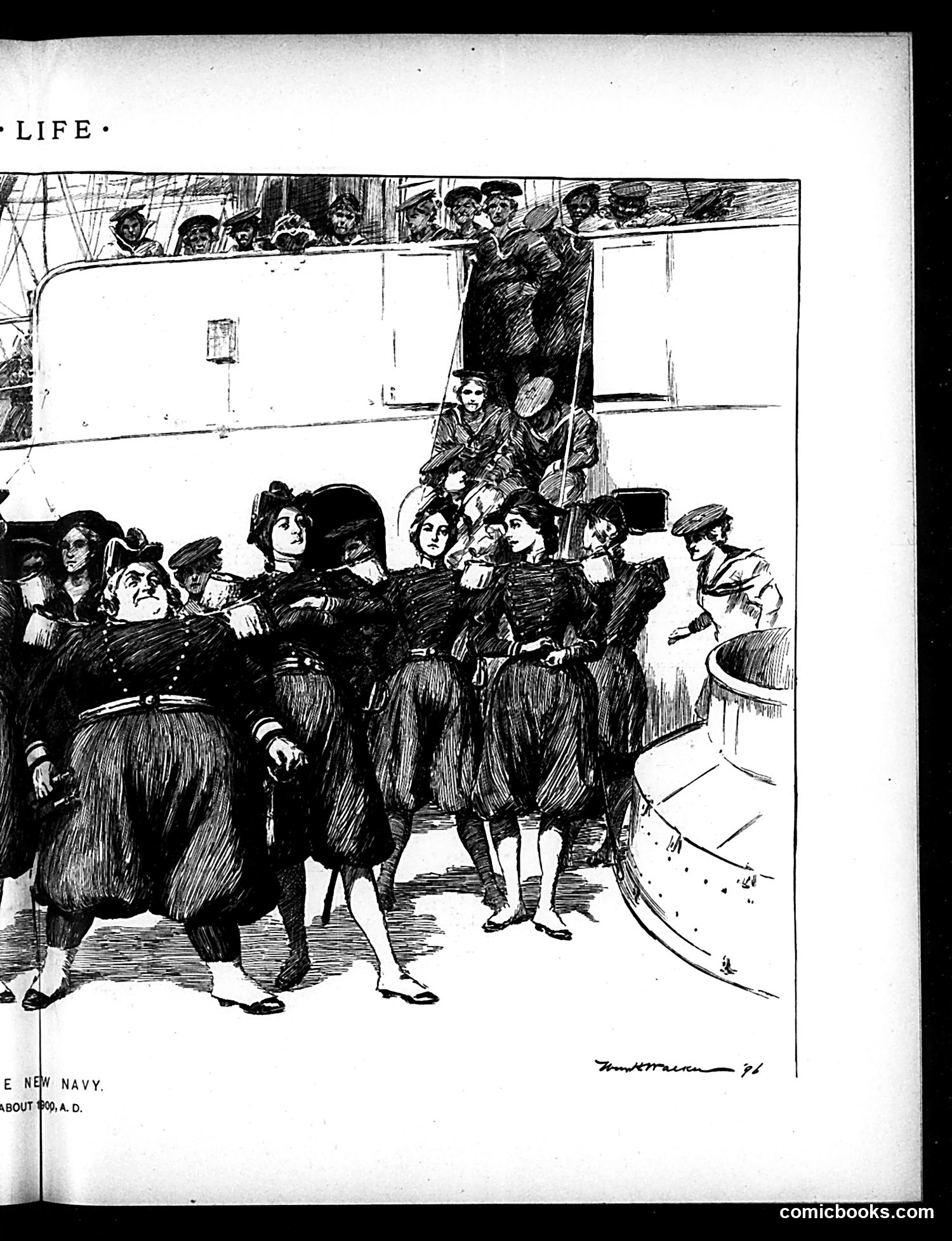
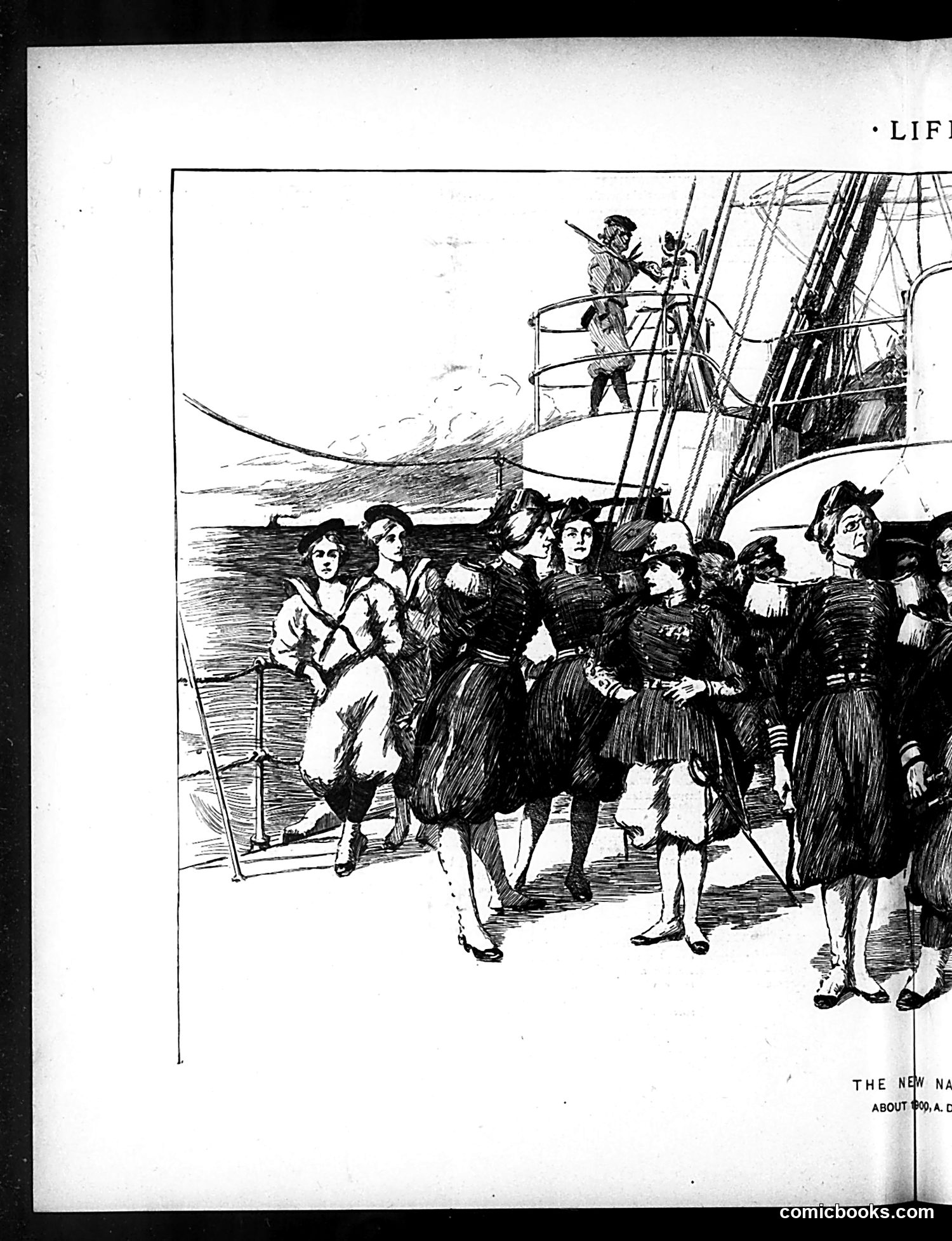
This Life magazine cartoon depicts women boarding a naval vessel, likely illustrating commentary on women's roles in the military or navy around the early 1900s (the OCR references "THE NEW NAVY" and "ABOUT 1900, A.D."). The satire appears to mock either: 1. The potential recruitment or integration of women into naval service, or 2. Women's suffrage and expanded public roles during this era The artist uses exaggeration—particularly in the women's physiques and clothing—as comedic caricature typical of early Life magazine's satirical style. The contrast between the serious naval setting and the incongruity of women being boarded suggests the cartoonist found the concept absurd or noteworthy enough for public mockery. The specific historical context—whether this references an actual naval policy proposal or broader social anxieties about women's changing societal position—is unclear from the image alone.
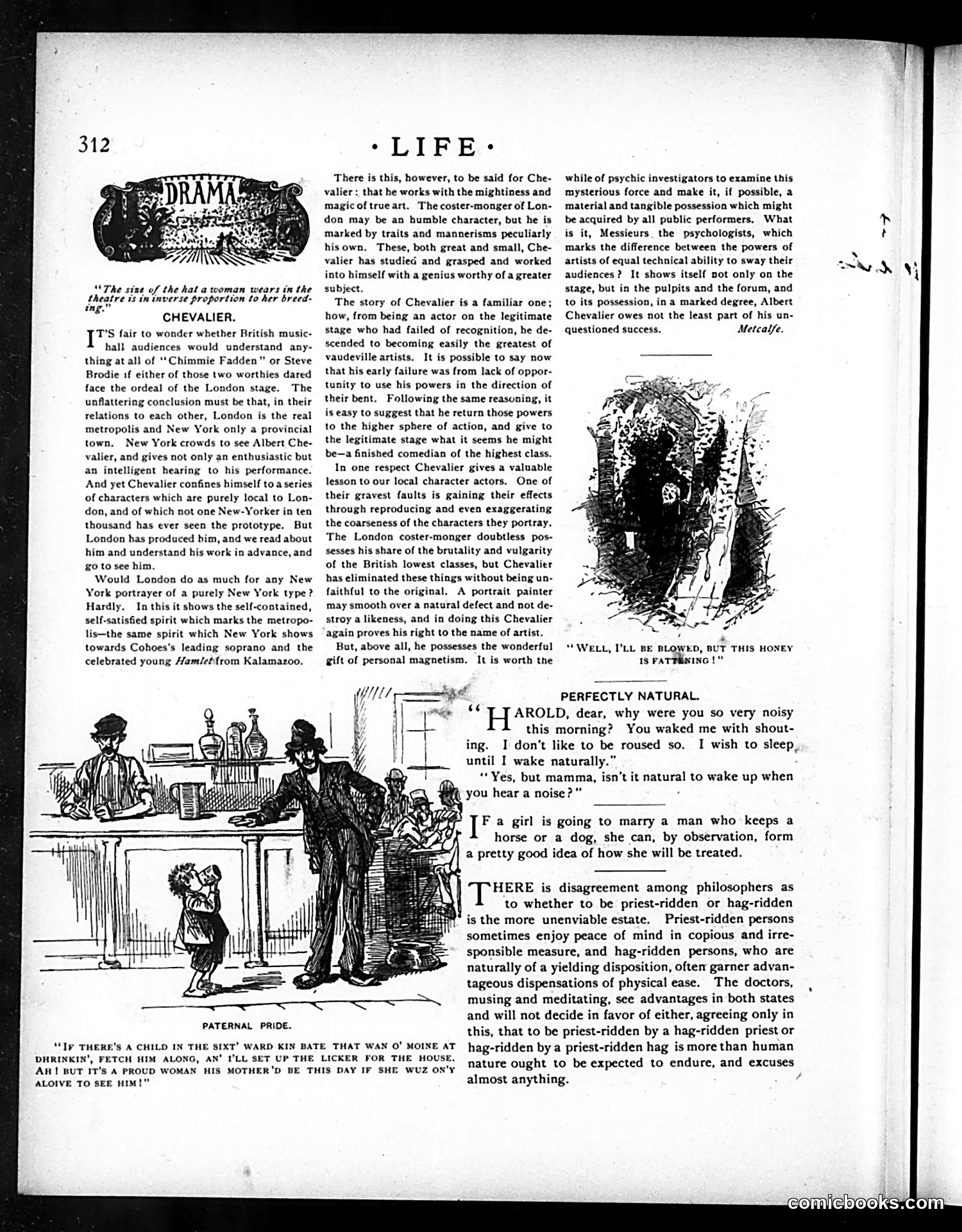
This page from *Life* magazine critiques **Albert Chevalier**, a British music-hall performer famous for portraying working-class London "coster-monger" (street vendor) characters. The article argues that while New York audiences eagerly attend Chevalier's performances, London wouldn't reciprocate by supporting American vaudeville acts. The piece praises Chevalier's artistry—he captures authentic working-class mannerisms without exaggerating vulgarity, unlike inferior American character actors. The text also emphasizes his mysterious "personal magnetism," a quality the author suggests psychologists should study. The cartoons illustrate domestic scenes (one labeled "Paternal Pride" showing a man with children; another titled "Perfectly Natural" depicting a conversation between spouses about waking). These satirize everyday life and social pretensions—contrasting with the article's celebration of Chevalier's refined artistic approach to portraying "lower" classes. The overall satire critiques both Anglo-American cultural rivalry and the gap between authentic character and its performance.
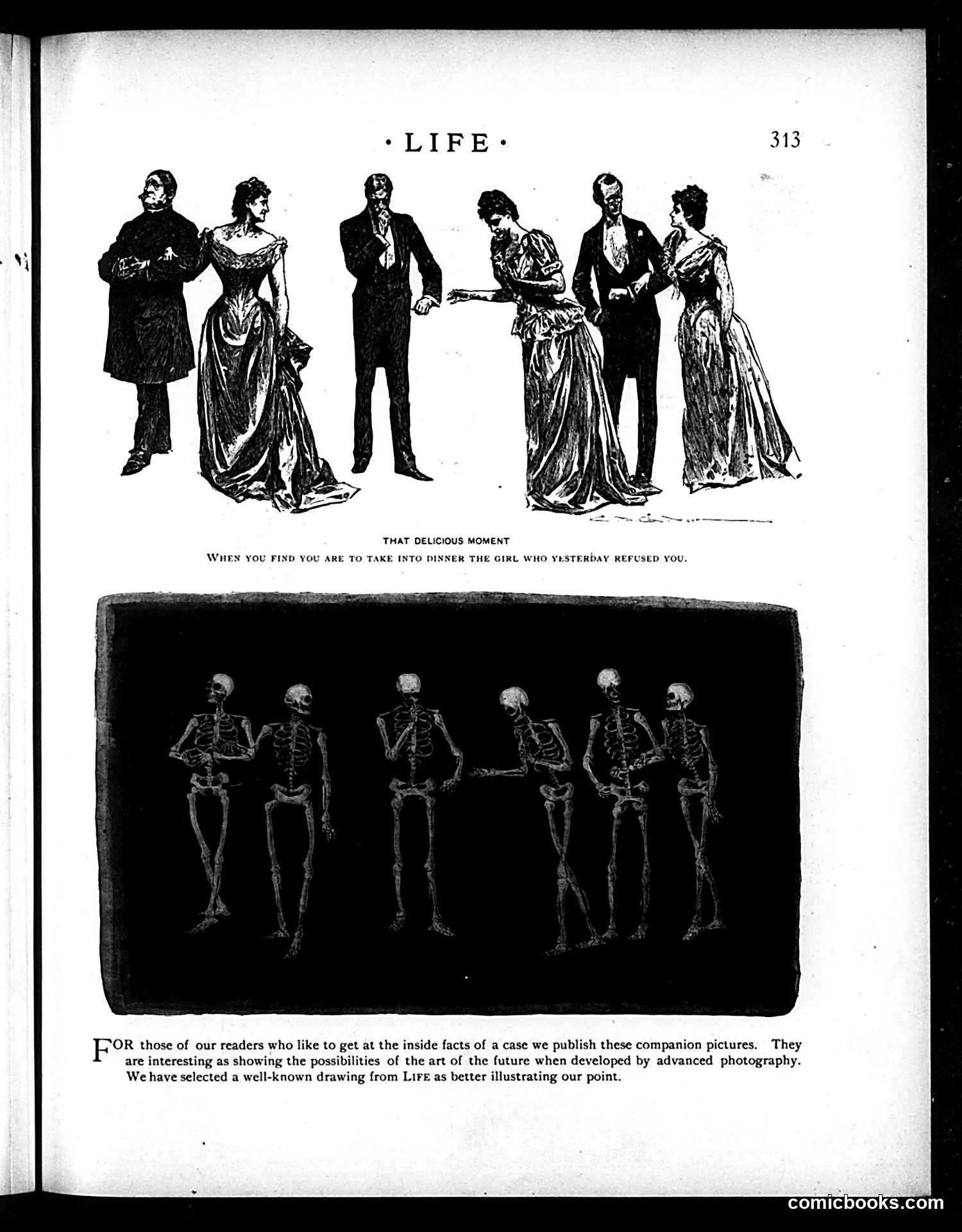
This page presents two contrasting illustrations on the theme of romantic rejection and reversal. The top image shows a social scene where a man discovers he'll escort to dinner a woman who previously refused his romantic advances—depicting the "delicious moment" of role reversal and vindication. The bottom image shows the same scenario rendered as skeletons, suggesting a darkly humorous "X-ray" or internal view of the same social interaction. The accompanying text explains these are examples of how "advanced photography" (likely X-ray technology, a relatively new innovation) could reveal hidden truths beneath surface appearances. The skeleton imagery implies satirical commentary on the emptiness or mortality underlying social pretense and romantic games. The overall point appears to be satirizing both the pettiness of romantic rejection and society's obsession with surface appearances versus inner reality.
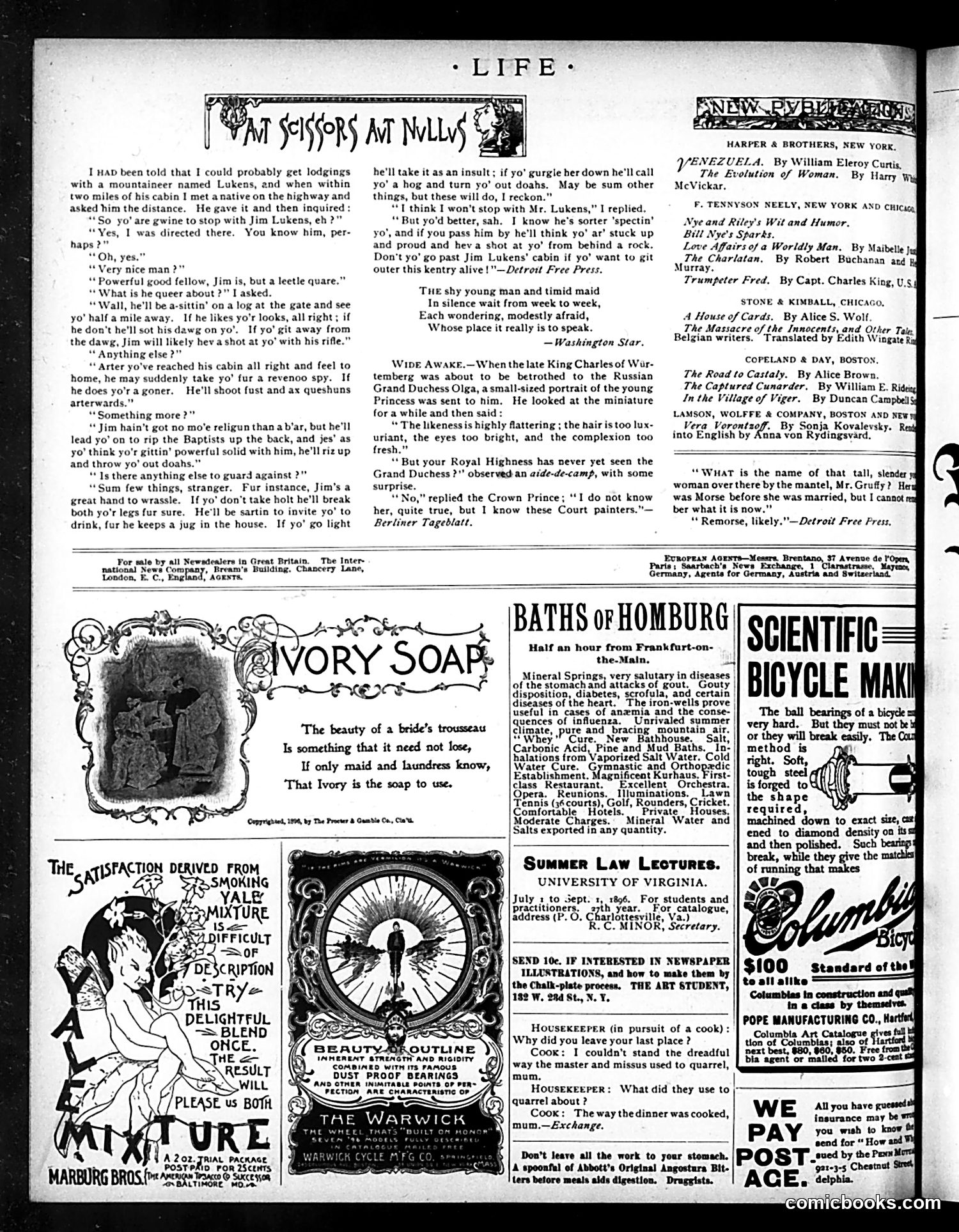
This page contains primarily **literary advertisements and short humor pieces** rather than political cartoons. The main content includes: 1. **"Jim Lukens' Cabin"** (top): A humorous dialect story about a dangerous mountaineer in Appalachia. The joke relies on **exaggerated frontier stereotypes**—depicting rural mountain folk as violent, unpredictable, and crude. The humor comes from the cascading warnings about Lukens shooting visitors, wrestling guests, and forcing whiskey upon them. This reflects period attitudes toward rural Americans as backward and brutish. 2. **Short quips** about shy romance and a Prussian prince's unflattering portrait assessment showcase typical magazine humor of the era. 3. **Book advertisements** dominate the page—publishers promoting titles on women's evolution, worldly affairs, and fiction. 4. **Product advertisements** (Ivory Soap, Yale cigarettes, scientific bicycles, etc.) fill remaining space. The **satirical tone is primarily social**—mocking rural mountain culture and gender dynamics—rather than explicitly political. This reflects *Life*'s audience: educated, urban readers who found rural stereotypes amusing.
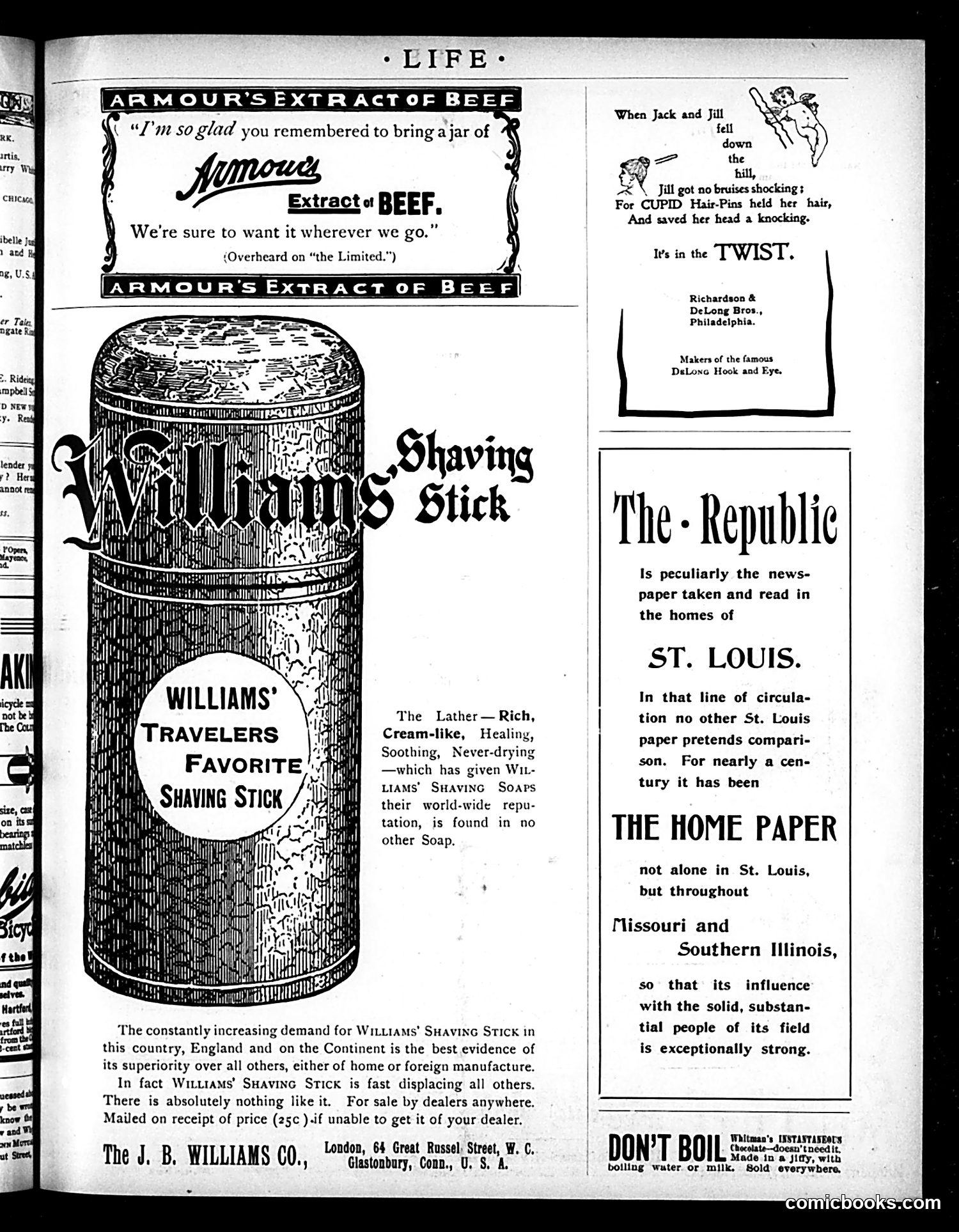
This is primarily an **advertising page** from Life magazine, not political satire. It contains four distinct advertisements: 1. **Armour's Extract of Beef** – quotes a traveler on "the Limited" (a train) praising the product for portable convenience. 2. **Williams' Shaving Stick** – emphasizes superiority over competitors, claiming increasing global demand proves its quality. 3. **CUPID Hair-Pins** – uses the Jack and Jill nursery rhyme as a humorous sales pitch, claiming the pins prevented Jill's injuries in the fall. 4. **The Republic newspaper** (St. Louis) – promotes itself as the dominant "home paper" throughout Missouri and Southern Illinois with strong influence among "solid, substantial people." 5. **Whitman's Instantaneous Chocolate** – a quick beverage mix advertisement. There is no political cartoon or satire on this page. It represents typical early 20th-century Life magazine content: a mix of commercial advertisements designed to reach middle-class readers.
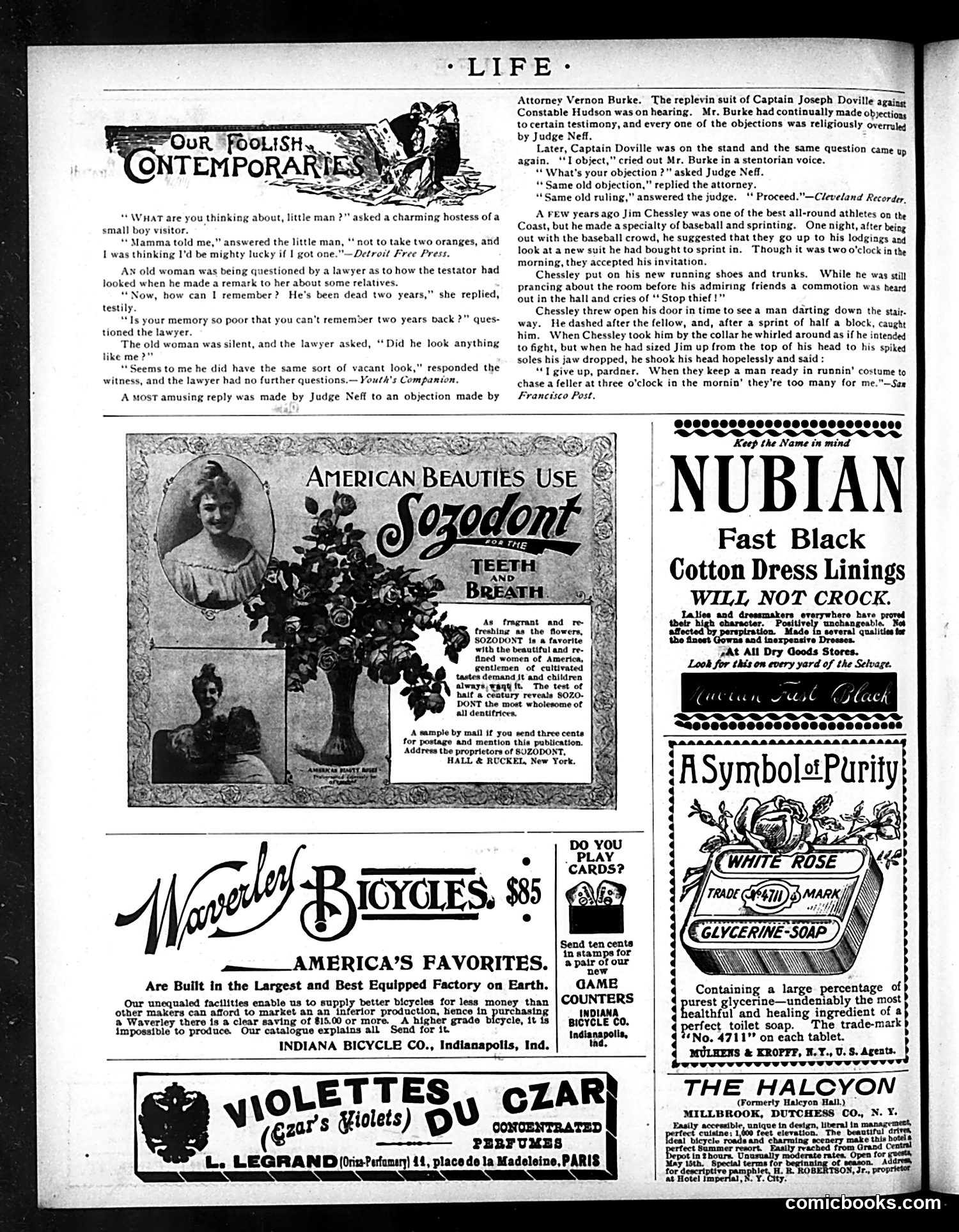
This page showcases *Life* magazine's signature format: short humorous anecdotes mocking human folly. The cartoons illustrate four brief jokes: 1. **A child's honesty**: A boy admits he's hoping to steal oranges—satirizing children's unfiltered desires versus parental instruction. 2. **Memory and lawyers**: An old woman's "vacant look" comment sarcastically suggests the dead man resembled the questioning attorney—poking fun at legal proceedings and bad-tempered lawyers. 3. **Judge Neff's wit**: A judge tired of repeated objections simply overrules the same complaint with the same ruling, mocking legal tedium and judicial impatience. 4. **The burglar's surrender**: A thief gives up chasing a sprinter at 3 a.m. because the man's athletic readiness seems excessive—humor from the criminal's rational cowardice. The page also contains period advertisements (Sozodont toothpaste, Nubian dress linings, Waverley bicycles), typical of *Life*'s format blending satire with commercial content.
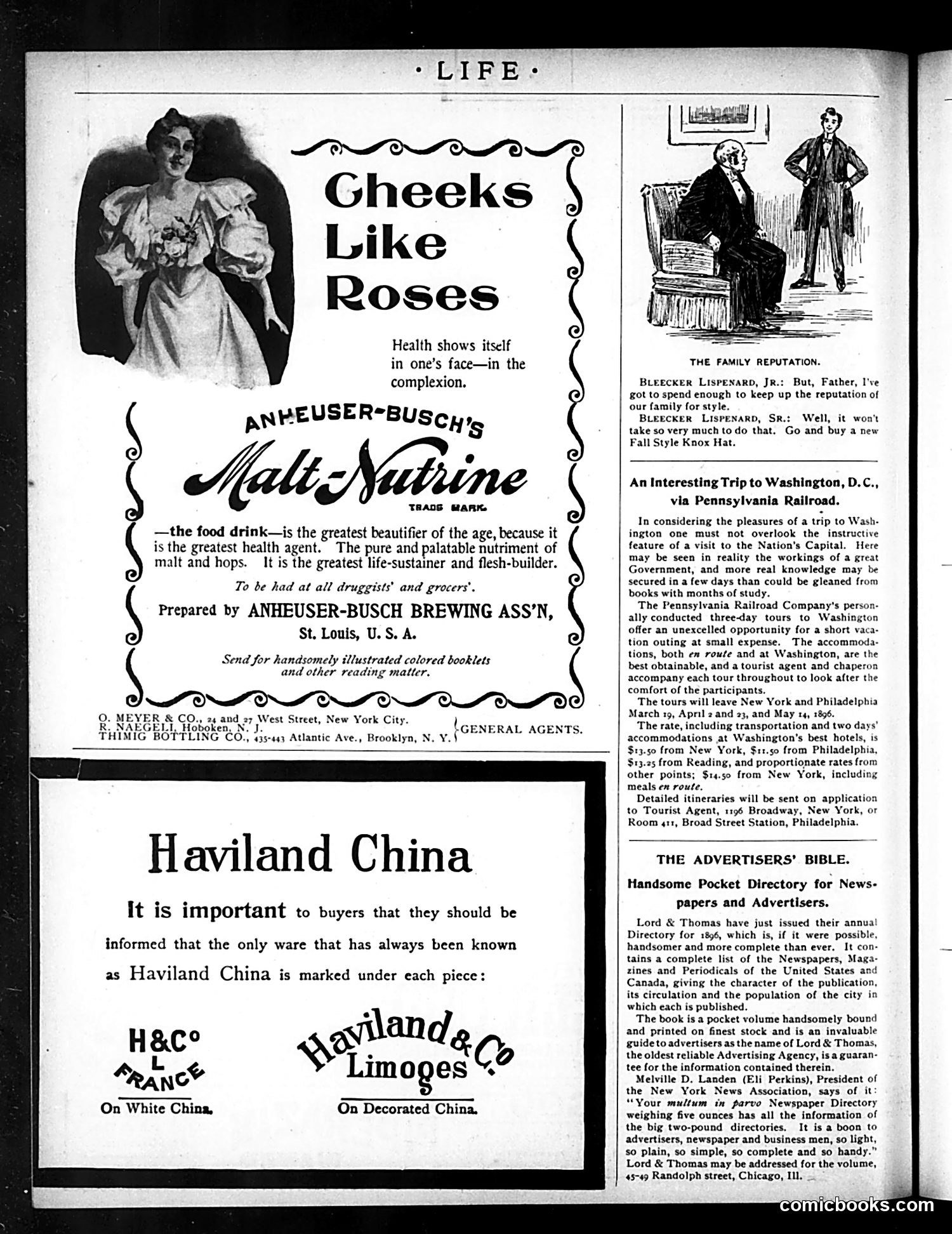
This page (from *Life* magazine, circa 1896) consists primarily of advertisements rather than editorial satire. The main satirical piece is "The Family Reputation," a brief joke about wealth and status anxiety: a young man (Bleecker Lispenard Jr.) tells his father he needs money to maintain the family's high social standing, but the father dismisses this with practical humor—buy a *Fall Style Knox Hat*, a recognizable brand of the era, which will suffice to preserve their reputation. The joke mocks upper-class pretension about "style" spending while suggesting a good hat solves everything. The page otherwise advertises Anheuser-Busch's Malt Nutrine (a health drink), Haviland china, Pennsylvania Railroad tours to Washington, and an advertising directory. These ads are straightforward commercial pitches with no apparent satirical intent—typical magazine content of the period.
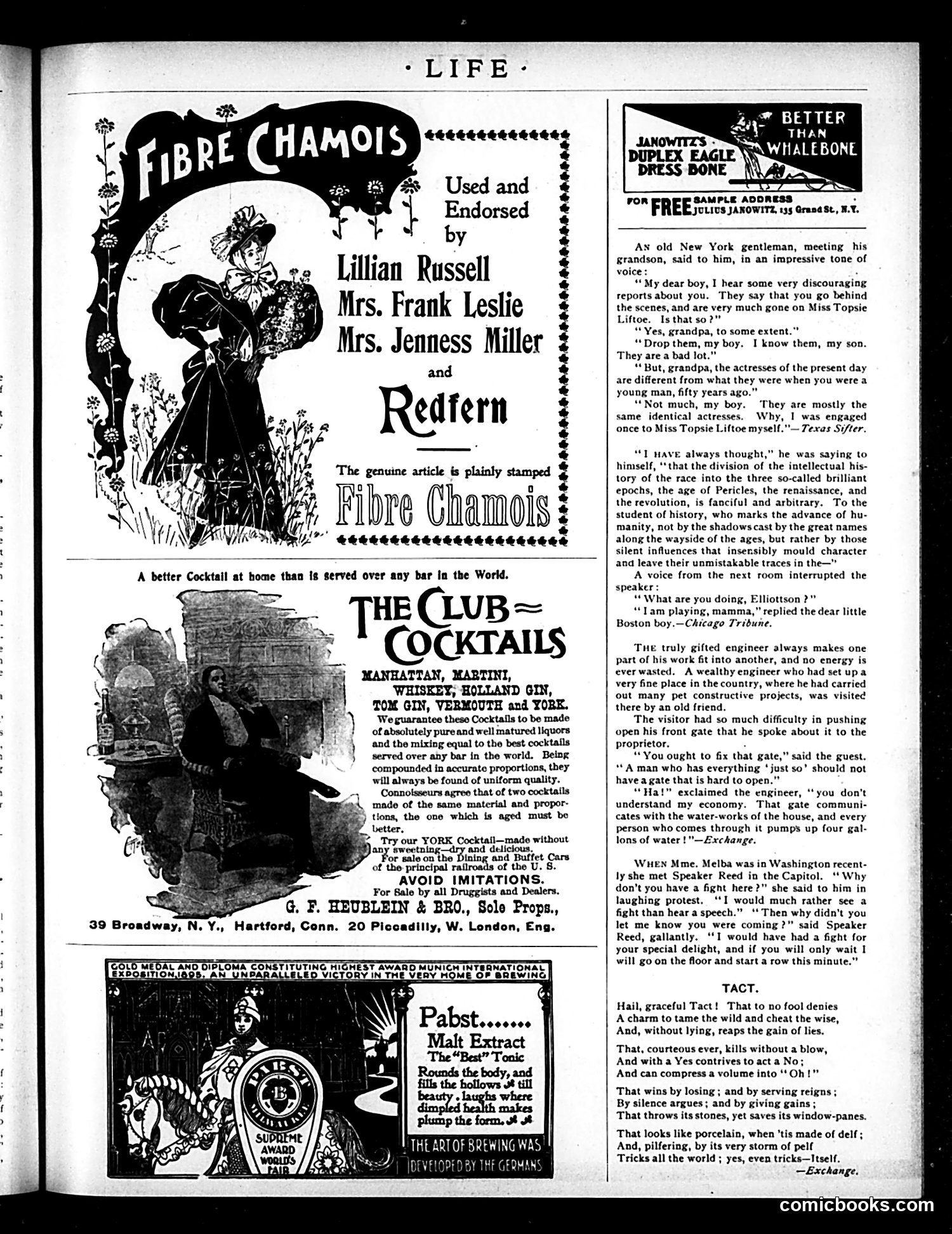
This page is primarily **advertisements and humorous anecdotes**, not political satire. The main advertisement promotes **Fibre Chamois** (a fabric product), endorsed by celebrities Lillian Russell, Mrs. Frank Leslie, and Mrs. Jenness Miller—prominent public figures of the era whose endorsements carried weight. Below are ads for **cocktails** (Heublein & Bro.) and **Pabst Malt Extract**, typical of early 1900s advertising. The text consists of **four humorous short stories**: 1. A grandfather warns his grandson about actresses, revealing he was once engaged to one fifty years prior 2. A boy playing while his mother thinks he's studying 3. An engineer who designed his gate to pump water when opened—demonstrating efficiency 4. Speaker Reed and opera singer Mme. Melba joking about congressional fights The final poem on "Tact" is cut off. These are light, genteel humor pieces typical of Life's satirical tone—social commentary through anecdote rather than visual caricature.
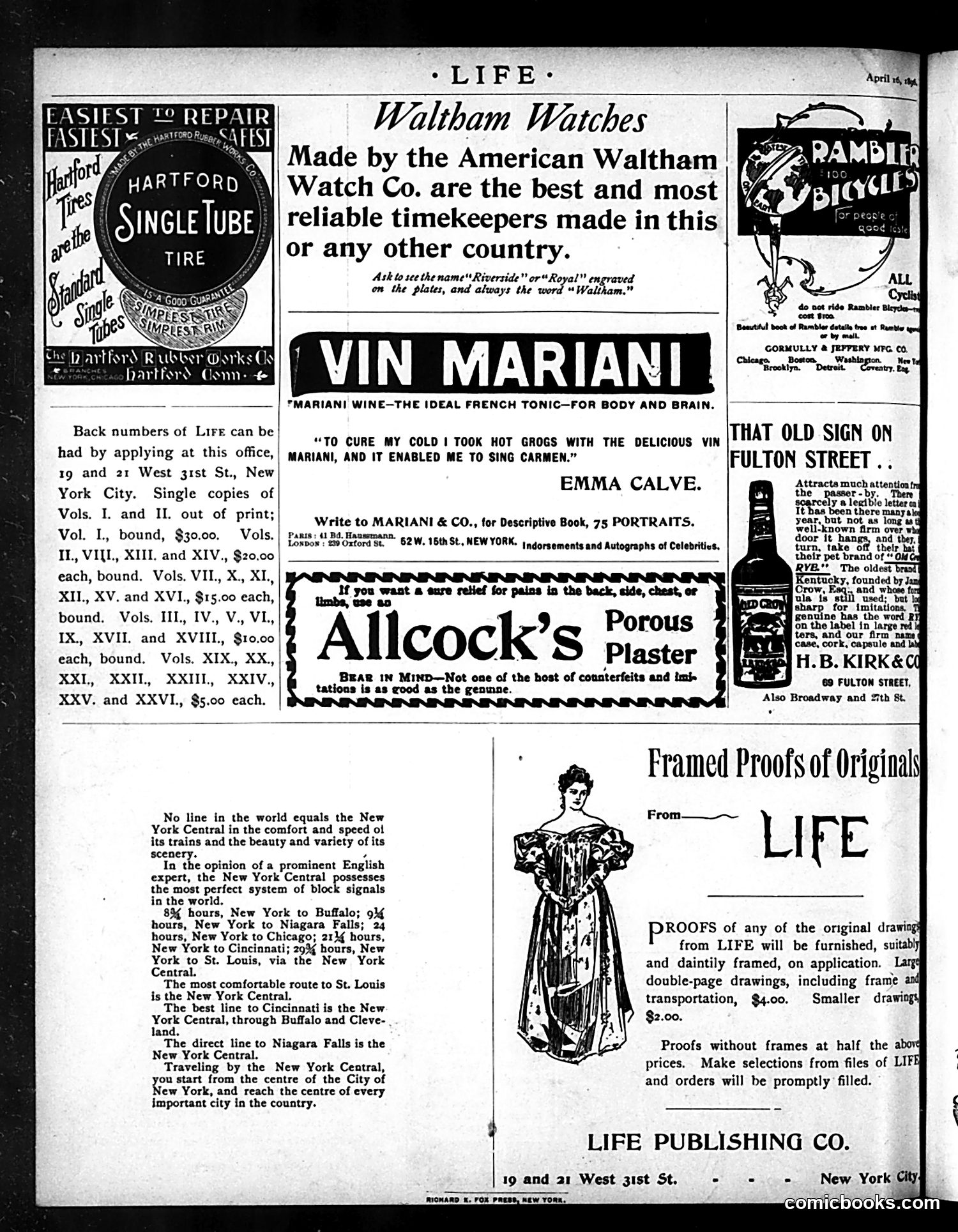
This is primarily an **advertising page** from Life magazine, not a political cartoon. The page contains commercial advertisements for various products and services popular in early 1900s America: **Key advertisements:** - Hartford Single Tube Tires - Waltham Watches (positioning as superior American timekeepers) - Rambler Bicycles - Vin Mariani wine tonic, endorsed by opera singer Emma Calvé - Allcock's Porous Plaster (pain relief) - New York Central Railroad (emphasizing speed and comfort to major cities) - Life Publishing Company's own back-issue sales and framed artwork **Notable context:** The Vin Mariani endorsement reflects the era's acceptance of wine tonics as legitimate medicinal products. Emma Calvé was a famous French opera singer, lending celebrity credibility to the product. The page also advertises Life's back-issue subscription options and offers to frame original artwork from the magazine—reflecting Life's dual role as both satirical publication and art magazine.