
Life, 1896-04-16 · page 4 of 20
Life — April 16, 1896 — page 4: what you’re looking at
What you’re looking at
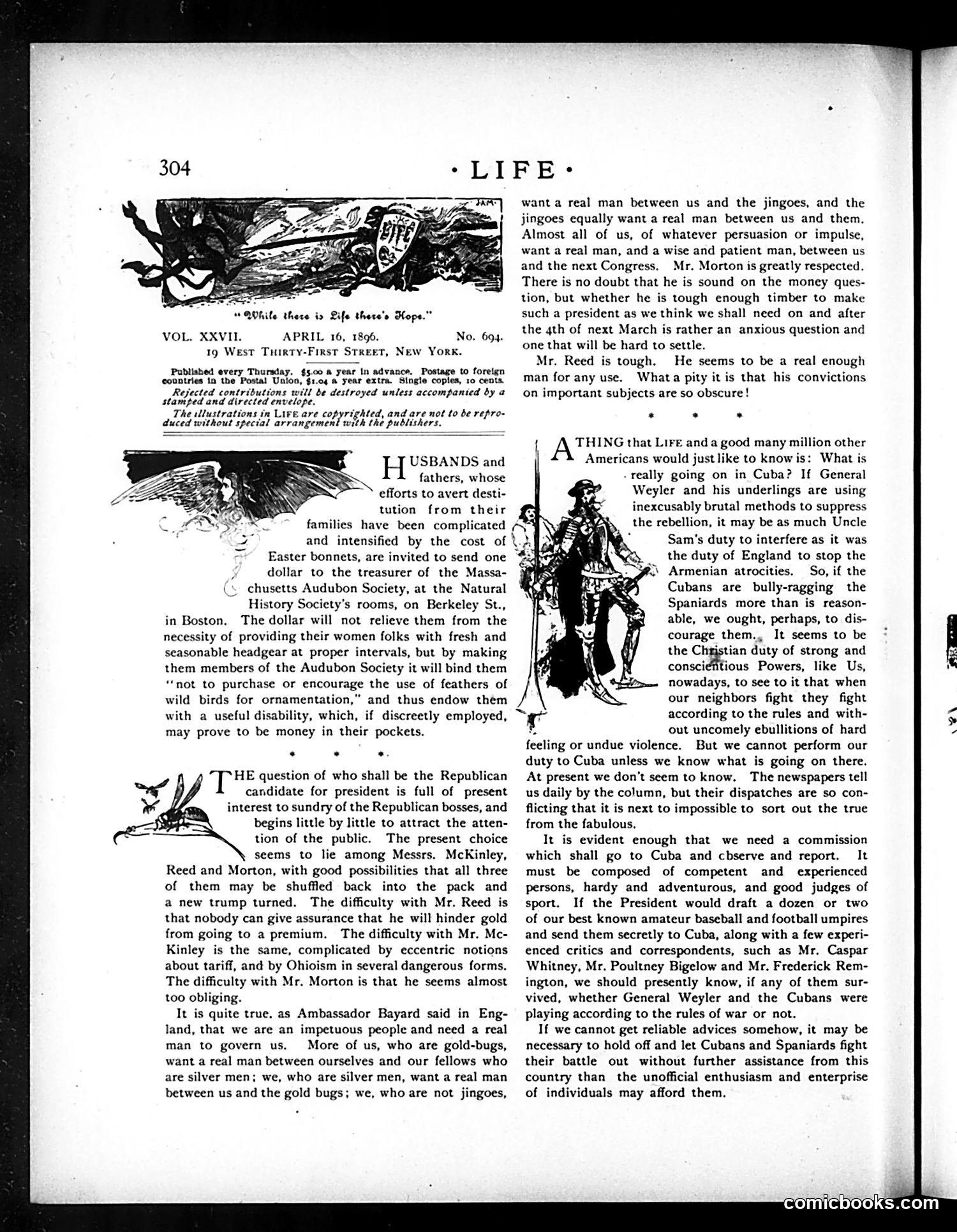
This page discusses the 1896 Republican presidential race and the Cuba crisis. The text debates three possible candidates—Reed, McKinley, and Morton—questioning which represents a "real man" strong enough to lead. The cartoons (though small and unclear in detail) appear to satirize political weakness and indecision. The opening illustration depicts a figure labeled "While there is Life there's Hope," likely commenting on the uncertain political landscape. The Cuba section criticizes American hesitation about intervening in Spanish colonial brutality, arguing that sending investigative commissions is insufficient—the nation needs decisive action and reliable intelligence rather than relying on newspaper reports. The satire targets both political vacillation and American reluctance to assert power in international affairs.
📄 Transcribed text from this page (OCR, searchable)
Machine-transcribed from the original scan — historical spelling and the odd misread are preserved.
> LIFE: “OQVhile there is Life there's Hope.” VOL. XXVII. APRIL 16, 1896. No. 694. 19 West Tuirty-First Street, New York. Published every Thursday, $5.00 a year In advance, Postage to foreign countries in the Postal Union, $1.04 year extra. Single copies, 10 cents Rejected contributions will be destroyed unless accompanied by a stamped and directed envelope. The tllustrations in Live are copyrighted, and are not to be repro- duced without special arrangement with the publishers. USBANDS and fathers, whose efforts to avert desti- tution from their families have been complicated and intensified by the cost of Easter bonnets, are invited to send one dollar to the treasurer of the Massa- chusetts Audubon Society, at the Natural History Society's rooms, on Berkeley St., in Boston, The dollar will not relieve them from the necessity of providing their women folks with fresh and seasonable headgear at proper intervals, but by making them members of the Audubon Society it will bind them “‘not to purchase or encourage the use of feathers of wild birds for ornamentation,” and thus endow them with a useful disability, which, if discreetly employed, may prove to be money in their pockets. SS ~\ . . *. Te question of who shall be the Republican candidate for president is full of present interest to sundry of the Republican bosses, and begins little by little to attract the atten- tion of the public. The present choice seems to lie among Messrs. McKinley, Reed and Morton, with good possibilities that all three of them may be shuffled back into the pack and a new trump turned. The difficulty with Mr. Reed is that nobody can give assurance that he will hinder gold from going to a premium. The difficulty with Mr. Mc- Kinley is the same, complicated by eccentric notions about tariff, and by Ohioism in several dangerous forms. The difficulty with Mr. Morton is that he seems almost too obliging. It is quite true, as Ambassador Bayard said in Eng- land, that we are an impetuous people and need a real man to govern us, More of us, who are gold-bugs, want a real man between ourselves and our fellows who are silver men; we, who are silver men, want a real man between us and the gold bugs; we, who are not jingoes, want a real man between us and the jingoes, and the jingoes equally want a real man between us and them. Almost all of us, of whatever persuasion or impulse, want a real man, and a wise and patient man, between us and the next Congress. Mr. Morton is greatly respected. There is no doubt that he is sound on the money ques- tion, but whether he is tough enough timber to make such a president as we think we shall need on and after the 4th of next March is rather an anxious question and one that will be hard to settle. Mr. Reed is tough. He seems to be a real enough man for any use. Whata pity it is that his convictions on important subjects are so obscure! * . * THING that Lire anda good many million other Americans would just like to know is: What is - really going on in Cuba? If General Weyler and his underlings are using inexcusably brutal methods to suppress the rebellion, it may be as much Uncle i Sam's duty to interfere as it was the duty of England to stop the Armenian atrocities. So, if the Cubans are bully-ragging the Spaniards more than is reason- able, we ought, perhaps, to dis- courage them., It seems to be the ee duty of strong and consciefitious Powers, like Us, nowadays, to see to it that when our neighbors fight they fight according to the rules and with- out uncomely ebullitions of hard feeling or undue violence. But we cannot perform our duty to Cuba unless we know what is going on there. At present we don't seem to know. The newspapers tell us daily by the column, but their dispatches are so con- flicting that it is next to impossible to sort out the true from the fabulous. It is evident enough that we need a commission which shall go to Cuba and cbserve and report. It must be composed of competent and experienced persons, hardy and adventurous, and good judges of sport. If the President would draft a dozen or two of our best known amateur baseball and football umpires and send them secretly to Cuba, along with a few experi- enced critics and correspondents, such as Mr. Caspar Whitney, Mr. Poultney Bigelow and Mr. Frederick Rem- ington, we should presently know, if any of them sur- vived, whether General Weyler and the Cubans were playing according to the rules of war or not. If we cannot get reliable advices somehow, it may be necessary to hold off and let Cubans and Spaniards fight their battle out without further assistance from this country than the unofficial enthusiasm and enterprise of individuals may afford them.