
Life, 1896-04-16 · page 12 of 20
Life — April 16, 1896 — page 12: what you’re looking at
What you’re looking at
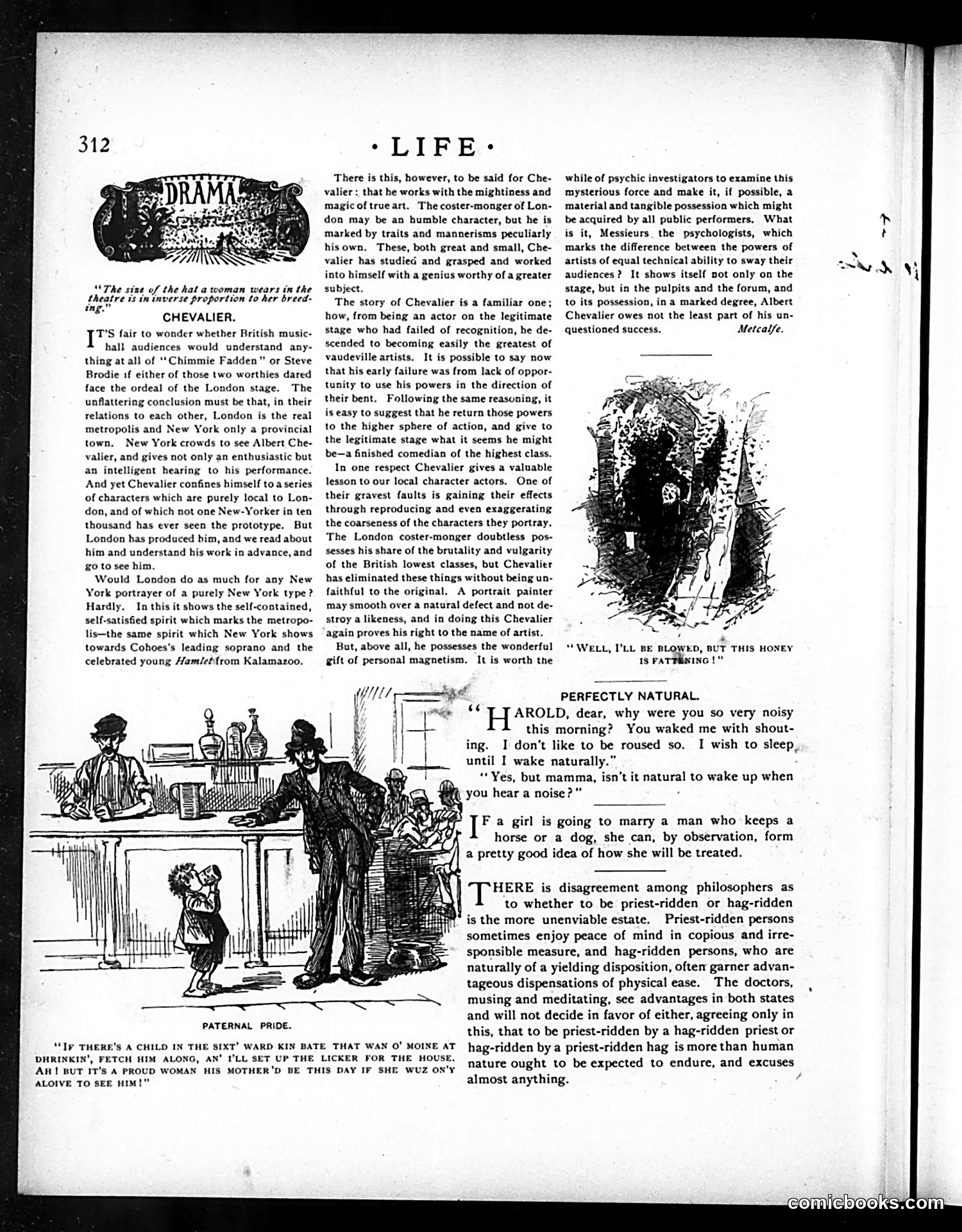
This page from *Life* magazine critiques **Albert Chevalier**, a British music-hall performer famous for portraying working-class London "coster-monger" (street vendor) characters. The article argues that while New York audiences eagerly attend Chevalier's performances, London wouldn't reciprocate by supporting American vaudeville acts. The piece praises Chevalier's artistry—he captures authentic working-class mannerisms without exaggerating vulgarity, unlike inferior American character actors. The text also emphasizes his mysterious "personal magnetism," a quality the author suggests psychologists should study. The cartoons illustrate domestic scenes (one labeled "Paternal Pride" showing a man with children; another titled "Perfectly Natural" depicting a conversation between spouses about waking). These satirize everyday life and social pretensions—contrasting with the article's celebration of Chevalier's refined artistic approach to portraying "lower" classes. The overall satire critiques both Anglo-American cultural rivalry and the gap between authentic character and its performance.
📄 Transcribed text from this page (OCR, searchable)
Machine-transcribed from the original scan — historical spelling and the odd misread are preserved.
“The size of the hat a woman wears in the theatre is in inverse proportion to her breed- ing. e CHEVALIER. ‘T’S fair to wonder whether British music- hall audiences would understand any- thing at all of “*Chimmie Fadden” or Steve Brodie if either of those two worthies dared face the ordeal of the London stage. The unflattering conclusion must be that, in their relations to each other, London is the real metropolis and New York only a provincial town. New York crowds to see Albert Che- valier, and gives not only an enthusiastic but an intelligent hearing to his performance. And yet Chevalier confines himself toa series of characters which are purely local to Lon- don, and of which not one New-Yorker in ten thousand has ever seen the prototype. But London has produced bim, and we read about him and understand his work in advance, and go to see him. Would London do as much for any New York portrayer of a purely New York type? Hardly, In this it shows the self-contained, self-satisfied spirit which marks the metropo- lis—the same spirit which New York shows towards Cohoes's leading soprano and the celebrated young Ham/e¢from Kalamazoo. “LIFE: There is this, however, to be said for Che- valier : that he works with the mightiness and magic oftrueart. The coster-monger of Lon- don may be an humble character, but he is marked by traits and mannerisms peculiarly hisown, These, both great and small, Che- valier has studied and grasped and worked into himself with a genius worthy of a greater subject. The story of Chevalier is a familiar one; how, from being an actor on the legitimate stage who had failed of recognition, he de- scended to becoming easily the greatest of vaudeville artists. It is possible to say now that his early failure was from lack of oppor- tunity to use his powers in the direction of their bent. Following the same reasuning, it is easy to suggest that he return those powers to the higher sphere of action, and give to the legitimate stage what it seems he might be—a finished comedian of the highest class. In one respect Chevalier gives a valuable lesson to our local character actors. One of their gravest faults is gaining their effects through reproducing and even exaggerating the coarseness of the characters they portray. The London coster-monger doubtless pos- sesses his share of the brutality and vulgarity of the British lowest classes, but Chevalier has eliminated these things without being un- faithful to the original. A portrait painter may smooth over a natural defect and not de- stroy a likeness, and in doing this Chevalier again proves his right to the name of artist. But, above all, he possesses the wonderful gift of personal magnetism. It is worth the Wes La of ( // —=*s i| ing. while of psychic investigators to examine this mysterious force and make it, if possible, a material and tangible possession which might be acquired by all public performers. What is it, Messieurs. the psychologists, which marks the difference between the powers of artists of equal technical ability to sway their audiences? It shows itself pot only on the stage, but in the pulpits and the forum, and to its possession, ina marked degree, Albert Chevalier owes not the least part of his un- questioned success. Metcalfe. “WELL, I'LL BE BLOWED, BUT THIS HONEY 18 FA’ ING 1" PERFECTLY NATURAL. ge AROLD, dear, why were you so very noisy this morning? I don’t like to be roused so. You waked me with shout- until I wake naturally.” D “Yes, but mamma, isn’t it natural to wake up when {you hear a noise?” F a girl is going to marry a man who keeps a horse or a dog, she can, by observation, form a pretty good idea of how she will be treated. AREAL is disagreement among philosophers as to whether to be priest-ridden or hag-ridden is the more unenviable estate. Priest-ridden persons I wish to sleep, sometimes enjoy peace of mind in copious and irre- sponsible measure, and hag-ridden persons, who are naturally of a yielding disposition, often garner advan- tageous dispensations of physical ease. The doctors, musing and meditating, see advantages in both states and will not decide in favor of either, agreeing only in this, that to be priest-ridden by a hag-ridden priest or hag-ridden by a priest-ridden hag is more than human nature ought to be expected to endure, and excuses almost anything. PATERNAL PRIDE. “Ip THERE'S A CHILD IN THE SIXT’ WARD KIN BATE THAT WAN O! MOINE AT DHRINKIN', FETCH HIM ALONG, AN’ I'LL SET UP THE LICKER FOR THE HOUSE. AH! BUT IT’S A PROUD WOMAN HIS MOTHER'D BE THIS DAY IF SHE WUZ ON'Y ALOIVE TO SEE HIM!"