
A complete issue · 20 pages · 1896
Life — January 9, 1896
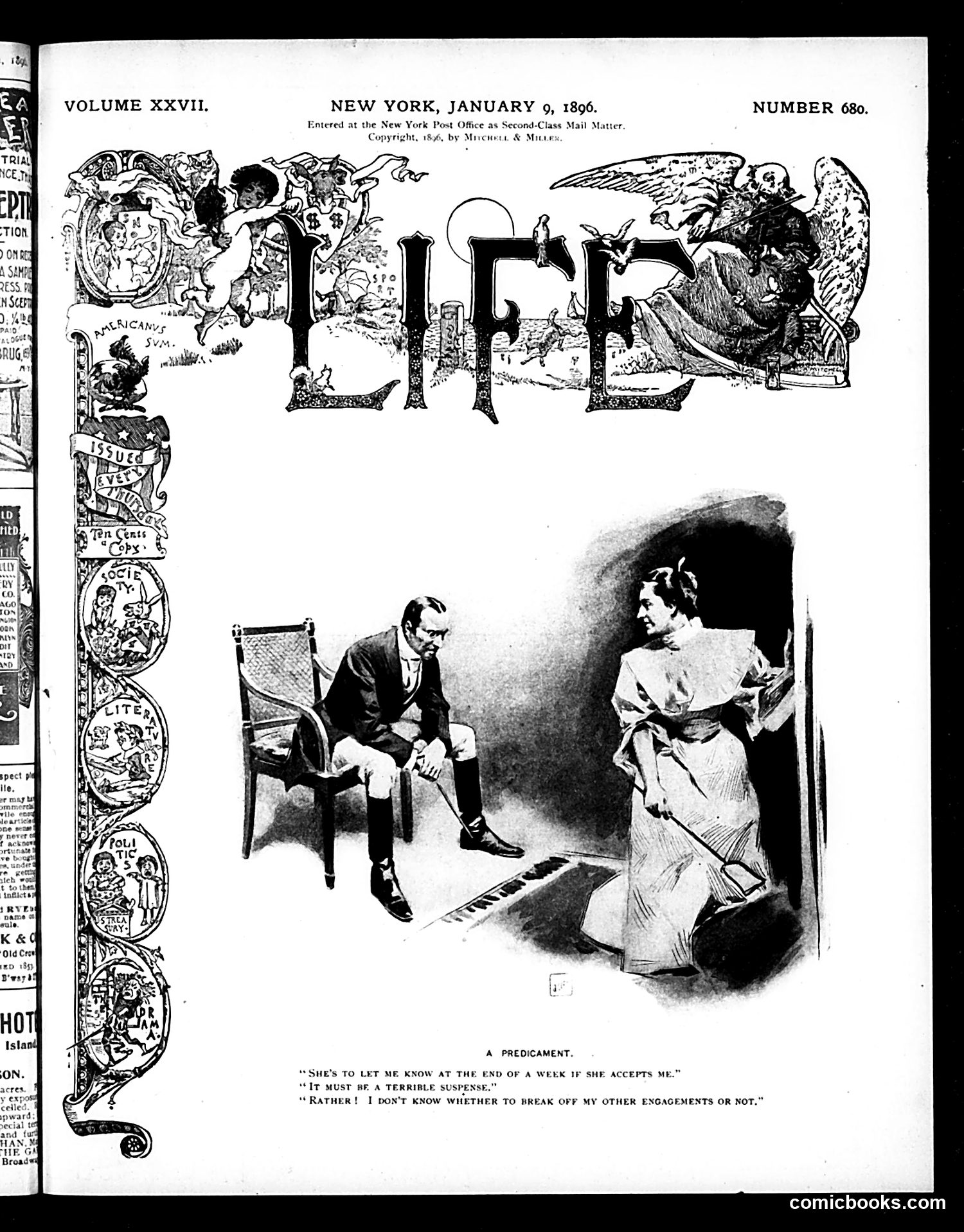
This cartoon illustrates a romantic dilemma common in early 20th-century courtship etiquette. A man sits uncomfortably facing a woman, apparently proposing marriage or declaring romantic intentions. The caption reveals his anxiety: he's asking her to decide within a week, framing it as "a terrible suspense," while he's uncertain whether to break off his other engagements first. The humor targets male indecision and the social awkwardness of simultaneous courtships—a man juggling multiple romantic prospects and wanting the woman to commit before he commits to her. This reflects Edwardian-era dating customs where men pursued multiple women simultaneously until formal engagement, making the cartoon a gentle satire of masculine hesitation and poor romantic priorities.
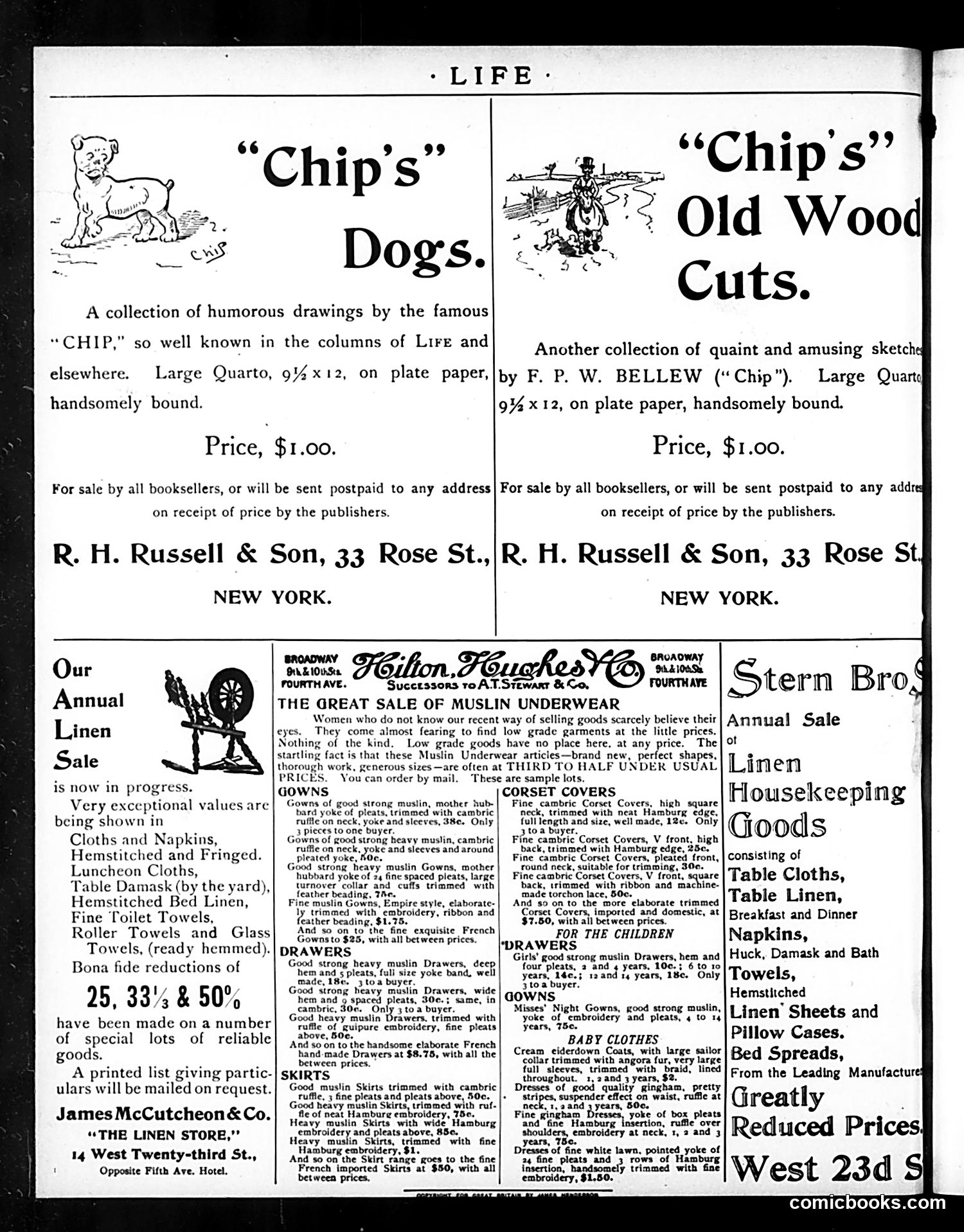
This page is primarily **advertising**, not political satire. It contains four distinct ads: 1. **"Chip's" Dogs** and **"Chip's" Old Wood Cuts** — books of humorous drawings by F.P.W. Bellew, a cartoonist known for contributing to Life magazine. These are being sold by R.H. Russell & Son publishers. 2. **Halliton, Hunches & Co.** — advertises a "Great Sale of Muslin Underwear," listing various garments (gowns, drawers, corset covers, skirts) with detailed descriptions and prices. 3. **James McCutcheon & Co.** — announces their annual linen sale with discounts of 25-50% on household textiles. 4. **Stern Bros.** — promotes their annual sale of linen housekeeping goods. The page reflects early 20th-century consumer culture and retail advertising strategies.
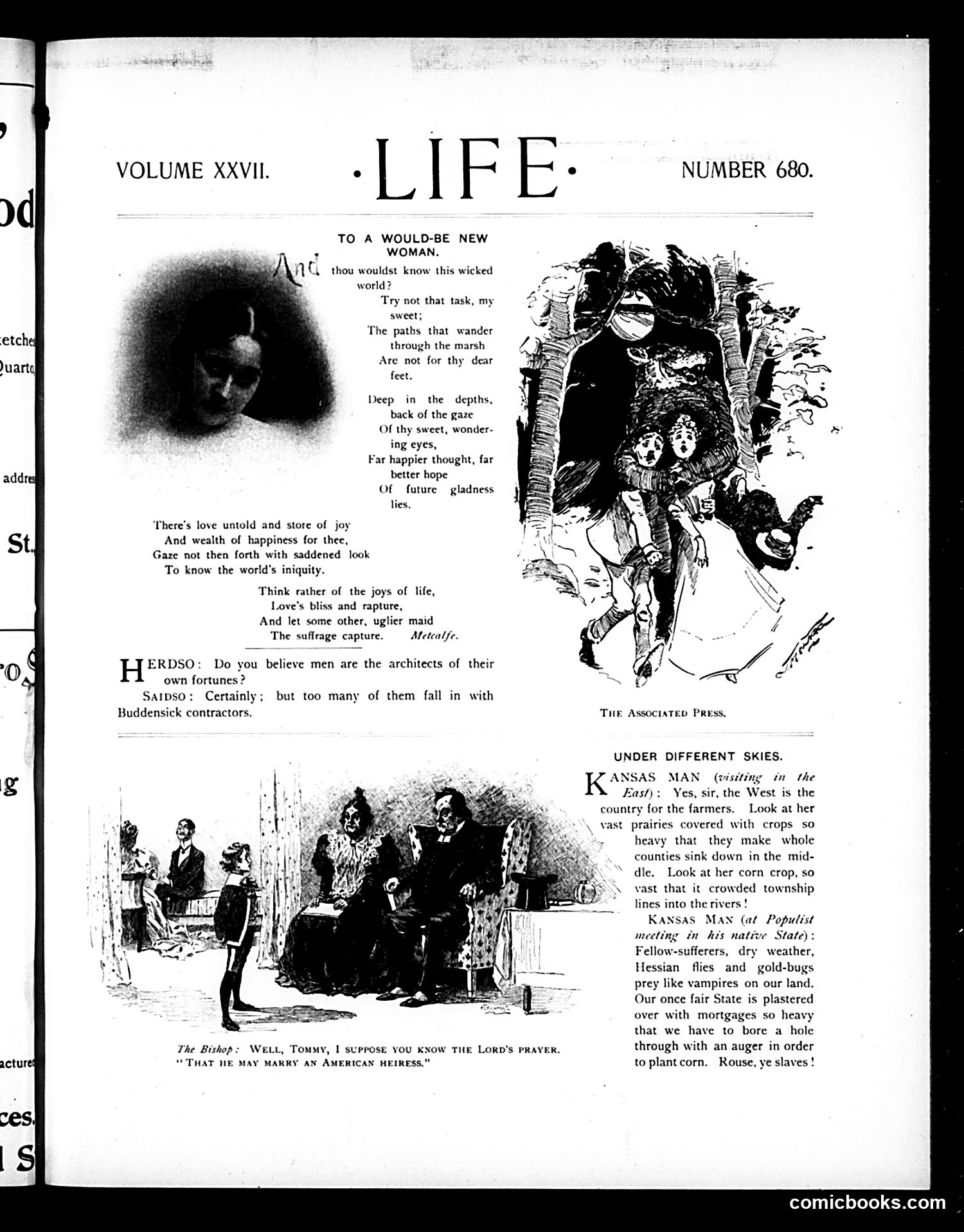
This page contains three distinct pieces: 1. **"To a Would-Be New Woman"** - A romantic poem discouraging a woman from learning about worldly wickedness, advising her to focus on domestic happiness instead. This satirizes Victorian attitudes restricting women's independence. 2. **"Herdso/Sirso" dialogue** - A brief exchange about whether men control their own fortunes, with a quip that many fall in with "Hudduck contractors," likely a topical reference to corrupt business practices (unclear which specific scandal). 3. **"Kansas Man Under Different Skies"** - A political cartoon featuring dialogue between a Bishop and Tommy about American heiresses. The Kansas farmer's monologue bitterly describes agricultural hardship—mortgaged land, weather, pests—versus wealthy easterners, satirizing economic inequality and the farmers' plight during the Populist era.
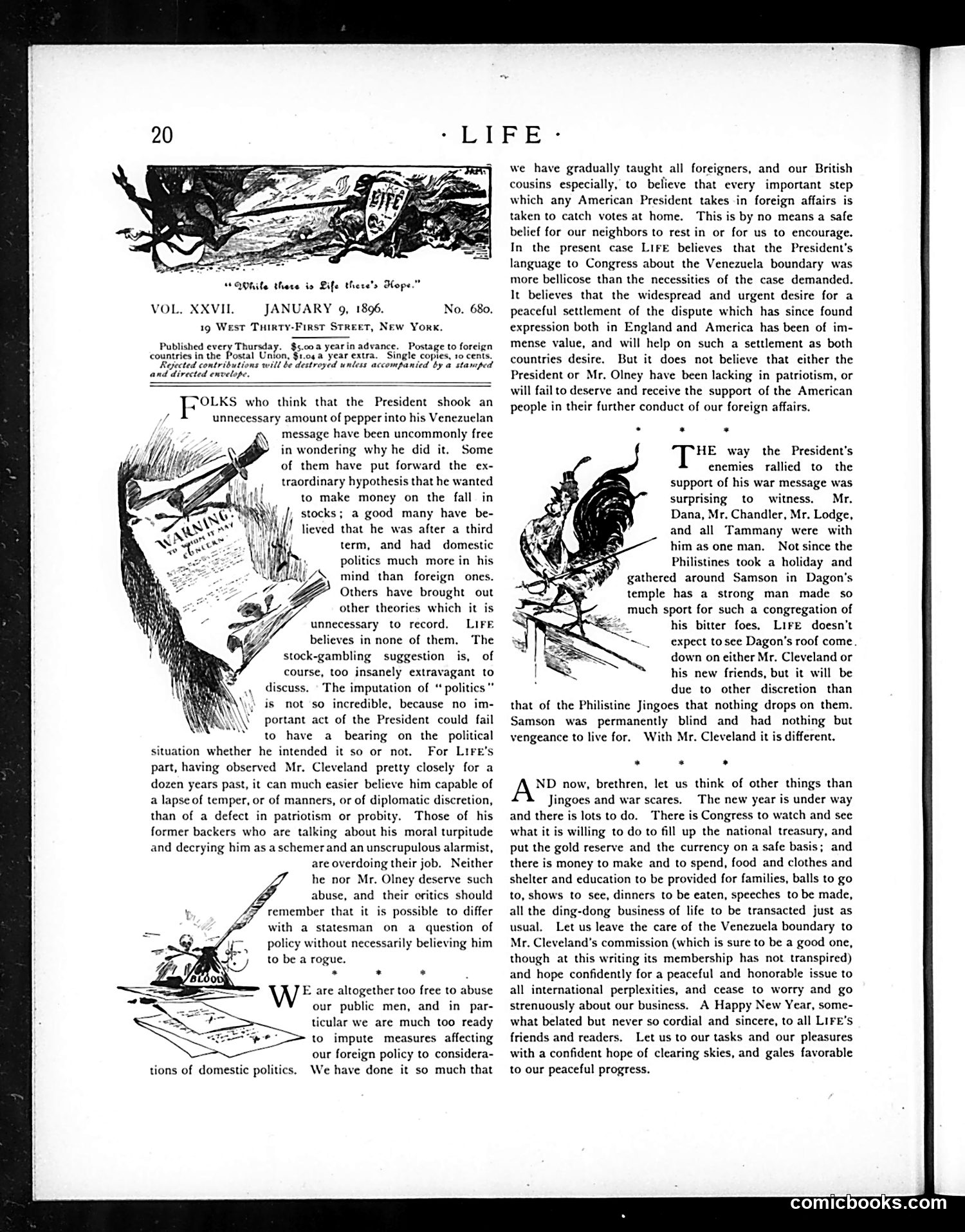
This page critiques President Cleveland's handling of the Venezuela boundary dispute with Britain. The left cartoon depicts a "War Drum" labeled with financial terms, satirizing critics who claimed Cleveland manufactured the crisis for political gain or stock-market manipulation. The right cartoon shows figures (likely Cleveland's supporters Dana, Chandler, and Lodge) rallying behind his war message, with a reference to the "Philistines" celebrating at a temple—mocking their fervent support. The editorial argues Cleveland acted appropriately, defending him against accusations of unnecessary bellicosity while urging Americans to focus on domestic concerns: currency reform, treasury management, and social welfare rather than jingoistic war sentiment.
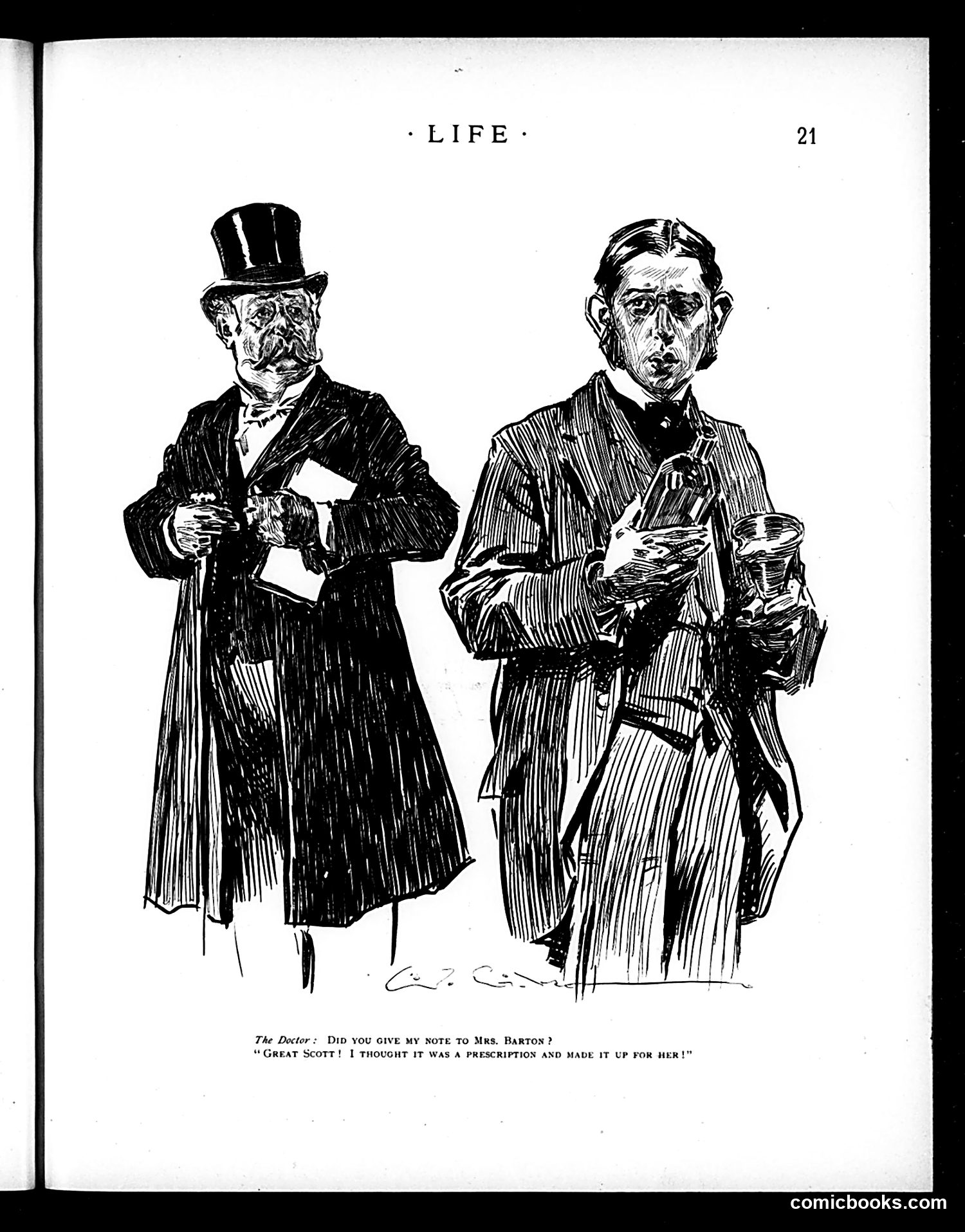
This page presents a single cartoon titled "The Doctor," depicting two men in formal attire from what appears to be the early 20th century. The figure on the left wears a top hat and formal coat; the right figure is dressed as a military officer holding what appears to be medical supplies or bottles. The dialogue reads: "Did you give my note to Mrs. Barton? 'Great Scott! I thought it was a prescription and made it up for her!'" The joke hinges on mistaking a personal note for a medical prescription—a confusion playing on doctors' notoriously illegible handwriting. This was a common satirical theme in period publications, mocking the medical profession's communication practices without apparent political or social commentary beyond general professional humor.
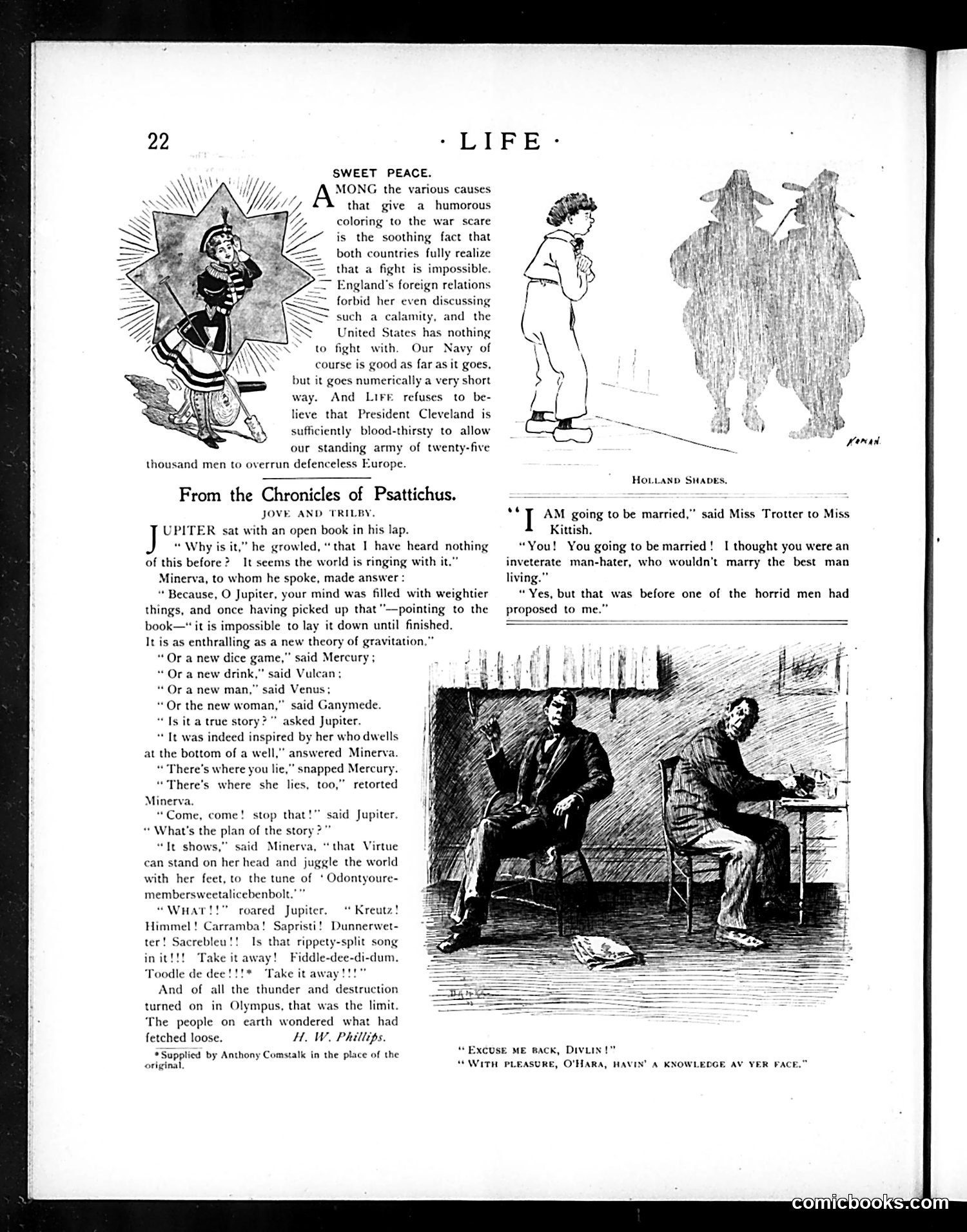
**"Sweet Peace"** (top left): A satirical commentary on war impossibility. The piece mocks President Cleveland's foreign policy, suggesting England won't fight America and our Navy is strong enough to deter conflict. Life sarcastically doubts Cleveland is "blood-thirsty" enough to risk war over European disputes—the point being that economic and diplomatic factors make major conflict unlikely, not moral restraint. **"Holland Shades"** (top right): A crude cartoon depicting what appears to be a dark figure, likely a racial caricature common to this era's satirical magazines. **"From the Chronicles of Psattichus"** (middle): Mythological parody where Jupiter and other gods debate women and virtue, using classical references for contemporary social commentary. The bottom illustration shows two men in conversation, likely satirizing genteel social interaction.
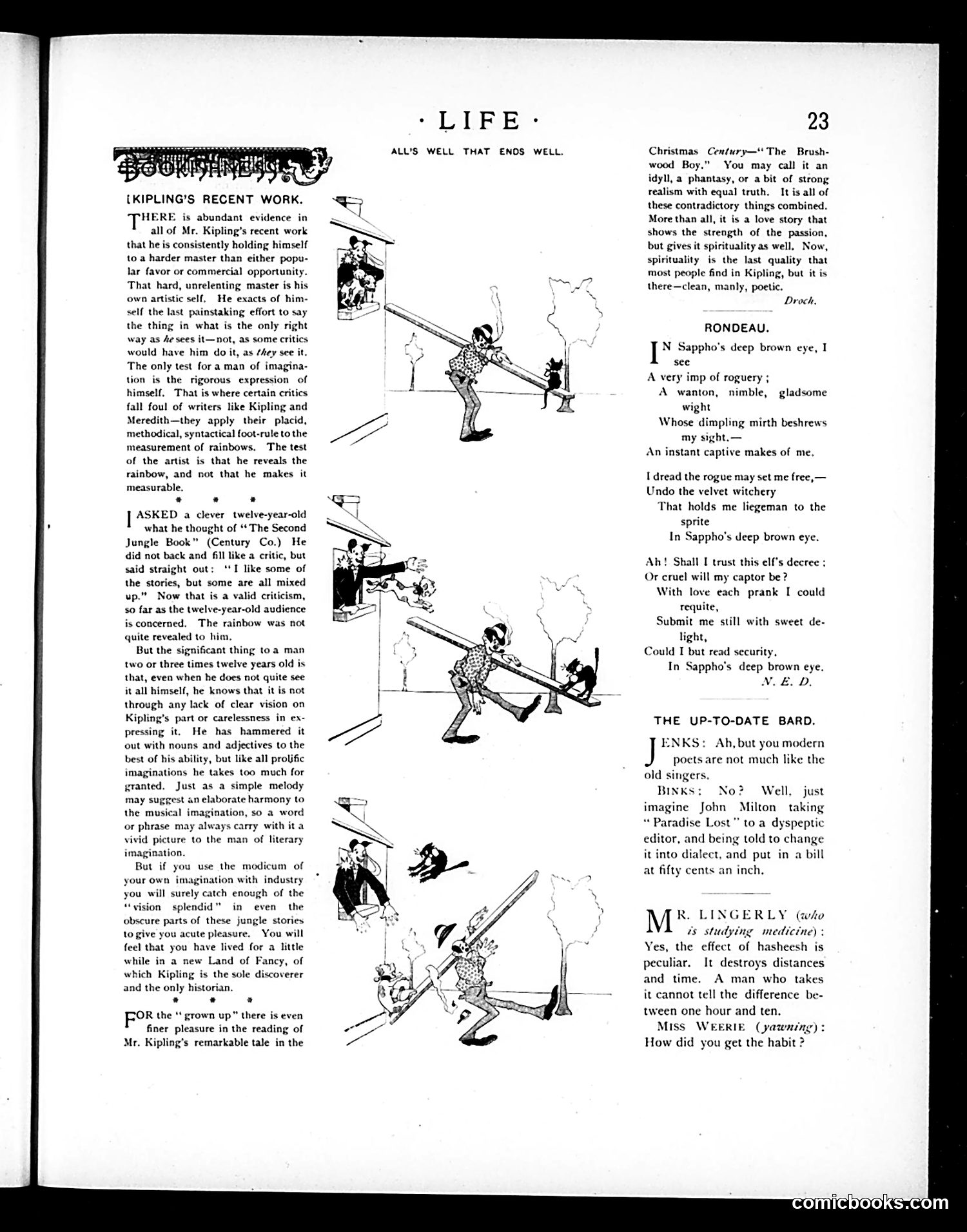
This page contains literary and cultural commentary rather than political cartoons. The main sections are: **"Kipling's Recent Work"** — A serious critique of Rudyard Kipling's artistic integrity, arguing he holds himself to a higher standard than commercial pressures demand. It defends his work against critics who find it contradictory, praising his "clean, manly, poetic" spirituality. **"Rondeau"** — A romantic poem about a woman named Sapho with a "deep brown eye," expressing the speaker's captivation and uncertainty about her feelings. **"The Up-to-Date Bard"** — A brief humorous dialogue mocking modern poets as inferior to classics like John Milton, with a joke about selling "Paradise Lost" to a cheap editor who'd alter it for profit. The left side contains whimsical illustrations of children engaged in various physical activities (skiing, sledding, etc.), likely accompanying a separate story or feature.
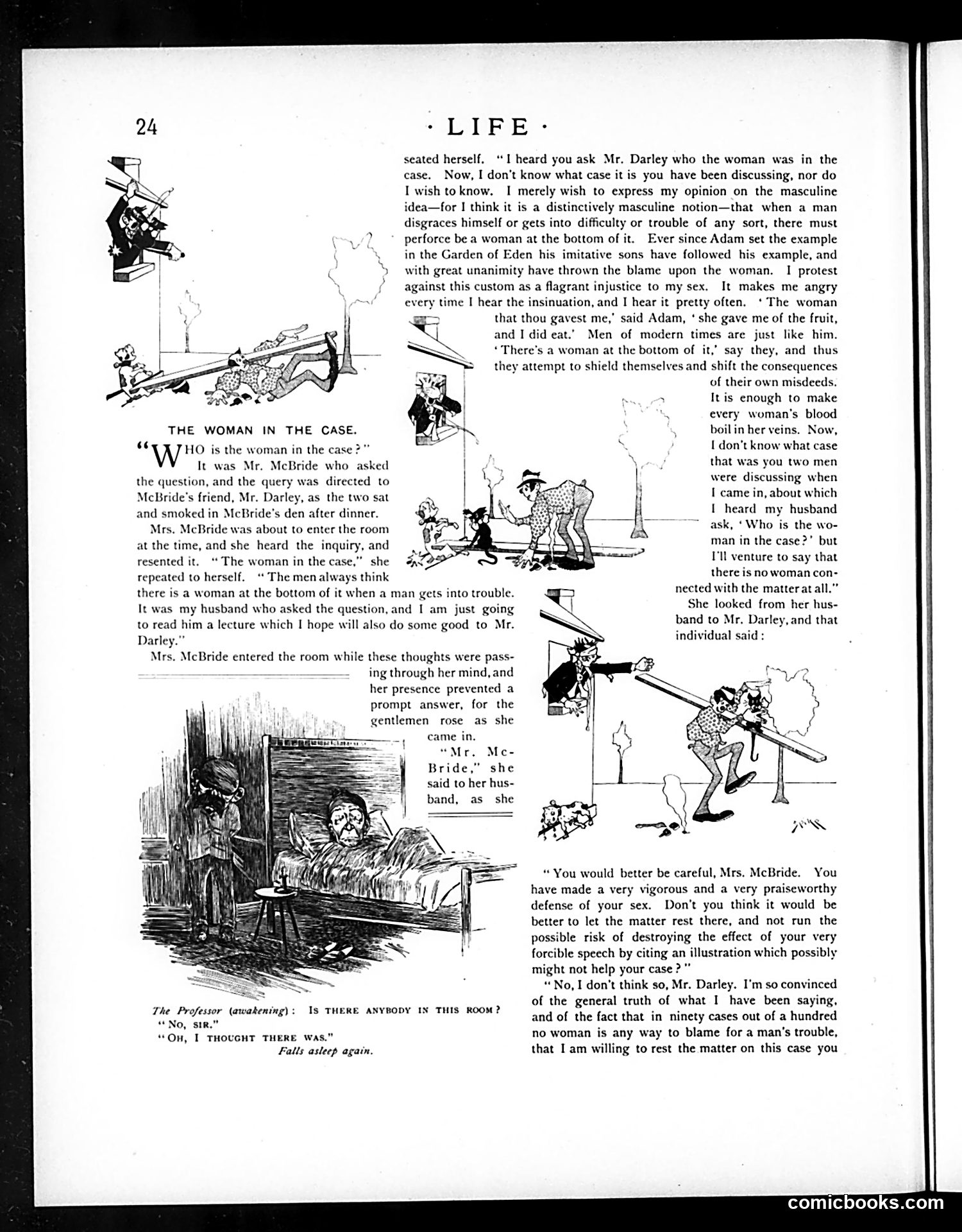
This page satirizes the common Victorian-era legal and social excuse that blamed women for men's wrongdoing. The headline "Who is the woman in the case?" references a legal cliché where scandals involving men are reflexively attributed to female influence—implying women are responsible for men's troubles. Mrs. McBride defends her sex vigorously, referencing Adam and Eve to protest this pattern. She argues men unfairly use "a woman at the bottom of it" as a shield against accountability for their own misdeeds. Mr. Darley cautions her against such forceful speech, suggesting restraint might better serve "your case"—a pointed joke about how women's advocacy for themselves was itself viewed as problematic by the male establishment.
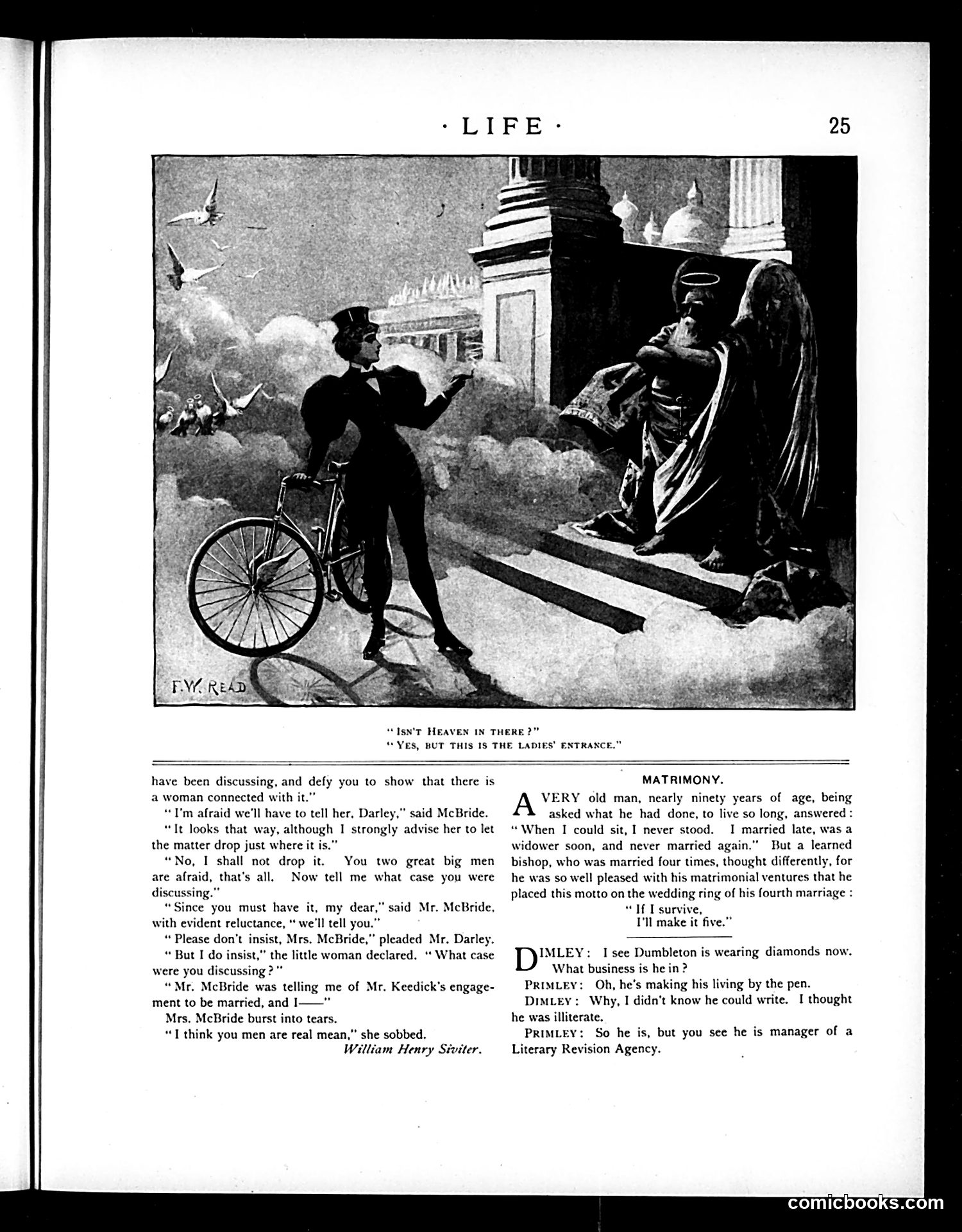
The cartoon (signed F.V.C. Reed) depicts a man with a bicycle encountering Death at Heaven's gates. The caption reads: "Isn't Heaven in there?" / "Yes, but this is the ladies' entrance." **The satire:** This is a joke about gender segregation in the afterlife, playing on Victorian-era social conventions that rigidly separated men and women—even in heaven. The bicycle suggests modernity (bicycles were newly popular), contrasting with the archaic idea of gendered divine spaces. The text below contains unrelated humor about marriage and relationships, including a William Henry Stister quotation. The overall effect mocks outdated social hierarchies by suggesting they persist even in the spiritual realm.
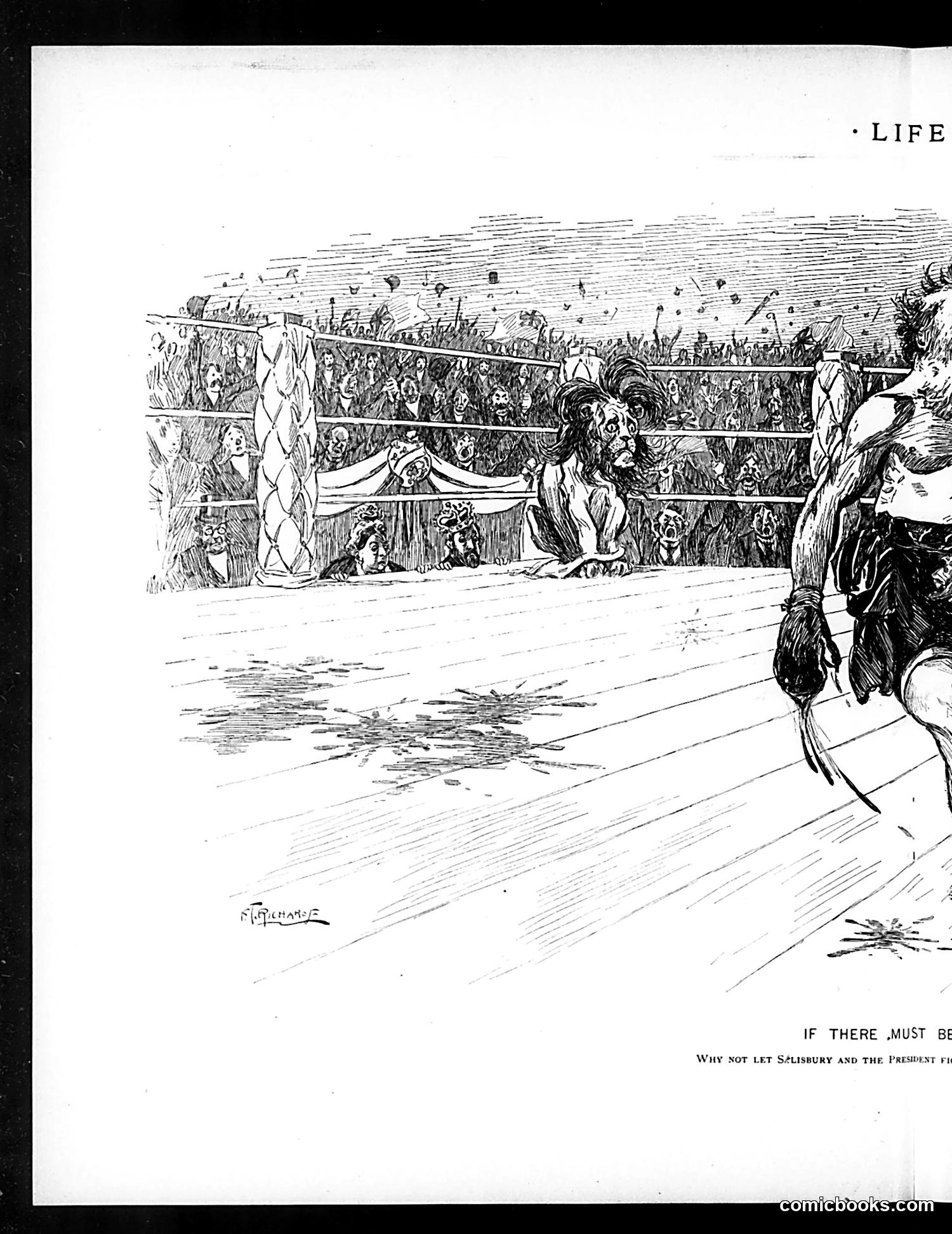
This Life magazine illustration depicts a Roman amphitheater scene with a large lion facing a figure in the arena, while crowds fill the stands. The caption reads "If there must be" with partial text below: "Why not let Salisbury and the President fight?" The cartoon is a satirical commentary on political conflict, likely referencing British Prime Minister Lord Salisbury and an American president (the specific president is unclear from this excerpt). The lion-versus-gladiator imagery suggests the cartoonist views their dispute as a spectacle—public entertainment rather than serious governance. The joke implies that if these politicians must quarrel, they should settle it like ancient combatants rather than through actual policy or diplomatic channels. It's mockery of political grandstanding presented as entertainment for the masses.
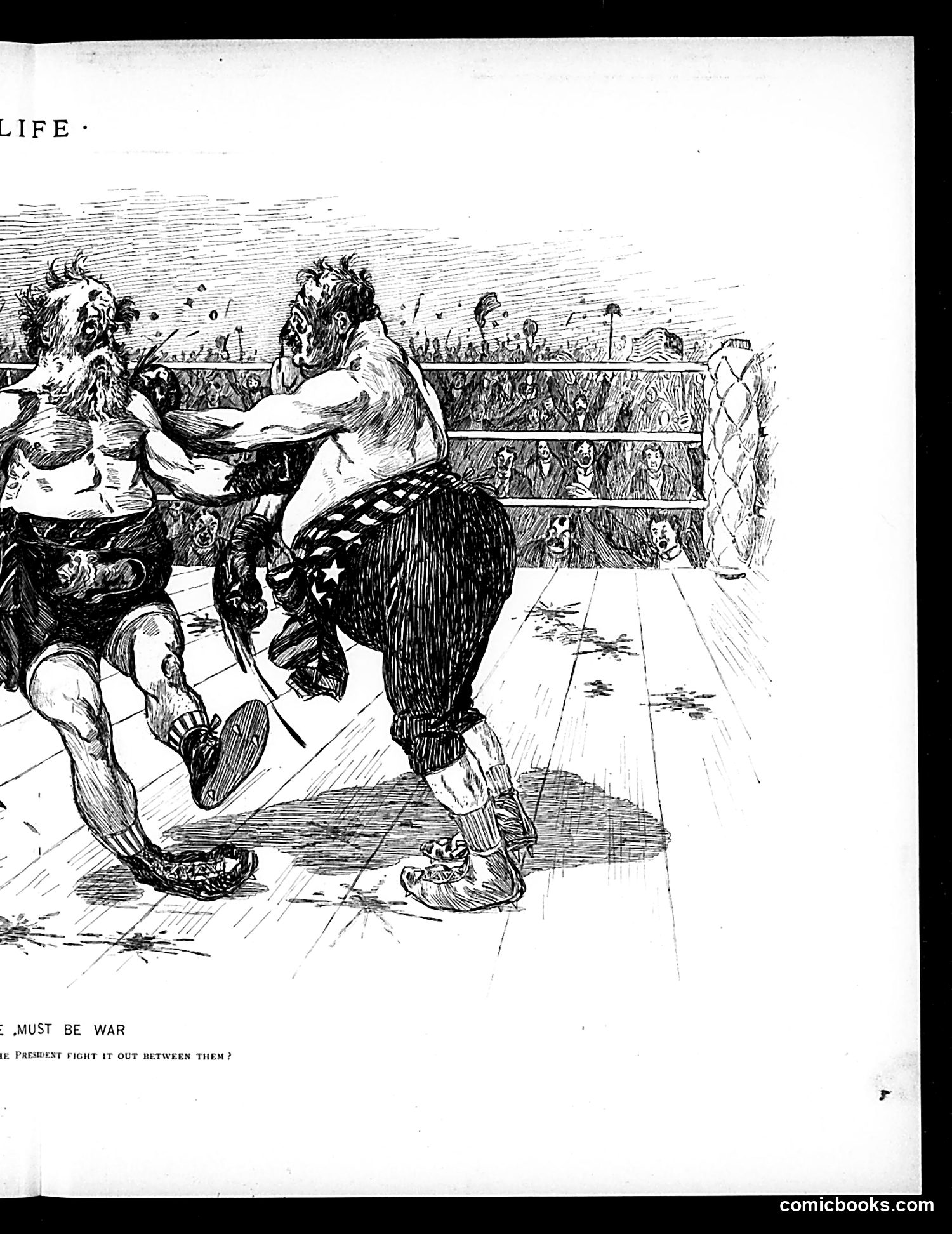
This satirical cartoon depicts two figures in what appears to be a boxing ring before a large crowd. The text fragment reads "...MUST BE WAR" and "...HE PRESIDENT FIGHT IT OUT BETWEEN THEM?" The cartoon appears to be commenting on a political dispute that the artist suggests should be resolved through combat rather than diplomacy. The caricatured figures and arena setting suggest this is mocking either a presidential dispute or conflict between political leaders. The exaggerated, animalistic features of the combatants and the phrase about the President indicate this is satirizing either an actual political confrontation or the idea of violent resolution to political disagreements. Without the full caption and date, the specific figures and incident referenced remain unclear, though the satirical intent—criticizing either the conflict itself or the suggestion of violent resolution—is evident.
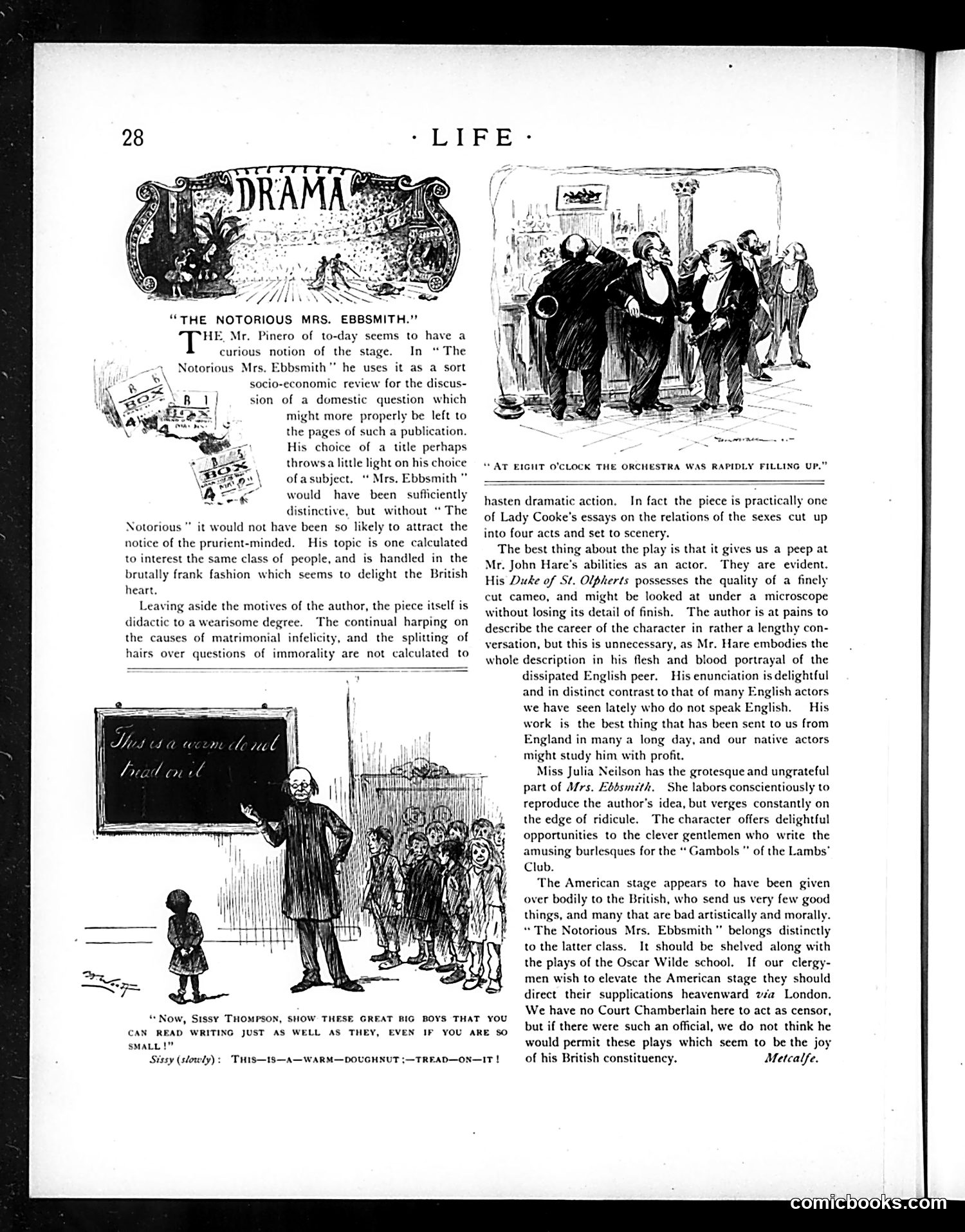
This page reviews a contemporary play by Arthur Wing Pinero about a woman of questionable morality. The critic (signed "Metcalfe") argues that Pinero uses sensationalism—the word "Notorious"—to attract prurient audiences rather than serve dramatic art. The play supposedly functions as a tedious essay on marital unhappiness rather than compelling theater. The review praises British actor John Hare's performance while criticizing American theater's wholesale adoption of British plays, particularly those influenced by Oscar Wilde's controversial aesthetic. The critic laments that America lacks a "Court Chamberlain" (British censorship board) to prevent morally questionable imports, suggesting such plays pander to base instincts rather than elevate the stage. The accompanying sketches appear to illustrate theatrical scenes, including what seems to be a schoolroom lesson, reinforcing the didactic, preachy nature the reviewer criticizes.
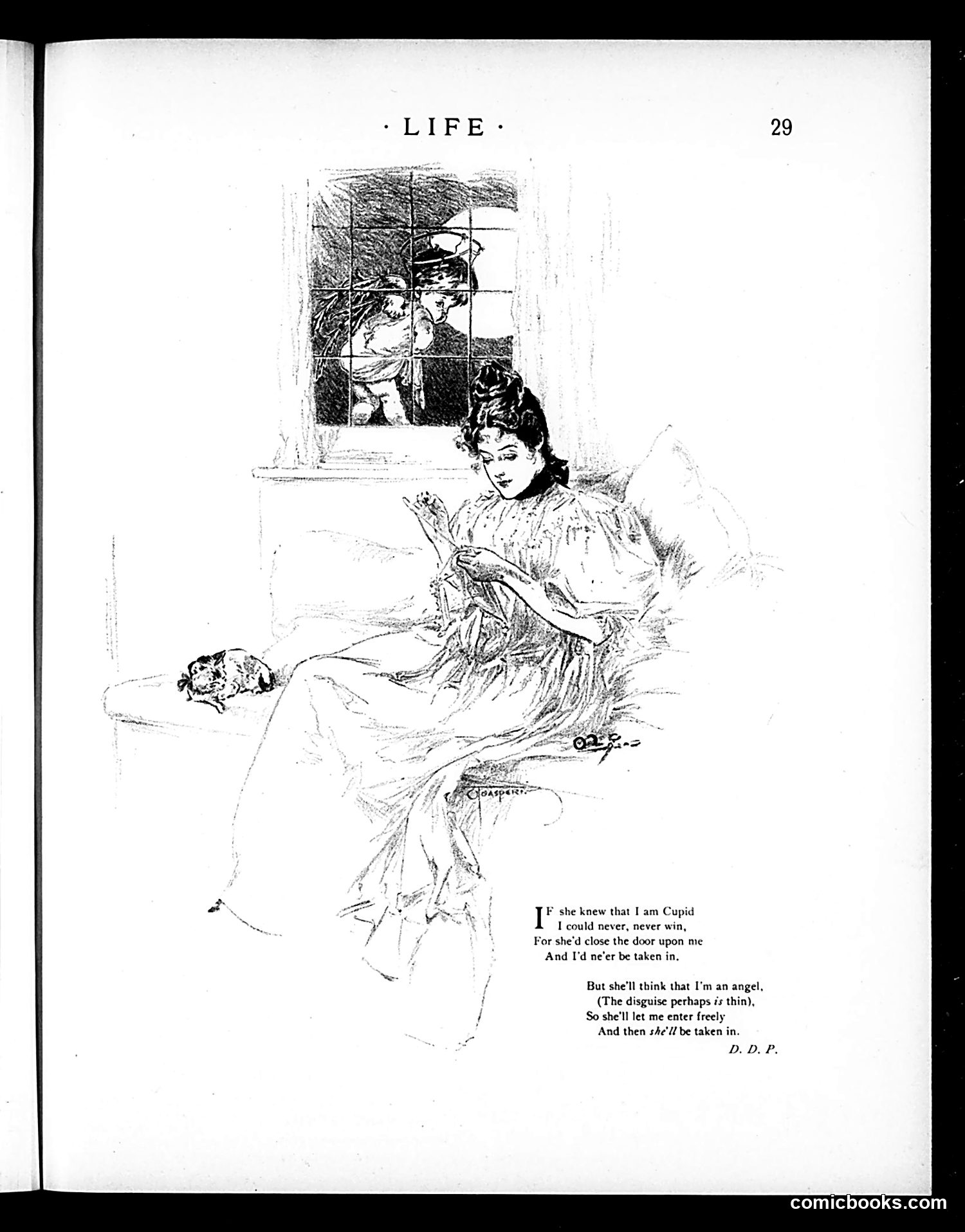
This is a humorous illustration from *Life* magazine (page 29) depicting Cupid in disguise. The cartoon's joke relies on a sexual double entendre: Cupid plans to deceive a woman by disguising himself as an angel rather than revealing his true identity. The poem's wordplay hinges on "taken in"—meaning both "admitted/allowed entry" and "deceived/seduced." The satire mocks male deception in romantic pursuits: if the woman knew she was being targeted by Cupid (the god of love/desire), she'd refuse him. But believing he's a virtuous angel, she'll lower her guard and be "taken in" both literally and figuratively. The illustration shows a woman in a negligee with the disguised Cupid visible through a window behind her, emphasizing the predatory nature of the "seduction by false pretenses" joke. The humor is distinctly early-20th-century in its casual treatment of male romantic deception.
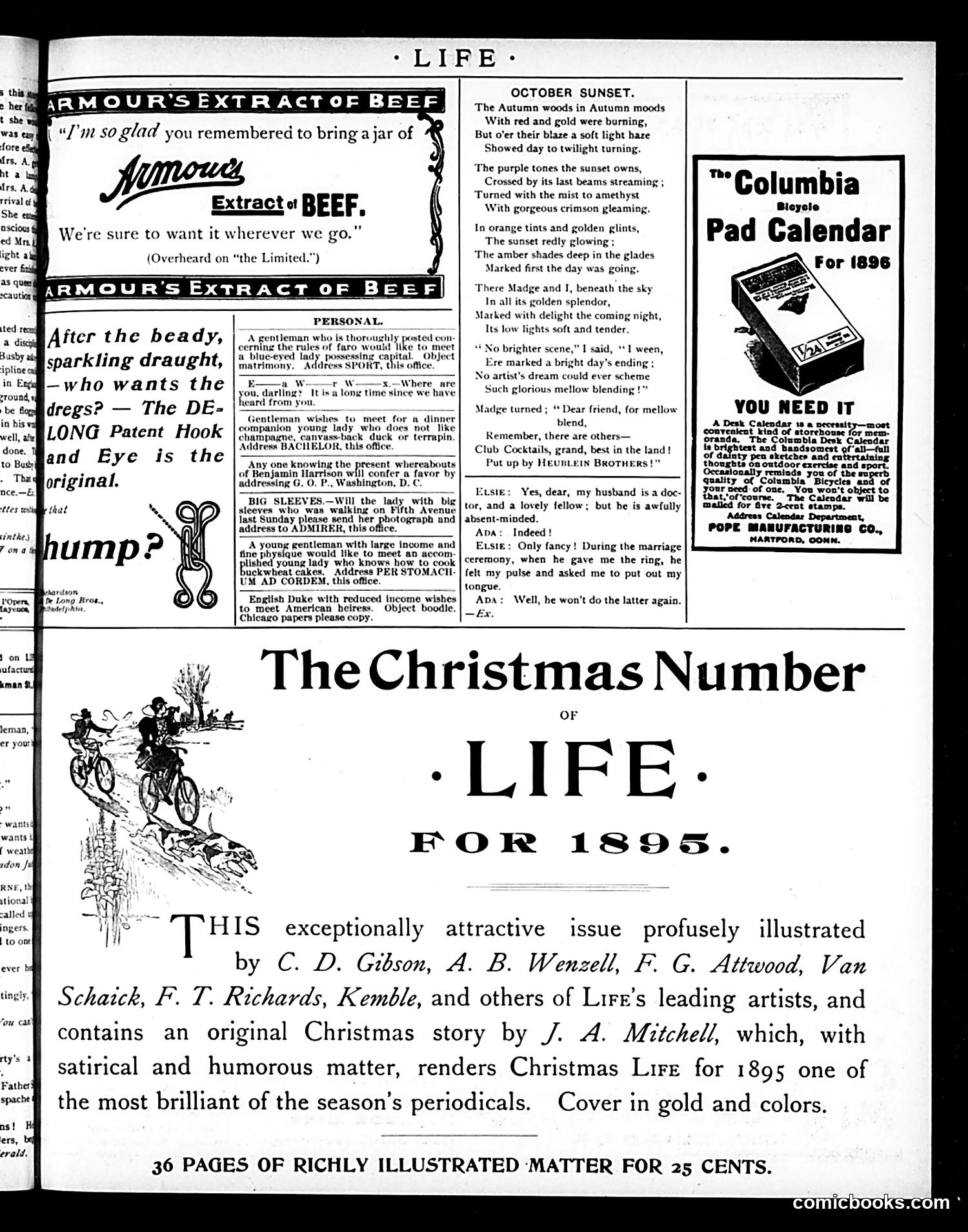
This is primarily a **advertisements and announcements page** rather than editorial satire. Key content: **Armour's Extract of Beef ad**: A straightforward product advertisement with a conversational quote allegedly overheard on a train ("the Limited"). **Personal ads section**: Contains satirical *classified advertisements* that mock contemporary social types—a lonely gentleman seeking undemanding female companionship, a wealthy young man wanting a woman who can bake, and notably, **"Benjamin Harrison" missing person joke** (Harrison was the sitting U.S. President 1889-1893, suggesting political ridicule of a Republican figure). **"October Sunset" poem**: Romantic verse interrupted by product placement—a woman recommends "Heunlein Brothers" cocktails as superior to nature itself. **Doctor/marriage joke**: Brief marital humor about an absent-minded physician. **Bottom section**: Advertisement for Life's 1895 Christmas issue and a Columbia Bicycle pad calendar promotion. The page demonstrates how *Life* blended satire with commercial content, using humor to mock social conventions, politics, and advertising itself.
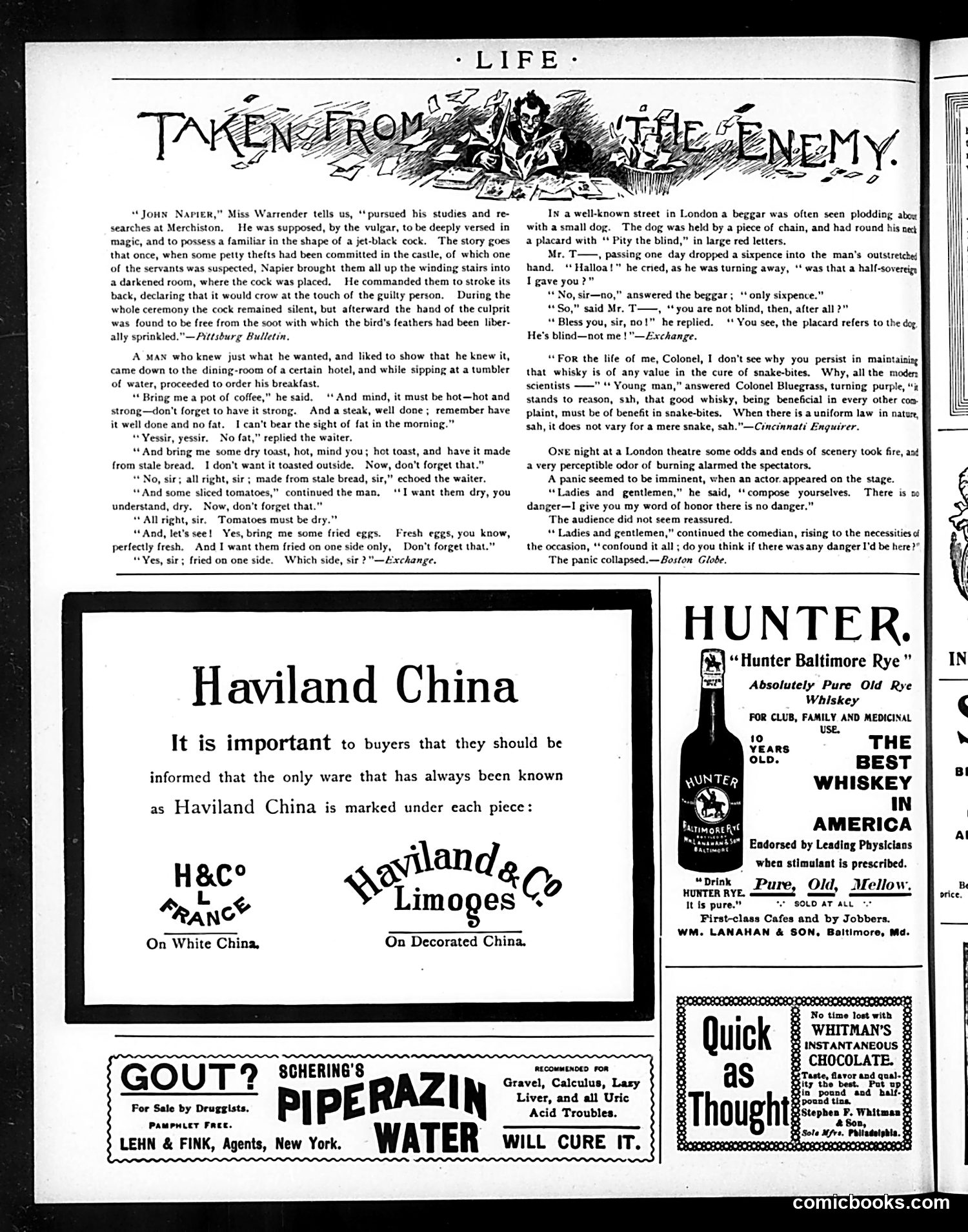
This Life magazine page presents humorous anecdotes rather than political cartoons. The title illustration shows a menacing figure, establishing a collection of ironic stories about deception and misplaced assumptions. The anecdotes mock human credulity and flawed logic: 1. **John Napier's magical cock**: A servant's guilt is revealed when soot doesn't transfer to his hand—he alone avoided touching the bird, exposing his innocence through reverse psychology. 2. **The "blind" beggar**: A donor assumes the beggar is blind until realizing the placard refers only to the dog, satirizing hasty charitable assumptions. 3. **The fastidious diner**: A man's obsessive breakfast specifications (hot coffee, dry toast, steak well-done, fresh fried eggs) represent pointless perfectionism. 4. **The theater panic**: A comedian calms an audience by claiming he wouldn't remain if danger existed—self-interest paradoxically reassures. 5. **The whisky debate**: A colonel defends whisky for snakebites through circular logic rather than evidence. The page also contains period advertisements for Haviland China, Piperazin Water, Hunter Whiskey, and Whittman's Chocolates—typical for the era.
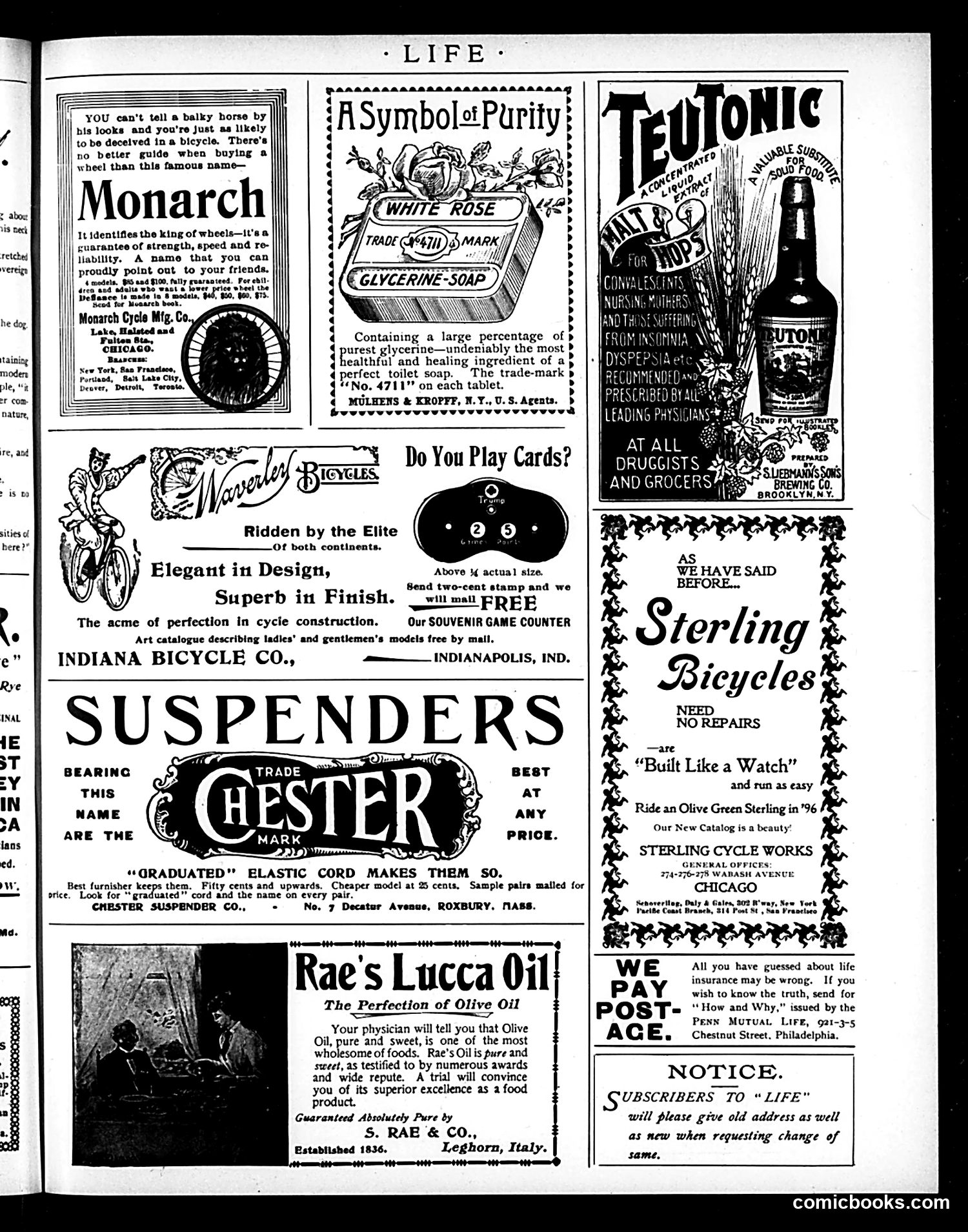
This page is primarily **advertising**, not political satire or editorial cartoons. It showcases consumer products from the 1890s-early 1900s era: **Notable advertisements include:** - **Monarch bicycles** — marketed as the "king of wheels," emphasizing reliability and strength - **White Rose glycerine soap** — positioning itself as a premium toilet product - **Teutonic tonic** — a patent medicine advertised for insomnia and nervousness, sold "at all druggists" - **Sterling and Indiana bicycles** — competing cycle manufacturers - **Chester suspenders** — highlighting their "graduated elastic cord" construction - **Rae's Lucca Oil** — imported Italian olive oil marketed as a food product The page reflects the era's commercial landscape: bicycles were wildly popular consumer goods, patent medicines made unregulated health claims, and imported products signaled quality and status. The advertisements use brand names, testimonials, and appeals to reliability rather than modern advertising techniques. A small **notice to Life subscribers** appears at bottom, requesting address changes.
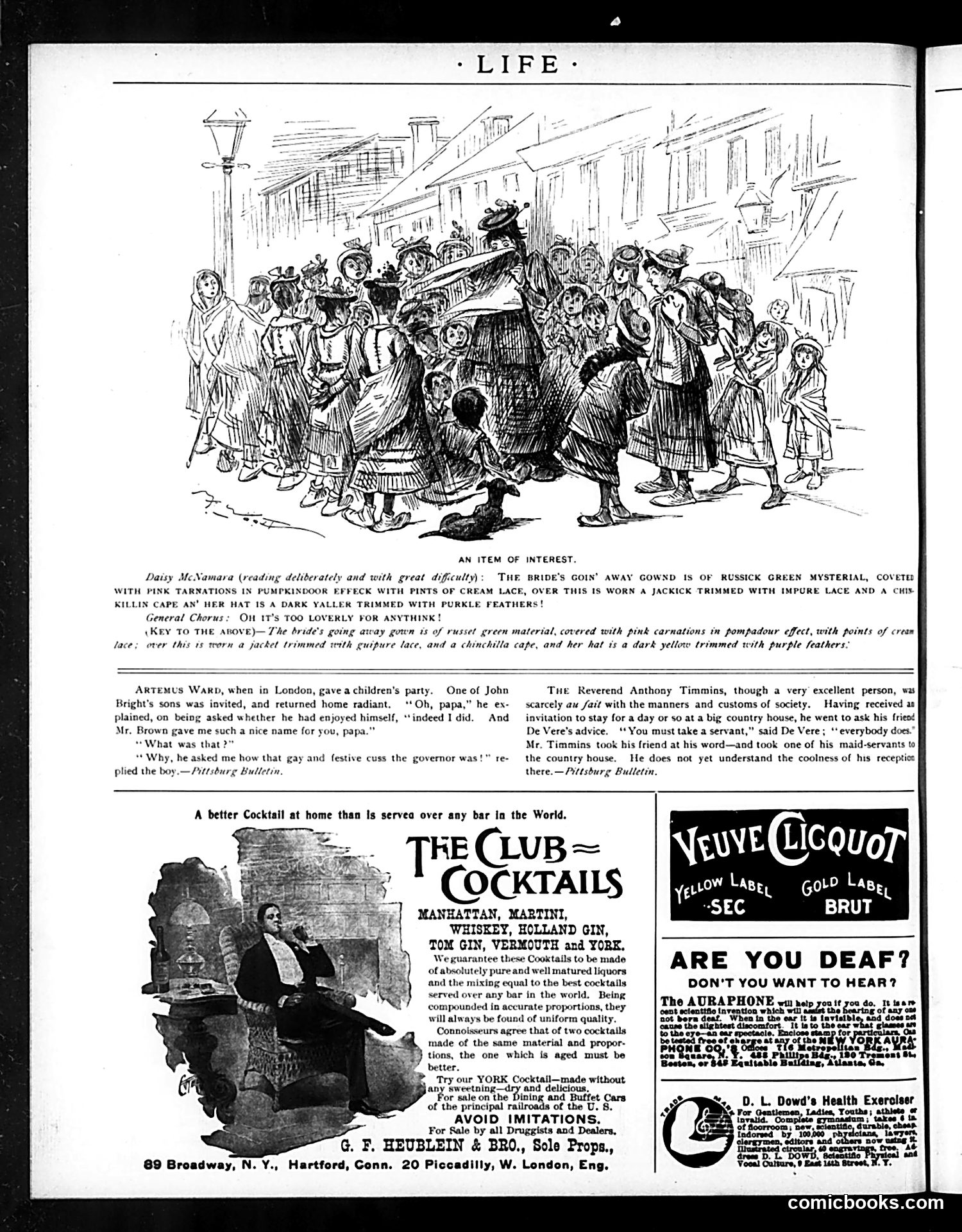
This page contains three humor pieces satirizing working-class speech and social pretension: 1. **"An Item of Interest"**: Daisy McNamara struggles to read aloud a description of a bride's wedding outfit, mangling sophisticated vocabulary ("russick green mysterial," "pints of cream lace," "purkle feathers"). The joke mocks lower-class attempts to discuss upper-class fashion using unfamiliar, pretentious language—the "key" below translates her malapropisms into correct terms. The chorus approves anyway, satirizing how people often admire things they don't understand. 2. **Artemus Ward anecdote**: A child calls the governor a "gay and festive cuss," amusing his father. Simple humor about childish frankness. 3. **Reverend Timmins story**: An inexperienced clergyman, advised to hire a servant for a country visit, brings a maid-servant—missing the social convention of hiring a *male* servant. He's then coldly received, satirizing both his naïveté and upper-class social codes. The page also contains period advertisements for cocktails and a hearing device, typical of *Life*'s mixed content format.
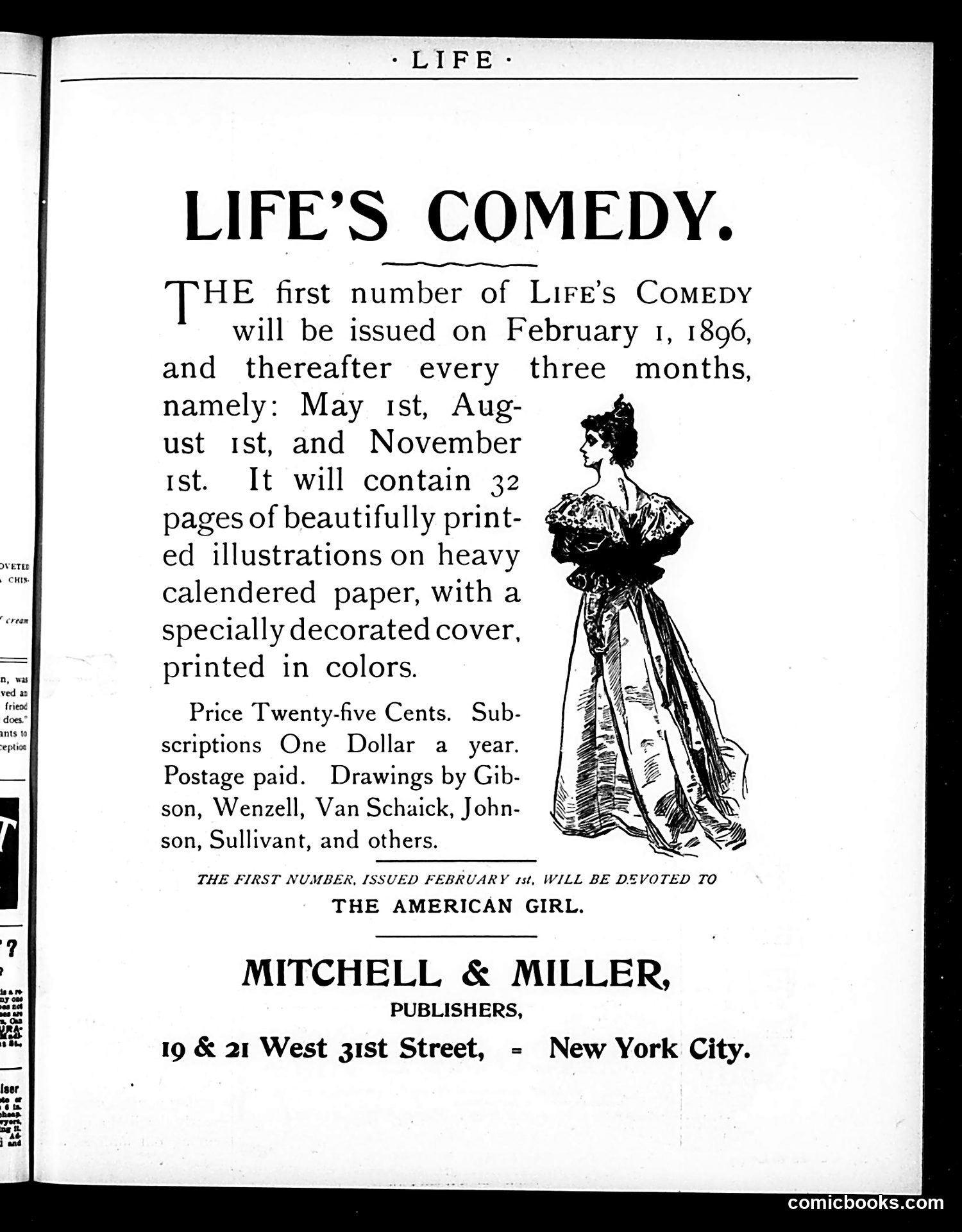
This is a publisher's advertisement for a new illustrated quarterly magazine launching February 1, 1896. The page announces *Life's Comedy*, a 32-page publication featuring drawings by prominent illustrators including Gibson (likely Charles Dana Gibson, famous for his "Gibson Girl" ideal), Wenzell, Van Schaick, Johnson, and Sullivant. The inaugural issue will focus on "The American Girl"—a significant cultural subject in 1890s America. The elegant illustration of a fashionable woman in period dress reflects the magazine's emphasis on depicting contemporary American femininity and social life. At 25 cents per issue ($1 annually), it targets middle-class readers. Mitchell & Miller, the New York publishers, positioned this as a competitor to the established *Life* magazine, capitalizing on late-Victorian interest in humor, social satire, and idealized representations of modern American womanhood.
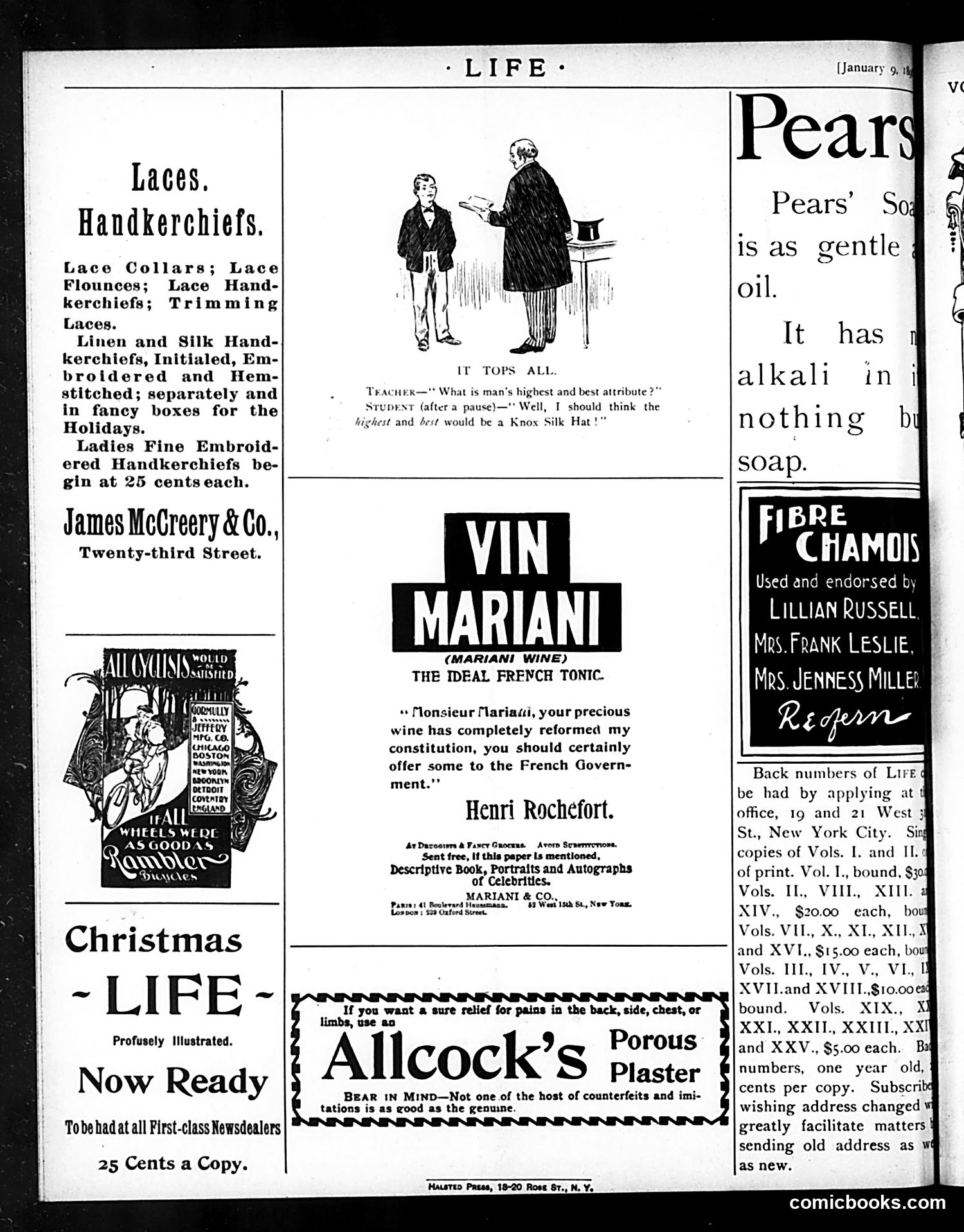
This small cartoon satirizes American vanity and materialism. A teacher asks a student about "man's highest and best attribute," expecting a serious moral answer. The student, after pausing to think, answers that it's a "Knox Silk Hat"—a premium men's hat brand. The joke mocks how superficial values have replaced genuine virtues in American society. Rather than naming intelligence, virtue, or character, the student reflexively identifies a luxury consumer product as humanity's greatest achievement. The title "It Tops All" works as a pun: the hat literally tops one's head while also being positioned as "topping" all other human qualities. This reflects turn-of-the-century satirical concern about commercialism and consumer culture displacing traditional moral education in American life.