
Life, 1896-01-09 · page 12 of 20
Life — January 9, 1896 — page 12: what you’re looking at
What you’re looking at
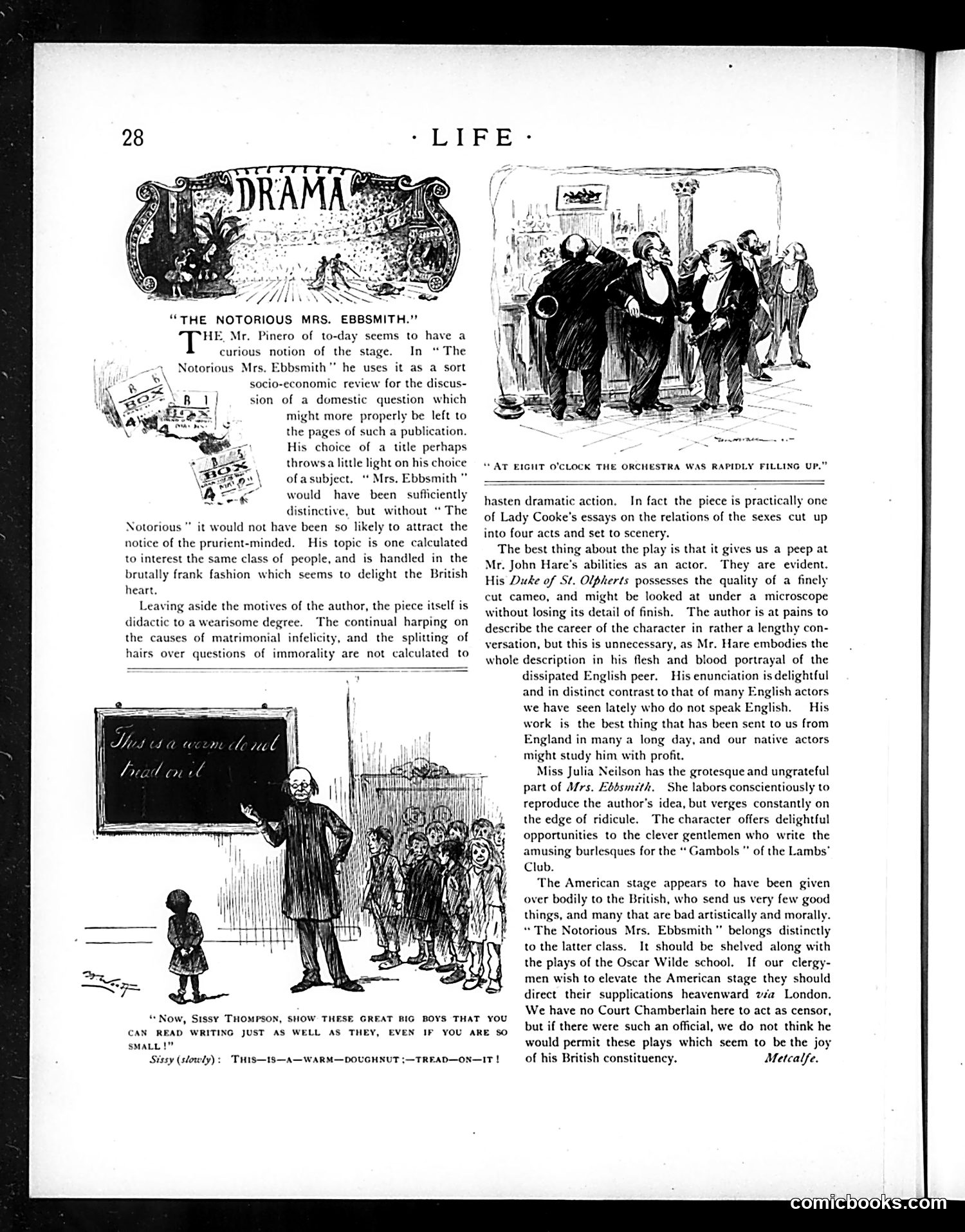
This page reviews a contemporary play by Arthur Wing Pinero about a woman of questionable morality. The critic (signed "Metcalfe") argues that Pinero uses sensationalism—the word "Notorious"—to attract prurient audiences rather than serve dramatic art. The play supposedly functions as a tedious essay on marital unhappiness rather than compelling theater. The review praises British actor John Hare's performance while criticizing American theater's wholesale adoption of British plays, particularly those influenced by Oscar Wilde's controversial aesthetic. The critic laments that America lacks a "Court Chamberlain" (British censorship board) to prevent morally questionable imports, suggesting such plays pander to base instincts rather than elevate the stage. The accompanying sketches appear to illustrate theatrical scenes, including what seems to be a schoolroom lesson, reinforcing the didactic, preachy nature the reviewer criticizes.
📄 Transcribed text from this page (OCR, searchable)
Machine-transcribed from the original scan — historical spelling and the odd misread are preserved.
COMIN “THE NOTORIOUS MRS. EBBSMITH.” HE, Mr. Pinero of to-day seems to have a curious notion of the . In “The Notorious Mrs. Ebbsmith"’ he uses it as a sort socio-economic review for the discus- sion of a domestic question which might more properly be left to the pages of such a publication. His choice of a title perhaps throwsa little light on his choice ofasubject. “ Mrs, Ebbsmith ” would have been sufficiently distinctive, but without “* The Notorious " it would not have been so likely to attract the notice of the prurient-minded. His topic is one calculated to interest the same class of people, and is handled in the brutally frank fashion which seems to delight the British heart. Leaving aside the motives of the author, the piece itself is didactic to a wearisome degree. The continual harping on the causes of matrimonial infelicity, and the splitting of hairs over questions of immorality are not calculated to “ Now, Sissy THOMPSON, SHOW THESE GREAT BIG BOYS THAT YOU EVEN IF YOU ARE SO CAN READ WRITING JUST AS WELL AS THEY, SMALL!” Sissy (slowly) : THIS—1s—A—WARM—DOUGHNUT ;—TREAD—ON—IT ! “AT EIGHT O'CLOCK THE ORCHESTRA WAS RAPIDLY FILLING UP.” hasten dramatic action. In fact the piece is practically one of Lady Cooke's essays on the relations of the sexes cut up into four acts and set to scenery. The best thing about the play is that it gives us a peep at Mr. John Hare's abilities as an actor. They are evident. His Duke of St. Olpherts possesses the quality of a finely cut cameo, and might be looked at under a microscope without losing its detail of finish. The author is at pains to describe the career of the character in rather a lengthy con- versation, but this is unnecessary, as Mr. Hare embodies the whole description in his flesh and blood portrayal of the dissipated English peer. His enunciation is delightful and in distinct contrast to that of many English actors we have seen lately who do not speak English. His work is the best thing that has been sent to us from England in many a long day, and our native actors might study him with profit. Miss Julia Neilson has the grotesque and ungrateful part of Mfrs. Ebbssmith. She labors conscientiously to reproduce the author's idea, but verges constantly on the edge of ridicule. The character offers delightful opportunities to the clever gentlemen who write the amusing burlesques for the “ Gambols " of the Lambs’ Club. The American stage appears to have been given over bodily to the British, who send us very few good things, and many that are bad artistically and morally. “The Notorious Mrs. Ebbsmith" belongs distinctly to the latter class. It should be shelved along with the plays of the Oscar Wilde school. If our clergy- men wish to elevate the American stage they should direct their supplications heavenward va London. We have no Court Chamberlain here to act as censor, but if there were such an official, we do not think he would permit these plays which seem to be the joy of his British constituency. Metcalfe.