
Life, 1896-01-09 · page 7 of 20
Life — January 9, 1896 — page 7: what you’re looking at
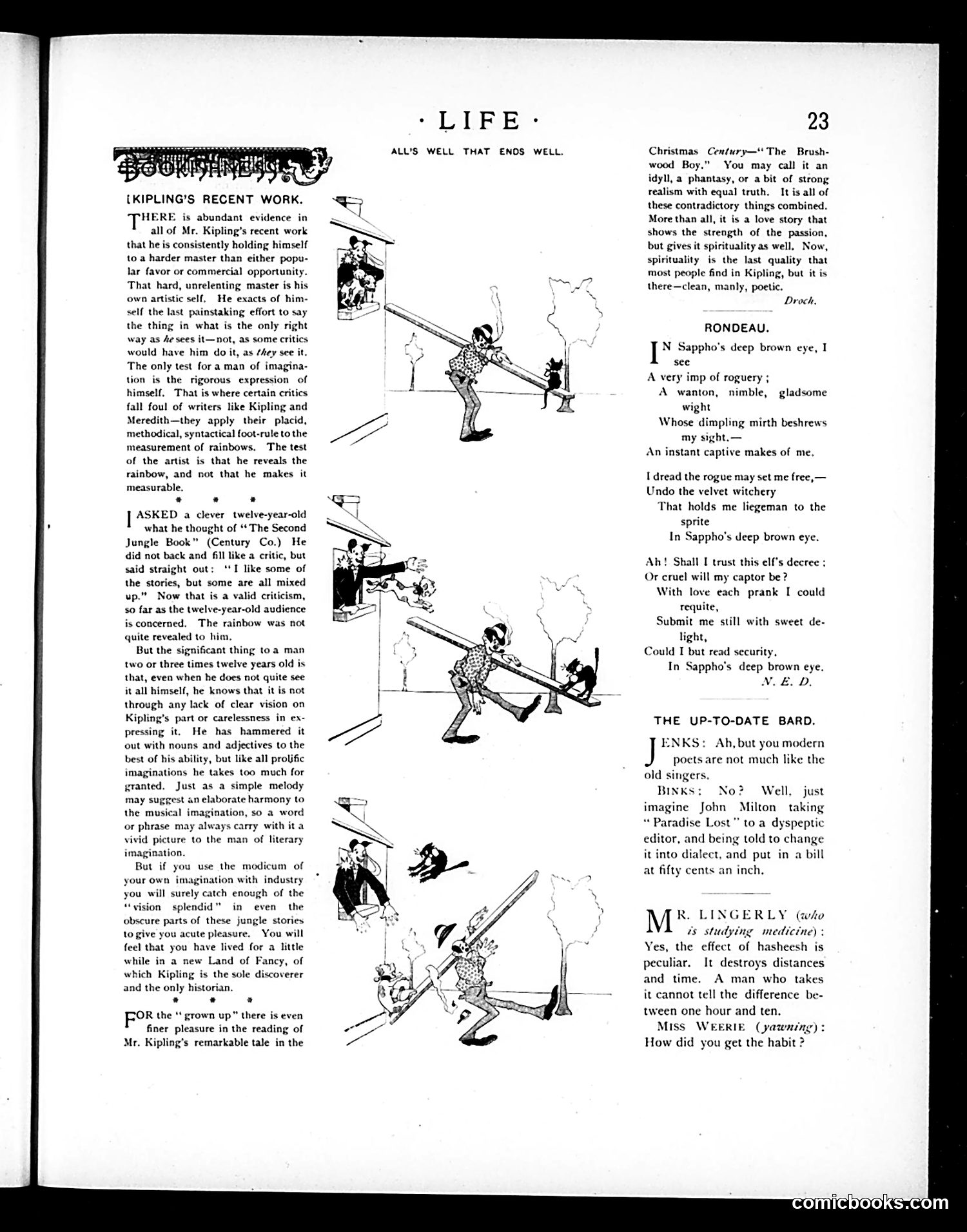
What you’re looking at
This page contains literary and cultural commentary rather than political cartoons. The main sections are: **"Kipling's Recent Work"** — A serious critique of Rudyard Kipling's artistic integrity, arguing he holds himself to a higher standard than commercial pressures demand. It defends his work against critics who find it contradictory, praising his "clean, manly, poetic" spirituality. **"Rondeau"** — A romantic poem about a woman named Sapho with a "deep brown eye," expressing the speaker's captivation and uncertainty about her feelings. **"The Up-to-Date Bard"** — A brief humorous dialogue mocking modern poets as inferior to classics like John Milton, with a joke about selling "Paradise Lost" to a cheap editor who'd alter it for profit. The left side contains whimsical illustrations of children engaged in various physical activities (skiing, sledding, etc.), likely accompanying a separate story or feature.
📄 Transcribed text from this page (OCR, searchable)
Machine-transcribed from the original scan — historical spelling and the odd misread are preserved.
UKIPLING’S RECENT WORK. HERE is abundant evidence in all of Mr. Kipling’s recent work that he is consistently holding himself toa harder master than either popu- lar favor or commercial opportunity. That hard, unrelenting master is his own artistic self, He exacts of him- self the last painstaking effort to say the thing in what is the only right way as he sees it—not, as some critics would have him do it, as shey see it. The only test for a man of imagina- tion is the rigorous expression of himself. That is where certain critics fall foul of writers like Kipling and Meredith—they apply their placid, methodical, syntactical foot-rule to the measurement of rainbows. The test of the artist is that he reveals the rainbow, and not that he makes it measurable. * * * [ASKED a clever twelve-year-old what he thought of ‘The Second Jungle Book” (Century Co.) He did not back and fill like a critic, but said straight out: ‘I like some of the stories, but some are all mixed up.” Now that is a valid criticism, ‘so far as the twelve-year-old audience is concerned. The rainbow was not quite revealed to him, But the significant thing toa man two or three times twelve years old is that, even when he does not quite see it all himself, he knows that it is not through any lack of clear vision on Kipling’s part or carelessness in ex- pressing it. He has hammered it out with nouns and adjectives to the best of his ability, but like all prolific imaginations he takes too much for granted. Just as a simple melody may suggest an elaborate harmony to the musical imagination, so a word or phrase may always carry with ita vivid picture to the man of literary imagination. But if you use the modicum of your own imagination with industry you will surely catch enough of the “vision splendid" in even the obscure parts of these jungle stories togive you acute pleasure. You will feel that you have lived for a little while in a new Land of Fancy, of ling is the sole discoverer and the only historian. * * * R the * grown up” there is even finer pleasure in the reading of Mr. Kipling’s remarkable tale in the * LIFE: ALL'S WELL THAT ENOS WELL. eS 23 Christmas Century—“ The Brush- wood Boy.” You may call it an idyll, a phantasy, or a bit of strong realism with equal truth. It is all of these contradictory things combined. More than all, it is a love story that shows the strength of the passion, but gives it spirituality as well, Now, spirituality is the last quality that most people find in Kipling, but it is there—clean, manly, poetic. Droch. RONDEAU. N Sappho’s deep brown eye, I see A very imp of roguery ; A wanton, nimble, gladsome wight Whose dimpling mirth beshrews my sight,— An instant captive makes of me, I dread the rogue may set me free,— Undo the velvet witchery That holds me liegeman to the sprite In Sappho's deep brown eye. Ah! Shall I trust this elf's decree ; Or cruel will my captor be? With love each prank I could requite, Submit me still with sweet de- light, Could I but read security, In Sappho's deep brown eye. NIE. D. THE UP-TO-DATE BARD. ENKS: Ah, but you modern J poets are not much like the old singers. Binks: No? Well, just imagine John Milton taking “ Paradise Lost” toa dyspeptic editor, and being told to change it into dialect, and put in a bill at fifty cents an inch, R. LINGERLY (who ts studying medicine): Yes, the effect of hasheesh is peculiar. It destroys distances and time. A man who takes it cannot tell the difference be- tween one hour and ten. MIss WEERIE (yawning): How did you get the habit ?