
A complete issue · 14 pages · 1895
Life — August 1, 1895
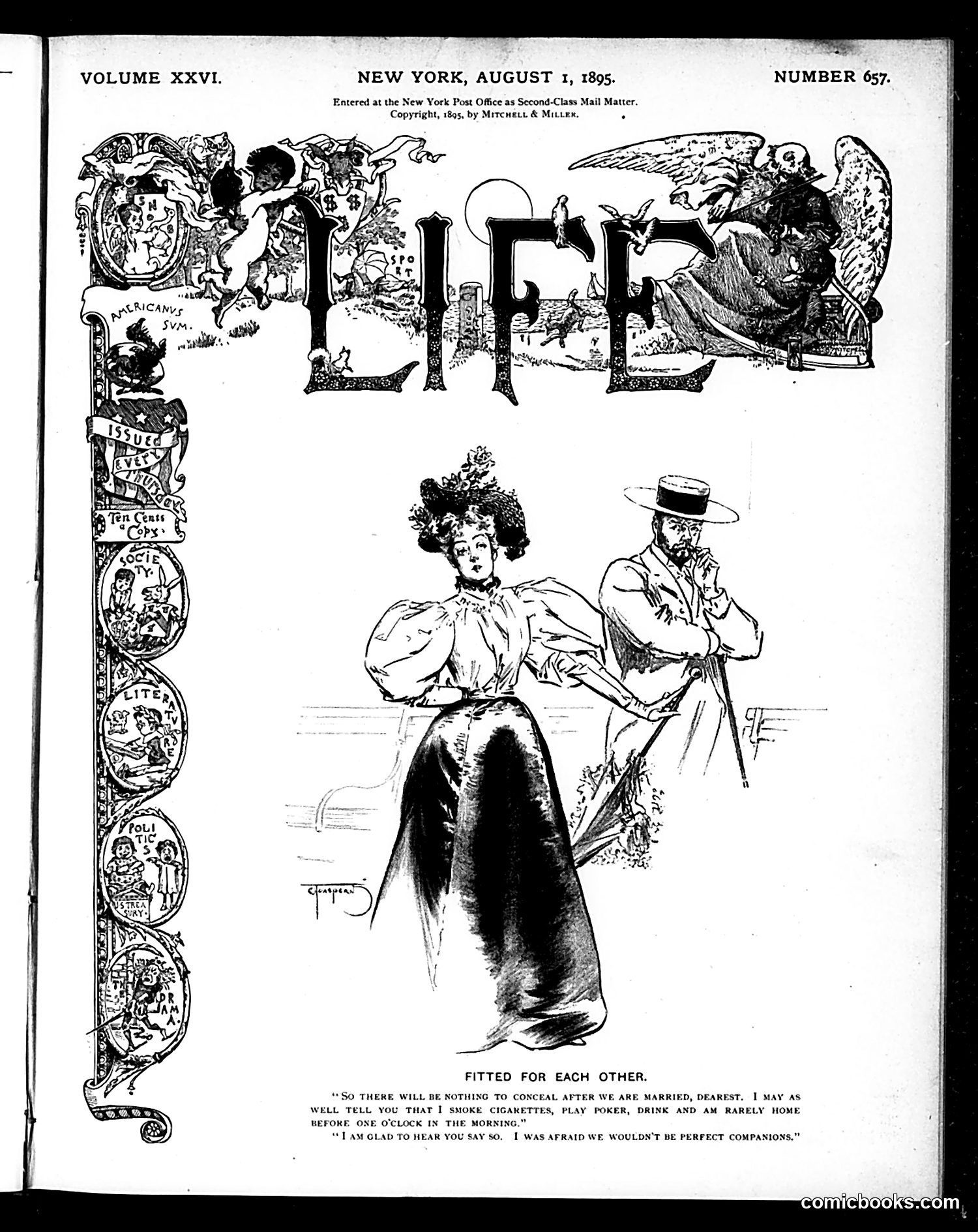
This satirical page titled "Fitted for Each Other" depicts a couple contemplating marriage. The woman appears fashionably dressed in 1890s style, while the man wears a straw hat and casual attire. The satire mocks pre-marital anxieties about compatibility. The man's quote reveals his concerns about post-marriage restrictions: he wants to continue smoking cigarettes, playing poker, drinking, and staying out late—activities he assumes marriage will prohibit. The woman's response—"I am glad to hear you say so. I was afraid we wouldn't be perfect companions"—suggests she approves of these habits, making them apparently "fitted" for each other. This reflects turn-of-the-century anxieties about marital roles and the "New Woman" of the 1890s, who challenged traditional domestic expectations.
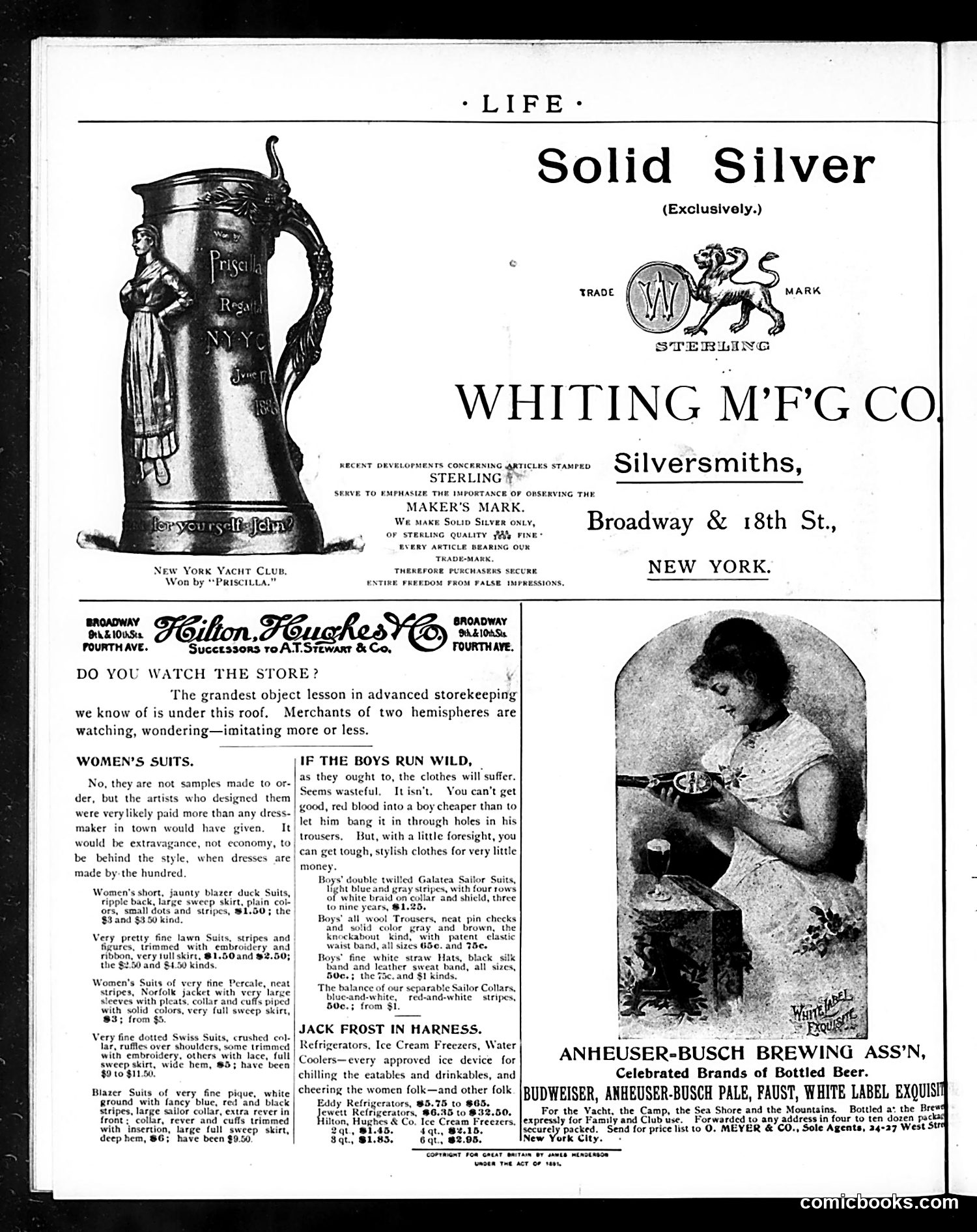
This page is predominantly **advertising rather than satire or editorial content**. The main visual elements are: 1. **Upper left**: A decorative silver pitcher/stein from the New York Yacht Club, advertising Whiting M'fg Co.'s sterling silver goods. 2. **Lower right**: A photograph of a young child with what appears to be a dog, advertising Anheuser-Busch beer. The text sections discuss women's fashion suits and boys' clothing in straightforward product descriptions, along with advertisements for ice cream freezers and refrigerators. There is **no apparent political satire or social commentary** visible. The page represents typical early 20th-century magazine advertising mixed with general merchandise information, with no identifiable caricatures or satirical intent.
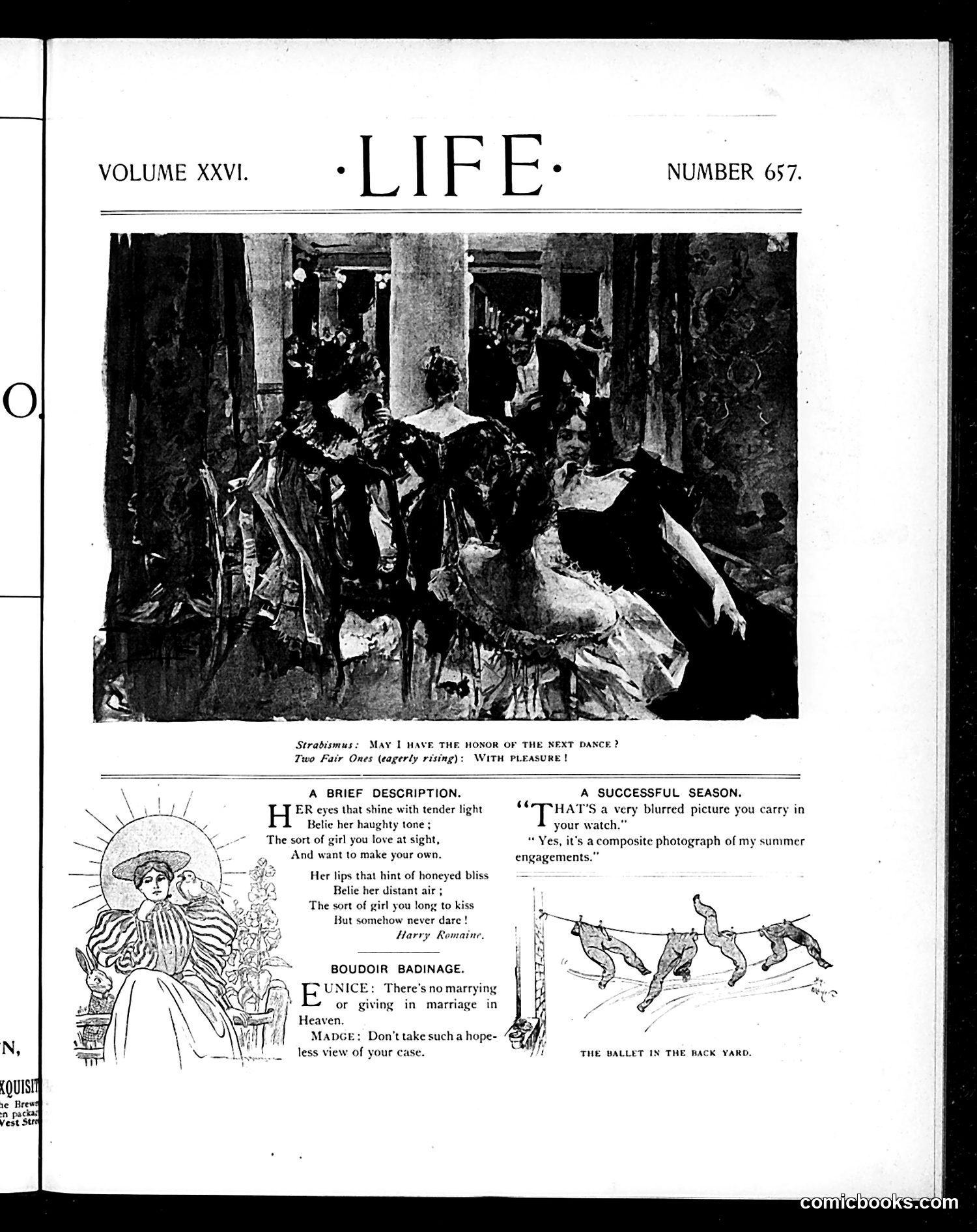
This page contains light social humor rather than political satire. The main image shows an elegant ballroom scene with couples dancing. The caption quotes "Stradamus" making a playful pun about requesting the "next dance." Below are three brief comedic pieces: **"A Brief Description"** — A poem by Harry Romaine describing an idealized young woman with romantic imagery (halo, flowers). **"Boudoir Badinage"** — A dialogue between characters named Eunice and Madge debating marriage prospects, suggesting marital skepticism was fashionable humor of the era. **"A Successful Season"** — References a composite photograph of summer engagements, with an illustration of dogs running in a yard as visual comedy. The page is primarily **social/romantic humor** targeting upper-class leisure activities, not political commentary.
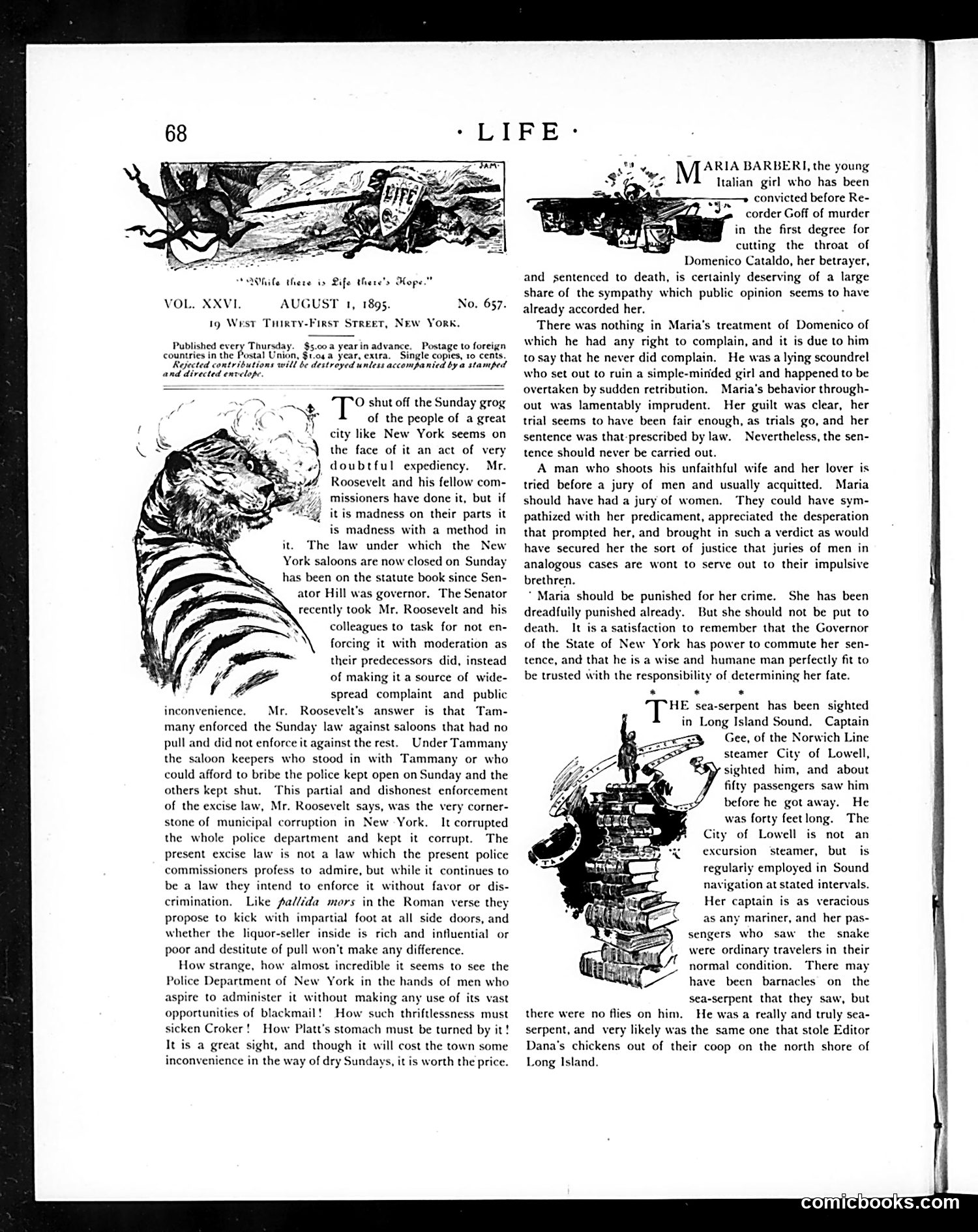
The left illustration depicts a tiger labeled "Tammany," referencing the corrupt Democratic political machine that controlled New York City. This is accompanying an editorial criticizing Police Commissioner Roosevelt's selective enforcement of Sunday saloon-closing laws. The satire argues that Roosevelt's partial enforcement against Tammany-aligned saloons while ignoring others is hypocritical and perpetuates police corruption. The tiger represents the predatory nature of Tammany Hall itself—suggesting the organization remains dangerous despite superficial reforms. The right column discusses an unrelated murder case of Maria Barberi and a sea serpent sighting, typical of Life's miscellaneous content mix. The overall critique suggests Roosevelt's reforms are insufficient window-dressing on a fundamentally corrupt system.
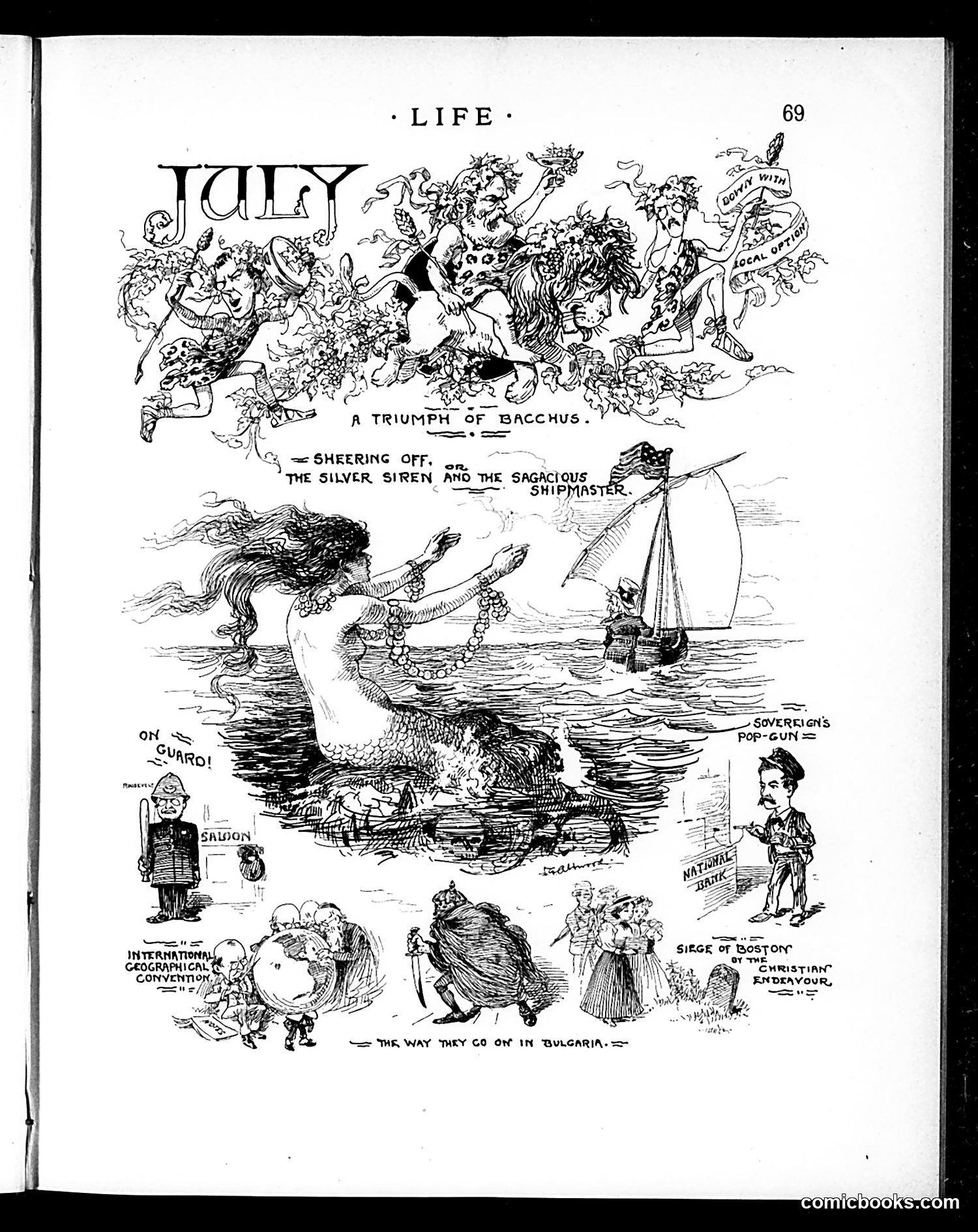
This page contains multiple July-themed political cartoons. The top illustration, "A Triumph of Bacchus," depicts a chaotic bacchanal—classical revelers with wine and grapes—likely satirizing excessive celebration or drunkenness during July festivities. Below are smaller vignettes addressing contemporary political issues: - "Sheering Off: The Silver Siren and the Sagacious Shipmaster" appears to reference naval or diplomatic matters - References to "International Geographical Convention," "Bulgaria," and "Christian Endeavour" suggest commentary on geopolitical conflicts or religious/organizational matters of the period - Caricatured figures labeled include a "Sovereign's Pop-Gun" and "National Bark," using maritime/naval metaphors for political power The cartoons employ visual puns and exaggerated characterization typical of early 20th-century American political satire, though specific historical events require additional context to fully decode.
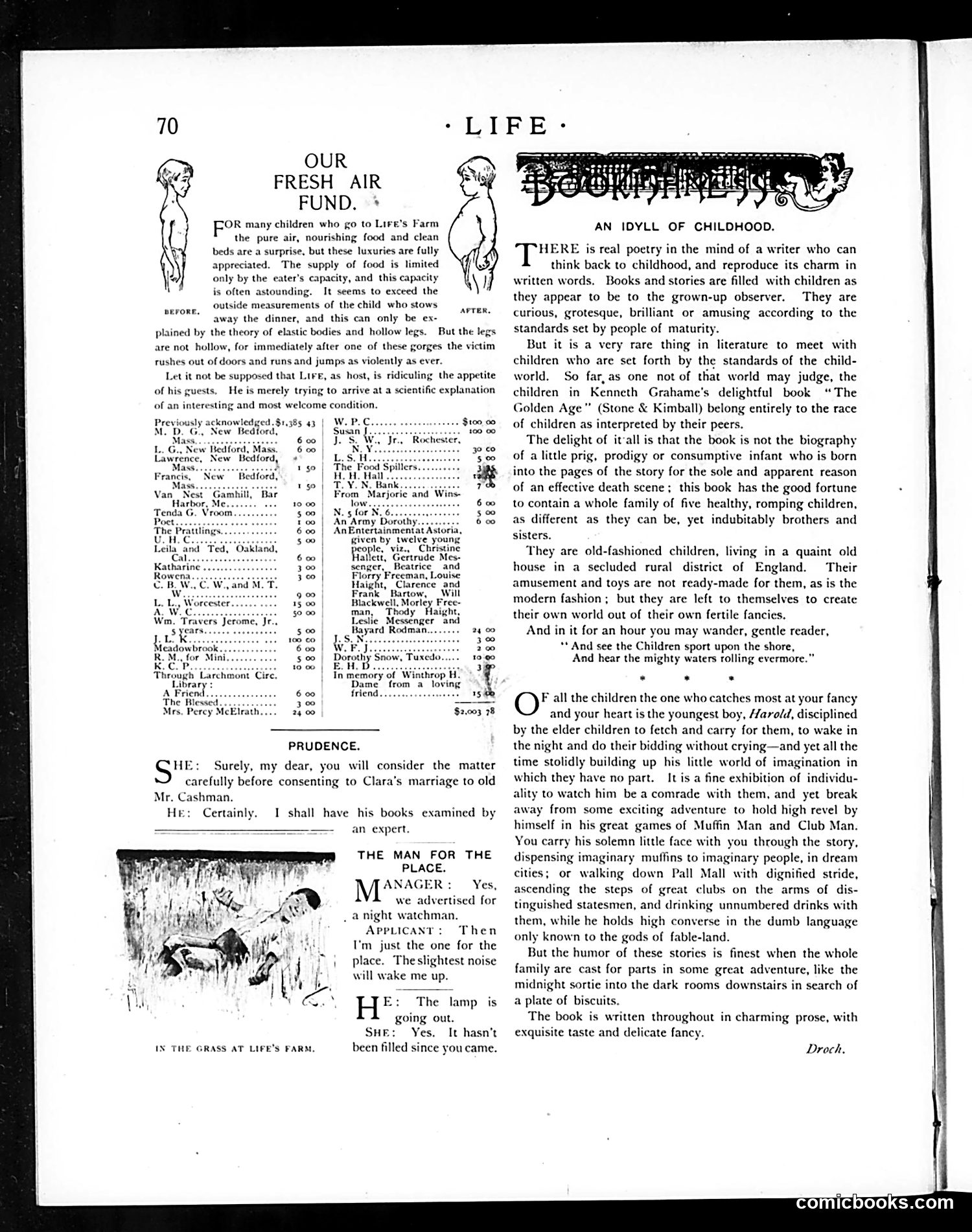
This page contains **three distinct sections**: a charitable fundraising appeal ("Our Fresh Air Fund"), a literary review of Kenneth Grahame's "The Golden Age," and two satirical dialogue pieces ("Prudence" and "The Man for the Place"). The cartoons are **brief comic dialogues** rather than visual political satire. "Prudence" presents a conversation between a woman and man debating marriage to an older gentleman (Mr. Cashman), apparently satirizing mercenary marriage calculations. "The Man for the Place" depicts a hiring exchange between a manager and applicant, mocking workplace hiring practices. The accompanying illustrations show simple line drawings of domestic/social scenes rather than caricatures of specific political figures. The humor derives from dialogue and situation rather than visual exaggeration or topical political reference.
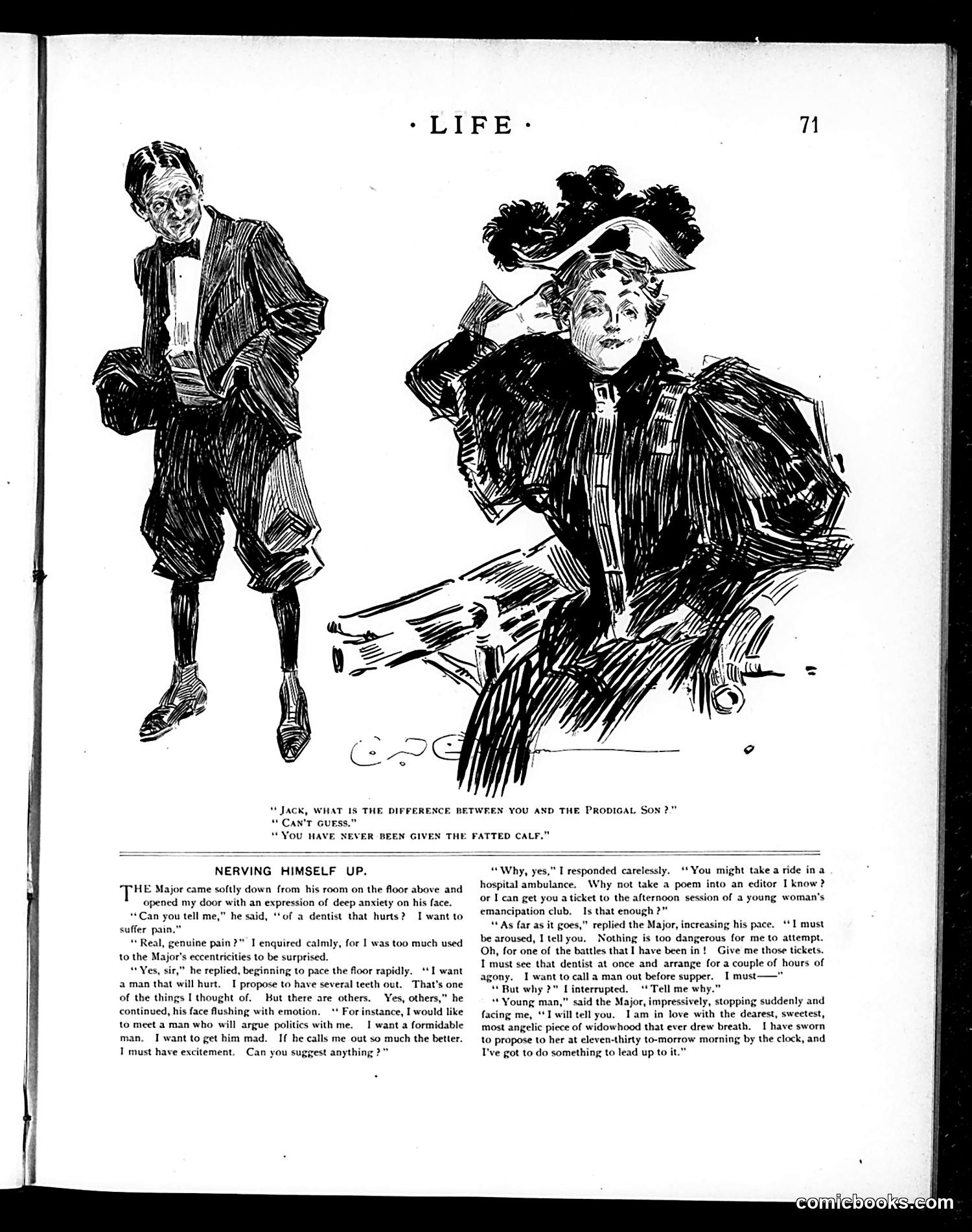
This page contains a satirical sketch and accompanying story titled "Nerving Himself Up." The illustration shows two figures: a man in formal attire (pinstriped suit and bow tie) standing nervously, and a woman seated wearing an elaborate hat with feathers and a fur-collared coat. The narrative describes the man's anxious attempt to propose marriage. He seeks advice on how to approach the woman, wanting to "meet a man who will argue politics with me" and desiring "a formidable man." The humor derives from the man's evident nervousness about proposing to this apparently fashionable, strong-willed woman—a reversal of typical gender dynamics of the era. The satire mocks both masculine anxiety about courtship and the emerging "modern woman" figure of early 20th-century society.
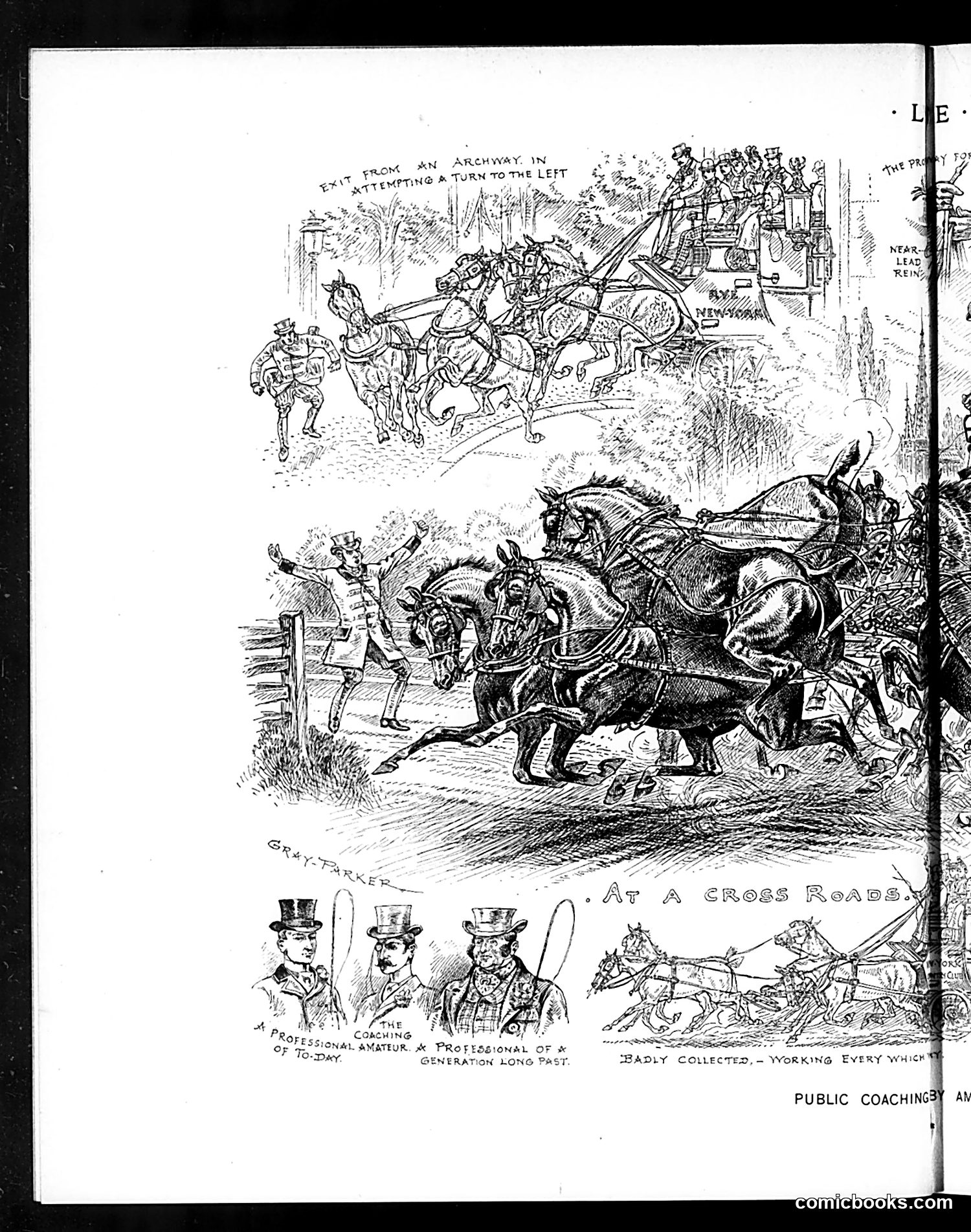
This satirical illustration by Craytarker depicts a collision between old and new transportation methods. The upper scene shows a modern motorcar (labeled "NEW YORK") colliding with a horse-drawn coach at a crossroads, with passengers tumbling dramatically. Below, three well-dressed gentlemen in top hats represent "the professional amateur & profiteer of a generation long past"—likely mocking outdated coaching enthusiasts or those clinging to obsolete traditions. The caption "Badly Collected—Working Every Which" suggests chaotic disorder. The satire critiques the clash between modernization and those resistant to change, portraying the old guard as ridiculous obstacles to progress. The automobile represents contemporary advancement, while traditional coaching represents a fading era defended by stubborn traditionalists.
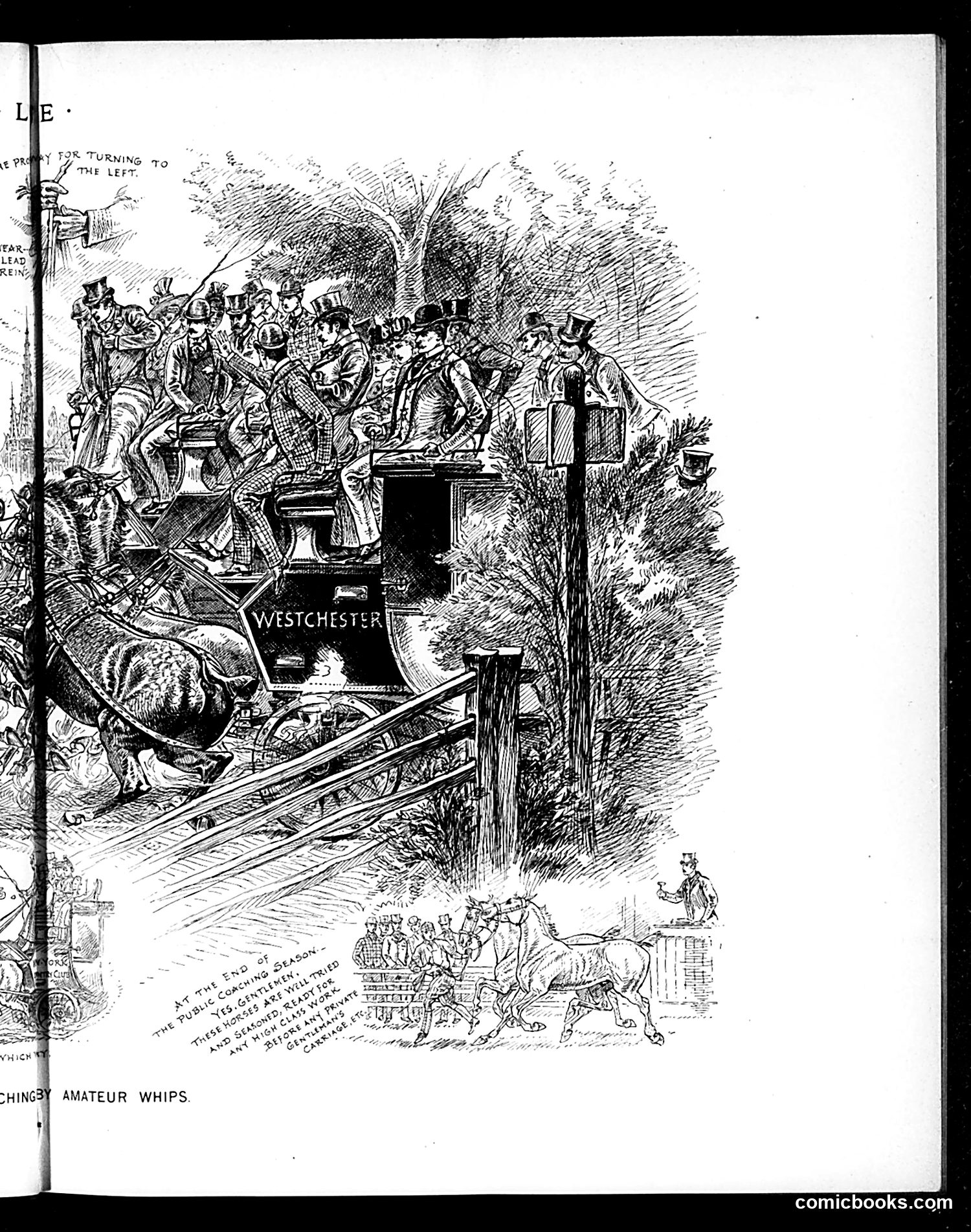
This satirical cartoon depicts a crowded railway scene labeled "Westchester" with well-dressed Victorian-era gentlemen aboard what appears to be a train or carriage. The upper portion shows gentlemen in top hats gathered together in apparent chaos or confusion. The title "Amateur Whips" suggests satire about inexperienced or incompetent leadership—likely referencing amateur politicians or administrators attempting to "drive" (control) public matters, much as one would control a horse-drawn vehicle with a whip. The lower portion shows a horse-drawn carriage with passengers, suggesting incompetent driving or management. The overall joke appears to mock wealthy, upper-class men attempting to manage public affairs without proper expertise, resulting in disorderly chaos. The specific historical or political context remains unclear without additional publication details.
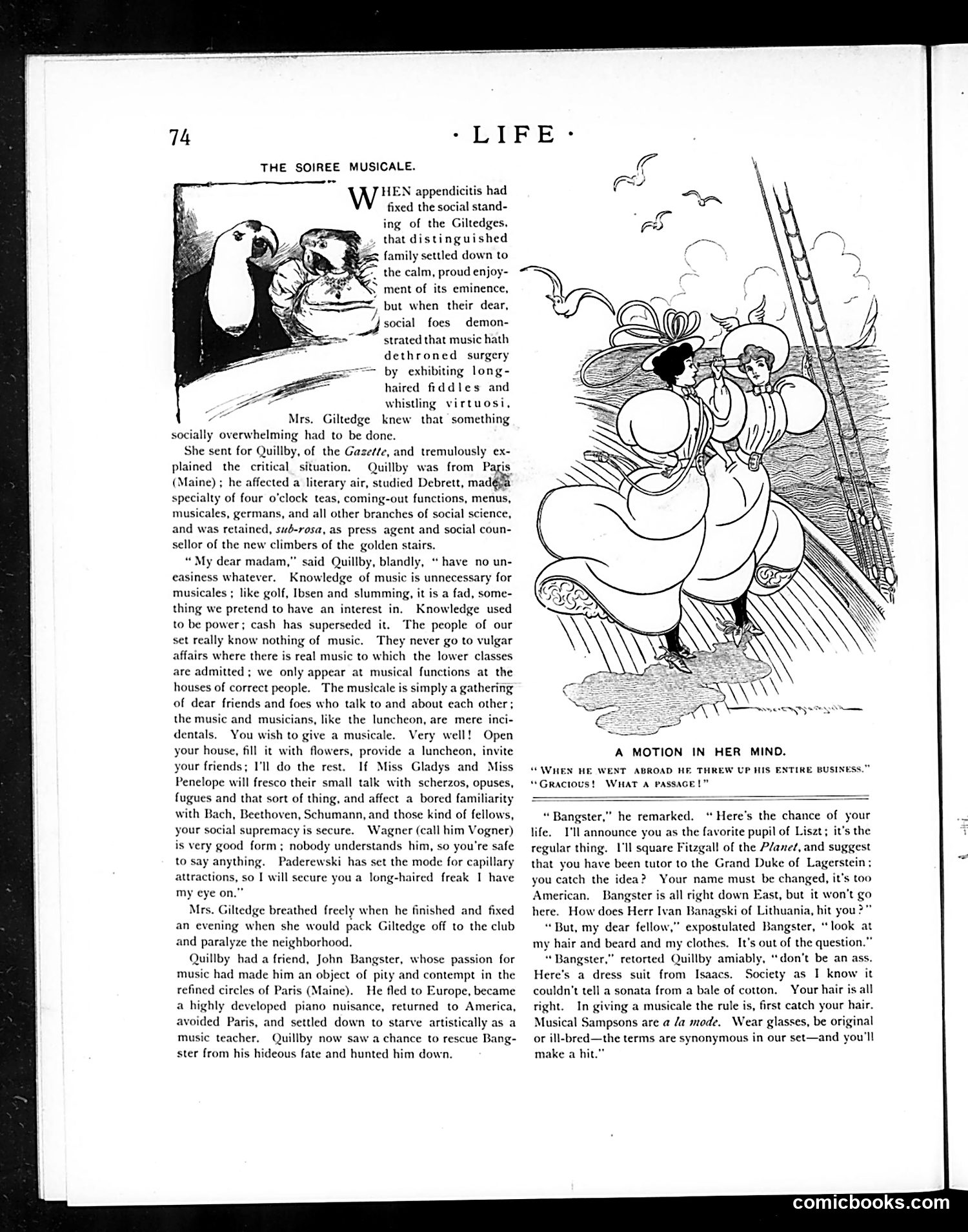
This page satirizes upper-class American pretension about classical music and culture. The text mocks the Giltedge family's social climbing through hosting a musical evening, featuring a character named Quillby from Paris (Maine) who pompously lectures about music's necessity for refined society. The right-hand illustration, titled "A Motion in Her Mind," depicts a woman in an absurdly oversized dress at what appears to be a social gathering. The satire targets the contradiction between elaborate, uncomfortable fashion and claims of cultural sophistication. The overall joke: wealthy Americans frantically adopt European musical traditions and uncomfortable fashions to appear cultured, while the reality is merely social pretension masking emptiness. Quillby's cynical commentary exposes how "musicales" are just gatherings where the fashionable display themselves.
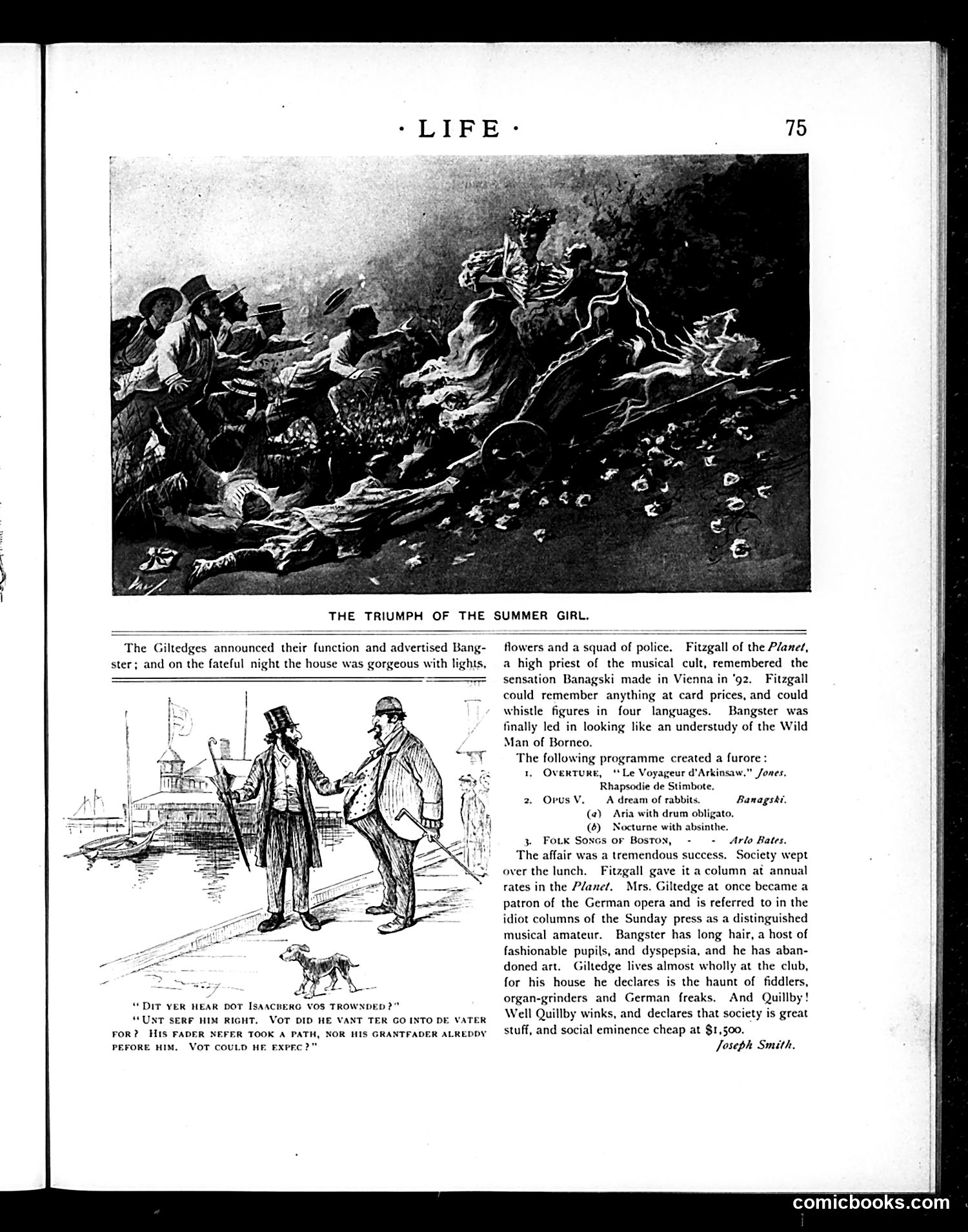
This page satirizes high-society opera culture and fashionable pretension. The top illustration depicts skeletal Death figures attending an opera—a visual joke suggesting that boring, pretentious operatic performances are literally deadly. The bottom cartoon shows two well-dressed gentlemen (appearing to be opera patrons or impresarios) with German captions in mock-formal dialect, likely mocking affected European cultural snobbery. The accompanying article references a scandal involving an opera called "Le Voyage d'Orphée" and a character named Bangster, performed in Vienna in 1892. It criticizes the pretentious Giltedge family, who use high culture as social status signaling while the article suggests their circle is filled with frauds and poseurs claiming sophistication they lack. The satire targets wealthy Americans' obsessive mimicry of European cultural authority.
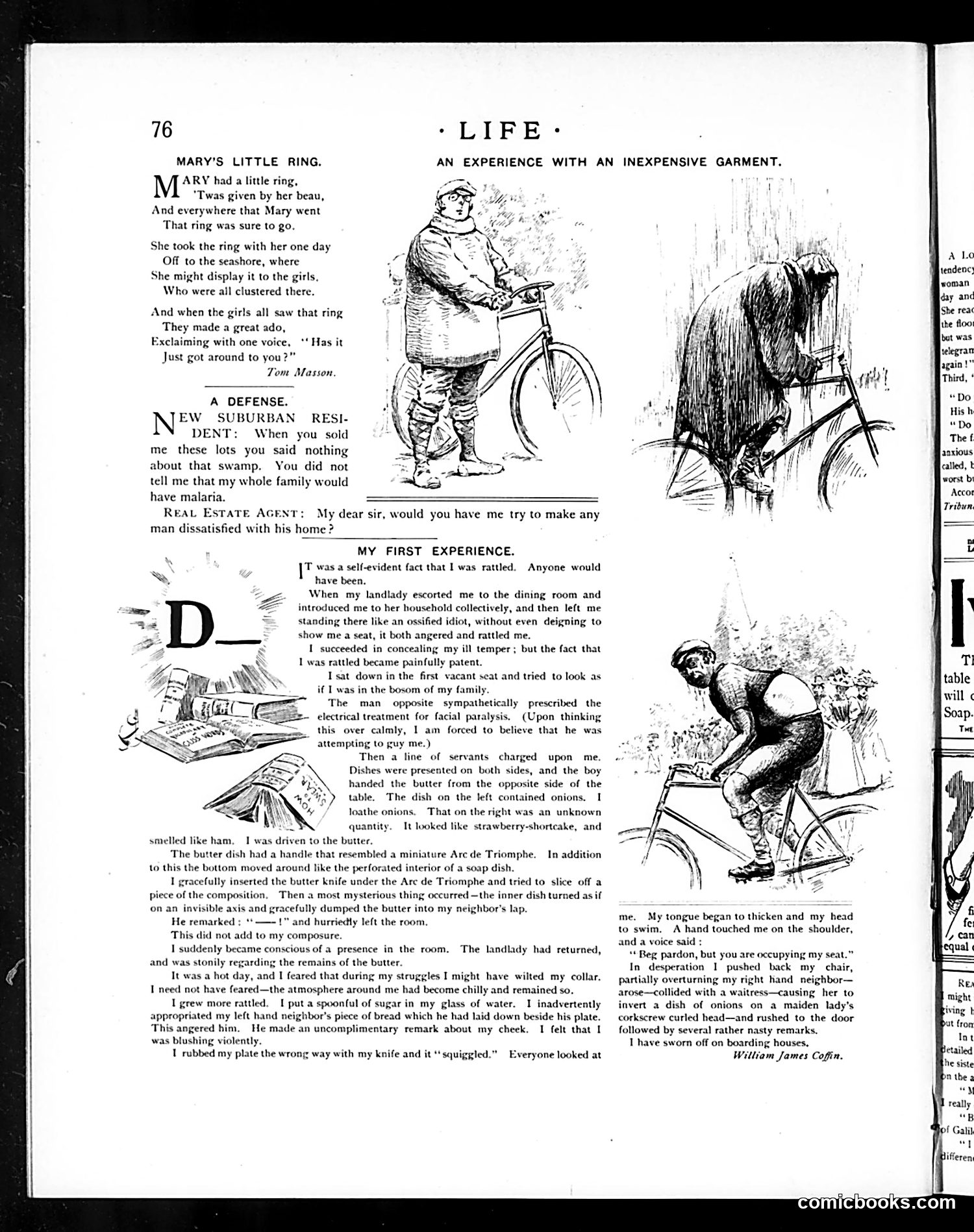
This page contains three satirical pieces from *Life* magazine: **"Mary's Little Ring"**: A brief, lighthearted poem about a woman proudly displaying an engagement ring to friends at the seashore—poking fun at the social attention such displays generate. **"A Defense"**: A real estate agent dismisses a customer's complaint about buying swampy land that caused malaria, suggesting the agent bears no responsibility for undisclosed property defects. The satire targets dishonest real estate practices. **"My First Experience"**: A humorous first-person account of a boardinghouse dining disaster. The narrator is so nervous meeting strangers that he commits a series of embarrassing social blunders—using wrong utensils, accidentally taking someone else's bread, flipping butter onto a neighbor's lap, and creating chaos with onions. The piece satirizes both awkward social anxiety and the rigid etiquette rules of the era. All three pieces target class-conscious social pretensions and emerging consumer anxieties of early 20th-century American life.
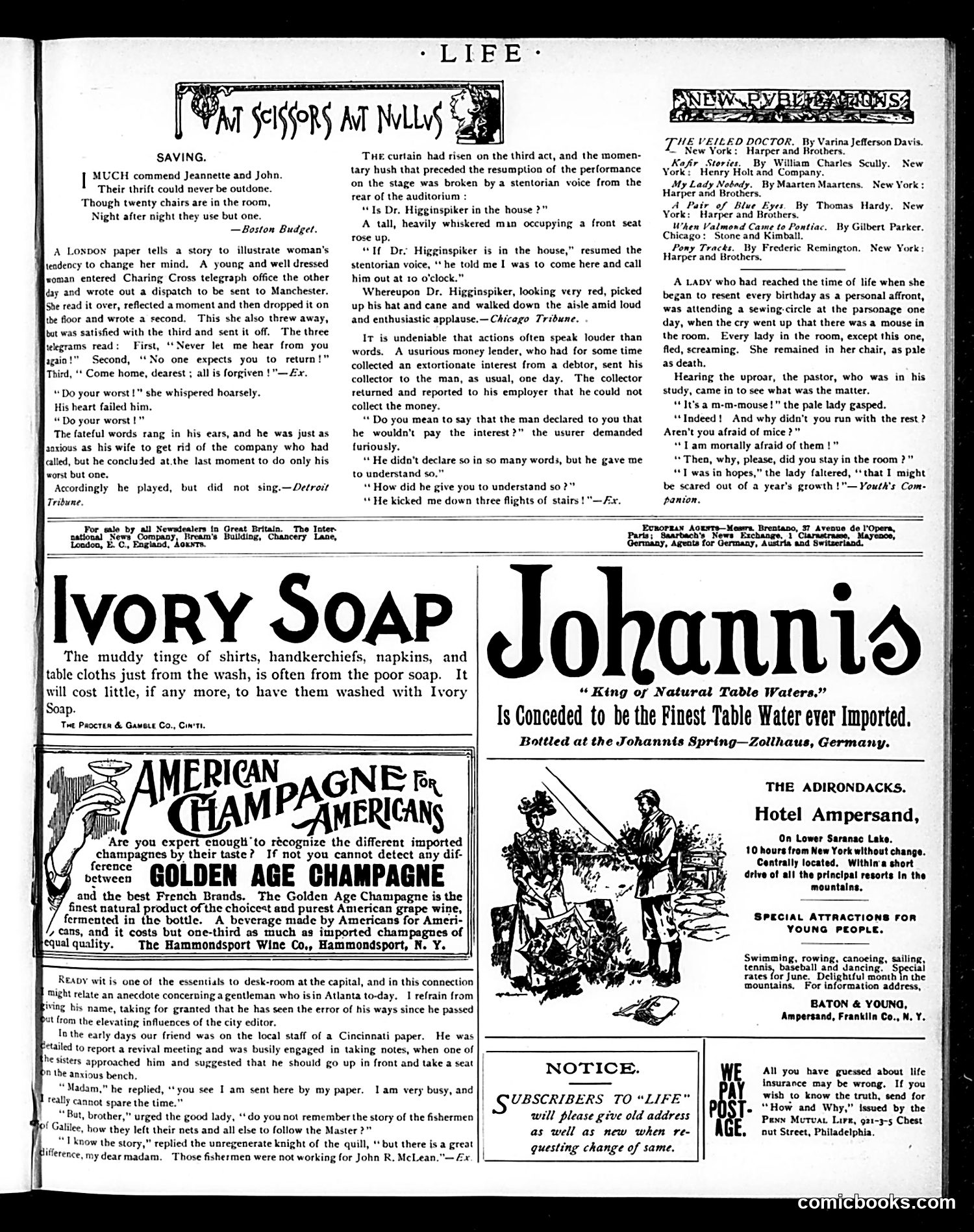
This page contains **brief humorous anecdotes** rather than political cartoons. The jokes illustrate Victorian-era attitudes and social conventions: 1. **"Saving"** mocks thrift obsession: a couple uses only one chair nightly to save wear. 2. **Woman's indecision**: A woman sends three contradictory telegrams (rejecting, then welcoming back a lover), satirizing female fickleness—a common stereotype of the period. 3. **"Do your worst"**: A husband deliberately plays poorly (but not his absolute worst) at music, showing ironic restraint. 4. **Doctor interruption**: A man loudly summons Dr. Higginspiker from a theater audience, disrupting the performance—comedy from public rudeness. 5. **"Mouse in the room"**: A woman stays seated during a mouse scare, hoping fright will make her "lose a year's growth" (stop aging)—satirizing women's vanity about appearance. The page is primarily **advertising and book reviews**, not political satire.
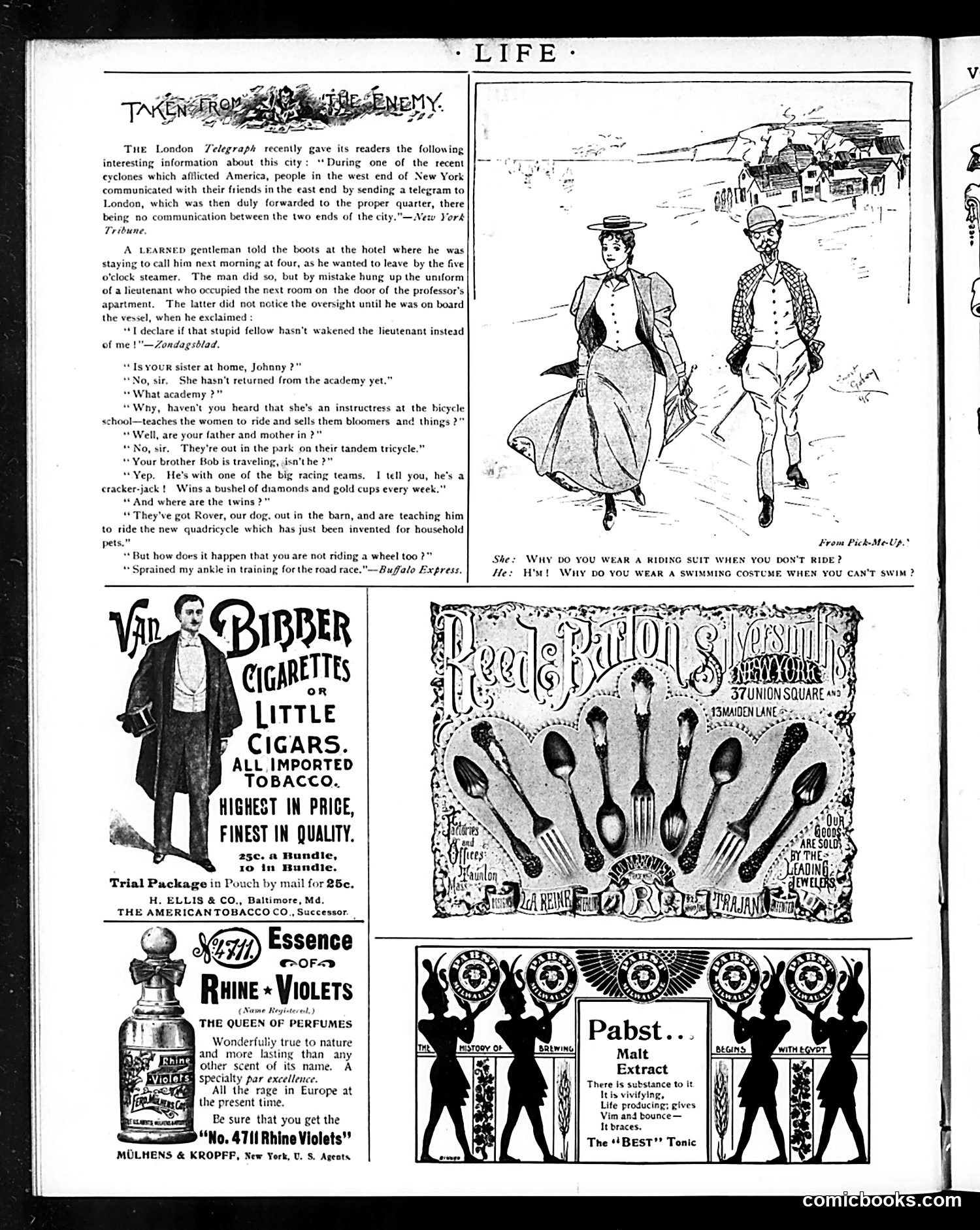
This page contains three separate humorous anecdotes satirizing the bicycle craze of the 1890s. **The main cartoon** (top right) depicts two cyclists in riding attire. The accompanying joke mocks fashion affectation: a woman wears full cycling costume despite not actually riding, while a man wears a swimming costume but cannot swim. The satire targets how people adopted specialized sporting clothes as fashionable status symbols rather than practical gear. **The three anecdotes below** all ridicule how bicycle mania had consumed American society. One describes a family where every member—sister, parents, brother, even the family dog—rides bicycles competitively or professionally, while the narrator alone cannot due to a training injury. Another notes New Yorkers had to telegram London to communicate between neighborhoods during a cyclone, yet could easily cross town by bicycle. **Context**: The 1890s bicycle boom was genuinely transformative, enabling women's mobility and independence. This page satirizes how thoroughly cycling had penetrated daily life and how people performed bicycle culture through dress and conversation, even when not actively cycling.