
Life, 1895-08-01 · page 6 of 14
Life — August 1, 1895 — page 6: what you’re looking at
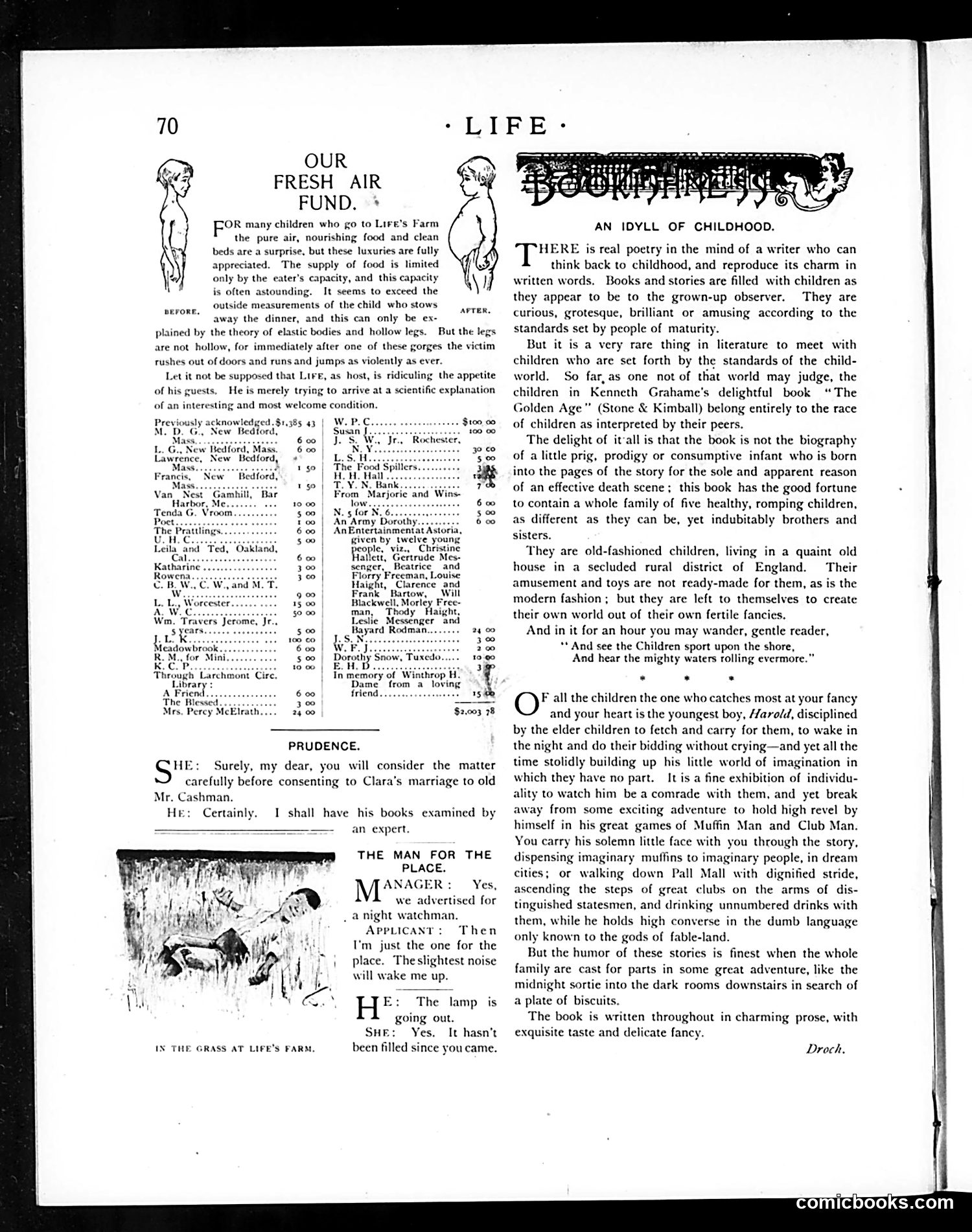
What you’re looking at
This page contains **three distinct sections**: a charitable fundraising appeal ("Our Fresh Air Fund"), a literary review of Kenneth Grahame's "The Golden Age," and two satirical dialogue pieces ("Prudence" and "The Man for the Place"). The cartoons are **brief comic dialogues** rather than visual political satire. "Prudence" presents a conversation between a woman and man debating marriage to an older gentleman (Mr. Cashman), apparently satirizing mercenary marriage calculations. "The Man for the Place" depicts a hiring exchange between a manager and applicant, mocking workplace hiring practices. The accompanying illustrations show simple line drawings of domestic/social scenes rather than caricatures of specific political figures. The humor derives from dialogue and situation rather than visual exaggeration or topical political reference.
📄 Transcribed text from this page (OCR, searchable)
Machine-transcribed from the original scan — historical spelling and the odd misread are preserved.
OUR FRESH AIR FUND. * FOR many children who go to Live's Farm the pure air, nourishing food and clean beds are a surprise, but these luxuries are fully appreciated. The supply of food is limited 1) only by the eater’s capacity, and this capacity Vs is often astounding. It seems to exceed the outside measurements of the child who stows away the dinner, and this can only be ex- plained by the theory of elastic bodies and hollow leg: are not hollow, for immediately after one of these gorges the victim rushes out of doors and runs and jumps as violently as ever. Let it not be supposed that Lire, as host, is ridiculing the appetite of his guests. He is merely trying to arrive at a scientific explanation berore, But the legs of an interesting and most welcome condition. W.P.C $100, 00 too 00 Rochester, P HH. Hail. T. YN. Bank : From Marjorie and ‘Wins N. 5 for An Army Dorothy. ‘AnEntertainmentat Astoria, given by twelve young people, viz.. Christine jallet trude Mes- senger, Beatrice and Florry Freeman, Louise Haight, Clarence and Frank ' Bartow, Will Blackwell, Morley Free- man, Thody Haight, Leslie Messenger and Bayard Rodman. an J. .. Dorothy Snow, Tuxedo. E.H. 0D . oo In memory of Winthrop H. Dame from a loving friend. steeeeeee 3 09 1 60 6 00 5.0 600 300 300 90 15 00 2 §0 0 Wm. Travers Jerome, Jr. Meadowbrook 6 00 .M.,for Minivccee ss 5 00 Kis Pics css wise 10.00 Through Larchmont Cire. i iorary A erm). The Blessed * Mrs. Percy McElrath... 5.00 6 00 300 2400 PRUDENCE. St Surely, my dear, you will consider the matter carefully before consenting to Clara’s marriage to old Mr. Cashman, He: Certainly. I shall have his books examined by an expert. THE MAN FOR THE PLACE. Maes SR: S, we advertised for . anight watchman. APPLICANT: Then I'm just the one for the place. Theslightest noise will wake me up. H going out. SHE: Yes. It hasn't The lamp is IN THE GRASS AT LIFE’S FARM. been filled since you came. AN IDYLL OF CHILDHOOD. is real poetry in the mind of a writer who can think back to childhood, and reproduce its charm in written words. Books and stories are filled with children as they appear to be to the grown-up observer. They are curious, grotesque, brilliant or amusing according to the standards set by people of maturity. But it is a very rare thing in literature to meet with children who are set forth by the standards of the child- world. So far,as one not of that world may judge, the children in Kenneth Grahame’s delightful book “The Golden Age” (Stone & Kimball) belong entirely to the race of children as interpreted by their peers. The delight of it-all is that the book is not the biography of a little prig, prodigy or consumptive infant who is born into the pages of the story for the sole and apparent reason of an effective death scene; this book has the good fortune to contain a whole family of five healthy, romping children, as different as they can be, yet indubitably brothers and sisters. They are old-fashioned children, living in a quaint old house in a secluded rural district of England. Their amusement and toys are not ready-made for them, as is the modern fashion ; but they are left to themselves to create their own world out of their own fertile fancies. And in it for an hour you may wander, gentle reader, ** And see the Children sport upon the shore, And hear the mighty waters rolling evermore.” * * . F all the children the one who catches most at your fancy and your heart is the youngest boy, Harold, disciplined by the elder children to fetch and carry for them, to wake in the night and do their bidding without crying—and yet all the time stolidly building up his little world of imagination in which they have no part. It is a fine exhibition of individu- ality to watch him be a comrade with them, and yet break away from some exciting adventure to hold high revel by himself in his great games of Muffin Man and Club Man. You carry his solemn little face with you through the story, dispensing imaginary muffins to imaginary people, in dream cities; or walking down Pall Mall with dignified stride, cending the steps of great clubs on the arms of dis- tinguished statesmen, and drinking unnumbered drinks with them, while he holds high converse in the dumb language only known to the gods of fable-land. But the humor of these stories is finest when the whole family are cast for parts in some great adventure, like the midnight sortie into the dark rooms downstairs in search of a plate of biscuits. The book is written throughout in charming prose, with exquisite taste and delicate fancy. Droch, Ccomicbooks.com