
Life, 1895-08-01 · page 4 of 14
Life — August 1, 1895 — page 4: what you’re looking at
What you’re looking at
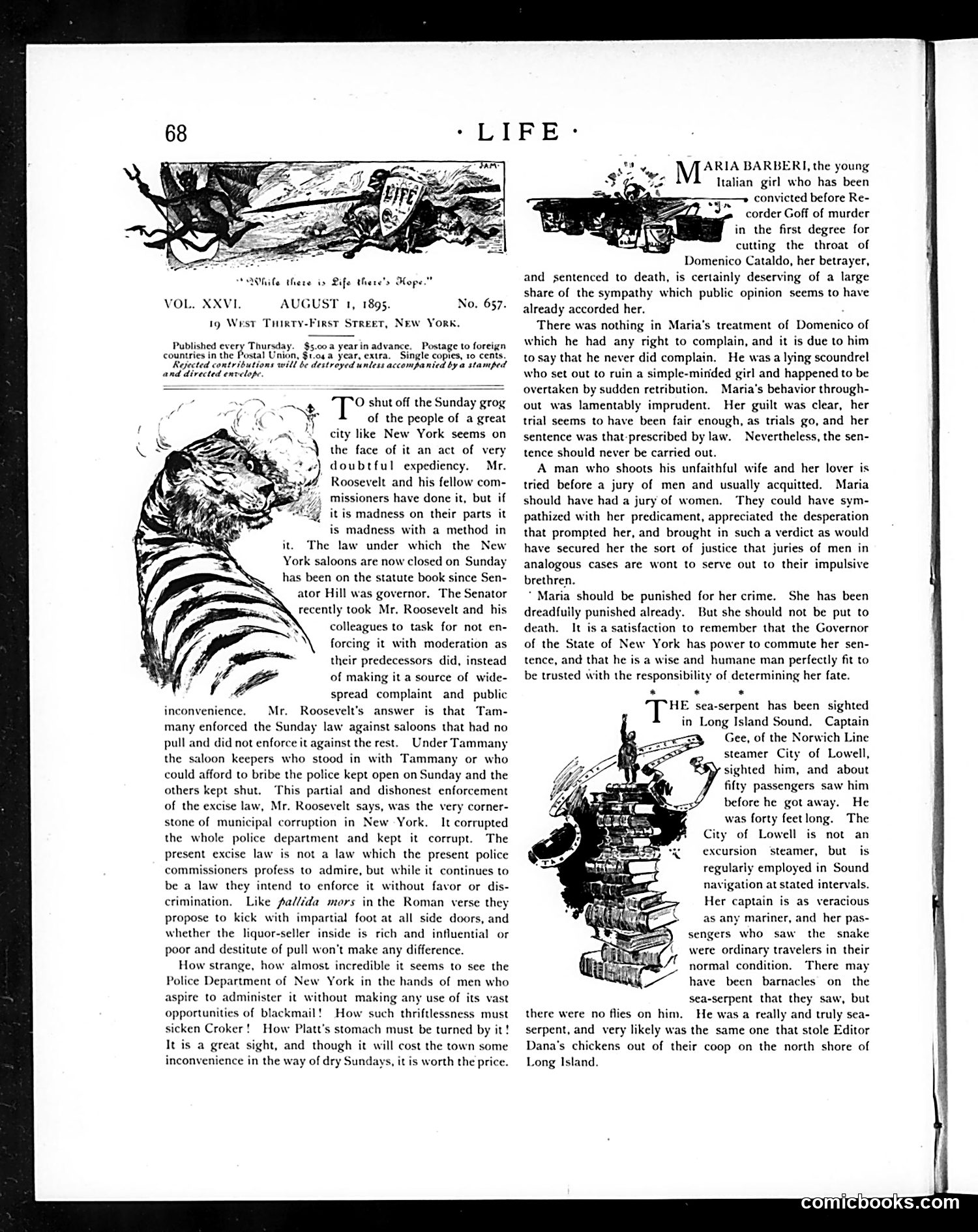
The left illustration depicts a tiger labeled "Tammany," referencing the corrupt Democratic political machine that controlled New York City. This is accompanying an editorial criticizing Police Commissioner Roosevelt's selective enforcement of Sunday saloon-closing laws. The satire argues that Roosevelt's partial enforcement against Tammany-aligned saloons while ignoring others is hypocritical and perpetuates police corruption. The tiger represents the predatory nature of Tammany Hall itself—suggesting the organization remains dangerous despite superficial reforms. The right column discusses an unrelated murder case of Maria Barberi and a sea serpent sighting, typical of Life's miscellaneous content mix. The overall critique suggests Roosevelt's reforms are insufficient window-dressing on a fundamentally corrupt system.
📄 Transcribed text from this page (OCR, searchable)
Machine-transcribed from the original scan — historical spelling and the odd misread are preserved.
Wile there is Life there's Hope.” VOL. XXV1. AUGUST 1, 1895. No. 657. 19 West Tuirty-First Street, New York. Published every Thursday. $5.coa yearin advance. Postage to foreign countries in the Postal Union, $t.o4a year, extra. Single copies, 10 cents. Rejected contributions will be destroyed unless accompanied bya stamped and directed envelope. 'O shut off the Sunday grog of the people of a great city like New York seems on the face of it an act of very doubtful expediency. Mr. Roosevelt and his fellow com- missioners have done it, but if it is madness on their parts it is madness with a method in it. The law under which the New York saloons are now closed on Sunday has been on the statute book since Sen- ator Hill was governor. The Senator recently took Mr. Roosevelt and his colleagues to task for not en- forcing it with moderation as their predecessors did, instead of making it a source of wide- spread complaint and_ public inconvenience. Mr. Roosevelt's answer is that Tam- many enforced the Sunday law against saloons that had no pull and did not enforce it against the rest. Under Tammany the saloon keepers who stood in with Tammany or who could afford to bribe the police kept open on Sunday and the others kept shut. This partial and dishonest enforcement of the excise law, Mr. Roosevelt says, was the very corner- stone of municipal corruption in New York. It corrupted the whole police department and kept it corrupt. The present excise law is not a law which the present police commissioners profess to admire, but while it continues to be a law they intend to enforce it without favor or dis- crimination, Like fad/éda mors in the Roman verse they propose to kick with impartial foot at all side doors, and whether the liquor-seller inside is rich and influential or poor and destitute of pull won't make any difference. How strange, how almost incredible it seems to see the Police Department of New York in the hands of men who aspire to administer it without making any use of its vast opportunities of blackmail! How such thriftlessness must sicken Croker! How Platt’s stomach must be turned by it! It is a great sight, and though it will co: inconvenience in the way of dry Sundays, it i the town some worth the price. ARIA BARBERI, the young Italian girl who has been convicted before Re- corder Goff of murder in the first degree for cutting the throat of Domenico Cataldo, her betrayer, and sentenced to death, is certainly deserving of a large share of the sympathy which public opinion seems to have already accorded her. There was nothing in Maria's treatment of Domenico of which he had any right to complain, and it is due to him to say that he never did complain. He was a lying scoundrel who set out to ruin a simple-minded girl and happened to be overtaken by sudden retribution. Maria's behavior through- out was lamentably imprudent. Her guilt was clear, her trial seems to have been fair enough, as trials go, and her sentence was that-prescribed by law. Nevertheless, the sen- tence should never be carried out. A man who shoots his unfaithful wife and her lover is tried before a jury of men and usually acquitted. Maria should have had a jury of women. They could have sym- pathized with her predicament, appreciated the desperation that prompted her, and brought in such a verdict as would have secured her the sort of justice that juries of men in analogous cases are wont to serve out to their impulsive brethren. * Maria should be punished for her crime. She has been dreadfuily punished already. But she should not be put to death. It is a satisfaction to remember that the Governor of the State of New York has power to commute her sen- tence, and that he is a wise and humane man perfectly fit to be trusted with the responsibility of determining her fate. 5 . * HE sea-serpent has been sighted in Long Island Sound. Captain Gee, of the Norwich Line steamer City of Lowell, sighted him, and about fifty passengers saw him before he got away. He was forty feetlong. The City of Lowell is not an excursion but is regularly employed in Sound navigation at stated intervals. Her captain is as veracious as any mariner, and her pa sengers who saw the sn. were ordinary travelers in their normal condition. There may have been barnacles on the sea-serpent that they saw, but there were no flies on him. He was a really and truly sea- serpent, and very likely was the same one that stole Editor Dana's chickens out of their coop on the north shore of Long Island. steamer,