
A complete issue · 16 pages · 1895
Life — June 13, 1895
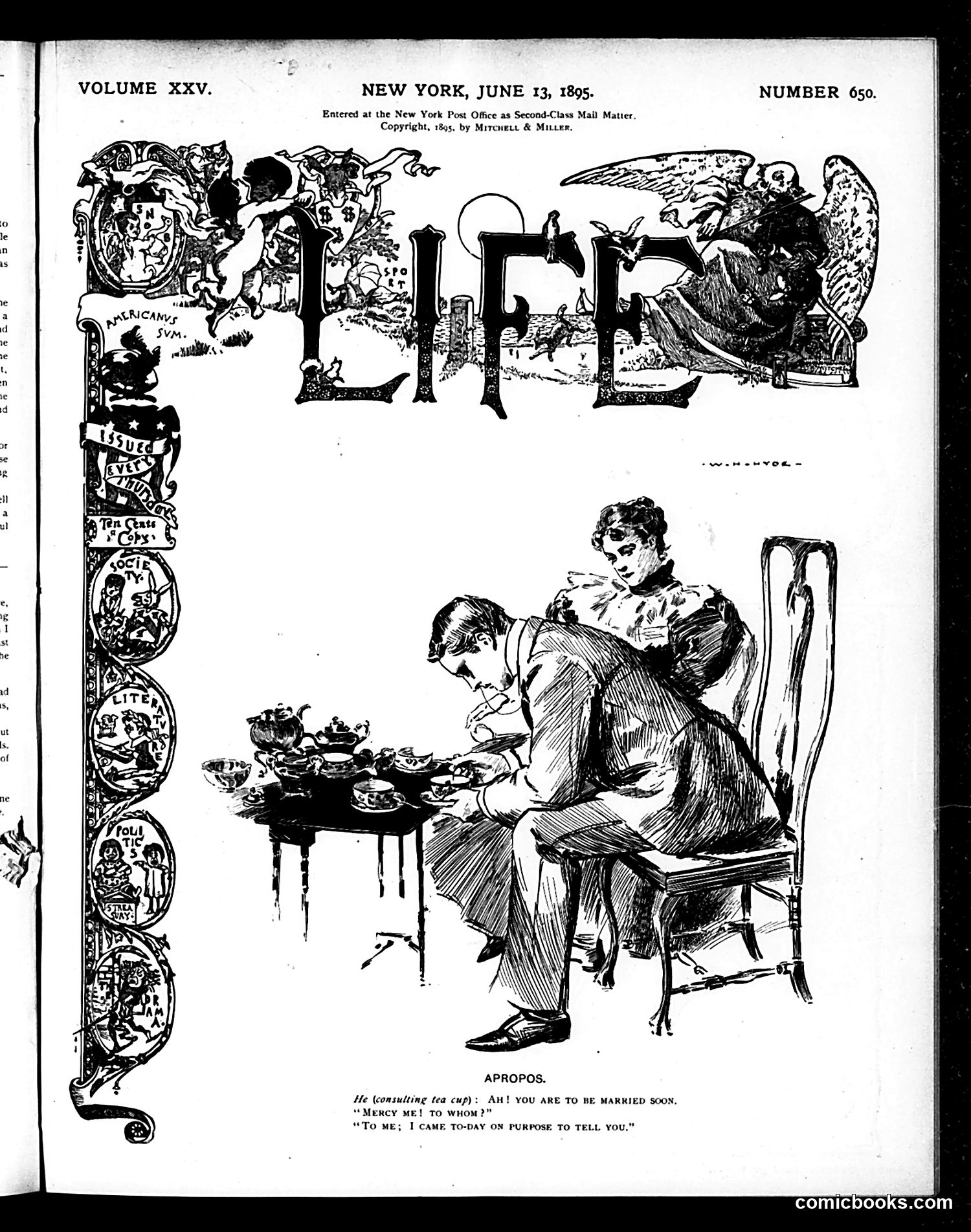
This page contains a satirical cartoon titled "Apropos" depicting a domestic scene. A man consults a teacup (suggesting fortune-telling or divination) while a woman sits nearby. The dialogue reads: "Ah! you are to be married soon. Mercy me! To whom?" "To me; I came to-day on purpose to tell you." The joke satirizes fortune-telling practices popular in the 1890s. The man mockingly uses tea-cup reading to propose marriage, treating the pseudoscientific divination method as his vehicle for a marriage proposal. The woman's surprised reaction suggests the unconventional and humorous nature of this proposal method. The ornate left border contains decorative period advertisements and illustrations typical of Life's layout during this era.
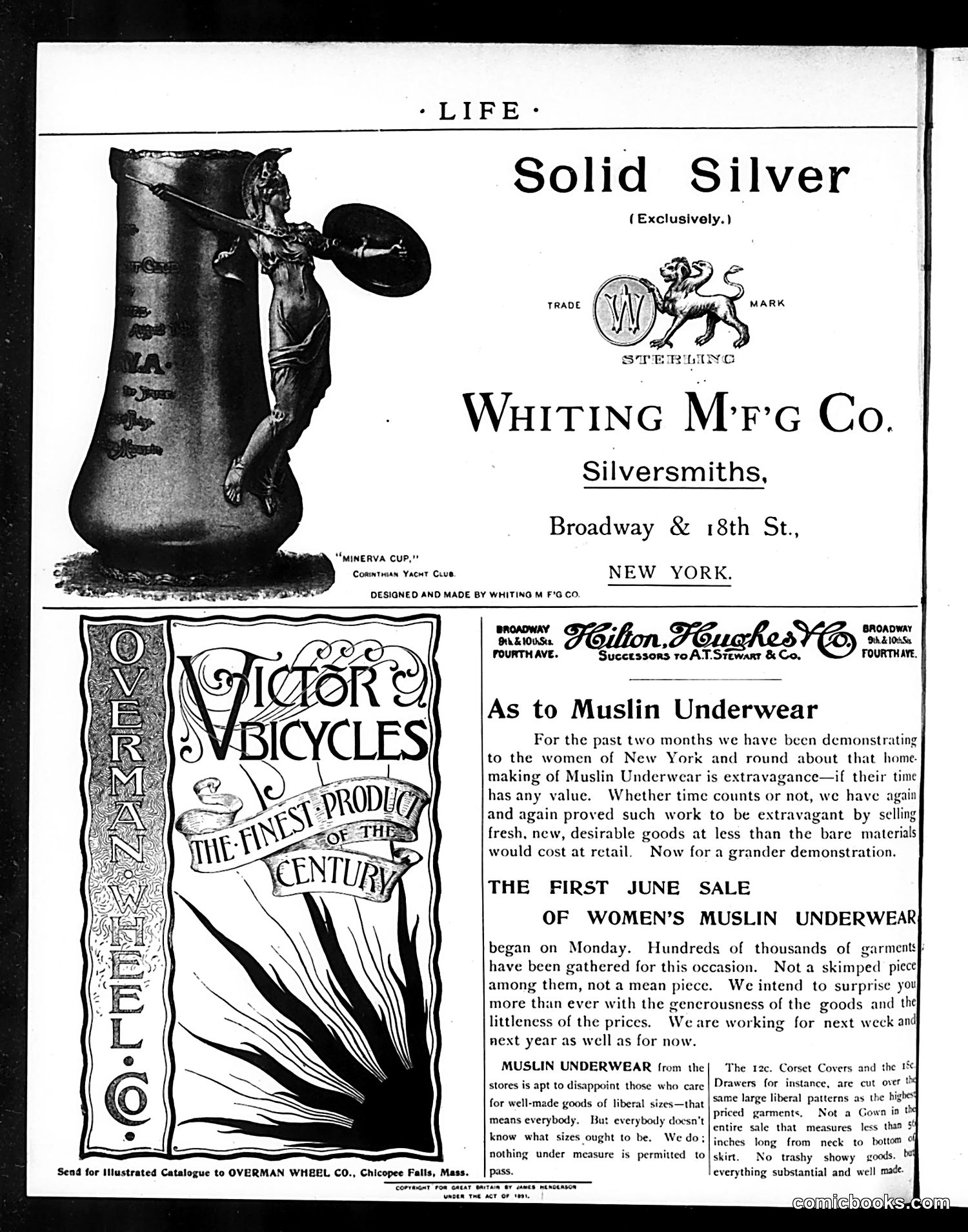
This page is primarily **advertisements** rather than satirical content. The top ad showcases **Whiting Mfg Co.**, a New York silversmith, displaying the "Minerva Cup"—an ornate silver pitcher featuring a classical female figure (Minerva, Roman goddess of wisdom). The ad emphasizes "Solid Silver" craftsmanship. Below are two additional advertisements: one for **Victor Bicycles** ("The Finest Product of the Century"), and one for **Hilton Hawksworth & Co.** promoting a "First June Sale of Women's Muslin Underwear," emphasizing affordability and quality. No political satire or caricature is evident. The page represents typical early-1900s *Life* magazine advertising, targeting middle and upper-class consumers with luxury goods and department store sales.
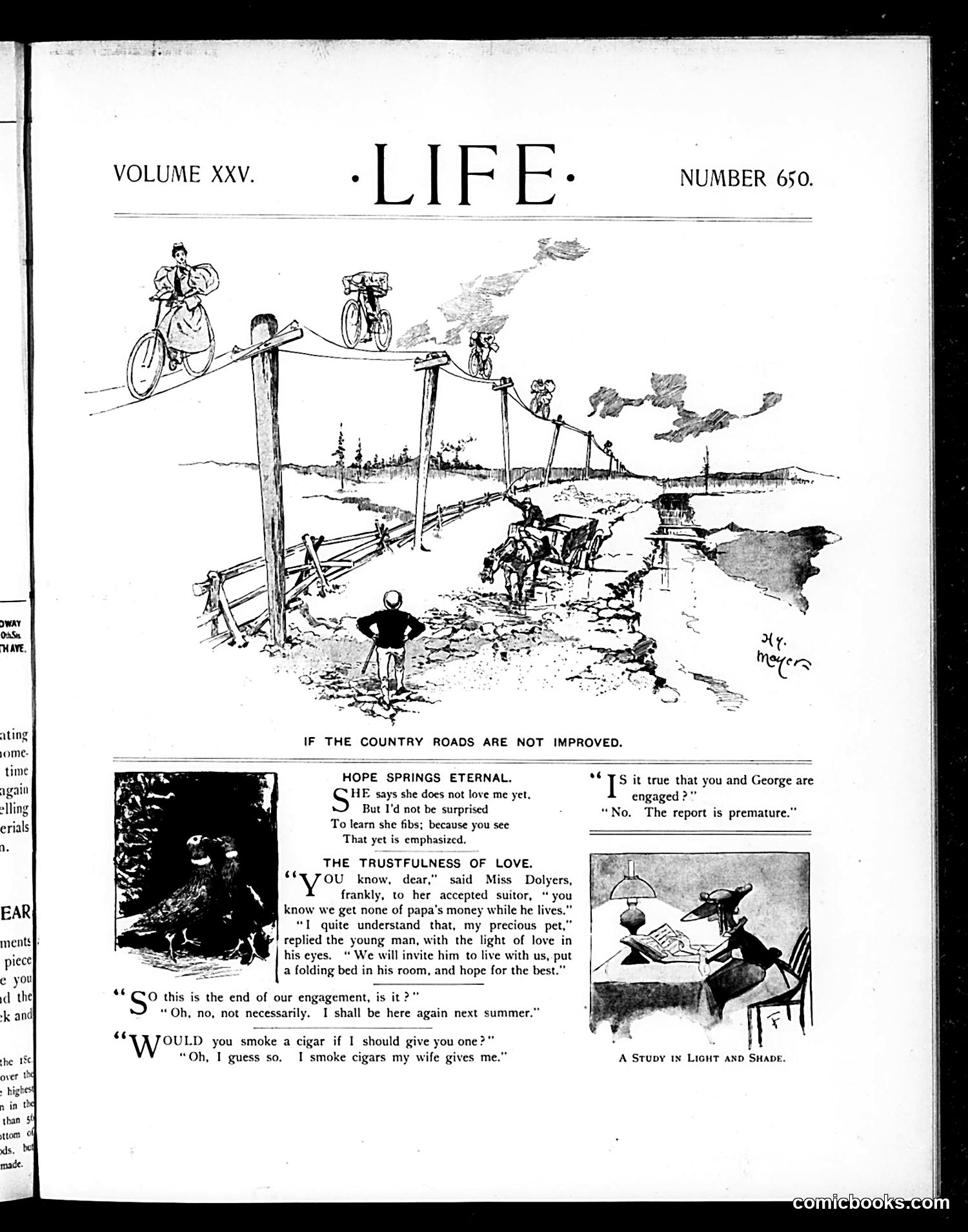
The main cartoon satirizes poor rural road conditions. It depicts people navigating a treacherous "country road" using a rope-and-pulley system, with bicyclists, horse-drawn vehicles, and pedestrians struggling across difficult terrain. The caption reads "IF THE COUNTRY ROADS ARE NOT IMPROVED." The satire suggests that without infrastructure investment, rural transportation will become increasingly absurd and impractical—people will need elaborate mechanical assistance just to traverse basic roads. Below are three brief text-based humor pieces about romantic relationships: "Hope Springs Eternal" (about a woman not yet in love), "The Trustfulness of Love" (about a couple's financial arrangements), and "A Study in Light and Shade" (about cigars and marriage). These reflect early 20th-century social commentary on rural development and domestic life.
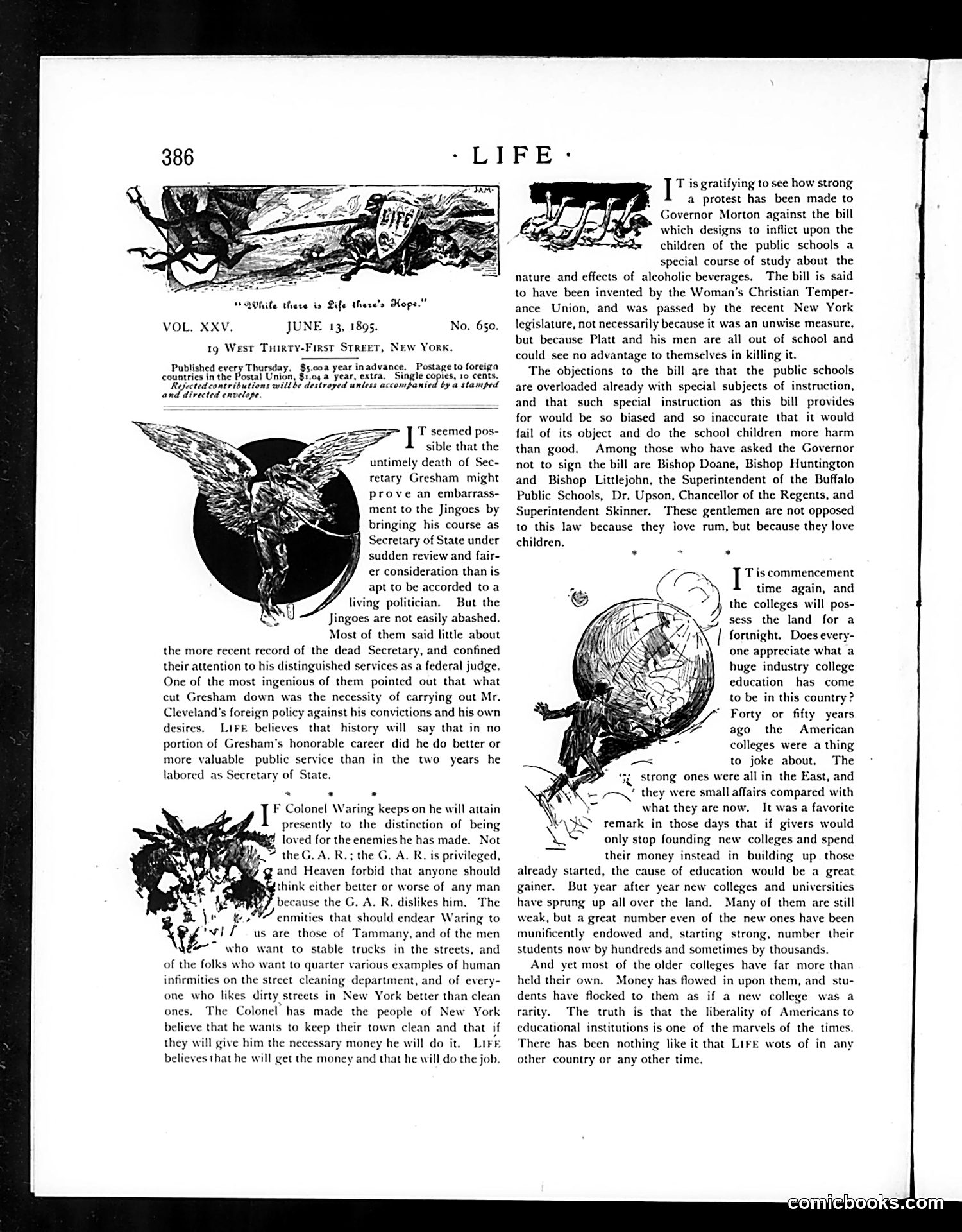
The page contains three distinct editorial sections critiquing New York politics and education policy. **Top cartoon**: Depicts Secretary of State Gresham's death as potentially embarrassing to Governor Morton, who must now justify his policies without Gresham's continued service as federal judge—suggesting political leverage was lost. **Middle section**: Attacks Governor Morton for opposing a bill (likely supported by the Woman's Christian Temperance Union) mandating temperance instruction in public schools. The text names prominent educators who opposed it, arguing the bill was biased and ineffective. **Bottom cartoon**: Shows a figure (likely Colonel Waring, NYC's street-cleaning commissioner) carrying a globe, celebrating American college expansion. The accompanying text praises the growth of American higher education as a national achievement comparable to no other country.
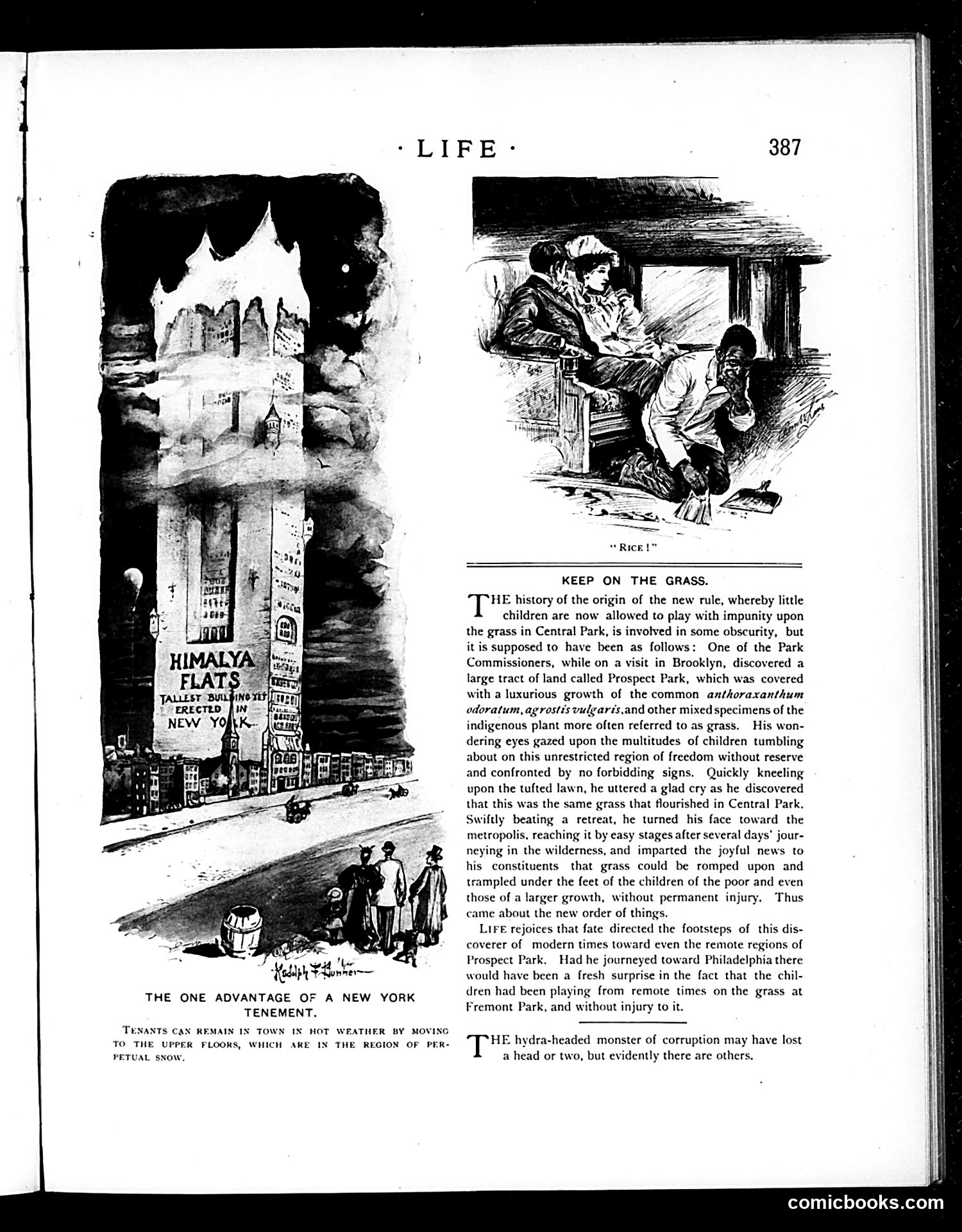
**Left cartoon:** "The One Advantage of a New York Tenement" depicts a tall, cramped tenement building labeled "Himalaya Flats—Tallest Building Erected in New York." The satirical "advantage" is stated below: tenants can remain indoors during hot weather by moving to upper floors "in the region of perpetual snow." This mocks both the absurd height of new construction and the sweltering conditions of tenement living. **Right illustration:** "Rice!" shows what appears to be a domestic scene with adults and a child, accompanying an article titled "Keep on the Grass." The text discusses a new Central Park rule allowing children to play on grass—previously forbidden. The article humorously recounts how a Park Commissioner discovered common plants growing there, treating this as a revelation about natural vegetation. Both pieces satirize New York City's urban conditions and bureaucratic absurdities.
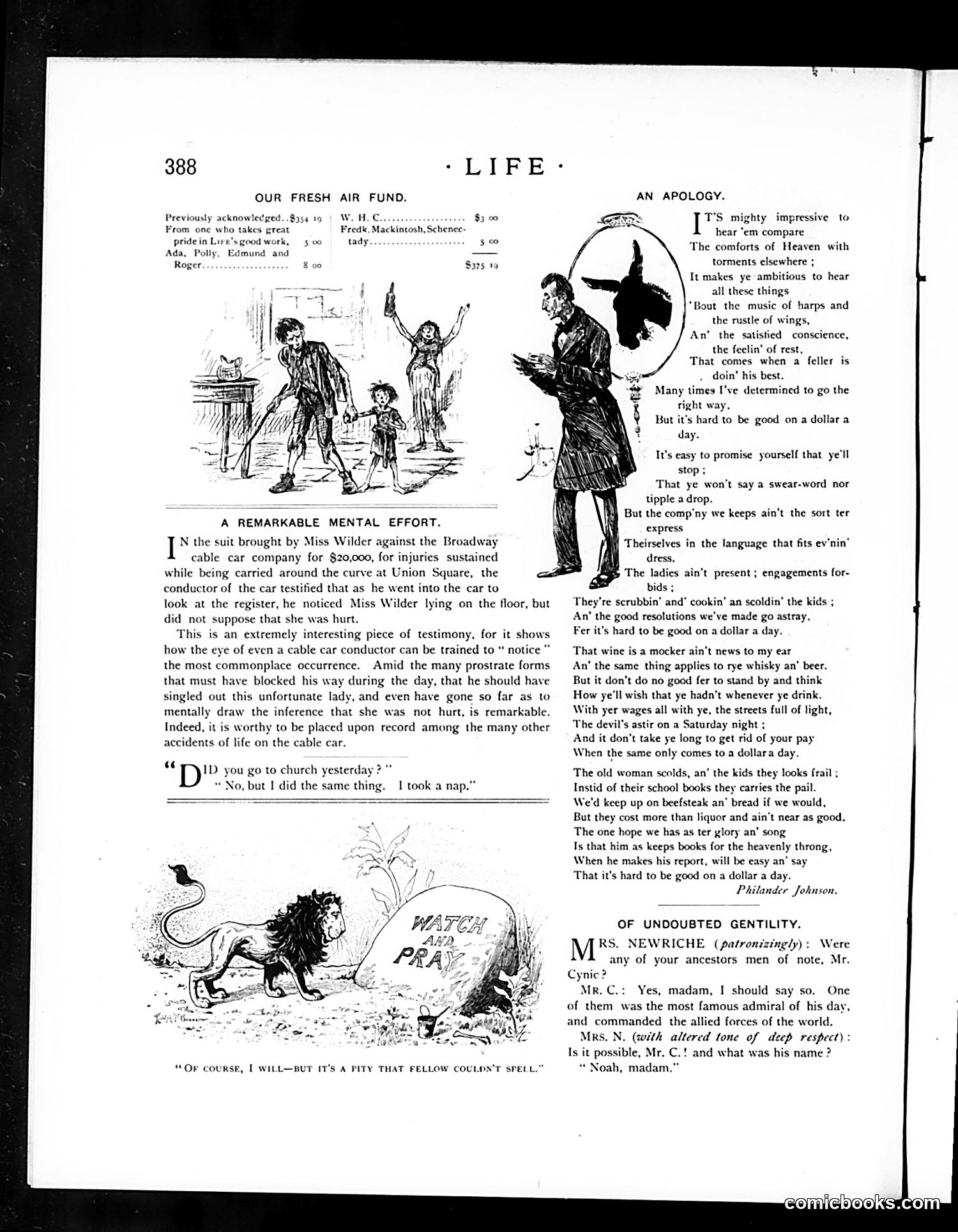
**"A Remarkable Mental Effort"** describes a lawsuit by Miss Wilder against a Broadway cable car company for $20,000 following injuries at Union Square. The satire highlights the conductor's acute observation: despite being knocked down and lying on the floor, he claimed not to have noticed he was hurt. The cartoon mocks how streetcar workers were trained to deny injuries to avoid company liability—requiring them to mentally suppress obvious physical trauma. This satirizes both corporate negligence and the absurd expectations placed on workers to sacrifice their wellbeing for employer protection. **"An Apology"** is a poem by Philander Johnson about the difficulty of maintaining moral virtue on meager wages ("hard to be good on a dollar a day"), addressing poverty's grip on working-class morality. **"Of Undoubted Gentility"** appears to be a brief comedic dialogue.
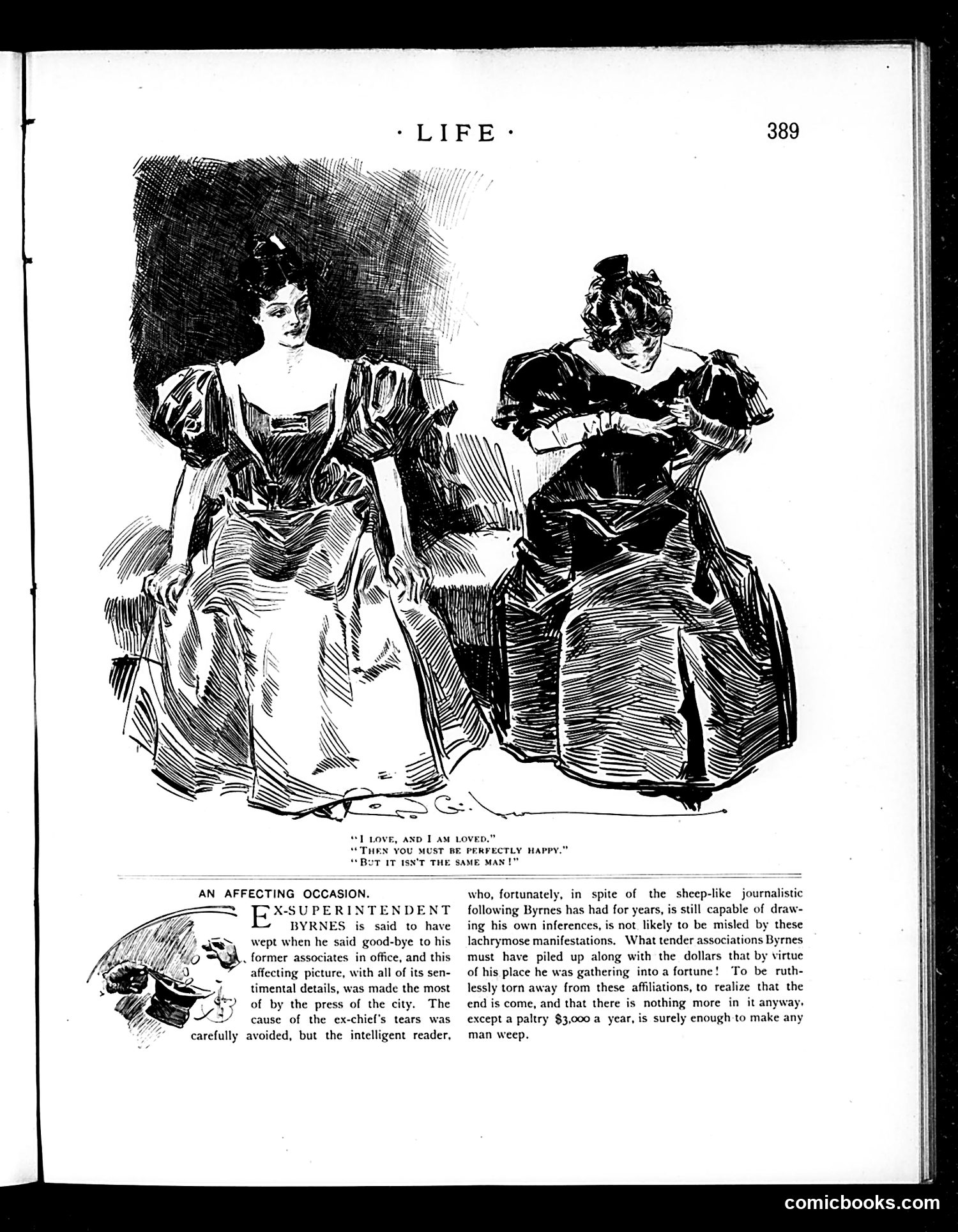
The top illustration shows two fashionably dressed women in conversation, with quoted dialogue about happiness and marriage ("Then you must be perfectly happy" / "But it isn't the same man!"). This appears to satirize assumptions about women's marital satisfaction. The lower section, titled "AN AFFECTING OCCASION," describes a farewell party for a departing newspaper editor named Byrnes. The accompanying sketch shows a weeping figure. The text satirizes the sentimental press coverage of Byrnes's departure, suggesting journalists exaggerated emotional details while avoiding explicit mention of tears. The piece mocks the "sheep-like journalistic following" and implies Byrnes accumulated wealth ($3,000 yearly salary mentioned) before leaving—critiquing both journalistic sentimentality and the subject's financial gains.
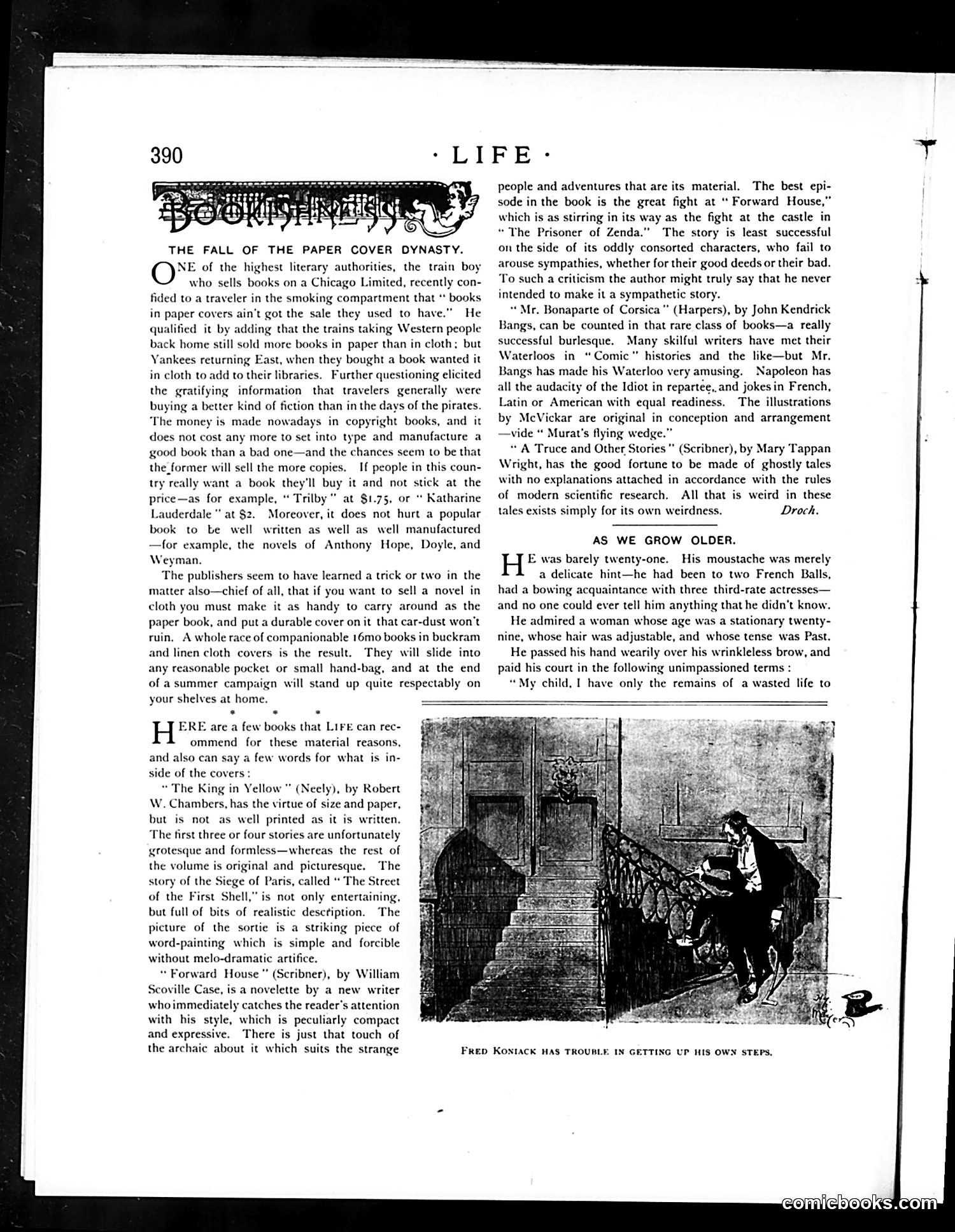
This page contains book reviews rather than political satire. The main illustration shows "Fred Koniak has trouble in getting up his own steps"—a humorous domestic scene depicting a man struggling to climb stairs, likely after drinking. The text discusses paper-covered books, their durability, and manufacturing quality. Reviews mention several works including "The King in Yellow" by Robert W. Chambers and "Forward House" by William Scoville Case. The section "As We Grow Older" presents a brief story about a young man reflecting on romantic failures and wasted youth. There is no clear political commentary or caricature on this page. It functions as a literary column with light domestic humor rather than satirical social criticism typical of Life's editorial content.
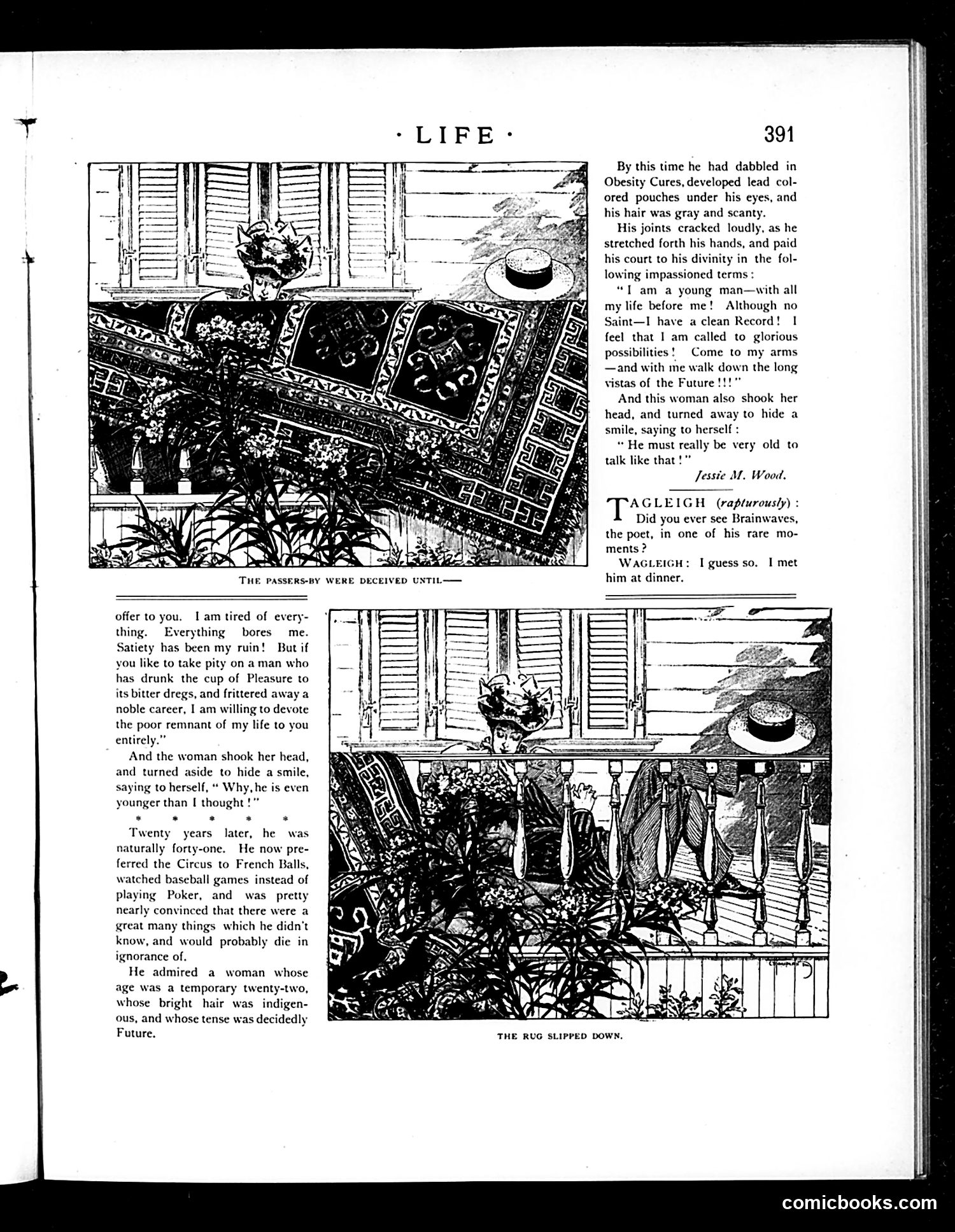
This page contains a fictional narrative with illustrations about a man's romantic and moral decline. The story describes how a man, after being rejected by a woman, pursues a life of pleasure and excess, eventually becoming dissolute by middle age. Twenty years later, now forty-one, he's aged significantly—dabbled in "Obesity Cures," has eye pouches, gray hair, and creaky joints. The narrative satirizes the consequences of hedonism and lost potential. The woman's dismissive response ("Why, he is even younger than I thought") mocks his premature aging from dissipation. The captions "The Passer-by Were Deceived Until—" and "The Rug Slipped Down" suggest ironic reversal or exposure of his deteriorated state beneath outward appearances. This is social satire about vanity, excess, and wasted life.
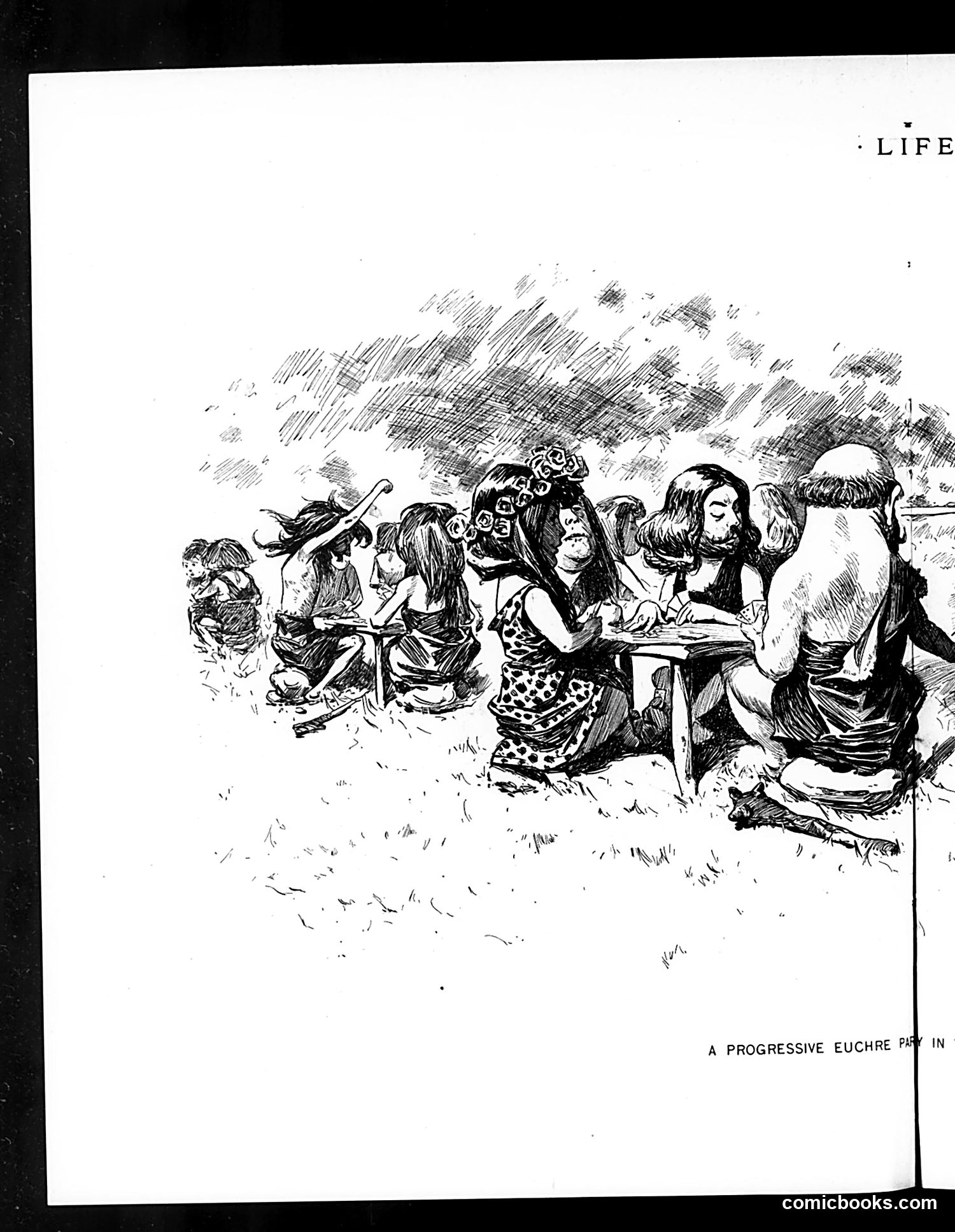
This is a satirical illustration from *Life* magazine depicting what appears to be a social gathering playing the card game euchre. The caption identifies it as a "progressive euchre party," a popular parlor entertainment where players rotated tables and partners. The cartoon likely satirizes social customs of the era—possibly mocking the pretensions of "progressive" entertainment, gender dynamics at mixed social gatherings, or the fashions and hairstyles visible in the sketch. The exaggerated character expressions and caricatured features suggest mockery of participants or their behavior. Without the complete caption, the specific satirical target remains unclear, but the drawing's emphasis on social interaction and entertainment suggests commentary on contemporary leisure-class habits or social conventions.
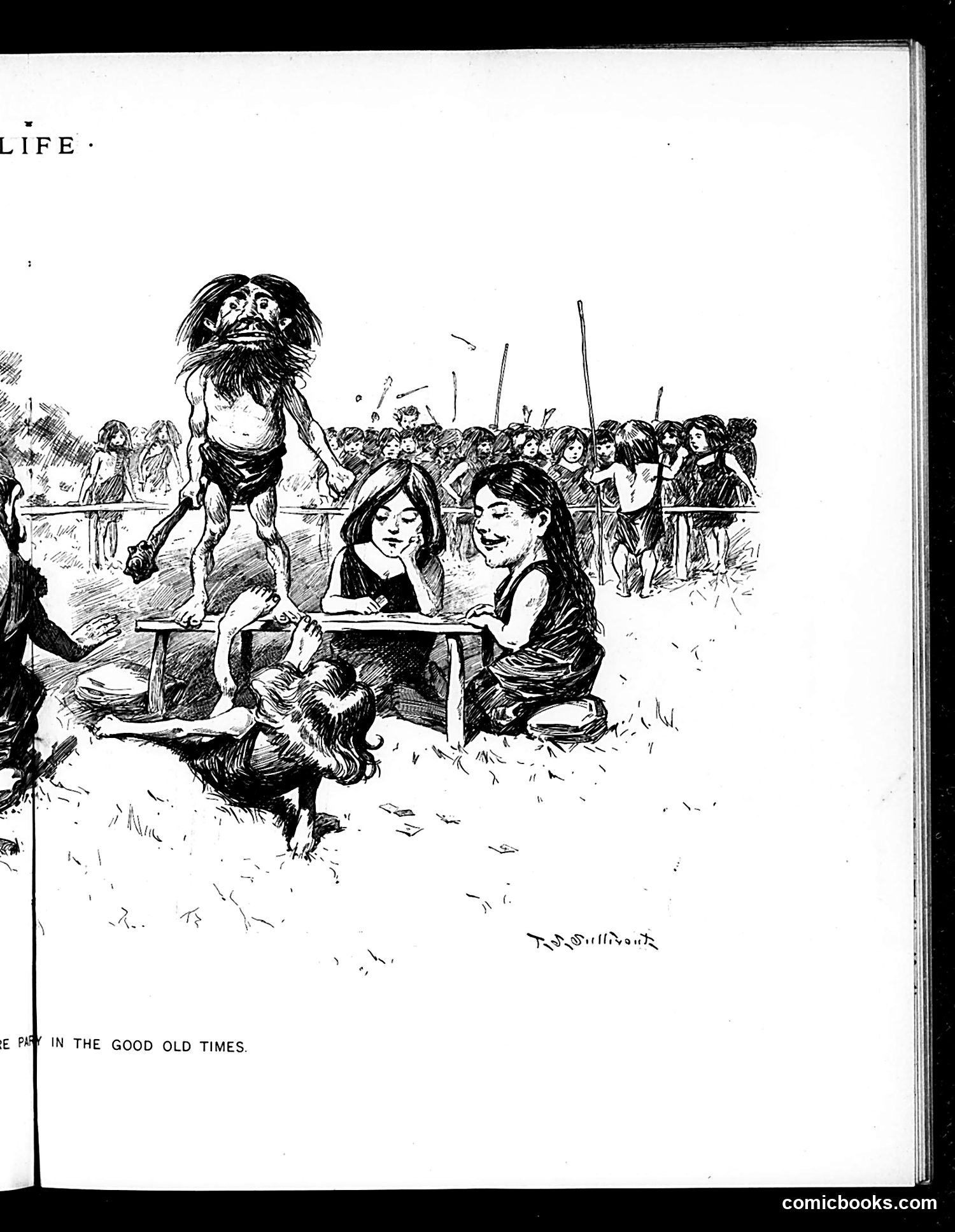
The page shows a satirical illustration titled "Life in the Good Old Times." It depicts two women seated at a table in what appears to be an arena or amphitheater, casually dining while a large, grotesque creature looms nearby and crowds gather in the background with spears or weapons raised. The satire likely comments on Roman-era gladiatorial games and public violence as entertainment. The women's composed, social demeanor while surrounded by brutal spectacle and danger suggests mockery of how audiences normalized extreme violence as casual amusement. The contrast between the refined domesticity of their meal and the savage scene surrounding them underscores the grotesque normalization of bloodshed. The "good old times" title appears ironic, critiquing nostalgic romanticization of historical periods that were actually brutal.
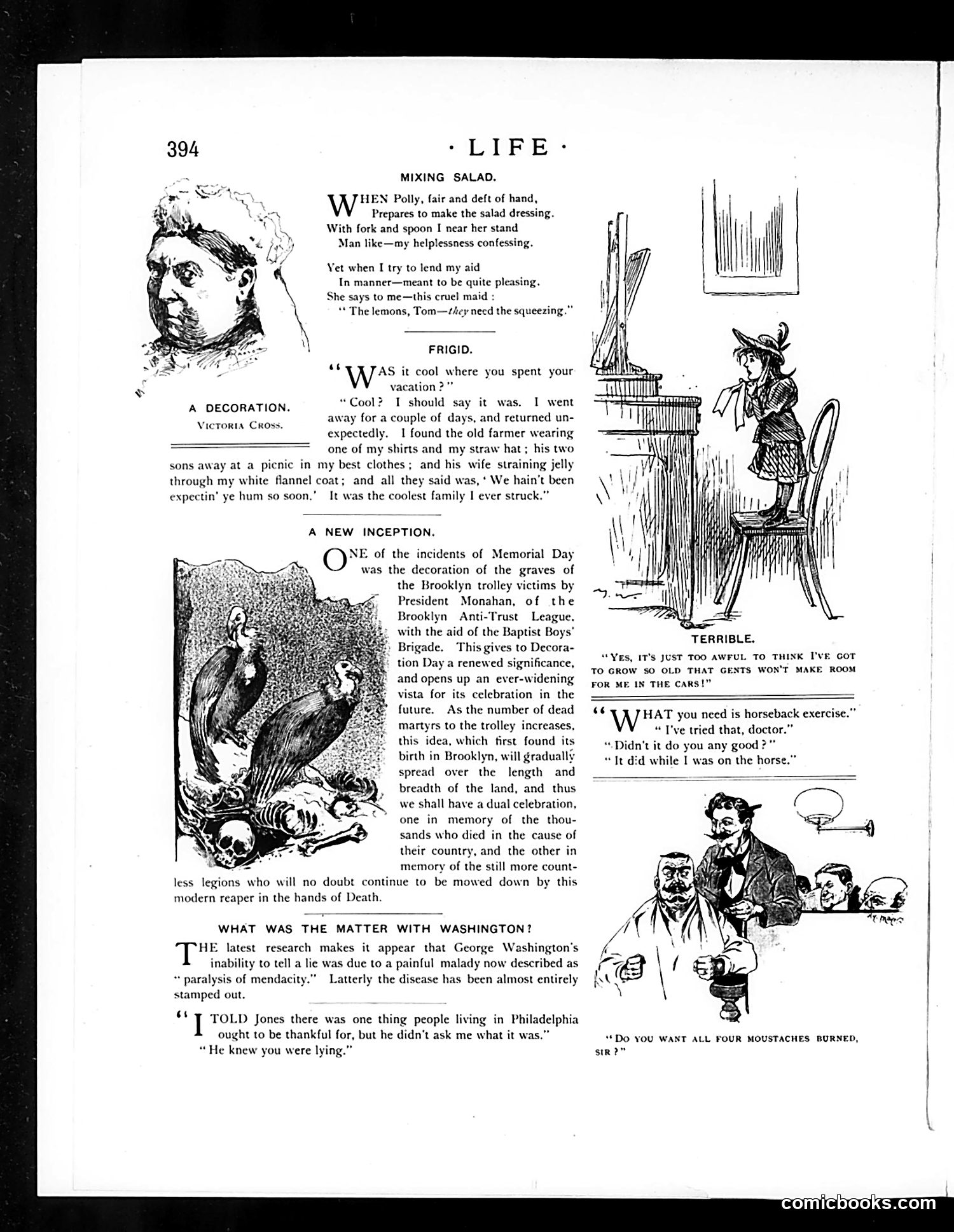
This page from *Life* contains several brief satirical pieces typical of the magazine's humor: **"Mixing Salad"** mocks domestic gender roles—a man helplessly watching his girlfriend prepare salad dressing, then being told his only job is squeezing lemons, emphasizing male incompetence in the kitchen. **"Frigid"** jokes about a man's vacation ruined by an inconsiderate farmer who borrowed his clothes without permission. The "cool" pun suggests both temperature and audacity. **"A New Inception"** sardonically proposes expanding Memorial Day celebrations to honor Brooklyn trolley accident victims alongside war dead, darkly suggesting trolleys kill people regularly like a "modern reaper." **"What Was the Matter with Washington?"** satirizes the nation's declining honesty through the founding father's legendary inability to lie, now (the piece claims) nearly extinct. The remaining pieces contain brief joke exchanges about aging, horseback riding, and shaving. Overall, the page demonstrates *Life's* mix of domestic humor, social commentary, and political satire targeting American manners and institutions.
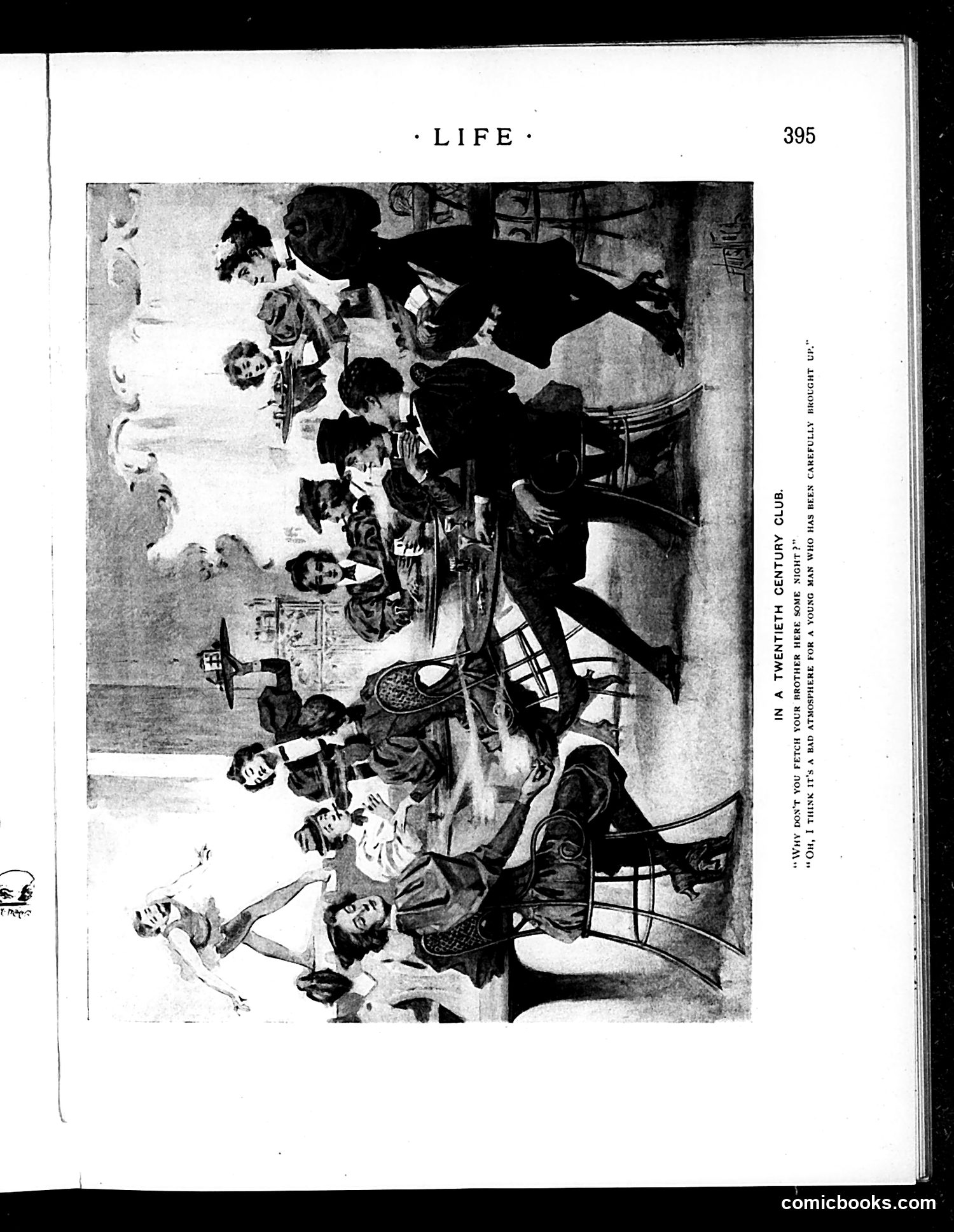
I cannot reliably read the OCR text on this page—it appears corrupted or reversed. The image itself, rotated 90 degrees, shows what appears to be a group scene in an interior setting with multiple figures in period costume, but the image quality and orientation make it difficult to identify specific individuals or determine the satirical subject with confidence. Without legible text identifying the cartoon's title, subjects, or context, I cannot accurately explain what political or social commentary this page contains. To properly identify the figures, references, and satire involved, I would need either clearer text or additional context about this specific Life magazine issue.
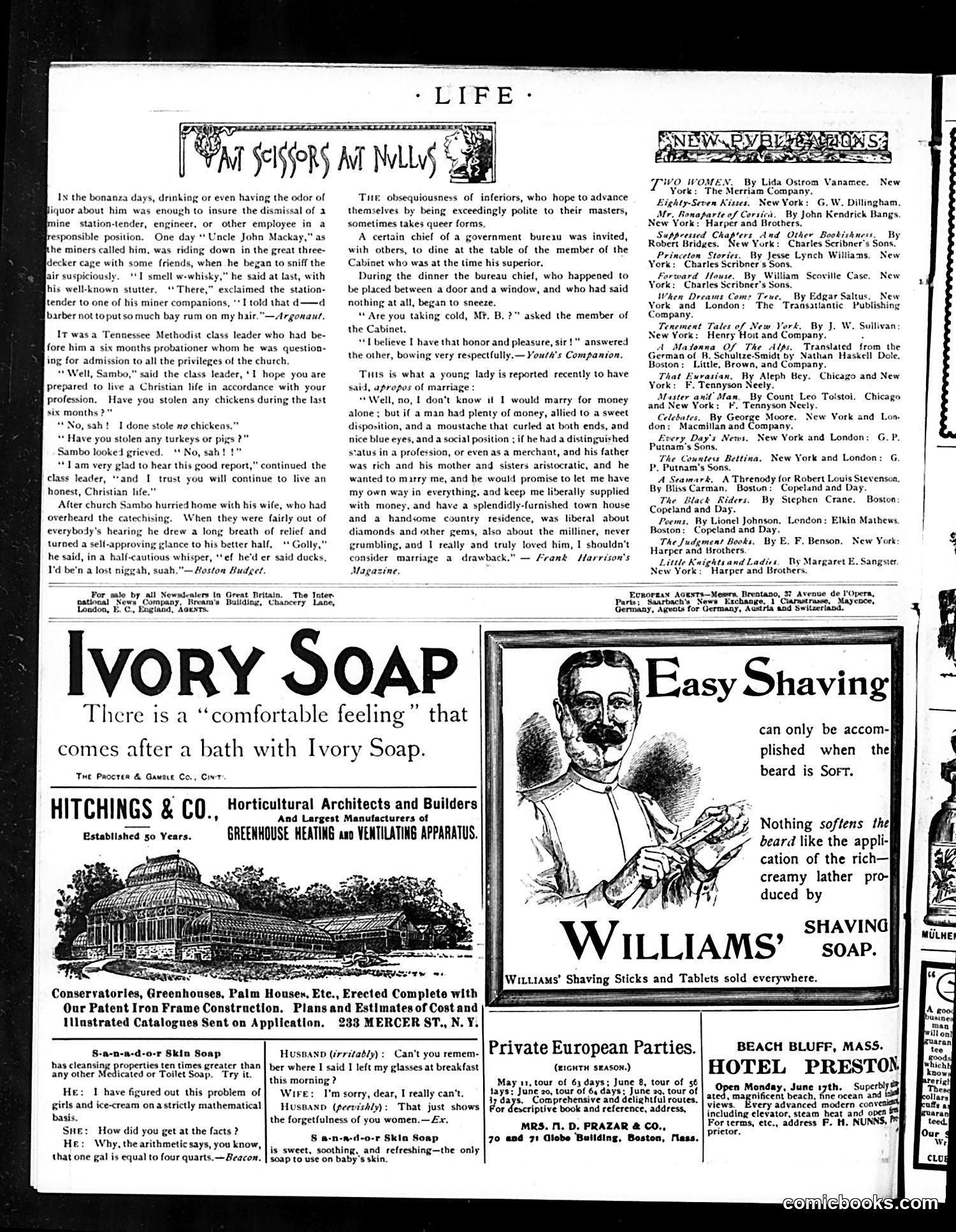
This page contains three separate humorous anecdotes satirizing social hypocrisy and absurd behavior among different classes: 1. **"All Scissors at Nulls"** mocks working-class attempts to explain away alcohol smell by blaming bay rum hair product instead of admitting drinking violations. 2. **The Methodist class leader story** satirizes a church authority figure whose moral questioning focuses obsessively on petty theft (chickens, turkeys, pigs) while missing larger spiritual concerns—poking fun at rigid, letter-of-the-law religiosity. 3. **The marriage anecdote** ridicules a young woman's contradictory claim that she wouldn't marry "for money alone," then lists increasingly mercenary and superficial requirements: wealth, good looks, social status, family connections, and obedience—the satire being that her conditions are entirely materialistic despite her protestations. The page also contains period advertisements (Ivory Soap, Williams' Shaving Soap, Hitchings & Co. greenhouses) and a book review section typical of Life's format.
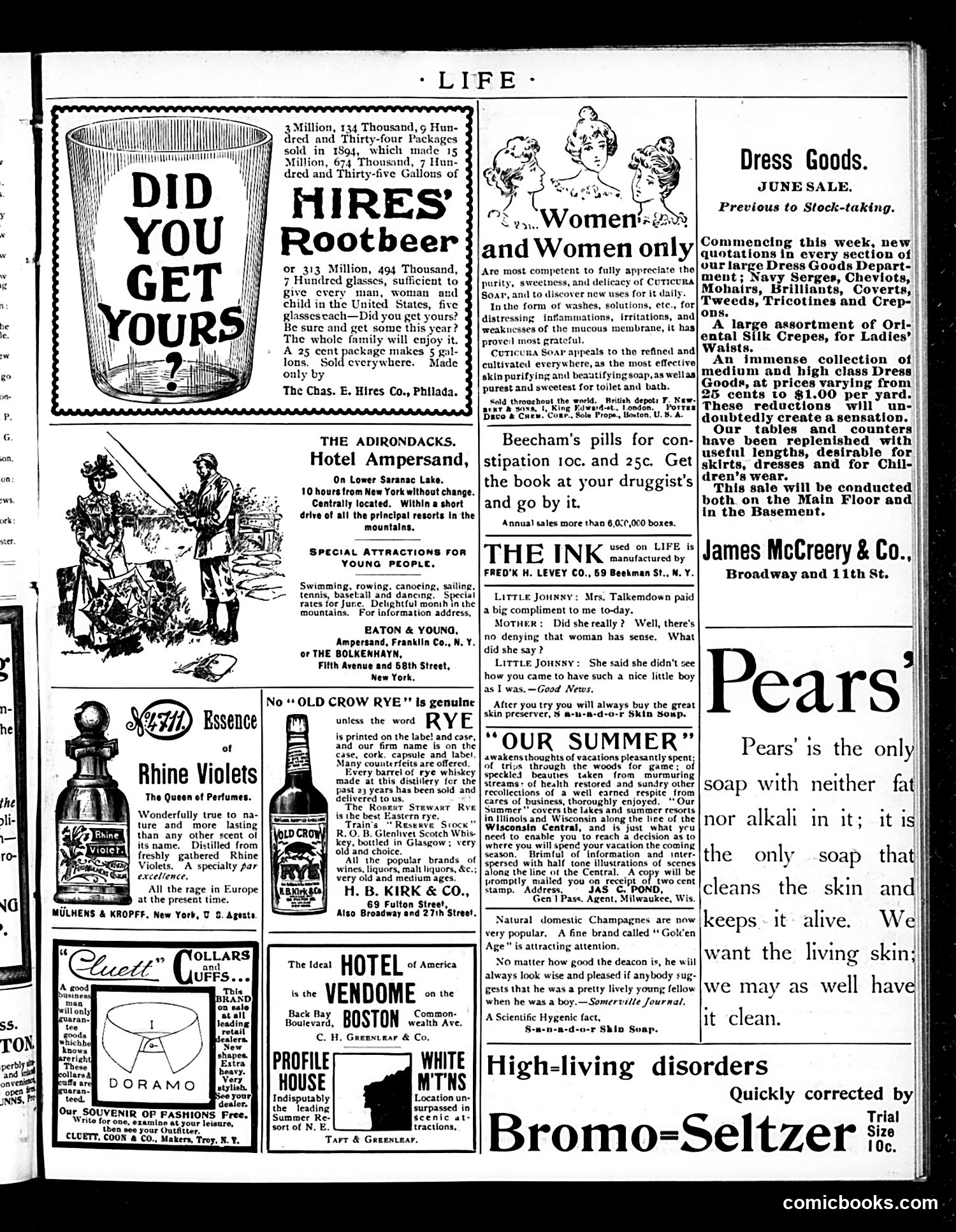
This page is primarily **advertising**, typical of early 1900s magazines. The main visual content is a large advertisement for Hires' Rootbeer featuring a glass with bold text asking "DID YOU GET YOURS?"—a marketing appeal emphasizing the product's popularity (claiming 3+ million packages sold in 1894). The page includes multiple period advertisements for luxury goods and services: hotels, perfume, whiskey, soap, and patent medicines. One small comic strip presents a mild joke about a child's compliment to his mother, which was common filler content. Notable is the **Cuticura Soap advertisement** addressing women about personal hygiene, reflecting Victorian-era marketing targeting female consumers for intimate health products. The **Bromo-Seltzer ad** promotes the patent medicine as a cure for "high-living disorders"—a euphemism for digestive complaints from overindulgence, common in Gilded Age advertising. Overall, this reflects **turn-of-century consumer culture** and the prevalence of patent medicines and dubious health claims before modern FDA regulation.
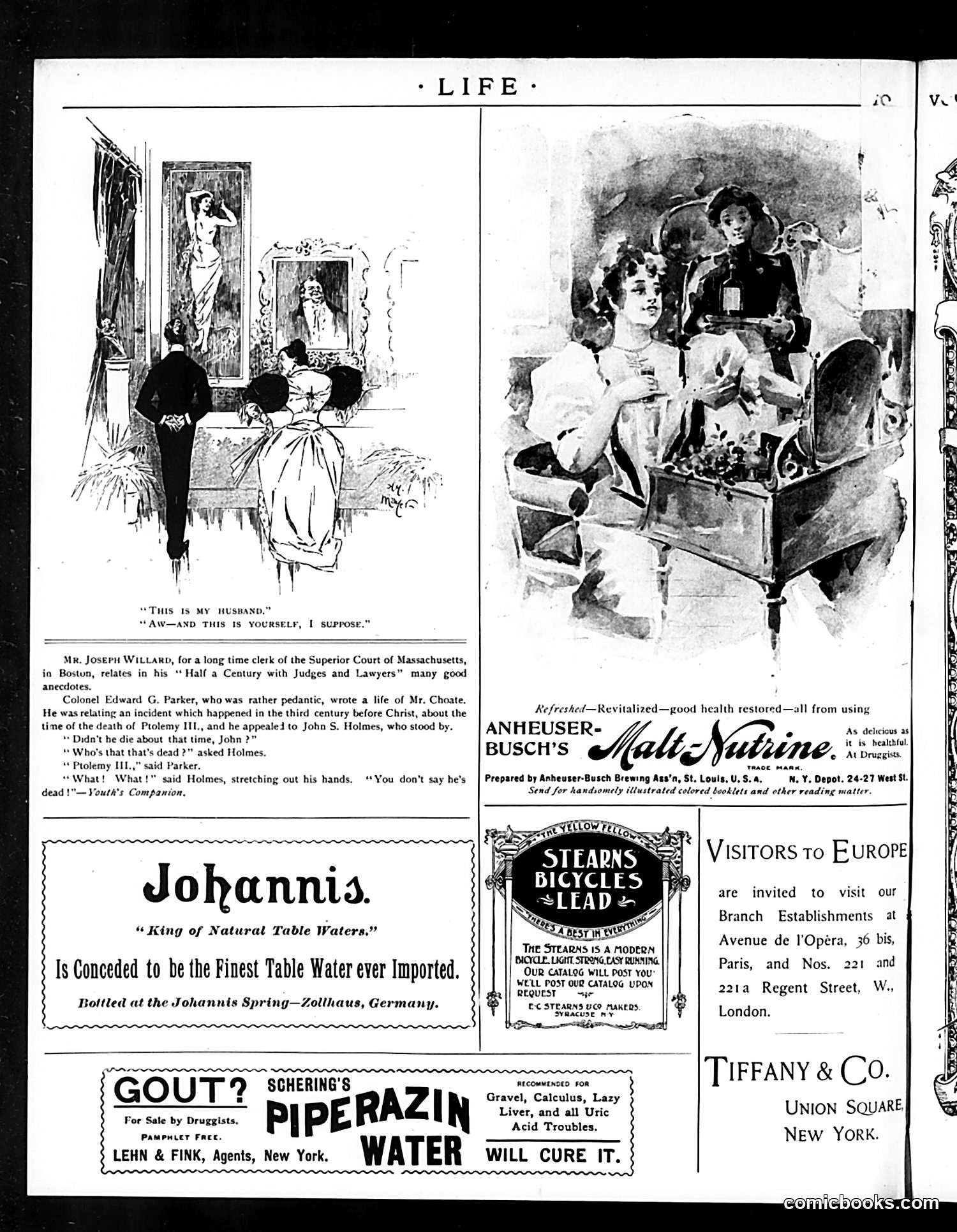
This page is primarily **advertisements with one brief cartoon**. The cartoon (upper left) depicts a social awkwardness joke: A man introduces his wife to another man, then awkwardly presents himself as if he were a separate person ("this is yourself, I suppose"). The humor lies in the absurd self-introduction—treating oneself as a third party worthy of formal introduction. Below it is an anecdote about Colonel Parker, a pedantic historian, who discusses the ancient Egyptian ruler Ptolemy III. When asked if Ptolemy died "about that time," Holmes (apparently unfamiliar with ancient history) responds with confusion—"Who's that that's dead?"—implying he doesn't recognize the name at all. The joke mocks both Parker's overly scholarly references and Holmes's historical ignorance. The remainder of the page consists of period **patent medicine and luxury goods advertisements** (mineral water, malt extract, bicycles, and remedies for gout and kidney stones)—typical for Life magazine of this era.