
Life, 1895-06-13 · page 8 of 16
Life — June 13, 1895 — page 8: what you’re looking at
What you’re looking at
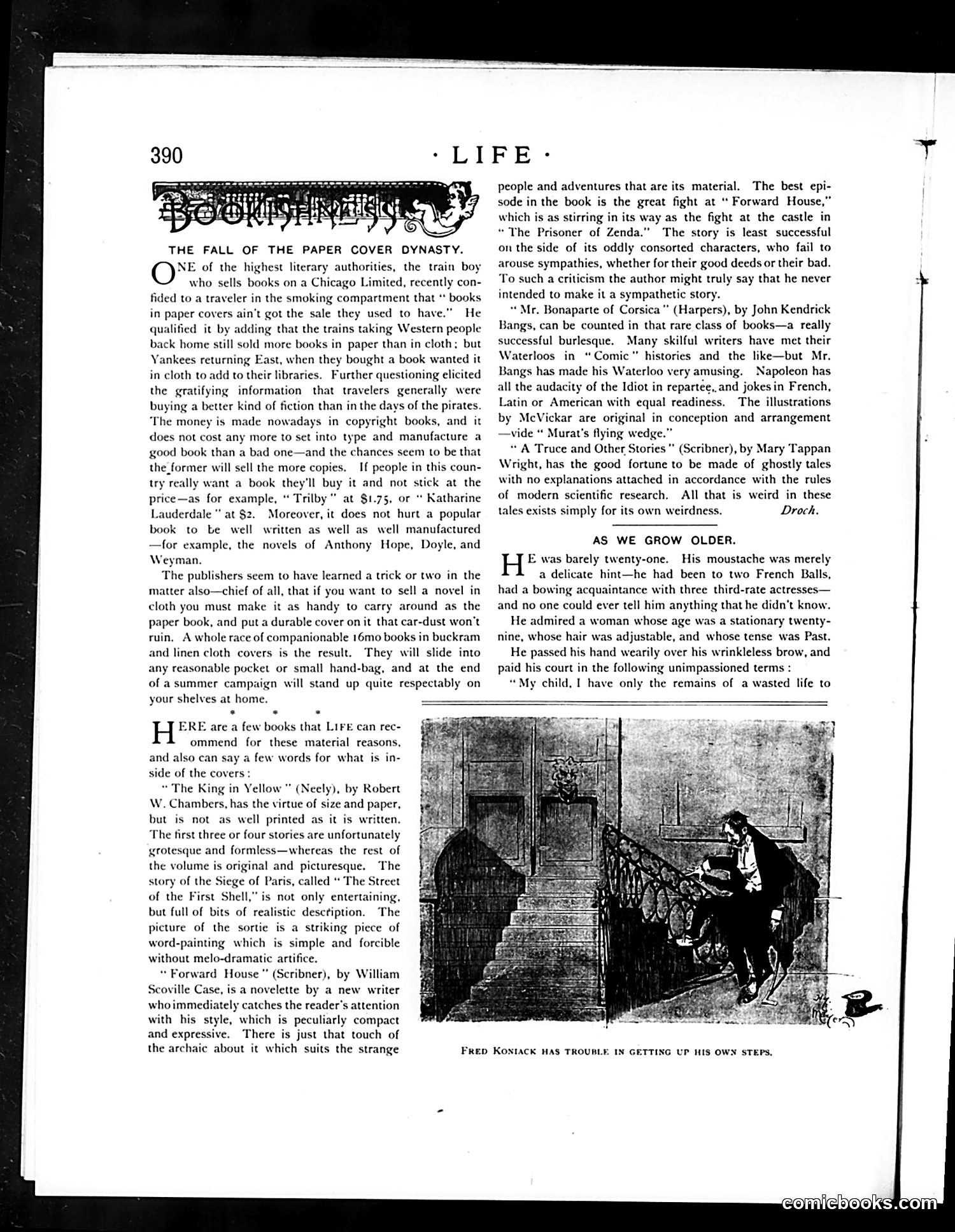
This page contains book reviews rather than political satire. The main illustration shows "Fred Koniak has trouble in getting up his own steps"—a humorous domestic scene depicting a man struggling to climb stairs, likely after drinking. The text discusses paper-covered books, their durability, and manufacturing quality. Reviews mention several works including "The King in Yellow" by Robert W. Chambers and "Forward House" by William Scoville Case. The section "As We Grow Older" presents a brief story about a young man reflecting on romantic failures and wasted youth. There is no clear political commentary or caricature on this page. It functions as a literary column with light domestic humor rather than satirical social criticism typical of Life's editorial content.
📄 Transcribed text from this page (OCR, searchable)
Machine-transcribed from the original scan — historical spelling and the odd misread are preserved.
THE FALL OF THE PAPER COVER DYNASTY. NE of the highest literary authorities, the train boy who sells books on a Chicago Limited, recently con- fided to a traveler in the smoking compartment that ** books He in paper covers ain’t got the sale they used to have.” qualified it by adding that the trains taking Western people back home still sold more books in paper than in cloth; but Yankees returning East, when they bought a book wanted it in cloth to add to their libraries. Further questioning elicited the gratifying information that travelers generally were buying a better kind of fiction than in the days of the pirates. The money is made nowadays in copyright books, and it does not cost any more to set into type and manufacture a good book than a bad one—and the chances seem to be that the former will sell the more copies. If people in this coun- try really want a book they'll buy it and not stick at the price—as for example, “ Trilby” at $1.75, or “ Katharine Lauderdale " at $2. Moreover, it does not hurt a popular book to be well written as well as well manufactured —for example, the novels of Anthony Hope, Doyle, and Weyman. The publishers seem to have learned a trick or two in the matter also—chief of all, that if you want to sell a novel in cloth you must make it as handy to carry around as the paper book, and put a durable cover on it that car-dust won't ruin. A whole race of companionable 16mo books in buckram and linen cloth covers is the result. They will slide into any reasonable pocket or small hand-bag, and at the end of a summer campaign will stand up quite respectably on - LIFE: The best epi- sode in the book is the great fight at ‘ Forward House,” which is as stirring in its way as the fight at the castle in people and adventures that are its material. * The Prisoner of Zenda.” The story is least successful on the side of its oddly consorted characters, who fail to arouse sympathies, whether for their good deeds or their bad. To such a criticism the author might truly say that he never intended to make it a sympathetic story. “ Mr. Bonaparte of Corsica" (Harpers), by John Kendrick Bangs, can be counted in that rare class of books—a really successful burlesque. Many skilful writers have met their Waterloos in “Comic histories and the like—but Mr. Bangs has made his Waterloo very amusing. Napoleon has all the audacity of the Idiot in repartee, and jokesin French, Latin or American with equal readiness. The illustrations by McVickar are original in conception and arrangement —vide “ Murat’s flying wedge.’ “A Truce and Other Stories" (Scribner), by Mary Tappan Wright, has the good fortune to be made of ghostly tales with no explanations attached in accordance with the rules of modern scientific research. All that is weird in these tales exists simply for its own weirdness. Droch. AS WE GROW OLDER. H was barely twenty-one. His moustache was merely a delicate hint—he had been to two French Balls, had a bowing acquaintance with three third-rate actresses and no one could ever tell him anything that he didn’t know. He admired a woman whose age was a stationary twenty- nine, whose hair was adjustable, and whose tense was Past. He passed his hand wearily over his wrinkleless brow, and paid his court in the following unimpassioned terms : “My child, 1 have only the remains of a wasted life to your shelves at home. . . . ERE are a few books that LiFe can rec- ommend for these material reasons, and also can say a few words for what is in- side of the covers : “ The King in Yellow " (Neely), by Robert W. Chambers, has the virtue of size and paper, but is not as well printed as it is written. ‘The first three or four stories are unfortunately grotesque and formless—whereas the res the volume is original and_ picturesque. The story of the Siege of Paris, called “ The Street of the First Shell,” is not only entertaining, but full of bits of realistic desctiption. The picture of the sortie is a striking picce of word-painting which is simple and forcible without melo-dramatic artifice. * Forward House" (Scribner), by William Scoville Case, is a novelette by a new writer who immediately catches the reader's attention with his style, which is peculiarly compact and expressive. There is just that touch of the archaic about it which suits the strange FreD KONIACK HAS TROUBLE IN GETTING UP HIS OWN STEPS.