
Life, 1895-06-13 · page 4 of 16
Life — June 13, 1895 — page 4: what you’re looking at
What you’re looking at
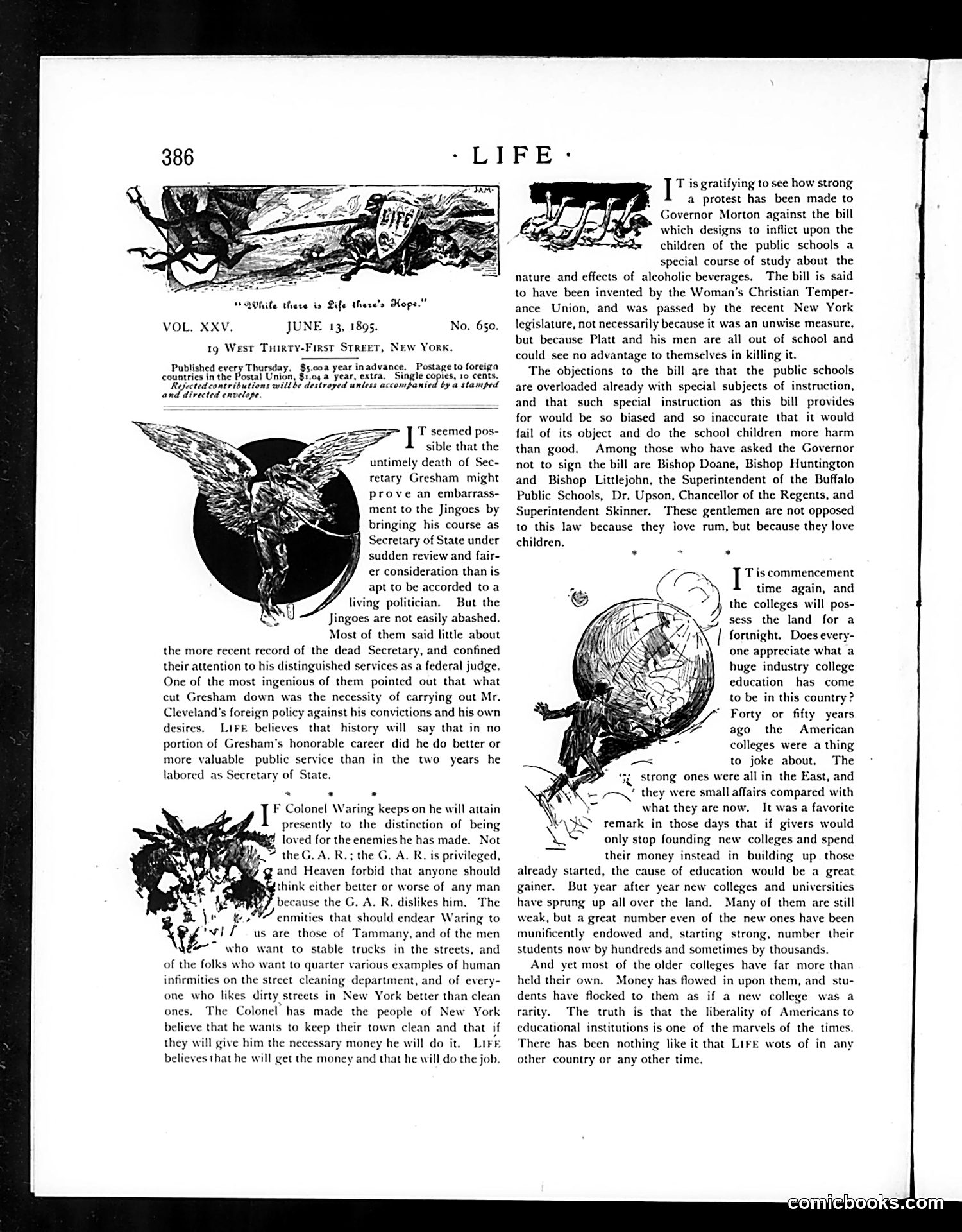
The page contains three distinct editorial sections critiquing New York politics and education policy. **Top cartoon**: Depicts Secretary of State Gresham's death as potentially embarrassing to Governor Morton, who must now justify his policies without Gresham's continued service as federal judge—suggesting political leverage was lost. **Middle section**: Attacks Governor Morton for opposing a bill (likely supported by the Woman's Christian Temperance Union) mandating temperance instruction in public schools. The text names prominent educators who opposed it, arguing the bill was biased and ineffective. **Bottom cartoon**: Shows a figure (likely Colonel Waring, NYC's street-cleaning commissioner) carrying a globe, celebrating American college expansion. The accompanying text praises the growth of American higher education as a national achievement comparable to no other country.
📄 Transcribed text from this page (OCR, searchable)
Machine-transcribed from the original scan — historical spelling and the odd misread are preserved.
hile there is Life there's Hope.” VOL. XXV. JUNE 13, 1895. 1g West Tiety-First Street, New York. Published every Thursday. $s.00a year inadvance. Postage to foreign countries in the Postal Union, $1.04 a year, extra. Single copies, 10 cents, Rejected contributions will be destroyed unless accompanied by a stamped and directed envelope. T seemed pos- sible that the untimely death of Sec- retary Gresham might prove an embarrass- ment to the Jingoes by bringing his course as Secretary of State under sudden review and fair- er consideration than is apt to be accorded toa living politician. But the Jingoes are not easily abashed. Most of them said little about the more recent record of the dead Secretary, and confined their attention to his distinguished services as a federal judge. One of the most ingenious of them pointed out that what cut Gresham down was the necessity of carrying out Mr. Cleveland's foreign policy against his convictions and his own desires. Lire believes that history will say that in no portion of Gresham's honorable career did he do better or more valuable public service than in the two years he labored as Secretary of State. * . . F Colonel Waring keeps on he will attain presently to the distinction of being loved for the enemies he has made. Not ? theG. A. R.; the G. A. R. is privileged, g and Heaven forbid that anyone should Bg think cither better or worse of any man ALY ry? because the G, A. R. dislikes him. The \e ¥ enmities that should endear Waring to ne "wt Tus are those of Tammany, and of the men who want to stable trucks in the streets, and of the folks who want to quarter various examples of human infirmities on the street cleaning department, and of every- one who likes dirty streets in New York better than clean The Colonel has made the people of New York believe that he wants to keep their town clean and that if ones. they will give him the neces: money he will do it. LIFE believes that he will get the money and that he will do the job. I T is gratifying to see how strong a protest has been made to Governor Morton against the bill which designs to inflict upon the children of the public schools a special course of study about the nature and effects of alcoholic beverages. The bill is said to have been invented by the Woman's Christian Temper- ance Union, and was passed by the recent New York legislature, not necessarily because it was an unwise measure, but because Platt and his men are all out of school and could see no advantage to themselves in killing it. The objections to the bill are that the public schools are overloaded already with special subjects of instruction, and that such special instruction as this bill provides for would be so biased and so inaccurate that it would fail of its object and do the school children more harm than good. Among those who have asked the Governor not to sign the bill are Bishop Doane, Bishop Huntington and Bishop Littlejohn, the Superintendent of the Buffalo Public Schools, Dr. Upson, Chancellor of the Regents, and Superintendent Skinner. These gentlemen are not opposed to this law because they love rum, but because they love children. . T iscommencement time again, and the colleges will pos- sess the land for a fortnight. Does every- one appreciate what a huge industry college education has come to be in this country ? Forty or fifty ago the America colleges were a thing to joke about. The Z strong ones were all in the East, and = aw they were small affairs compared with i what they are now, It was a favorite M\ S remark in those days that if givers would Nas only stop founding new colleges and spend _ their money instead in building up those already started, the cause of education would be a great gainer. But year after year new colleges and universities have sprung up all over the land. Many of them are still weak, but a great number even of the new ones have been munificently endowed and, starting strong, number their students now by hundreds and sometimes by thousands. And yet most of the older colleges have far more than held their own. Money has flowed in upon them, and stu- dents have flocked to them as if a new college was a rarity. The truth is that the liberality of Americ educational institutions is one of the marvels of the times There has been nothing like it that LiFe wots of in any other country or any other time.