
Life, 1895-06-13 · page 6 of 16
Life — June 13, 1895 — page 6: what you’re looking at
What you’re looking at
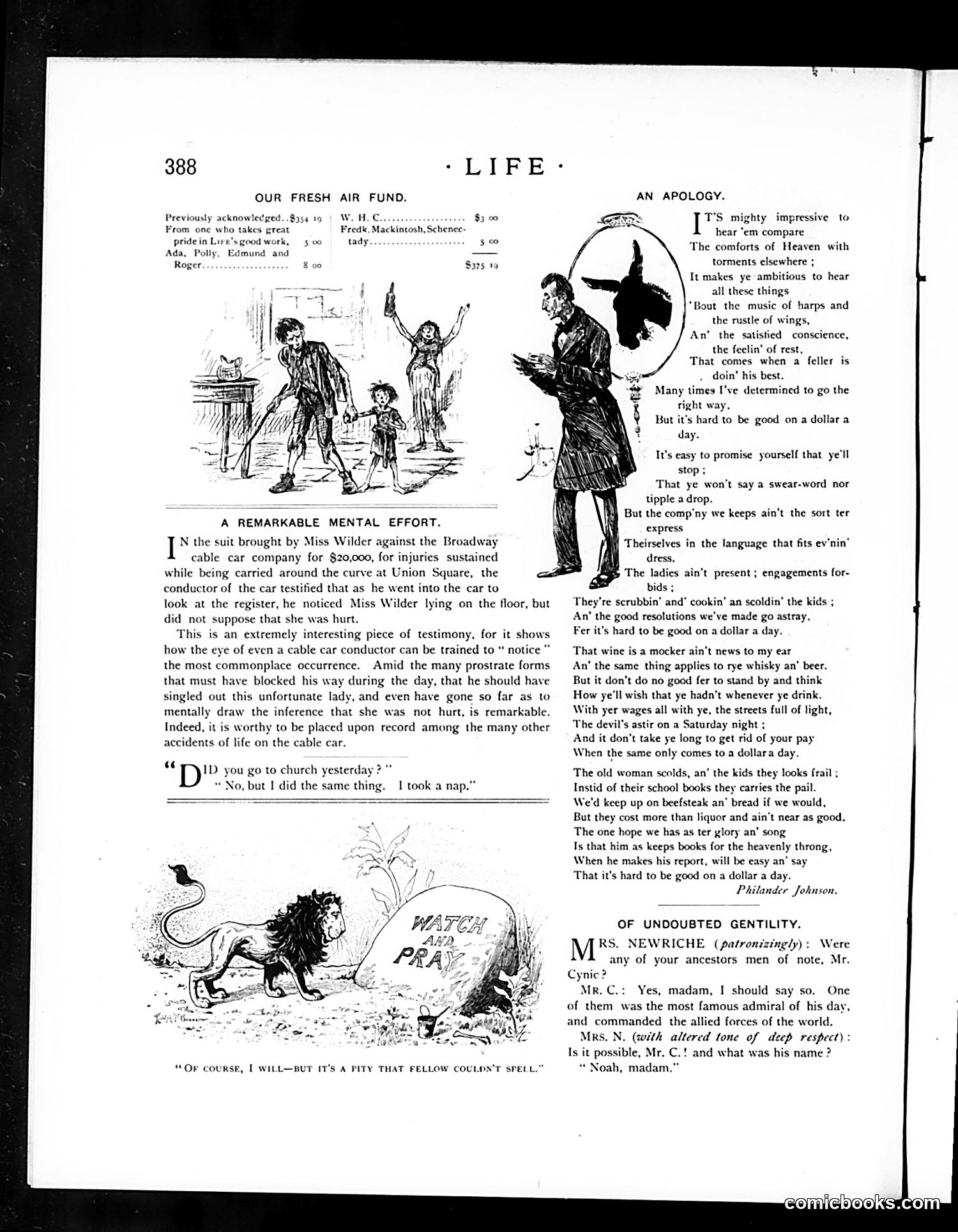
**"A Remarkable Mental Effort"** describes a lawsuit by Miss Wilder against a Broadway cable car company for $20,000 following injuries at Union Square. The satire highlights the conductor's acute observation: despite being knocked down and lying on the floor, he claimed not to have noticed he was hurt. The cartoon mocks how streetcar workers were trained to deny injuries to avoid company liability—requiring them to mentally suppress obvious physical trauma. This satirizes both corporate negligence and the absurd expectations placed on workers to sacrifice their wellbeing for employer protection. **"An Apology"** is a poem by Philander Johnson about the difficulty of maintaining moral virtue on meager wages ("hard to be good on a dollar a day"), addressing poverty's grip on working-class morality. **"Of Undoubted Gentility"** appears to be a brief comedic dialogue.
📄 Transcribed text from this page (OCR, searchable)
Machine-transcribed from the original scan — historical spelling and the odd misread are preserved.
388 -LIFE: OUR FRESH AIR FUND. WethiGcasss 5 Fredk, Mackintosh, Schenec- tady Previously acknowledged. .$354 19 From one who takes great pride in Live's good work, Ada, Polly, Edmund Roger $3 00 300 sco and $375 19 A REMARKABLE MENTAL EFFORT. N the suit brought by Miss Wilder against the Broadway cable car company for $20,000, for injuries sustained while being carried around the curve at Union Square, the conductor of the car testified that as he went into the car to look at the register, he noticed Miss Wilder lying on the floor, but did not suppose that she was hurt. This is an extremely interesting piece of testimony, for it shows how the eye of even a cable car conductor can be trained to “ notice” the most commonplace occurrence. Amid the many prostrate forms that must have blocked his way during the day, that he should have singled out this unfortunate lady, and even have gone so far as to mentally draw the inference that she was not hurt, is remarkable. Indeed, it is worthy to be placed upon record among the many other accidents of life on the cable car. §€ 1b you go to church yesterday “ No, but I did the same thing. | took a nap.” “OF COURSE, | WILL—BUT IT'S A PITY THAT FELLOW COULDN'T SPELL.” AN APOLOGY. I" mighty impressive to hear ‘em compare The comforts of Heaven with torments elsewhere ; It makes ye ambitious to hear all these things “Bout the music of harps and the rustle of wings, the satisfied conscience, the feelin’ of rest. That comes when a feller is doin’ his best. Many times I've determined to go the right way, But it’s hard to be good ona dollar a day. An’ It's easy to promise yourself that ye'll stop ; That ye won't say a swear-word nor tipple a drop. But the comp‘ny we keeps ain’t the sort ter express ] Theirselves in the language that fits ev'nin’ dress. ‘The ladies ain't present ; engagements for- bids ; They're scrubbin’ and’ cookin’ an scoldin’ the kids ; An’ the good resolutions we've made go astray, Fer it’s hard to be good on a dollar a day. That wine is a mocker ain't news to my ear An’ the same thing applies to rye whisky an’ beer. But it don't do no good fer to stand by and think How ye'll wish that ye hadn’t whenever ye drink. With yer wages all with ye, the streets full of light, ‘The devil's astir on a Saturday night ; And it don't take ye long to get rid of your pay When the same only comes to a dollara day. The old woman scolds, an’ the kids they looks frail ; Instid of their school books they carries the pail. We'd keep up on beefsteak an’ bread if we would, But they cost more than liquor and ain’t near as good. The one hope we has as ter glory an’ song Is that him as keeps books for the heavenly throng, When he makes his report, will be easy an’ say That it’s hard to be good on a dollar a day. Philander Johnson. OF UNDOUBTED GENTILITY. RS. NEWRICHE (patronizingly): Were any of your ancestors men of note, Mr. Cynic? Mr. C.: Yes, madam, I should say so. One of them was the most famous admiral of his day, and commanded the allied forces of the world. Mrs. N. (with altered tone of deep respect): Is it possible, Mr. C.! and what was his name ? “Noah, madam.”