
A complete issue · 18 pages · 1895
Life — May 23, 1895
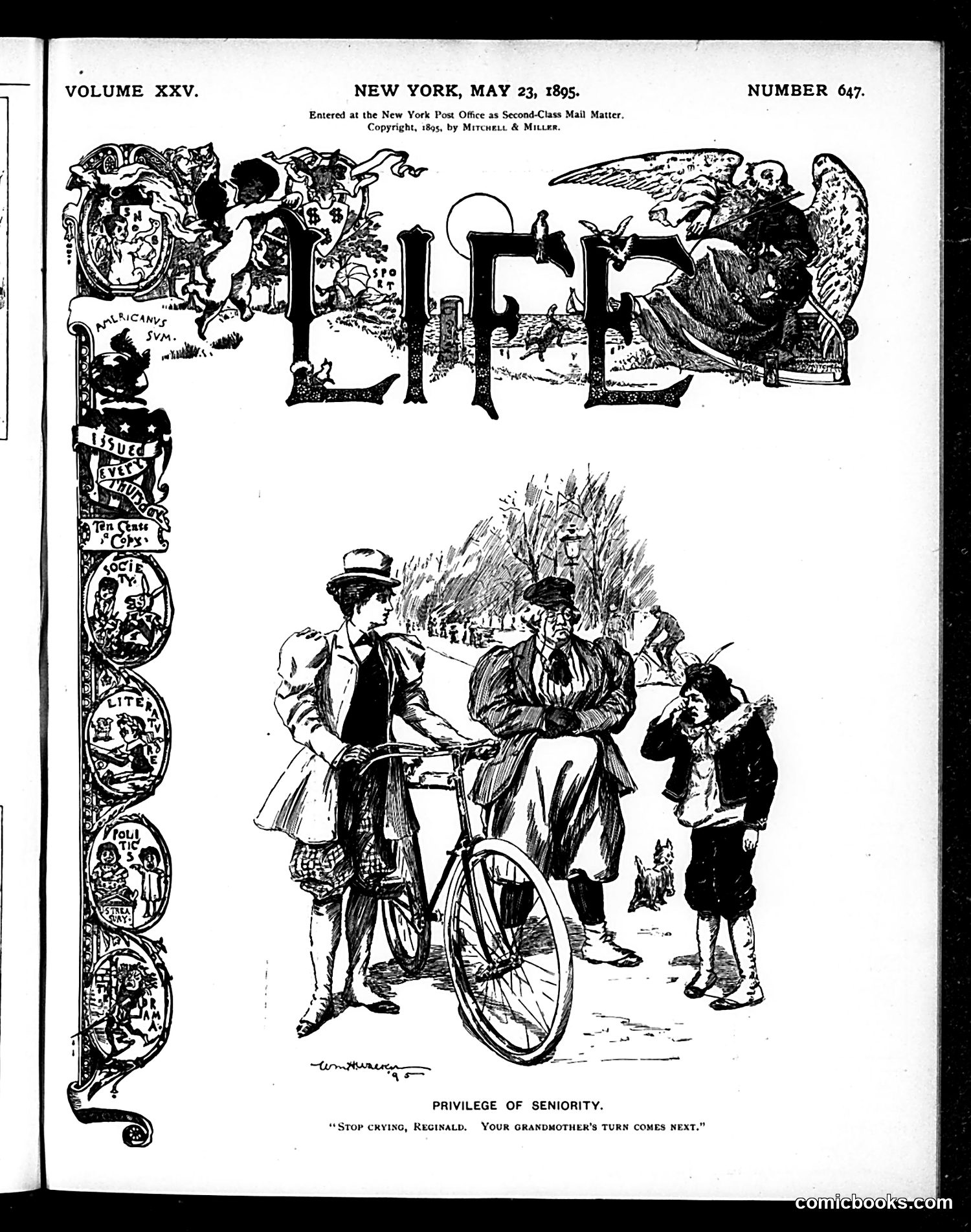
The cartoon titled "Privilege of Seniority" depicts a social hierarchy joke about bicycle riding. A young woman on a bicycle is being corrected by an older woman (likely her grandmother), who says "Stop crying, Reginald. Your grandmother's turn comes next." The humor relies on late-Victorian anxieties about bicycles—which were novel, controversial technologies that challenged gender norms by allowing women mobility and independence. The cartoon satirizes generational conflict: the impatient youth must defer to elders' claims on shared resources, even newfangled ones like bicycles. The ornamental sidebar contains Life magazine's various mastheads and emblems, establishing its satirical publication identity.
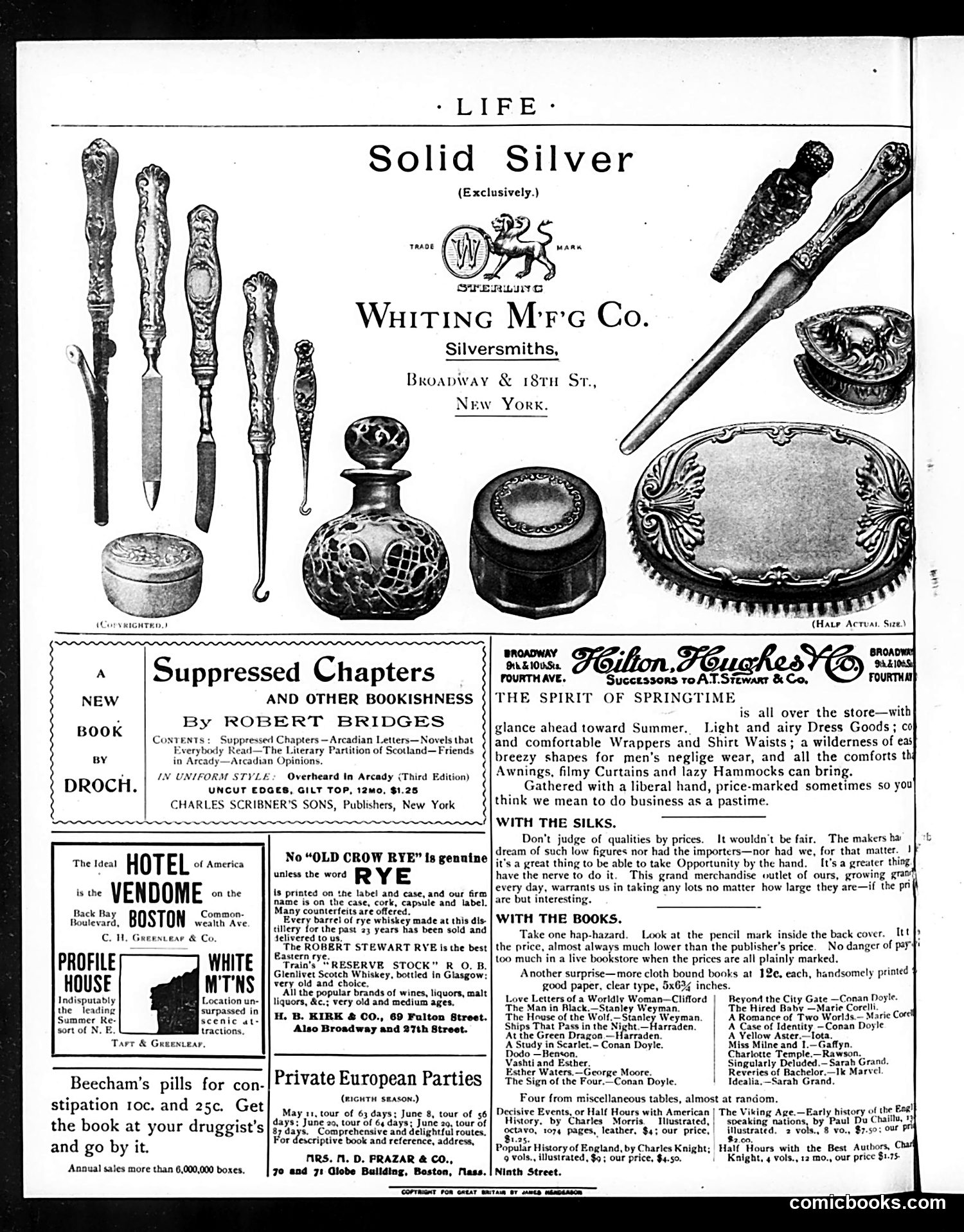
This page is primarily **advertising content**, not political satire. The dominant feature is a large advertisement for **Whiting Mfg Co., silversmiths** located on Broadway & 18th Street, New York, showcasing solid silver items like letter openers, boxes, and decorative vessels. The surrounding advertisements include: - A book about "Suppressed Chapters" by Robert Bridges - Hotels and restaurants (Vendome, Profile House) - Beecham's pills - European travel tours - Various retail establishments There are no political cartoons or satirical commentary visible on this page. It represents a typical early 20th-century *Life* magazine layout, where editorial content shared space with commercial advertisements from established New York businesses and publishers.
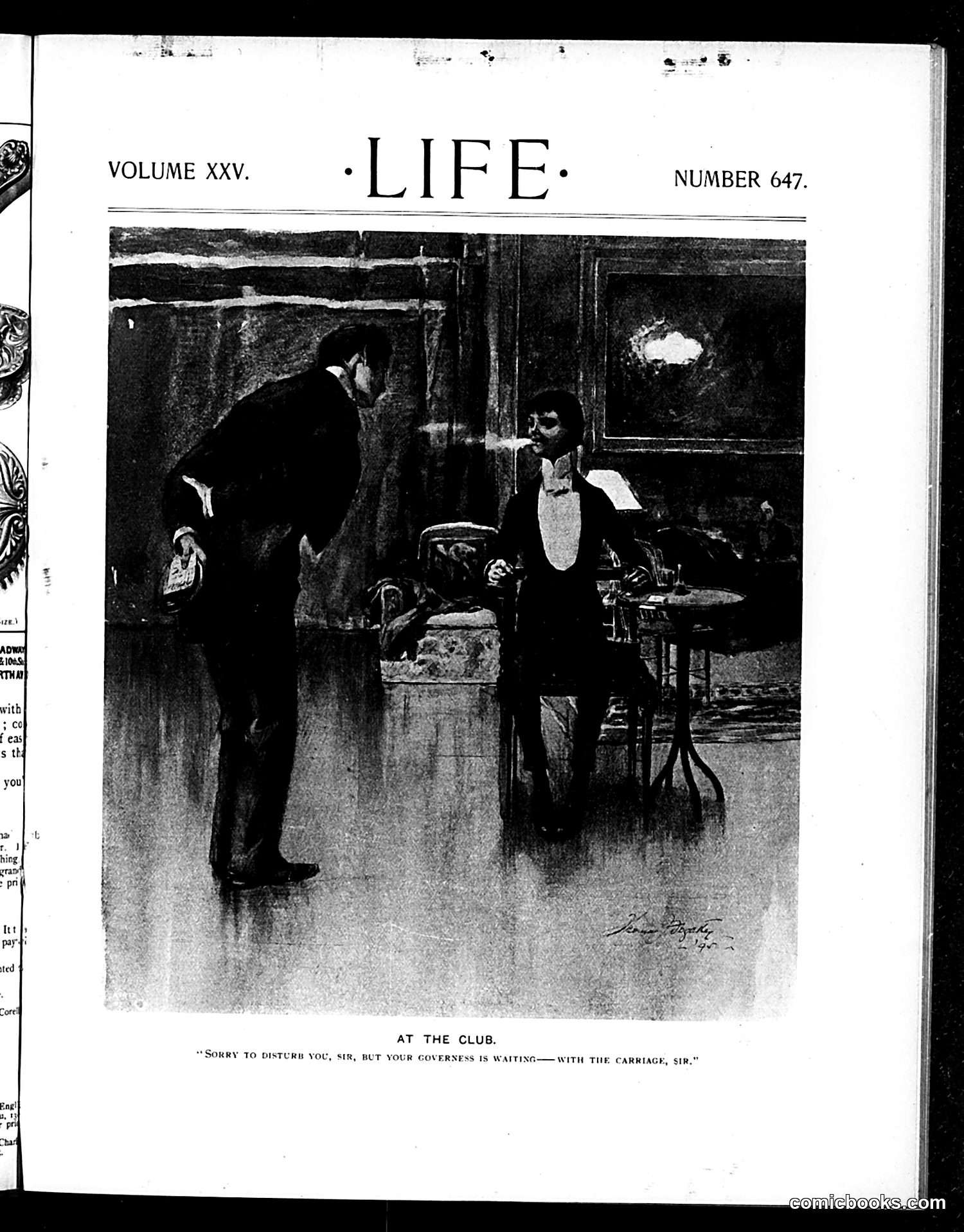
This illustration from Life magazine depicts a scene titled "At the Club" with the caption: "Sorry to disturb you, sir, but your governess is waiting—with the carriage, sir." The satire targets upper-class social pretension. A formally dressed gentleman at what appears to be an exclusive club is interrupted by a servant, who informs him that his governess—typically an employee hired to care for children—is waiting outside with a carriage. The humor lies in the absurdity and embarrassment of a grown man of apparent means being fetched by his governess like a child, suggesting either dependency, immaturity, or that his social status is less secure than he presents. The interruption in his club setting amplifies the social humiliation intended by the joke.
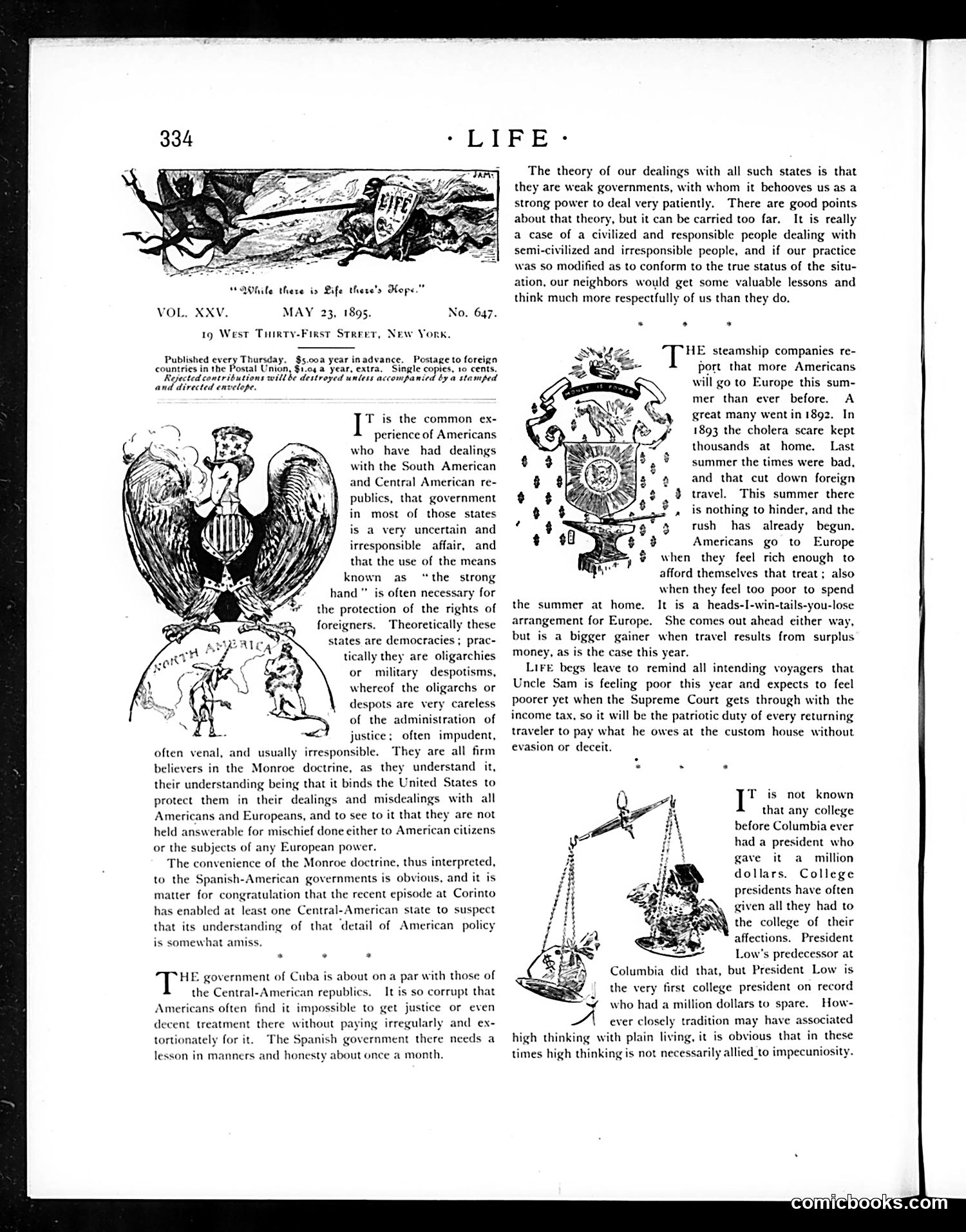
The page features editorial commentary on U.S. foreign policy toward Central and South American republics. The American eagle illustration represents the Monroe Doctrine, which claimed U.S. protection over the Western Hemisphere. The text criticizes Central American governments as corrupt, unstable oligarchies requiring U.S. intervention. It specifically references a recent incident at Corinto (likely a Central American port), suggesting American diplomatic involvement was justified. The author argues these weak governments need U.S. oversight to protect American citizens and interests. A secondary item discusses Columbia University's president receiving a million-dollar gift—notable because the institution supposedly valued plain living, making such wealth accumulation seem hypocritical. The satire targets both foreign instability and domestic contradictions in American values.
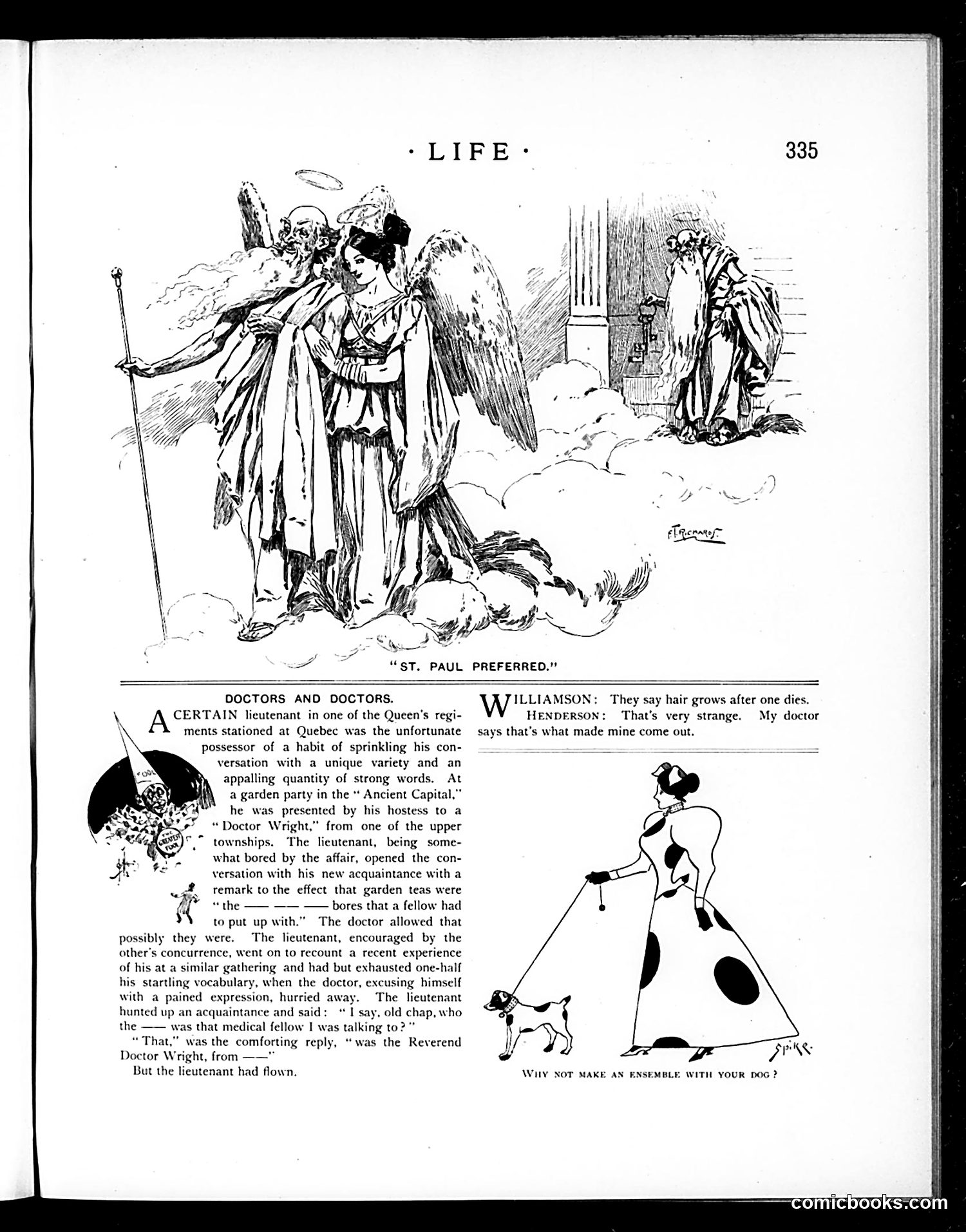
**Top Illustration ("St. Paul Preferred"):** This allegorical drawing depicts religious figures (likely Saint Paul and another saint or angel) in heaven, with a gatekeeper figure on the right. The caption suggests a humorous preference for Saint Paul's company in the afterlife, though the specific religious or contemporary reference remains unclear without additional context. **"Doctors and Doctors" Text Section:** A anecdote mocking a Lieutenant's crude language at a Quebec garden party. When a doctor introduces himself as "Doctor Wright," the Lieutenant confuses him with a Reverend Doctor Wright, creating an embarrassing social moment. The humor relies on the Lieutenant's coarse vocabulary and social awkwardness. **Bottom Cartoon:** A satirical drawing captioned "Why Not Make an Ensemble with Your Dog?" depicting a woman and dog in matching spotted outfits—mocking fashionable absurdity of coordinating clothing with pets.
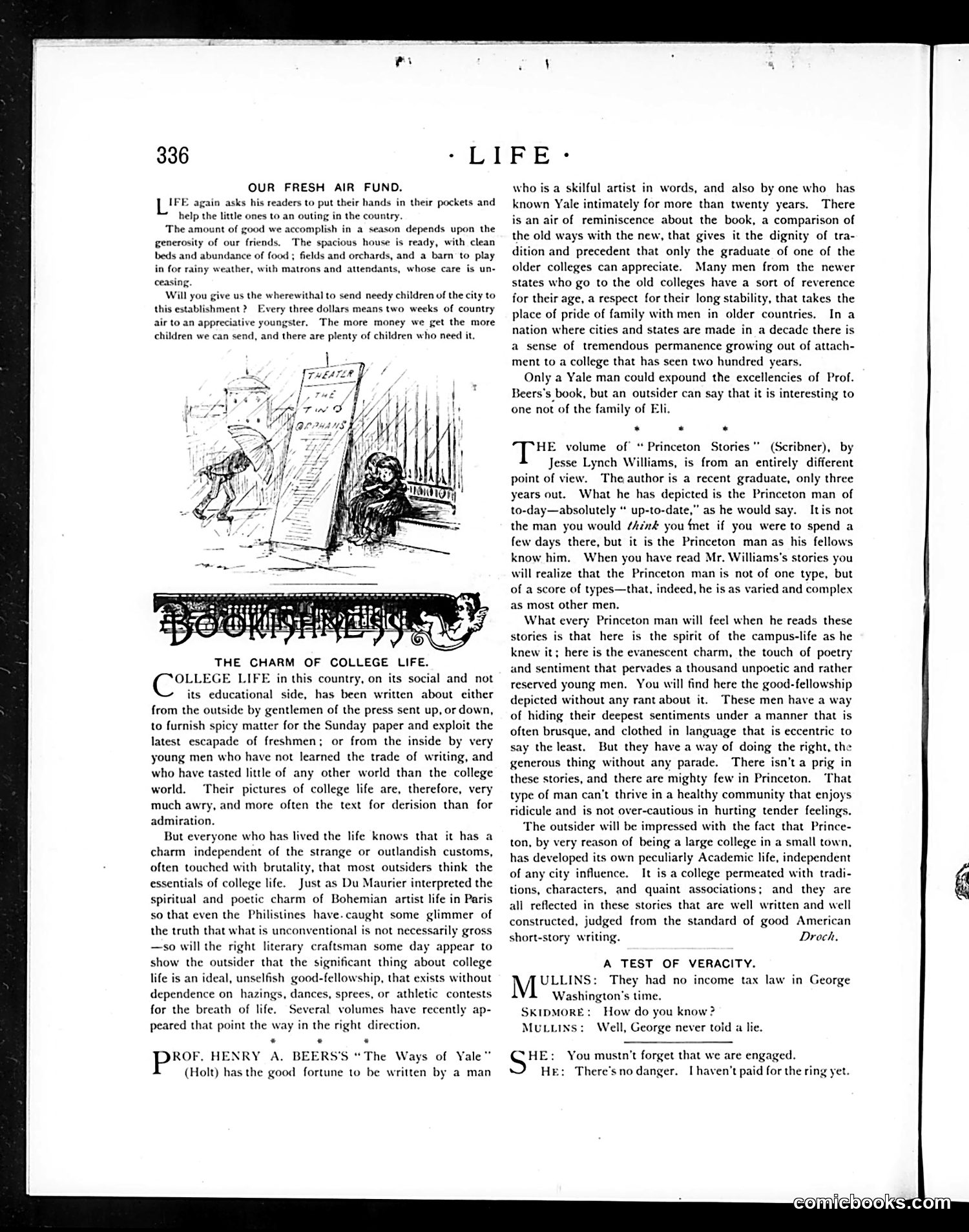
This page contains three distinct pieces rather than a unified political cartoon: 1. **"Our Fresh Air Fund"** (top): An illustration showing urban children receiving country air exposure—a charitable initiative. The sketch depicts kids at what appears to be a rural establishment. 2. **"The Charm of College Life"** (center): A lengthy essay discussing Princeton's distinctive character and culture, praising Jesse Lynch Williams's recent book "Princeton Stories." The text emphasizes Princeton's independence from urban influence and its cultivation of "good-fellowship" among students. 3. **"A Test of Veracity"** (bottom): A brief humorous dialogue joking about income tax evasion during George Washington's era—playing on the anachronism that no income tax existed then. The page primarily promotes collegiate ideals and charitable work rather than attacking specific political targets.
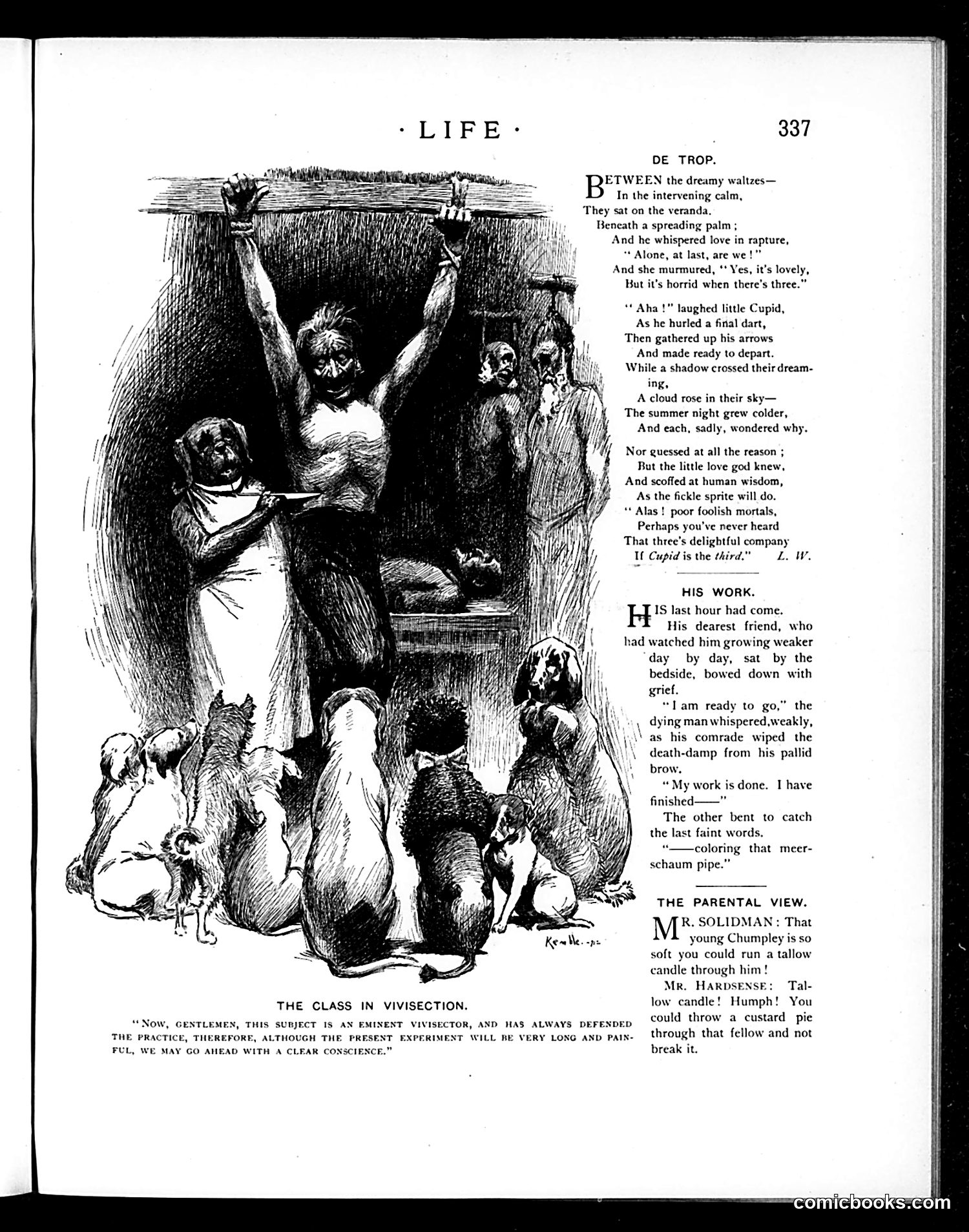
This cartoon satirizes medical education practices through a darkly comedic scene. A female anatomy student or cadaver is suspended while surrounded by male medical students and instructors conducting dissection. The caption quotes an authority figure defending vivisection (live animal experimentation) as necessary scientific practice. The satire targets two things: the gruesome nature of medical training and—given the female subject—likely contemporary debates about women entering medicine. The subsequent sections mock parental objections to such education ("too soft," references to tallow candles and custard pies) while the instructor defends scientific rigor. The joke relies on shocking imagery to critique both medical brutality and resistance to women's professional advancement, presented through Victorian satirical humor.
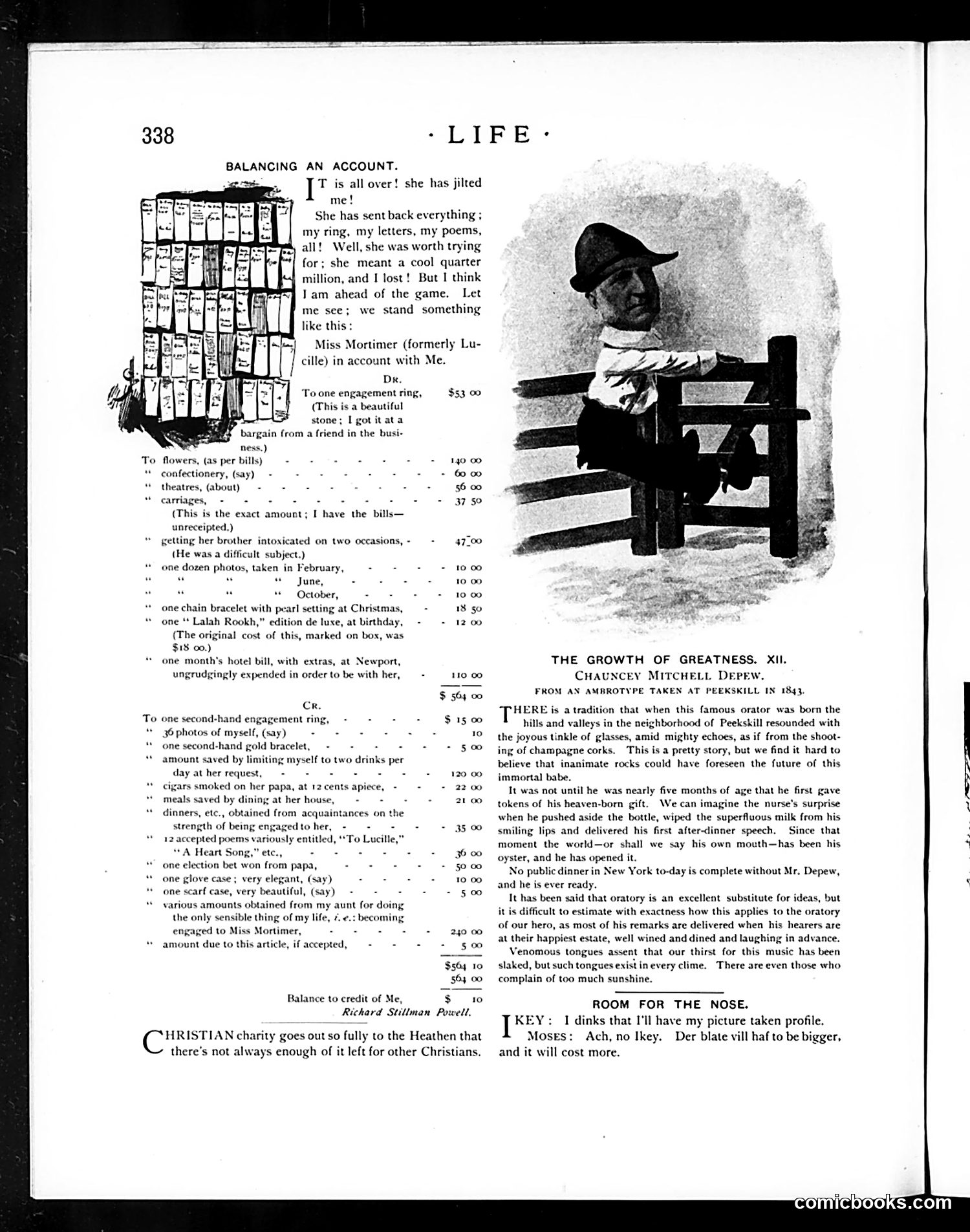
This page contains two distinct sections: **Left side:** A humorous article titled "BALANCING AN ACCOUNT" depicting a detailed financial reckoning between a man and "Miss Mortimer (formerly Lucille)." The narrator catalogs expenses from their relationship—engagement ring ($53), flowers, theater tickets, photographs, dinners, poems, and other courtship costs totaling $564.10. The joke satirizes the transactional nature of romance and broken engagements: he's calculating what he's "owed" after she jilted him. The accompanying small illustration shows a precarious stack of bills/receipts. **Right side:** "THE GROWTH OF GREATNESS. XII. CHAUNCEY MITCHELL DEPEW" features an anecdotal essay about the famous orator's infancy, claiming rocks could have "foreseen" his future greatness. Below is a brief comic dialogue titled "ROOM FOR THE NOSE" between characters Key and Moses about photograph sizing. The overall page uses humor to mock relationship economics and celebrity mythologizing—typical satirical targets for *Life* magazine.
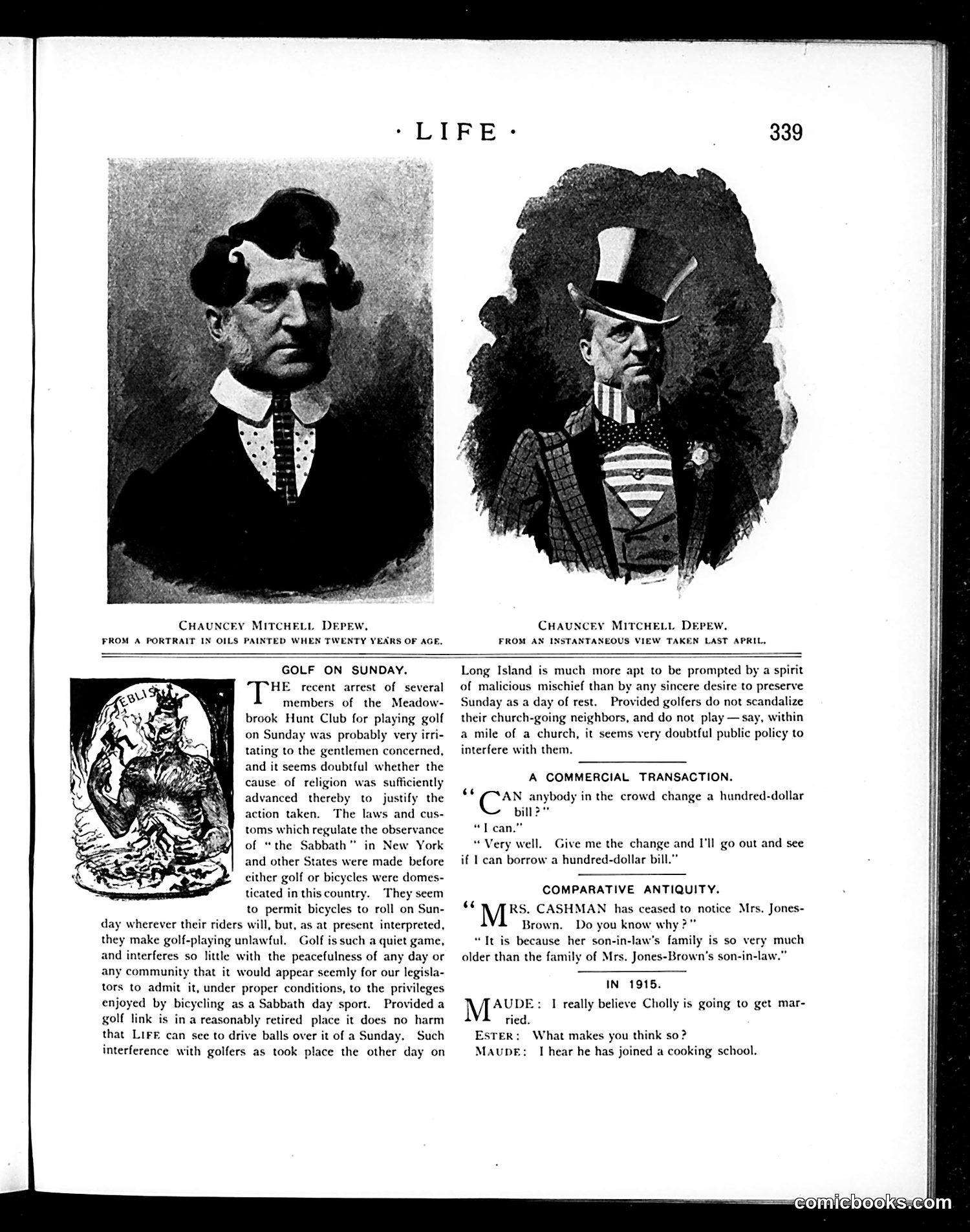
This page from *Life* magazine contains three satirical pieces mocking early 20th-century social behavior: 1. **Two portraits of "Chauncey Mitchell Depew"** — a historical figure (railroad executive and politician) shown at different ages, illustrating vanity or the passage of time. 2. **"Golf on Sunday"** — A lengthy editorial cartoon critiquing the controversy over playing golf on the Sabbath. The piece argues that while some religious leaders opposed Sunday golf, the practice doesn't genuinely harm religion and should be permitted as a reasonable leisure activity for retired persons. 3. **Three brief humorous dialogues** addressing commercial transactions, social pretense, and marriage prospects — typical satirical vignettes mocking middle-class manners and assumptions of the era.
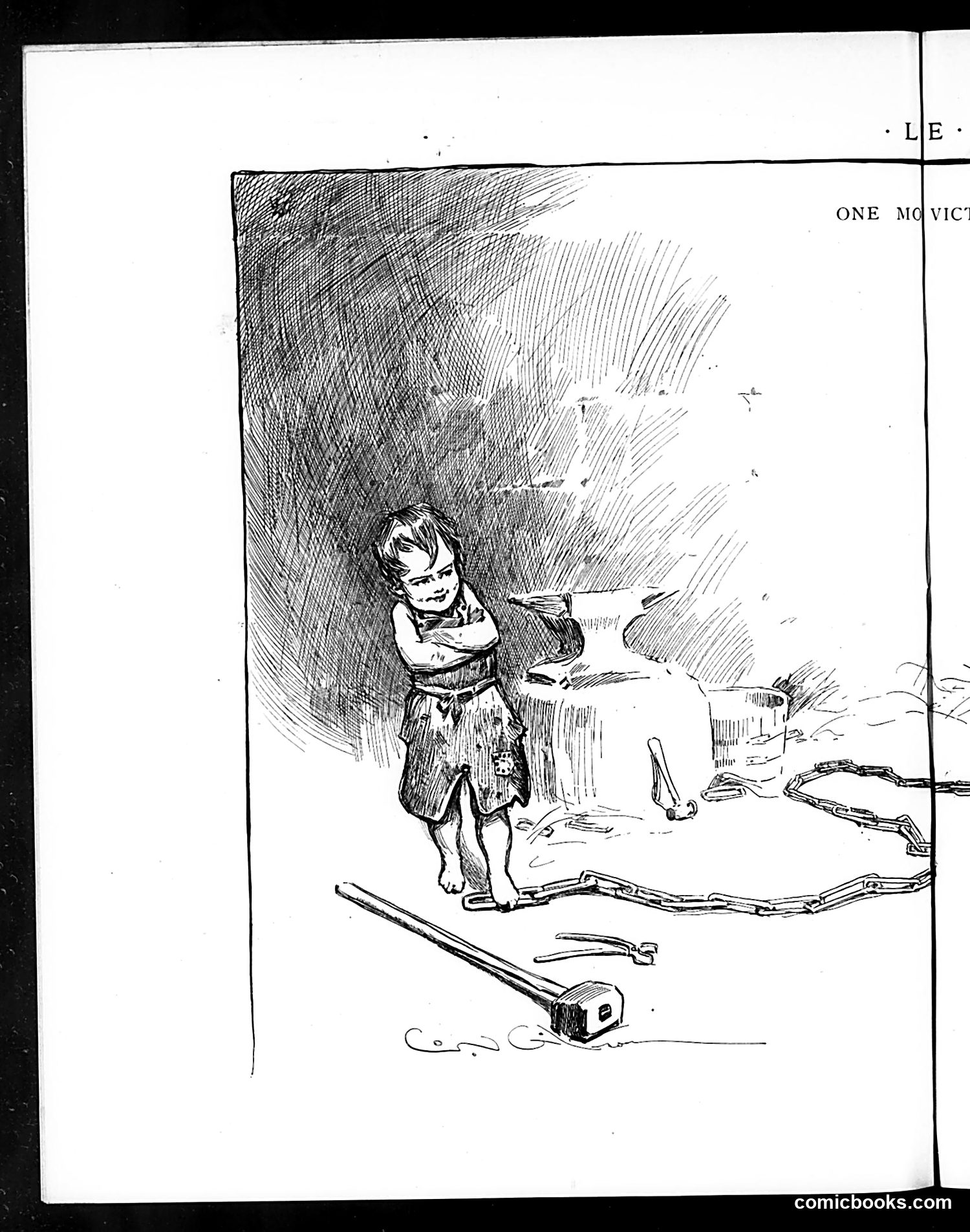
This appears to be a satirical illustration from *Life* magazine showing a small, poorly-clothed child chained and standing amid squalid conditions—broken tools, chains, and sparse surroundings. The child appears gaunt and neglected. The cartoon likely critiques **child labor** practices, a major social reform issue in early 20th-century America. The chains, poor clothing, and desolate setting symbolize the exploitation and captivity of working children in factories and mills. The broken tools suggest dangerous, inadequate working conditions. Without visible text identifying specific legislation, politicians, or companies, the cartoon's precise target remains unclear, but it represents broader Progressive Era advocacy against child labor abuse—a significant social justice concern of that period.
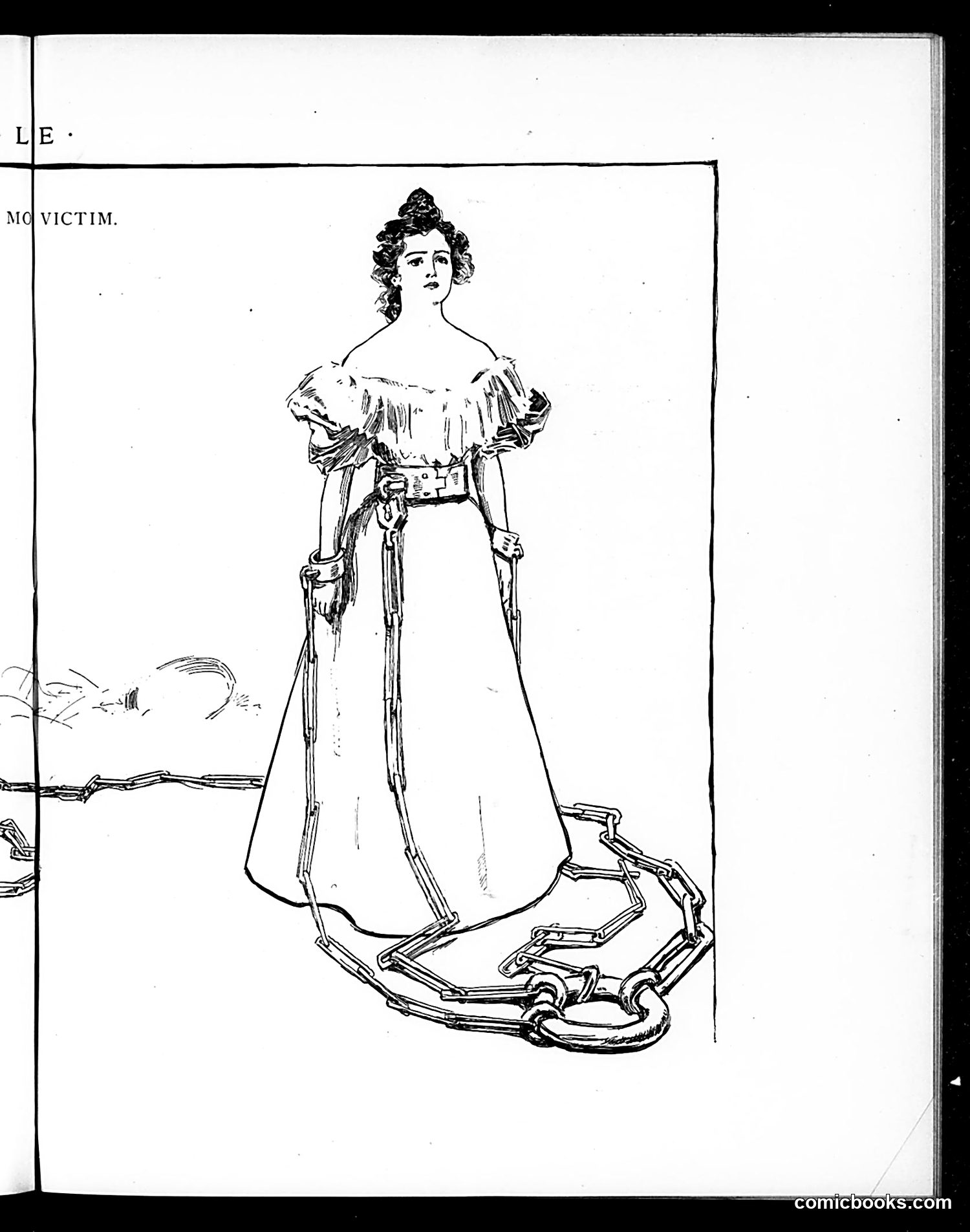
This illustration depicts a woman in Edwardian-era dress (early 1900s) bound in heavy chains. The caption reads "VICTIM," suggesting social commentary on women's status. The chains likely represent either marriage, legal restrictions on women's rights, or broader social constraints. Given *Life* magazine's satirical nature, this appears to critique the limited freedoms and legal disabilities women faced during this period—when married women had restricted property rights, couldn't vote, and had few legal protections. The elegant dress and composed posture contrast starkly with the chains, emphasizing the irony: despite outward refinement and social position, women remained legally and socially bound. This likely supported contemporary women's rights activism. Without additional context or dates visible, the exact campaign this references remains unclear.
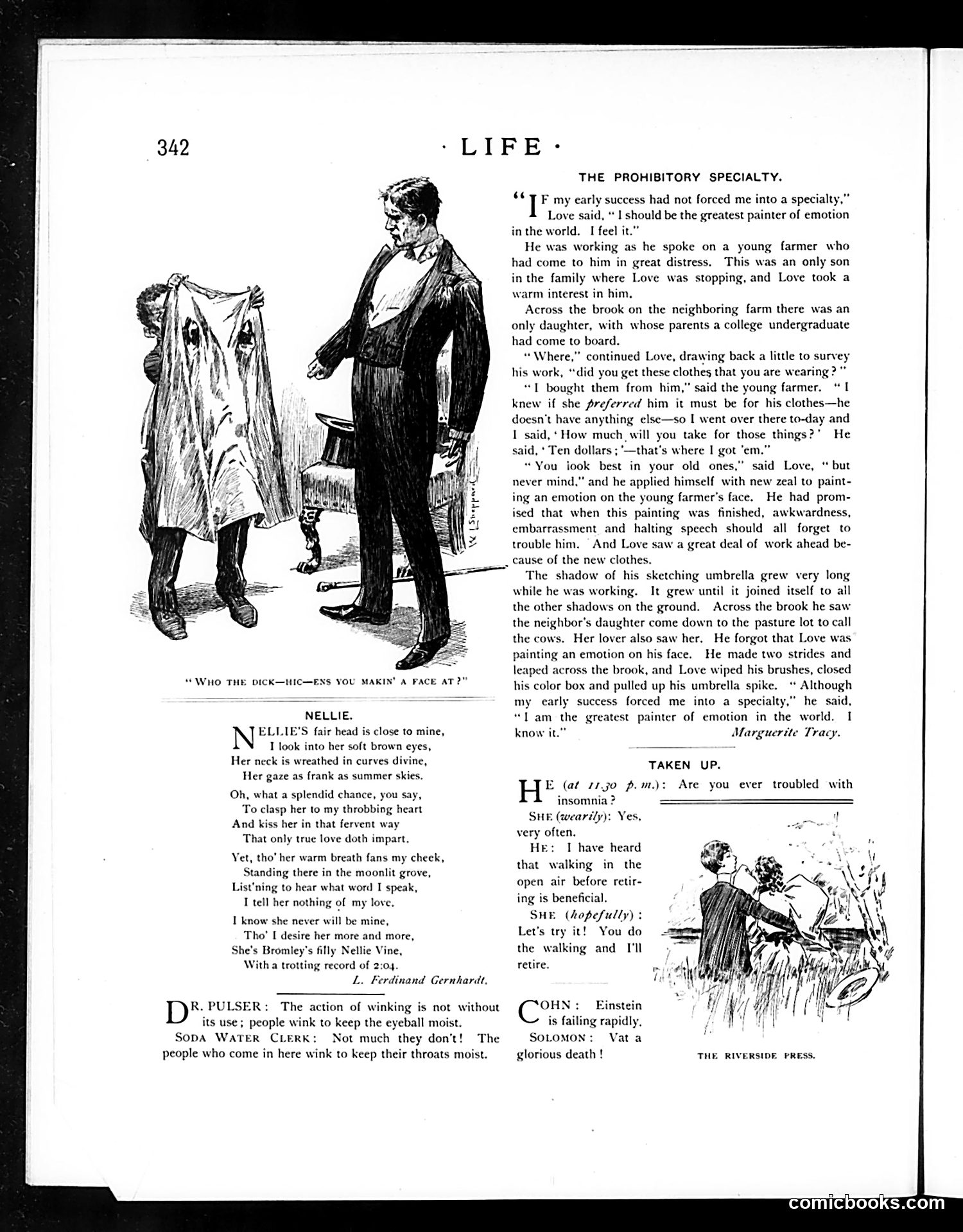
This page contains three satirical pieces from *Life* magazine: 1. **"Nellie"** (poem with illustration): A humorous take on unrequited love—a man pines for a woman he cannot have because she's a prized racehorse ("Bromley's filly Nellie Vine, / With a trotting record of 2:"). The joke inverts romantic sentiment by making the beloved literally a horse. 2. **"The Prohibitory Specialty"** (main story): A painter named Love specializes in painting "emotions." He attempts to boost a poor farmer's romantic chances by buying him better clothes to compete with a college boy. When the farmer's rival sees the neighboring girl, he forgets Love's work and leaps across the brook to her. The title references Prohibition-era concerns about how alcohol affected courtship and morality. 3. **"Taken Up"** (brief comic dialogue): A wife suggests her insomniac husband take a nighttime walk for health—clearly intending to get him out of the house so she can sleep peacefully. All pieces employ light satire about romance, class, and domestic life.
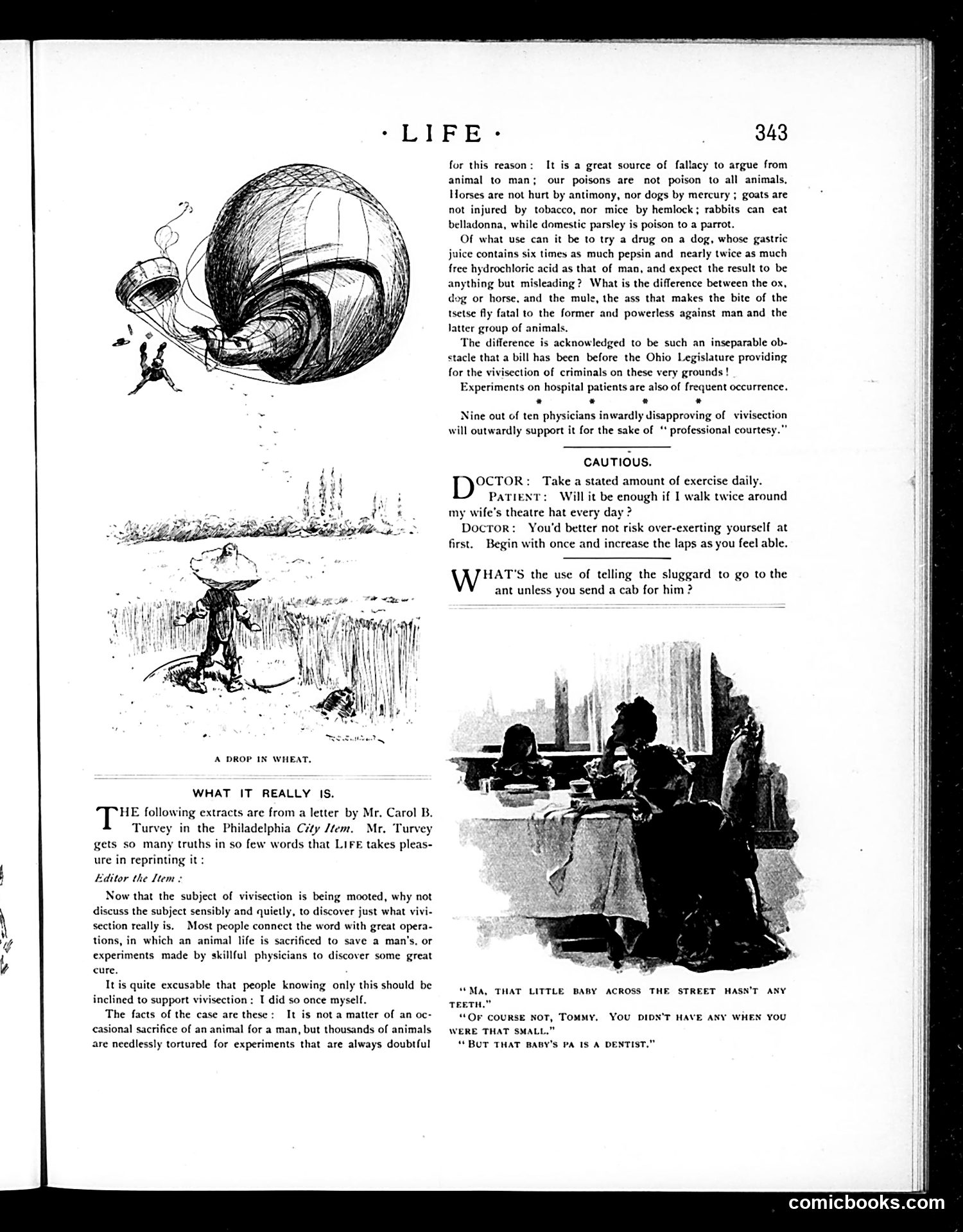
This page critiques **vivisection** (animal testing), a hotly debated practice in the early 20th century. The main article reprints a letter from Carol B. Turvey arguing that vivisection is scientifically worthless and needlessly cruel. His key point: animals respond differently to drugs than humans do (horses tolerate antimony, dogs tolerate mercury, etc.), making experimental results misleading. He notes Ohio even considered vivisecting criminals based on this logic. The illustrations are satirical humor unrelated to vivisection: one shows a doctor's patient joking that walking around his wife's large theatrical hat counts as exercise; another makes a dentist joke (a baby has no teeth because his father is a dentist—implying poor dental health in the family). The piece advocates for ending animal experimentation on both ethical and scientific grounds, positioning vivisection as pseudoscience dressed up as medical progress.
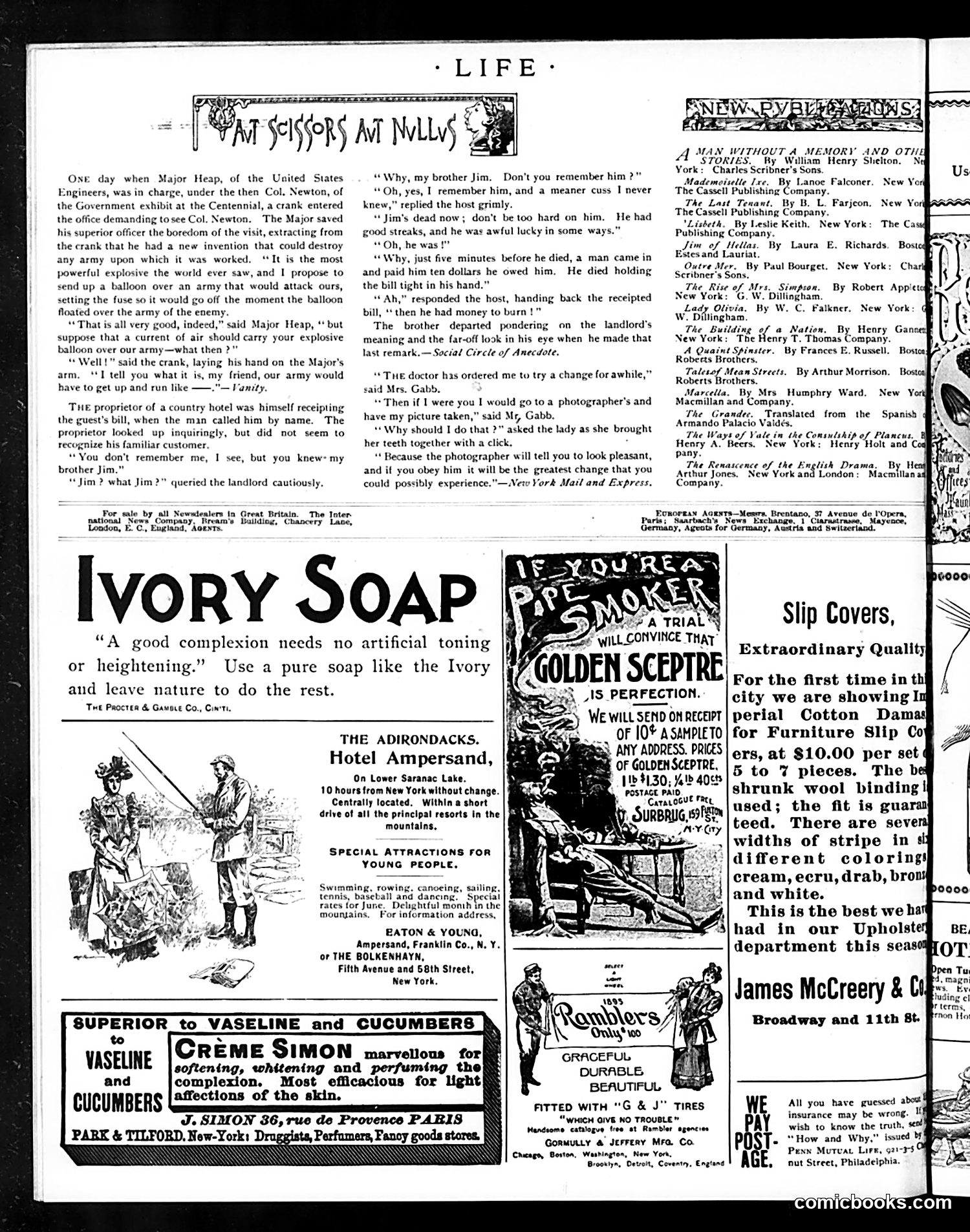
This page contains three humorous anecdotes rather than political cartoons: 1. **The Centennial Invention Story**: A crank pitches an explosive balloon weapon to Major Heap at the 1876 Centennial Exhibition. The joke: when asked what happens if wind blows the bomb toward *their own* army, the inventor suggests the army simply "run like—" (Vanity), implying they'd flee in shame. The satire targets both absurd inventors and military absurdity. 2. **The Dead Brother**: A man tells a hotel proprietor his brother Jim recently died. The host had called Jim "a meaner cuss" he'd known. The punchline: Jim's last act was clutching a $10 payment someone finally made him—so the host quips he "had money to burn," a cutting remark implying Jim's character was so worthless even this windfall meant nothing. 3. **The Photographer's Advice**: A wife asks a photographer how to look pleasant for a portrait. He suggests visiting a photographer, claiming it would be "the greatest change" in her appearance—insulting her naturally unpleasant demeanor. The remaining content is advertisements (Ivory Soap, Vaseline, Ramblers bicycles).
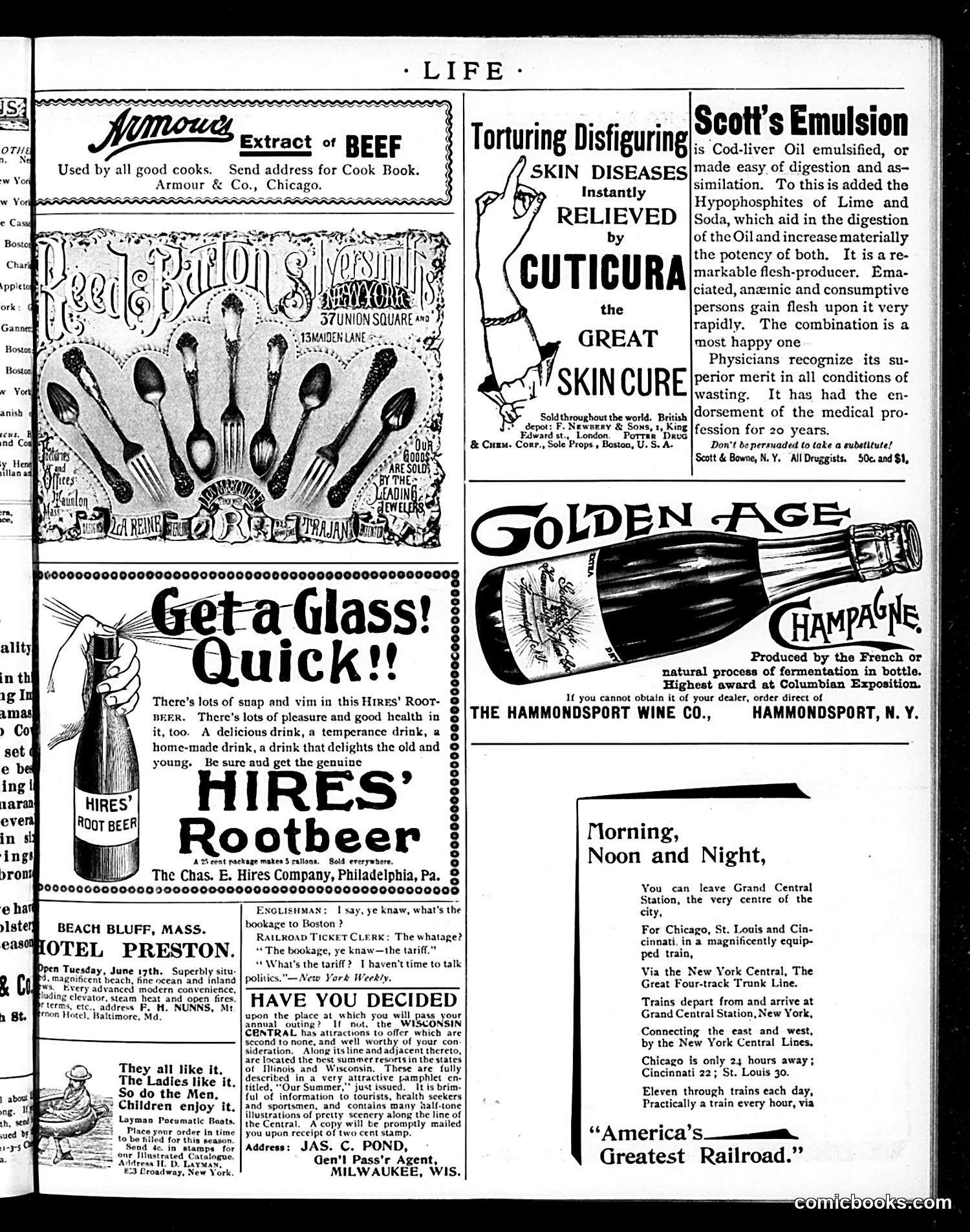
This page is **primarily advertisements** with one small political joke. The ads promote patent medicines and beverages typical of the era (Beef Extract, Cuticura skin cream, Scott's Emulsion cod-liver oil, Hires Root Beer, Golden Age Champagne) alongside railroad and hotel services. The only satirical content is a brief **"Englishman" joke** showing a British tourist asking a railroad clerk about "bookage to Boston," then claiming he hasn't time to discuss "politics"—punning on "tariff." This likely references **late-19th-century American protectionist tariff debates**, mocking both British indifference to American economic policy and the ubiquity of tariff arguments in public discourse. The remaining content consists of hotel and railroad advertisements promoting leisure travel and accommodations, reflecting Life's dual role as satirical magazine and advertising platform.
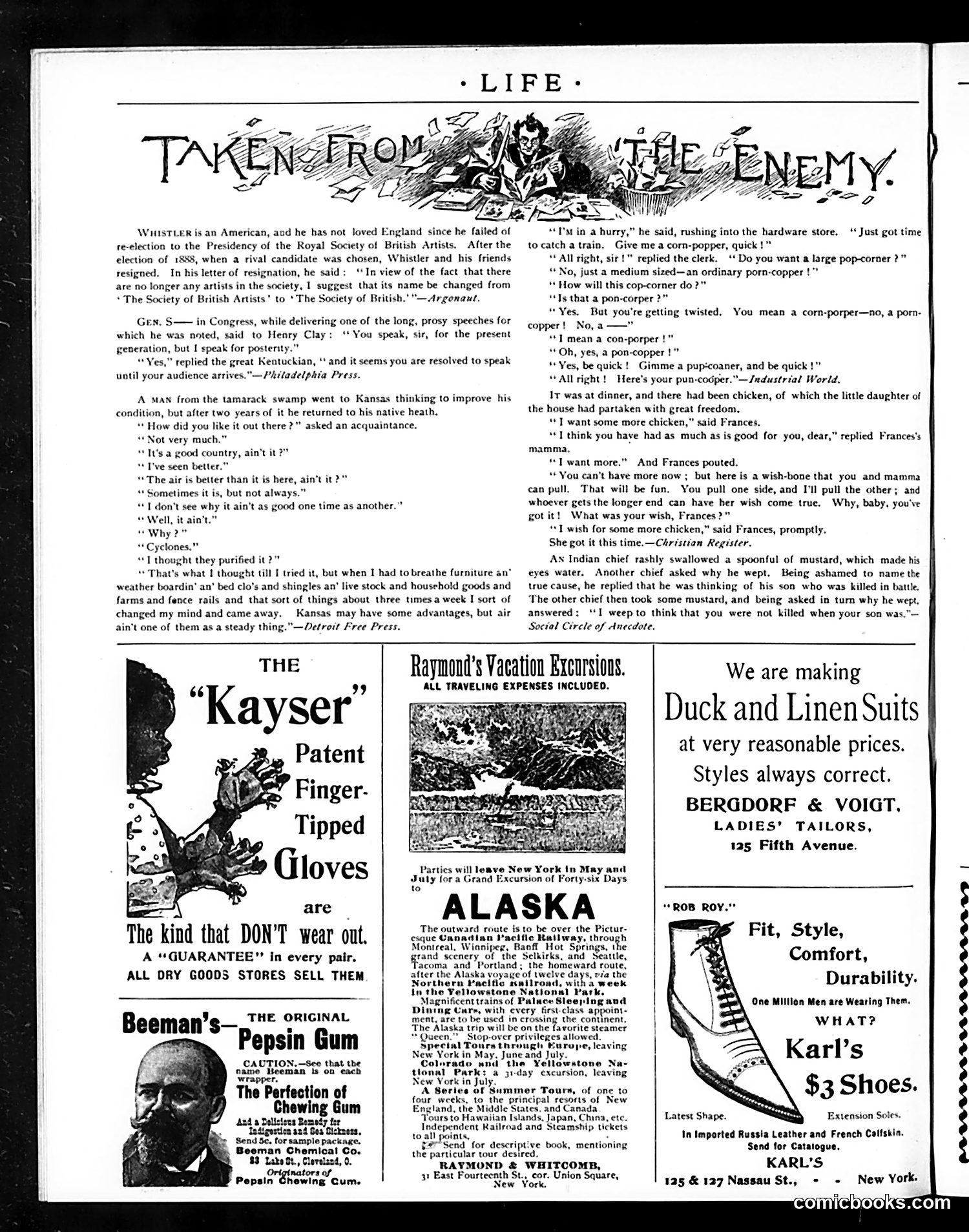
This page presents a collection of short humorous anecdotes mocking various figures and situations: **Top story**: James McNeill Whistler, the American artist, is quoted making a cutting remark after losing an election to lead the Royal Society of British Artists in 1888—he sarcastically suggests renaming it "The Society of British" since there are no longer any artists in it. The satire targets both Whistler's wounded pride and the society's alleged mediocrity. **Other anecdotes** include: a congressman's pretentious claim to speak "for posterity"; a Kansas settler complaining that cyclones make the air unbreathable (literally—furniture and debris); a slapstick bit about someone tongue-tied trying to buy a "corn-popper"; a child's transparent wish at a wishbone-pulling game; and Native Americans' darkly comic misuse of mustard. The page also contains period advertisements for Kayser gloves, Raymond's vacation excursions to Alaska, and Karl's shoes—typical of Life magazine's mixed content format blending satire with commercial notices.
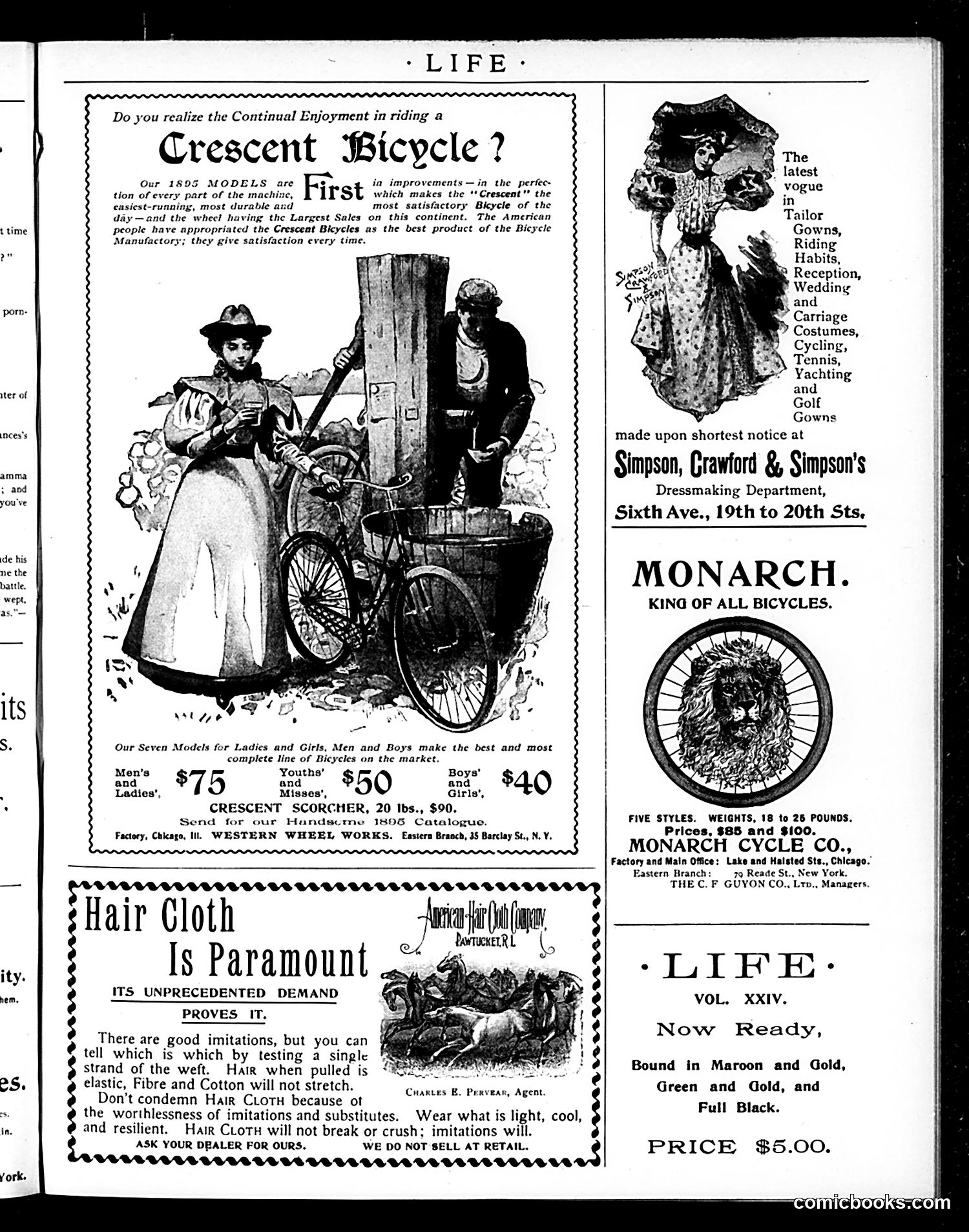
This is primarily an **advertising page** from Life's early years, not a political cartoon. The page features Victorian-era product advertisements rather than satire. The main illustration shows a **Crescent Bicycle advertisement** depicting two well-dressed figures (a woman in a large skirt and a man in formal wear) posing with a bicycle. This represents the bicycle craze of the 1890s—a genuine cultural phenomenon when bicycles symbolized modernity, independence, and leisure for middle and upper-class Americans. The page includes three bicycle manufacturers competing for sales: Crescent, Monarch, and Simpson Crawford & Simpson (featuring dressmaking services). Other ads promote Hair Cloth fabric and announce Life magazine Vol. XXIV. **The satirical element**: Life magazine itself, visible at bottom, was selling bound volumes—suggesting the magazine's popularity warranted collected editions as luxury items. The content reflects 1890s consumer culture, when bicycles were novel, expensive luxury goods ($40-$90 was substantial money), and symbol of progressive society—particularly women's increasing freedom and mobility.
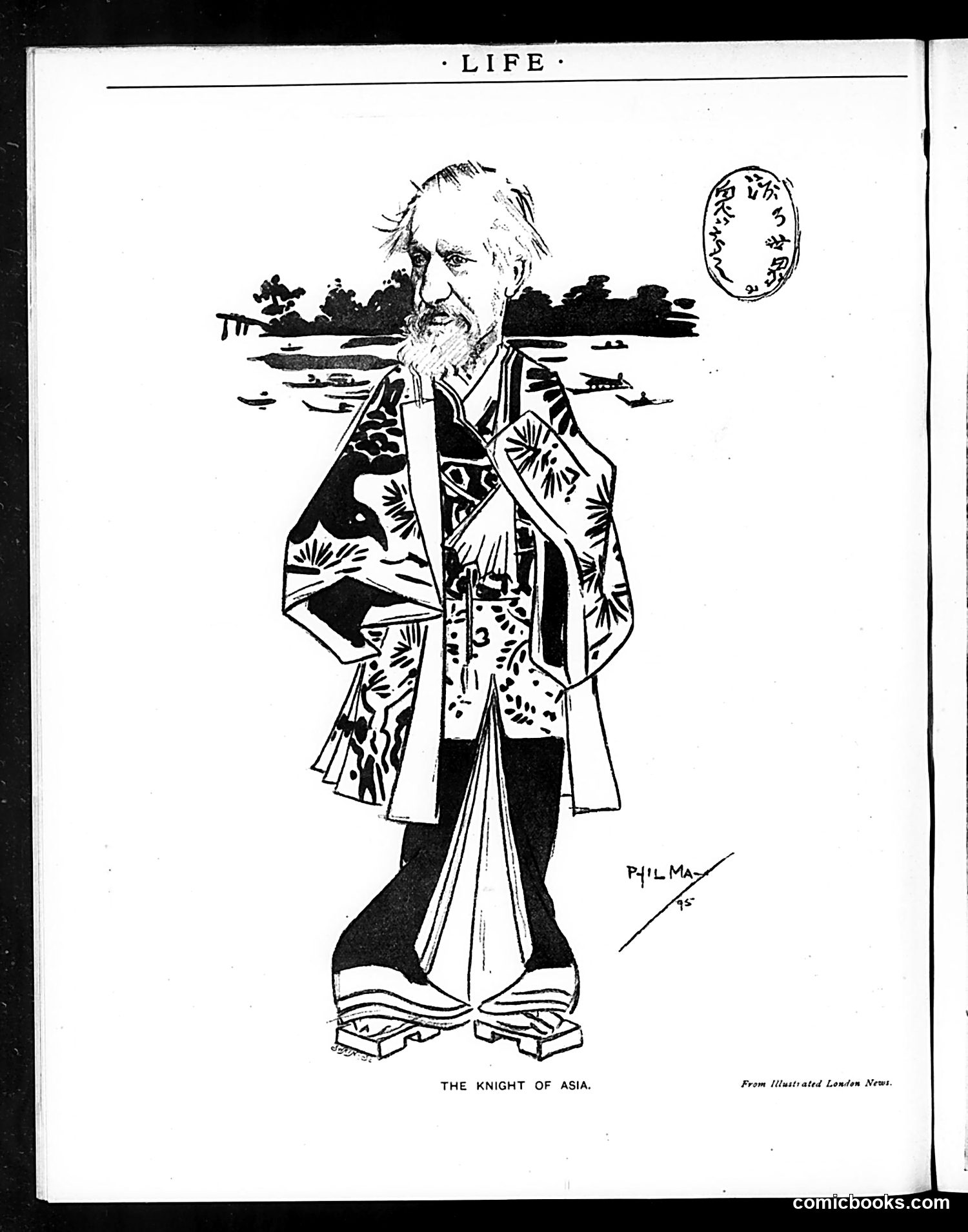
This Political cartoon from *Life* magazine depicts an elderly bearded man in ornate Asian-inspired clothing, standing over what appears to be an Asian landscape with boats and shoreline in the background. The figure is labeled "The Knight of Asia." The caricature style and title suggest this represents a Western figure who positioned himself as a champion or protector of Asian interests—likely a diplomat, military figure, or businessman active in Asian affairs. The exaggerated costume and grandstanding pose are satirical, mocking the subject's self-aggrandizing pretensions about his role in Asia. Without the publication date visible, the specific historical context remains unclear, though the satirical treatment suggests criticism of imperialist or interventionist attitudes toward Asia common in early 20th-century American commentary.