
Life, 1895-05-23 · page 4 of 18
Life — May 23, 1895 — page 4: what you’re looking at
What you’re looking at
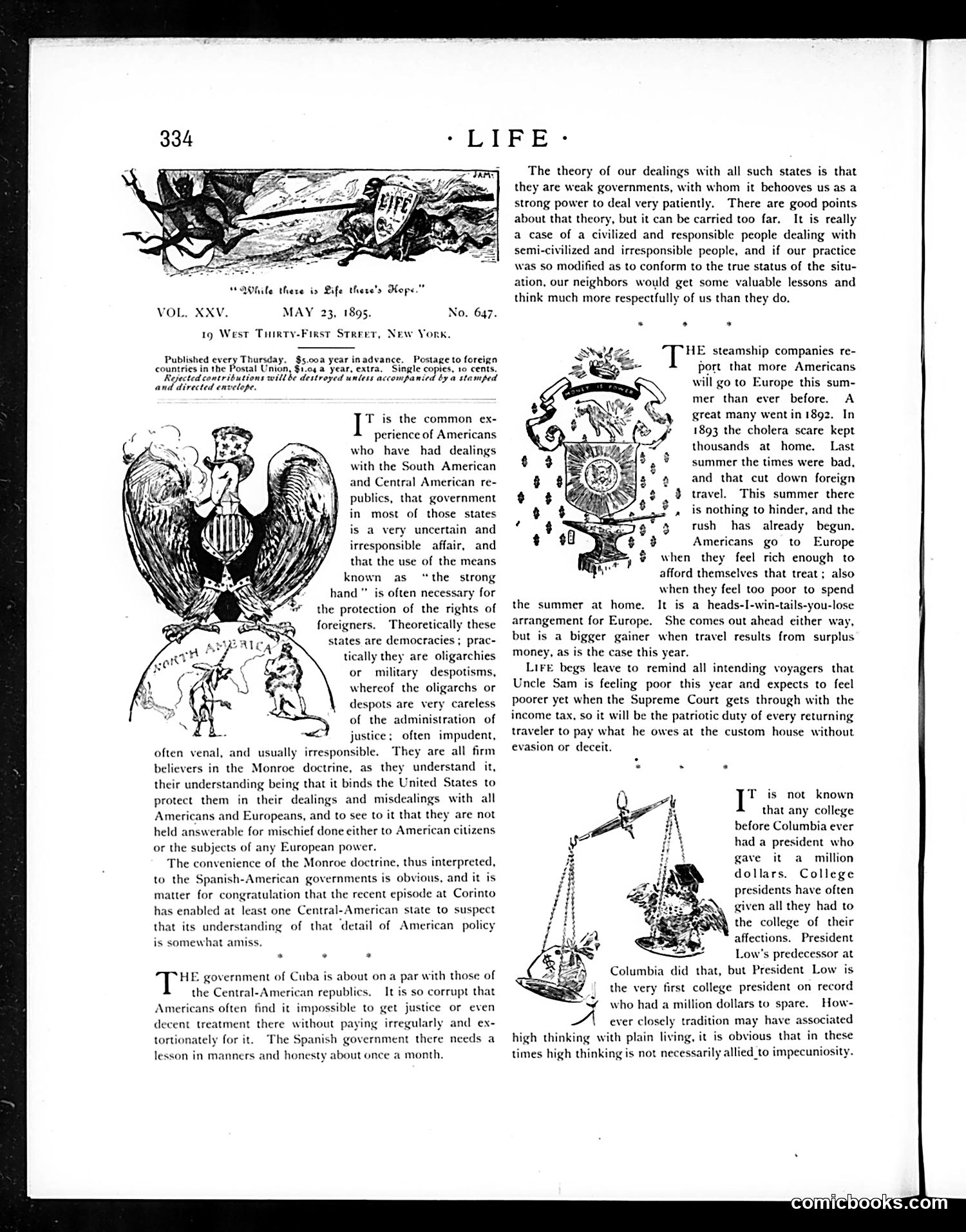
The page features editorial commentary on U.S. foreign policy toward Central and South American republics. The American eagle illustration represents the Monroe Doctrine, which claimed U.S. protection over the Western Hemisphere. The text criticizes Central American governments as corrupt, unstable oligarchies requiring U.S. intervention. It specifically references a recent incident at Corinto (likely a Central American port), suggesting American diplomatic involvement was justified. The author argues these weak governments need U.S. oversight to protect American citizens and interests. A secondary item discusses Columbia University's president receiving a million-dollar gift—notable because the institution supposedly valued plain living, making such wealth accumulation seem hypocritical. The satire targets both foreign instability and domestic contradictions in American values.
📄 Transcribed text from this page (OCR, searchable)
Machine-transcribed from the original scan — historical spelling and the odd misread are preserved.
- LIFE: “While there is Life there’s Hope.” VOL. XXV. MAY 23, 1895. 1g West Trirty-First Streer, New York. No. 647. Published every Thursday. $s.c0a year inadvance. Postage to foreign countries in the Postal Union, $1.04 a year, extra, Single copies, 10 cents. Rejected contributions will be destroyed unless accompanied by a stamped and directed envelope, T is the common ex- perience of Americans who have had dealings with the South American and Central American re- publics, that government in most of those states is a very uncertain and irresponsible affair, and that the use of the means known as “the strong hand” is often necessary for the protection of the rights of foreigners. Theoretically these states are democracies ; prac- tically they are oligarchies or military despotisms, whereof the oligarchs or despots are very careless of the administration of justice; often impudent, often venal, and usually irresponsible. They are all firm believers in the Monroe doctrine, as they understand it, their understanding being that it binds the United States to protect them in their dealings and misdealings with all Americans and Europeans, and to see to it that they are not held answerable for mischief done either to American citizens or the subjects of any European power. The convenience of the Monroe doctrine, thus interpreted, to the Spanish-American governments is obvious, and it is matter for congratulation that the recent episode at Corinto has enabled at least one Central-American state to suspect that its understanding of that detail of American policy is somewhat amiss. . ° * ba is about ona par with those of It is so corrupt that HE government of the Central-American republics. Americans often find it impossible to get justice or even decent treatment there without paying irregularly and ex- tortionately for it. The Spanish government there needs a lesson in manners and honesty about once a month. The theory of our dealings with all such states is that they are weak governments, with whom it behooves us as a strong power to deal very patiently. There are good points about that theory, but it can be carried too far. It is really a case of a civilized and responsible people dealing with semi-civilized and irresponsible people, and if our practice was so modified as to conform to the true status of the situ- ation, our neighbors would get some valuable lessons and think much more respectfully of us than they do. HE steamship companies re- port that more Americans will go to Europe this sum- mer than ever before. A great many wentin 1892. In 1893 the cholera scare kept thousands at home. Last summer the times were bad, and that cut down foreign travel. This summer there is nothing to hinder, and the tush has already begun. Americans go to Europe @ when they feel rich enough to afford themselves that treat; also when they feel too poor to spend the summer at home. It is a heads-I-win-tails-you-lose arrangement for Europe. She comes out ahead either way, but is a bigger gainer when travel results from surplus money, as is the case this year. LiFe begs leave to remind all intending voyagers that Uncle Sam is feeling poor this year and expects to feel poorer yet when the Supreme Court gets through with the income tax, so it will be the patriotic duty of every returning traveler to pay what he owes at the custom house without evasion or deceit. is not known that any college before Columbia ever had a president who gave it a million dollars. College presidents have often given all they had to SM the college of their affections. President Low's predecessor at Columbia did that, but President Low is the very first college president on record who had a million dollars to spare. How- ever closely tradition may have associated high thinking with plain living, it is obvious that in these times high thinking is not necessarily allied_to impecuniosity. Sta,