
Life, 1895-05-23 · page 6 of 18
Life — May 23, 1895 — page 6: what you’re looking at
What you’re looking at
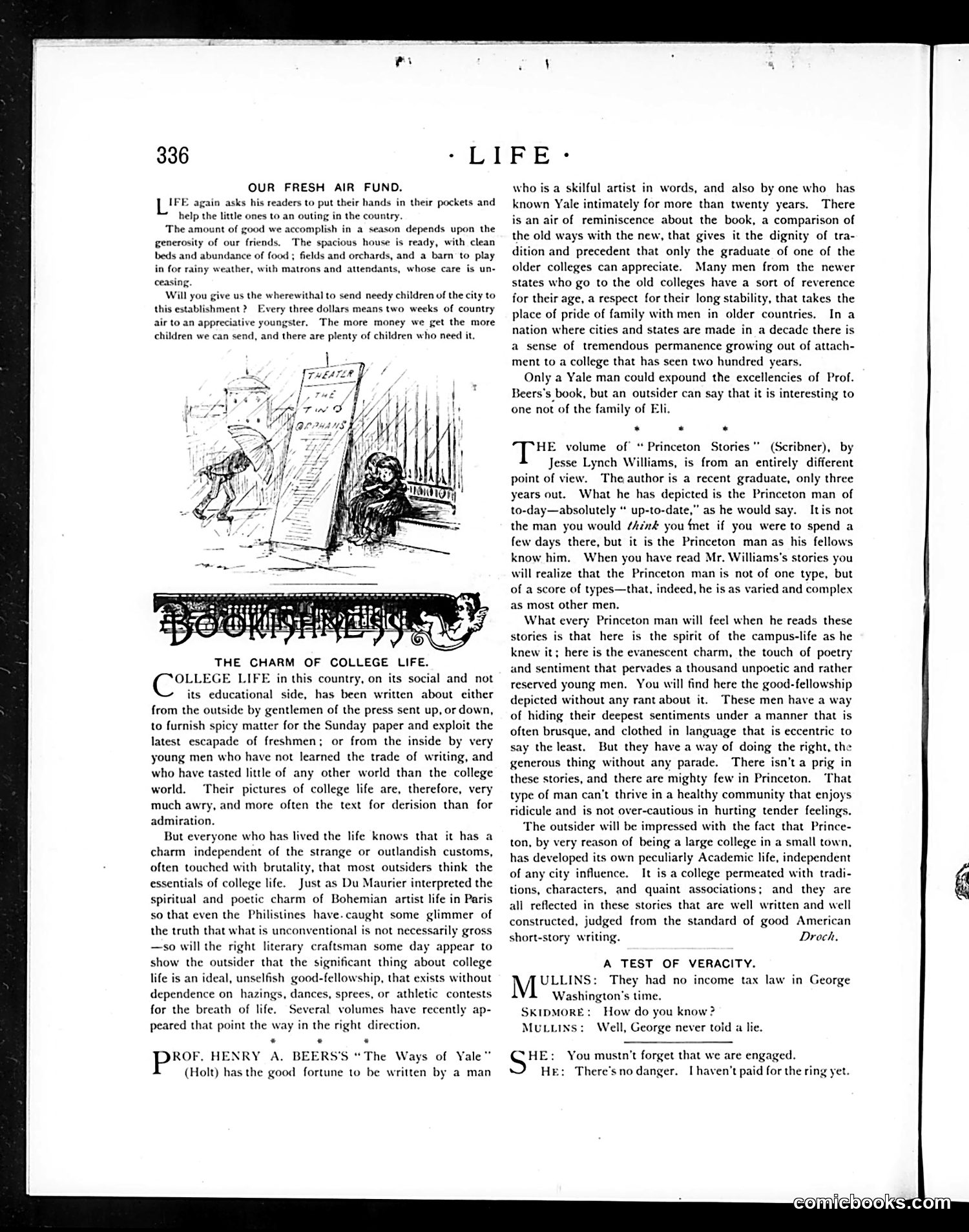
This page contains three distinct pieces rather than a unified political cartoon: 1. **"Our Fresh Air Fund"** (top): An illustration showing urban children receiving country air exposure—a charitable initiative. The sketch depicts kids at what appears to be a rural establishment. 2. **"The Charm of College Life"** (center): A lengthy essay discussing Princeton's distinctive character and culture, praising Jesse Lynch Williams's recent book "Princeton Stories." The text emphasizes Princeton's independence from urban influence and its cultivation of "good-fellowship" among students. 3. **"A Test of Veracity"** (bottom): A brief humorous dialogue joking about income tax evasion during George Washington's era—playing on the anachronism that no income tax existed then. The page primarily promotes collegiate ideals and charitable work rather than attacking specific political targets.
📄 Transcribed text from this page (OCR, searchable)
Machine-transcribed from the original scan — historical spelling and the odd misread are preserved.
336 OUR FRESH AIR FUND. LIFE again asks his readers to put their hands in their pockets and help the little ones to an outing in the country. ‘The amount of good we accomplish in a season depends upon the generosity of our friends. The spacious house is ready, with clean beds and abundance of food ; fields and orchards, and a barn to play in for rainy weather, with matrons and attendants, whose care is un- ceasing. Will you give us the wherewithal to send needy children of the city to this establishment? Every three dollars means two weeks of country air to an appreciative youngster, The more money we get the more children we can send, and there are plenty of children who need it, THE CHARM OF COLLEGE LIFE. OLLEGE LIFE in this country, on its social and not its educational le, has been written about cither from the outside by gentlemen of the press sent up, or down, to furnish spicy matter for the Sunday paper and exploit the latest escapade of freshmen; or from the inside by very young men who have not learned the trade of writing, and who have tasted little of any other world than the college world. Their pictures of college life are, therefore, very much awry, and more often the text for derision than for admiration. But everyone who has lived the life knows that it has a charm independent of the strange or outlandish customs, often touched with brutality, that most outsiders think the essentials of college life. Just as Du Maurier interpreted the spiritual and poetic charm of Bohemian artist life in Paris so that even the Philistines have.caught some glimmer of the truth that what is unconventional is not necessarily gross —so will the right literary craftsman some day appear to show the outsider that the significant thing about college life is an ideal, unselfish good-fellowship, that exists without dependence on hazings, dances, sprees, or athletic contests for the breath of life. Several volumes have recently ap- peared that point the way in the right direction. Pro: HENRY A. BEERS’S “The Ways of Yale” (Holt) has the good fortune to be written by a man - LIFE: who is a skilful artist in words, and also by one who has known Yale intimately for more than twenty years. There is an air of reminiscence about the book, a comparison of the old ways with the new, that gives it the dignity of tra- dition and precedent that only the graduate of one of the older colleges can appreciate. Many men from the newer states who go to the old colleges have a sort of reverence for their age, a respect for their long stability, that takes the place of pride of family with men in older countries. In a nation where cities and states are made in a decade there is a sense of tremendous permanence growing out of attach- ment to a college that has seen two hundred years, Only a Yale man could expound the excellencies of Prof. Beers's book, but an outsider can say that it is interesting to one not of the family of Eli. * . . HE volume of “Princeton Stories" (Scribner), by Jesse Lynch Williams, is from an entirely different point of view. The author is a recent graduate, only three years out. What he has depicted is the Princeton man of to-day—absolutely “ up-to-date,” as he would say. Itis not the man you would ¢Azné you {et if you were to spend a few days there, but it is the Princeton man as his fellows know him. When you have read Mr. Williams's stories you will realize that the Princeton man is not of one type, but of a score of types—that, indeed, he is as varied and complex as most other men. What every Princeton man will feel when he reads these stories is that here is the spirit of the campus-life as he knew it; here is the evanescent charm, the touch of poetry and sentiment that pervades a thousand unpoetic and rather reserved young men. You will find here the good-fellowship depicted without any rant about it. These men have a way of hiding their deepest sentiments under a manner that is often brusque, and clothed in language that is eccentric to say the least. But they have a way of doing the right, the generous thing without any parade. There isn’t a prig in these stories, and there are mighty few in Princeton. That type of man can’t thrive in a healthy community that enjoys ridicule and is not over-cautious in hurting tender feelings. The outsider will be impressed with the fact that Prince- ton, by very reason of being a large college in a small town, has developed its own peculiarly Academic life, independent of any city influence. It is a college permeated with tradi- tions, characters, and quaint associations; and they are all reflected in these stories that are well written and well constructed, judged from the standard of good American short-story writing. Droch, A TEST OF VERACITY. ULLINS: They had no income tax law in George Washington's time, SKIDMORE: How do you know? MULLI Well, George never told a lie. You mustn't forget that we are engaged. HE: There’sno danger. I haven't paid for the ring yet. SHE: