
A complete issue · 18 pages · 1895
Life — February 14, 1895
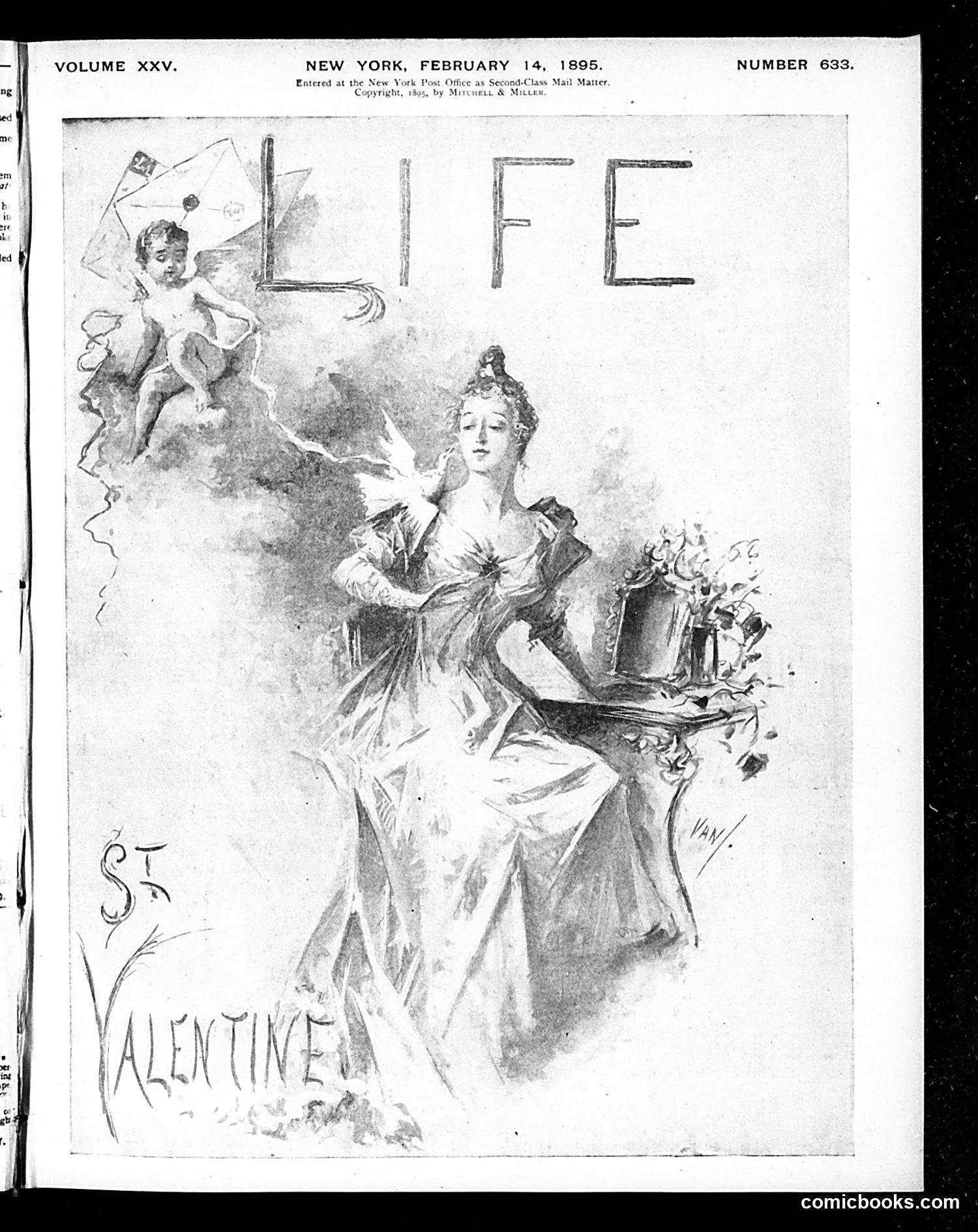
This is a Valentine's Day cover featuring an elegant woman in 1890s dress holding a large ornate vessel or urn that overflows with flowers and decorative elements. A cherub or Cupid figure floats above her head carrying what appears to be love letters or mail. The word "LIFE" dominates the top, with "VALENTINE" written at the bottom. The image is a straightforward romantic illustration rather than political satire—typical Valentine's Day coverage for a satirical magazine. The artistic style and composition celebrate idealized femininity and romantic sentiment of the Victorian era. The overflowing flowers and cherub emphasize themes of love and abundance appropriate for the holiday.
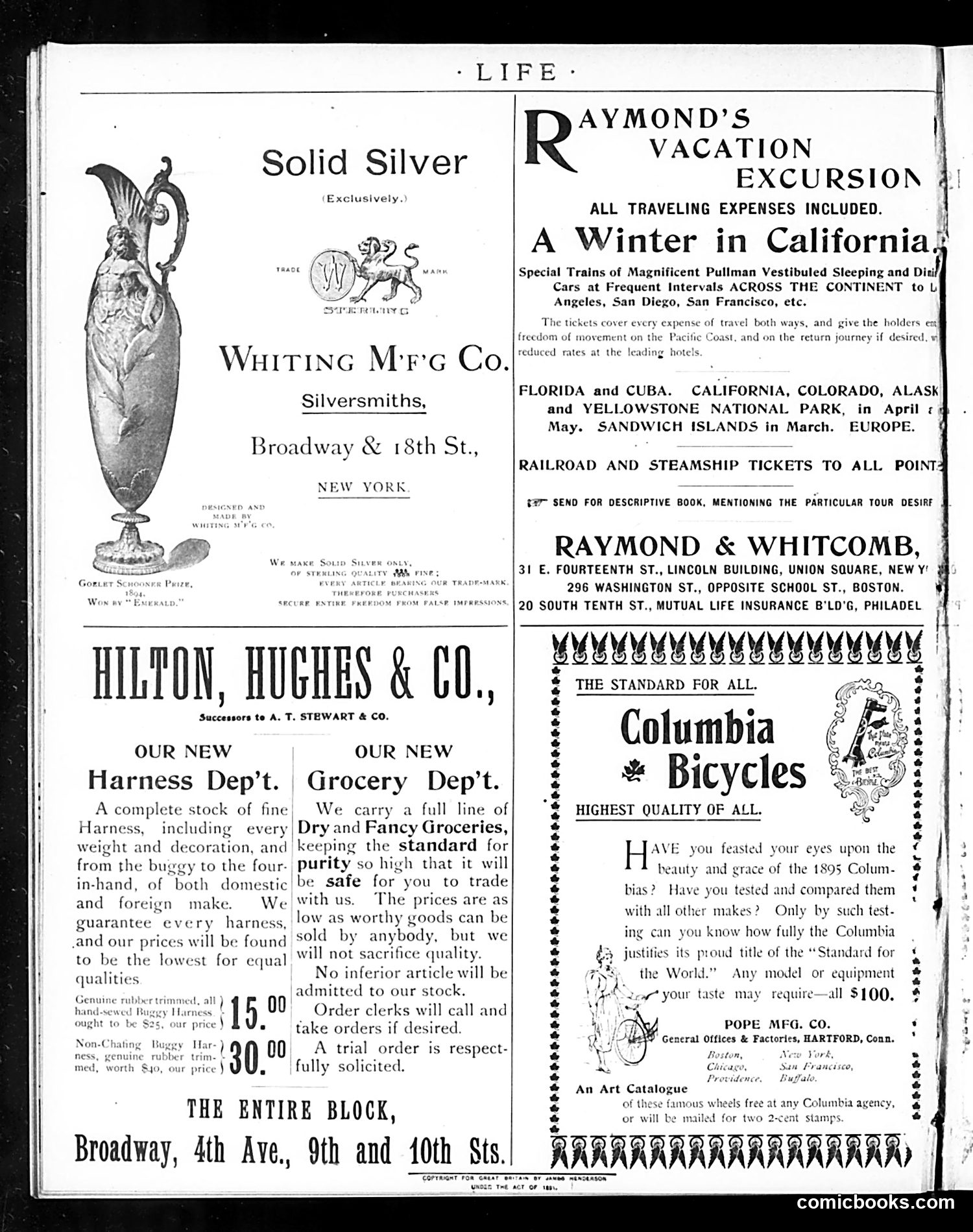
This page is primarily **advertising content**, not satire or political commentary. It contains four distinct ads: 1. **Whiting Mfg Co.**: Promotes solid silver pitchers and tableware made in New York 2. **Raymond & Whitcomb**: Travel agency advertising winter vacation excursions to California, Florida, Cuba, and Europe 3. **Hilton, Hughes & Co.**: Department store advertising new harness and grocery departments with specific prices ($15 and $30) 4. **Columbia Bicycles**: Manufacturers promote their 1895 bicycle models as "the standard for all," claiming superiority over competitors and offering an art catalog The page reflects **late 19th-century consumer culture** — luxury goods, leisure travel, and the bicycle craze. No political cartoons or satire appear here; this is a commercial page typical of Life magazine's advertising revenue model during this period.
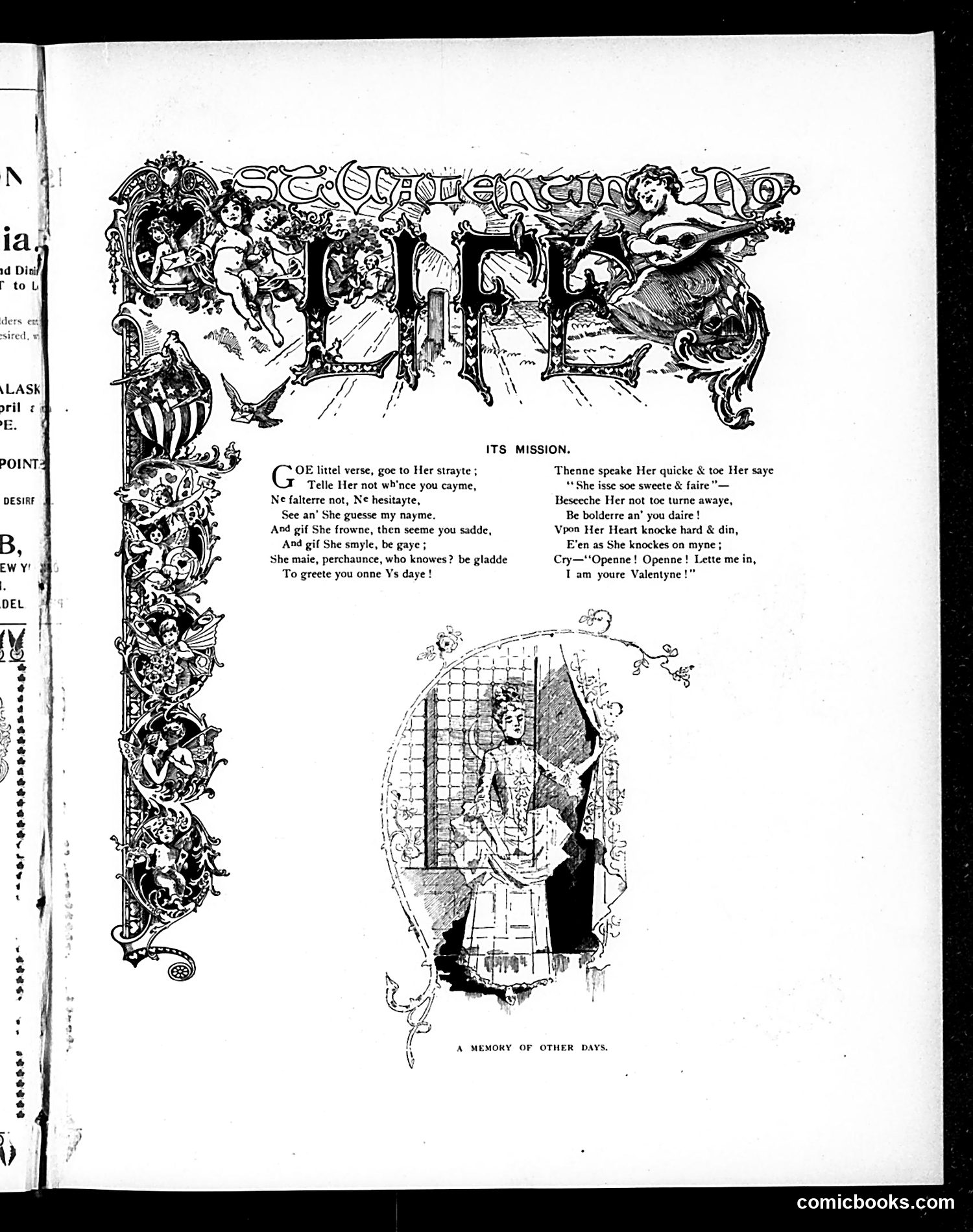
This page presents a romantic poem titled "ITS MISSION" addressed to "Her" — likely a sweetheart or romantic interest. The elaborate decorative border (left side) and ornamental header are typical of *Life* magazine's aesthetic style from the early 1900s. The poem uses courtly, Victorian language, asking the recipient to guess the speaker's name and promising devotion ("I am youre Valentyne"). The lower illustration labeled "A MEMORY OF OTHER DAYS" shows an interior scene, possibly depicting a romantic or nostalgic moment. Rather than political satire, this page appears to be sentimental romantic content — typical of *Life*'s mixture of humor, social commentary, and lighter fare. The elaborate ornamentation reflects period publishing standards for literary pages.
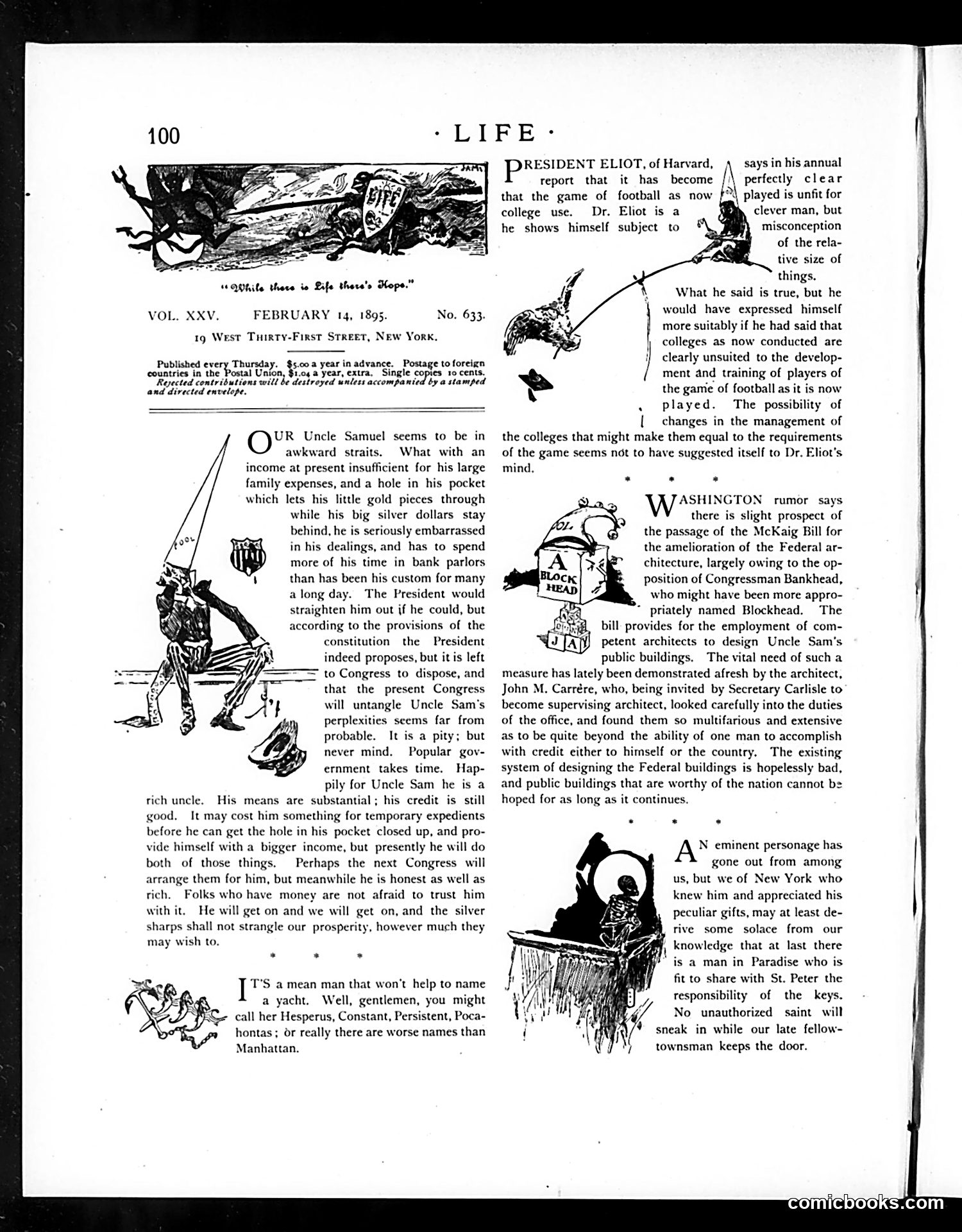
This page contains three political satires addressing contemporary issues: **"Uncle Sam's Financial Straits"** (left cartoon): Depicts Uncle Sam as financially embarrassed, unable to afford his government expenses. The satire criticizes the insufficient presidential income and suggests Congress should increase it—a commentary on late-19th-century debates over executive compensation and federal budget constraints. **"Football at Harvard"** (top): References President Eliot's criticism that college football is unfit for "clever" players, arguing universities are poorly suited to develop football players. The satire mocks Eliot's perspective on academic priorities. **"Paradise Gatekeeper"** (right): A brief humorous reference to an unnamed prominent New Yorker now in "Paradise," suggesting he'd make a suitable guardian of heaven's gates—appears to be a biographical or obituary notice.
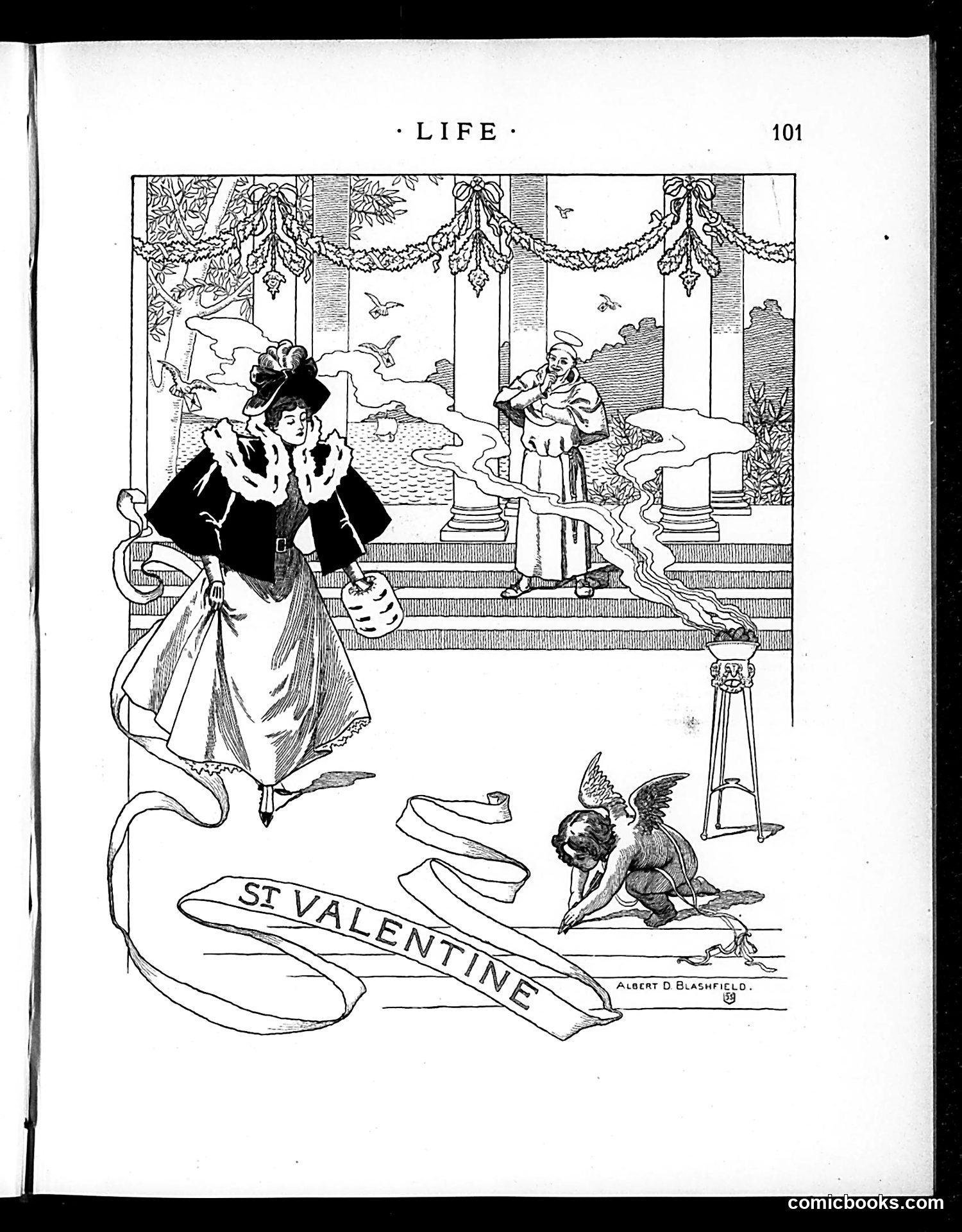
This is a Valentine's Day illustration by Albert D. Blashfield depicting an elegant woman in fashionable early 1900s dress as the central figure. She holds Cupid's arrow and a heart-shaped object labeled "ST VALENTINE." The scene shows a classical garden setting with cherubs, decorative columns, and other figures in the background. The elaborate styling—her fur-trimmed coat, fashionable hat, and the luxurious setting—suggests this celebrates romantic ideals of the era. The illustration appears to be a lighthearted satirical take on Valentine's Day customs among the wealthy elite, presenting romantic love as an ornate, theatrical performance rather than genuine emotion. The cherub at bottom left emphasizes the whimsical, artificial nature of the holiday's observance among high society.
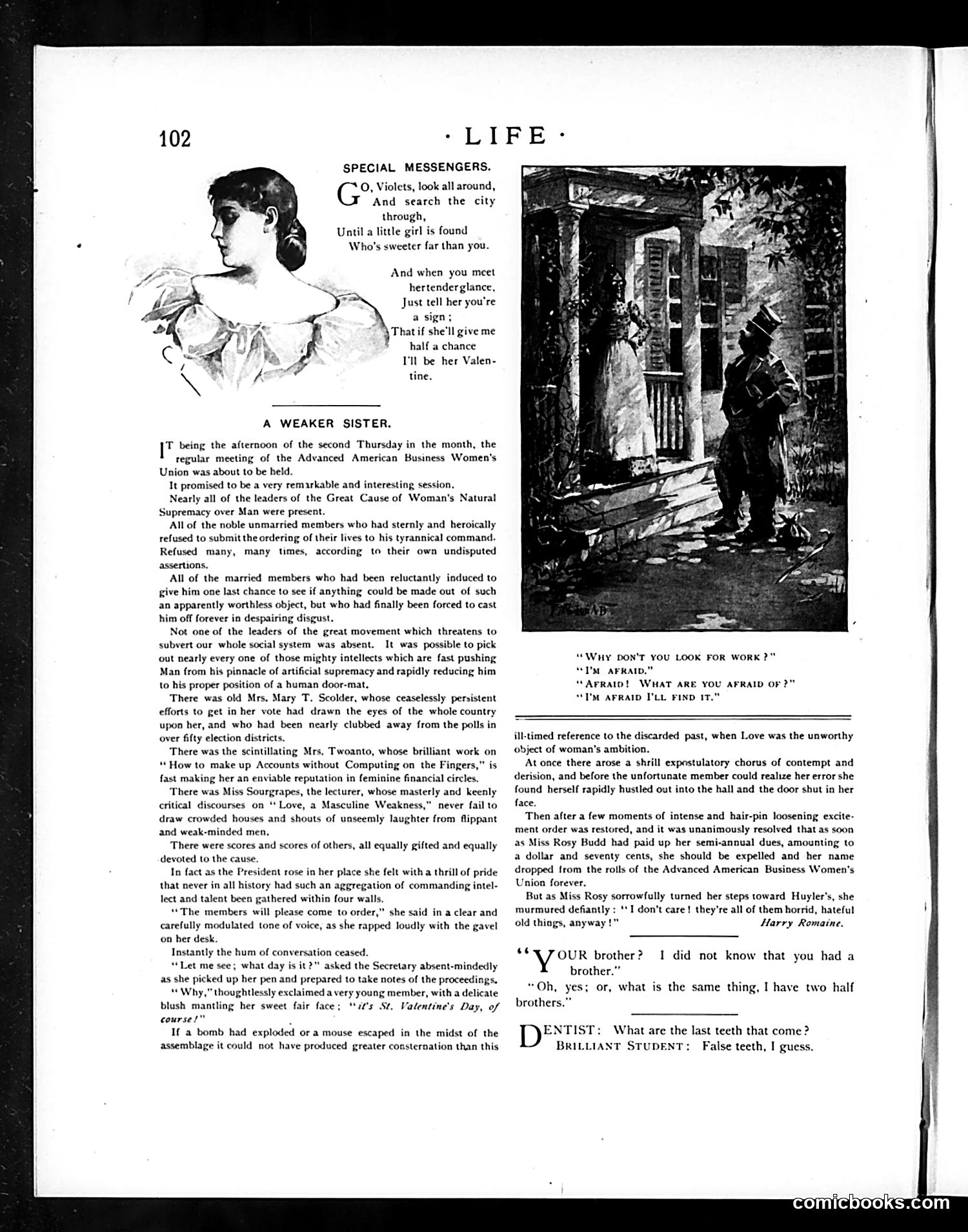
This page contains two distinct pieces: **"A Weaker Sister"** (left): A satirical article mocking the Advanced American Business Women's Union and its male leadership. The satire targets women who surrendered their autonomy to domineering men, describing various leaders (Miss Sourgrapes, Mr. Twoanto, Miss Rosy Budd) who exemplified subservience. The piece critiques how these women abandoned ambition and independence. **The photograph and dialogue** (right): Shows a woman being turned away from employment ("Why don't you look for work?"). The exchange suggests gender discrimination in the job market during this era—women faced barriers to employment and were blamed for not working. Together, these pieces satirize early-20th-century attitudes toward working women, highlighting both women's internalized subordination and systemic employment discrimination.
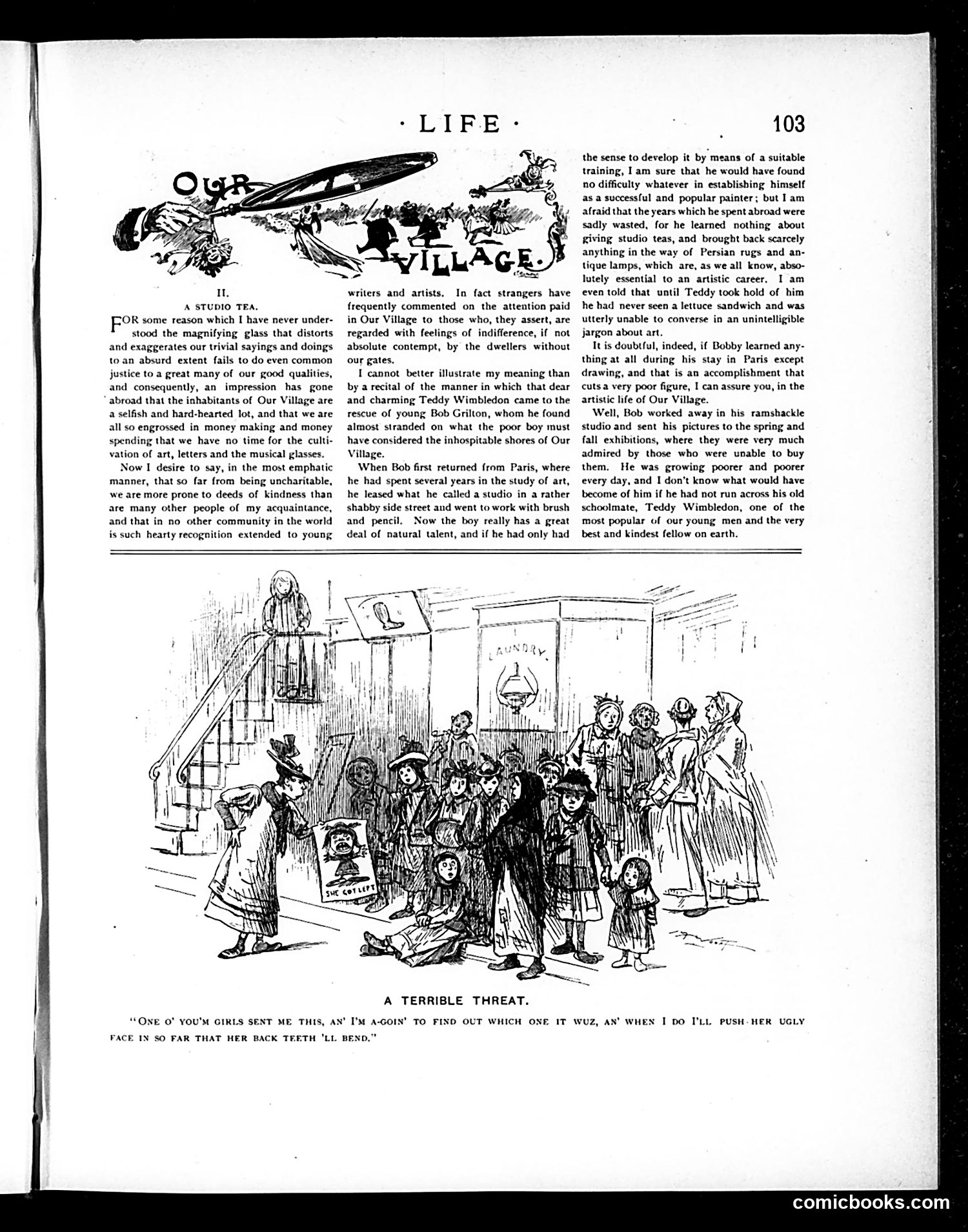
This cartoon satirizes schoolyard bullying and social hierarchies among children. A group of girls confronts what appears to be a vulnerable or unpopular peer, with the caption revealing a threat of physical violence—pushing the victim's face so hard her "back teeth 'll bend." The humor derives from the disproportionate severity of the threat (permanent dental damage) for a trivial schoolyard dispute. The illustration shows a crowd of children, suggesting mob dynamics and social pressure. The accompanying article discusses "Our Village" and artistic pursuits, but the cartoon's point is broader social commentary on childhood cruelty and how groups enforce conformity through intimidation and physical threats—a form of social commentary relevant to understanding turn-of-the-century American attitudes toward youth behavior.
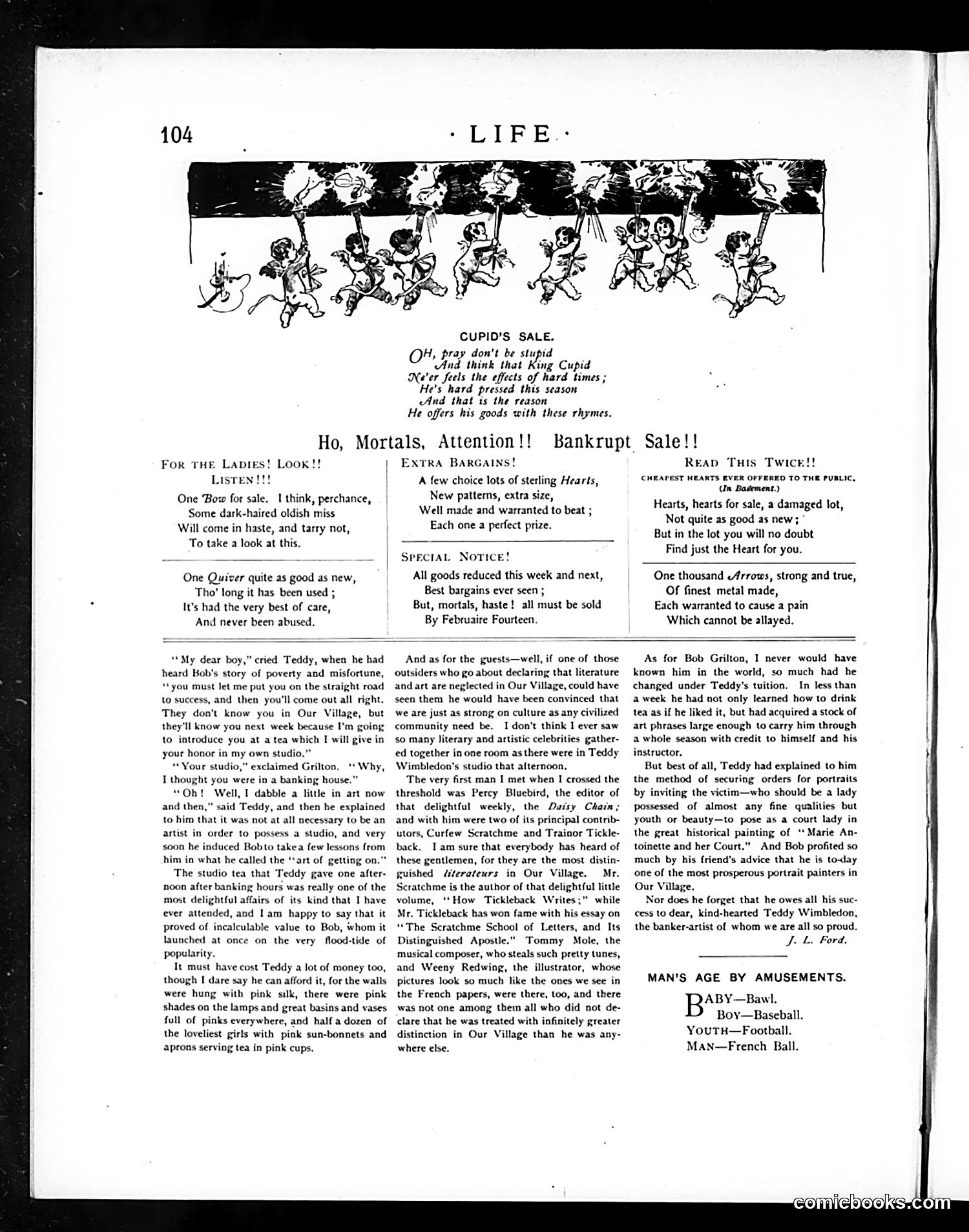
This page presents a humorous advertisement parody titled "Cupid's Sale," where the Roman god of love (Cupid) is depicted as a bankruptcy auctioneer selling hearts to the public. The illustration shows multiple cherub figures suspended above a banner, styled as if conducting an auction. The satire mocks commercialism and romantic sentimentality by treating love and "hearts" as consumer goods available at "bargain" prices. References to "damaged lots" and warranties suggest romance is commodified and mass-produced rather than genuine. The accompanying text discusses various Village literary and artistic celebrities (Percy Bluebird, editor of the *Daisy Chain*; Tickleback; Tommy Mole the composer), satirizing bohemian artistic circles and their pretensions. The overall tone ridicules both commercialism and artistic affectation common to early 20th-century American cultural life.
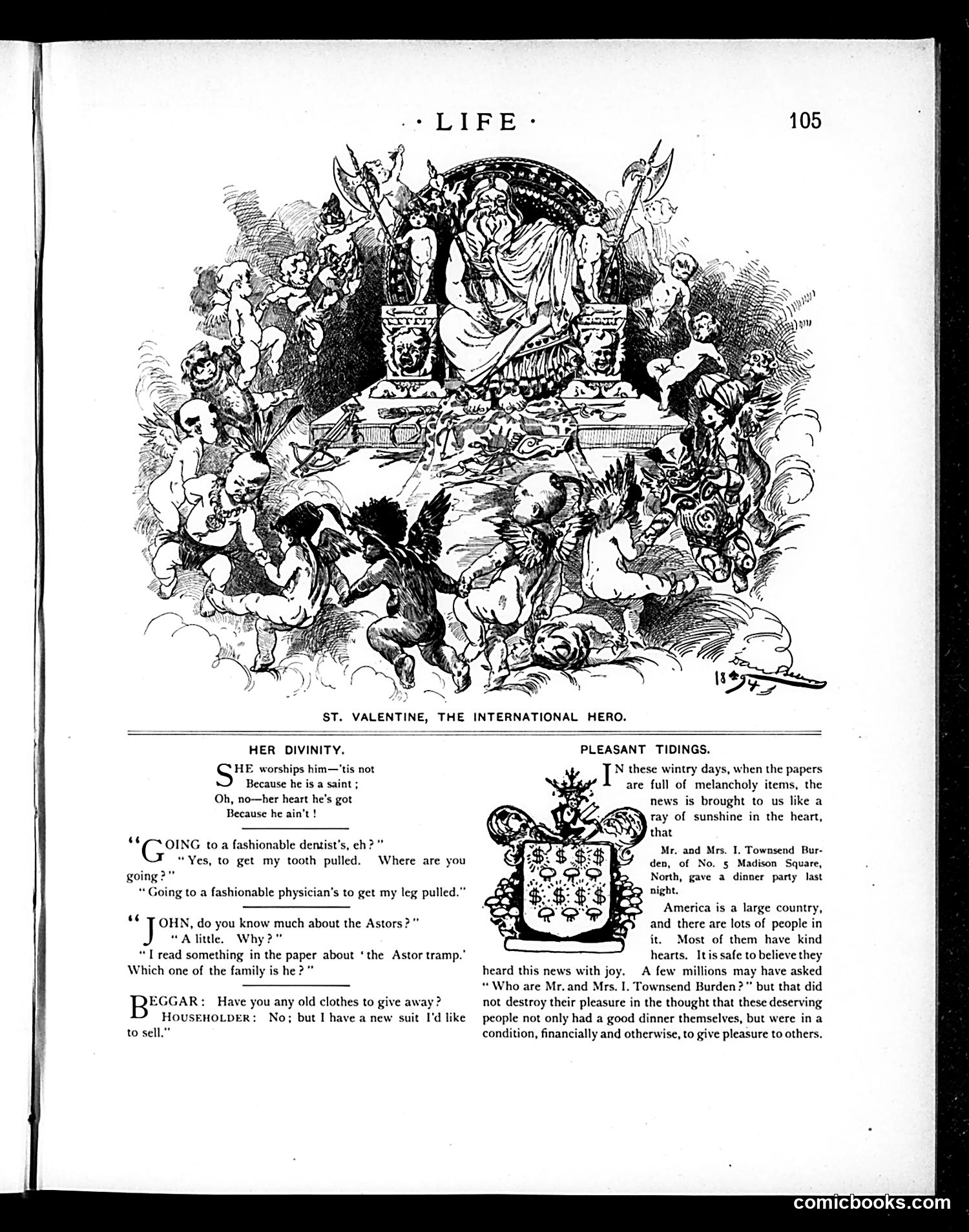
The main illustration depicts "St. Valentine, the International Hero"—a satirical heavenly scene with cupids and cherubs surrounding a central religious/regal figure, likely mocking the commercialization of Valentine's Day and romantic sentimentality. Below are three separate humorous anecdotes: 1. **"Her Divinity"**: A joke about a woman worshipping her boyfriend despite his flaws. 2. **"Going to a fashionable dentist's"**: A brief exchange satirizing the pretentious language used in upper-class medical visits. 3. **"Pleasant Tidings"**: A longer piece praising Mr. and Mrs. I. Townsend Burden's charitable dinner party, celebrating their generosity toward less fortunate guests during winter. The page appears aimed at satirizing both romantic excess and class attitudes, while also celebrating genuine charitable impulses among the wealthy.
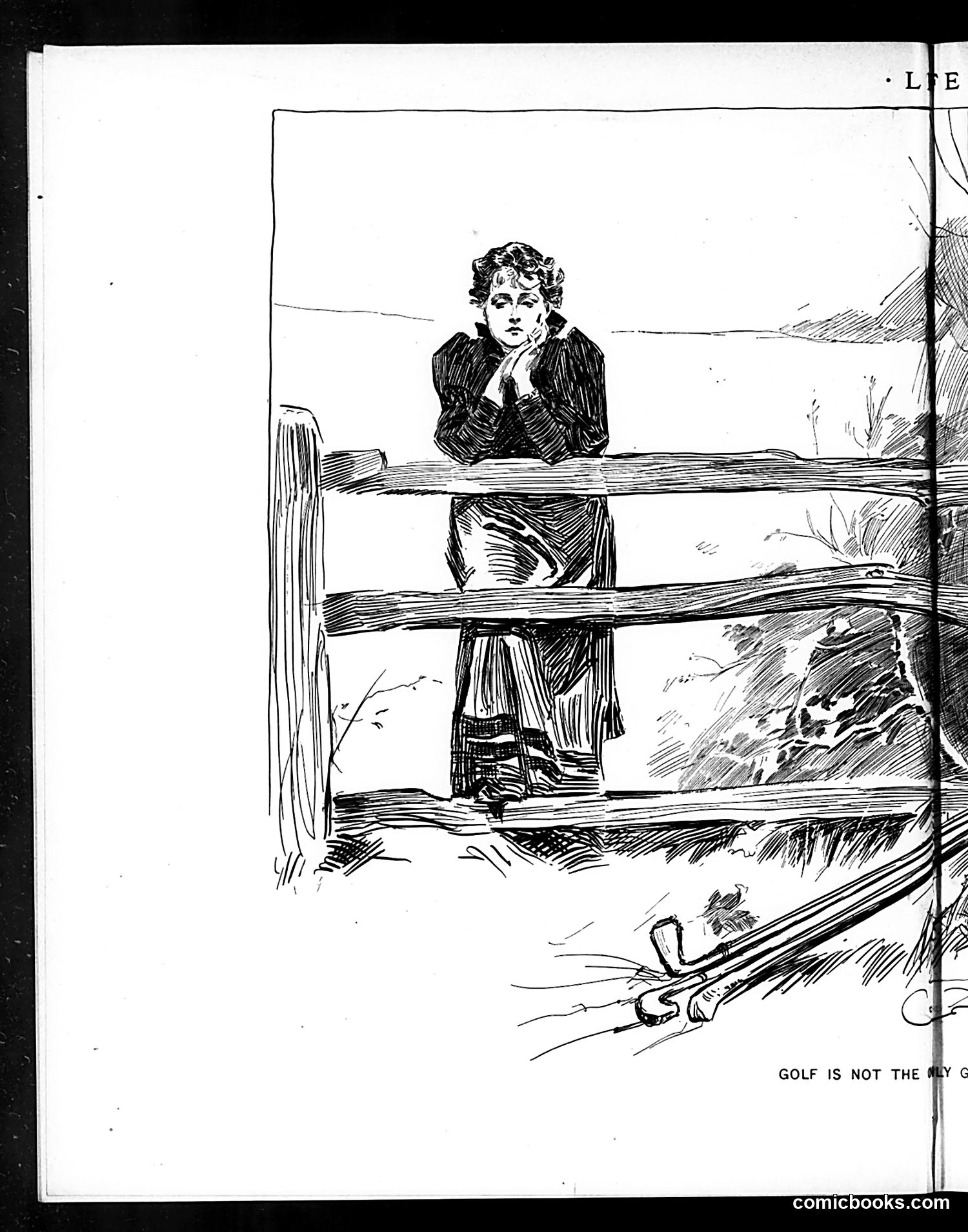
This appears to be a satirical illustration from *Life* magazine depicting a woman standing at a wooden fence, gazing into the distance with a wistful or longing expression. She wears early 20th-century clothing—a dark jacket and skirt. The partial caption at bottom reads "GOLF IS NOT THE ONLY G," suggesting the cartoon makes a play on words about "G" activities. Without the complete caption or additional context, the specific satirical point remains unclear, though it likely comments on women's leisure activities or social expectations of the era. The illustration's style and the woman's contemplative pose suggest social commentary, possibly about restrictions on women's recreational opportunities or romantic interests, but the exact target of satire cannot be determined from the visible text alone.
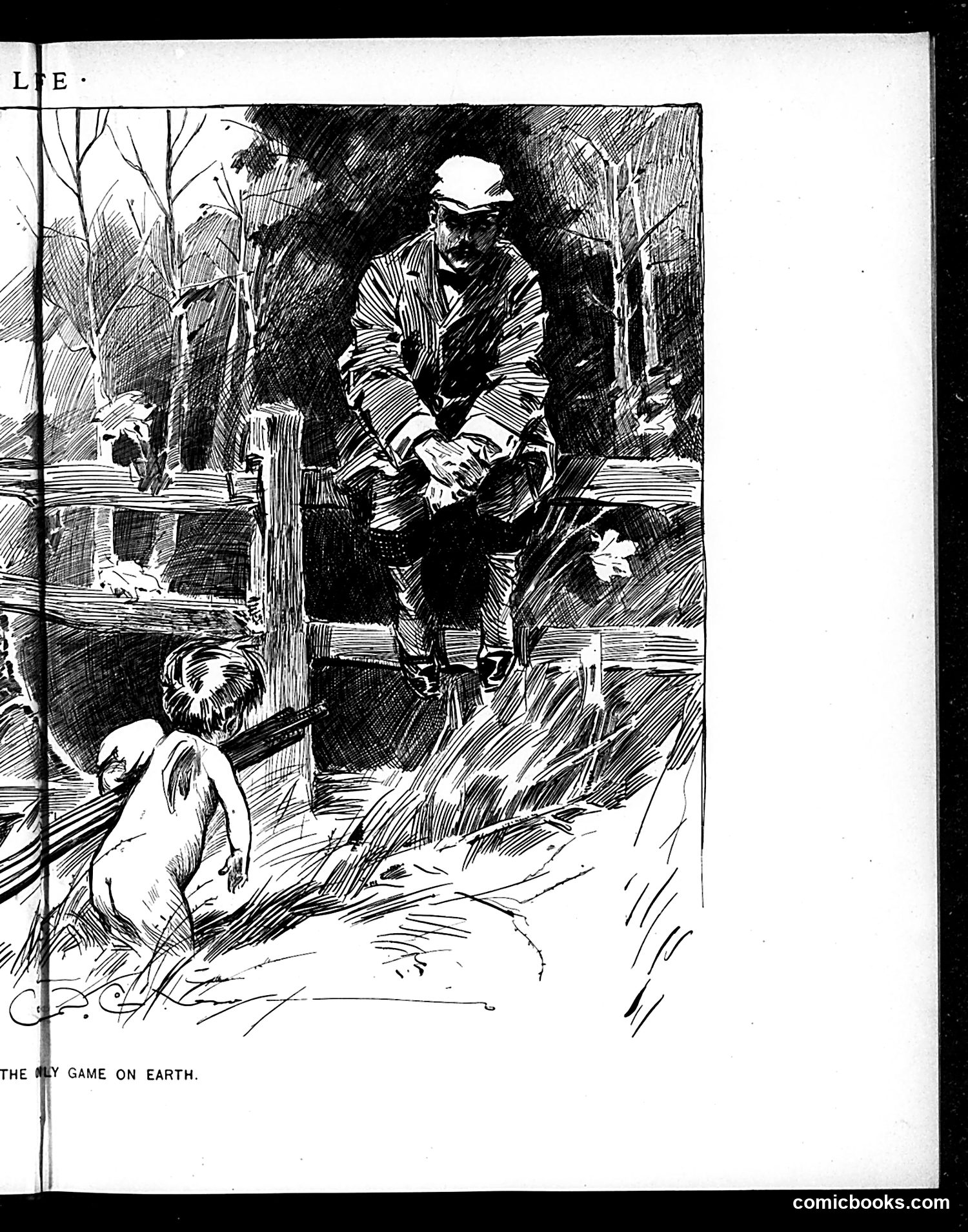
This black-and-white illustration depicts a man perched on a wooden fence, looking down at a small child in a yard below. The man wears a cap and striped shirt, rendered in heavy cross-hatching that emphasizes shadow and suggests menace. The caption "THE SLY GAME ON EARTH" indicates this is satirical commentary on deception or cunning behavior. The composition—with the adult positioned above and observing the vulnerable child—suggests the cartoon critiques predatory or exploitative conduct, likely targeting someone perceived as a schemer or manipulator taking advantage of the innocent. Without additional context about Life magazine's publication date or political climate, the specific target remains unclear, though the imagery powerfully conveys moral disapproval.
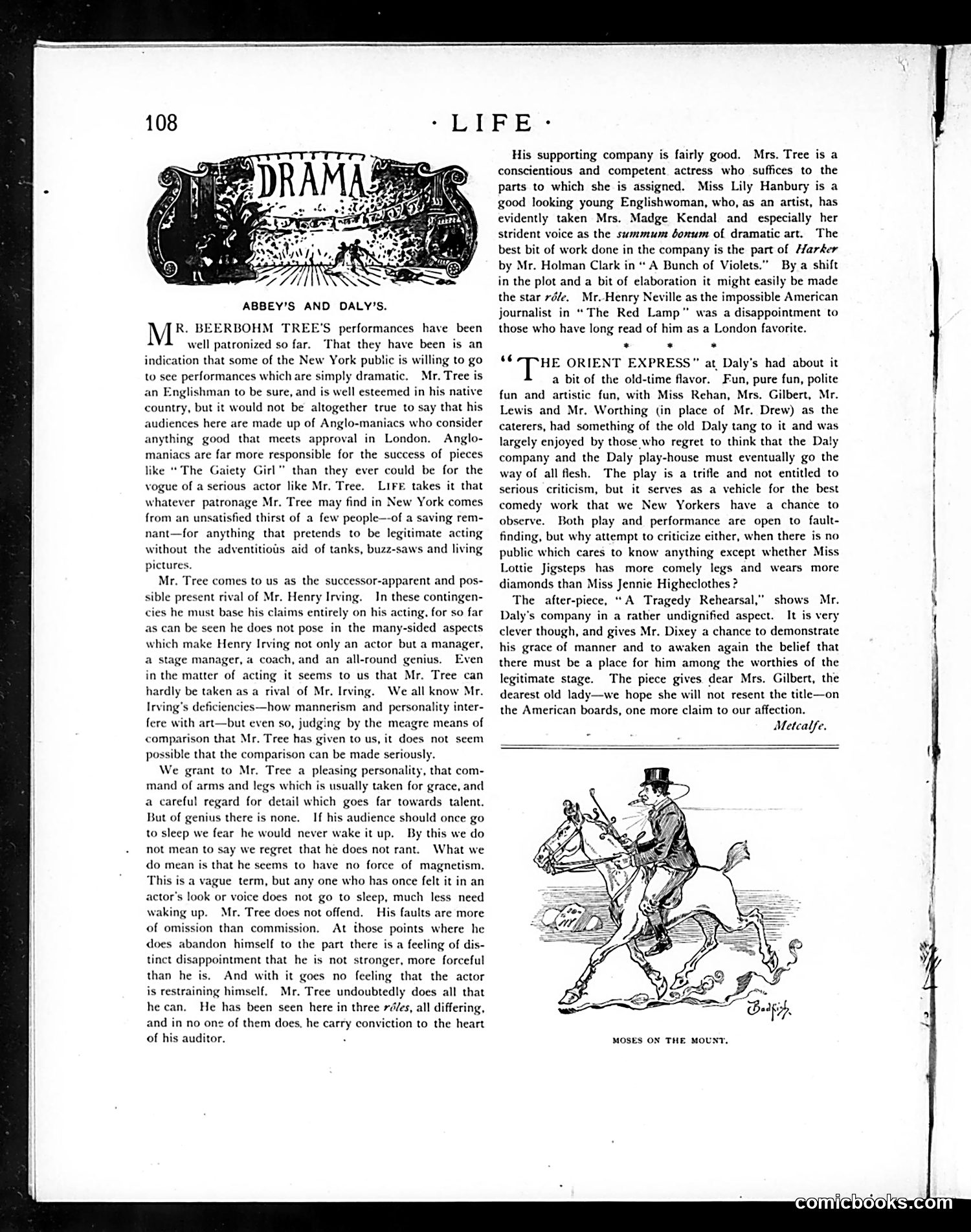
This page reviews theatrical performances by English actor Herbert Beerbohm Tree and productions at Daly's Theatre. The accompanying illustration titled "Moses on the Mount" depicts a figure on horseback—likely a satirical reference to theatrical spectacle or a character from one of the reviewed plays. The text critiques Tree as a competent but uninspired actor lacking the "magnetism" and commanding presence of his rival Henry Irving. The reviewer acknowledges Tree's technical skill—grace, personality, attention to detail—but argues he possesses no genius and cannot captivate an audience. The piece defends serious dramatic theater against frivolous spectacles ("tanks, buzz-saws and living pictures"), suggesting Tree's audiences appreciate legitimate acting over entertainment gimmicks. The review also comments on supporting performers, praising some while finding others disappointing. The satirical thrust mocks Tree's limitations rather than celebrating his work.
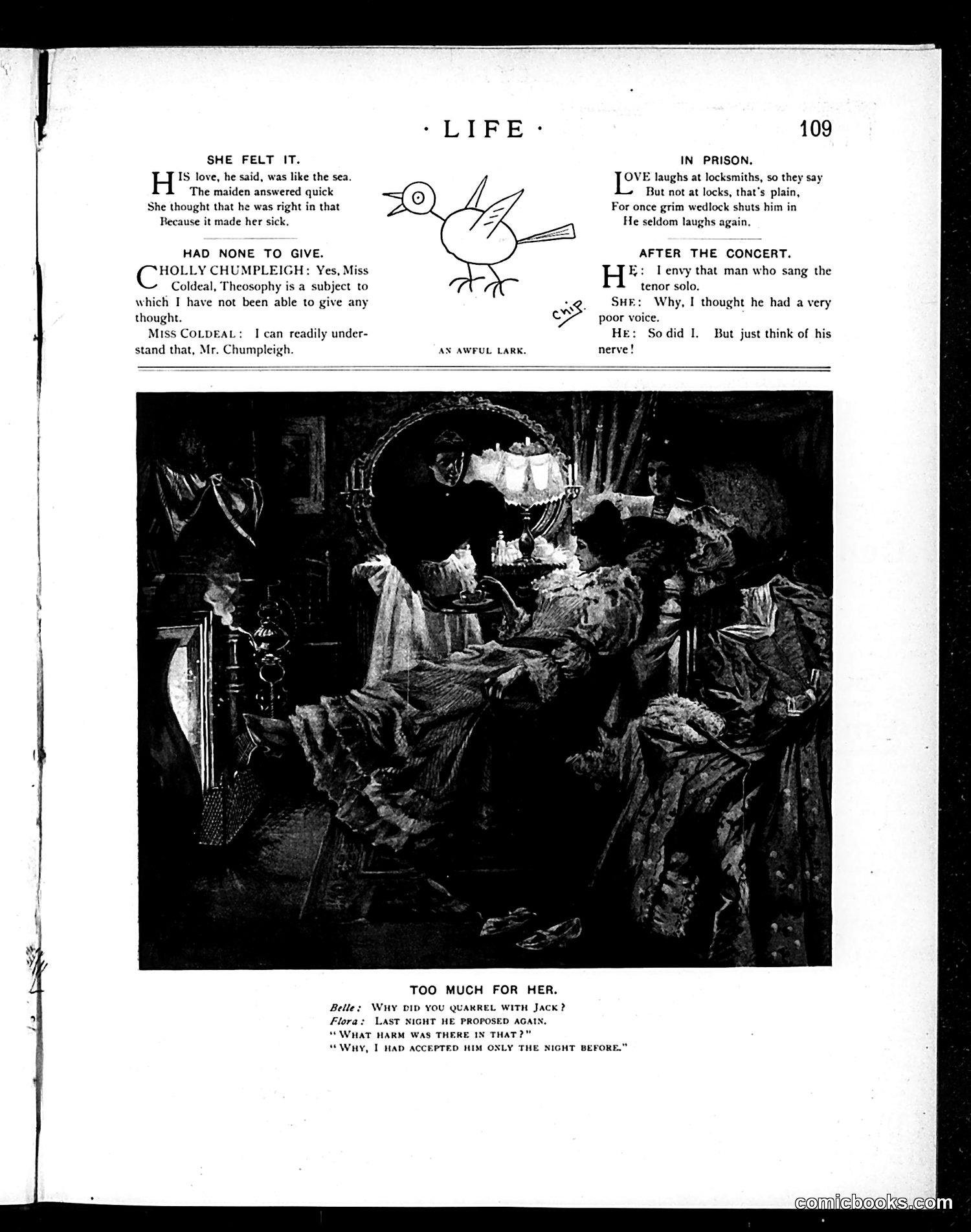
This page contains several satirical short jokes typical of early 20th-century humor magazines: **"She Felt It"** mocks romantic clichés—a suitor's poetic comparison of love to the sea makes his date physically ill, undermining the sentiment. **"Had None to Give"** is a snide joke about Mr. Chumpleigh's intellectual laziness regarding Theosophy (a spiritual movement popular at the time), with Miss Coldeal's retort suggesting he's incapable of thought on any subject. **"After the Concert"** plays on marital dynamics: a husband envies a tenor's "nerve" (audacity) for singing poorly in public, implying his wife wouldn't tolerate such boldness from him. **"Too Much for Her"** satirizes female fickleness in courtship—Flora rejected Jack's proposal one night, then accepted it the next, now regrets accepting him after he proposed *again*. The humor derives from the contradiction and the suggestion of emotional instability. The small illustration of an "awful lark" (bird) is a visual pun. These pieces reflect period attitudes toward women, marriage, and social propriety.
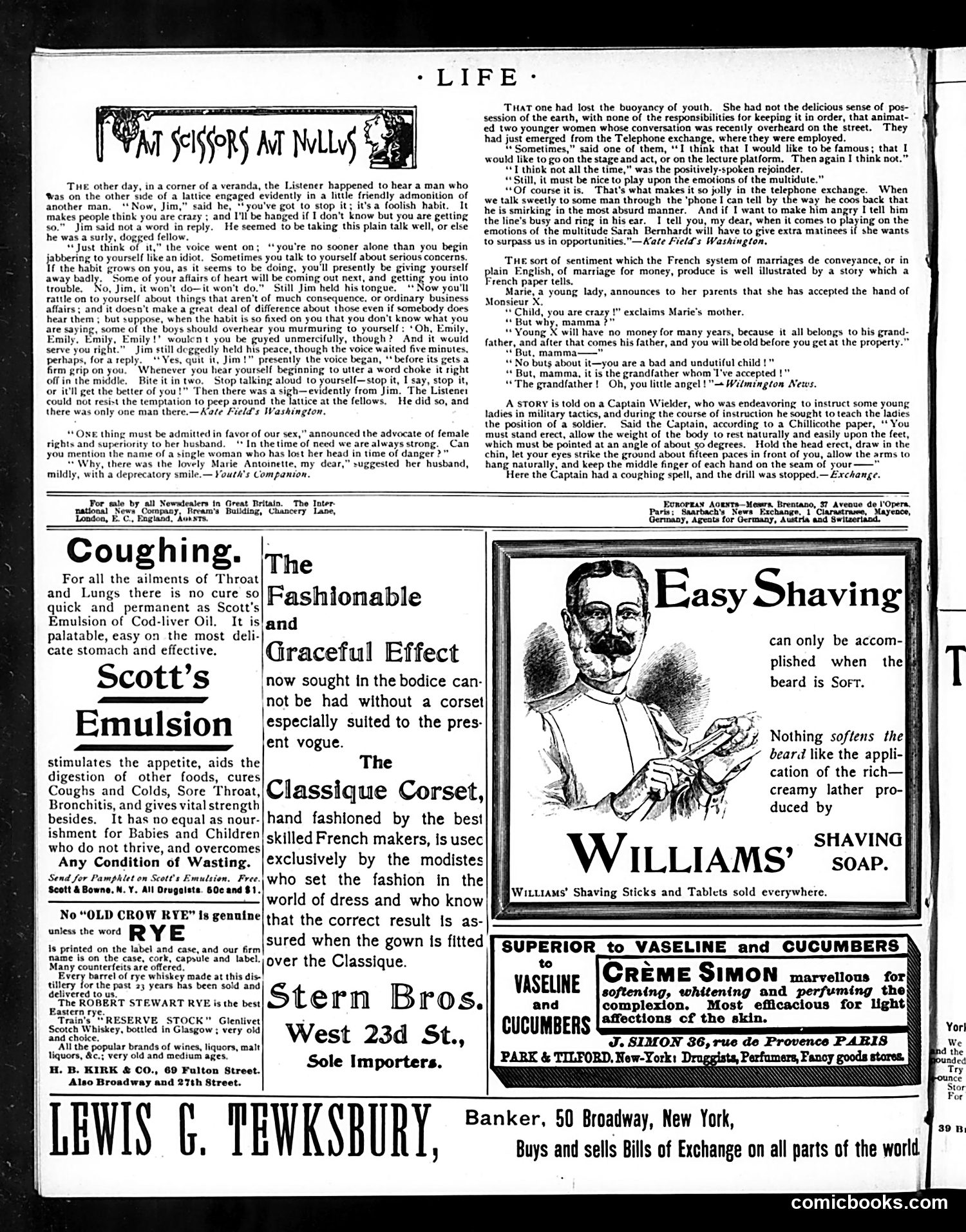
This page from *Life* magazine contains two satirical pieces typical of the publication's social commentary: **"The Listener"** (main article) depicts a man overhearing another man's self-directed conversation through a lattice. The scene mocks masculine vanity—a friend warns "Jim" that talking to himself makes him appear crazy and foolish, especially regarding matters of the heart ("Emily"). The humor lies in the irony: Jim remains silent during the entire lecture, suggesting he's either indifferent or the advice is pointless. The piece satirizes both masculine emotional vulnerability and social anxiety about appearing ridiculous. **"One Thing Must Be Admitted"** (sidebar) features a woman claiming women are "always strong" in emergencies, citing they've never "lost her head in time of danger." Her husband's counterexample—Marie Antoinette—humorously deflates her argument, as Antoinette literally lost her head (executed by guillotine during the French Revolution). This is gentle marital satire about female overconfidence. The remaining content comprises period advertisements for Scott's Emulsion, corsets, and shaving products—typical of the era's marketing.
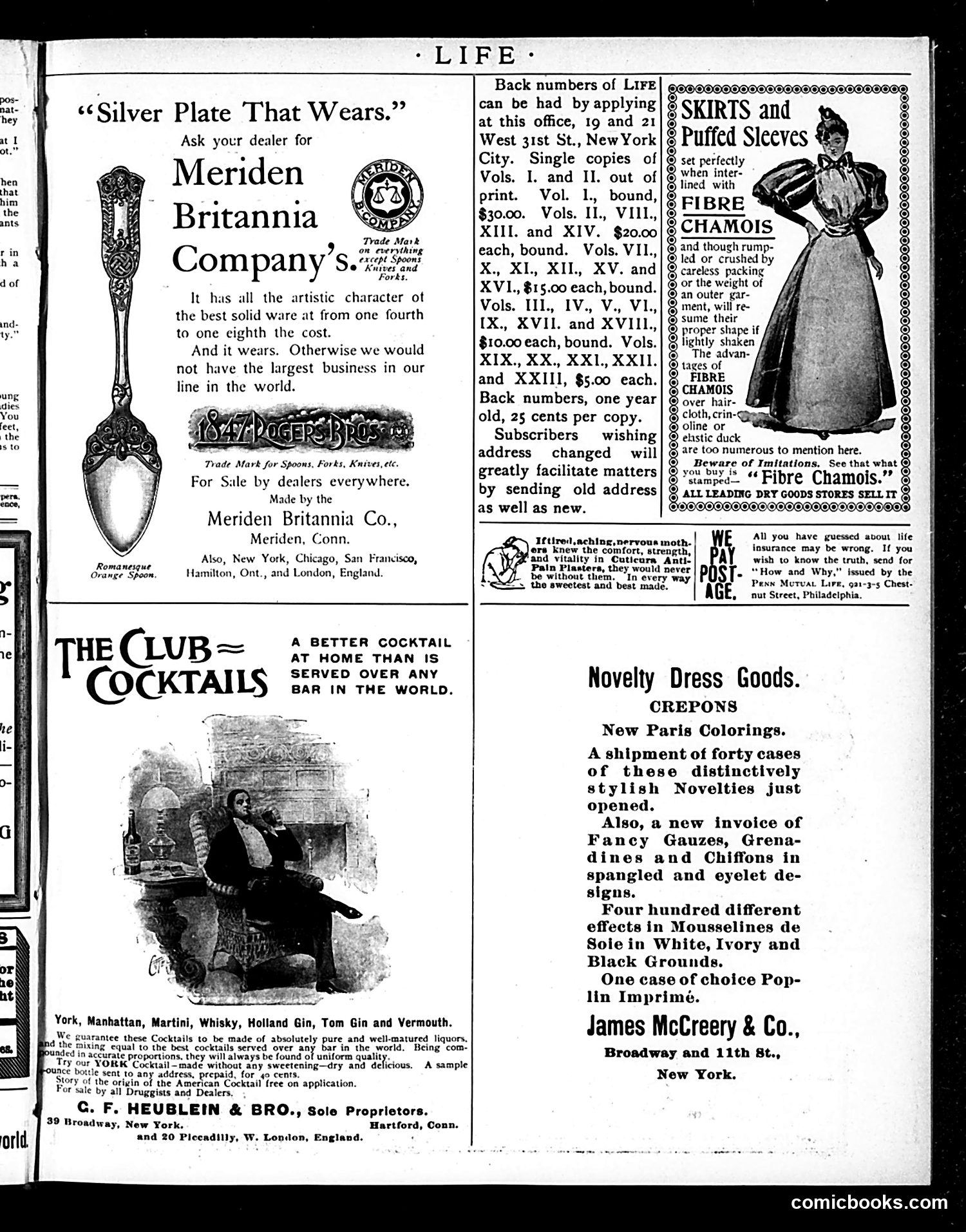
This page is primarily **advertising** rather than editorial content or satire. It features commercial advertisements for various products popular in the early 1900s: **Main Advertisements:** - **Meriden Britannia Company**: Silver-plated flatware marketed as affordable alternative to solid silver - **The Club Cocktails**: Pre-mixed cocktail brand (York, Manhattan, Martini varieties) - **Fibre Chamois**: Fabric for women's skirts and puffed sleeves - **Life Magazine back issues**: Subscription notices - **Novelty Dress Goods**: Fabric shipments (crepons, gauzes, chiffons) - **James McCreery & Co**: Department store advertising - **Penn Mutual Life Insurance**: Small advertisement **Context for Modern Readers:** These ads reflect early-1900s consumer culture—ready-made cocktails were novel luxury items, "puffed sleeves" were fashionable, and mail-order fabric shopping was standard. The page shows how Life magazine, while satirical editorially, relied heavily on upscale product advertising for revenue. No political cartoons or satire appear here.
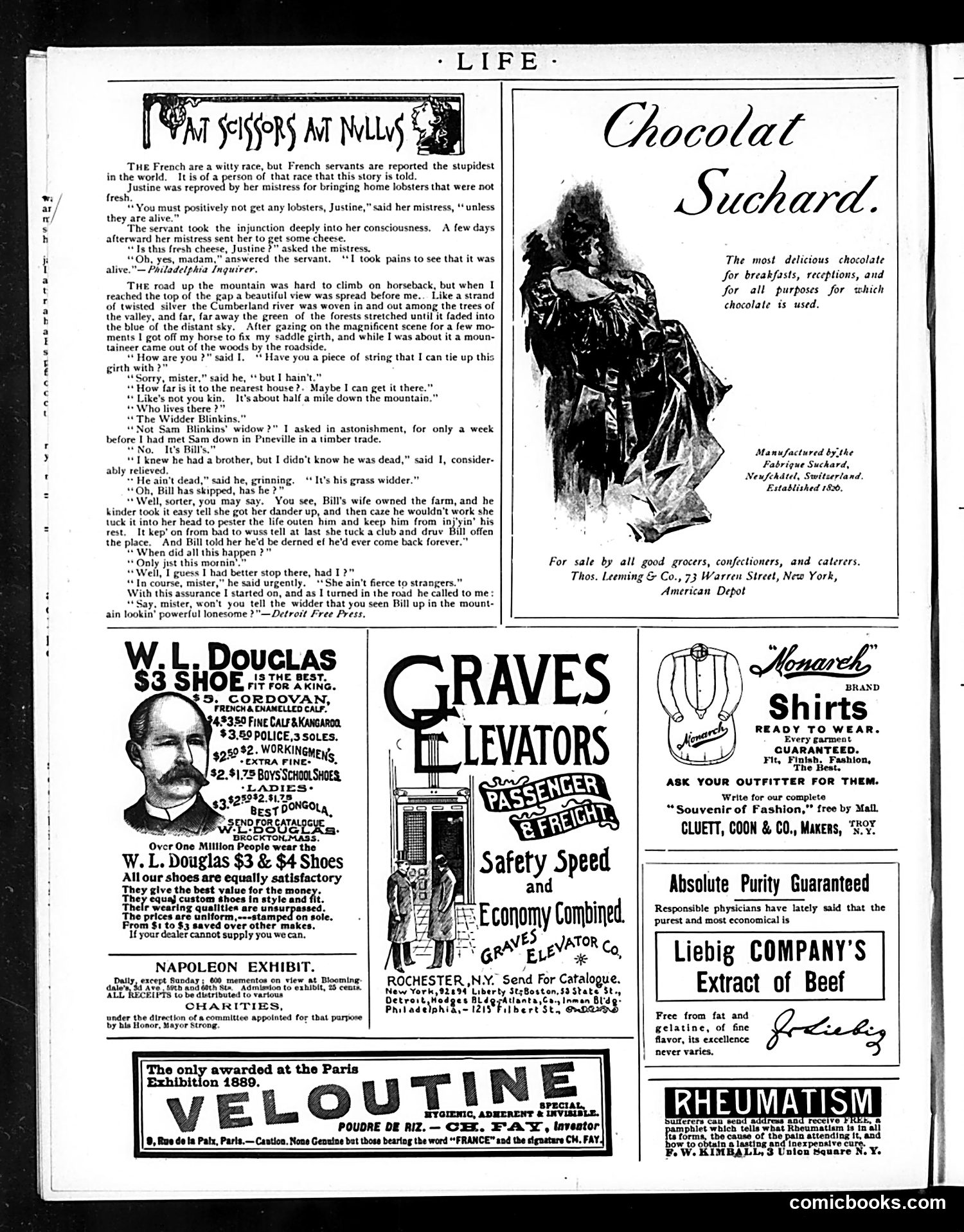
This page features two humorous anecdotes mocking French servants' supposed lack of intelligence. The first story tells of "Justine," a French maid who misunderstands her mistress's instruction to buy only fresh lobsters. When later asked if cheese is fresh, Justine responds that she ensured it was "alive"—literalistically applying the mistress's lobster directive to cheese, treating the word "fresh" as meaning "living." The second, longer story depicts a Kentucky mountaineer who uses dialect and rural logic to describe a neighbor's marital crisis. A man named Bill abandoned his farm (owned by his wife) after she beat him with a club; the woman is called a "grass widder"—a separated wife whose husband has left. The satire targets both French servant culture (popular European stereotype in American humor of this era) and rural American dialect speech. The page is otherwise filled with period advertisements for shoes, elevators, and chocolate—typical of *Life* magazine's commercial content.
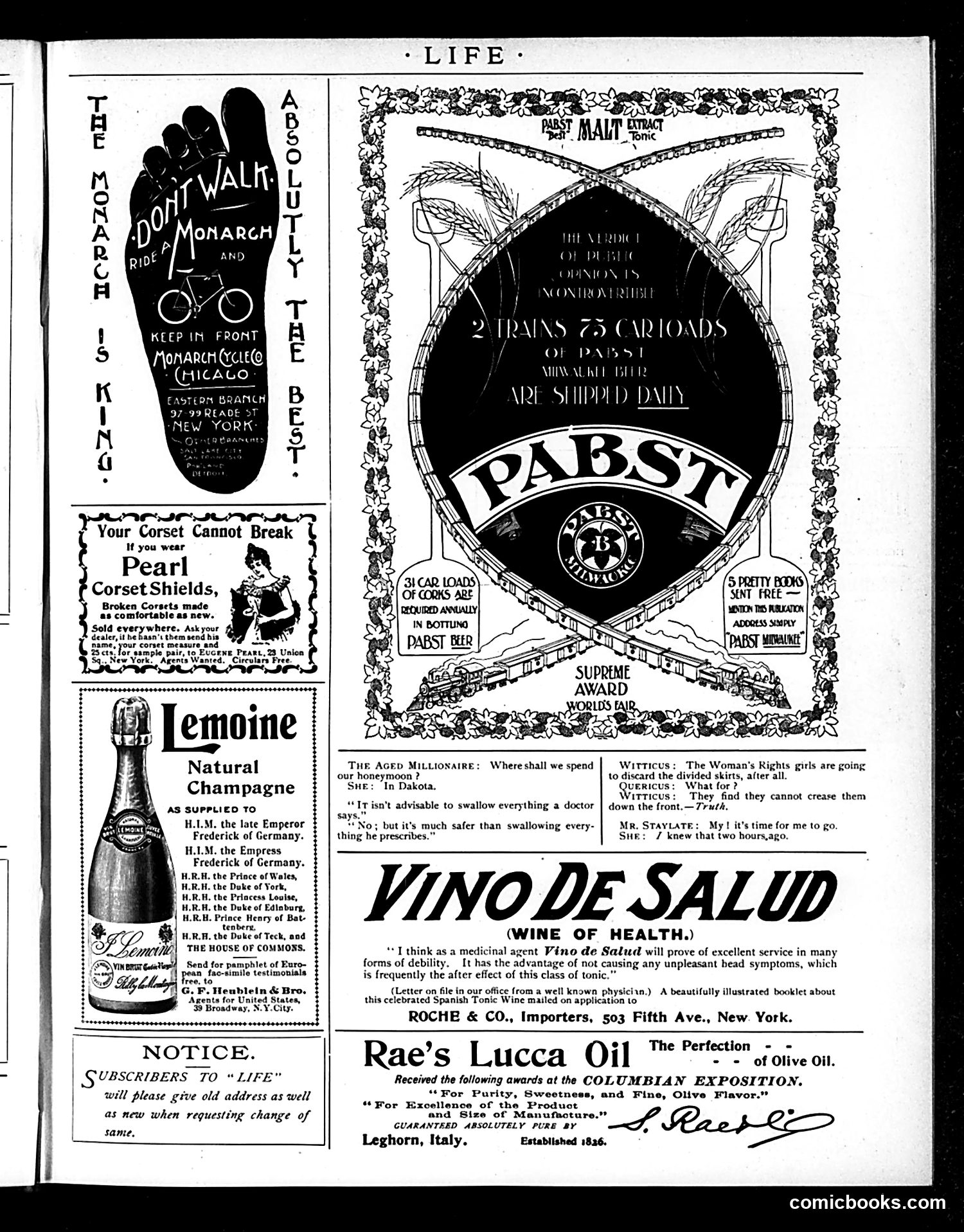
This page from *Life* magazine consists primarily of **advertisements** for luxury consumer goods popular with wealthy Americans in the 1890s-early 1900s, interspersed with brief humorous dialogue snippets. The ads promote: - **Pearl Corset Shields** (broken corsets repaired) - **Lemoine Champagne** (endorsed by European royalty) - **Vino de Salud** (Spanish tonic wine marketed as medicinal) - **Rae's Lucca Oil** (olive oil winning awards) The small jokes mock social conventions: one depicts an aged millionaire's honeymoon plans; another jokes about women's rights activists abandoning divided skirts because they can't crease them properly; a third features a man arriving late to his girlfriend who knew he would be delayed. The satirical value here is **gentle social commentary** rather than sharp political critique—mocking courtship rituals, fashion pretensions, and emerging women's rights movements through light domestic humor. The page reflects *Life*'s role as a magazine for educated, affluent readers amused by contemporary social foibles.
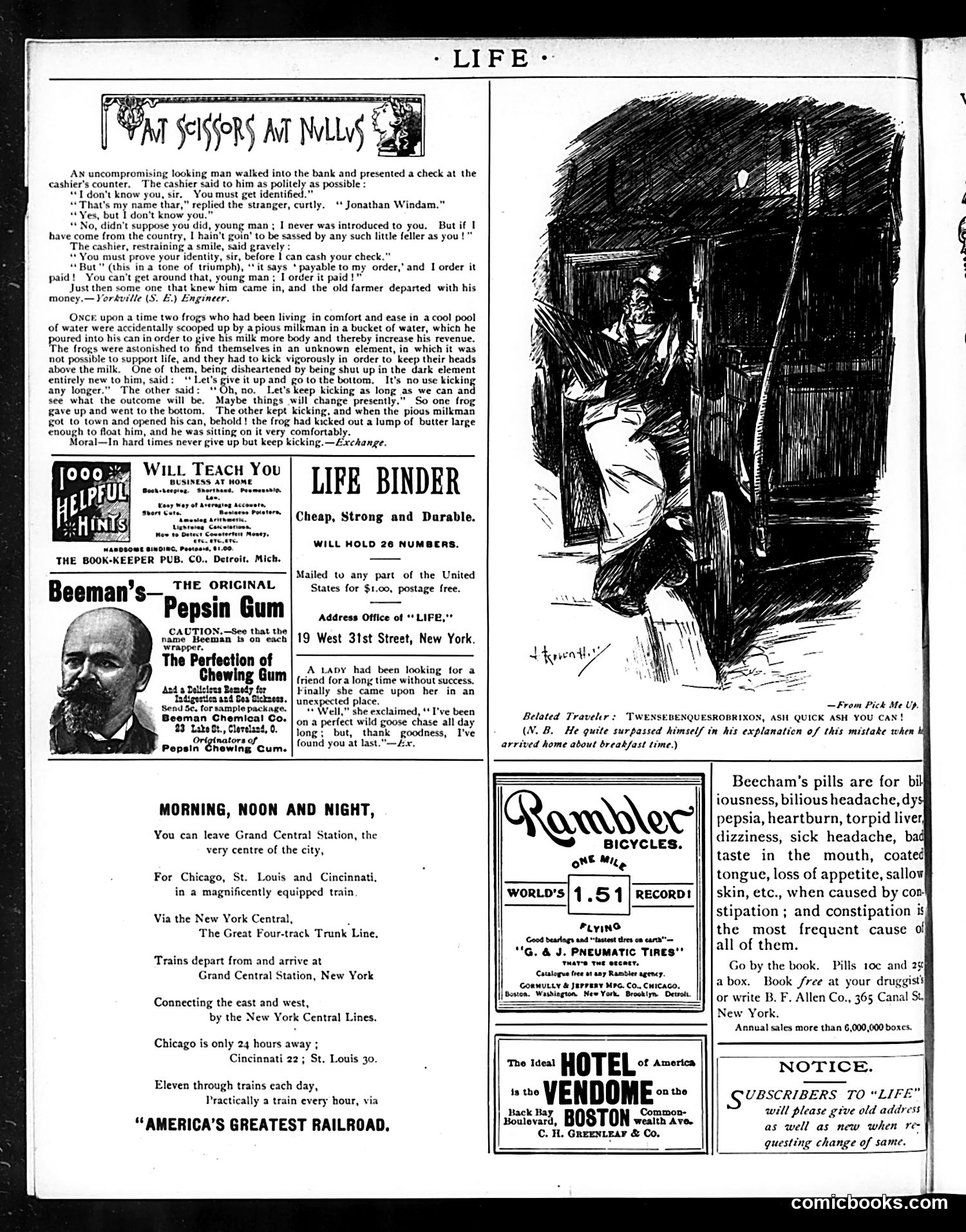
This page contains two satirical stories typical of Life magazine's humor: **The Bank Check Story**: A stubborn, unrefined country farmer ("Jonathan Windam") presents a check but refuses to prove his identity, arguing that since the check says "payable to my order," his verbal demand should suffice. The joke mocks rural ignorance of banking procedures and the farmer's absurd logic—treating a financial instrument like a personal command rather than a document requiring verification. **The Frogs in Milk**: Two frogs accidentally scooped into a milkman's pail must swim to survive. One gives up and drowns; the other persists and eventually churns the milk into butter, creating a raft to escape. The moral explicitly states: "In hard times never give up but keep kicking"—a Depression-era encouragement to persist through hardship rather than surrender. Both stories use rural or working-class characters to illustrate lessons about practical wisdom versus ignorance or perseverance versus despair. The page also contains period advertisements (Life Binder, Beecham's Pills, Rambler Bicycles).