
Life, 1895-02-14 · page 4 of 18
Life — February 14, 1895 — page 4: what you’re looking at
What you’re looking at
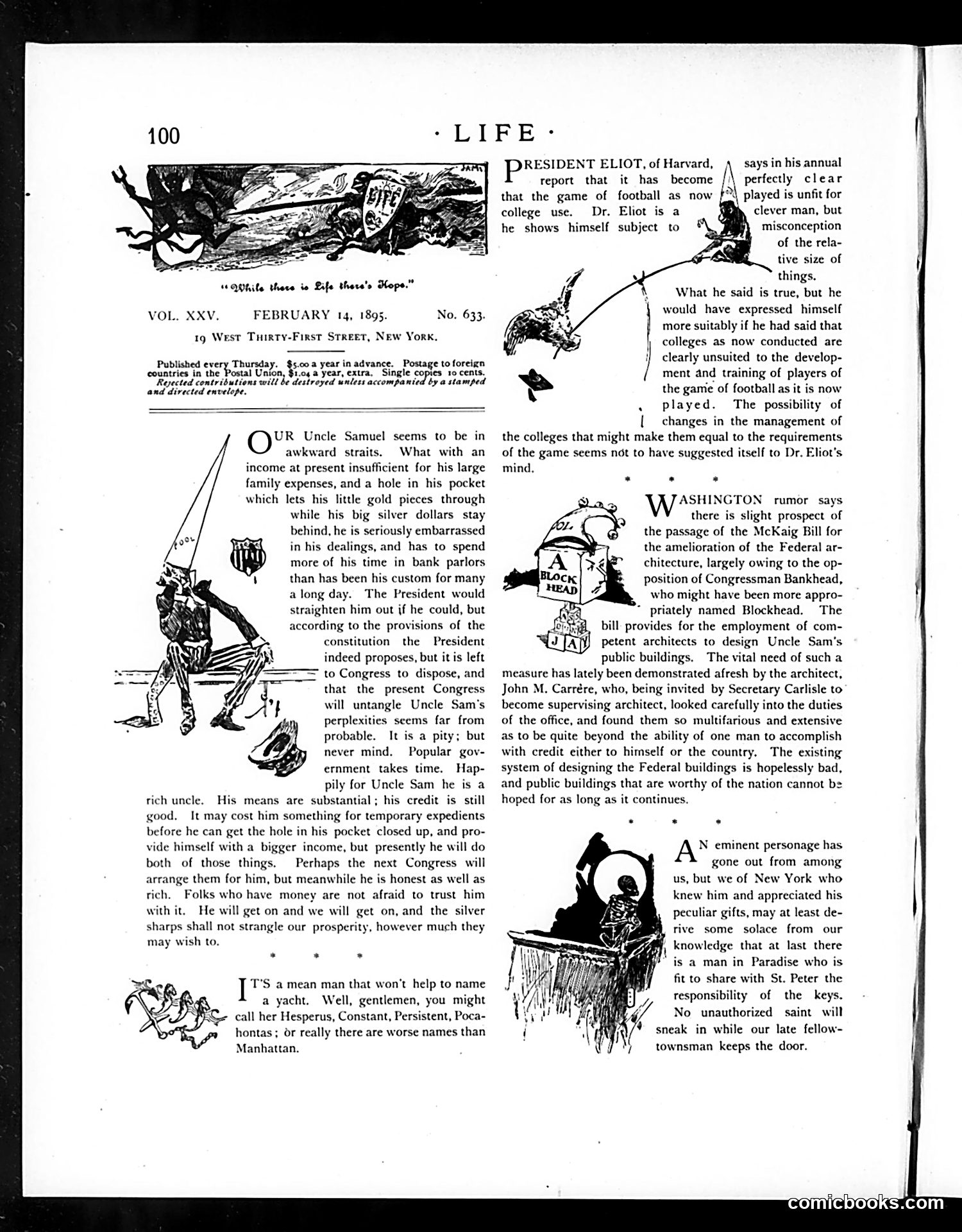
This page contains three political satires addressing contemporary issues: **"Uncle Sam's Financial Straits"** (left cartoon): Depicts Uncle Sam as financially embarrassed, unable to afford his government expenses. The satire criticizes the insufficient presidential income and suggests Congress should increase it—a commentary on late-19th-century debates over executive compensation and federal budget constraints. **"Football at Harvard"** (top): References President Eliot's criticism that college football is unfit for "clever" players, arguing universities are poorly suited to develop football players. The satire mocks Eliot's perspective on academic priorities. **"Paradise Gatekeeper"** (right): A brief humorous reference to an unnamed prominent New Yorker now in "Paradise," suggesting he'd make a suitable guardian of heaven's gates—appears to be a biographical or obituary notice.
📄 Transcribed text from this page (OCR, searchable)
Machine-transcribed from the original scan — historical spelling and the odd misread are preserved.
> LIFE: “WODhile thace io Life there's Hope.” VOL. XXV. FEBRUARY 14, 1895. No. 633. 1g West Tuirty-First Street, New York. Published every Thursday. $5.00 a year in advance. Postage to foreign countries in the Postal Union, $1.04 year, extra, Single copies 10 cents, Rejected contributions will be destroyed unless accompanied by a stamped and directed envelope. UR Uncle Samuel seems to be in awkward straits. What with an income at present insufficient for his large family expenses, and a hole in his pocket which lets his little gold pieces through while his big silver dollars stay behind, he is seriously embarrassed in his dealings, and has to spend more of his time in bank parlors than has been his custom for many along day. The President would straighten him out if he could, but according to the provisions of the constitution the President indeed proposes, but itis left to Congress to dispose, and that the present Congress will untangle Uncle Sam's perplexities seems far from probable. It is a pity; but never mind. Popular gov- aM ernment takes time. Hap- pily for Uncle Sam he is a rich uncle. His means are substantial; his credit is still good, It may cost him something for temporary expedients before he can get the hole in his pocket closed up, and pro- vide himself with a bigger income, but presently he will do both of those things. Perhaps the next Congress will arrange them for him, but meanwhile he is honest as well as rich, Folks who have money are not afraid to trust him with it. He will get on and we will get on, and the silver sharps shall not strangle our prosperity, however much they may wish to. Sp * . . T'S a mean man that won't help to name a yacht. Well, gentlemen, you might SS call her Hesperus, Constant, Persistent, Poca- hontas; or really there are worse names than Manhattan. RESIDENT ELIOT, of Harvard, \ says in his annual report that it has become //\ perfectly clear that the game of football as now [2M played is unfit for college use. Dr. Eliot is a clever man, but he shows himself subject to misconception of the rela- tive size of things. What he said is true, but he would have expressed himself more suitably if he had said that colleges as now conducted are clearly unsuited to the develop- ment and training of players of the game of football as it is now played. The possibility of changes in the management of the colleges that might make them equal to the requirements of the game seems not to have suggested itself to Dr. Eliot's mind. . . WASHINGTON rumor says there is slight prospect of the passage of the McKaig Bill for the amelioration of the Federal ar- chitecture, largely owing to the op- position of Congressman Bankhead, who might have been more appro- ~ priately named Blockhead, The bill provides for the employment of com- petent architects to design Uncle Sam's public buildings. The vital need of such a measure has lately been demonstrated afresh by the architect, John M. Carrére, who, being invited by Secretary Carlisle to become supervising architect, looked carefully into the duties of the office, and found them so multifarious and extensi: as to be quite beyond the ability of one man to accomplish with credit either to himself or the country. The existing system of designing the Federal buildings is hopelessly bad, and public buildings that are worthy of the nation cannot be hoped for as long as it continues. . . . N eminent personage has gone out from among us, but we of New York who knew him and appreciated his peculiar gifts, may at least de- rive some solace from our knowledge that at last there is a man in Paradise who is fit to share with St. Peter the responsibility of the keys. No unauthorized saint will sneak in while our late fellow- townsman keeps the door.