
Life, 1895-02-14 · page 12 of 18
Life — February 14, 1895 — page 12: what you’re looking at
What you’re looking at
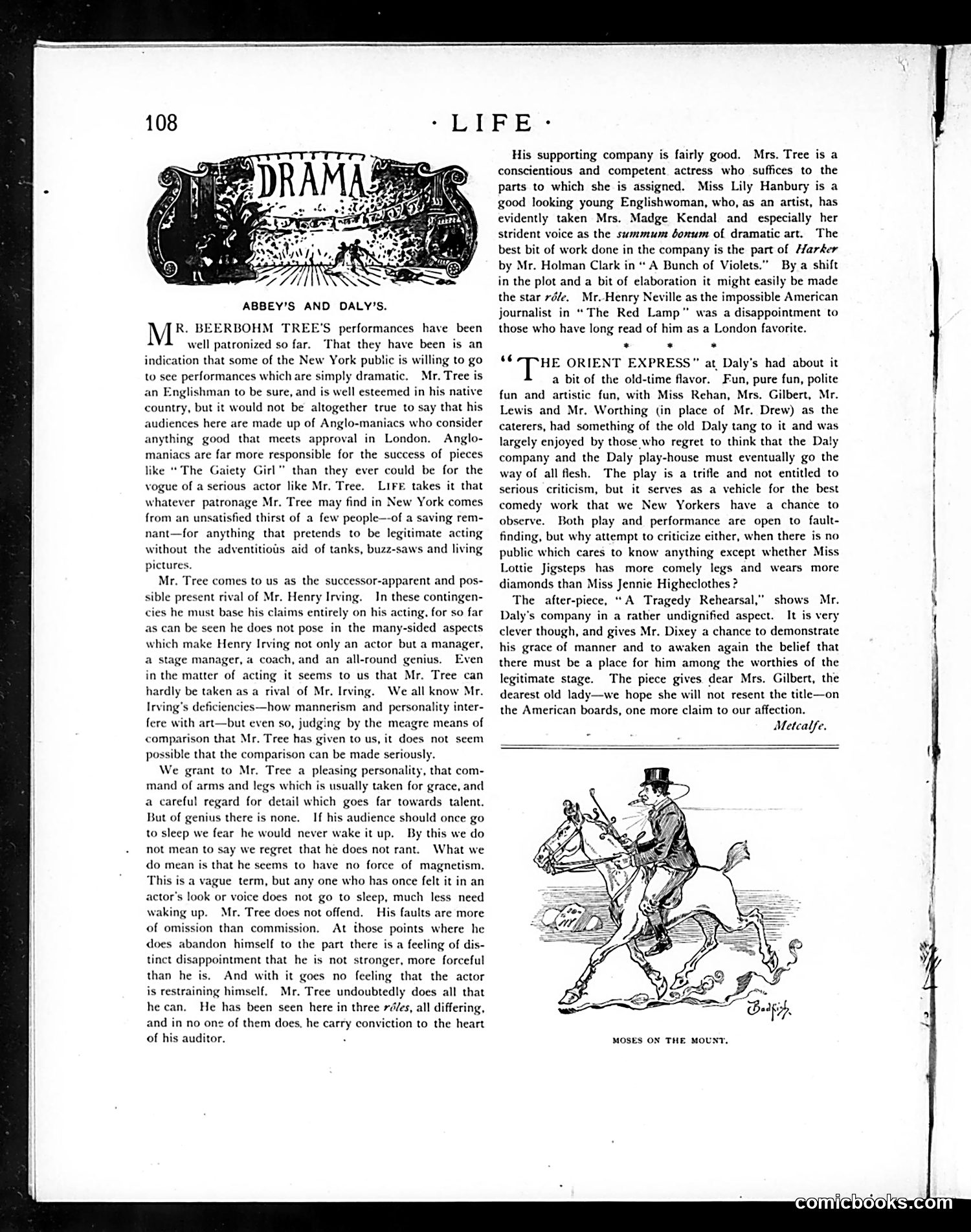
This page reviews theatrical performances by English actor Herbert Beerbohm Tree and productions at Daly's Theatre. The accompanying illustration titled "Moses on the Mount" depicts a figure on horseback—likely a satirical reference to theatrical spectacle or a character from one of the reviewed plays. The text critiques Tree as a competent but uninspired actor lacking the "magnetism" and commanding presence of his rival Henry Irving. The reviewer acknowledges Tree's technical skill—grace, personality, attention to detail—but argues he possesses no genius and cannot captivate an audience. The piece defends serious dramatic theater against frivolous spectacles ("tanks, buzz-saws and living pictures"), suggesting Tree's audiences appreciate legitimate acting over entertainment gimmicks. The review also comments on supporting performers, praising some while finding others disappointing. The satirical thrust mocks Tree's limitations rather than celebrating his work.
📄 Transcribed text from this page (OCR, searchable)
Machine-transcribed from the original scan — historical spelling and the odd misread are preserved.
ABBEY’S AND DALY’S. R. BEERBOHM TRE performances have been well patronized so far. That they have been is an ication that some of the New York public is willing to go to see performances which are simply dramatic. Mr. Tree is an Englishman to be sure, and is well esteemed in his native country, but it would not be altogether true to say that his audiences here are made up of Anglo-maniacs who consider anything good that meets approval in London. Anglo- maniacs are far more responsible for the success of pieces like * The Gaiety Girl” than they ever could be for the vogue of a serious actor like Mr. Tree. LIFE takes it that whatever patronage Mr. Tree may find in New York comes from an unsatisfied thirst of a few people—-of a saving rem- nant—for anything that pretends to be legitimate acting without the adventitious aid of tanks, buzz-saws and living pictures. Mr. Tree comes to us as the successor-apparent and pos- sible present rival of Mr. Henry Irving. In these contingen- cies he must base his claims entirely on his acting, for so far as can be seen he does not pose in the many-sided aspects which make Henry Irving not only an actor but a manager, a stage manager, a coach, and an all-round genius. Even in the matter of acting it seems to us that Mr. Tree can hardly be taken as a rival of Mr. Irving. We all know Mr. Irving's deficiencies—how mannerism and personality inter- fere with art—but even so, judging by the meagre means of comparison that Mr. Tree has given to us, it does not seem possible that the comparison can be made seriously. We grant to Mr. Tree a pleasing personality, that com- mand of arms and legs which is usually taken for grace, and a careful regard for detail which goes far towards talent. But of genius there is none. If his audience should once go to sleep we fear he would never wake it up. By this we do not mean to say we regret that he does not rant. What we do mean is that he seems to have no force of magnetism. This is a vague term, but any one who has once felt it in an actor's look or voice does not go to sleep, much less need waking up. Mr. Tree does not offend. His faults are more of omission than commission. At those points where he does abandon himself to the part there is a feeling of dis- tinct disappointment that he is not stronger, more forceful than he is. And with it goes no feeling that the actor is restraining himself. Mr. Tree undoubtedly does all that he can. He has been seen here in three ré/es, all differing, and in no one of them does, he carry conviction to the heart of his auditor. : LIFE: His supporting company is fairly good. Mrs. Tree is a conscientious and competent actress who suffices to the parts to which she is assigned. Miss Lily Hanbury is a good looking young Englishwoman, who, as an artist, has evidently taken Mrs. Madge Kendal and especially her strident voice as the summum bonum of dramatic art. The best bit of work done in the company is the part of Harker by Mr. Holman Clark in “ A Bunch of Violets.” By a shift in the plot and a bit of elaboration it might easily be made the star ré/e. Mr.Henry Neville as the impossible American journalist in “The Red Lamp” was a disappointment to those who have long read of him as a London favorite. . . . ‘©THE ORIENT EXPRESS” at, Daly's had about it a bit of the old-time flavor. Fun, pure fun, polite fun and artistic fun, with Miss Rehan, Mrs. Gilbert, Mr. Lewis and Mr. Worthing (in place of Mr. Drew) as the caterers, had something of the old Daly tang to it and was largely enjoyed by those who regret to think that the Daly company and the Daly play-house must eventually go the way of all flesh, The play is a trifle and not entitled to serious criticism, but it serves as a vehicle for the best comedy work that we New Yorkers have a chance to observe. Both play and performance are open to fault- finding, but why attempt to criticize either, when there is no public which cares to know anything except whether Miss Lottie Jigsteps has more comely legs and wears more diamonds than Miss Jennie Higheclothes ? The after-piece, A Tragedy Rehearsal," shows Mr. Daly's company in a rather undignified aspect. It is very clever though, and gives Mr. Dixey a chance to demonstrate his grace of manner and to awaken again the belief that there must be a place for him among the worthies of the legitimate stage. The piece gives dear Mrs. Gilbert, the dearest old lady—we hope she will not resent the title—on the American boards, one more claim to our affection. Metcalfe. MOSES ON THE MOUNT. ee a