
A complete issue · 14 pages · 1895
Life — January 24, 1895
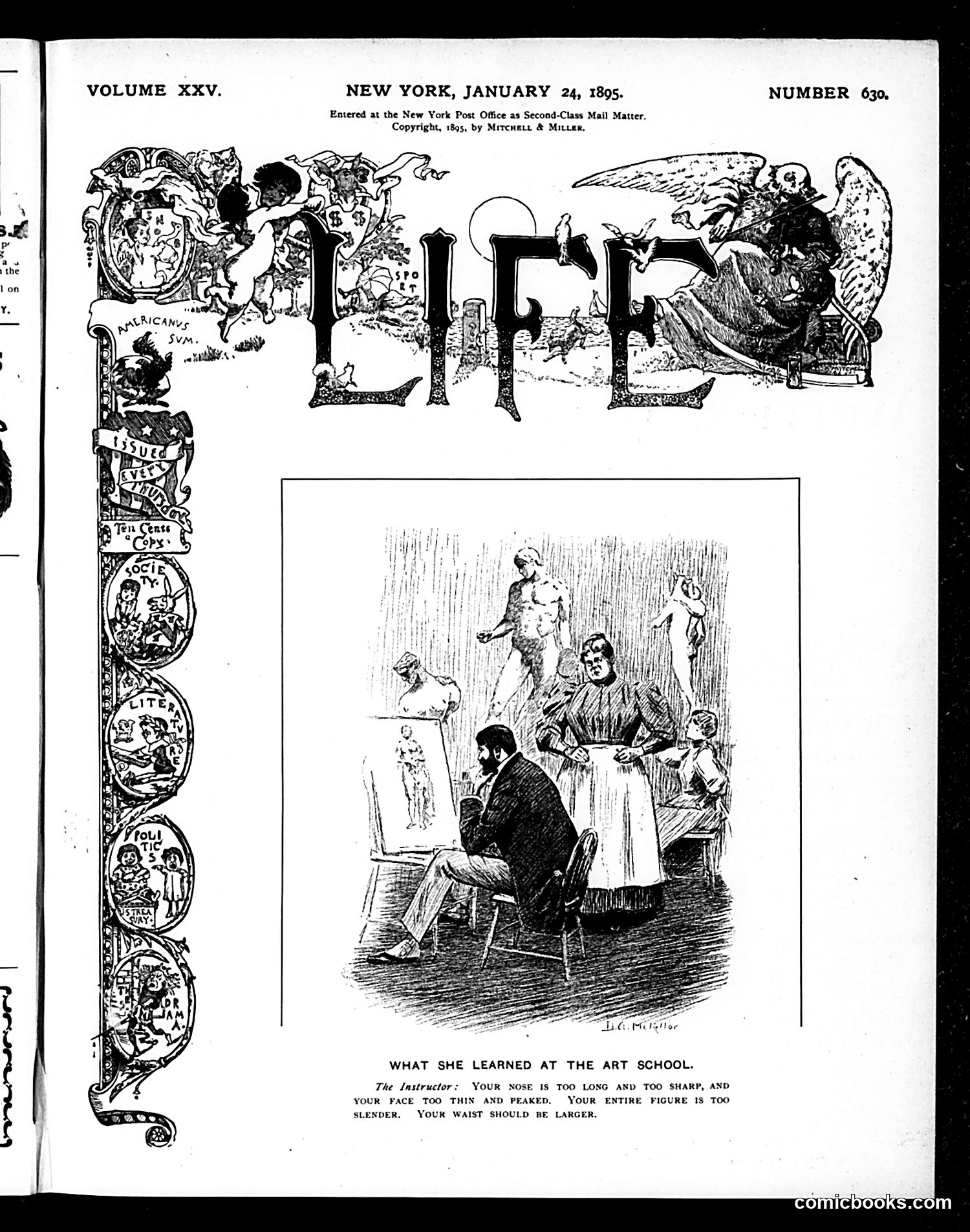
The main cartoon, titled "What She Learned at the Art School," satirizes art instruction by depicting an instructor critiquing a female student's work. The instructor's comments—visible in the caption—mock her artistic ability, noting her subject has a nose that's "too long and too sharp," a face that's "too thin and peaked," and a figure that's "too slender." The satire appears to target either inadequate art pedagogy or unrealistic beauty standards being reinforced through art instruction. The female student poses with classical statuary visible behind her, suggesting tension between academic ideals and actual human forms. The joke criticizes what constitutes "proper" artistic training for women in the 1890s.
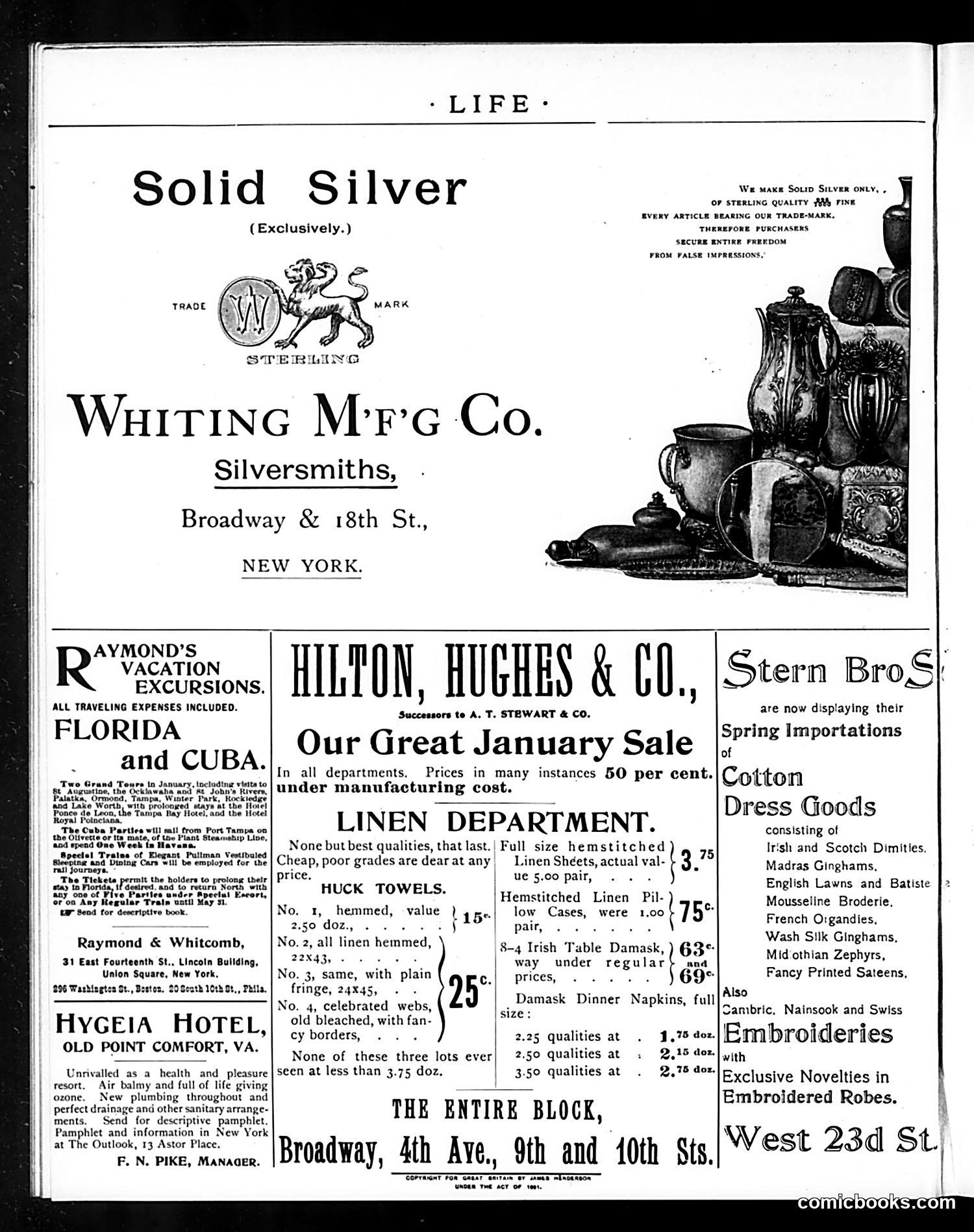
This page is **primarily advertising**, not satirical content. It contains no political cartoons or comics. The page features ads for: - **Whiting Mfg Co.** (solid silver goods) - **Raymond's Vacation Excursions** (Florida and Cuba travel) - **Hilton, Hughes & Co.** (January sale of linens and textiles) - **Stern Bros** (spring cotton dress goods and embroideries) - **Hygeia Hotel** (Old Point Comfort, Virginia health resort) The only illustrative element is a decorative image of silver vessels and tableware accompanying the Whiting advertisement. This is a standard commercial magazine page from the early 20th century, showcasing luxury goods and travel services to affluent readers—not satirical commentary.
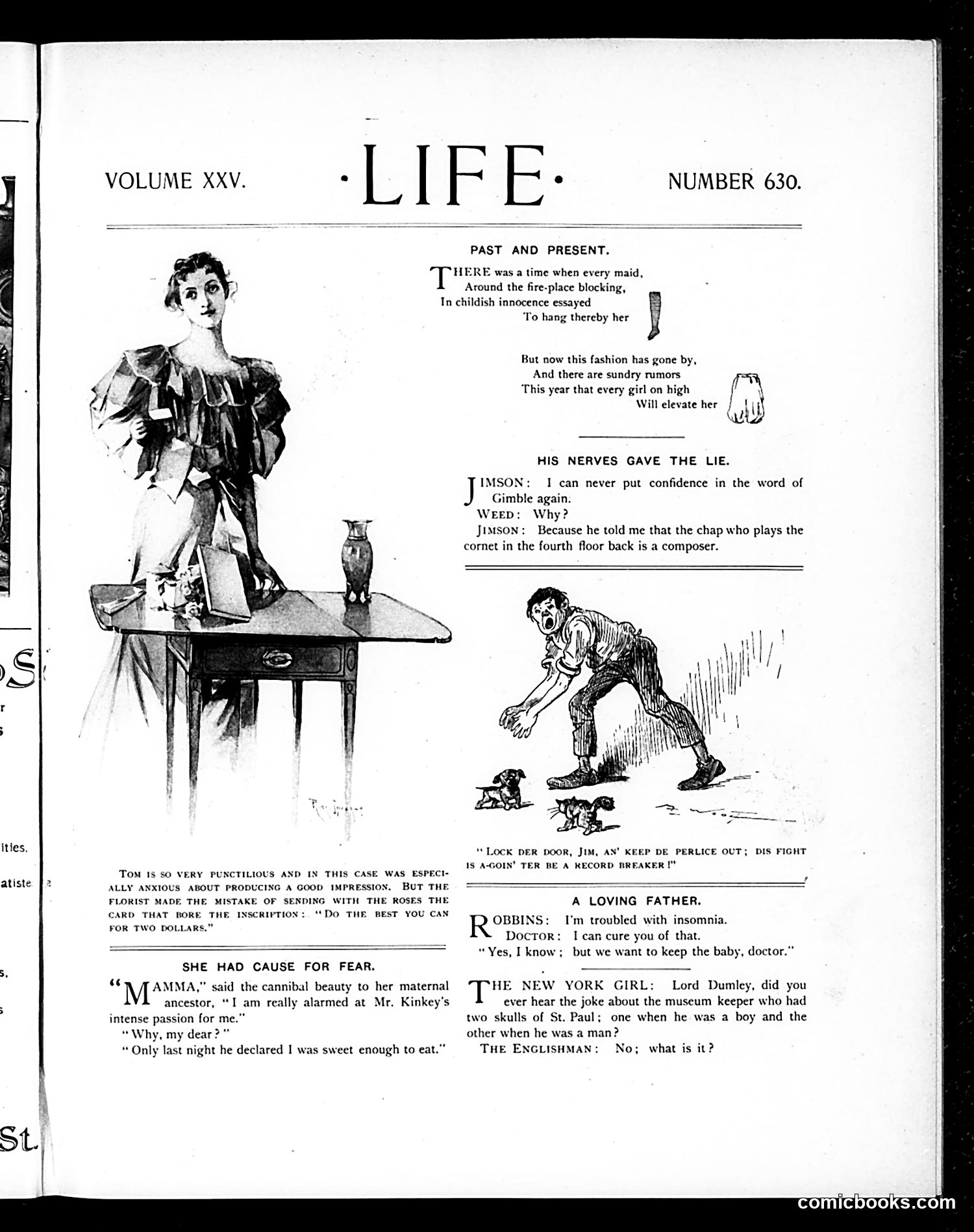
This page contains several brief satirical pieces typical of Life's humor format: **"Past and Present"**: A poem contrasting old-fashioned propriety (maids hanging around fireplaces) with modern fashion trends where "every girl on high" will elevate herself—likely mocking contemporary women's changing social ambitions. **"His Nerves Gave the Lie"**: A joke about unreliable testimony regarding a composer, poking fun at casual deception. **"She Had Cause for Fear"**: Dark humor about a "cannibal beauty" and her mother's appetite—a racist caricature common to the era's offensive stereotyping. **"A Loving Father"** and **"The New York Girl"**: Brief conversational humor pieces about parenting and tourist behavior. The cartoons and text reflect early 20th-century Life magazine's mix of social observation, class humor, and period racism that would be unacceptable today.
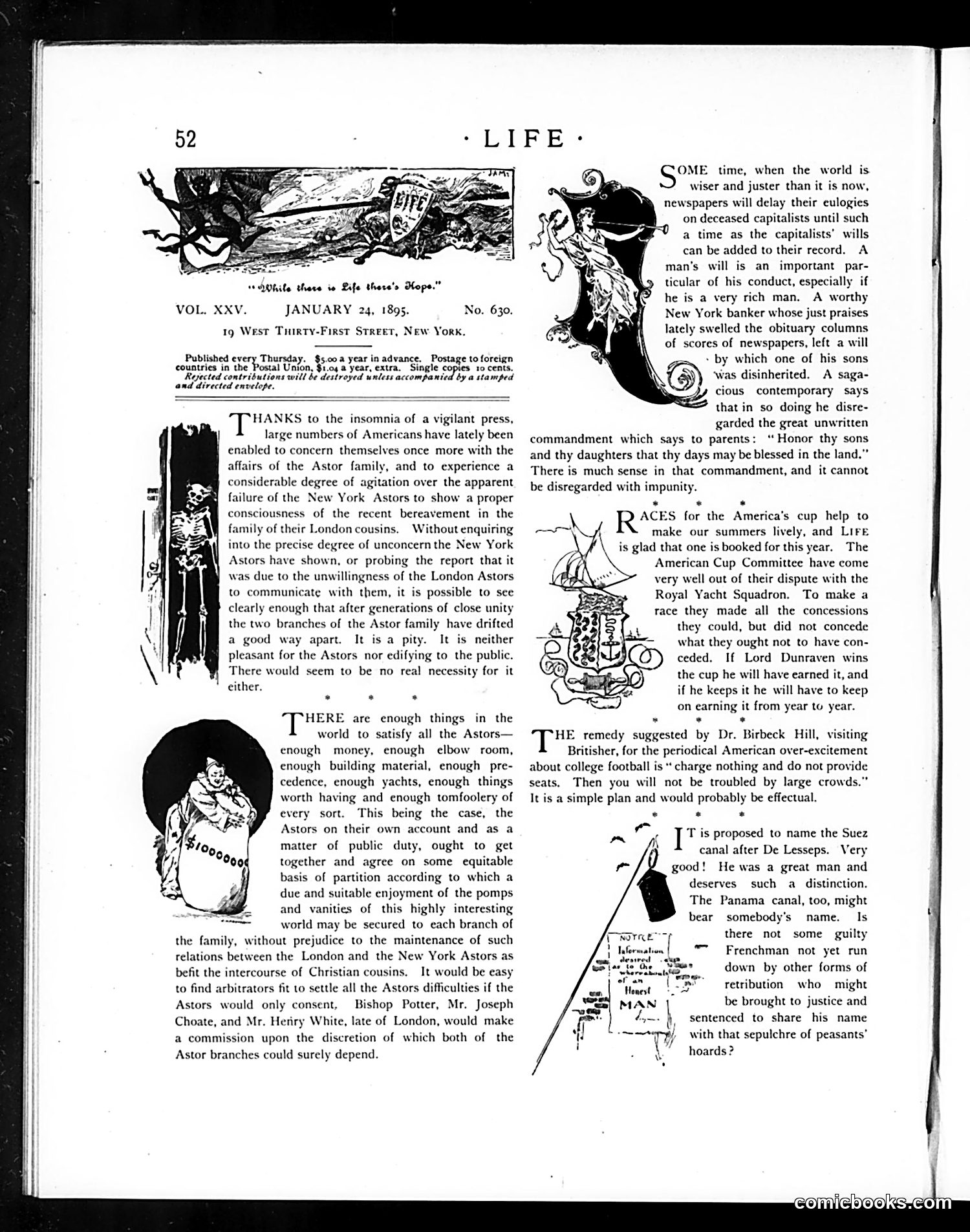
This page discusses the Astor family dispute. The text notes that American and London branches of the wealthy Astor family have had a "considerable degree of agitation" following a recent bereavement. The author argues the family should resolve their differences through arbitration rather than public airing of grievances. The cartoons appear to satirize wealthy family conflicts. One figure, labeled "Bloodsuck," likely represents parasitic hangers-on or financial complications within aristocratic estates. The page also includes brief satirical notes on other topics: a suggestion about the America's Cup yacht race, Dr. Birbeck Hill's remedy for college football crowds, and a humorous proposal to name the Suez Canal after De Lesseps rather than attributing it to a "guilty Frenchman."
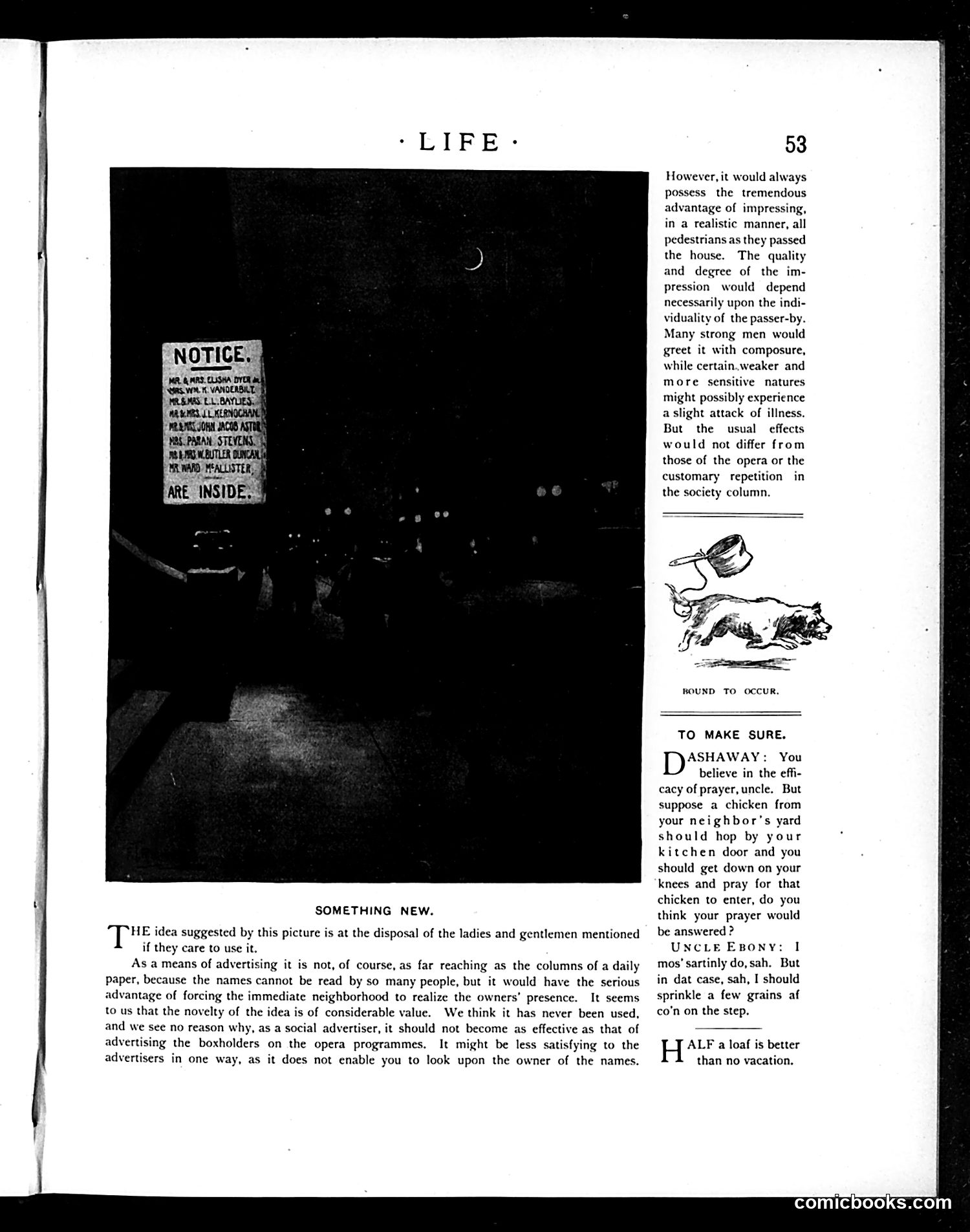
This page satirizes a novel advertising idea: placing a notice on a residential house listing the names of prominent people living inside. The accompanying photograph shows an actual house with a "NOTICE" sign stating "ARE INSIDE" with what appears to be multiple names. The text argues this method, while attention-grabbing, has serious drawbacks. It would impress pedestrians but lacks the reach of newspaper advertising and awkwardly requires passersby to read names on the house itself—an impractical approach compared to traditional opera program advertising. The satire criticizes the inefficiency and social oddness of this residential advertising scheme, suggesting it prioritizes novelty over practical effectiveness in reaching potential audiences or customers.
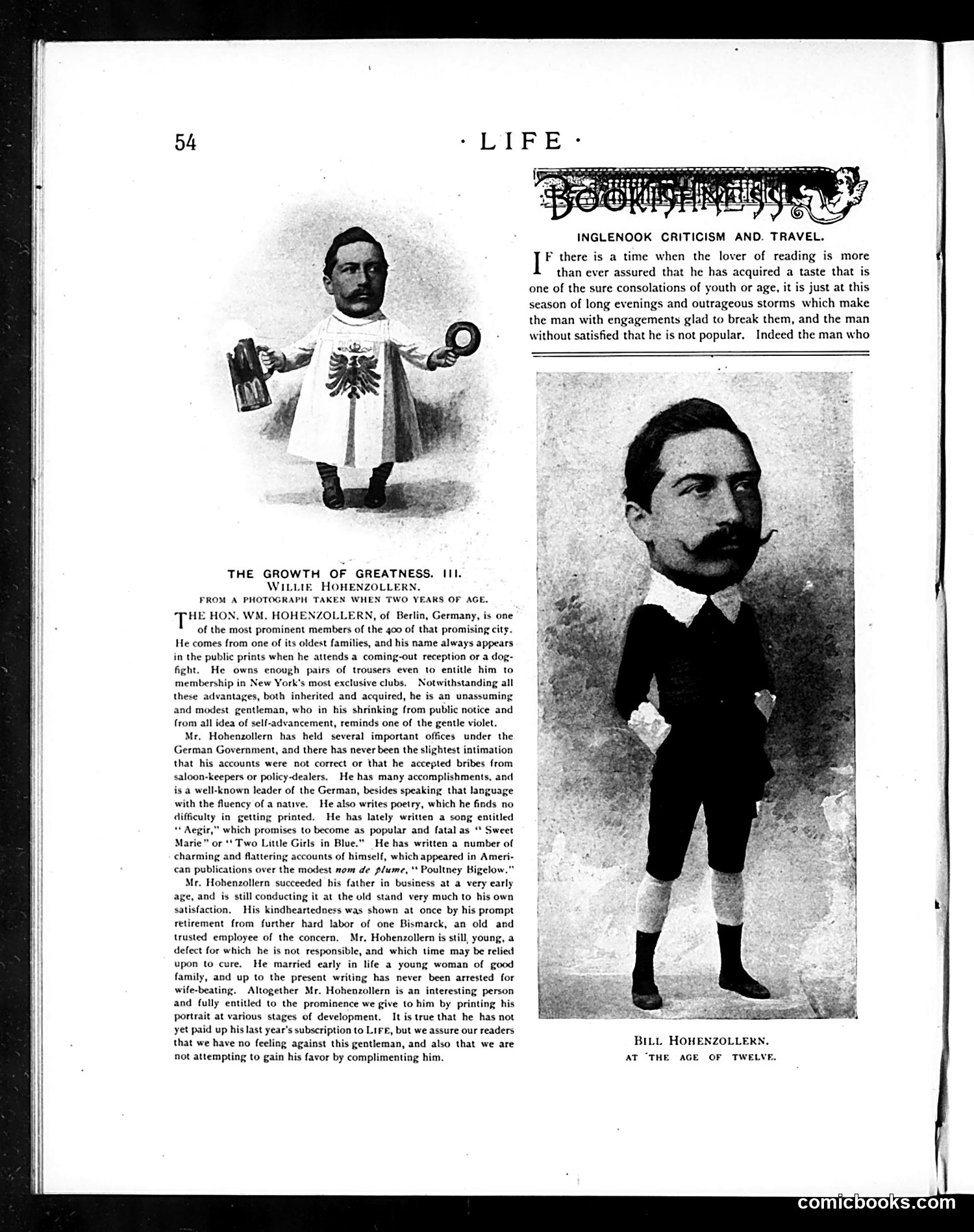
This page features "The Growth of Greatness III," a satirical portrait series about **Willie Hohenzollern**, identified as Hon. Wm. Hohenzollern of Berlin, Germany. The left image shows him as a child in formal dress, holding a beer mug and what appears to be a scepter—satirizing his aristocratic pretensions and German stereotypes about beer culture. The accompanying text describes him as a prominent Berlin socialite from an old family, holding German government offices, and claims he's written poetry and songs. The satire appears to mock his modest self-presentation despite inherited wealth and status, his business dealings, and his overall self-importance. The name "Hohenzollern" references the actual German royal dynasty, suggesting this is likely a caricature of a real contemporary figure using a loaded name for comic effect.
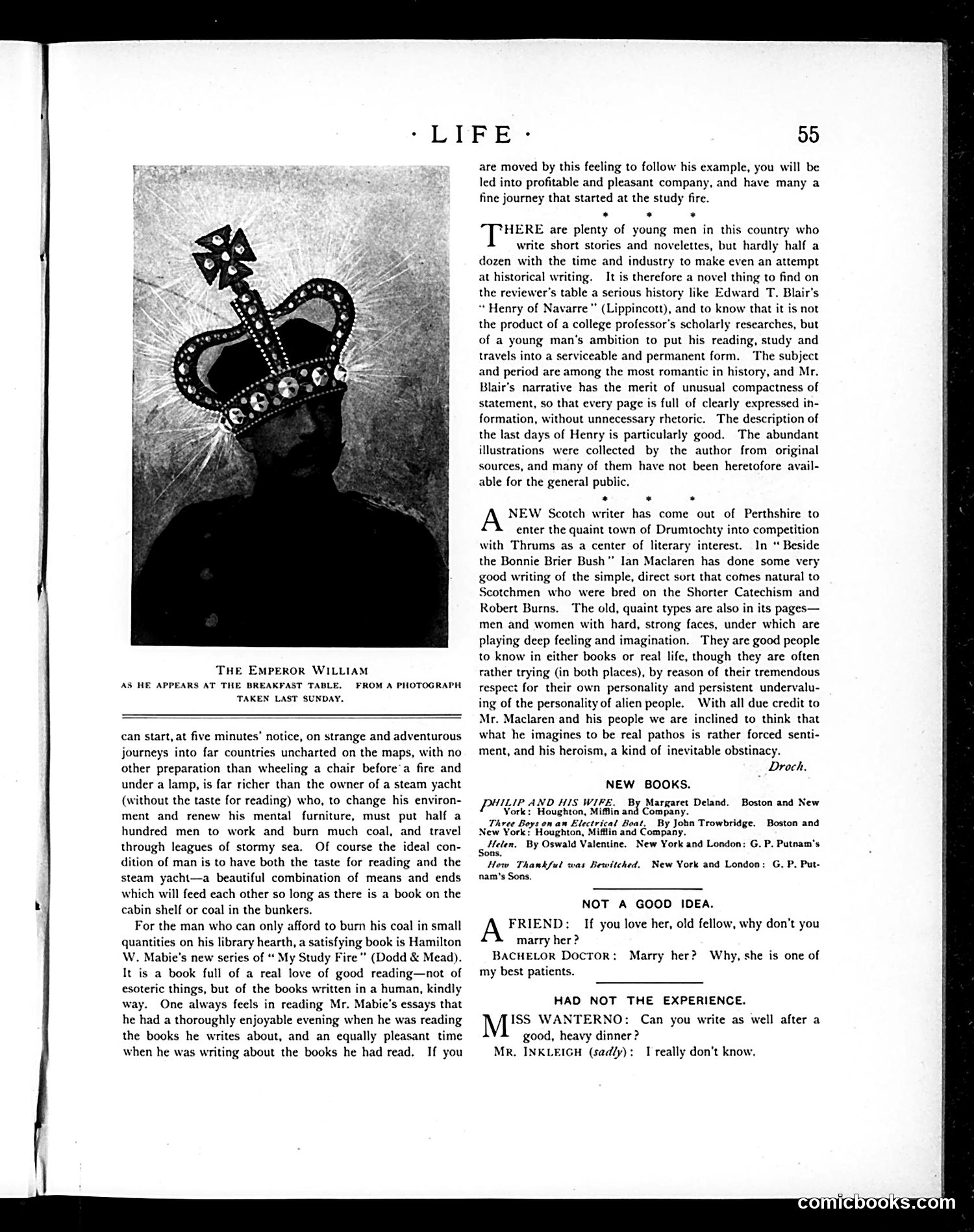
This political cartoon depicts **Kaiser Wilhelm II of Germany**, identifiable by the distinctive spiked Prussian military helmet (pickelhaube) and ornate uniform visible in silhouette. The photograph caption indicates this shows him "as he appears at the breakfast table from a photograph taken last Sunday." The satire appears to target Wilhelm's **imperial pretensions and militarism**—the exaggerated, elaborate military regalia worn even at an intimate domestic moment like breakfast suggests mockery of Prussian martial culture and the Kaiser's ostentatious display of power. The image likely dates to a period of German-American tensions, probably around World War I, when *Life* magazine frequently satirized German leadership and military aggression through caricature and visual exaggeration.
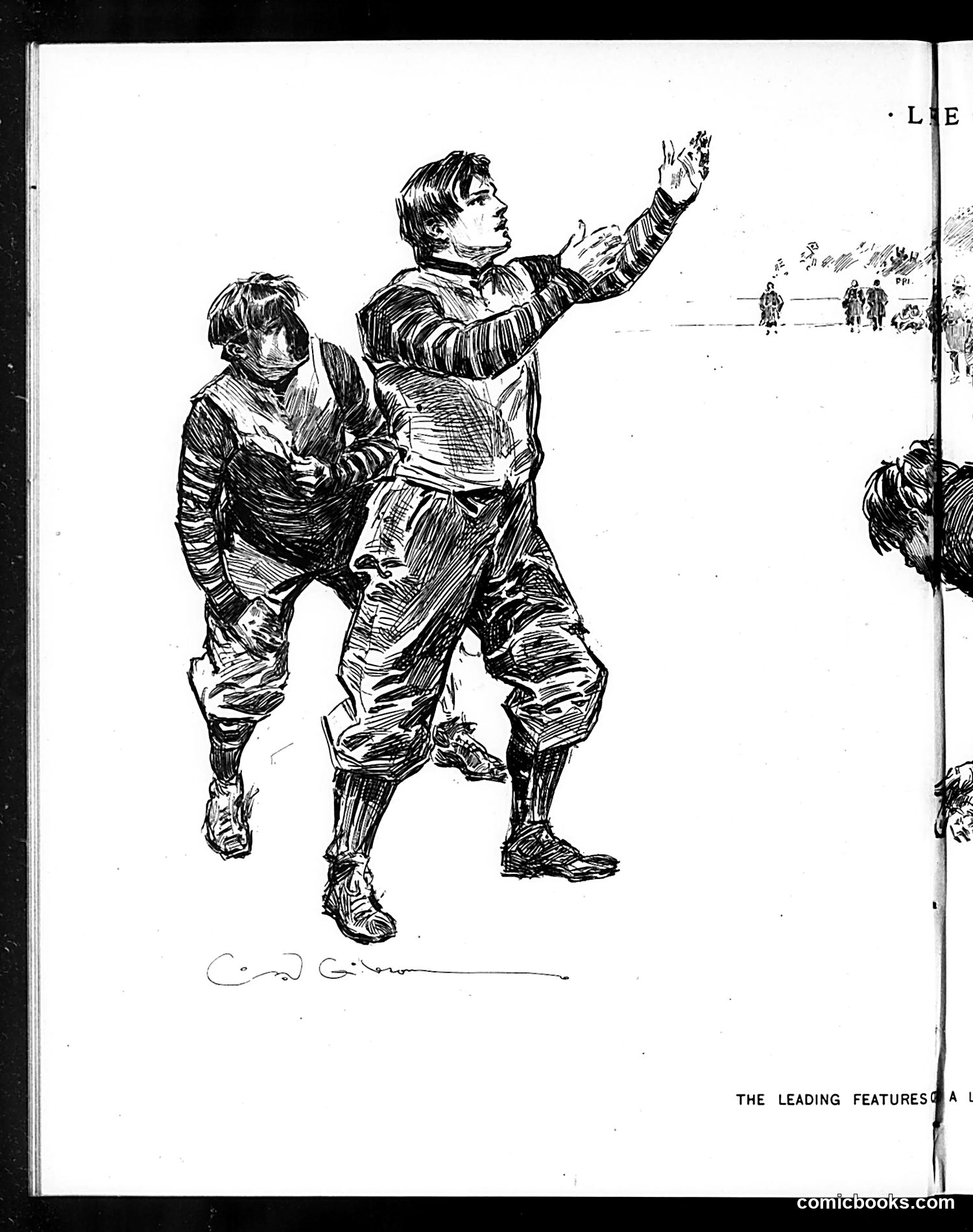
This page shows a pen-and-ink illustration of two soldiers in military gear, with one pointing or gesturing outward while the other stands beside him. The style is dynamic, capturing movement and action. The caption reads "THE LEADING FEATURES OF A" (text cuts off), suggesting this illustration is part of a larger series showcasing prominent aspects of something—likely military operations or a war effort, given the soldiers' uniforms and dramatic pose. Without the complete caption or fuller context from surrounding pages, I cannot definitively identify which specific conflict, campaign, or historical moment this depicts. The illustration's style and the "Life" magazine publication suggest early-to-mid 20th century, but the exact satirical point or political commentary remains unclear from this page alone.
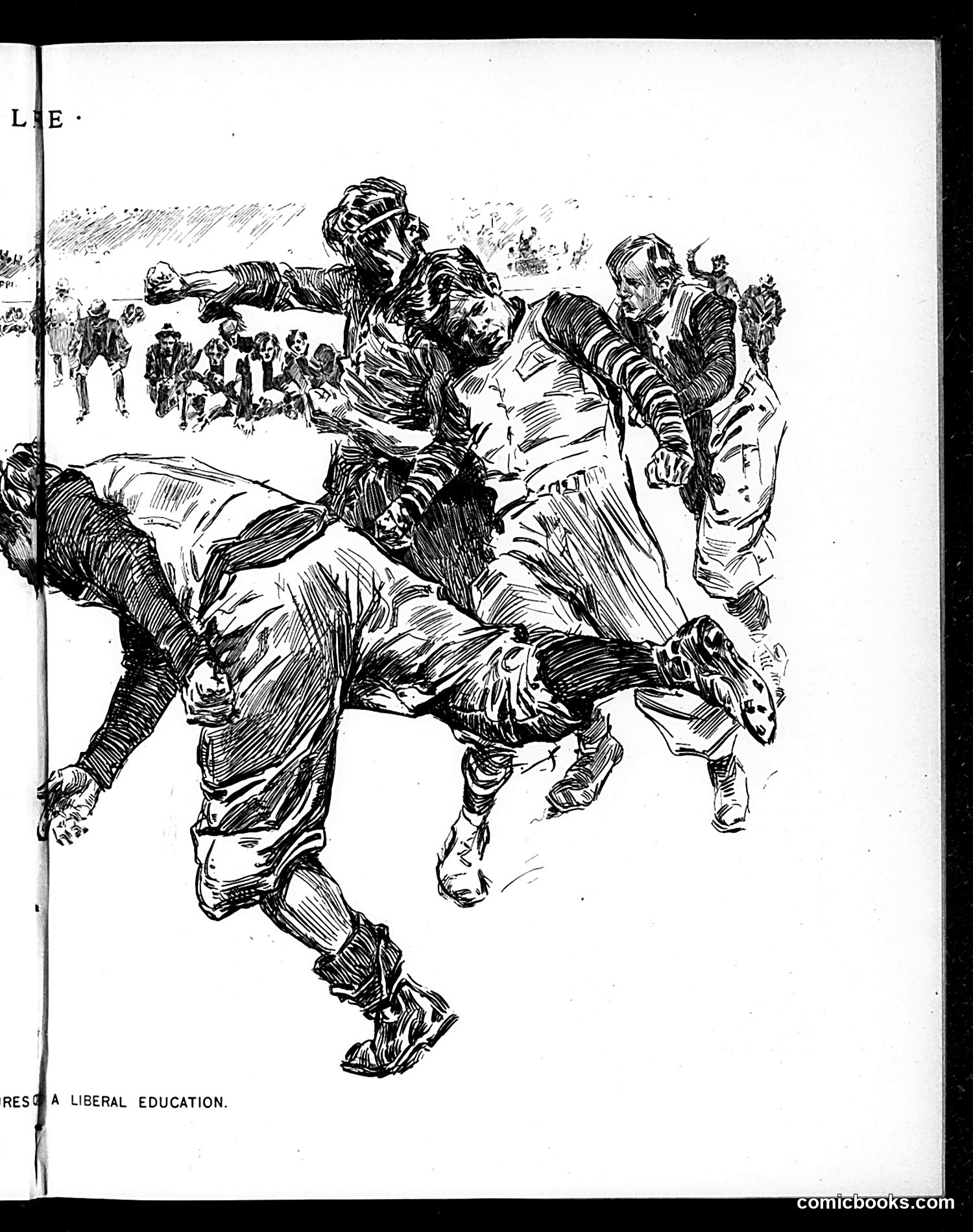
This political cartoon satirizes violent confrontation, likely from the early 20th century. The image depicts several figures engaged in physical struggle or assault, with spectators watching in the background. The caption "A Liberal Education" suggests ironic commentary—that brutal violence or street conflict represents a form of "education" for the masses or political movements. The cartoon likely critiques either labor unrest, radical political activism, or police brutality of its era. The central figures appear to be engaged in a chaotic brawl, while onlookers witness the scene. The satirical title implies that such public violence has become a common, almost normalized form of civic learning in contemporary American society. Without additional context about the specific issue of *Life* magazine, the precise historical event referenced remains unclear.
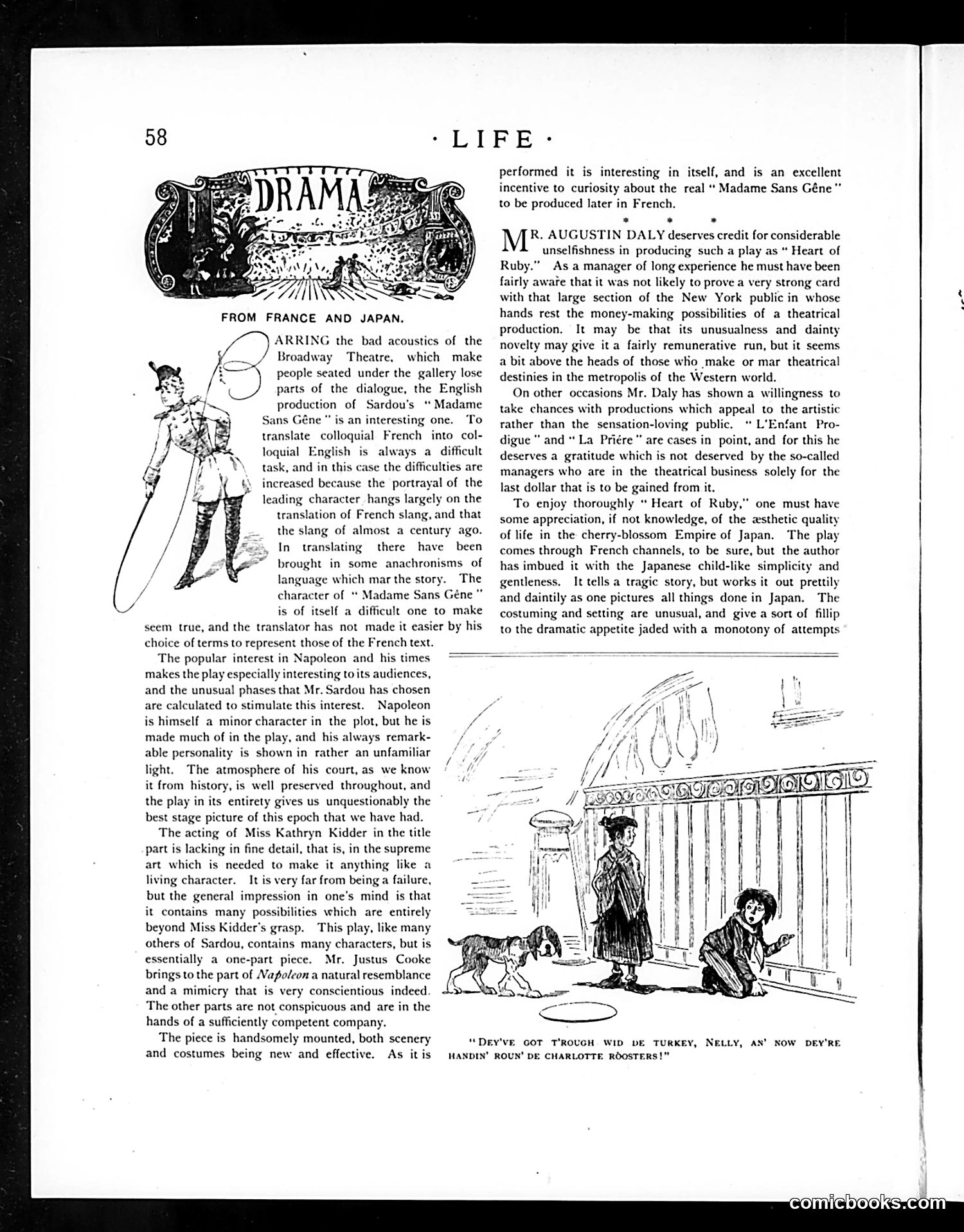
This page reviews theatrical productions, specifically discussing "Heart of Ruby" and French plays like "Madame Sans Gène." The left illustration depicts a character in period costume, likely from the French play being discussed. The lower cartoon shows a domestic scene with a woman kneeling before a man near a fireplace, with a small dog present. The caption reads: "Dev've got t'rough wid de turkey, Nelly, an' now dey're hasn't roust de Charlotte Roosters!" This appears to be ethnic humor, using dialect spelling ("Dev've," "hasn't") typical of early 20th-century American comedy. The joke likely plays on class humor—servants discussing leftover poultry and preparing alternative dishes—reflecting period attitudes toward working-class speech patterns as inherently comic.
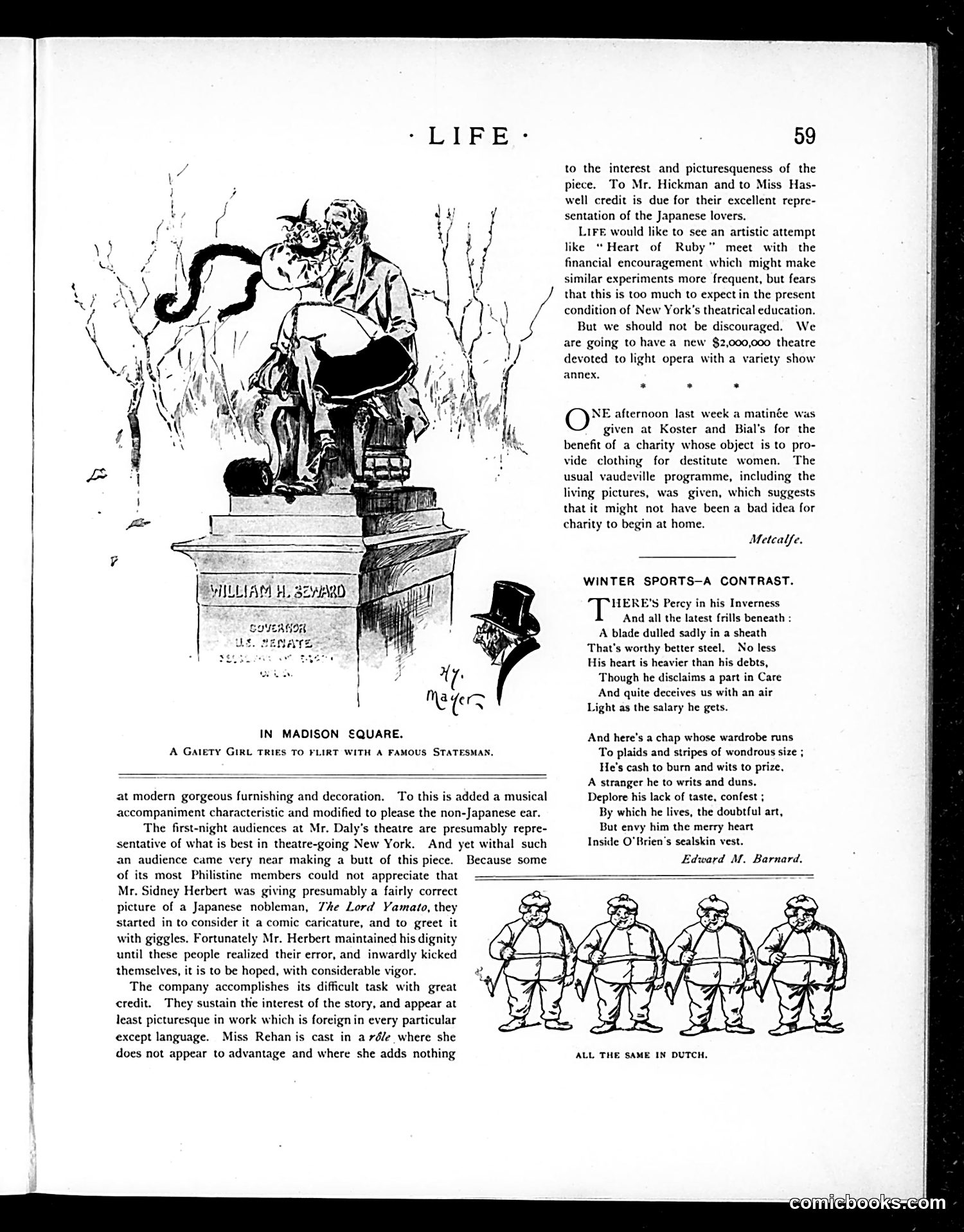
This page contains two distinct satirical pieces: **"In Madison Square" (top):** A statue of William H. Seward depicts him holding a woman. The caption notes a "Gaiety Girl tries to flirt with a famous statesman." This appears to satirize either the statue itself or public behavior around it—possibly commentary on inappropriate conduct or the tension between serious historical monuments and modern frivolity in public spaces. **"Winter Sports—A Contrast" (middle):** A poem by Edward M. Barnard contrasts two winter figures: Percy in the Scottish Highlands (noble, skilled) versus "a chap" in ordinary clothes (incompetent, pretentious). The satire mocks class pretension and incompetence masquerading as sophistication. **"All the Same in Dutch" (bottom):** Four identical rotund figures illustrate a joke about Dutch people or Dutch fashion—the humor derives from uniformity or stereotyping.
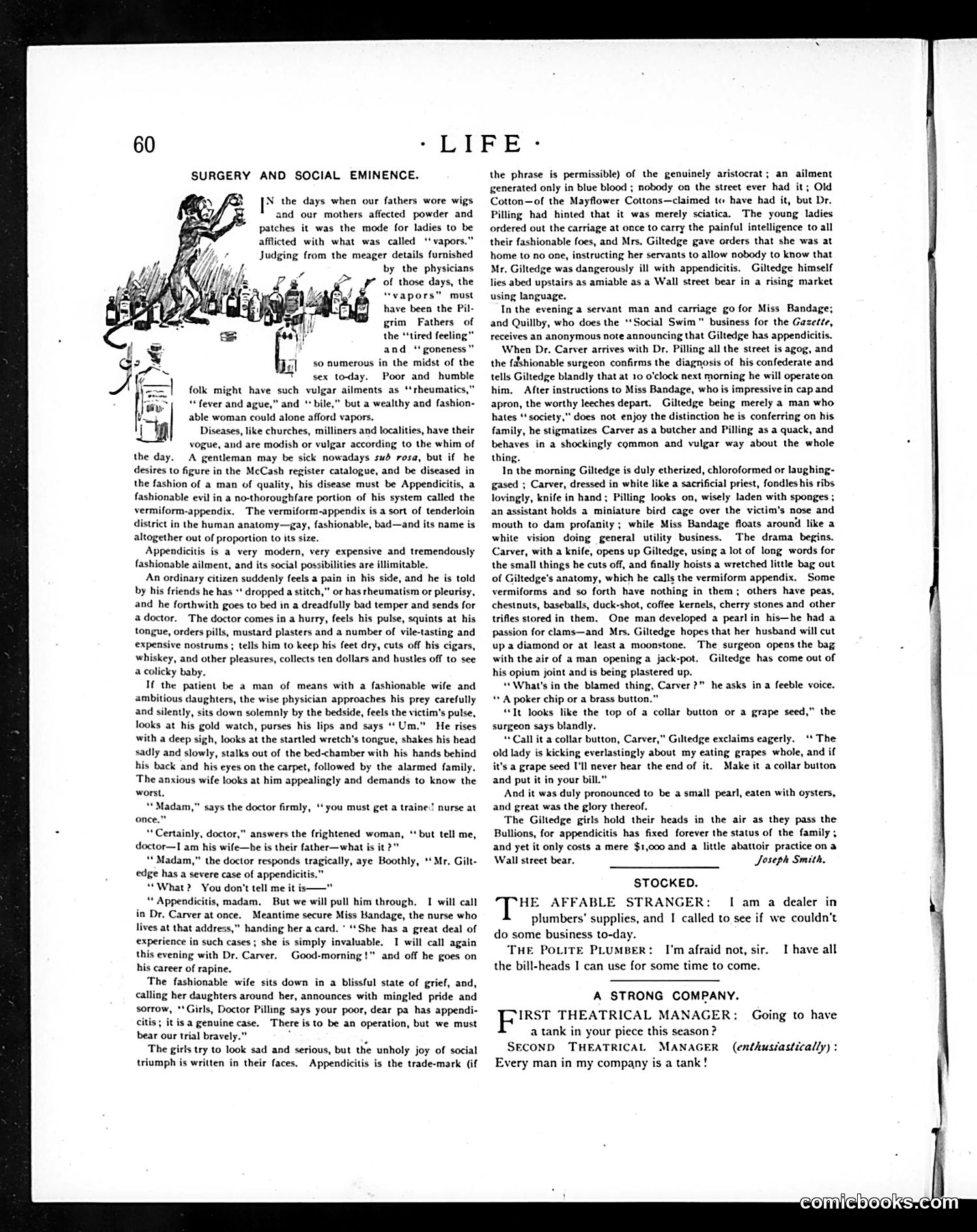
This satirical article mocks how wealthy Americans of the era treated appendicitis as a *status symbol*. The piece argues that fashionable diseases—like appendicitis—have become markers of social class, replacing earlier ailments like "vapors." The satire targets physicians who exploit this: a poor patient with side pain receives routine care and pills, while a wealthy man with identical symptoms gets dramatic pronouncements, expensive specialists (Dr. Carver and Dr. Pilling), trained nurses, and surgery. The doctor's grave demeanor—checking his gold watch, sighing deeply—is performance designed to elevate the patient's condition into something prestigious. The punchline is that the wealthy man's family actually *celebrates* his appendicitis diagnosis with "unholy joy," viewing it as proof of their social standing. The article suggests doctors deliberately cultivate this perception to justify expensive, fashionable treatments for what might be ordinary ailments, making appendicitis essentially a luxury disease that separates the rich from the common poor.
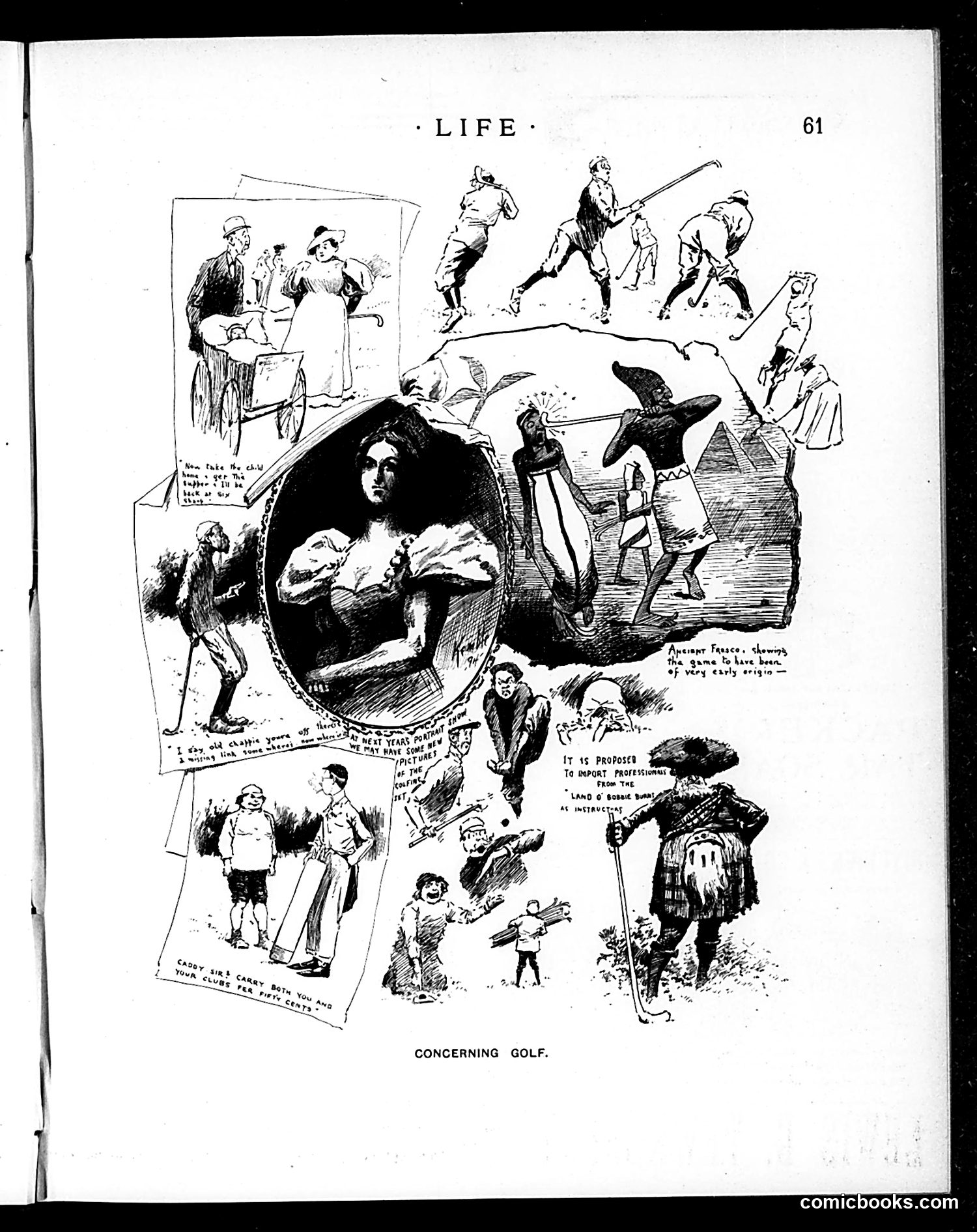
This Life magazine page satirizes golf through multiple sketches. The central large portrait appears to show a woman, with surrounding vignettes depicting various golf scenarios and characters. The sketches illustrate common golf situations and social types—players of different skill levels, spectators, and instructors. The title "Concerning Golf" suggests the page humorously explores the sport's culture and participants. One caption mentions "Ancient Fences" and "very early origin," possibly joking about golf's historical roots. Another references importing "professional" expertise and "land o'lakes" instruction, likely mocking the commercialization of golf instruction in the early 20th century. The overall effect pokes fun at golf's pretensions and the absurdities of both playing and teaching the sport to various social classes.
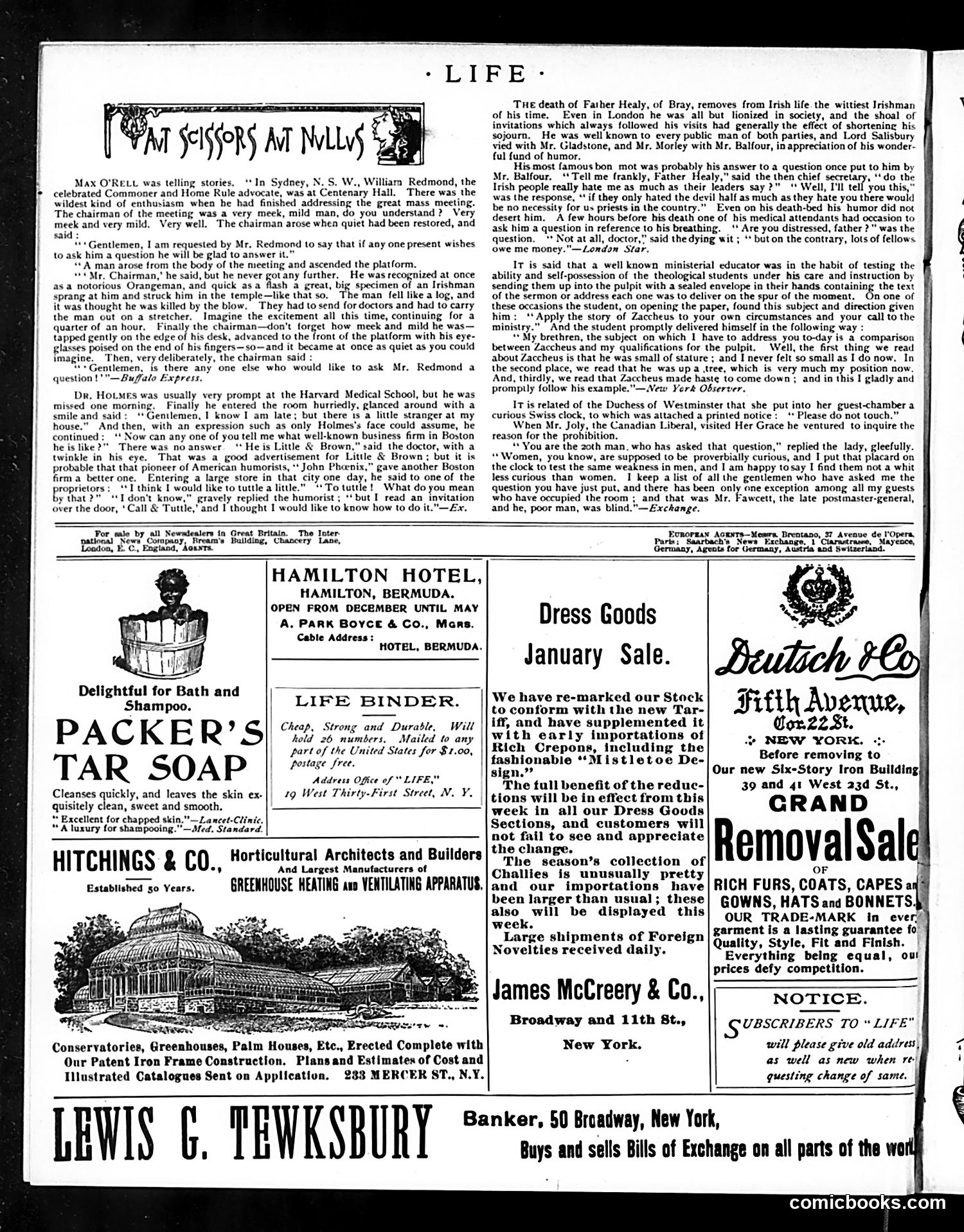
This page from Life magazine (undated, but likely late 19th century) contains humorous anecdotes rather than political cartoons. The main content presents three jokes: 1. **Max O'Rell's story** about an Irish Home Rule meeting where a "meek" chairman maintains order by merely tapping his desk—after an Orangeman (Protestant) was violently attacked by an Irish nationalist for daring to question William Redmond, the "celebrated Commoner and Home Rule advocate." 2. **Dr. Holmes' joke** at Harvard Medical School comparing a newborn to the Boston publisher "Little & Brown." 3. **John Phoenix's pun** playing on a Boston store's sign reading "Call & Tuttle" (the owners' names). The Father Healy obituary celebrates an Irish priest famous for wit, including his retort to British politician Balfour about Irish hatred of him. **Context:** These anecdotes reflect late-Victorian fascination with Irish wit and Anglo-Irish political tensions around Home Rule, presented as genteel humor for educated readers.