
Life, 1895-01-24 · page 7 of 14
Life — January 24, 1895 — page 7: what you’re looking at
What you’re looking at
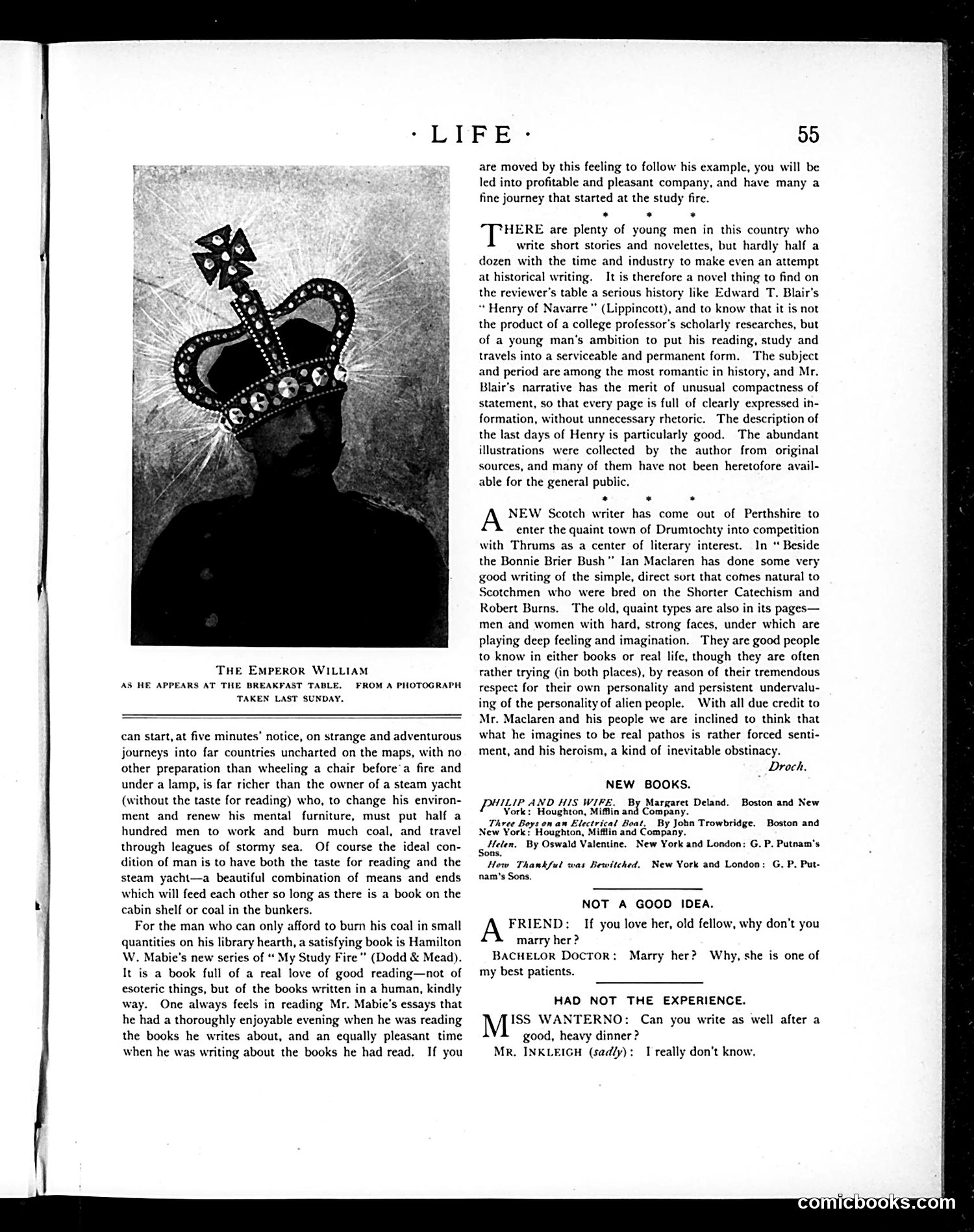
This political cartoon depicts **Kaiser Wilhelm II of Germany**, identifiable by the distinctive spiked Prussian military helmet (pickelhaube) and ornate uniform visible in silhouette. The photograph caption indicates this shows him "as he appears at the breakfast table from a photograph taken last Sunday." The satire appears to target Wilhelm's **imperial pretensions and militarism**—the exaggerated, elaborate military regalia worn even at an intimate domestic moment like breakfast suggests mockery of Prussian martial culture and the Kaiser's ostentatious display of power. The image likely dates to a period of German-American tensions, probably around World War I, when *Life* magazine frequently satirized German leadership and military aggression through caricature and visual exaggeration.
📄 Transcribed text from this page (OCR, searchable)
Machine-transcribed from the original scan — historical spelling and the odd misread are preserved.
‘LIFE: THE EMPEROR WILLIAM AS HE APPEARS AT THE BREAKFAST TABLE, FROM A PHOTOGRAPH TAKEN LAST SUNDAY. can start, at five minutes’ notice, on strange and adventurous journeys into far countries uncharted on the maps, with no other preparation than wheeling a chair before’a fire and under a lamp, is far richer than the owner of a steam yacht (without the taste for reading) who, to change his environ- ment and renew his mental furniture, must put half a hundred men to work and burn much coal, and travel through leagues of stormy sea. Of course the ideal con- dition of man is to have both the taste for reading and the steam yacht—a beautiful combination of means and ends which will feed each other so long as there is a book on the cabin shelf or coal in the bunkers. For the man who can only afford to burn his coal in small quantities on his library hearth, a satisfying book is Hamilton W. Mabie’s new series of “ My Study Fire” (Dodd & Mead). It is a book full of a real love of good reading—not of esoteric things, but of the books written in a human, kindly way. One always feels in reading Mr. Mabie’s essays that he had a thoroughly enjoyable evening when he was reading the books he writes about, and an equally pleasant time when he was writing about the books he had read. If you 55 are moved by this feeling to follow his example, you will be led into profitable and pleasant company, and have many a fine journey that started at the study fire. . . . *HERE are plenty of young men in this country who write short stories and novelettes, but hardly half a dozen with the time and industry to make even an attempt at historical writing. It is therefore a novel thing to find on the reviewer's table a serious history like Edward T. Blair's “ Henry of Navarre” (Lippincott), and to know that it is not the product of a college professor's scholarly researches, but of a young man’s ambition to put his reading, study and travels into a serviceable and permanent form. The subject and period are among the most romantic in history, and Mr. Blair's narrative has the merit of unusual compactness of statement, so that every page is full of clearly expressed in- formation, without unnecessary rhetoric. The description of the last days of Henry is particularly good. The abundant illustrations were collected by the author from original sources, and many of them have not been heretofore avail- able for the general public. . . . NEW Scotch writer has come out of Perthshire to enter the quaint town of Drumtochty into competition with Thrums as a center of literary interest. In “ Beside the Bonnie Brier Bush” Ian Maclaren has done some very good writing of the simple, direct sort that comes natural to Scotchmen who were bred on the Shorter Catechism and Robert Burns. The old, quaint types are also in its pages— men and women with hard, strong faces, under which are playing deep feeling and imagination. They are good people to know in either books or real life, though they are often rather trying (in both places), by reason of their tremendous respect for their own personality and persistent undervalu- ing of the personality of alien people. With all due credit to Mr. Maclaren and his people we are inclined to think that what he imagines to be real pathos is rather forced senti- ment, and his heroism, a kind of inevitable obstinacy. Droch. NEW BOOKS. HILIP AND HIS WIFE. Margaret Deland. York: Houghton, Mifflin and Company. Three Boys onan Electrical Boat, By John Trowbridge. New York? Houghton, Mifflin and Company. glee By Oswald Valentine. New York and London: G. P, Putnam's ons, Hew Thankful was Bewitched, New York and London: G, P. Put- nam's Sons, Boston and New Boston and NOT A GOOD IDEA. If you love her, old fellow, why don’t you FRIEND: marry her ? BACHELOR Doctor: my best patients. Marry her? Why, she is one of HAD NOT THE EXPERIENCE. ISS WANTERNO: Can you write as well after a good, heavy dinner? Mr. INKLEIGH (sadly): I really don’t know.