
Life, 1895-01-24 · page 10 of 14
Life — January 24, 1895 — page 10: what you’re looking at
What you’re looking at
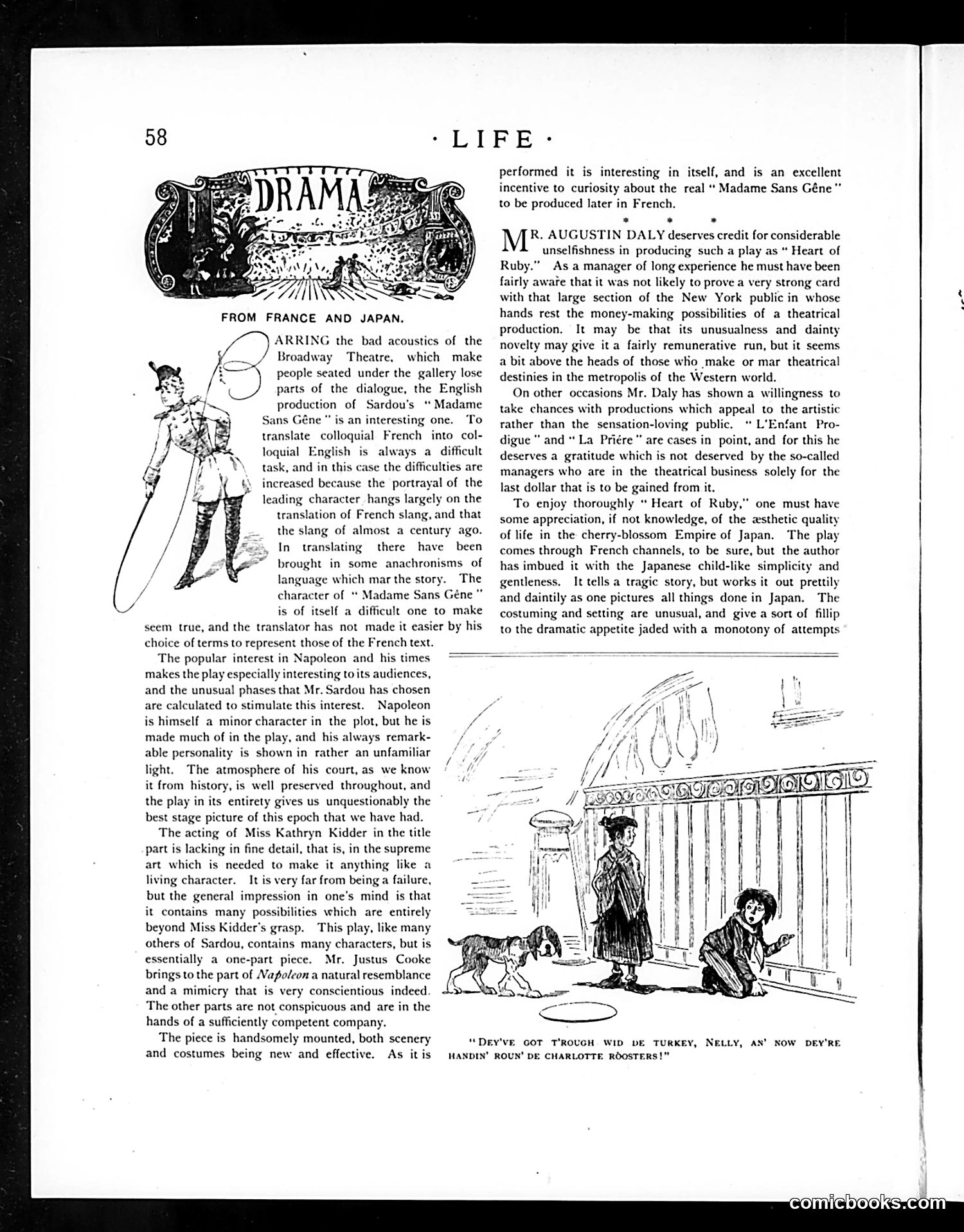
This page reviews theatrical productions, specifically discussing "Heart of Ruby" and French plays like "Madame Sans Gène." The left illustration depicts a character in period costume, likely from the French play being discussed. The lower cartoon shows a domestic scene with a woman kneeling before a man near a fireplace, with a small dog present. The caption reads: "Dev've got t'rough wid de turkey, Nelly, an' now dey're hasn't roust de Charlotte Roosters!" This appears to be ethnic humor, using dialect spelling ("Dev've," "hasn't") typical of early 20th-century American comedy. The joke likely plays on class humor—servants discussing leftover poultry and preparing alternative dishes—reflecting period attitudes toward working-class speech patterns as inherently comic.
📄 Transcribed text from this page (OCR, searchable)
Machine-transcribed from the original scan — historical spelling and the odd misread are preserved.
ARRING the bad acou of the Broadway Theatre, which make people seated under the gallery lose parts of the dialogue, the English production of Sardou's ‘ Madame Sans Géne " is an interesting one. To translate colloquial French into col- loquial English is always a difficult task, and in this case the difficulties are increased because the portrayal of the leading character hangs largely on the translation of French slang, and that the slang of almost a century ago. translating there have been brought in some anachronisms of language which mar the story. The character of ** Madame Sans Géne is of itself a difficult one to make seem true, and the translator has not made it easier by his choice of terms to represent those of the French text. In > LIFE: performed it is interesting in itself, and is an excellent incentive to curiosity about the real “ Madame Sans Géne” to be produced later in French. . * . R, AUGUSTIN DALY deserves credit for considerable unselfishness in producing such a play as “ Heart of Ruby.” As a manager of long experience he must have been fairly aware that it was not likely to prove a very strong card with that large section of the New York public in whose hands rest the money-making possibilities of a theatrical production. It may be that its unusualness and dainty novelty may give ita fairly remunerative run, but it seems a bit above the heads of those who make or mar theatrical destinies in the metropolis of the Western world. On other occasions Mr. Daly has shown a willingness to take chances with productions which appeal to the artistic rather than the sensation-loving public. “ L’Enfant Pro- digue " and “ La Priére” are cases in point, and for this he deserves a gratitude which is not deserved by the so-called managers who are in the theatrical business solely for the last dollar that is to be gained from it. To enjoy thoroughly “ Heart of Ruby,” one must have some appreciation, if not knowledge, of the asthetic quality of life in the cherry-blossom Empire of Japan. The play comes through French channels, to be sure, but the author has imbued it with the Japanese child-like simplicity and gentleness. It tells a tragic story, but works it out prettily and daintily as one pictures all things done in Japan. The costuming and setting are unusual, and give a sort of fillip to the dramatic appetite jaded with a monotony of attempts The popular interest in Napoleon and his times = makes the play especially interesting to its audiences, and the unusual phases that Mr. Sardou has chosen are calculated to stimulate this interest. Napoleon is himself a minor character in the plot, but he is made much of in the play, and his always remark- able personality is shown in rather an unfamiliar light. The atmosphere of his court, as we know it from history, is well preserved throughout, and the play in its entirety gives us unquestionably the best stage picture of this epoch that we have had. The acting of Miss Kathryn Kidder in the title part is lacking in fine detail, that is, in the supreme art which is needed to make it anything like a living character. It is very far from being a failure, but the general impression in one’s mind is that it contains many pé bilities which are entirely beyond Miss Kidder's grasp. This play, like many others of Sardou, contains many c| ters, but is essentially a one-part piece. Mr. Justus Cooke brings to the part of Napoleon a natural resemblance and a mimicry that is very conscientious indeed The other parts are not conspicuous and are in the hands of a sufficiently competent company. The piece is handsomely mounted, both scenery and costumes being new and effective. As it is “DEY'VE GOT T'ROUGH WID DE TURKEY, NELLY, AN’ NOW HANDIN’ ROUN’ DE CHARLOTTE ROOSTERS!" DEY'RE