
Life, 1895-01-24 · page 12 of 14
Life — January 24, 1895 — page 12: what you’re looking at
What you’re looking at
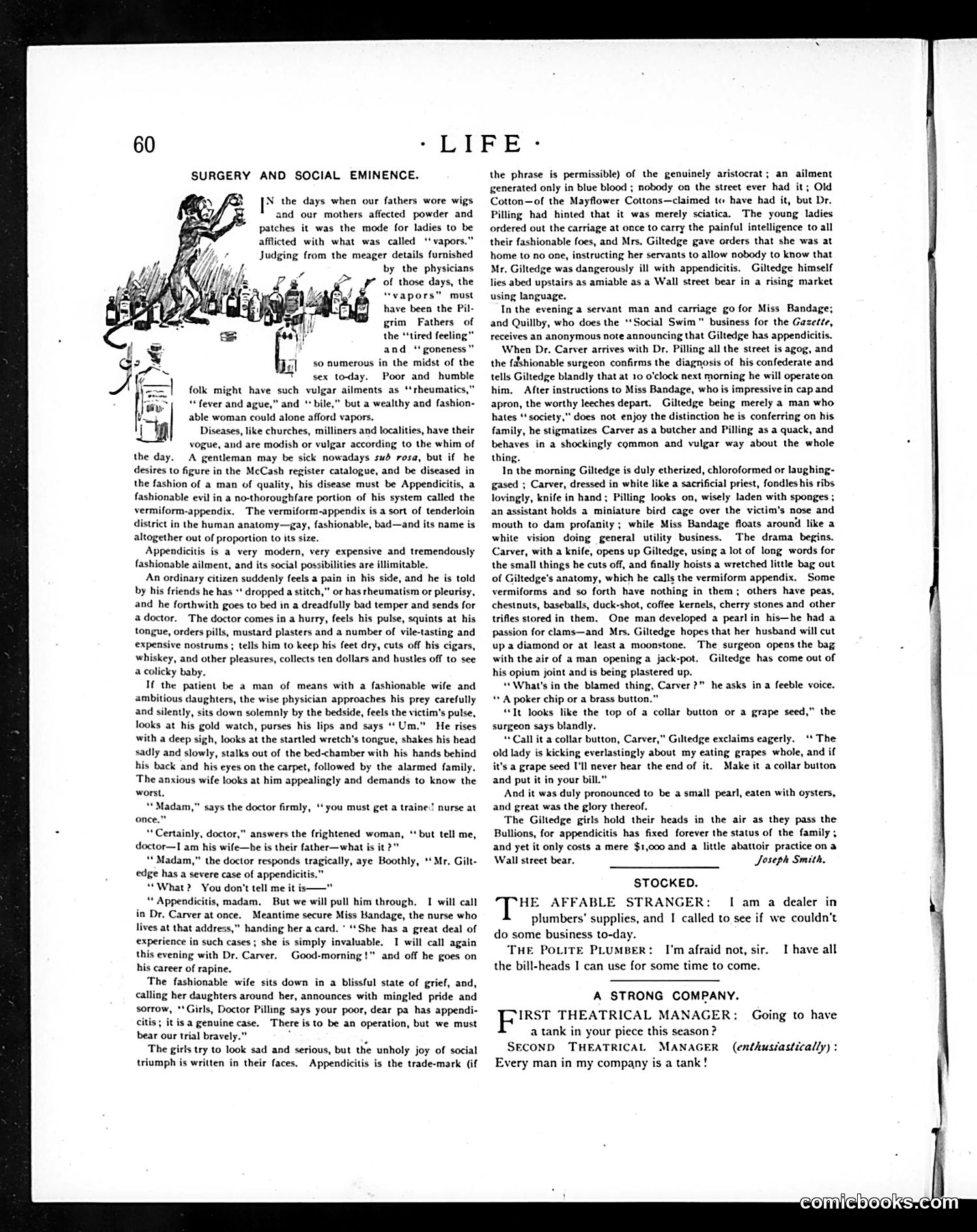
This satirical article mocks how wealthy Americans of the era treated appendicitis as a *status symbol*. The piece argues that fashionable diseases—like appendicitis—have become markers of social class, replacing earlier ailments like "vapors." The satire targets physicians who exploit this: a poor patient with side pain receives routine care and pills, while a wealthy man with identical symptoms gets dramatic pronouncements, expensive specialists (Dr. Carver and Dr. Pilling), trained nurses, and surgery. The doctor's grave demeanor—checking his gold watch, sighing deeply—is performance designed to elevate the patient's condition into something prestigious. The punchline is that the wealthy man's family actually *celebrates* his appendicitis diagnosis with "unholy joy," viewing it as proof of their social standing. The article suggests doctors deliberately cultivate this perception to justify expensive, fashionable treatments for what might be ordinary ailments, making appendicitis essentially a luxury disease that separates the rich from the common poor.
📄 Transcribed text from this page (OCR, searchable)
Machine-transcribed from the original scan — historical spelling and the odd misread are preserved.
- LIFE: SURGERY AND SOCIAL EMINENCE. [8 the days when our fathers wore wigs and our mothers affected powder and patches it was the mode for ladies to be afflicted with what was called “vapors.” Judging from the meager details furnished by the physicians of those days, the “vapors” must have been the Pil- grim Fathers of the “tired feeling” and “goneness” Ha] so numerous in the midst of the t sex today. Poor and humble folk might have such vulgar ailments as ‘rheumatics,” “fever and ague,” and “bile,” but a wealthy and fashion- able woman could alone afford vapors. Diseases, like churches, milliners and localities, have their vogue, and are modish or vulgar according to the whim of the day. A gentleman may be sick nowadays sud rosa, but if he desires to figure in the McCash register catalogue, and be diseased in the fashion of a man of quality, his disease must be Appendicitis, a fashionable evil in a no-thorougbfare portion of his system called the vermiform-appendix. The vermiform-appendix is a sort of tenderloin district in the human anatomy—gay, fashionable, bad—and its name is, altogether out of proportion to its size. Appendicitis is a very modern, very expensive and tremendously fashionable ailment, and its social possibilities are illimitable. An ordinary citizen suddenly feels a pain in his side, and he is told by his friends he has ** dropped a stitch,” or has rheumatism or pleurisy, and he forthwith goes to bed in a dreadfully bad temper and sends for a doctor. The doctor comes in a hurry, feels his pulse, squints at his tongue, orders pills, mustard plasters and a number of vile-tasting and expensive nostrums ; tells him to keep his feet dry, cuts off his cigars, whiskey, and other pleasures, collects ten dollars and hustles off to see a colicky baby. If the patient be a man of means with a fashionable wife and ambitious daughters, the wise physician approaches his prey carefully and silently, sits down solemnly by the bedside, feels the victim's pulse, looks at his gold watch, purses his lips and says “Um.” He rises with a deep sigh, looks at the startled wretch’s tongue, shakes his head sadly and slowly, stalks out of the bed-chamber with his hands behind his back and his eyes on the carpet, followed by the alarmed family. The anxious wife looks at him appealingly and demands to know the worst. “Madam,” says the doctor firmly, “ you must get a traine? nurse at once.” “Certainly, doctor,” answers the frightened woman, “but tell me, doctor—I am his wife—be is their father—what is it?” “Madam,” the doctor responds tragically, aye Boothly, Mr. Gilt- edge has a severe case of appendiciti “What? You don't tell me it is— “ Appendicitis, madam. But we will pull him through. I will call in Dr. Carver at once. Meantime secure Miss Bandage, the nurse who lives at that address," handing her a card. * ‘She has a great deal of experience in such cases; she is simply invaluable. I will call again this evening with Dr. Carver. Good-morning !" and off he goes on his career of rapine. The fashionable wife sits down in a blissful state of grief, and, calling her daughters around her, announces with mingled pride and sorrow, **Girls, Doctor Pilling says your poor, dear pa has appendi- citis; it isa genuine case. There is to be an operation, but we must bear our trial bravely.” ; The girls try to look sad and serious, but the unholy joy of social triumph is written in their faces. Appendicitis is the trade-mark (if the phrase is permissible) of the genuinely aristocrat; an ailment generated only in blue blood ; nobody on the street ever had it; Old Cotton—of the Mayflower Cottons—claimed to have had it, but Dr. Pilling had hinted that it was merely sciatica. The young ladies ordered out the carriage at once to carry the painful intelligence to all their fashionable foes, and Mrs. Giltedge gave orders that she was at home to no one, instructing her servants to allow nobody to know that Mr. Giltedge was dangerously ill with appendicitis. Giltedge himself lies abed upstairs as amiable as a Wall street bear in a rising market using language. In the evening a servant man and carriage go for Miss Bandage; and Quillby, who does the ‘Social Swim” business for the Gazette, receives an anonymous note announcing that Giltedge has appendicitis. When Dr. Carver arrives with Dr, Pilling all the street is agog, and the fashionable surgeon confirms the diagnosis of his confederate and tells Giltedge blandly that at 10 o'clock next morning he will operateon him, After instructions to Miss Bandage, who is impressive in cap and apron, the worthy leeches depart. Giltedge being merely a man who hates “society,” does not enjoy the distinction he is conferring on his family, he stigmatizes Carver as a butcher and Pilling as a quack, and behaves in a shockingly common and vulgar way about the whole thing. In the morning Giltedge is duly etherized, chloroformed or laughing- gased ; Carver, dressed in white like a sacrificial priest, fondles his ribs lovingly, knife in hand ; Pilling looks on, wisely laden with sponges ; an assistant holds a miniature bird cage over the victim's nose and mouth to dam profanity ; while Miss Bandage floats around like a white vision doing general utility business. The drama begins. Carver, with a knife, opens up Giltedge, using a lot of long words for the small things he cuts off, and finally hoists a wretched little bag out of Giltedge’s anatomy, which he calls the vermiform appendix. Some vermiforms and so forth have nothing in them; others have peas, chestnuts, baseballs, duck-shot, coffee kernels, cherry stones and other trifles stored in them. One man developed a pearl in his—he had a passion for clams—and Mrs. Giltedge hopes that her husband will cut up a diamond or at least a moonstone. The surgeon opens the bag with the air of a man opening a jack-pot. Giltedge has come out of his opium joint and is being plastered up. “What's in the blamed thing, Carver?” he asks ina feeble voice. ‘+ A poker chip or a brass button.” “Tt looks like the top of a collar button or a grape seed,” the surgeon says blandly. “Call ita collar button, Carver,” Giltedge exclaims eagerly. The old lady is kicking everlastingly about my eating grapes whole, and if it's a grape seed U'll never hear the end of it. Make it a collar button and put it in your bill.” And it was duly pronounced to be a small pearl, eaten with oysters, and great was the glory thereof. The Giltedge girls hold their heads in the air as they pass the Bullions, for appendicitis has fixed forever the status of the family ; and yet it only costs a mere $1,000 and a little abattoir practice on a Wall street bear. Joseph Smith. STOCKED. HE AFFABLE STRANGER: I am a dealer in plumbers’ supplies, and I called to see if we couldn't do some business to-day. THE POLITE PLUMBER: I’m afraid not, sir. the bill-heads I can use for some time to come. Ihave all A STRONG COMPANY. IRST THEATRICAL MANAGER: a tank in your piece this season ? Going to have SECOND THEATRICAL MANAGER (enthusiastically): Every man in my company is a tank!