
A complete issue · 16 pages · 1895
Life — January 17, 1895
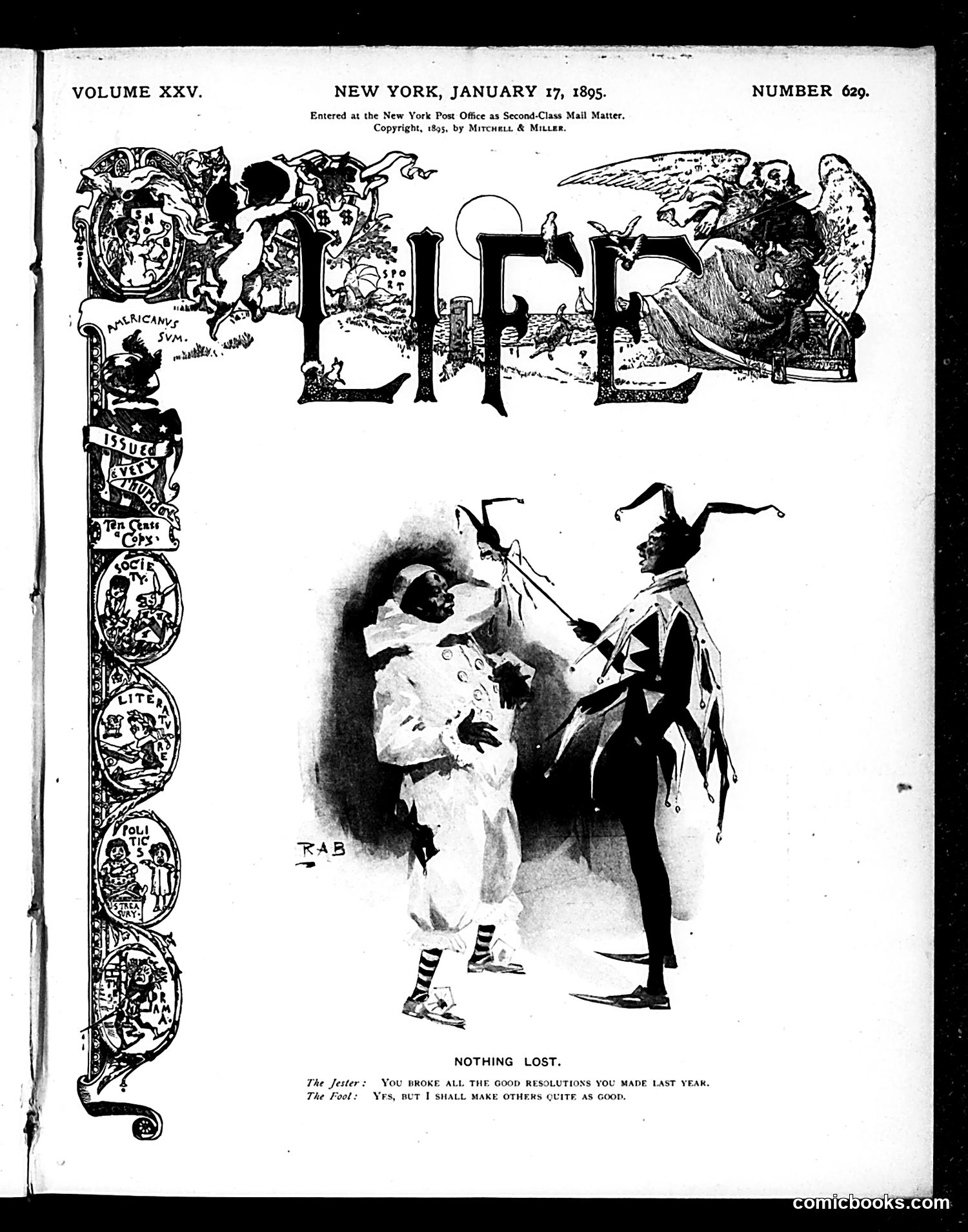
This New Year's cartoon depicts a Jester (representing a fool or satirized person) confronting a Fool character. The Jester accuses: "You broke all the good resolutions you made last year." The Fool replies: "Yes, but I shall make others quite as good." The satire mocks the common human habit of making New Year's resolutions—ambitious promises of self-improvement made annually—only to break them immediately and repeat the cycle. The joke's cynicism suggests that people make resolutions not from genuine intent to change, but merely to maintain the social ritual. The ornate left border with period emblems reinforces Life's satirical identity, while the sketch's style is typical of 1890s American comic illustration.
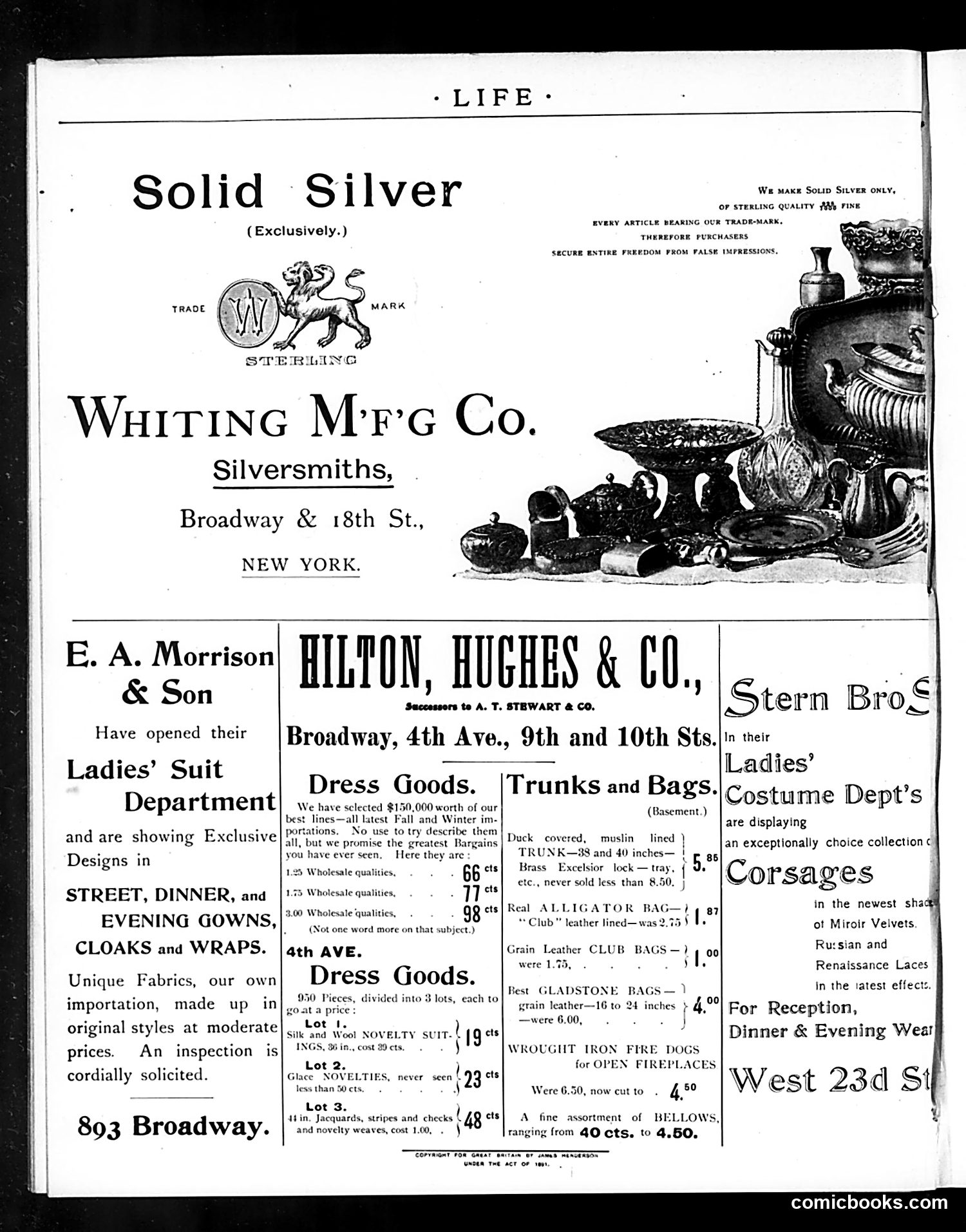
This page is **primarily advertising**, not satirical content. It contains multiple late 19th-century department store and merchant advertisements for New York City businesses: - **Whiting Mfg Co.** (silversmiths) advertises solid sterling silver goods - **E.A. Morrison & Son** promotes a new Ladies' Suit Department featuring exclusive dress designs, cloaks, and wraps - **Hilton, Hughes & Co.** advertises dress goods and trunks/bags - **Stern Bros.** showcases corsets and evening wear The page header reads "LIFE," indicating this is from the satirical magazine, but this particular page is dedicated to commercial announcements rather than political or social satire. The decorative illustrations of silver goods and fashion items are typical period advertising imagery meant to showcase merchandise rather than deliver commentary.
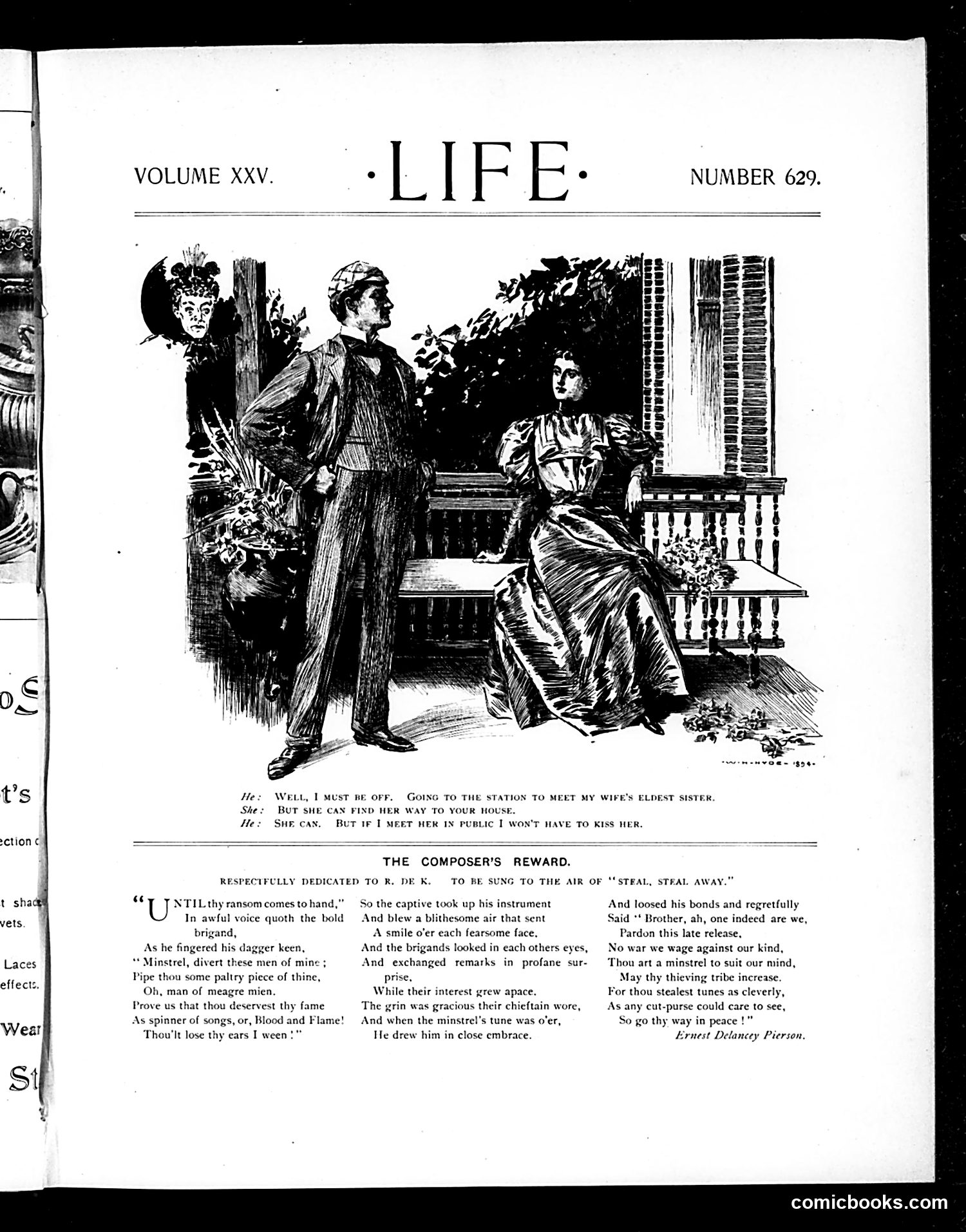
This page features a domestic comedy sketch and an accompanying poem. The illustration shows a man departing hastily while two women remain at home—one seated, one standing in the background. The dialogue's humor relies on a common Victorian-era marital scenario: the husband claims he must leave to meet his wife's sister at the station, but the wife suspects he's fabricating an excuse to escape. Her retort—that if he meets her sister in public, he needn't kiss her—is a pointed jab at his dubious explanation. The poem "The Composer's Reward" (credited to Ernest Delaney Pierson) humorously narrates a minstrel musician ransoming himself from captors by performing music so beautifully that even brigands weep and release him. Both pieces appear to be light satirical commentary on domestic life and artistic sentiment typical of early 20th-century American humor magazines.
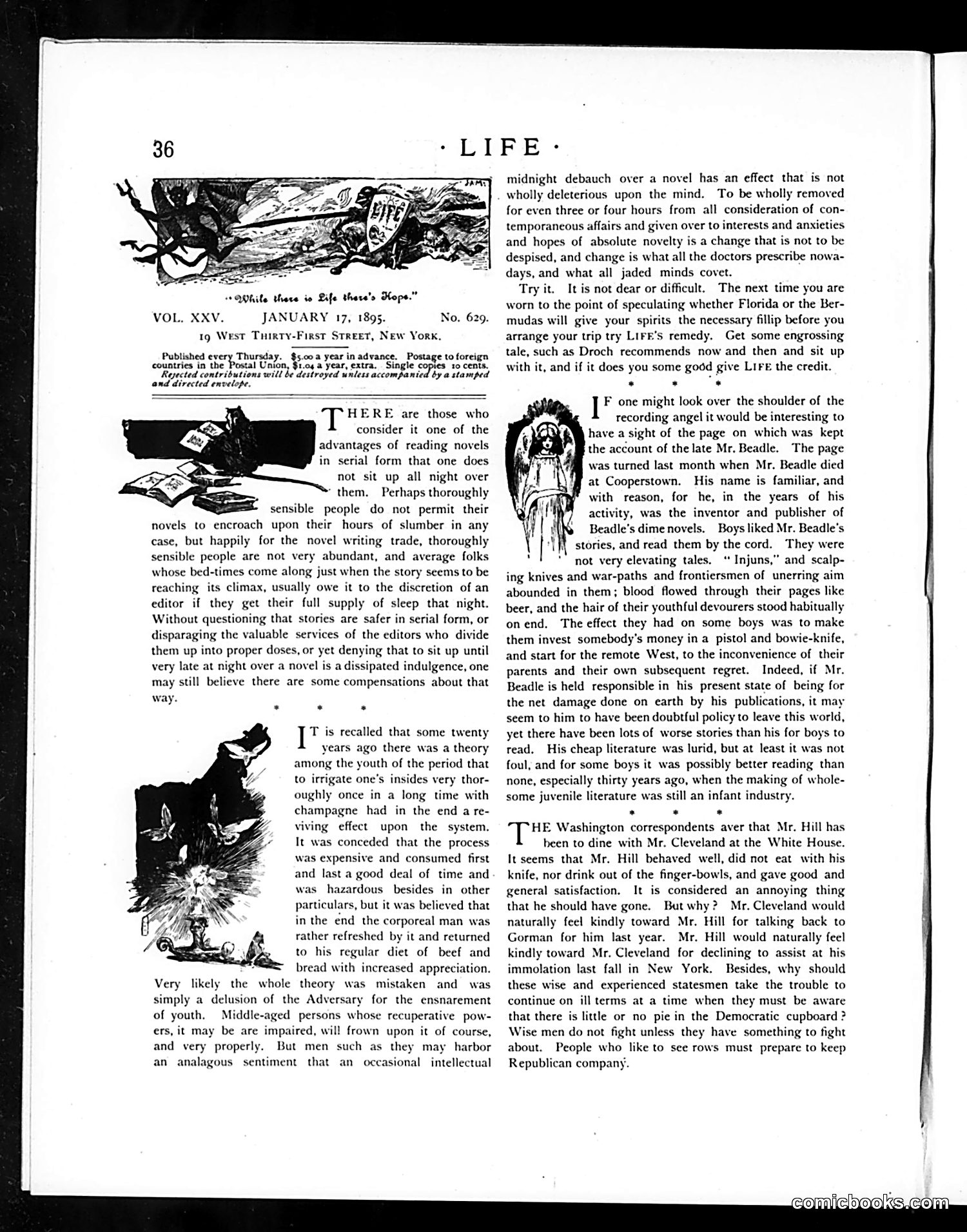
The page contains editorial commentary rather than political cartoons. The text discusses reading novels in serial form and debates their merits versus bound books. A notable section references **Mr. Beadle**, publisher of dime novels, whose sensationalized stories about "injuns" and frontier violence allegedly inspired boys to run away westward. The author criticizes Beadle's cheap literature as potentially harmful to youth. The final paragraph discusses **Mr. Hill dining with President Cleveland at the White House**, apparently criticizing Hill for improper conduct (not using a knife properly, drinking excessively). The author suggests Cleveland was unwise to host Republican company, implying the visit was politically awkward or inappropriate—reflecting the partisan tensions of the 1890s. The cartoons' specific meaning remains unclear from this reproduction quality.
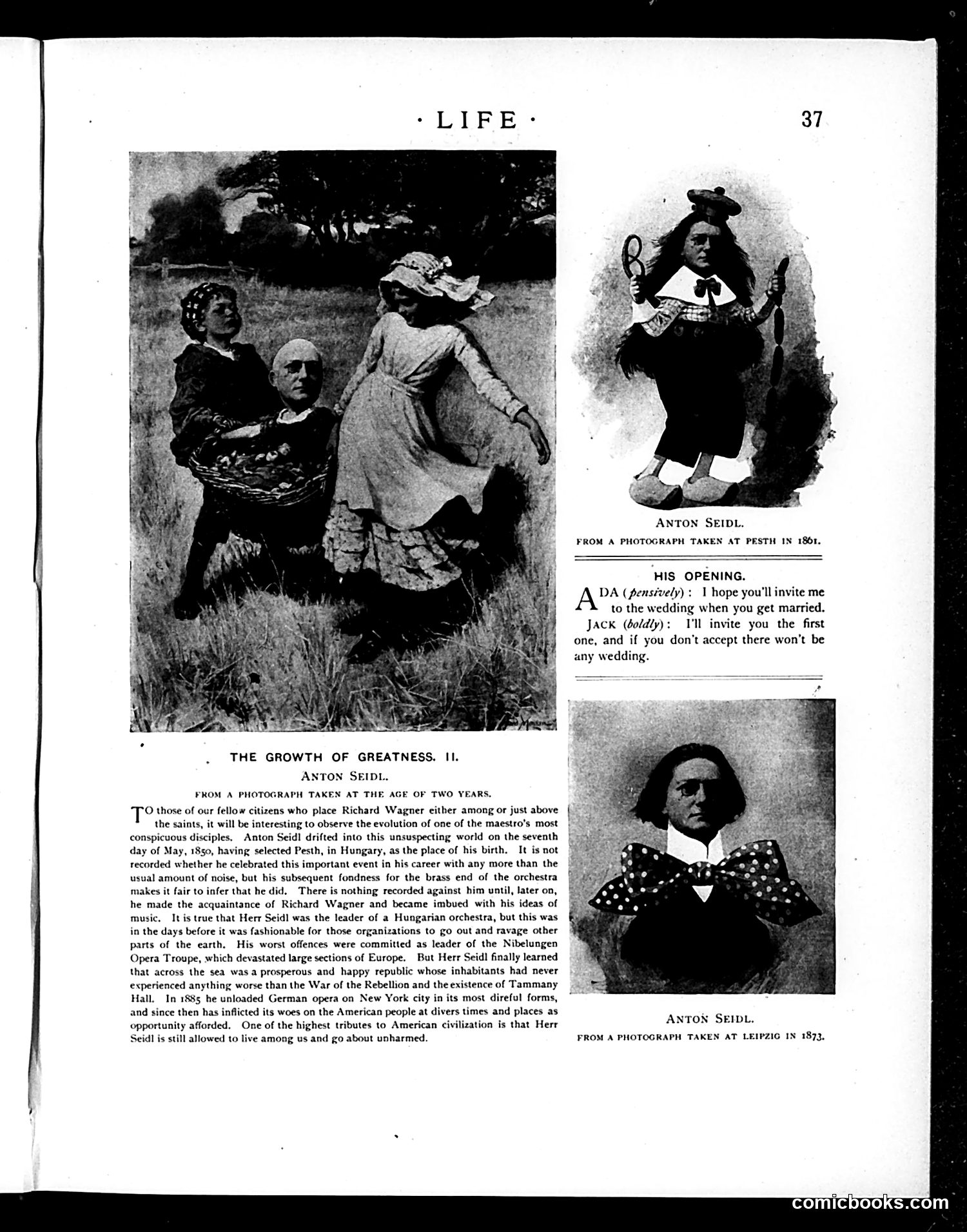
This page is NOT a political cartoon but rather a biographical feature on **Anton Seidl**, a Hungarian orchestra conductor. The page includes: 1. **"The Growth of Greatness"** — a portrait series showing Seidl at age two, at Perth in 1861, and at Leipzig in 1873, tracing his career development. 2. **"His Opening"** — a brief comedic dialogue between characters Ada and Jack about wedding invitations, appearing unrelated to the main subject. The text discusses Seidl's controversial history: his association with Richard Wagner, leadership of the Nibelungen Opera Troupe (which "devastated large sections of Europe"), and his subsequent arrival in America, where he continued causing offense. The piece concludes with dark irony: despite his destructive legacy, Seidl remains "allowed to live among us and go about unharmed."
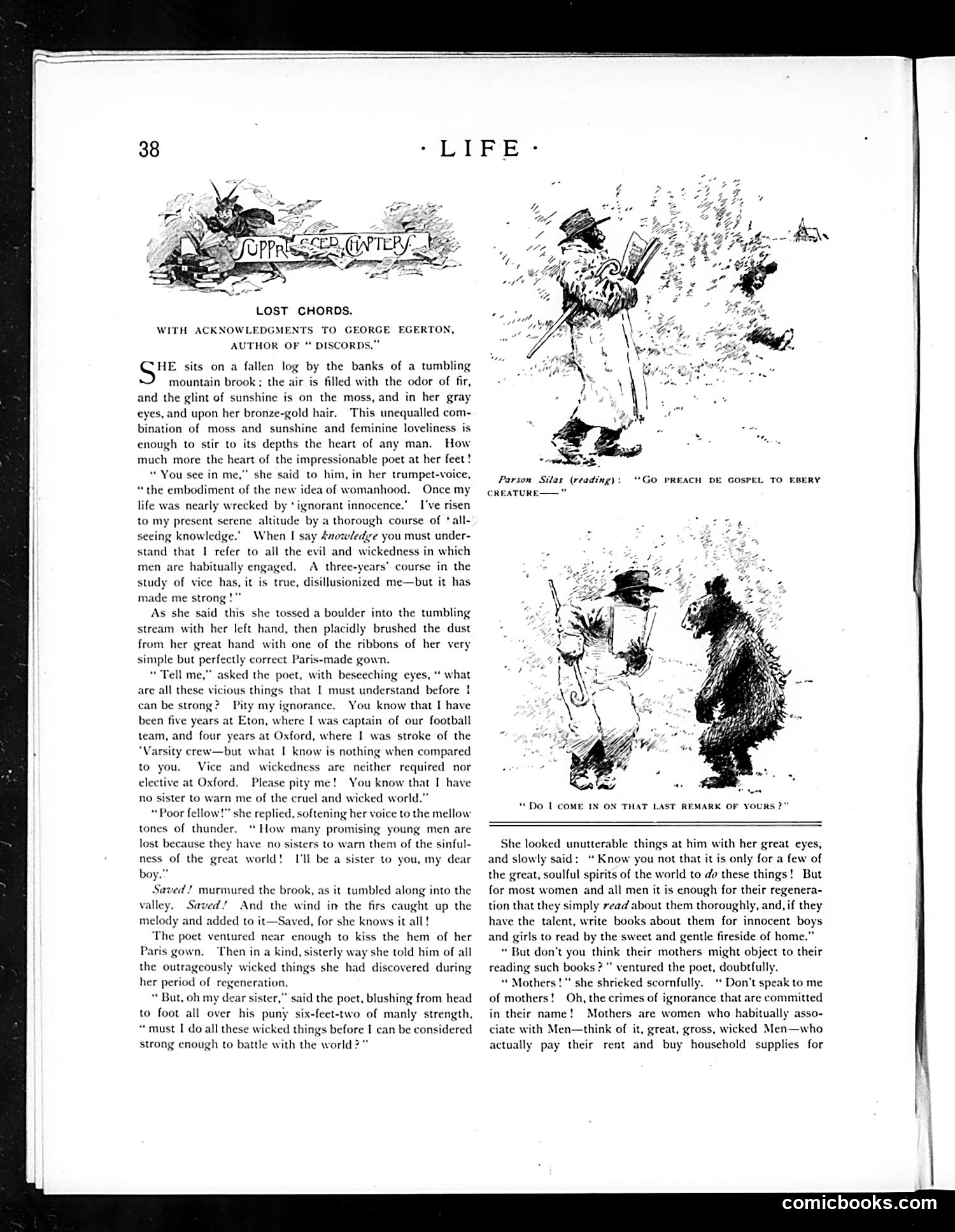
This page features a satirical story with accompanying illustrations. The narrative presents a woman in "gray eyes and bronze-gold hair" sitting by a stream, engaging a male poet in philosophical debate about vice, wickedness, and morality. The illustrations show a figure (labeled "Parson Silas (reading): 'Go preach de gospel to ebery creature'") apparently preaching or gesturing dramatically. The cartoon's satire likely mocks Victorian-era moral hypocrisy—specifically the disconnect between preachers' sanctimonious pronouncements about vice and actual human behavior. The story's woman character represents an educated, liberated perspective challenging conventional morality, while the poet's reactions suggest the discomfort such frank discussion provoked in polite society. The overall piece appears to critique rigid moral instruction divorced from real-world complexity.
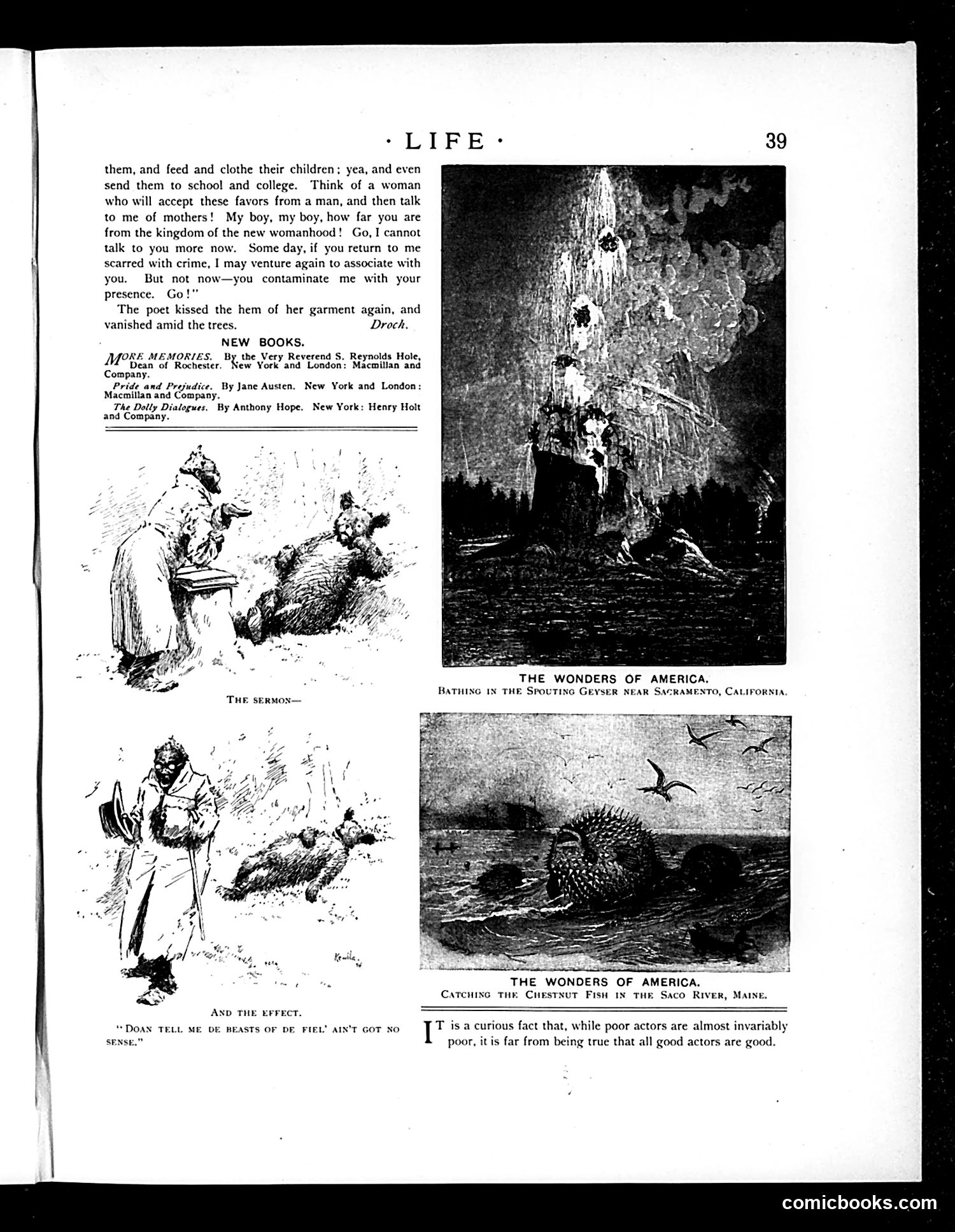
This page contains three distinct sections: **Top Left:** Two sketch cartoons labeled "The Sermon" and "And the Effect," depicting what appears to be a preacher addressing an audience, with the second sketch showing the audience's reaction. The caption reads: "Doan tell me de beasts of de fiel' ain't got no sense." **Top Right & Bottom:** Photographs titled "The Wonders of America" showing natural attractions: a geyser in Sacramento, California, and what appears to be catching chestnut fish in the Saco River, Maine. **Bottom Text:** A brief observation about actors, stating: "It is a curious fact that, while poor actors are almost invariably poor, it is far from being true that all good actors are good." The page also lists "New Books" at top left, including titles by Reverend S. Reynolds Hole, Jane Austen, and Anthony Hope.
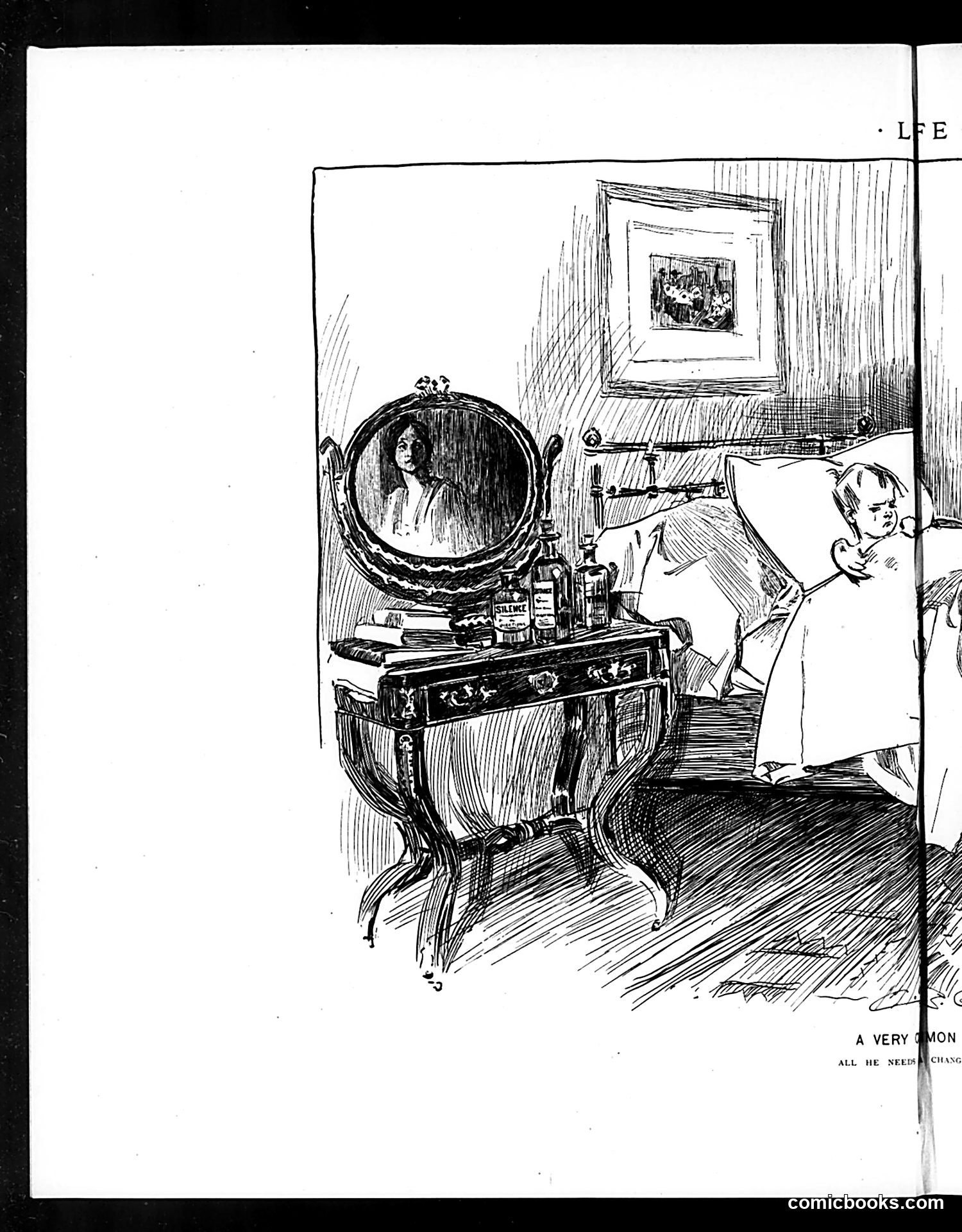
This is a satirical illustration from *Life* magazine showing a domestic scene. A woman sits at a vanity table with a round mirror, examining her reflection while applying cosmetics. A child stands nearby watching. On the vanity are various bottles and jars of beauty products. The partially visible caption reads "A VERY [COMMON]" and "ALL HE NEEDS [CHANG]" (text is cut off). The satire appears to target **women's preoccupation with beauty and cosmetics**, a common *Life* magazine theme mocking consumer culture and vanity. The woman's absorbed attention to her appearance—presumably at the expense of other duties or her child's needs—suggests criticism of materialistic priorities. The illustration's style and subject matter reflect early 20th-century attitudes toward women's roles and consumerism, though the incomplete caption prevents determining the exact satirical point.
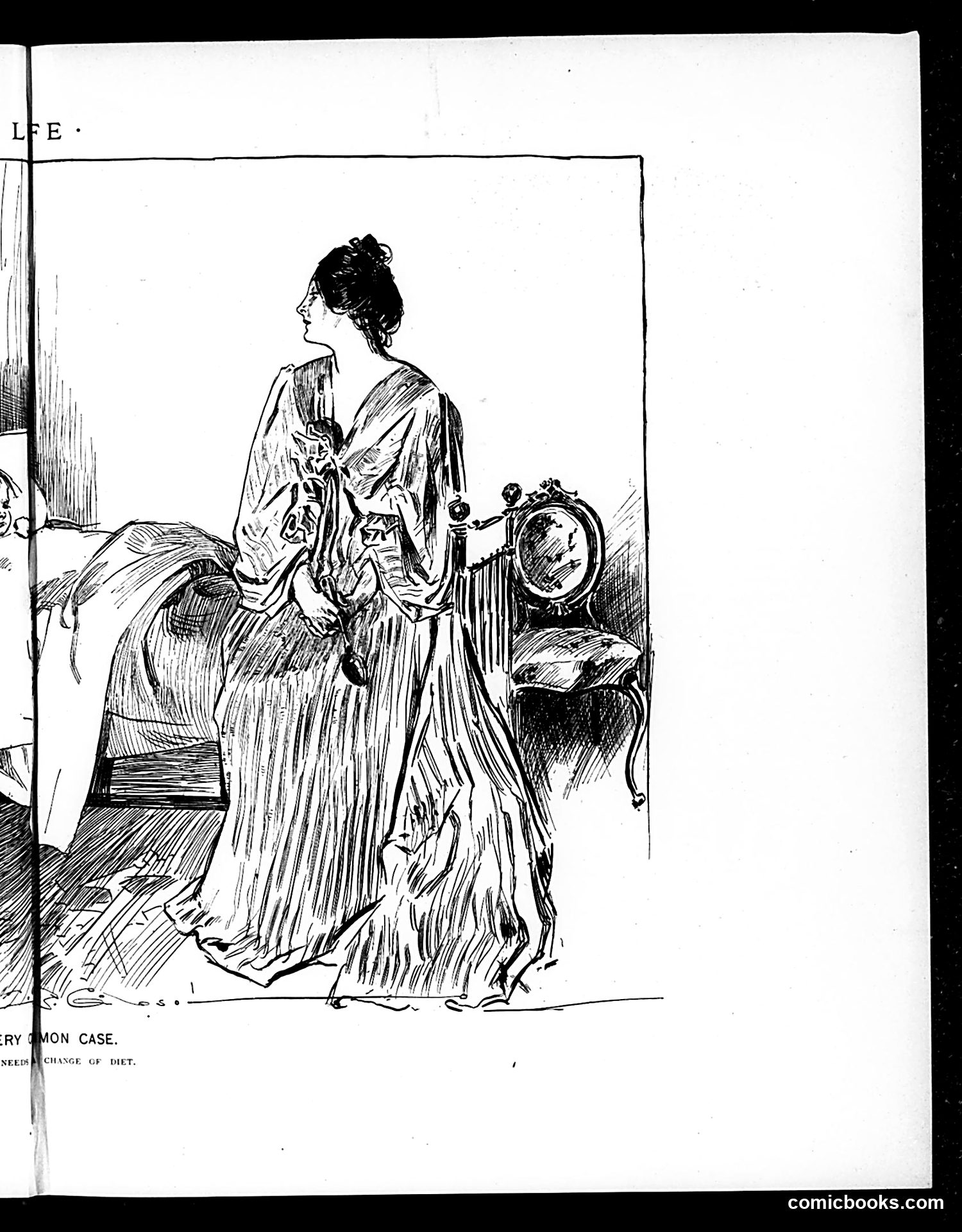
This appears to be a satirical illustration from *Life* magazine depicting a woman in an elegant, flowing gown standing in what seems to be a bedroom or dressing room. The visible partial text mentions "VERY COMMON CASE" and references "NEEDS A CHANGE OF DIET." The illustration likely satirizes late 19th or early 20th-century concerns about women's health, fashion, or domestic life. The woman's elaborate dress and the bedroom setting suggest commentary on either: - Women's fashion excess and its supposed health consequences - Medical or dietary advice for women - Social expectations about women's appearance and comportment Without additional context or complete text, the exact satirical target remains unclear, though the tone suggests criticism of contemporary attitudes toward women's health or lifestyle practices.
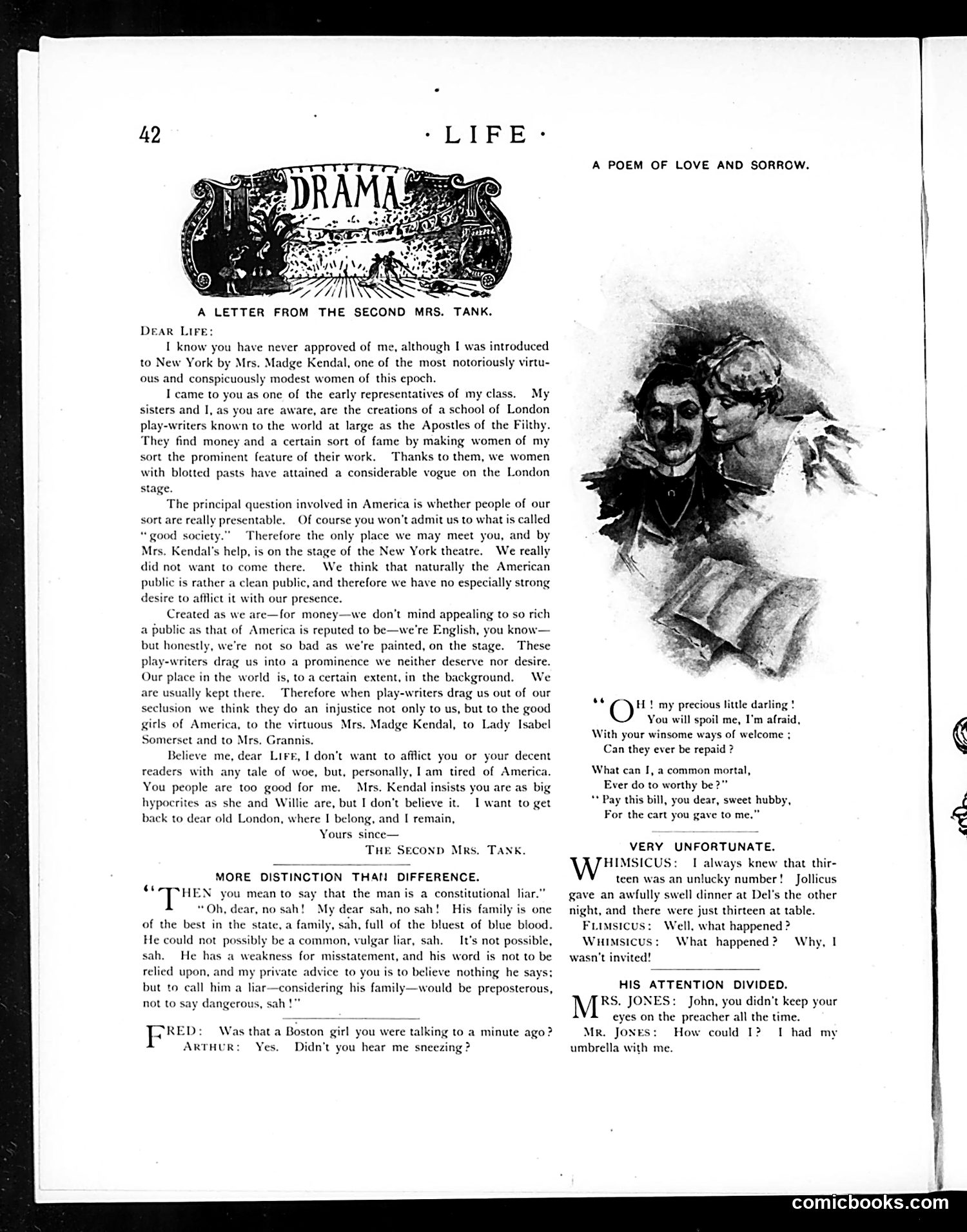
This page from *Life* magazine contains satirical theatrical content rather than political cartoons. The main piece is "A Letter from the Second Mrs. Tank," a humorous complaint to *Life* from a character claiming to represent English theatrical women. She defends her profession against American disapproval, noting that English playwrights have made respectability through their work, while Americans consider theater disreputable. She argues English actresses deserve acceptance in "good society." Below are brief comedic dialogues mocking social pretension and marital infidelity. The accompanying illustration shows a woman's face in sketch form. The satire targets American social snobbery toward theater performers and the hypocrisy of those who attend plays while disdaining actors socially.
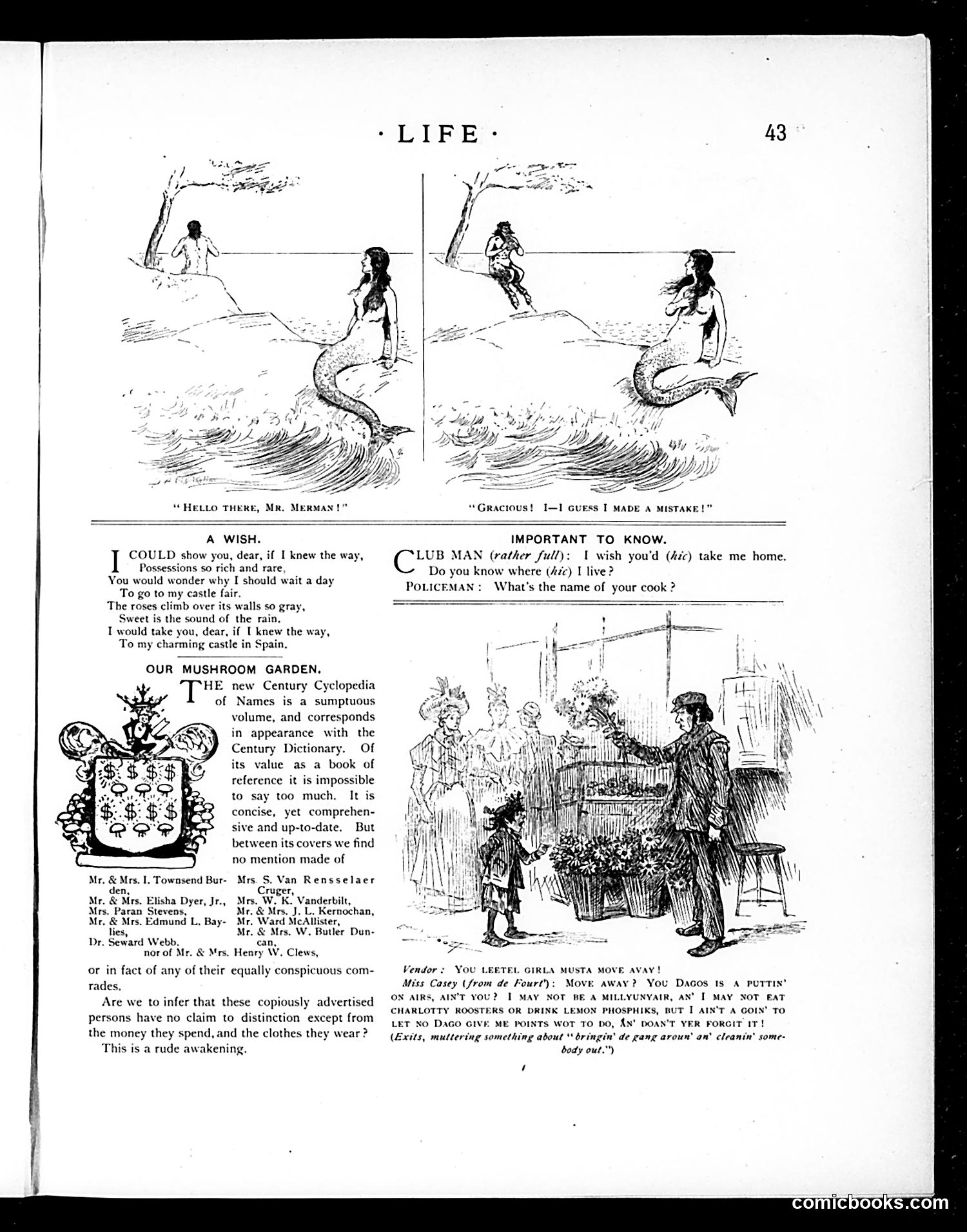
The top cartoons show a mermaid encountering a man by the shore, with captions playing on the phrase "I made a mistake!" — a simple visual gag about unexpected romantic encounters. Below are three distinct items: a poem titled "A Wish" about romantic longing; an "Our Mushroom Garden" section advertising the Century Encyclopedia (listing wealthy names, suggesting it's marketed to the affluent); and a sketch labeled "Important to Know" depicting a street vendor and customer, with dialogue in dialect about the vendor's cook. The satire in "Our Mushroom Garden" is explicit: it mocks the wealthy people listed for having "no claim to distinction except from the money they spend, and the clothes they wear," calling this "a rude awakening" — critiquing conspicuous consumption and class pretension.
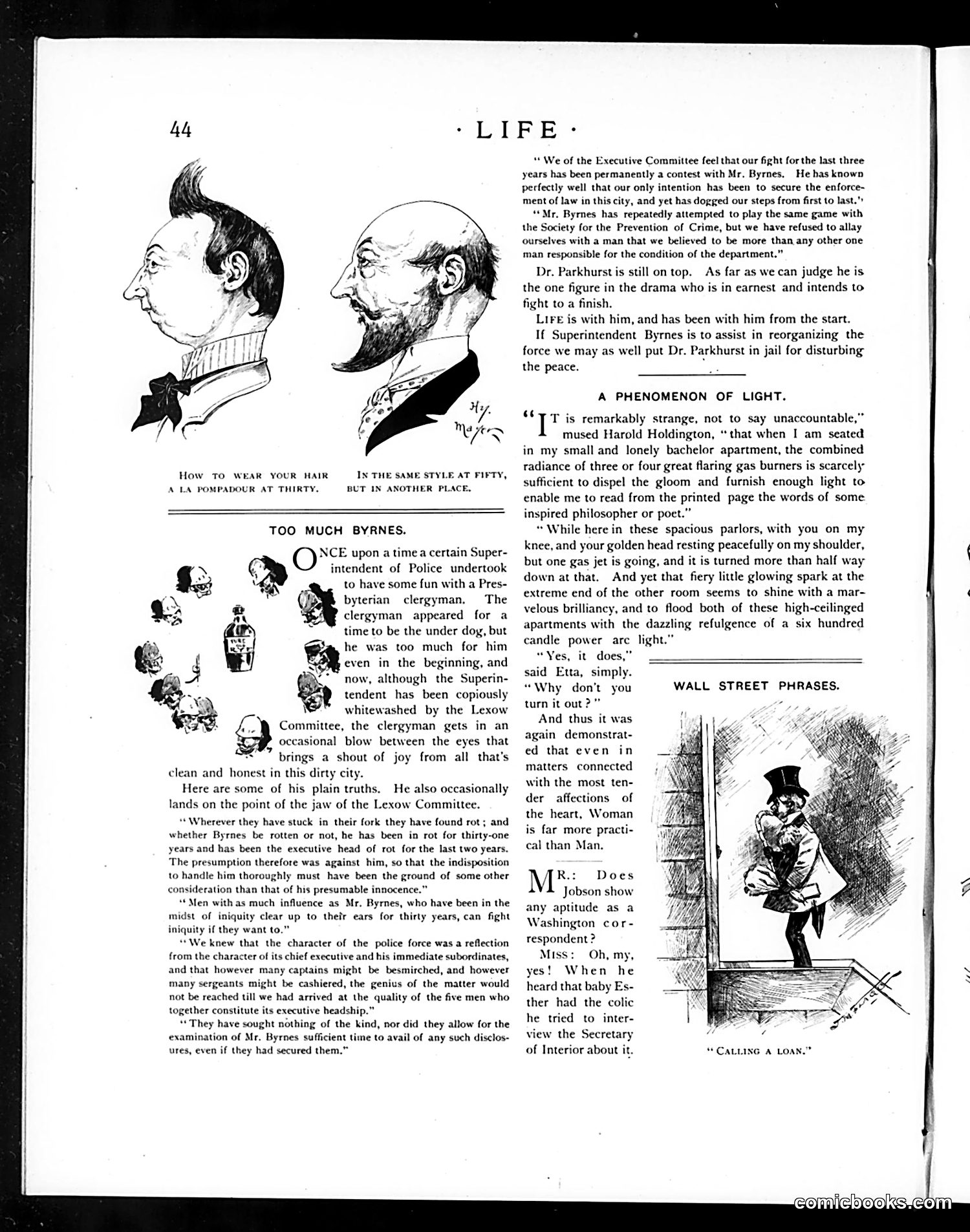
This page satirizes **Police Superintendent Byrnes** of New York City, who is being criticized by **Dr. Parkhurst**, a Presbyterian clergyman and reform advocate. The text supports the "Lexow Committee" investigation into NYPD corruption. The caricatured heads at top likely represent Byrnes and Parkhurst. The "Too Much Byrnes" section quotes Parkhurst's attacks: Byrnes has been "in rot for thirty-one years" and led the corrupt force for two years. Parkhurst argues the Lexow Committee didn't go far enough—real reform requires examining Byrnes himself, not just subordinates. **Life magazine sides with Parkhurst**, declaring him earnest while suggesting that if Byrnes "assists" reform efforts, Parkhurst should be jailed instead for "disturbing the peace"—heavy sarcasm. The lower section, "A Phenomenon of Light," is an unrelated romantic satire about how a bachelor's apartment needs bright gas lamps, but a woman's presence makes dim lighting seem brilliant—suggesting love blinds judgment.
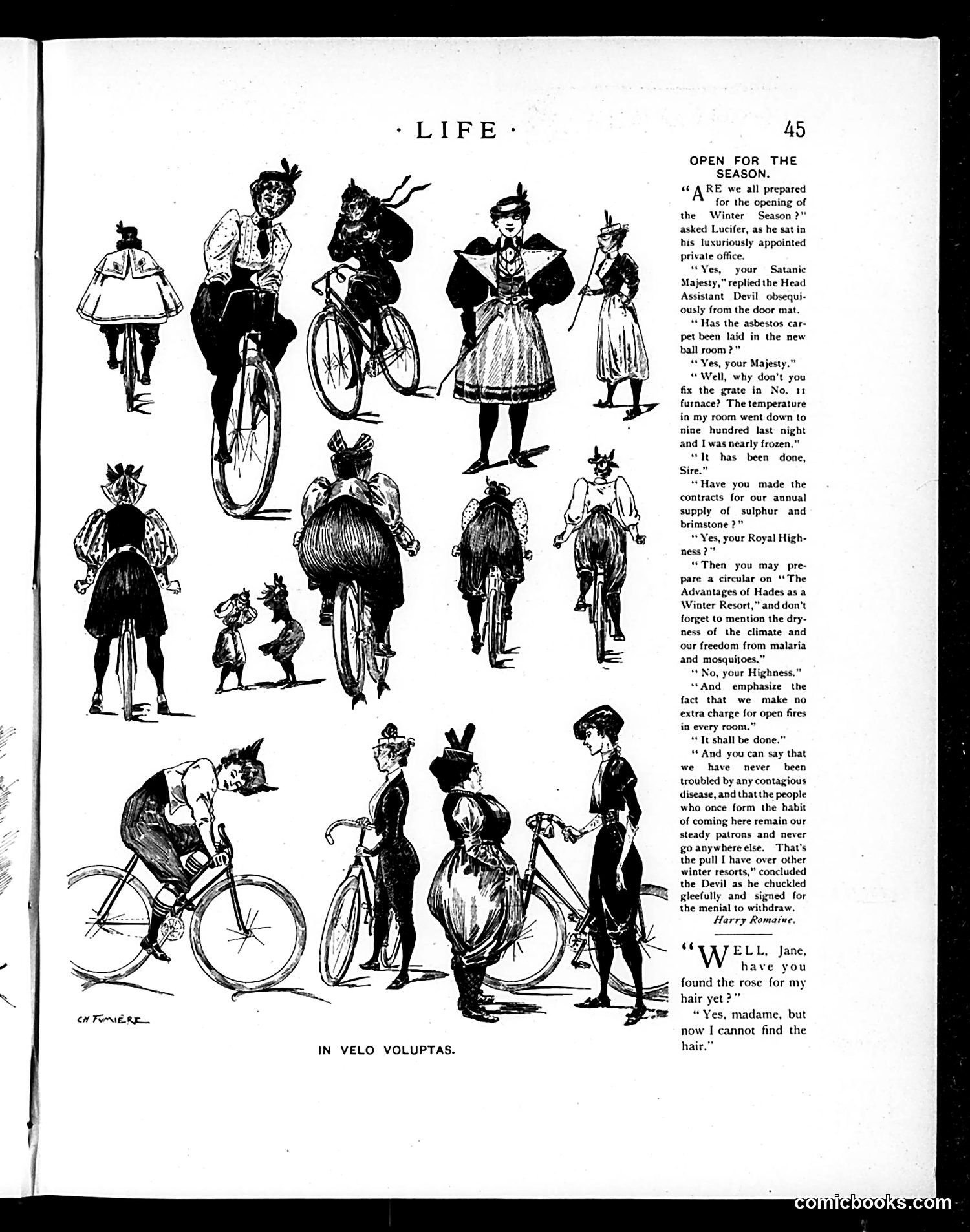
This page contains two distinct pieces of satire: **"In Velo Voluptas"** (left): A series of illustrations showing people on bicycles in various fashionable poses and outfits. The Latin title means "pleasure in speed," satirizing the bicycle craze of the 1890s—when cycling was a major leisure activity and status symbol among the wealthy, particularly women. The drawings mock the elaborate costumes and pretentious attitudes cyclists adopted. **"Open for the Season"** (right): A satirical dialogue where the Devil prepares "Hades" as a winter resort, using language mimicking luxury hotel management. It's a social joke: wealthy Americans would escape winter by traveling to warm resorts; the piece humorously suggests Hell as an alternative destination, emphasizing comfort (no disease, open fires, dry climate). The final exchange about Jane losing "the rose for my hair" suggests absent-minded fashionable society women. Both pieces mock late-Victorian upper-class leisure culture—cycling fads and resort-going—with gentle, knowing humor aimed at Life's educated readership.
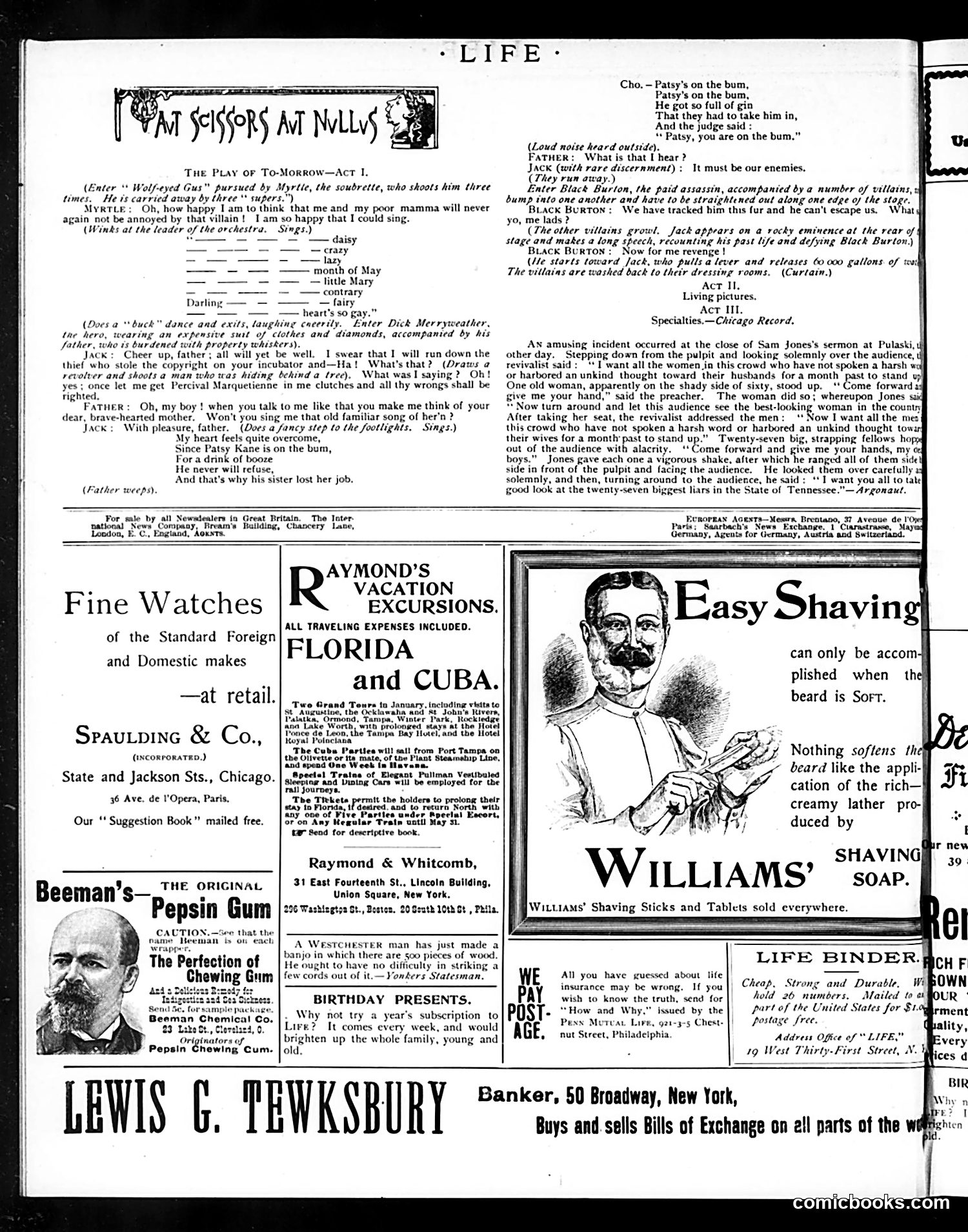
This page features a satirical one-act play titled "The Play of To-Morrow—Act 1," mocking the overwrought melodrama conventions of contemporary theater. The sketch ridicules absurdly contrived plots: a soubrette (comic actress) shoots a villain multiple times; a hero retrieves revolvers to shoot hidden threats; villains are comically washed offstage by released water. The humor targets theatrical clichés—improbable violence, convenient eavesdropping, lengthy vindictive speeches, and ludicrous stagecraft solutions. Characters bear names like "Wolf-eyed Gus" and "Black Burton," emphasizing the genre's heavy-handed villainry. Below the play, an anecdote about revivalist preacher Sam Jones provides social commentary: he asks virtuous parishioners to stand, then reveals twenty-seven men claiming month-long marital peace, calling them "liars"—satirizing both clergy moralizing and masculine hypocrisy. The page is primarily satirical content with surrounding period advertisements for watches, vacation packages, and shaving soap.
This page is primarily **advertisements and filler content**, not political satire. The visible elements include: **Major Advertisements:** - Armour Extract of Beef (cooking product) - New York Central Railroad (transportation) - Deutsch & Co. (fur/clothing removal sale) - Hotels (Hygeia, Vendome, Hamilton) - Scott's Emulsion (health tonic for weak women and nursing mothers) - Fibre Chamois (fabric interlining for garments) - Miss Maria Parloa's Cook Book **Humorous Content:** Several brief comedic anecdotes appear in the middle section—short jokes about punctuality, marriage, courtroom testimony, and a story about actor Henry Irving visiting Scotland. These are **generic period humor**, not political satire. **Notable Social Context:** The Scott's Emulsion ad reflects period attitudes about women's health and maternal duty. The fashion advertisement for "Puffed Sleeves" references contemporary Edwardian fashion trends. This page contains **no identifiable political cartoons or satire**—it's a typical turn-of-the-century magazine layout mixing advertisements with light humor.
This is primarily a **product advertisement page** from *Life* magazine, not a political cartoon. It contains no satire or social commentary—just commercial ads typical of the era. The page showcases late-19th/early-20th century consumer goods: W.L. Douglas shoes (emphasizing affordability and quality), corset stays, dress bindings, suspenders, hair tonic, and wines. Each ad uses period marketing tactics: endorsements from authority figures (doctors for wine), claims of superiority, and competitive pricing. Notable is the **medical/health angle**—wine is marketed as a "tonic," hair products promise vigor, and suspenders claim health benefits. This reflects the era's tendency to medicalize consumer goods. The ads target distinct demographics: shoes for working men and women; corset products for ladies; hair tonic for those concerned with appearance. The typography and illustration styles are typical of 1890s-era advertising design. No political figures, satire, or hidden meanings are present—this is straightforward commercial messaging.