
Life, 1895-01-17 · page 4 of 16
Life — January 17, 1895 — page 4: what you’re looking at
What you’re looking at
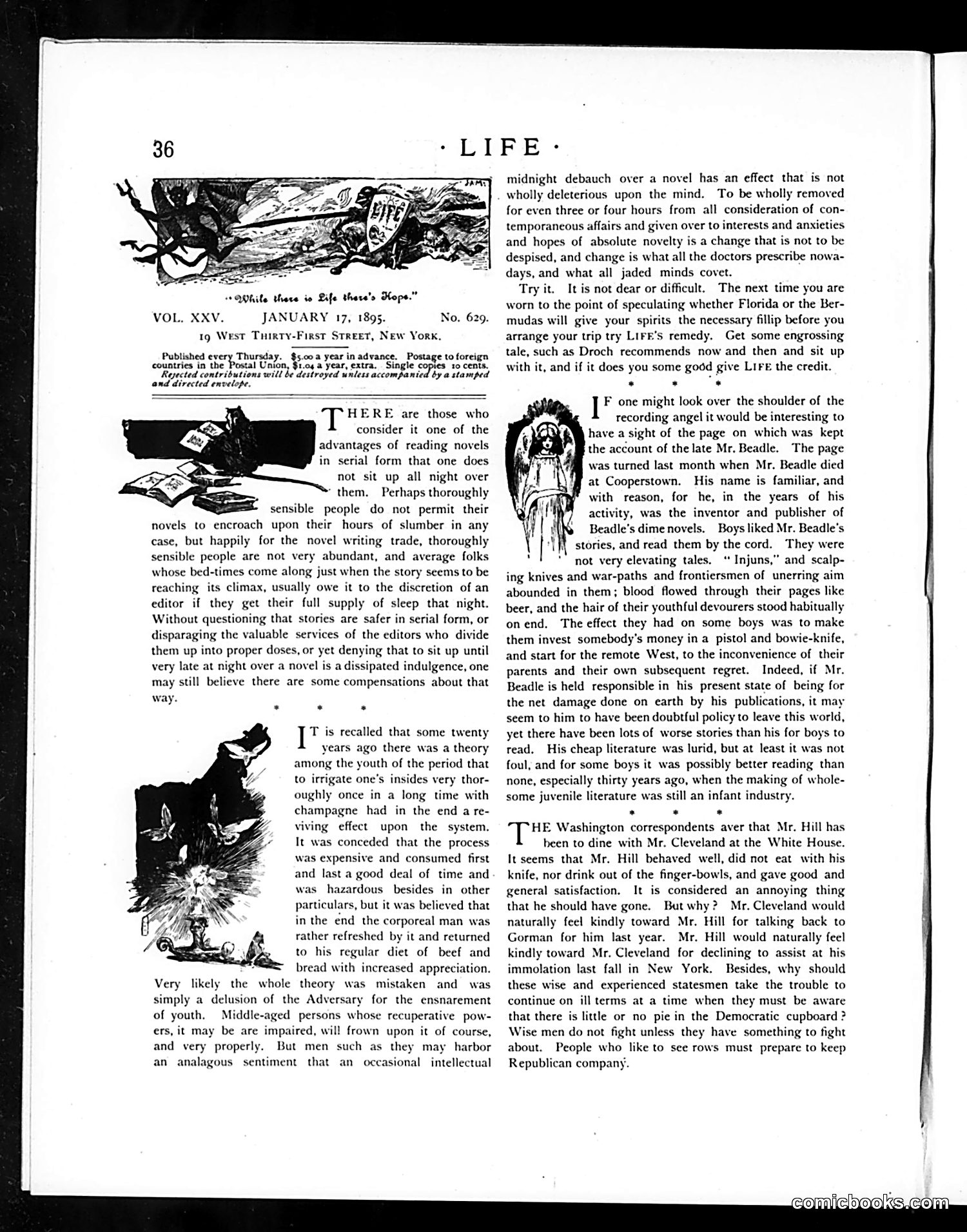
The page contains editorial commentary rather than political cartoons. The text discusses reading novels in serial form and debates their merits versus bound books. A notable section references **Mr. Beadle**, publisher of dime novels, whose sensationalized stories about "injuns" and frontier violence allegedly inspired boys to run away westward. The author criticizes Beadle's cheap literature as potentially harmful to youth. The final paragraph discusses **Mr. Hill dining with President Cleveland at the White House**, apparently criticizing Hill for improper conduct (not using a knife properly, drinking excessively). The author suggests Cleveland was unwise to host Republican company, implying the visit was politically awkward or inappropriate—reflecting the partisan tensions of the 1890s. The cartoons' specific meaning remains unclear from this reproduction quality.
📄 Transcribed text from this page (OCR, searchable)
Machine-transcribed from the original scan — historical spelling and the odd misread are preserved.
- LIFE: While there io Life there's Hope.” ‘OL, XXV. JANUARY 17, 1895. No. 629. 19 West Tuinty-First Street, New York, Reyected contributions will be destroyed untess accompanied by a stamped and directed envelope. HERE are those who consider it one of the advantages of reading novels in serial form that one does not sit up all night over * them. Perhaps thoroughly sensible people do not permit their novels to encroach upon their hours of slumber in any case, but happily for the novel writing trade, thoroughly sensible people are not very abundant, and average folks whose bed-times come along just when the story seems to be reaching its climax, usually owe it to the discretion of an editor if they get their full supply of sleep that night. Without questioning that stories are safer in serial form, or disparaging the valuable services of the editors who divide them up into proper doses, or yet denying that to sit up until very late at night over a novel is a dissipated indulgence, one may still believe there are some compensations about that way. . . . T is recalled that some twenty years ago there was a theory among the youth of the period that to irrigate one's insides very thor- oughly once in a long time with champagne had in the end a re- viving effect upon the system, It was conceded that the process was expensive and consumed first and last a good deal of time and was hazardous besides in other particulars, but it was believed that in the end the corporeal man was rather refreshed by it and returned to his regular diet of beef and bread with increased appreciation. Very likely the whole theory was mistaken simply a delusion of the Adversary for the ensnarement and was of youth. Middle-aged persons whose recuperative pow- ers, it may be are impaired, will frown upon it of course, and very properly. But men such as they may harbor an analagous sentiment that an occasional intellectual midnight debauch over a novel has an effect that is not wholly deleterious upon the mind. To be wholly removed for even three or four hours from all consideration of con- temporaneous affairs and given over to interests and anxieties and hopes of absolute novelty is a change that is not to be despised, and change is what all the doctors prescribe nowa- days, and what all jaded minds covet. Try it. It is not dear or difficult. The next time you are worn to the point of speculating whether Florida or the Ber- mudas will give your spirits the necessary fillip before you arrange your trip try LIFR’s remedy. Get some engrossing tale, such as Droch recommends now and then and sit up with it, and if it does you some godd give Lire the credit. . . “. I F one might look over the shoulder of the recording angel it would be interesting to have a sight of the page on which was kept the account of the late Mr. Beadle. The page was turned last month when Mr. Beadle died at Cooperstown. His name is familiar, and with reason, for he, in the years of his activity, was the inventor and publisher of Beadle’s dime novels. Boys liked Mr. Beadle’s stories, and read them by the cord. They were not very elevating tales. “ Injuns,” and scalp- ing knives and war-paths and frontiersmen of unerring aim abounded in them; blood flowed through their pages like beer, and the hair of their youthful devourers stood habitually onend. The effect they had on some boys was to make them invest somebody's money in a pistol and bowie-knife, and start for the remote West, to the inconvenience of their parents and their own subsequent regret. Indeed, if Mr. dle is held responsible in his present state of being for the net damage done on earth by his publications, it may seem to him to have been doubtful policy to leave this world, yet there have been lots of worse stories than his for boys to read. His cheap literature was lurid, but at least it was not foul, and for some boys it was possibly better reading than none, especially thirty years ago, when the making of whole- some juvenile literature was still an infant industry. . . . HE Washington correspondents aver that Mr. Hill has been to dine with Mr. Cleveland at the White House. It seems that Mr. Hill behaved well, did not eat with his knife, nor drink out of the finger-bowls, and gave good and general satisfaction, It is considered an annoying thing that he should have gone. But why? Mr. Cleveland would naturally feel kindly toward Mr. Hill for talking back to Gorman for him last year. Mr. Hill would naturally feel kindly toward Mr. Cleveland for declining to assist at his immolation last fall in New York. Besides, why should these wise and experienced statesmen take the trouble to continue on ill terms at a time when they must be aware that there is little or no pie in the Democratic cupboard ? Wise men do not fight unless they have something to fight about. People who like to see rows must prepare to keep Republican company.