
Life, 1895-01-17 · page 6 of 16
Life — January 17, 1895 — page 6: what you’re looking at
What you’re looking at
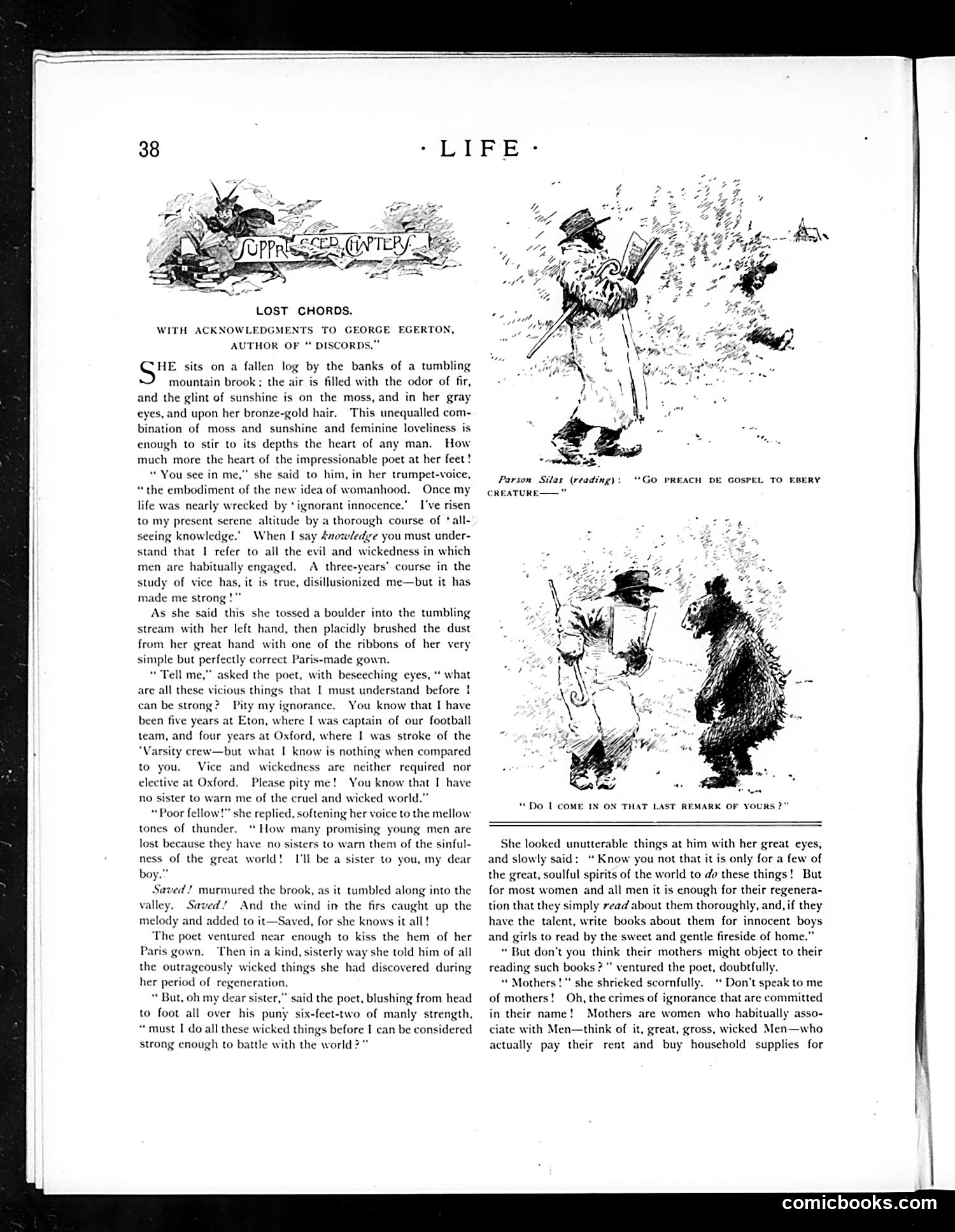
This page features a satirical story with accompanying illustrations. The narrative presents a woman in "gray eyes and bronze-gold hair" sitting by a stream, engaging a male poet in philosophical debate about vice, wickedness, and morality. The illustrations show a figure (labeled "Parson Silas (reading): 'Go preach de gospel to ebery creature'") apparently preaching or gesturing dramatically. The cartoon's satire likely mocks Victorian-era moral hypocrisy—specifically the disconnect between preachers' sanctimonious pronouncements about vice and actual human behavior. The story's woman character represents an educated, liberated perspective challenging conventional morality, while the poet's reactions suggest the discomfort such frank discussion provoked in polite society. The overall piece appears to critique rigid moral instruction divorced from real-world complexity.
📄 Transcribed text from this page (OCR, searchable)
Machine-transcribed from the original scan — historical spelling and the odd misread are preserved.
LOST CHORDS. WITH ACKNOWLEDGMENTS TO GEORGE Et AUTHOR OF * DISCORD! ~HE sits on a fallen log by the banks of a tumbling mountain brook ; the air is filled with the odor of fir, and the glint of sunshine is on the moss, and in her gray d upon her bronze-gold hair. This unequalled com- bination of moss and sunshine and feminine loveliness is enough to stir to its depths the heart of any man. How much more the heart of the impressionable poet at her feet! “ You see in me,” she said to him, in her trumpet-voice, “the embodiment of the new idea of womanhood. Once my life was nearly wrecked by ‘ignorant innocence.’ I've risen to my present serene altitude by a thorough course of ‘all- seeing knowledge.’ When I say Anowledye you must under- stand that I refer to all the evil and wickedness in which men are habitually engaged. A three-years’ course in the study of vice has, it is true, disillusionized me—but it has made me strong!” As she said this she tossed a boulder into the tumbling stream with her left hand, then placidly brushed the dust from her great hand with one of the ribbons of her very simple but perfectly correct Paris-made gown. ell me, d the poet, with beseeching eyes, what are all these vicious things that I must understand before ! can be strong? Pity my ignorance. You know that I have been five years at Eton, where | was captain of our football team, and four years at Oxford, where I was stroke of the "Varsity crew—but what I know is nothing when compared to you. V and wickedness are neither required nor elective at Oxford. Please pity me! You know that I have no sister to warn me of the cruel and wicked world.” “Poor fellow!” she replied, softening her voice to the mellow tones of thunder. “ How many promising young men are lost because they have no sisters to warn them of the sinful ness of the great world! I'll be a sister to you, my dear boy.” Saved! murmured the brook, as it tumbled along into the Saved! And the wind in the firs caught up the nd added to it—Saved, for she knows it all! ‘The poet ventured near enough to kiss the hem of her Paris gown. Then in a kind, sisterly way she told him of all the outrageously wicked things she had discovered during her period of regeneration. “ But, oh my dear sister,” said the poet, blushing from head to foot all over his puny six-feet-two of manly strength, “must I do all these wicked things before I can be considered strong enough to battle with the world?” Parson Sitas (reading): “GO PREACH DE GOSPEL TO EBERY CREATURE" “Do L COME IN ON THAT LAST REMARK OF YOURS?” She looked unutterable things at him with her great eyes, and slowly said: ‘* Know you not that it is only for a few of the great, soulful spirits of the world to do these things! But for most women and all men it is enough for their regenera- tion that they simply vead about them thoroughly, and, if they have the talent, write books about them for innocent boys and girls to read by the sweet and gentle fireside of home.” “ But don’t you think their mothers might object to their reading such books?” ventured the poet, doubtfully. “ Mothers!" she shrieked scornfully. “ Don’t speak to me of mothers! Oh, the crimes of ignorance that are committed in their name! Mothers are women who habitually O- ciate with Men—think of it, great, gross, wicked Men—who actually pay their rent and buy household supplies for —— comicbooks.com