
A complete issue · 14 pages · 1895
Life — January 10, 1895
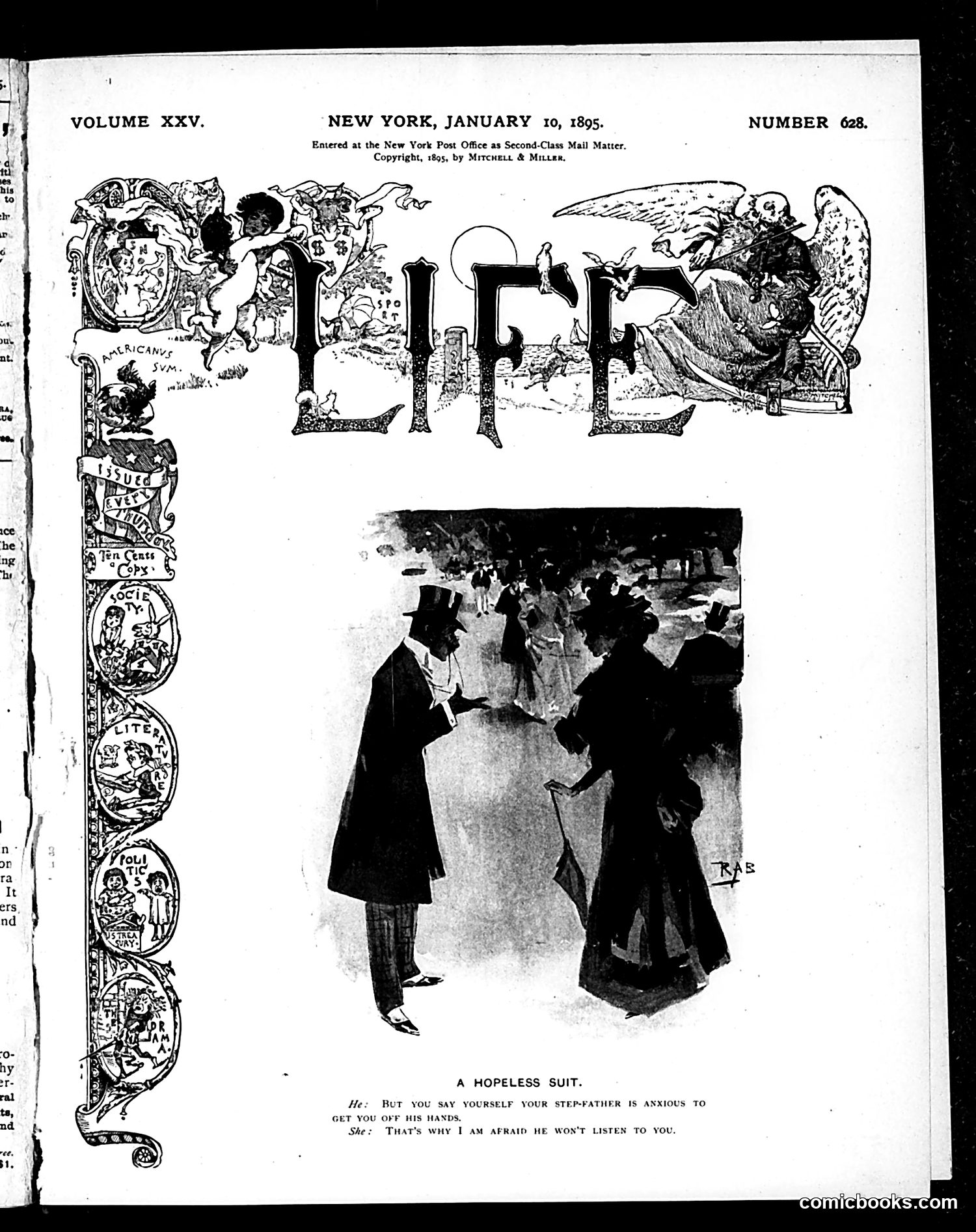
This 1895 *Life* cartoon depicts a domestic dispute over a stepfather's authority. The illustration shows a man and woman in conversation, with the caption capturing their disagreement: the man claims the stepfather is "anxious to get you off his hands," while the woman responds, "That's why I am afraid he won't listen to you." The joke plays on the awkward family dynamics of blended households—specifically, the stepfather's lack of genuine parental interest in the stepdaughter, which ironically makes her immune to the man's appeals on her behalf. The title "A Hopeless Suit" suggests his romantic or matrimonial pursuit is doomed because he cannot leverage the stepfather's authority, a common social concern in the Victorian era when family hierarchies determined courtship outcomes.
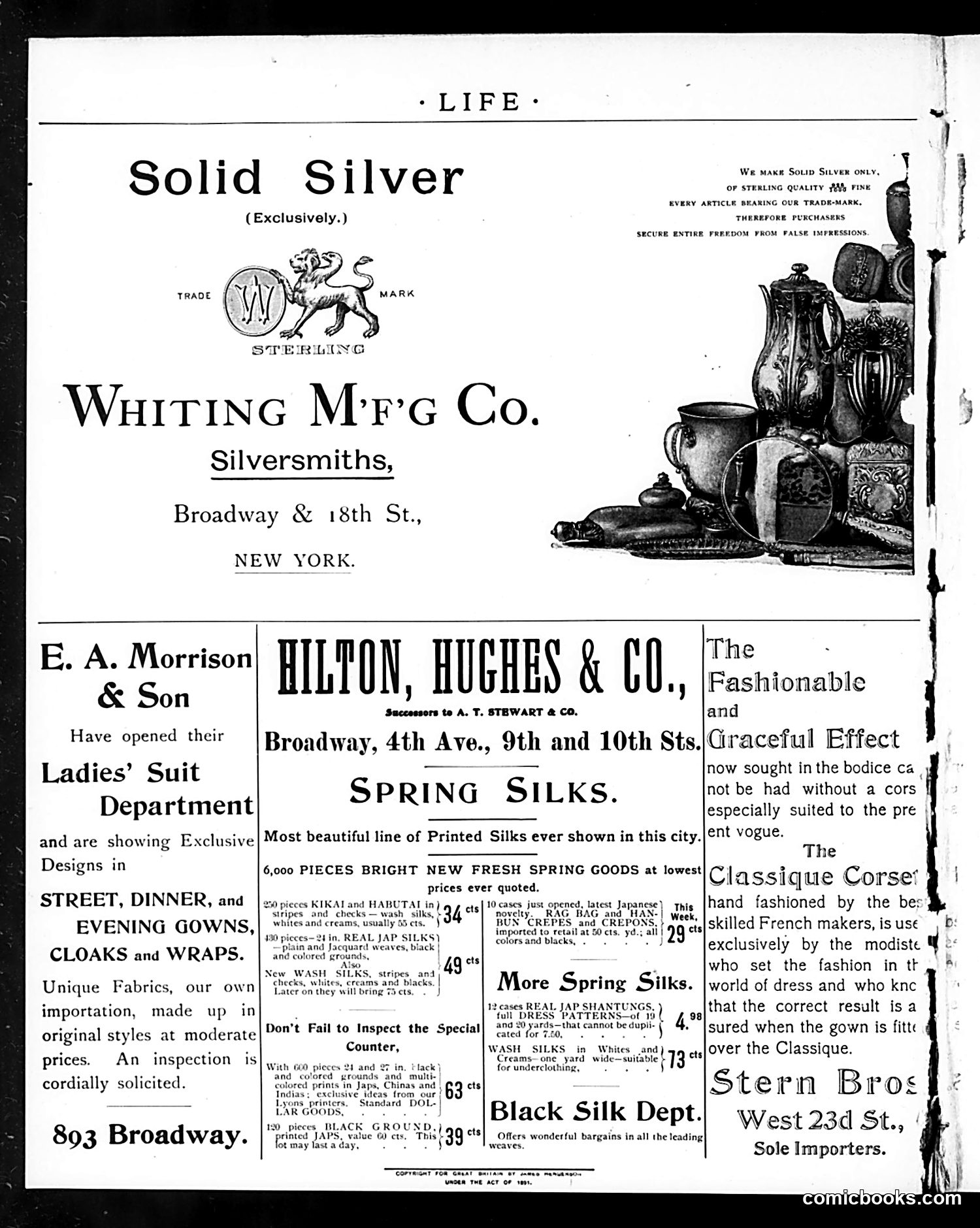
This page contains **no political cartoons or satire**. It is primarily **advertising content** from what appears to be a late 19th or early 20th-century issue of Life magazine. The advertisements feature: - **Whiting Mfg Co.**, a silversmith company promoting solid silver goods - **E.A. Morrison & Son**, advertising a new Ladies' Suit Department with exclusive gown and cloak designs - **Hilton, Hughes & Co.**, promoting spring silks with 6,000 pieces of printed fabric - **Stern Bros.**, advertising the "Classique Corset" as hand-fashioned by French makers The page is a straightforward commercial section showcasing upscale retail merchandise typical of the era—fine silver, fashionable clothing, textiles, and corsetry. There is no satirical commentary or political content visible.
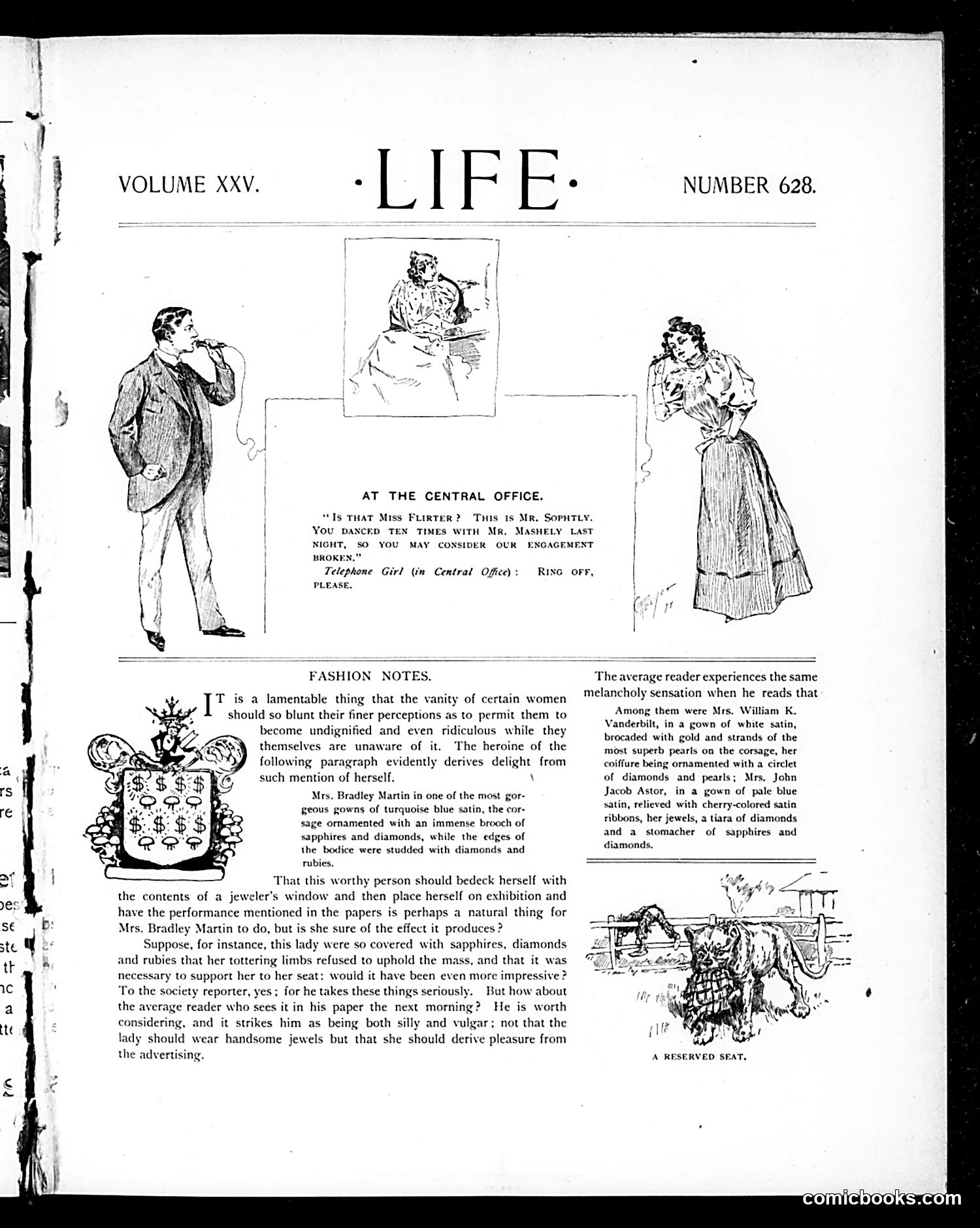
This page contains social satire about women's fashion and vanity. The top cartoon "At the Central Office" mocks a telephone operator (identified as "Miss Flirter") who apparently danced excessively at social events—the joke being she's too distracted by dancing to do her job properly. The "Fashion Notes" section criticizes wealthy women, particularly Mrs. Bradley Martin, for wearing ostentatious jewelry in public. The satirist argues this is undignified self-promotion, comparable to displaying oneself in a jeweler's window. The text suggests respectable women should wear fine jewelry privately, not for public advertisement. The accompanying illustrations and "A Reserved Seat" sketch reinforce themes of social propriety and the satirical critique of female vanity and status-seeking behavior among the wealthy.
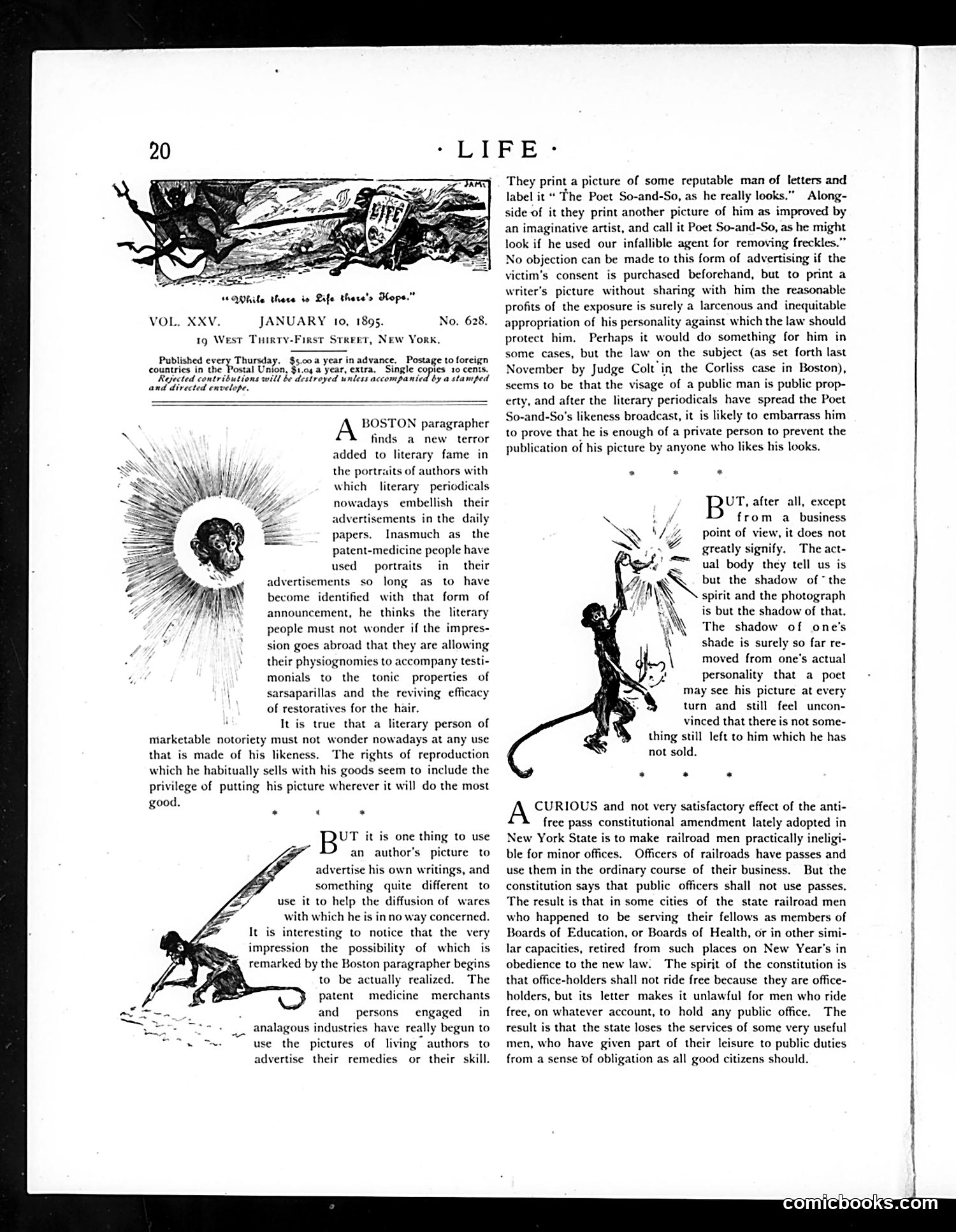
This page critiques the commercial exploitation of poets' likenesses in advertising. The text discusses a "Poet So-and-So" whose portrait is being used without proper compensation—a practice common in patent medicine advertisements of the era. The accompanying cartoons show a small figure (representing the poet) being dwarfed or pulled along by his own enlarged shadow/portrait, illustrating how his image has taken on a life of its own in commerce, separate from his actual identity and control. The satire targets both the patent medicine industry's unscrupulous marketing practices and the broader issue of personality rights—arguing that profiting from someone's likeness without adequate compensation or consent is legally and ethically troubling. The "shadow" metaphor suggests the poet's authentic self has been completely overshadowed by commercial exploitation.
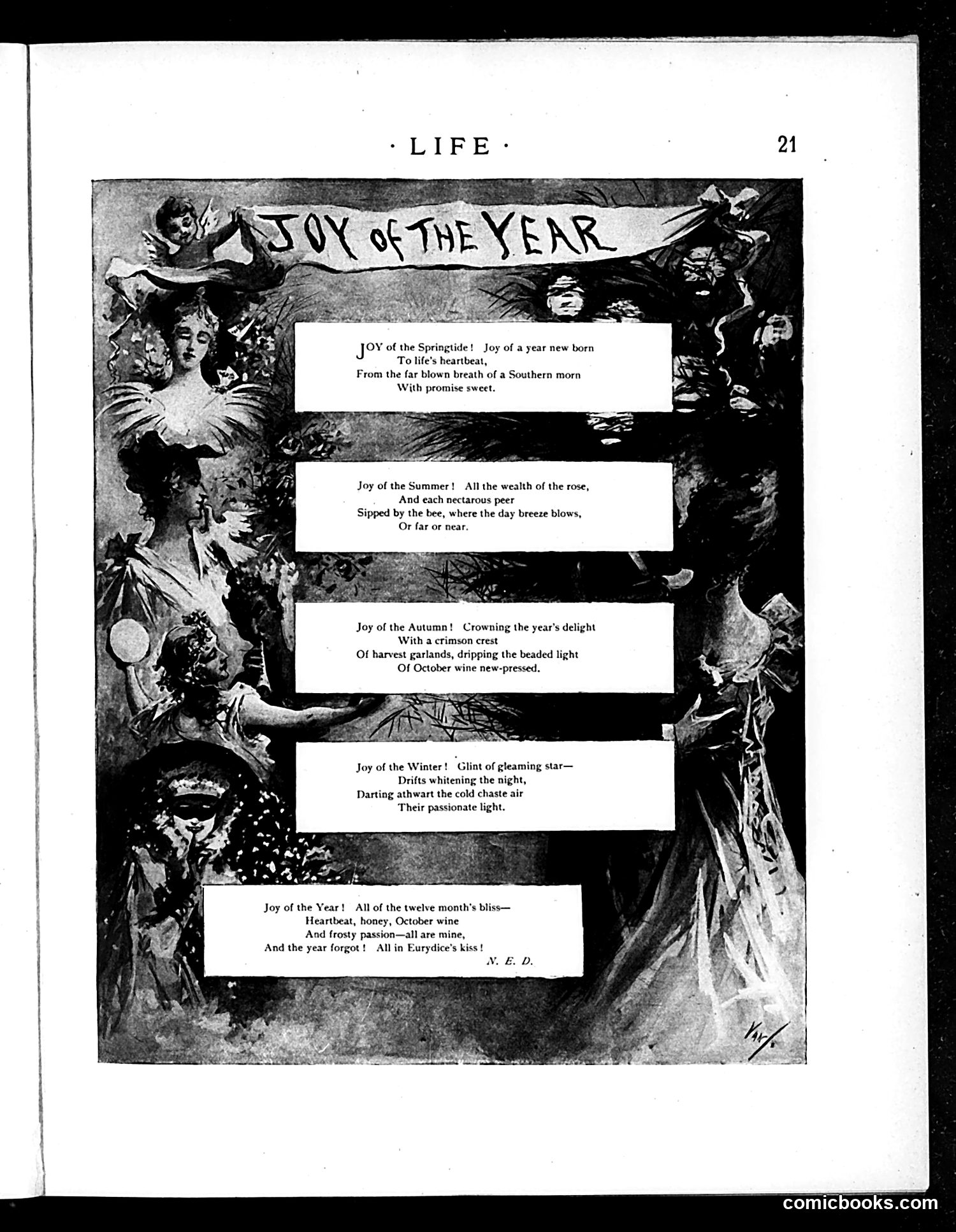
This is a decorative, non-satirical poem celebrating the four seasons and the full year itself. The page features allegorical female figures representing Spring, Summer, Autumn, and Winter arranged vertically around ornamental borders with cherubs and harvest imagery. The verses praise each season's pleasures—springtime's promise, summer's roses and bees, autumn's harvest and wine, winter's stars and frost—culminating in a final stanza celebrating "all of the twelve month's bliss." Credited to "N.E.D." (the author's initials), this appears to be sentimental Victorian-era verse rather than political satire. It's purely celebratory and decorative, using classical allegorical imagery popular in Life magazine's aesthetic content during this period.
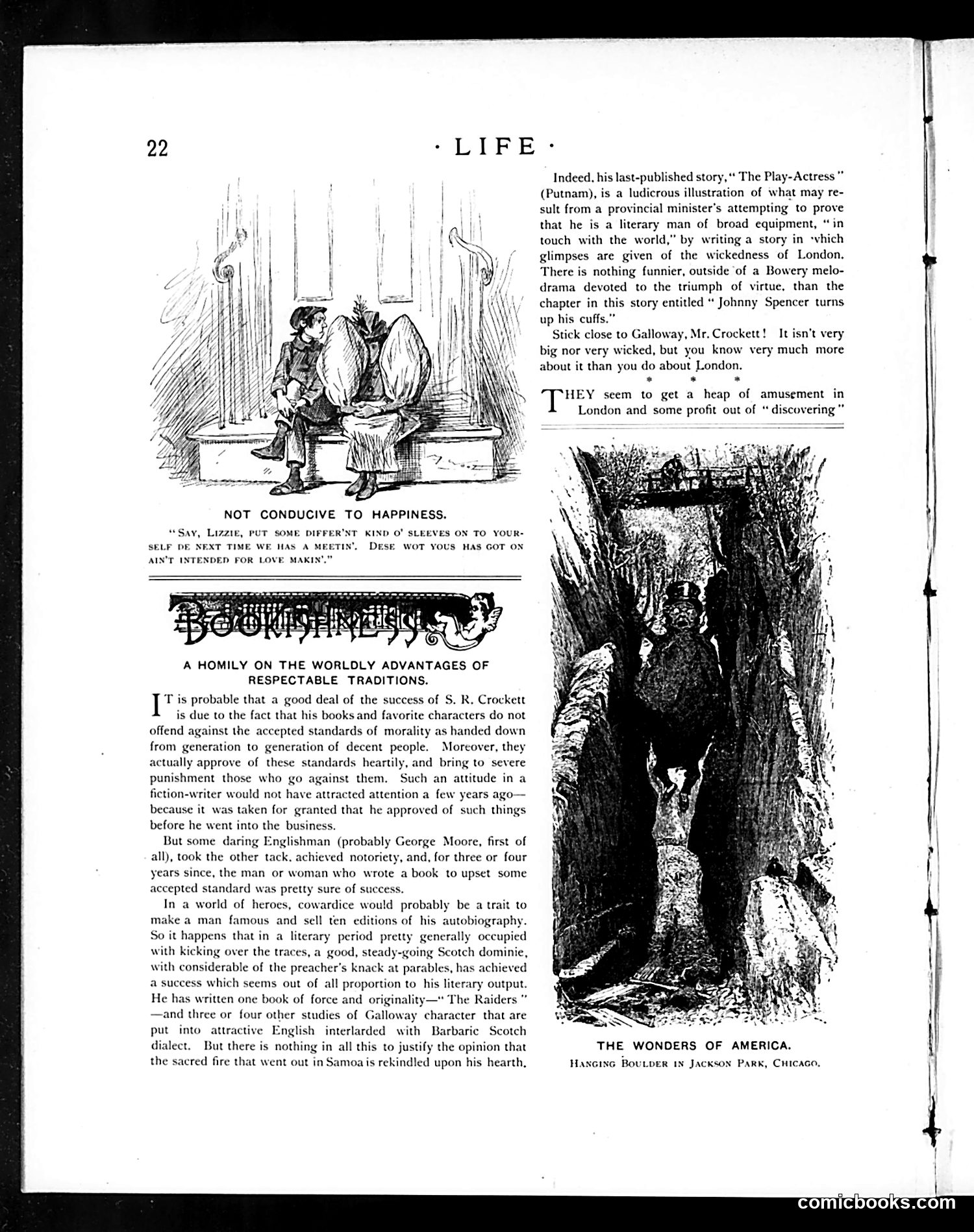
This page critiques S.R. Crockett, a Scottish author popular in the 1890s-1900s. The text praises his commercial success while gently mocking his formulaic approach: his books feature stereotypical "Galloway character" protagonists and Scottish dialect, suggesting limited literary range despite strong sales. The top cartoon titled "NOT CONDUCIVE TO HAPPINESS" depicts a domestic scene where a woman complains about her husband's wardrobe choices—a mild domestic humor vignette. The bottom illustration, "THE WONDERS OF AMERICA: HANGING BOULDER IN JACKSON PARK, CHICAGO," shows a natural rock formation, apparently unrelated to the Crockett discussion above. The satire suggests Crockett achieved disproportionate commercial success relative to his literary merit by relying on marketable but repetitive Scottish themes.
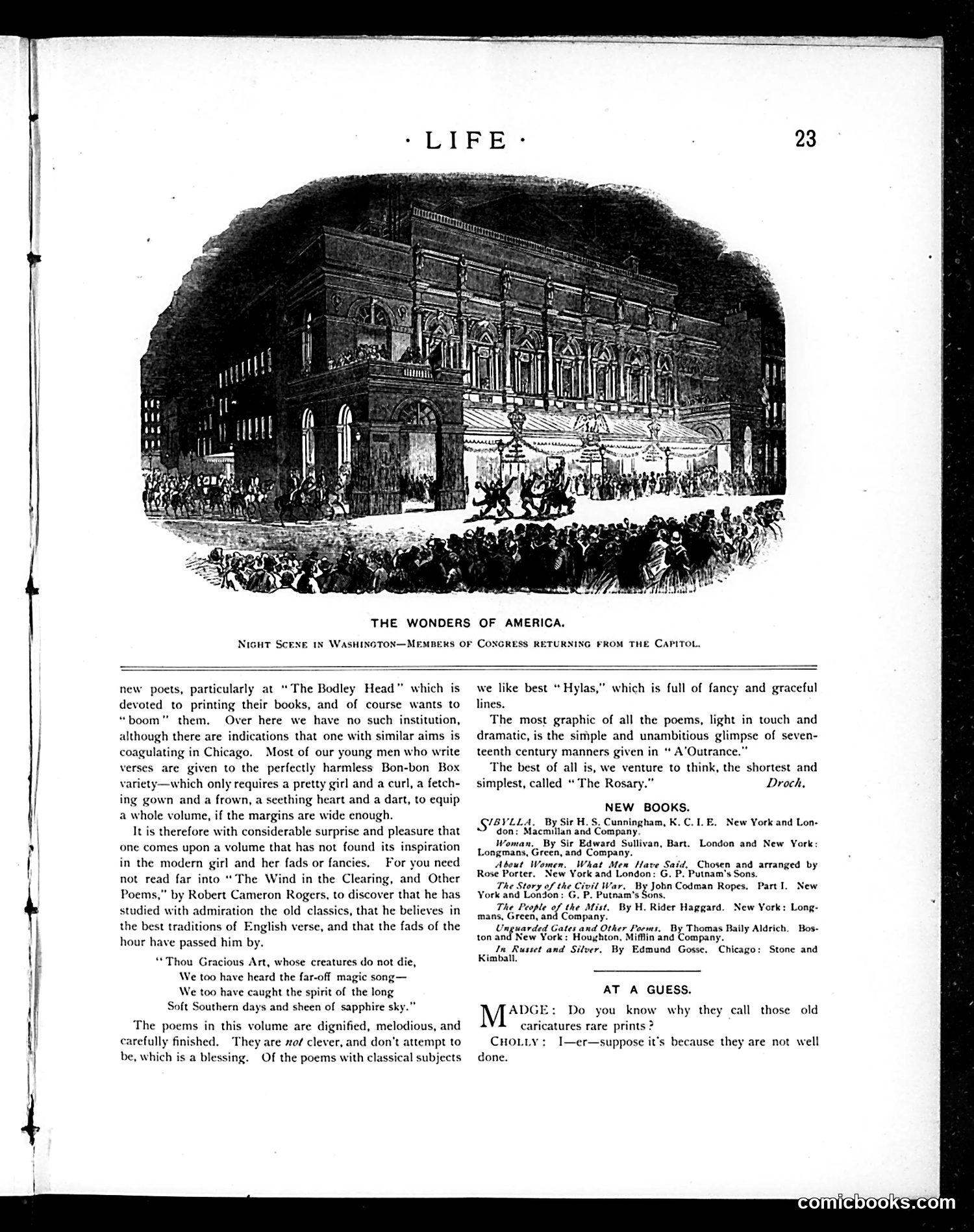
The engraved illustration depicts "The Wonders of America: Night Scene in Washington—Members of Congress returning from the Capitol." The satirical image shows a grand, ornate government building with crowds of figures streaming from it into the streets below. The satire likely mocks Congress members and their activities or behaviors when leaving official duties. The accompanying text discusses poetry and literature rather than directly explaining the cartoon's political meaning. Without additional context about the specific historical period this issue was published, I cannot identify particular Congress members or reference specific political events being satirized. The general thrust appears to be commentary on American political life and governmental proceedings, rendered through the exaggerated, crowded scene typical of nineteenth-century satirical engravings.
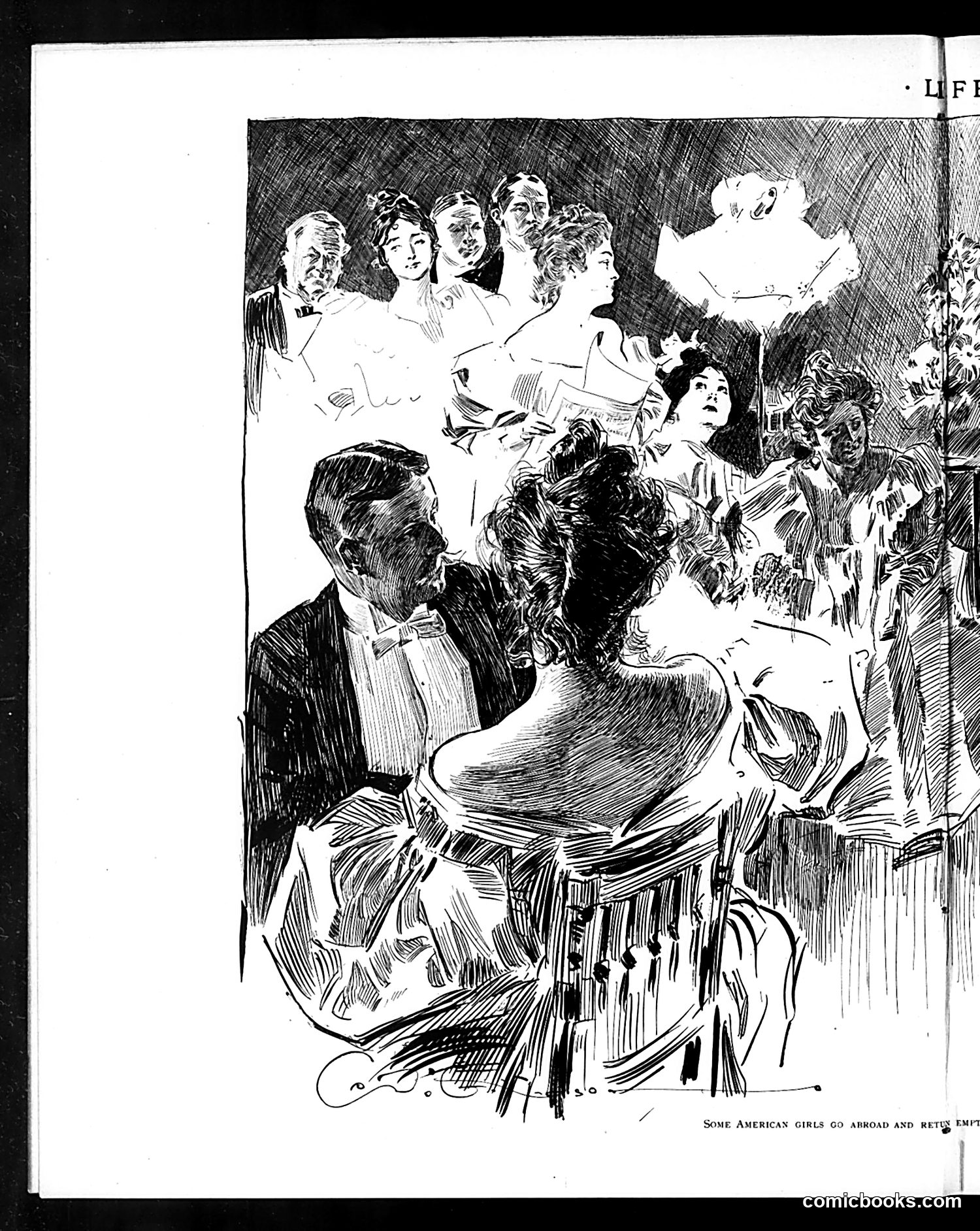
The visible caption reads: "SOME AMERICAN GIRLS GO ABROAD AND RETURN EMI[GRANT?]" (text is cut off). This appears to be a satirical illustration about American women traveling abroad. The sketch shows a well-dressed man in formal attire (tuxedo and bow tie) interacting with a fashionably dressed woman in what looks like an elegant social setting, with observers in the background. The satire likely comments on young American women who traveled to Europe and either married foreign nobility or adopted European sophistication and mannerisms upon returning home—a concern of early 20th-century American society. The joke appears to mock the transformation or pretensions these women acquired abroad, though the incomplete caption prevents full certainty about the specific satirical target.
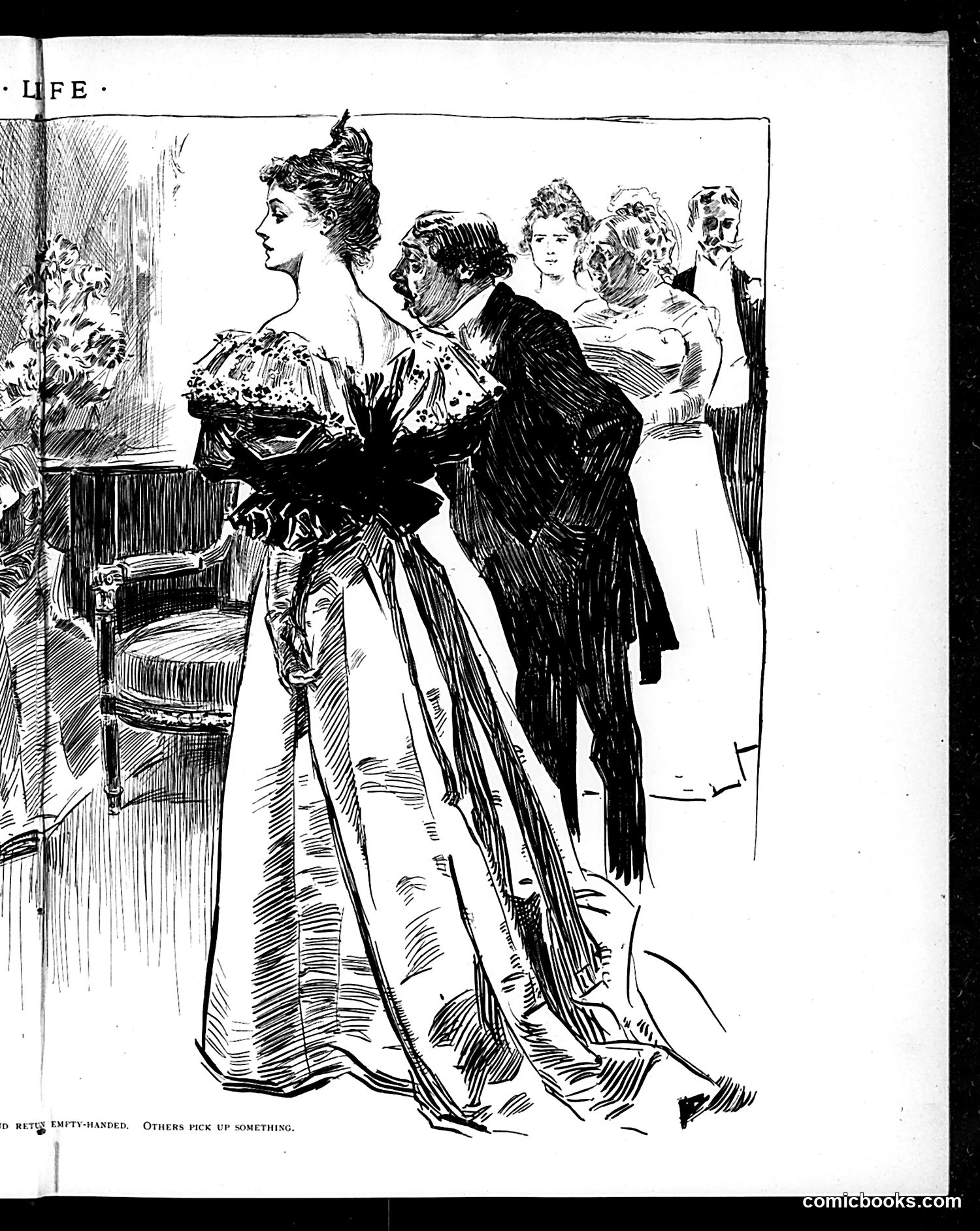
This is a satirical illustration from *Life* magazine showing a social scene at what appears to be an elegant party or reception. The caption reads "**'D RITZ' EMPTY-HANDED. OTHERS PICK UP SOMETHING.**" The joke appears to target social pretension and class behavior: a well-dressed woman in an elaborate gown (labeled or implied to be from "the Ritz," a luxury hotel) arrives empty-handed to what seems to be a gift-giving or charitable event, while other attendees behind her carry items. The satire mocks the wealthy or fashionable elite for their lack of generosity or contribution, contrasting their opulent appearance with their empty-handedness compared to more modest guests who actually brought something. It's a commentary on hypocrisy in high society.
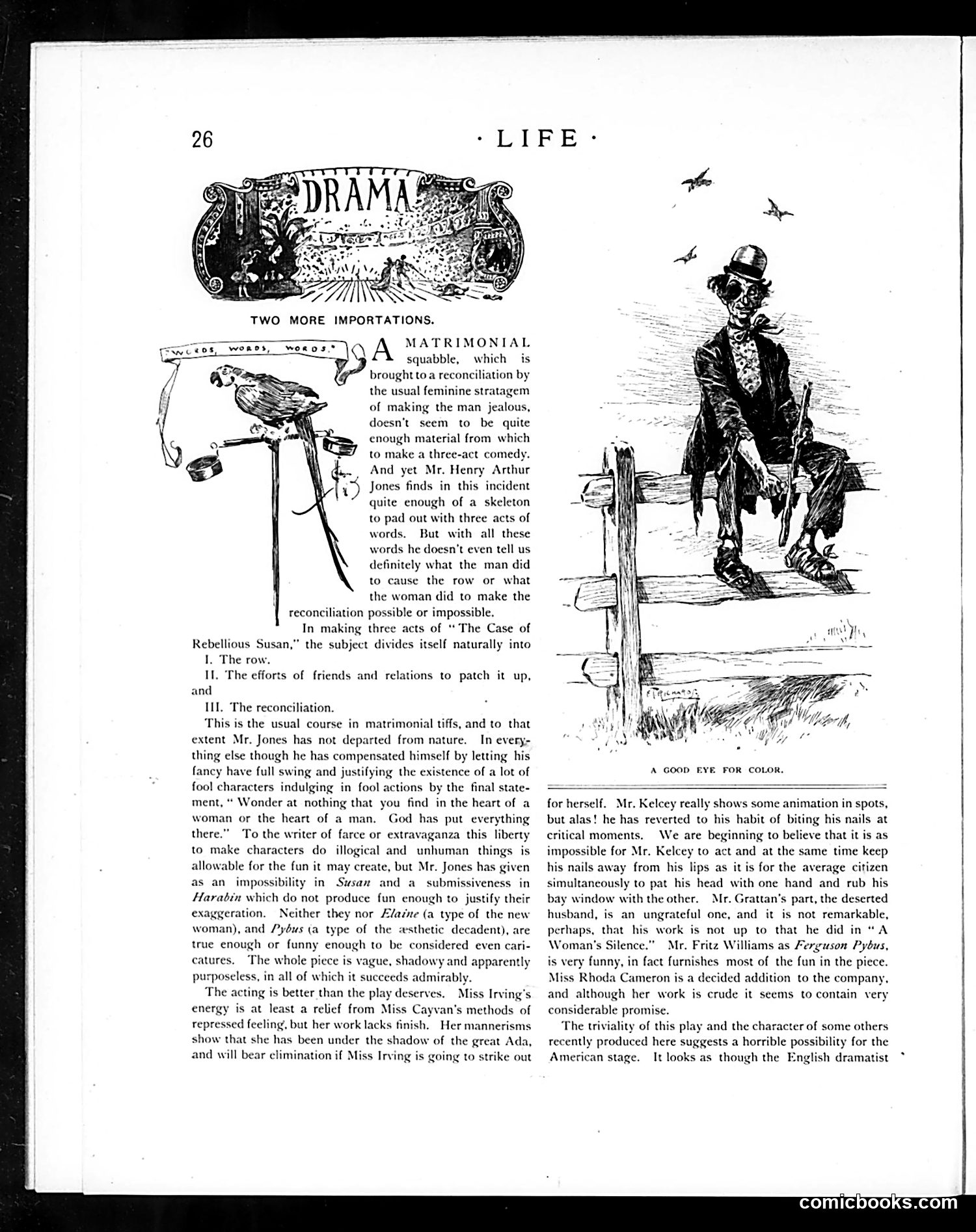
This page critiques three theatrical productions. The text reviews "Two More Importations"—plays brought to American stages. The left illustration shows a bird perched on a makeshift stand, accompanying discussion of a "matrimonial squabble" play by Henry Arthur Jones where a jealous man and reconciliation plot provide thin material for three acts. The right illustration depicts "A Good Eye for Color"—a man in a bowler hat and patterned clothing, likely a character from one of the reviewed plays. The text criticizes actor Kelcey for biting his nails at dramatic moments, and discusses other cast members' performances, including Miss Rhoda Cameron and Miss Williams, suggesting their work shows "considerable promise" despite the play's triviality. The overall tone is satirical, mocking the imported theatrical fare as shallow and the actors' occasionally amateurish execution.
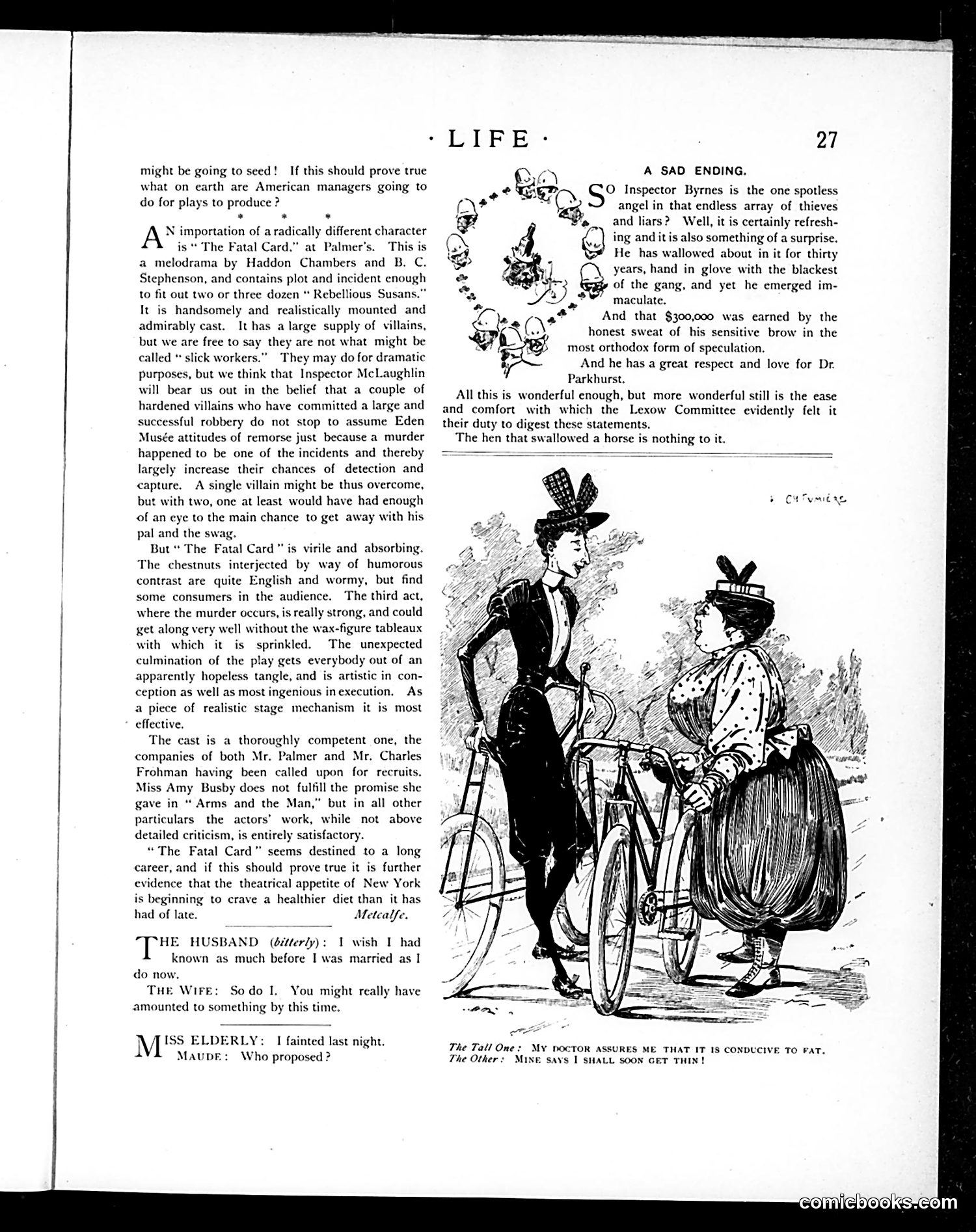
This page contains theatrical reviews and a satirical cartoon about bicycles and courtship. The main illustration shows a well-dressed man on a bicycle speaking with a woman in elaborate dress, captioned with dialogue about doctors' dietary advice. The cartoon satirizes how bicycles—a relatively new technology at the time—functioned as spaces for courting and romance, particularly for women gaining independence through cycling. The woman's comment that her doctor says she'll "soon get thin" suggests bicycles were promoted as exercise equipment, while the couple's interaction on the vehicles implies bicycles enabled unsupervised socializing between unmarried people. The text reviews theatrical productions including "The Fatal Card," praising its realistic staging and competent cast while noting New York audiences increasingly appreciated healthier theatrical fare than previous melodrama.
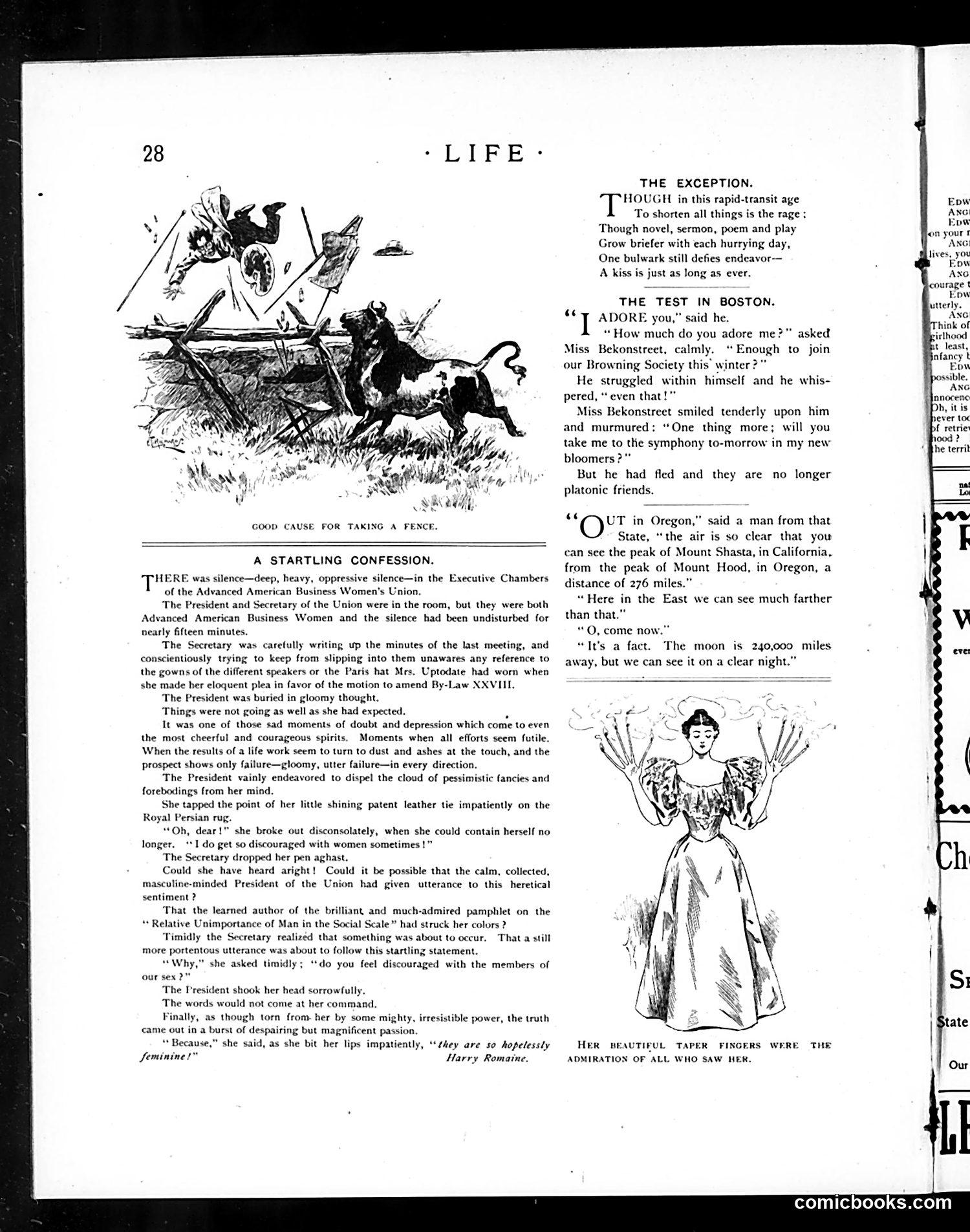
This page contains three satirical pieces mocking contemporary gender attitudes and social pretensions: **"A Startling Confession"** (main story): Depicts the president of the "Advanced American Business Women's Union"—an organization promoting women's intellectual equality and independence—confessing to her secretary that she's discouraged because women are "hopelessly feminine." The satire attacks the contradiction: women claiming to transcend traditional femininity while remaining trapped by it. The cartoon shows a woman taking a fence, illustrating the hypocrisy. **"The Exception"** (poem): A brief joke that despite modern efficiency culture shortening everything, kisses remain unchanged—a lighthearted dig at romance's imperviousness to progress. **"The Test in Boston"**: A man claims to adore a woman but flees when she demands he attend the symphony wearing her new "bloomers" (reform dress). The satire mocks both women's dress reform advocates and men's shallow professions of devotion. All three pieces ridicule early 20th-century feminism and women's reform movements through gentle mockery of their contradictions and perceived extremism.
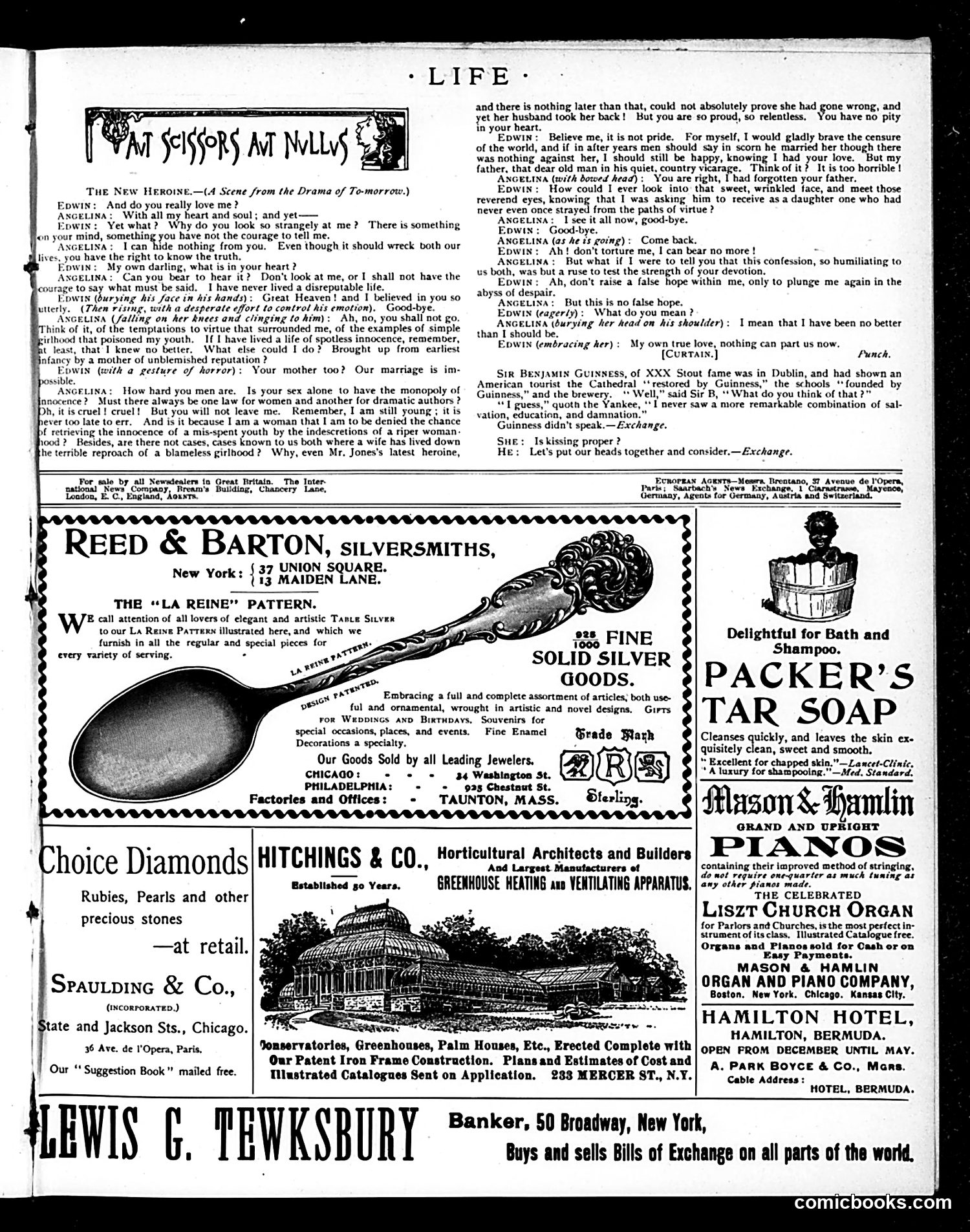
This is a dramatic parody satirizing contemporary theater conventions and evolving attitudes toward female morality. The sketch depicts a melodramatic proposal scene where Angelina confesses she has lived a "spotless" life of "unblemished" innocence—presented as a shameful secret that nearly destroys her romance with Edwin. The satire mocks two things: first, the theatrical obsession with fallen women and moral transgression as plot devices; second, the absurdity of condemning women *for virtue* when society typically condemned them for vice. Angelina's anguished confession—that she's *too innocent*—exposes the impossible double-bind women faced. Edwin's horror at her spotless past (and worry about telling his vicar father) ridicules male hypocrisy and Victorian sexual anxieties. The twist ending, where she admits the confession was a "ruse to test" his devotion, provides comedic resolution while undermining the entire melodramatic premise. It's contemporary satire of stage conventions, not historical political commentary.
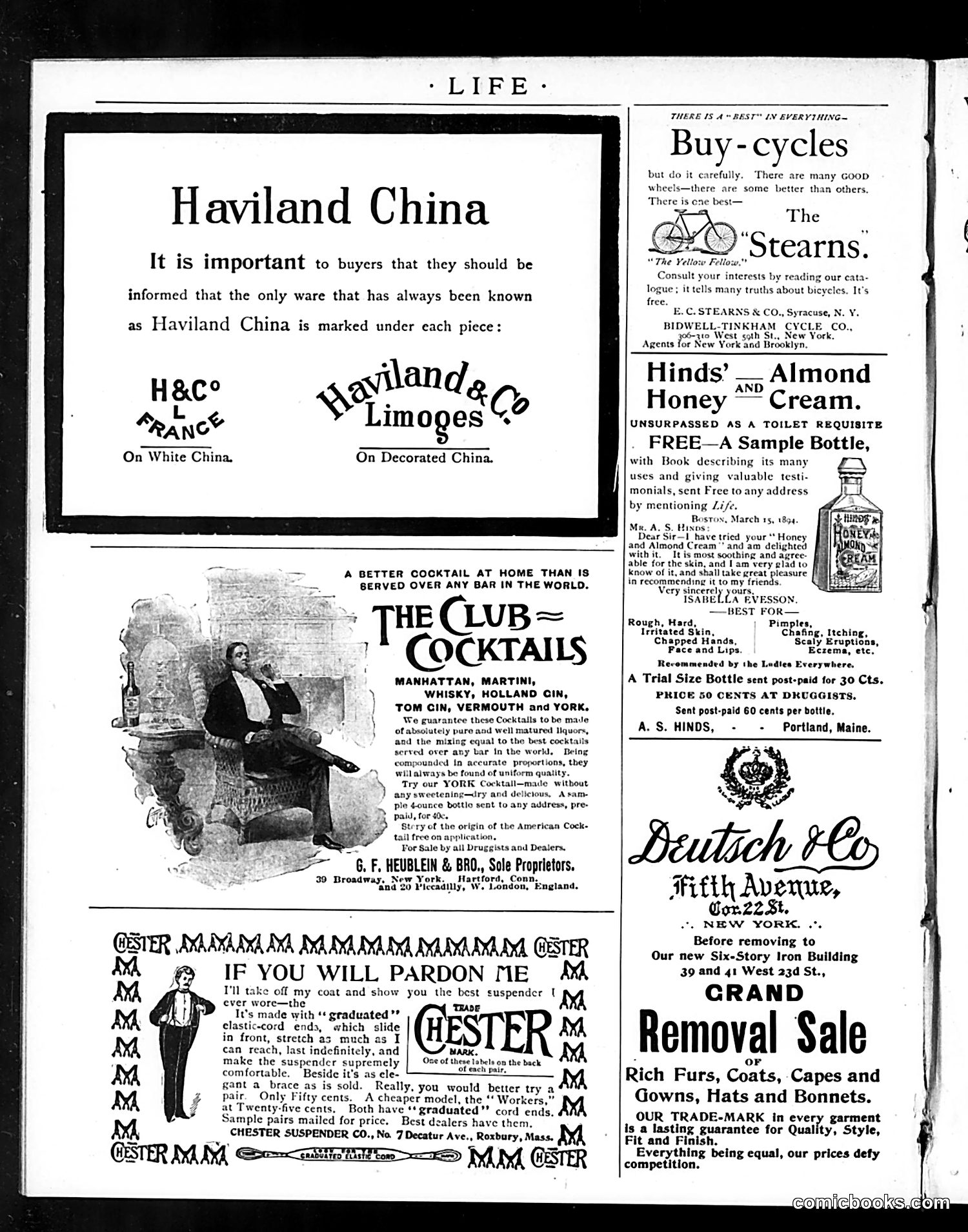
This page is primarily **advertisements** with no political cartoons or satirical content. The visual material consists of: 1. **"The Club Cocktails" ad** (center-left): Shows a man in formal dress relaxing in a chair, illustrating the leisure of home cocktail consumption. The text promises quality spirits "equal to the best cocktails served over any bar in the world"—appealing to Gilded Age consumers who could afford home bar culture. 2. **"Chester Suspender" ad** (lower-left): Features a man demonstrating suspenders with "graduated elastic-cord ends," emphasizing durability and comfort as selling points. The remaining advertisements promote bicycles ("Stearns"), china, skin cream, and fur removal sales—typical late-19th-century consumer goods. **Context for modern readers**: This represents the era when *Life* magazine was primarily a vehicle for advertising luxury goods to affluent readers, reflecting the conspicuous consumption of the 1890s American upper class.