
Life, 1895-01-10 · page 7 of 14
Life — January 10, 1895 — page 7: what you’re looking at
What you’re looking at
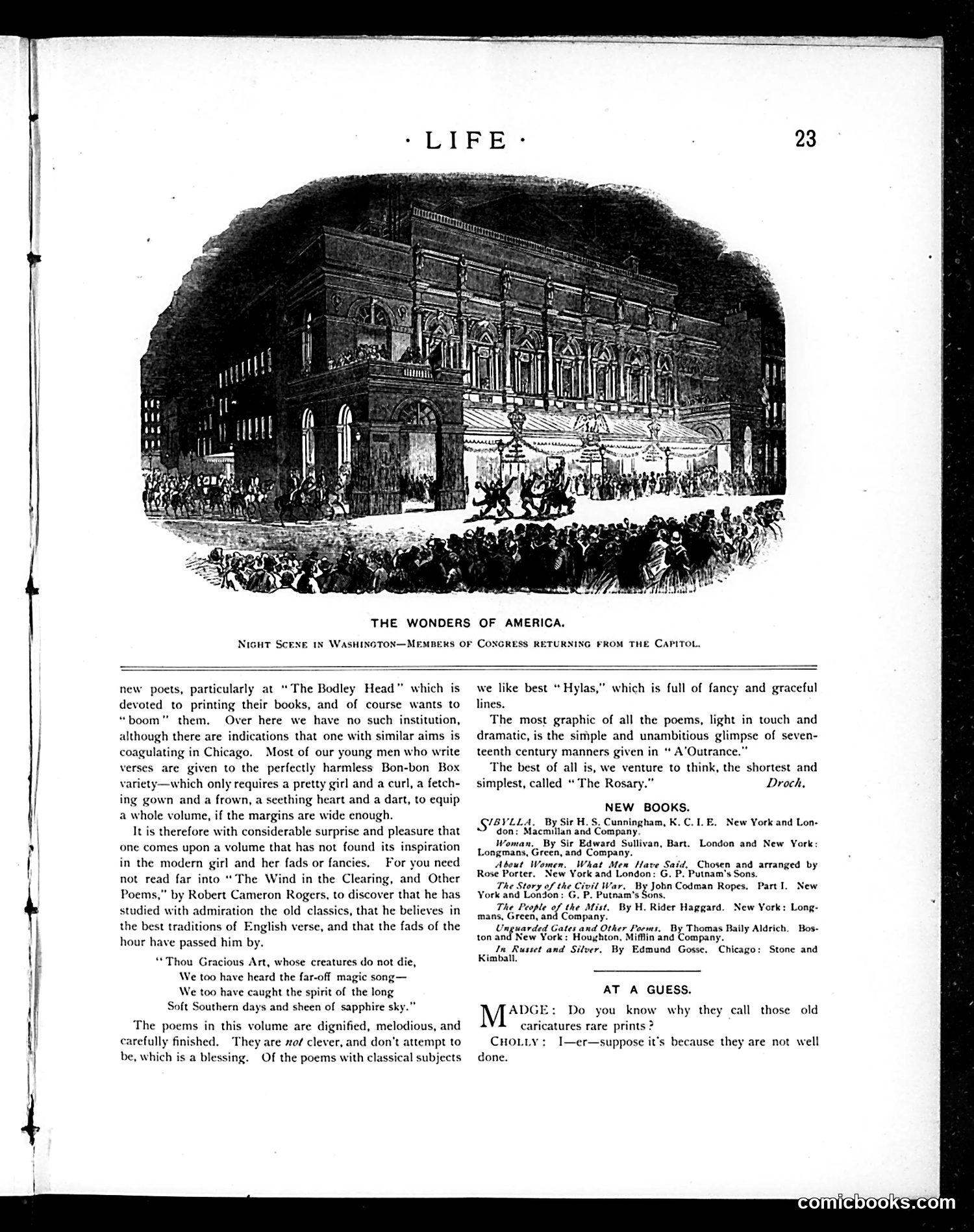
The engraved illustration depicts "The Wonders of America: Night Scene in Washington—Members of Congress returning from the Capitol." The satirical image shows a grand, ornate government building with crowds of figures streaming from it into the streets below. The satire likely mocks Congress members and their activities or behaviors when leaving official duties. The accompanying text discusses poetry and literature rather than directly explaining the cartoon's political meaning. Without additional context about the specific historical period this issue was published, I cannot identify particular Congress members or reference specific political events being satirized. The general thrust appears to be commentary on American political life and governmental proceedings, rendered through the exaggerated, crowded scene typical of nineteenth-century satirical engravings.
📄 Transcribed text from this page (OCR, searchable)
Machine-transcribed from the original scan — historical spelling and the odd misread are preserved.
—— —$>——- SF THE WONDERS Nigut ENE IN WASHINGTON—MEMRBERS OF OF AMERICA. CONGRESS RETURNING FROM THE CaPITOL. new poets, particularly at “The Bodley Head” which is devoted to printing their books, and of course wants to “boom” them. Over here we have no such institution, although there are indications that one with similar aims is coagulating in Chicago. Most of our young men who write are given to the perfectly harmless Bon-bon Box which only requires a pretty girl and a curl, a fetch- ing gown and a frown, a seething heart and a dart, to equip a whole volume, if the margins are wide cnough. It is therefore with considerable surprise and pleasure that one comes upon a volume that has not found its inspiration in the modern girl and her fads or fancies. For you need not read far into “The Wind in the Clearing, and Other Poems,” by Robert Cameron Rogers, to discover that he has studied with admiration the old classics, that he believes in the best traditions of English verse, and that the fads of the hour have passed him by. ‘Thou Gracious Art, whose creatures do not die, We too have heard the far-off magic song— We too have caught the spirit of the long Soft Southern days and sheen of sapphire sl The poems in this volume are dignified, melodious, and carefully finished. They are xof clever, and don’t attempt to be, which is a blessing. Of the poems with classical subjects we like best “ Hylas,” which is full of fancy and graceful lines. The most graphic of all the poems, light in touch and dramatic, is the simple and unambitious glimpse of seven- teenth century manners given in “ A’Outrance.” The best of all is, we venture to think, the shortest and simplest, called “ The Rosary.” Droch. NEW BOOKS. S/SVLLA. By Sir H.S. Cunningham, K.C.1.E. New York and Lon- ©" don: Macmillan and Company. Woman. By Sir Edward Sullivan, Bart. London and New York: Longmans, Green, and Company. About Women. What Men Have Said, Chosen and arranged by Rose Porter. New York and London: G. P, Putnam's Sons. The Story of the Civil War, By Jobn Codman Ropes, PartI. New York and London: G. P. Putnam’s Sons. The People of the Mist, By H. Rider Haggard. New York: Long- mans, Green, and Company. Unguarded Gates and Other Poems, By Thomas Baily Aldrich, Bos- ton and New York: Houghton, Mifflin and Company. Jn Russet and Silver, By Edmund Gosse. Chicago: Stone and Kimball. AT A GUESS. ADGE: Do you know why they call those old caricatures rare prints ? CHOLLY : I—er—suppose it’s because they are not well done.