
Life, 1895-01-10 · page 6 of 14
Life — January 10, 1895 — page 6: what you’re looking at
What you’re looking at
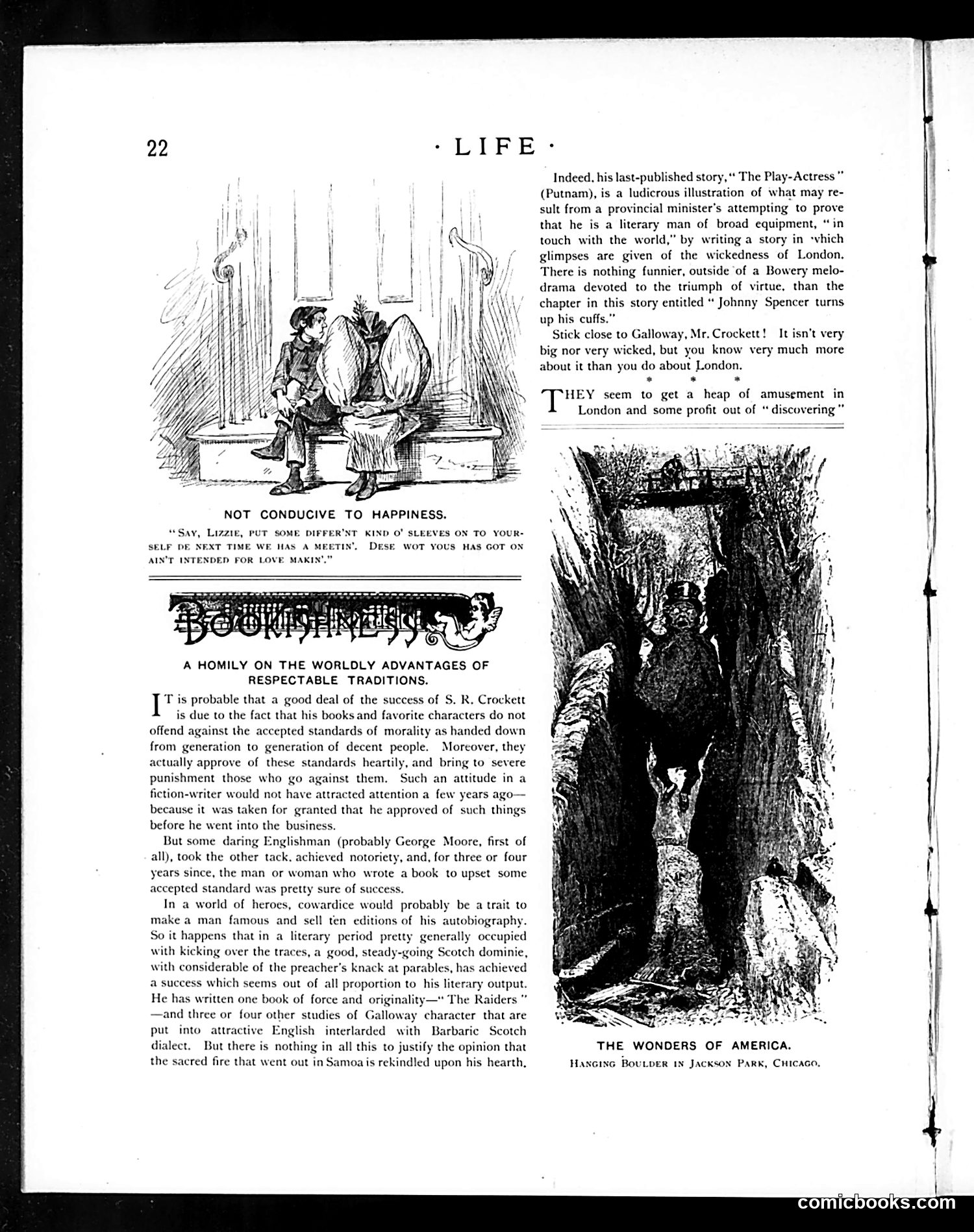
This page critiques S.R. Crockett, a Scottish author popular in the 1890s-1900s. The text praises his commercial success while gently mocking his formulaic approach: his books feature stereotypical "Galloway character" protagonists and Scottish dialect, suggesting limited literary range despite strong sales. The top cartoon titled "NOT CONDUCIVE TO HAPPINESS" depicts a domestic scene where a woman complains about her husband's wardrobe choices—a mild domestic humor vignette. The bottom illustration, "THE WONDERS OF AMERICA: HANGING BOULDER IN JACKSON PARK, CHICAGO," shows a natural rock formation, apparently unrelated to the Crockett discussion above. The satire suggests Crockett achieved disproportionate commercial success relative to his literary merit by relying on marketable but repetitive Scottish themes.
📄 Transcribed text from this page (OCR, searchable)
Machine-transcribed from the original scan — historical spelling and the odd misread are preserved.
- LIFE: NOT CONDUCIVE TO HAPPINESS, T KIND O' SLEEVES ON TO YouR- DESE WOT YOUS MAS GOT ON A HOMILY ON THE WORLDOLY ADVANTAGES OF RESPECTABLE TRADITIONS. T is probable that a good deal of the success of S. R, Crockett is due to the fact that his books and favorite characters do not offend against the accepted standards of morality as handed down from generation to generation of decent people. Moreover, they actually approve of these standards heartily, and bring to severe punishment those who go against them. Such an attitude in a fiction-writer would not have attracted attention a few years ago— because it was taken for granted that he approved of such things before he went into the business. But some daring Englishman (probably George Moore, first of all), took the other tack. achieved notoriety, and, for three or four years since, the man or woman who wrote a book to upset some accepted standard was pretty sure of success. In a world of heroes, cowardice would probably be a trait to make a man famous and sell ten editions of his autobiography. So it happens that in a literary period pretty generally occupied with kicking over the traces, a good, steady-going Scotch dominie, with considerable of the preacher's knack at parables, has achieved a success which seems out of all proportion to his literary output. He has written one book of force and originality—* The Raiders ” —and three or four other studies of Galloway character that are put into attractive English interlarded with Barbaric Scotch dialect. But there is nothing in all this to justify the opinion that the sacred fire that went out in Samoa is rekindled upon his hearth, Indeed, his last-published story,“ The Play-Actress ” (Putnam), is a ludicrous illustration of what may re- sult from a provincial minister's attempting to prove that he is a literary man of broad equipment, “in touch with the world,” by writing a story in -vhich glimpses are given of the wickedness of London. There is nothing funnier, outside of a Bowery melo- drama devoted to the triumph of virtue, than the chapter in this story entitled “ Johnny Spencer turns up his cuffs.” Stick close to Galloway, Mr. Crockett! It isn’t very big nor very wicked, but you know very much more about it than you do about London. . * * HEY seem to get a heap of amusement in London and some profit out of “ discovering" THE WONDERS OF AMERICA. Hanoixe Boutper IN Jackson PARK, Citicaco,