
Life, 1895-01-10 · page 4 of 14
Life — January 10, 1895 — page 4: what you’re looking at
What you’re looking at
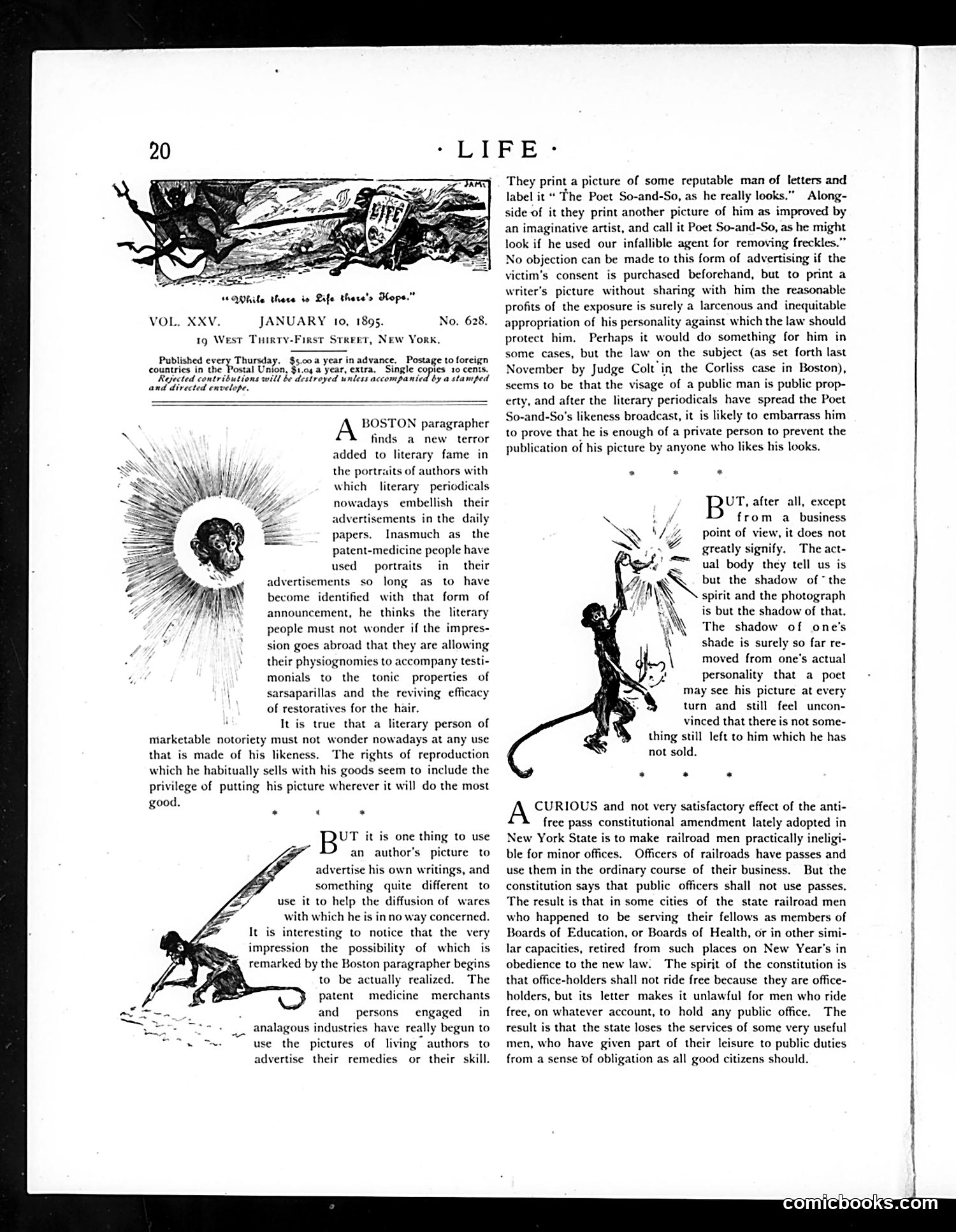
This page critiques the commercial exploitation of poets' likenesses in advertising. The text discusses a "Poet So-and-So" whose portrait is being used without proper compensation—a practice common in patent medicine advertisements of the era. The accompanying cartoons show a small figure (representing the poet) being dwarfed or pulled along by his own enlarged shadow/portrait, illustrating how his image has taken on a life of its own in commerce, separate from his actual identity and control. The satire targets both the patent medicine industry's unscrupulous marketing practices and the broader issue of personality rights—arguing that profiting from someone's likeness without adequate compensation or consent is legally and ethically troubling. The "shadow" metaphor suggests the poet's authentic self has been completely overshadowed by commercial exploitation.
📄 Transcribed text from this page (OCR, searchable)
Machine-transcribed from the original scan — historical spelling and the odd misread are preserved.
“OVhile there io Life there's Hope.” VOL. XXV. JANUARY 10, 1895. No. 628. 1g West Tuirty-First Street, New York, Published every Thursday. $5.00 a year in advance. Postage to foreign countries in the Postal Union, $1.o« a year, extra. Single copies 10 cents, Rejected contributions will be destroyed unless accompanied by a stamped and directed envelope. . BOSTON paragrapher > finds a new terror added to literary fame in the portraits of authors with which literary periodicals nowadays embellish their advertisements in the daily papers. Inasmuch as the patent-medicine people have used portraits in their advertisements so long as to have become identified with that form of announcement, he thinks the literary people must not wonder if the impres- sion goes abroad that they are allowing their physiognomies to accompany testi- monials to the tonic properties of | sarsaparillas and the reviving efficacy of restoratives for the hair. It is true that a literary person of marketable notoriety must not wonder nowadays at any use that is made of his likeness. The rights of reproduction which he habitually sells with his goods seem to include the privilege of putting his picture wherever it will do the most good, UT it is one thing to use an author's picture to advertise his own writings, and something quite different to use it to help the diffusion of wares with which he is in no way concerned. It is interesting to notice that the very impression the possibility of which is remarked by the Boston paragrapher begins to be actually realized. The patent medicine merchants and persons engaged in ws analagous industries r ally begun to ~~ use the pictures of living authors to advertise their remedies or their skill. - LIFE: They print a picture of some reputable man of letters and label it * The Poet So-and-So, as he really looks.” Along- side of it they print another picture of him as improved by an imaginative artist, and call it Poet So-and-So, as he might look if he used our infallible agent for removing freckles. No objection can be made to this form of advertising if the victim's consent is purchased beforehand, but to print a writer's picture without sharing with him the reasonable profits of the exposure is surely a larcenous and inequitable appropriation of his personality against which the law should protect him, Perhaps it would do something for him in some cases, but the law on the subject (as set forth last November by Judge Colt’in the Corliss case in Boston), ms to be that the visage of a public man is public prop- erty, and after the literary periodicals have spread the Poet So-and-So's likeness broadcast, it is likely to embarrass him to prove that he is enough of a private person to prevent the publication of his picture by anyone who likes his looks. * * * UT, after all, except \ to from a_ business \ ‘/.Z point of view, it does not SS WM greatly signify. The act- i ual body they tell us is \ but the shadow of ~ the N spirit and the photograph ny is but the shadow of that. aN The shadow of one’s \ shade is surely so far re- moved from one's actual 9 personality that a poct may see his picture at every turn and still feel uncon- vinced that there is not some- thing still left to him which he has not sold. * . . CURIOUS and not very satisfactory effect of the anti- free pass constitutional amendment lately adopted in New York State is to make railroad men practically ineligi- ble for minor offices. Officers of railroads have passes and use them in the ordinary course of their business. But the constitution says that public officers shall not use passes. The result is that in some cities of the state railroad men who happened to be serving their fellows as members of Boards of Education, or Boards of Health, or in other simi- lar capacities, retired from such places on New Year's in obedience to the new law. The spirit of the constitution is that office-holders shall not ride free because they are office- holders, but its letter makes it unlawful for men who ride free, on whatever account, to hold any public office. The result is that the state loses the services of some very useful men, who have given part of their leisure to public duties from a sense of obligation as all good citizens should. | | |